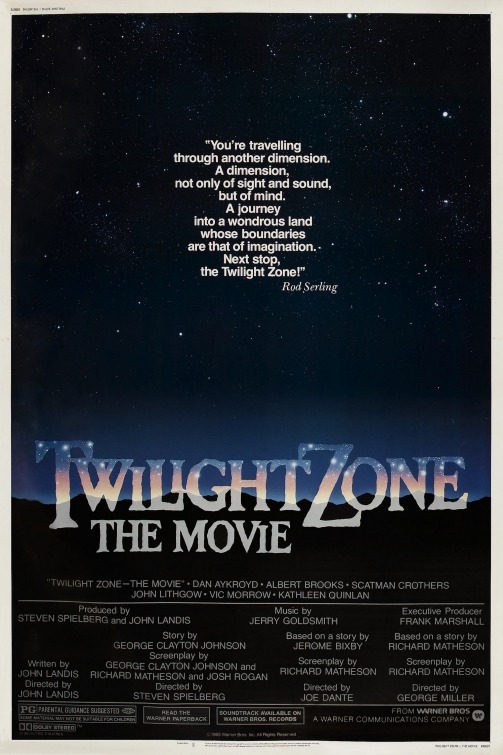
Twilight Zone: The Movie (John Landis, Steven Spielberg, Joe Dante, George Miller, 1983) The well-regarded TV series created by Rod Serling—to create a broader palette to write with, while also giving him a chance to write metaphorically about social themes without the pearl-clutching of sensitive advertisers—is one of those hallmarks of television creativity, as well as being the inspiration for creative thinkers the world over. It's probably running right now, this very minute, on some channel in the world as it's an evergreen series, one that never loses its charm or ability to chill...or preach. Every episode, narrated by Serling himself, offered some little lesson in humanity, some softball sermon, some irony, that offered "for your consideration" that one couldn't escape some aspect of goodness or frailty, even in one's escapism.
It could also creep the be-jee-sus out of you.
It was a staple for the television viewer uninterested in westerns, soap operas or family comedies, but more invested in science fiction, anthologies and speculative stories with a twist...and a point of view.
That included many of the up-and-coming film-makers learning their craft during the time the series was broadasting, the most prominent of which was Steven Spielberg, who secured a deal with the Serling Estate to make a tribute film, using the anthology format, some old hands, and recreating the show's magic utilizing widescreen, color, and the new diversity in special effects. At the same time he brought in scenarist Richard Matheson (who'd written 16 of the original episodes) and composer Jerry Goldsmith (who'd written the background scores for seven of the original episodes). Three of the four stories would be "re-imaginings" of old episodes and one would be completely original. Four different directors would be involved. The narration for each segment was done by Burgess Meredith, who'd starred in four of the original broadcasts.
One cannot discuss the movie without mentioning "the accident" while filming the first segment when star Vic Morrow and two Vietnamese child-actors were killed during a night-time helicopter shoot. All were killed instantly—and horrifically—when the vehicle crashed on them during what looked like a particularly chaotic sequence involving an unsupported vehicle, waist-high water with spray, children being carried by the actor, and explosions. Plus, there were many violations of safety and child employment. The tragedy cast a pall over the movie that it was never able to shake: Spielberg basically disowned the movie, director George Miller quit it, leaving the post-production of his segment to Joe Dante. One has to judge the results of what's on the screen dispassionately, and it's almost impossible to do with Twilight Zone: The Movie.
Segment One: Time Out (d: John Landis)
You're about to meet an angry man. Mr. William Connor, who carries on his shoulder a chip the size of the national debt. This is a sour man, a lonely man, who's tired of waiting for the breaks that come to others, but never to him. Mr. William Connor, whose own blind hatred is about to catapult him into the darkest corner of the Twilight Zone.
A bigot, Bill Connor (Vic Morrow),* walks into a bar, but it's no joke. Bitter from being passed over for a promotion, he drown his sorrows and vents his besotted spleen, hurling invective at Jews, African Americans, the "usual suspects" on the White Supremacist List. Leaving the bar, he seems to be walking in other people's shoes...and times...as he is mistaken for a Jew in Nazi Germany, a "Negro" facing a lynching in the 1950's South, and a Vietnamese citizen in the Vietnam War. After caroming from time to time, he is last seen on a transport train headed for a concentration camp, unseen by his companions from the bar.
Landis' segment was totally original (if reminiscent of some of Serling's fables of bad men getting their comeuppance ironically while also presaging TV's "Quantum Leap" by a few years) and Morrow's performance in what is basically a one-man show is very strong. Landis shoots it like a low budget TV episode, making it feel much more like an episode from the original series. A not-too good episode, one should mention. One wishes—for Morrow's sake—that they could have hit it out of the park. It would have been small consolation for an unnecessary tragedy.
Segment Two: Kick the Can (d: Steven Spielberg)
It is sometimes said that where there is no hope, there is no life. Case in point: the residents of Sunnyvale Rest Home, where hope is just a memory. But hope just checked into Sunnyvale, disguised as an elderly optimist, who carries his magic in a shiny tin can.
Adapted from the original episode written by George Clayton Johnson by Johnson, Matheson and E.T. scenarist Melissa Mathison (credited as Josh Rogan), Spielberg's segment (filmed in six days) takes place at a rest home, which welcomes a new resident, Mr. Bloom (Scatman Crothers), eternal optimist, who encourages the oldsters to think young by the simple act of playing a game—kick the can—and, miraculously (not because it's Spielberg, but because it's John and TZ), they do become young little kids.
That's where the TV episode ended, but the older, wiser scribes continue the story, making the kids realize that they've already had full lives that they couldn't recapture again and so—with one notable adventuring exception—they return to their aged forms, older, if spiritually renewed.
Spielberg almost did "The Monsters Are Due on Marple Street" but, after the accident, he changed stories, not wanting to do something with a night-time shoot, special effects and with kids involved. There are still kids in "Kick the Can" (he'd just finished E.T. and loved that shoot, working with children; he hadn't yet made Hook, which cured him of it), but no special effects and no risks. No real enjoyment, either, unless your preference is for oldsters and tykes acting very, very sincerely.
Segment Three: It's a Good Life! (d: Joe Dante)
Portrait of a woman in transit. Helen Foley, age 27. Occupation: schoolteacher. Up until now, the pattern of her life has been one of unrelenting sameness, waiting for something different to happen. Helen Foley doesn't know it yet, but her waiting has just ended.
One of the creepiest of the original "Twilight Zone" episodes was based on Jerome Bixby's 1953 short story "It's a Good Life!" which featured Bill Mumy as little Anthony Fremont, the six year old "head of the household" due to his murderous psychic powers. A haunting, scary little story—which probably resonates with any adult who has children—"It's a Good Life!" has a nightmarish quality filtered through a young child's imagination, but doesn't offer any way out. Anthony's family is stuck in their situation and the only way to survive is to placate their kid's murderous impulses. The movie version is a bit looser.
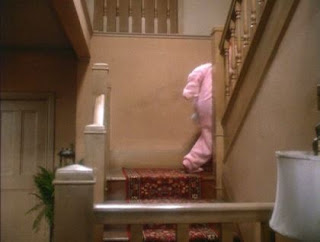
Dante, working with Matheson's screenplay, complicates it and actually resolves it, while also filling it with childish nightmare images designed to both evoke horror and a laugh at the bizarreness of it all. Foley (Kathleen Quinlan), who is on her way to a new job nearly runs into Anthony (Jeremy Licht) on his bicycle and offers him a ride home. There she meets his family—made up of TZ alums Kevin McCarthy, William Schallert, and Patricia Barry as well as Nancy Cartwright and Cherie Currie—and the one's who are actually ambulatory are a nervous bunch. It turns out Anthony has earlier murdered his family and these people are replacements and subject to his whims, all the products of a child's hyper mind.
Segment Four: Nightmare at 20,000 Feet (d: George Miller)
What you're looking at could be the end of a particularly terrifying nightmare. It isn't. It's the beginning. Introducing Mr. John Valentine, air traveler. His destination: the Twilight Zone.
Please fasten your seat-belts. We're expecting some turbulence. The darling of the Australian film renaissance and director of Mad Max and the recent hit The Road Warrior is restricted to merely the interior of an airplane in this story of a very nervous passenger (John Lithgow) on the worst flight of his life. Already afraid of flying, his terror is increased exponentially by irritating passengers, a flight-path through a thunderstorm, and...a gremlin on the wing of the plane throwing things into a jet engine, threatening to make it crash.
The original is remembered for its simple concept and a performance by William Shatner that pre-sages scenery-chewing to come. But, Lithgow out-Shatners by an additional over-the-top 20,000 feet in a performance that is hysterical in both senses of the term. He's aided and abetted by Miller's restless—and at times, anarchic—camera and even some literal eye-popping special effects. Tight, efficient, and relentless, Miller's segment is absolutely brilliant...and always seems to come up in conversations on plane flights. It's the perfect capper in an uneven movie.
John Landis also did a prologue section, which opened the film before the titles—two dudes-in-flannel (Albert Brooks, Dan Aykroyd) spend a nighttime road-trip amusing each other. First, the driver teases by turning off his headlights at random, then they play a TV-theme song guessing game, which leads to talking about "The Twilight Zone" and ends with "Hey. You wanna see something really scary?"
Besides the Dante and Miller segments, that prelude is one of the things that people remember about the movie. There had been plans for certain characters to cross-over into other segments, but a late-in-the-game reshuffling of their order and a general torpor over the film due to the filming deaths nixed those plans.
The film did make money, but suffered blistering reviews—critics always mentioned the deaths and took pot-shots at Spielberg. No movie is worth a human life, but that would be true if the result was a masterpiece, as well. TZ's critics seemed to think the sin worse if the movie is only semi-successful. So much for moral high ground. But, people remember the best things about it—"Really Scary" "It's a Good Life!" and "Nightmare at 20,000 Ft." There have been a few revivals of the series (and probably always will be), and other similarly themed series from "The Outer Limits" to "Black Mirror." Spielberg even tried his hand in the game with his series "Amazing Stories," which served as a clearing house for his ideas and a proving ground for directors, old and new.
But, the movie lives up to the Serling grandiloquence—whether intentionally or not—of lying "somewhere between the pit of one's fears and the summit of his knowledge."
* The TZ movie is full of Easter eggs and little buried bits of trivia throughout: Bill Connor's name is a one-off of "Bull" Connor, the Alabama Sheriff known for his brutal treatment of Civil Rights protestors, "Helen Foley" is the name of a teacher of Serling's (and was used in a TZ episode), and Serling himself appears in the blink of an eye in the Main Title. Dante's episode is rife with actors from the series, including a cameo by Bill Mumy, who played the uber-kid in the original episode of "It's a Good Life" as well as mentioning city-names from other episodes.


 His one hitch of the locals is old-timer Ben Knox (Fulton Mackay) who lives in a shack on the beach, but he owns the land and has no intention of selling, no matter the price, a human sea-wall to the development. Although the Fernessians might be "quirky" it's a mercenary kind of quirky and Knox's recalcitrance takes a bit of "twee" out of their quaintness. And a row looks to be a-brewing in the small town.


 If it had been made three or four decades before, one would swear it was a product of The Archers, and, in fact, it bears a lot of tonal resemblance to I Know Where I'm Going! without leaning so much into Scottish culture. But, it has a way of making you yearn for community and towny closeness. And it's beautiful as all get-out.
 In the next few weeks, I'm going to be doing more reviews of Forsyth's work, as in my obsessive movie days, he was always a particular favorite of mine to watch.