Showing posts with label B. Show all posts

Thursday, March 20, 2025

Black Bag (2025)

"You Are Cordially Invited to a Night of Fun and Games at George and Kathryn's"
or
"Will There Be a Mess to Clean up?" "Only if We Do it Right"
 
Something is brewing at the NCSC ("Making the UK the safest place to live and work online"), a division of the GCHQ, which is a branch of British Intelligence. Even before the titles come up, George Woodhouse (Michael Fassbender) is called to an off-site meeting with his boss, Philip Meacham (Gustaf Skarsgård—another one! A month of movie releases can't go by without one with a Skarsgård in it) who informs him "we have a traitor in our midst" regarding a very hush-hush program called "Severus" and Meacham wants him to find the "mole" and "ferret" them out. "Give me two weeks" says George. Meacham replies "If Severus is deployed as intended, thousands of people will die."
 
"Okay," says George. "One week."
 
It will be that kind of movie.
 
George, you see, is a highly-regarded agent at intelligence. And so is his wife, Kathryn St. Jean (Cate Blanchett) and he is absolutely devoted to her, as she is to him. But, we've seen enough movies with husband/wife teams in the same professions where vows and oaths clash enough that they can hasten the expiration date of "'til death do you part." And in the spy game, trust is everything, depending on verifiable proof. In the marriage game, trust is usually handled in another department and hemisphere of the brain.
And George has been informed by Meacham that his wife is one of the suspects. Oh, bother. That can tests one's concepts of loyalty, what? But, being a punctilious sort he begins his investigation by inviting the suspects over for dinner, prepared by him, and with the added ingredient being a drug to lower everyone's inhibitions—he has a reputation of being able to catch anyone in a lie—and that gets an amused admonition from his wife ("Darling, you must not dose our guests."), but, as we know, he only has a week.
The dinner guests include the agency's psychiatric analyst Zoe Vaughan (
Naomie Harris), her boyfriend and agent, Col. James Stokes (Regé-Jean Page), his counterpart Freddie Smalls (Tom Burke) and his girlfriend, satellite imagery specialist Clarissa Dubose (Marisa Abela). All work together for the agency for the head of the department Arthur Steiglitz (Pierce Brosnan), but all that really gets revealed at dinner is that Freddie, as is his way, is cheating on Clarissa, which results in her stabbing him in the hand with a steak knife. It is only one of three violent acts in the film, but it gets George no closer to the truth.
And he hasn't begun to investigate his wife, yet. As she was preparing for dinner, she happened to mention that she liked it when he watched her, but, she has no way of knowing how far that will go. He finds out her schedule—she's traveling to Zurich on business—and persuades Clarissa to temporarily way-lay a satellite and discovers that Katheryn is meeting a Soviet operative there. James informs him that she's got access to a Swiss bank account with £7 million in it and that a highly-placed colleague of the fellow she there has gone missing. Perhaps most alarmingly, Meacham—his boss who gave him the assignment of "finding the rat"—has unexpectedly died of a coronary. Things are happening pretty fast.
But, then it's a 
Steven Soderbergh movie. Black Bag is the second 
film he's directed film to be released in three months (the earlier one was Presence, also written by David Koepp), and it is more in the style of Soderbergh's caper movies (the "Ocean's" films, Logan Lucky, or Out of Sight), although slicker and with more of a professional veneer given the spy/thriller setting. It's stylish, witty, but with an underlying smartness that might leave some watchers in the cold. Things get complicated, red herrings abound, and if you're not paying attention, you could get lost. But, the spy vs. spy bubble the movie moves in gives it a certain edge where you're not sure whose side anybody's on at any given moment.
Call it Tinker Tailor Soldier Spy-lite, with a little bit more tech with spy-satellites and AI-enhancers and the like, plus a bit of sleuthing, psychological games, a big "MacGuffin", and even an Agatha Christie "it's-someone-in-this-room" reveal, checking off a lot of film-fan favorites. And the structure of the thing is a nice little touch. It's a clever little game, if not much of a thriller, although Soderbergh keeps it moving at a fast clip, and the badinage witty even if no one smiles. 

Saturday, February 22, 2025

The Brutalist

A Hell-hole of His Own Design
or
"I Just Don't Appreciate It. I Cherish It"
 
These days get me down.

Brady Corbet 's The Brutalist (made for an incredibly modest $10 million) comes with all the showmanship brio of those old "roadshow" films of the 1950's and 1960's, back in the day before the trend today where every movie became its own sole inhabitor of a given theater's screen...when movies openly defied the "bargain-prices-for-the-masses" concepts of the now-extinct double-bill for the self-proclaimed "importance" of the single solitary roadshow attraction. Those "big, important" presentations did not survive the decade of the 1960's when the more independent and youth-oriented...and cheaper...films (which defied the portentousness ambitions of their more gaudy studio products) took over both screens and audiences' interests. The Brutalist has the ambitions and trappings of those roadshow attractions: VistaVision photography, an Overture (all 30 seconds of it, really) and an intermission at the 2/3rd mark to give you a recess to escape during its 3½ hour length.
Not that it's really needed. The Brutalist moves along at a quick, if somewhat trance-like pace, but without any of the sweep that you'd expect in the blockbuster format. And that intermission comes at a time when there is an interruption of the story-line—a work-project is stopped—and the film takes up a few years later after everyone has moved on and must once again begin the project after law-suits are settled. A less time-consuming interstitial or an added narration might have been enough to impart that information, but I guess the filmmakers wanted to impart the sense of time being wasted...The Brutalist began production in 2018 and didn't start photography until March 2021 and was delayed by the pandemic until further work in 2023. An intermission probably felt organic to the process.
But, it isn't, really. It just marks the demarcation point where the movie starts to unravel. The "Part 1" of the film--and, yes, it has "chapters"--"The Enigma of Arrival" sees the arrival of László Tóth (Adrien Brody), a Polish architect, who has barely survived the Holocaust and arrives in post-war New York, ahead of his wife Erzsébet (Felicity Jones) and niece Zsófia (Raffey Cassidy), to do what so many refugees and migrants have done—try to make a new life for themselves after leaving a life with little prospects. At this point, Corbet is happy to provide every detail in his story-telling and make some bold choices doing so. Toth's arrival in New York—when he finally is able to emerge from the dark hold of the ship and into the sunlight—is highlighted by his first glimpse  of the Statue of Liberty—but Corbet presents it to us upside-down, as if we were looking back at it from behind. This might have been just for practical purposes—you shoot up at Lady Liberty so you don't have to show the New York skyline, which looked very different in 1946 than it did at the time of filming.* It also says something, vaguely (if one is looking for such things) about the Ancestry.com fairy-tales of immigrants braving the unknown to "make a better life" for themselves than what they would find on their home-soil.
But, The Brutalist takes those stories that have become so familiar on "Finding Your Roots" and turns it—like the Statue of Liberty—on its head. Ship's manifests and census records can tell you the "when" of things, but not the "how" of things—of prejudice by the already-established immigrants (all of them being immigrants, ironically, except for the indigenous tribes and there was a "final solution" reserved for them, as well), of huddled masses forced into "Little" communities of slums, and of hard-scrabble existences, supposedly based of hard work and fortitude, but mostly based on dumb, stupid luck and the seizing of opportunity. And will, a basic will to survive.
The Brutalist rubs your broken nose in it. Toth is initially welcomed in Philadelphia by his cousin, Attila (
Alessandro Nivola) who runs an established design-furniture store, Miller and Sons, and takes him in, hiring him for his design-work and giving him a little room in the back of the storeroom. The cousin has assimilated ("Who's Miller?" "Me" Who are the sons?" There aren't any"), changed his name, become Catholic, married a shiksa wife (Emma Laird) and she is less than pleased with the arrangement. An initial job to design a modernist chair for the store-window produces a tube-dominant functional design that would hardly attract customers.
But, the company gets a commission—the children (
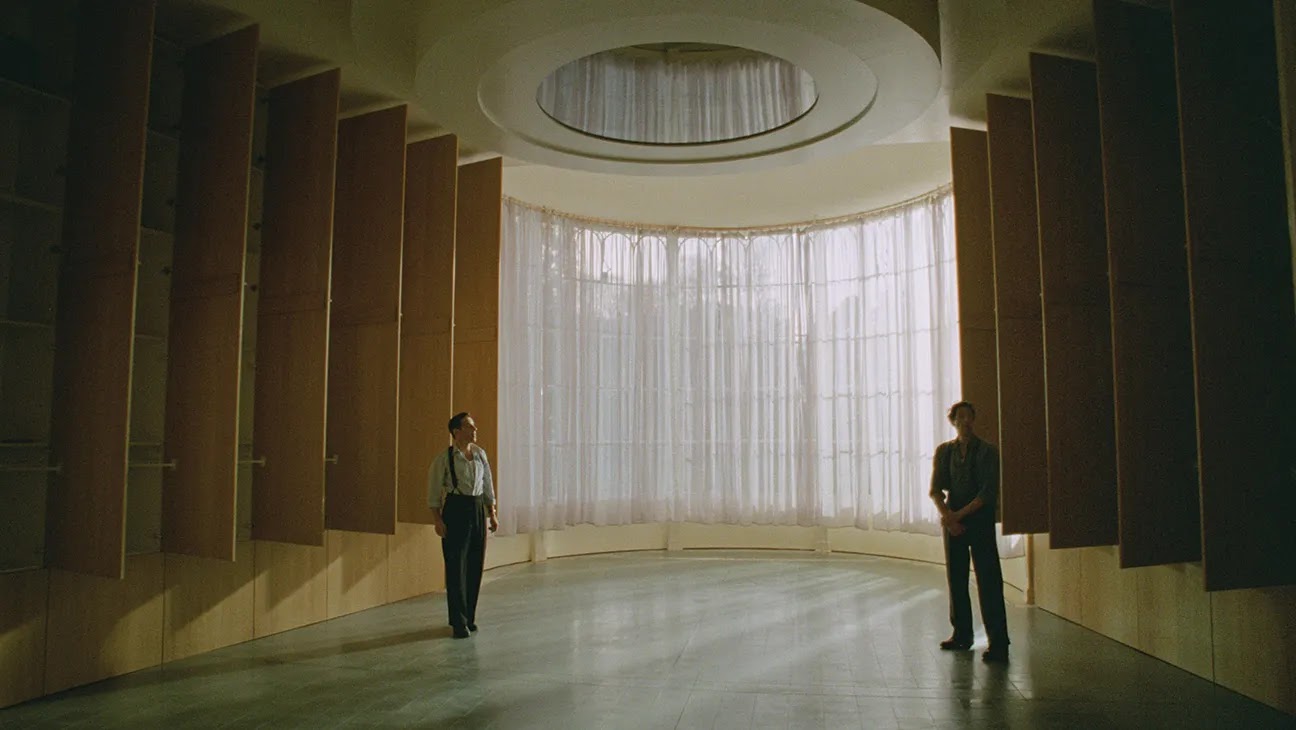
Joe Alwyn, Stacy Martin)of a rich businessman, Harrison Lee Van Buren, Sr. (Guy Pearce), want a library constructed in his mansion while he is tending to his ailing mother. The job has its challenges—the desired location is all vaulted windows letting in sunlight that could fade the valuable first editions. What to do? Toth has a solution and it is a bold one.
Keep the windows. Protect the books. Cantilevered doors hide the shelves and their precious burdens. But when Van Buren the Elder comes back, he isn't pleased ("I don't like surprises!"—Pearce, here, is at his foaming, berzerker best) because there's a BLACK man (one of the workers) in his drive-way, everything's different and his Mother's in the car. Get OUT! Get OUT NOW! No explanation is heard or good enough. "Miller and Sons" doesn't get paid for the commission. They have to pay the expenses. They'll be lucky if they're not sued. So, "of course", cousin 
László gets sacked by his own cousin. The assimilation gets set back a few years...if it was ever going to happen at all.
The Brutalist has a pace, but it's a herky-jerky one, sort of like the phrase a friend reminded me of the other day: "The days go slow, but the years go quick." Flash forward three years. László is a laborer shoveling coal, living in a charity house, addicted to heroin, his only friend is Gordon (Isaach De Bankolé) a single father also down on his luck—he was the guy seen in the driveway that Van Buren was so incensed about—working at the same facility. Then, one day Van Buren the Elder shows up at his work, invites him to lunch, and tells him a story.
At lunch, he shows Toth an article in an architectural magazine, extolling Van Buren and the library's aesthetic, and the magnate has done some digging, found out the name of the man who created the masterpiece he now owns and for which he, the owner, has been lauded. He's researched him, discovered the architectural work he did in Europe before the war, and...pays him for the work he did on the library. Toth's work has made Van Buren an exemplar of an aesthetic—even if he didn't know the name of the man who designed it or anything about why the fuss being made about his library—and he invites him to a dinner the next night so he can meet his society's circle and maybe...how he can be used in the future. Toth celebrates by taking the money and buying heroin.
At the dinner, Toth is fêted by the Van Burens, where he is treated as an honored guest and treated with an air of "your not one of us but we like what you do." He meets Van Burens' lawyer, the only other Jew at the table, who offers his work to try and patriate
Erzsébet and Zsófia out of Eastern Europe to America. And something else. The next day, Van Buren tells him of "a vision" he wants him to design and build. "Something boundless. Something new." There's a site on the highest point of his property overlooking the village of Doylesville, where he wants to build a tribute to his late Mother, a center consisting of a gymnasium, a library, a gathering center...oh, and per Doylesville request...a chapel. A Protestant chapel. Toth, thinks Van Buren—still aglow from his reflected light of Toth's work—is obviously the man for the job.
Maybe he is, but he's certainly the most handy. And, given Van Buren's patronage, if not sponsorship, he's the one who can achieve Van Buren's "vision." But, first, Toth needs to get his own vision approved, which is where Van Buren, who pulls a lot of strings, is at his most useful—besides funding the project.
And why shouldn't he fund it? It's a Van Buren version of a Pyramid, the grandest tombstone his mother—and probably any member of the Van Buren family could have. Toth's designs are different, large, blocky made of concrete and though not really brutalist in design, the brutalist school was very influential in the production of
government buildings and slums—and prisons. But a prominent negative-space crucifix atop it seems to reassure the doubters. The rest of the movie is of Toth's struggles—and they are constant—in trying to keep the integrity of his design (despite middle-men, budget-cuts, capricious "second-thoughts") in a Sissyphussian environment of anti-semitism, xenophobia, and just plain interference for interference's sake.
It's an example of that disease that suffuses American business (and I suppose any business), "office politics." For whatever reasons, egos clash, contrariness becomes the norm and the "Bad CEO" lords over the chaos, letting it happen, because he likes people "doing their jobs" even if it's at cross-purposes ("Leslie is a bastard." "Yes, he is. That's what we pay him for."). Toth tries to negotiate the madness, maintaining his vision of Van Buren's vision, and retreating into heroin when the pain becomes unbearable. Watching it unfold is like being a functionary at a terrible job at a terrible company, choking on its own cholesterol-like dysfunction.
And the building itself, the "Van Buren Institute", that great Pyramid to an industrialist's vain-glory? We never really get to see it. What we get to see are empty corridors and walk-ways, a vast inner chamber at its core, seemingly a shell of a building housing mazes and catacombs that a despondent man can get lost in and die. We never really get to see its scope or the wonders that might have impressed and inspired in the first place. It's a big vacuum in the center of the movie that might have done more than provide ambiguity. It's a "commission," nothing more. An idea, unrealized, at least in terms of the movie.
If that wasn't frustrating enough, the movie has a coda. It's 1980 and Toth is elderly, in a wheelchair, attending another 
fête, a retrospective of his work, and, because he is too weak to speak, his niece speaks for him, and says something that hit me with a thud and make me bitterly leave the theater, questioning the writers and if they knew what they were writing.
"Don't let anyone fool you, Zsófia" he would say to me as a struggling young mother raising my daughter during our first years in Jerusalem, "no matter what the others try and sell you, it is the destination, not the journey."** 
 
Well, that's just bullshit. Only an artist—be they architect or a manipulative director—an entrepreneur or politician (with visions of dictatorship dancing in their heads) can go along with that "the ends justify the means" thinking. Human experience informs us, changes us, manipulates our thoughts and our ideas. Often it is the journey—not the destination—that is important (Erzsébet after coming to America says this: "This place is rotten. The landscape, the food we eat. This whole country is rotten."). Yes, it's good to have goals. But, what do you have to become to achieve them? Is it worth getting what you want by—where you want— by sacrificing everything but the dream?
 
The sportscaster Red Barber had a wonderful rejoinder for the old "whoever has the most toys, wins" mind-set: "God doesn't count the toys. He counts the scars."
But, the edifice will excuse it all. After all, people still flock to the Pyramids; nobody cares what kinds of horrors inspired them or carried them out. Our Edifice Complex negates all that. Why (he says sarcastically) maybe the slavery was worth it, Ozymandias...
 
Tell that to the wrecking ball.
This piece has taken me forever to write—despite "The Last Word" at the bottom of the page I do not always find writing bad reviews "fun"—and I've been listening to and reading rave reviews for this film, trying to understand what they're seeing that I'm not. All I can conclude is that the framing, cinematography, and acting (all of which are quite good) have overwhelmed any critical thinking about content. "Style over substance".*** "Miller and Sons." That old trick. But not for me.
 
I like ambiguity. I cherish it in movies if it's not a stunt (as Hollywood so often makes it). You can even be vague about things. But, The Brutalist asks questions that it doesn't bother to answer, nor does it seem to care, as if a point of view was something beneath it to attempt. I shouldn't have to divine what it's attempting to say (if anything). It should be there on the screen so that I can share the artist's thoughts. That's the very basis of communication and the DNA of film. But, Corbet's film tries so hard not to tell a story, or to advocate for anything, other than that life, even a life devoted to your craft, is misery. In the end, The Brutalist is neither inspirational or aspirational. As such, as a work of art...it is useless.
I wouldn't be at all surprised if this wins the Oscar for Best Picture.
 
These days get me down.

* I've always loved the story Sidney Lumet tells—in his book "Making Movies" (©1995, Vintage Press)—of meeting his hero, director Akira Kurosawa, and asking him why he had framed one particular shot in Ran the way he did and the Japanese Master told him that if he'd panned the camera one inch to the left, the Sony building would have been visible and one inch to the right, an airport, neither of which were appropriate to a samurai movie. It's not all inspiration and artistic intent.
 
** Here's the thing—not even Toth believes that, if we're to believe the screenplay. If he had, why then would his time at Buchenwald inspire the dimensions of the Van Buren Institute (in the same speech, his niece says this: "The building referenced his time at Buchenwald as well as the deeply felt absence of his wife, my Aunt Erzsébet. For this project, he re-imagined the camp's claustrophobic interior cells with precisely the same dimensions as his own place of imprisonment, save for one electrifying exception; when visitors looked 20 meters upwards, the dramatic heights of the glass above them invited free thought; freedom of identity. He further re-imagined Buchenwald and his wife's venue of imprisonment in Dachau on the same grounds, connected by a myriad of secret corridors re-writing their history and transcending space and time so that he and Erzsébet would never be apart again.") So...in other words...his journey through the war years inspired the destination. Or is the niece putting words in the mouth of the elderly Toth, for his benefit to burnish his image, and so is she also a part of the same self-aggrandizement as, say, the nefarious benefactor Van Buren? Is everybody in this movie corrupt?
 
*** I'm reminded of the story Jerry Lewis told about Stanley Kubrick, who was wandering around during the days of making 2001: a Space Odyssey while Lewis was struggling to edit his abortive The Day the Clown Cried. Kubrick was sitting in the back of the editing room just hanging out, taking it all in when Lewis said over a particularly frustrating "cut," "That's it! You can't polish a turd!" To which Kubrick responded (after a thoughtful pause): "You can if you freeze it..."

Friday, November 22, 2024

The Big Combo

The Big Combo
(
Joseph H. Lewis, 1955) A girl (Jean Wallace) runs away in the dark. Down murky corridors and naked open spaces where she can't hide, she runs through a stadium promenade and nobody notices her because their eyes are on a boxing match, where every light of the facility seems to be focused. But, she's not the only one running, as she's followed closely by two goons, Fante (Lee Van Cleef) and Mingo (Earl Holliman), who have split up and are trying to catch her in a pincer move. That's their job tonight, to look after the girl, Susan Lowell, who's the girl of Mr. Brown (Richard Conte), who's attending the fight—it's a business matter for him—and Mr. Brown wants her to see it. But, she's run out in Round 3 and he's mad about it. When Mr. Brown gets mad, that's when Fante and Mingo enter the picture and they finally catch up to her and try to man-handle her back to the fight. But, she decides she's hungry and although Mingo wants to drag her back to the fight-crowd, Fante tells Mingo to hail down a cab. "Mr Brown says to keep her happy." Fat chance.
Down at the 93rd precinct, they're not happy, either. There's an ongoing investigation into Mr. Brown that's been going on for too much of a time and two people are frustrated by it: the first is Capt. Peterson (Robert Middleton) who's mad at all the tax-payers' money he's been laying out for no results; and then there's Detective Lt. Leonard Diamond (Cornel Wilde) who's been spending all that money and who's come up with bupkis except for frustration and the captain breathing down his neck. Diamond wants to turn the heat up on Brown, but the boss has his job on the line, too, and he wants to drop the whole shooting match. Plus, he thinks there might be something more to this for Diamond—he reminds him that he's been tailing Susan Lowell wherever she goes and when Diamond gripes that he paid those expenses himself, the Captain brings the hammer down: "But, I'm not in love with her! You are!" The Captain is starting to think it's all personal and a wild-skirt chase.
But, it's more than that. It's a grudge match. Find a crime in town and it eventually snakes up to Brown. Take down Brown and the 93rd gets a lot quieter. Then, when Susan shows up in the hospital for swallowing pills, Diamond thinks he has something: Susan keeps talking about an "Alicia" from Brown's past and when Diamond hauls in every Brown flunky for questioning and puts Brown under a lie detector, "Alicia" makes the needle jump the Richter scale but there's no answers from the big man. Just more patter from the mutual contempt society. "A righteous man" Brown scoffs to the old boss (
Brian Donlevy) he took over the gang from. "Makes $96.50 a week—the bellboys at my hotels make more than that!" But, Diamond does get some respect, if you call taking the trouble to put him on a hit-list respectable.
The Big Combo may not be the best noir-mystery of the genre, there are no stars with bright futures of note (unless you count Van Cleef), the sets are cheap—heck, the director didn't know he was working on it until a week before shooting—but, it skirts the edges of acceptability for its time with an unsympathetic authority figure, a flashy villain (Conte is brilliant in it, rattling off dialog with a no-cares contemptuous smile), some nice hard-nosed dialog, and an artist's touch with the lighting. And, it suggests a lot more than it shows—like Susan's codependent sexual kink for Brown, the "longtime companionship" of Fante and Mingo, and some brutal violence that usually happens off-screen, but comes front-and-center in a scene that features torture-by-hearing-aid (they should have had Wilde's Diamond character shouting his dialog for the rest of the movie). The movie takes chances, at a point when many film-noir tropes were already played out.
But, the star of the show is cinematographer John Alton, who worked shadowy wonders for cash-strapped studios like Republic Pictures and eye-popping color scenes for the extravagant M-G-M, and brought rich dark spaces pierced by shimmering light to whatever set-up he touched. Born in Hungary, Alton began his camera work in the silent era and worked all the way up to 1960's Elmer Gantry. He was quick, economical, and created stunning images that arrest the eye and catch the breath. The Big Combo, for all its outlandishness, becomes more centered because of Alton's photography. You take it more seriously and things matter a bit more. Things "hit" harder because of the look of the thing.
Since 2007, The Big Combo has been in the public domain and, for that reason, we're featuring it in this post below.


Wednesday, November 20, 2024

The Bedford Incident

The Bedford Incident (James B. Harris, 1965) A veritable volume of Bartlett's Quotations fills my head after seeing The Bedford Incident

For instance, the astronaut's description of his job as "98% tedium punctuated by moments of sheer terror," and Elwood P. Dowd's "You can be 'oh-so-smart' or 'oh-so-pleasant'—I recommend "pleasant." Then, because the story is basically, "Moby Dick in The Cold War," there are all sorts of Melville quotes...and one bad joke: "Cook 'em, Dan-O."

It's that last one that sticks, though. The Bedford Incident is, basically, a terrible, terrible joke with a possible several mega-tonnage punchline. And director James B. Harris, who, before making this film, was Stanley Kubrick's film-making partner, can't have missed the thought as his ex was making an out-and-out comedy of errors out of the nuclear arms race.  

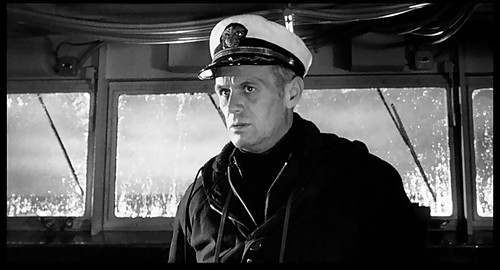
But where that one took to the air, The Bedford Incident plays out at sea in a cat-and-mouse game between a Soviet nuclear sub and a naval destroyer. In command is Captain Eric Finlander (Richard Widmark, steely with just a touch of baleful twitchiness that goes full-on berzerkoid in an interview), a determined commander who takes enormous pride in the proficiency of his crew, and in the hunt and pursuit of his targets. As an advisor is a former Nazi U-boat commander Wolfgang Shrepke (Eric Portman), who was responsible for the most tonnage (ours) sunk during the second World War. Also on board is reporter Ben Munceford (Sidney Poitier), who serves as an exposition conduit and Royal Pain In The Ass. Among the crew are Martin Balsam as the ship's new doc, James MacArthur as a too-eager ensign, Wally Cox as the sonar bat, and if you're watching early and quickly, there's a young Donald Sutherland as a garbage analyst—garbage being clues to conditions on the enemy boat, and age-analysis gives tracking position and history.
It shows how extreme the measures are on the Bedford, how detail oriented, how precise, how strategic and how puckered the thought processes go into keeping an eye on the enemy. And once found, Finlander will pursue chasing Soviet subs out of territorial waters, even forcing them to stay underwater until they're desperate for air, provoking confrontation. When your Nazi adviser tells you he's scared of your methods, it means you might be going so overboard as to pro-actively lower the life-rafts.

If you're immersed at all in pop-culture, you can see elements of Bedford in such disparate strategy plays as "Star Trek" and The Hunt for Red October. And such gamesmanship is all well and good in limited skirmishes. But, when the arsenal is nuclear? Do you really want a cigarette in a room full of gasoline?
 

No, and that the game is played despite the mega-stakes makes the movie and its characters seem not just petty, but a little dim for all the talk of brilliance. The point of hubris is well taken, but the point was better made as an out-and-out black comedy about short-term, selfish interests in the face of global catastrophe.

Friday, October 25, 2024

A Bucket of Blood

 
"I will talk to you of Art, for there is nothing else to talk about, for there is nothing else. Life is an obscure hobo bumming a ride on the omnibus of Art. Burn gas buggies, and whip your sour cream of circumstance and hope, and go ahead and sleep your bloody heads off. Creation is, all else is not. What is not creation, is graham crackers; let it all crumble to feed the creator. The Artist is, all others are not. A canvas is a canvas or a painting. A rock is a rock or a statue. A sound is a sound or is music. A preacher is a preacher, or an Artist. Where are John, Joe, Jake, Jim, jerk? Dead, dead, dead. They were not born before they were born, they were not born. Where are Leonardo, Rembrandt, Ludwig? Alive! Alive! Alive! They were born! Bring on the multitude, the multitude of fishes: feed them with the fishes for liver oil to nourish the Artist, stretch their skin upon an easel to give him canvas, crush their bones into a paste that he might mold them. Let them die, and by their miserable deaths become the clay within his hands that he might form an ashtray or an ark. For all that is comes through the eye of the Artist. The rest are blind fish, swimming in the cave of aloneness. Swim on you maudlin, muddling, maddened fools, and dream that one bright and sunny night, some Artist will bait a hook and let you bite upon it! Bite hard - and die! In his stomach you are very close to immortality."
Maxwell H. Brock
 
Feel free to snap your fingers at the crazy, words, man, and order another espresso. But, don't expect it anytime soon because the guy waiting tables, Walter, is a little bit distracted. Because he's surrounded by Art, baby, and internally roiling by his lack of it inside him. He aspires to be an artist...and to get a girlfriend...so don't harsh your mellow if the java's a little cold. You're in the Yellow Door cafe in Venice, California and the hipsters and beatniks are milling and mulling. Looking for the next "thing" to give life meaning and distract them. Because in this milieu if you aren't an artist, you're not anything. Dig?
Walter Paisley (
Dick Miller) isn't an artist; he's a busboy. But, the words of all the hep cats extolling art makes him want to be an artist, too. Except he's not good at anything. Not even waiting tables. As the Yellow Door's resident genius (Julian Burton) states (and he doesn't doing anything less than "stating"):"Walter has a clear mind. Some day a thought will enter it, get lonely and leave again."
He gets a block of modeling clay, but although he has a picture of the prettiest girl at the Yellow Door (
Barboura Morris), he can't make that clay into the form of what he loves. "Make a nose! Make a nose!" he pleads to the gunk in his hands, but it remains mere clay; something is needed to make the transition from raw material to completed artwork. Fortunately, Walter manages to find it when he accidentally kills the landlady's cat stuck in his stucco wall (unfortunately for the cat). The next day he presents a clay sculpture of a cat with a knife sticking through it (he's basically covered it in clay) and—what do ya know?—the hipsters think it's really good! They dig it (without having to dig anything)!
Oh, the owner of the club (
Antony Carbone) gets wind of it—the "sculpture" breaks when it's knocked to the floor after-hours...and the cat's hair pokes through the crack. But, when a potential buyer looking to make an investment in "very important art" makes an offer for the sculpture far exceeding expectations, he's willing to look the other way. But, he sweats Walter's rise in stature...and statuary ("Keep up the good work...but don't RUSH things!"). Especially when Walter starts to bring in life-size...or past-life-size...figurines.
See, one of Walter's admirers, in appreciation, gave Walter a little vial. And when one of the undercover vice-cops (Ed Nelson and...Bert Convy..!!) casing the Yellow Door comes over to Walter's flea-bag apartment and tells him the vial contains "H! Horse! Heroin!" and tells the clueless Walter that he's going to drag him down to the pokey, Walter resists arrest by cracking him over the head with a skillet. But, how is he going to get rid of the body? 
 
He has to get creative.
Shot over five days and with a budget of a mere $50,000, A Bucket of Blood was a cheap horror film made by Corman on demand from the bosses at American International Pictures. The budget was a curse and a strength: with so little money, Corman and his writer
Charles B. Griffith could not depend on monsters, effects, or even atmospherics; but with such a small budget, the film couldn't help but make money. So, they based their story on where they were holding their writer meetings—coffee-houses—and twisted the "Mystery of the Wax Museum"-based plot into a black comedy about the morose Beat culture, art pretensions and the skin-thin veneer of both, as well as the craving of status at any cost. That they all merge in as unironic a way as possible is a nice little "dig" at the values of hipsters, whichever coast they may find themselves on.
To maintain his admittedly minor status as an artist, Walter moves from obtaining raw material by accidental death to becoming a serial killer of whoever so much as gives him a stink-eye, and pretty soon, it becomes obvious where the schlubby sculptor gets his talent, and the film devolves into a noir-chase through the back-alleys of L.A. before the final shot of life imitating death.
It doesn't deserve to be as good as it is, but Griffith's script is clever with a lot of call-backs and ironic choices of words and some of the performances are actually better than they deserve to be. I've long been an admirer of Dick Miller,
who stars as Walter Paisley* and there are times when his portrayal here has a whiff of Jerry Lewis to it—he'd be a lot more disciplined and funnier, underplaying as a flower-eating customer of Mushnik's Flowers in The Little Shop of Horrors the next year—but his physical acting at times is extraordinary, almost rodent-like initially, and then, when fame comes, flailing in ways both subtle and wild.
Everybody else is good, too, but they have the advantage of playing pretentious "types", so that florid over-acting is par for the personality and under-acting means that that character is merely holding their cards to their vest, dramatically. Also, much of the darker shading of the film is inherent in the beat milieu—the morbidity of folk-music with their subjects of murders down-by-the-river and death-row histrionics is not so out of place in a horror movie and the cynical poetry (which foreshadows events in the film) make the moral ambiguity a bit more reachable. But, a lot of what makes A Bucket of Blood so great happened by accident—there wasn't time for prep!—so, if one of the actors affected a limp or decided to wear sandals with their tuxedo it was just more detail in a project that didn't have the budget to be overstuffed with it.
And Corman makes the budget stretch as credibly as the incredulity allows. Miller groused about how the film would have been better with more budget so that they didn't have to depend on mannequins for the statues and such. True enough (although a bigger-budgeted remake isn't as good...or clever). But, budget can't replace the innovation needed to overcome its lack and it put Corman in the mind-set to make more of making-do, which would stand him in good stead for the rest of his career at AIP, and the many mentors to whom he passed on that ethic.

* He...or his collaborators...would use that name for quite a few Dick Miller characters throughout his career.
...where the title comes from.