Showing posts with label Michael Fassbender. Show all posts

Thursday, March 20, 2025

Black Bag (2025)

"You Are Cordially Invited to a Night of Fun and Games at George and Kathryn's"
or
"Will There Be a Mess to Clean up?" "Only if We Do it Right"
 
Something is brewing at the NCSC ("Making the UK the safest place to live and work online"), a division of the GCHQ, which is a branch of British Intelligence. Even before the titles come up, George Woodhouse (Michael Fassbender) is called to an off-site meeting with his boss, Philip Meacham (Gustaf Skarsgård—another one! A month of movie releases can't go by without one with a Skarsgård in it) who informs him "we have a traitor in our midst" regarding a very hush-hush program called "Severus" and Meacham wants him to find the "mole" and "ferret" them out. "Give me two weeks" says George. Meacham replies "If Severus is deployed as intended, thousands of people will die."
 
"Okay," says George. "One week."
 
It will be that kind of movie.
 
George, you see, is a highly-regarded agent at intelligence. And so is his wife, Kathryn St. Jean (Cate Blanchett) and he is absolutely devoted to her, as she is to him. But, we've seen enough movies with husband/wife teams in the same professions where vows and oaths clash enough that they can hasten the expiration date of "'til death do you part." And in the spy game, trust is everything, depending on verifiable proof. In the marriage game, trust is usually handled in another department and hemisphere of the brain.
And George has been informed by Meacham that his wife is one of the suspects. Oh, bother. That can tests one's concepts of loyalty, what? But, being a punctilious sort he begins his investigation by inviting the suspects over for dinner, prepared by him, and with the added ingredient being a drug to lower everyone's inhibitions—he has a reputation of being able to catch anyone in a lie—and that gets an amused admonition from his wife ("Darling, you must not dose our guests."), but, as we know, he only has a week.
The dinner guests include the agency's psychiatric analyst Zoe Vaughan (
Naomie Harris), her boyfriend and agent, Col. James Stokes (Regé-Jean Page), his counterpart Freddie Smalls (Tom Burke) and his girlfriend, satellite imagery specialist Clarissa Dubose (Marisa Abela). All work together for the agency for the head of the department Arthur Steiglitz (Pierce Brosnan), but all that really gets revealed at dinner is that Freddie, as is his way, is cheating on Clarissa, which results in her stabbing him in the hand with a steak knife. It is only one of three violent acts in the film, but it gets George no closer to the truth.
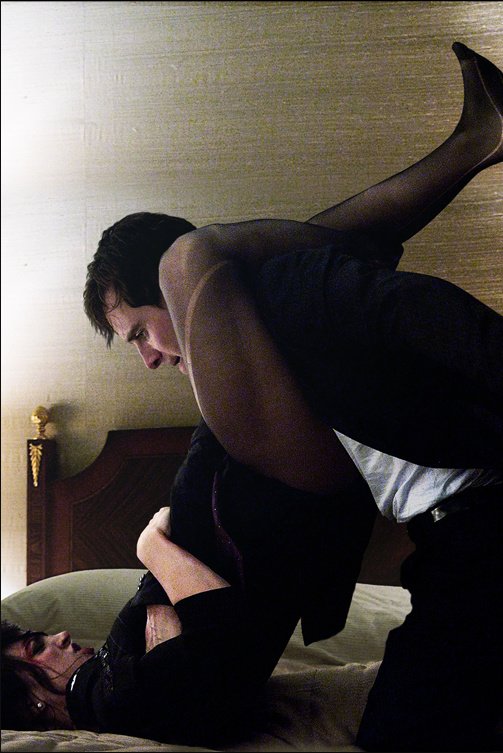
And he hasn't begun to investigate his wife, yet. As she was preparing for dinner, she happened to mention that she liked it when he watched her, but, she has no way of knowing how far that will go. He finds out her schedule—she's traveling to Zurich on business—and persuades Clarissa to temporarily way-lay a satellite and discovers that Katheryn is meeting a Soviet operative there. James informs him that she's got access to a Swiss bank account with £7 million in it and that a highly-placed colleague of the fellow she there has gone missing. Perhaps most alarmingly, Meacham—his boss who gave him the assignment of "finding the rat"—has unexpectedly died of a coronary. Things are happening pretty fast.
But, then it's a 
Steven Soderbergh movie. Black Bag is the second 
film he's directed film to be released in three months (the earlier one was Presence, also written by David Koepp), and it is more in the style of Soderbergh's caper movies (the "Ocean's" films, Logan Lucky, or Out of Sight), although slicker and with more of a professional veneer given the spy/thriller setting. It's stylish, witty, but with an underlying smartness that might leave some watchers in the cold. Things get complicated, red herrings abound, and if you're not paying attention, you could get lost. But, the spy vs. spy bubble the movie moves in gives it a certain edge where you're not sure whose side anybody's on at any given moment.
Call it Tinker Tailor Soldier Spy-lite, with a little bit more tech with spy-satellites and AI-enhancers and the like, plus a bit of sleuthing, psychological games, a big "MacGuffin", and even an Agatha Christie "it's-someone-in-this-room" reveal, checking off a lot of film-fan favorites. And the structure of the thing is a nice little touch. It's a clever little game, if not much of a thriller, although Soderbergh keeps it moving at a fast clip, and the badinage witty even if no one smiles. 

Wednesday, November 29, 2023

Next Goal Wins (2023)

The Anti-Lasso ("We're Just Asking That You Not Embarrass This Nation Any Further")

or
FIFA Faux Fun
 
The story behind Next Goal Wins has been told before...in the 2014 documentary also titled Next Goal Wins. The facts are all there, too. You can look it up.*
 
It's just never been told by Taika Waititi before.
 
The story of the American Samoa soccer team attempting to invigorate (hell, "hot-wire" is the better term) their club after a record-book-breaking loss of 31-0 (to Australia) by hiring a coach who'd been fired from his last three coaching positions for anger-management issues is an absurdist nightmare of reaching for the dirt, and failing your way to greatness, the sort of story they don't cover in the sports channels except for a cruel laugh-getter before breaking to the next beer or ED commercial. It's hardly an inspirational story in the Lombardi** circles of "winning is the only thing" quippage. But, it IS a story about survival and dignity and overcoming log-odds humiliation. You know, the place where the other 98% of us live.
Now, I've been seeing a lot of grumbling about Waititi on the inter-webs in anticipation of this film. My general impression from it all is that the New Zealand director has somehow worn out his welcome or gone past his "Sell By" date. Oh, the gripers still like his TV shows—"Reservation Dogs" (on Hulu) and "Our Flag Means Death" (on HBO Max...or is it just "Max" these days?) and, of course, the "What We Do in the Shadows" series (on FX)—everybody likes those, but Waititi long-form seems to make me people cranky.
 
I don't get it (but I don't "get" a lot of things on the inter-webs). 
Maybe Waititi is too "twee"—that is (by Oxford) "
excessively or affectedly quaint, pretty, or sentimental"—for some folks, but I would argue that Waititi takes on some pretty strong stuff in his movies (Hell-oo, Jojo Rabbit!)—and, as he works in a comedic vein, the effectiveness of his work will, also, always be subjective. Some folks have an under-developed sense of humor while some folks laugh at the the most painful of accidents. Comedians take on the burden of failure just by telling a joke. Waititi may not please everybody (and he certainly doesn't from the comments I've read), but he's also adept at horror and tragedy, frequently mixing things up and finding the absurd in everything.
And a LOT of people...especially those espousing a religious, bed-rock view of their deities...do not like that at all (Hey, I didn't like Thor: Love and Thunder, either, but I'm not going to dismiss a director for a dud***). There were just too many good things about What You Do in the Shadows, The Hunt for the Wilderpeople, the afore-mentioned Jojo Rabbit, and Thor: Ragnarok, not least of which was a steadfast impudence to take the material and play with it, rather than merely pay homage.
Okay, okay. How's the film?

Funny, for the main part...despite it beginning "with incredible humiliation." The film starts—after an introduction by Waititi playing a community priest—with a recap of that terrible World Cup defeat, followed by coach Tom Rongen (Michael Fassbender) being brought before a FIFA board with the intent of doing two things: walking him through the five stages of grief, and giving him a "take-it-or-leave-it" offer—he either goes to Samoa to coach the worst team in the league...or they fire him. That two members of the board are his separated wife (Elisabeth Moss) and her current boyfriend (Will Arnett) does not help in any way, shape or form.
Reluctantly, he flies to American Samoa, where he is greeted by the President of the Football Federation American Saomoa, Tavita Taumua (Oscar Kightley), who is also a camera-man/restaurateur/manager of the hotel provided to Rongen. At this point, Rongen considers himself exiled to prison, so he is merely content to drink his troubles away. The first practice does not go well, Rongen resorting to basics, laps, sipping from his SOLO cup and stewing. Then, one of the better players, Jaiyah (Kaimana) shows up late, back from Hawaii and still after-glowing from a great trip.
Next Goal Wins has been called transphobic in some circles (a handful of reviews at the film's film festival premiere) because of this character. Put aside that this is based on a real player, Jaiyah Saelua, fa'afafine in the Samoan culture, an important figure in the sports trans community and is played by a trans actor. This smattering of reviews seem to think that the story is not about the team, but the one character. They play an important part, but are not the main focus of the story. The ultimate sin seems to be at one point, the drunken, frustrated and boorish head coach "deadnames" her to get her to focus. This is, of course, bad behavior. But, what this clutch of clutching reviewers seem to forget is that the coach—at this point in the story—is a bad guy. He's a white...Dutch (cue the colonizer music)...outsider who knows nothing about the culture and needs to be schooled. Call me cisgendered for taking that approach, but also call me a reviewer for looking at the bigger picture. I endeavor to go into a movie without preconceived notions and prejudices. I also try not to watch a movie myopically.
As it is, Jaiyah is the most winning part of the movie and is clearly more defined than the other team members, who, by this time of the movie aren't hoping to win a match...but merely to score a goal. She, to my mind, gains the audience's loyalty at that point and for the remainder of the movie. Not so, the coach. And as the token Aryan in the cast, Fassbender—not known for his comedic chops or his expressiveness—seemed to me to be channeling his inner Charlton Heston, all gritted teeth and furrowed forehead, a stranger in a strange land but determined to buffalo his way through it. And we all know what happened to the buffalo.
Look, it's good. It's funny. It does well by its subject and it will provoke a laugh or two...if you're not sensitive to being shocked into laughter now and again.**** But, then I like the New Zealander humor and brashness (Crikey!). And everybody improves their game.
Look. I'm not an apologist for Waititi. Taste is subjective as is humor. And he's doing more things right than he might be doing wrong.
 
But, here's the thing: there is a perfectly fine documentary of the story out there if you look around. It just won't be as entertaining.

Which is why we need "irritating" directors like Taika Waititi.
The actual 2014 American Samoa soccer club
* And you can watch highlights (or low-lights, depending on your POV) of it here:  

** Lombardi didn't come up with that "Winning isn't everything, it's the only thing" line. He stole it. From UCLA Bruins coach "Red" Sanders who'd been using it since the 1930's. Evidently plagiarism isn't the only thing, either.

*** Yeah, this is mostly a dig at Marvel fans who don't like Waititi's disrespectful treatment of the Marvel Universe, but, if any of the MCU series needed some rejuvenating sass it was the moribund "Thor" series.

Waititi's on tap to do a Star Wars movie in the future.  You have to be a brave soul to walk into that fan-boy viper's nest.

**** One bit had me laughing for a solid 3 minutes after it occurred. Did not see that coming.

Tuesday, November 28, 2023

The Killer (2023)

WWJWBD?
or
Skepticism is often mistaken for cynicism. (Suuuure, it is...)

Stick to your plan.
 
Anticipate. Don't improvise.
 
Trust no one.
 
Never yield an advantage.
 
Fight only the battle you're paid to fight.
 
Forbid empathy. Empathy is weakness. Weakness is vulnerability. 
 
Each and every step of the way ask yourself: what's in it for me? 
 
This is what it takes. 
 
What you must commit yourself to...if you want to succeed.

Simple.
 
It's the mantra by which the hired sniper (played by Michael Fassbender and unnamed except for some wildly amusing aliases on his I.D.'s and credit cards—he can't be accused of identity theft but might be in violation of the recent writer's strike) of David Fincher's The Killer (based on a graphic novel series by Alexis Nolent—ndp Matz—and Luc Jacamon) lives his life and dutifully repeats to himself after all the anticipation stops and he's actually required to pull a trigger—and only then, if his pulse-rate is hovering at 60.
It's the waiting that kills you. He keeps his body in shape with daily exercise, a light diet of protein—McDonald's...really?—and his mind focused with a steady stream of The Smiths and the aphorisms constantly scrolling through his head. 
 
He is in Paris, taking up temporary residence in an abandoned WeWork space across from a plush Paris penthouse that he constantly eyes for any sign of activity...or of a target. He's received an assignment, but the intended corpse is late. And this gun-man hates that. It's rude, for one thing. And if his intel is wrong about this, what else is off-track? Not that he knows anything about the target. He's not there to judge. "My process is purely logistical," he muses "narrowly focused by design. I'm not here to take sides. It's not my place to formulate any opinion. No one who can afford me, needs to waste time winning me to some cause. I serve no god, or country. I fly no flag. If I'm effective, it's because of one simple fact: I. Don't. Give. A. Fuck ."
But, he does, as far as the inefficiency goes. Cameras are everywhere. And though he purposely dresses as a German tourist to discourage any recognition...or interest...he can't help but think that his constant presence will gradually work against him, despite his M.O. of "redundancies, redundancies, and redundancies." On "Annie Oakley jobs" like this one, it's the details. "It only takes a few episodes of 'Dateline' to know there are countless ways to trip yourself up. If you can think of a dozen, you're a genius. I'm no genius." Later, he will get nostalgic: "When was my last, nice, quiet drowning?"
Maybe he should have waited until the guy got in the hotel pool. It wouldn't be a very interesting idea for a movie if everything went according to his plan. And little-by-little, that mantra becomes increasingly irrelevant and The Great Anticipator finds that he must improvise...a lot. The redundancies, redundancies, redundancies become complications, complications, complications. And, for once, he has to deal with the consequences as they hit closer to home. He finds it tough to be a target.
"I blame you...for having to bring my work home," he muses at one point. 
 
The Killer is fine, if you don't mind spend spending so much time with a conscienceless sociopath who has the advantage of never having to stick around for the aftermath—that's just something he never needs to calculate. But, when the tables turn and he actually has to give one of those fucks, there is no apparent empathy shift. He's still the coldly calculating death merchant with a penchant for pretense. And given his track record for playing sublimation and even mechanization, Fassbender is the perfect guy to play him. He's on-camera for most of the movie's running time, constantly in the sights of the view-finder and those types of marathons are tough to pull off. But, he does it with a seeming ease as the toughest thing his character can do is crack a smile.
Ultimately, it's a revenge movie—his clients don't like the outcome of the job he was hired for and so they go after him—and he has to methodically go up the chain, finding his contact, finding out his contacts, and taking them out one by one. He finds out "who", but the "why" is a bit of a mystery, unless you ascribe his own philosophy to their motivations:
"From the beginning of history, the few have always exploited the many. This is the cornerstone of civilization. The blood and mortar that binds all bricks. Whatever it takes, make sure you're one of the few, not one of the many." And so he goes about his business. Whatever it takes.
Fincher's direction is full of his feints and slights of hand—the time-transitions in a cut, the "impossible" shots (he did start out in special effects and he's in his wheel-house in a CGI-world—see the video below), all carefully controlled, composed and edited with a distinctive *snap* to them. It all looks simple, but what it takes to achieve that effect is extraordinarily complicated. That it's in service to another "revenge" plot is a bit disheartening. That it's something Fincher has wanted to make for years is more than a little depressing.
Fincher is such a craftsman, that he shouldn't be punching down. Maybe he had an extra commitment to Netflix for making Mank. Maybe he wanted to see if he could curb his instincts for budget and length and make something spare with both. Maybe the option to the graphic novel's film-rights were going to lapse. Or maybe this is his attempt to make a comedy ( although I've always considered Fincher's Fight Club more of a comedy) with its assassin who seems to have grown his habit for internal monologue watching "Dexter." Maybe it's his way of making a "John Wick" movie (why you'd want to, aside from the absurdity of it, escapes me). But, this is more This Gun For Hire than Le Samouraï.
 
If he was looking to make art, he was aiming a little low.
"Of those who like to put their faith in the inherent goodness of mankind,
 I have to ask, 'Based on what, exactly?'"


Tuesday, December 20, 2022

Genre/Gender-Bending with Mr. Soderbergh

Written at the time of the films' releases

Haywire (Steve Soderbergh, 2011) Fairly standard actioner about a wet-ops unit for hire, and one particular freelancer who's beginning to suspect harmful links between gigs, directed by Soderbergh (written by past collaborator Lem Dobbs), with some unusual qualities of note. For one, the director stages his fights like they were dance sequences from an M-G-M musical—full-frame/full-figure (but without the Lion Studio's "stage" angle on the axis of the central figures). There are no tight shots, tight editing, it's all composed of mis-en-scene, rather than montage, just an angle/reverse angle one-two parrying between perspectives. It's tough, athletic, and the only real reason to cut away is if something goes wrong—a fluffed punch, or bad timing that creates a lull in the fight or a disconnect with "reality." There's no "lull" between hits because the way the altercations are staged you never see the connections, and there's no simulation of connection, because they're composed mostly of gymnastics, wrestling and fast action—the opposite of The Bourne Identity style of rapid cutting and implication of "hits." Soderbergh does something different with this style, while accomplishing the same intensity of the edit-dependent fisticuffs of the last few years. The most critical part, however, is who's doing the fighting, and that's where Haywire is really different and utterly dependent on its athletic lead.

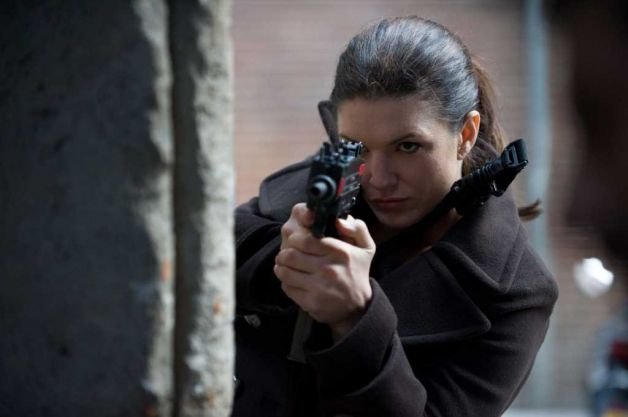
Gina Carano, mixed martial artist—and frequent participant in "American Gladiator"—plays Mallory Kane, and she is disciplined enough to pull off the fight sequences with a savage speed. Any actress can train to look convincing, but Carano has the moves down for her character who is supposed to be a berserker weapon of mass-destruction, so there's rarely a cut-away or an insert shot to betray the use of stunt-doubles. There aren't any. 
So, Soderbergh (who also shot the film) keeps his camera out of the way and keeps everything and everybody in frame as best he can. We've seen women in fights before—fights with men (Tarantino loves to do that)—but it's slightly unnerving to see these, knowing full well that everything was done in-camera, with few editing tricks. The speed makes it a bit more visual—there's no 1/4 second adjustment/orientation lag between cuts—and more upsetting initially, but one does, as the fighting continues for minutes unabated, used to it (except for the question of what kind of make-up she uses to hide the bruising).
Because Carano is largely unknown except for her MMA career—she's fine in her dramatic scenes, just not great (but then, have I ever complained about Jet Li or Jason Statham's acting?)—the cast is a little top-heavy with big-name victims...Ewan McGregor, Michael Douglas, Channing Tatum, Michael Fassbender (the latter doing a fine riff on Bond coolness—of course, he gets his ass kicked in the film's best fight), Bill Paxton and Antonio Banderas. Nobody is required to do anything beyond displaying detached coolness. But the internal logic is there, so at least this one is a better example for the experiment than, say, Salt.
The girl breaks bones and furniture.

Welcome to the Crazy Club!
or
The Moon's Just a Cheap Shot Away

And what's good for the goose...
 
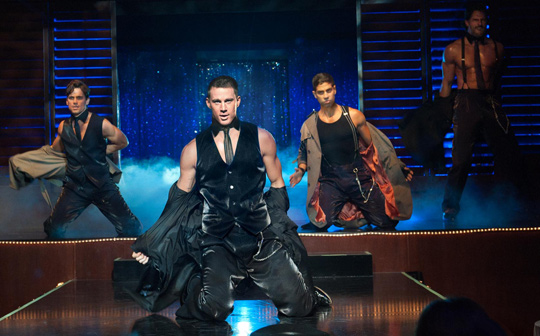
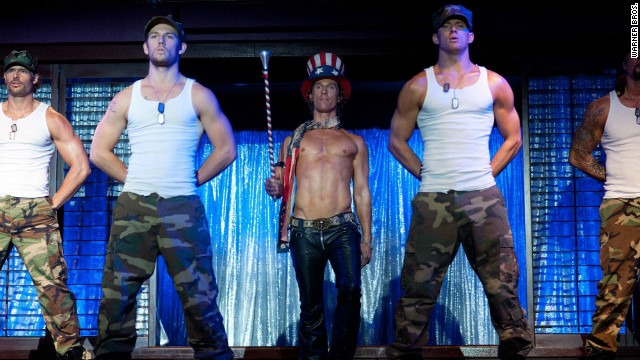
Soderbergh's next film after Haywire (if we don't count his second-unit work for The Hunger Games), also goes against the grain in the traditional genre/gender roles that we come to expect in movies—a dance/backstage drama movie, but with male leads.  Magic Mike is Flashdance with testosterone, the only thing missing is the "if you give up your dreams, you die" line. Here, the basic dream is moving out of Tampa, Florida...to a bigger venue, or a better life. The clutch of male strippers each have their own motivations—mostly money—and for them, the gig is a better alternative than slogging through a 9 to 5 job, wearing a tie. So, at night, they dance, flirt, tease, and as club owner Dallas (Matthew McConaughey) "pry the cash out of their purses."
We're introduced to the skin-trade by Adam (Alex Pettyfer) irresponsible brother of Brooke (Cody Horn), who makes a good enough living for him to sponge off by having a steady job dealing with medical claims. At a construction job that he's ill-equipped for, he runs into Mike Lane (Channing Tatum), who, despite seeing Adam as a loser, takes him under his wing, giving him a job as a "gopher" for the Xquisite dance club, where Mike, he finds to his surprise, is a featured dancer. Well, you know how these backstage stories go: one of the performers can't go on-stage—he's passed out from a growth hormone overdose, and so Adam must make his stripper debut.  Dallas and Mike watch from the wings and simultaneously offer an opinion: "Can't dance worth shit."
 
"But..that..can..be..taught," replies Dallas.
Wish the rest of it could be. It'd save us all a bunch of time. Mike's the hero of the tale, the veteran, "the guy most-together," but Adam is the neophyte and must go through the unfulfilling one-nighters, the drug problems,
the crack-ho relationship, the debts to the hood-pushers, the spiral down to the bottom. Mike just goes home to a brewsky and a night of uncrinkling his Benjamins on the edge of his self-designed furnishings (the establishment of such a business is his dream). He's the cleverest of the bunch—Tatum developed the story based on his own experiences dancing in Tampa, so naturally he's the cleverest—and he's the most romantic of the bunch, mooning over a past-patron (Olivia Munn
*) and very interested in Adam's sister. He probably stays around being The Kid's Obi-Wan just to keep her in the picture, because there's only so many times you can say "You don't want that in your life, bro'" before it gets tiresome.
It does, but it could be a lot worse. It could be "Showboys," and in outline form it resembles it, but it avoids the smarmy camp quality of that film by having a sense of humor about itself** and what it is (and what it doesn't aspire to, which is anything with an overt message) and it stresses the economic times that drop the unskilled (but ripped) into such night-work (day-jobs being rather scarce, especially when you party until 4 am) without having any pretensions about suffering for your art.  And the performances are fine, especially Tatum and McConaughey, who clearly relishes playing an out-and-out bad-boy with no shame. But, all the men throw themselves into the roles of buck-a-throw sex-objects, with a brio and swagger that's fun to watch—as long as nobody takes it for anything more. 
 
It's the old "show-biz is a rough road, kids" movie, but with a "y" chromosome in the script of its DNA, a morality tale with enough immorality to make it worth watching.  And it's a healthy thing for Soderbergh (or anybody) to be turning the tables on these themes with their built-in sexism—even if the tables have some dancing on them.
The boys break rules (but not twenties)

* Interesting role for her.  She plays a woman who plays with Mike like a boy-toy for jollies, but he finds, much to his dismay, that she does not consider him someone to bring home to meet Mom and Dad.  Dude...(if I can use the language of the film) Why do you think you never went over to her place??  As they might say in Showgirls "Denial's not just a river in Egypt, honey..."

** Reviews and synopses are saying it's a comedy-drama, though. No. No, it's not. It's a light drama (with sprinkles of heaviness) and some clever writing here and there. Maybe that hyphenate was there to attract the ladies (as if all the beef-cake and pretty boys wasn't enough).

Tuesday, November 23, 2021

X-Men: First Class

Written at the time of the film's release... 
 
"The X Factor"
or
"Don't 'X,' Don't Tell"

Movies from Marvel Studios seem to be running the pattern of "Star Trek" movies (at least in my eyes), the "even"-numbered ones tend to be best, while the "odd"-numbered ones are a little clunky.* That's certainly the case with the "X-Men" franchise. Bryan Singer's first film did a lot of heavy lifting adapting the comic to the screen, but there was a virulent strain of exposition, and some jostled positioning of the characters in what is essentially an action soap opera.  The best thing about it was its casting, but its big confrontation was poorly done.  X-II, also  directed by Singer, with all the introductions out of the way, concentrated on story and moved along smoothly with an emotional end-point that seemed to matter. Singer left to complicate the "Superman" movies, and left X-III in the hands of Brett Ratner, who produced a very expensive film that looked cheap, felt cheap and really screwed up the X-Men line-up. Ratner was required to use an expensive cast which ate up a lot of the film's budget, and the results on-screen suffered, despite the audience familiarity of the stars. There really didn't seem to be anywhere for another film to go, without some heavy gene-splicing of the cast.
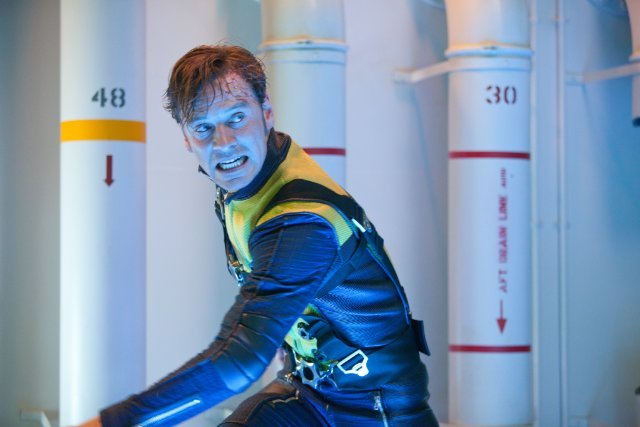
So, here's the fourth "X-Men" Movie (we won't talk about X-Men Origins: Wolverinewe already have) X-Men: First Class, a sort of re-boot of the series, although keeping elements from the original films that everybody seems to like.  They could have easily made it an "X-Men Origins" film.  It starts where the first film began—at a concentration camp in Poland as Erik Lensherr (here Bill Milner, but he'll grow up to be Michael Fassbender**) watches helplessly (for the moment) as his parents are imprisoned in a concentration camp.***  The parallel story is of young Charles Xavier (Laurence Belcher, then James McAvoy ) who finds a metamorph in his kitchen (Morgan Lily, but she'll be played as a young adult by the ubiquitous Jennifer Lawrence), whom, recognizing a fellow mutant-traveler, he takes in as a sister.  Their lives progress and Lensherr, who has developed powers over metal, hunts down the Nazis (particularly Kevin Bacon) who killed his parents and tortured him, while Xavier attends Oxford with his "sister" Raven, achieving top honors—and why wouldn't he, as
he can read minds and project thoughts. 
What is nice about X-Men: First Class is it takes real-world events of the time that
Lee and Kirby were creating the series in the early 1960's—in this case, the nuclear gamesmanship of 1962 when the U.S. planted missiles in Turkey, which was then challenged by the Russians planting nukes in Cuba, thus lighting the match for the Cuban Missile Crisis in October of that year, which came within a sub-crew's breath of a nuclear X-change between the two very real "super-powers."  Singer is credited with the story, and however counter-intuitive it might have been to place it there (and it does create a couple of continuity errors), it "works" and works gang-busters.  With Singer's story and the direction of Matthew Vaughn (getting stronger and stronger with each movie), it feels more like a 60's groovy spy story than your standard super-hero fare, and for once—save for a poignant moment in X-II—the consequences of the plot really seem to matter.
Those familiar with the "X-Men" comics will know of "
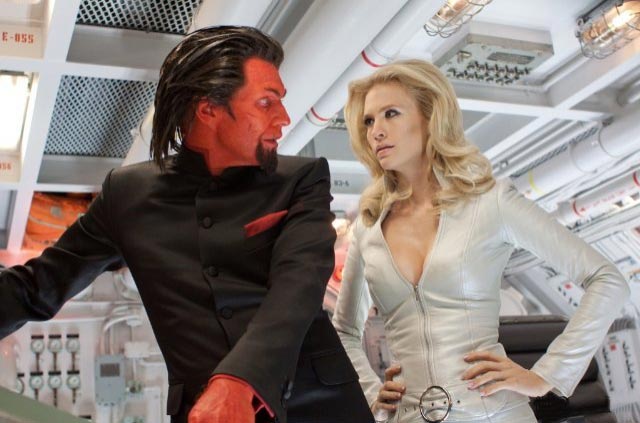
The Hellfire Club"**** and it turns out that organization of nefariousness and debauchery fits in well with the swinging '60's.  Led by Sebastian Shaw (Bacon), with henchmen Azazel (Jason Flemyng), Riptide (Álex González) and Emma Frost (January Jones), they've pulled the mental strings of military puppets on both sides to set up the nuclear stand-off, and as Shaw absorbs energy, a nuclear holocaust wouldn't kill him, it would only make him stronger.
Banding together with the CIA, (uneasily, except for agent Moira McTaggert—
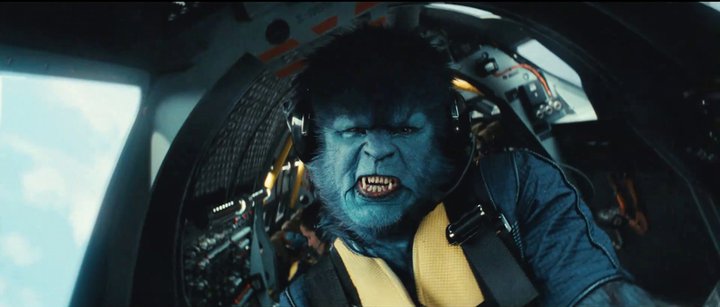
Rose Byrne and another played by Oliver Platt), Xavier joins forces with Lensherr, in classic "the enemy of my enemy is my friend" style, and begin recruiting other mutants to form a secret society of operatives hiding in the shadows to do undercover work against the Hellfire Club. Pretty soon, things become dire enough that they must come out of the cold and overtly take a stand, certainly taking their place among "the best and the brightest."
It's your classic "oppressed minority" story (something Lee and Kirby knew all too well when they were doing the comics—both were Jews, which was common among the pioneers of the creators of the superhero comics genre), but during the 60's it was a civil rights metaphor that only became more overt as the years went on.  Singer pitched his initial The X-Men concept as a "meeting between
Martin Luther King and Malcolm X," but it was more than that; Singer gave it a "hiding in plain sight" slant towards gay rights that involved not only opposition to the mutants but out-right hysteria (something the scenario buys into with the "recruitment" angle, long a charge of anti-gay paranoia).
So, you have a superhero flick that acknowledges its comics roots by employing a style from the movies of its origin's time-frame, with a rather clear-eyed look at a real-life crisis (mutants weren't involved, although I've always had my suspicions about Robert McNamara), some nice performances, grand-standing direction, good action set-pieces, and a few nice surprises for fans of both the comics and the previous films.  X-Men: First Class manages to be more than the sum of its parts, certainly the best of the series and among the best of the genre, thanks to its scope and style and its own undefinable, uncanny "X"-factor.

The First "X-Men" comic (from 1963)

* Iron Man being an exception.

** Fassbender is terrific, playing contained rage and menace throughout, but when he lets go with the emotional histrionics, there is just enough control to it to make you worry what would happen if he "really" let go.

*** They even use Michael Kamen's music from the first film in the scene.

**** Although writer Chris Claremont and artist John Byrne cite "A Touch of Brimstone"—a controversial episode of the British TV series "The Avengers" (and it's important to make that distinction with Marvel)—there's been a long history of actual Hellfire Clubs.