Showing posts with label Kevin Bacon. Show all posts

Saturday, November 23, 2024

JFK

JFK
(
Oliver Stone, 1991) 
 
"To sin by silence when we should protest makes cowards of men."
 
At the time of this film's release, Stone's movie-collage of Kennedy assassination conspiracy theories was more than controversial, it was inflammatory. Experts in "the field" criticized it for playing fast and loose with facts and some went so far as to call it dangerous in its implications. There was so much flummery going on, some of which contradicted other speculations of the film, that it was considered a new form of propaganda, where new possibilities popped up before previous assertions were followed up on, that one was simply overwhelmed with the slew of speculations so that, finally, nothing was ever concluded. There were no answers, merely a mountain of questions, all of them vague and unsubstantiated. Stone was merely throwing stuff up at the screen and seeing if anything stuck.
Stone answered these charges by saying that he was making a new kind of film, and that he was trying to build a new narrative for the Kennedy assassination, not provide a definitive answer, but to ask questions, merely. The evidence of film bears it out—at least at first glance—as it's so filled with theories and goes down so many rabbit-holes, unchecked and unverified (Stone has stated he was using the films Rashomon and Z as his models). But, one only has to see how Stone starts the movie to know where he thinks the center of the conspiracy lies. After that quote by author and spiritualist Ella Wheeler Wilcox, he introduces Kennedy's predecessor, Dwight Eisenhower's final address as President, in which he warns of "the military-industrial complex". Like so many openings of so many movies, it is the director's thesis statement, providing that one bit of detail before launching into a history of Kennedy's recent history (narrated by Martin Sheen, who has played both John and Robert Kennedy in the past).
"I'm ashamed to be an American today."
The film proper begins the day of Kennedy's assassination as New Orleans District Attorney Jim Garrison (Kevin Costner, who had, in 1998's Bull Durham, delivered a speech in which his character states "I believe that Lee Harvey Oswald acted alone.") sees the assassination coverage on television initially in his office, then watches mournfully from a nearby bar where the local booze-hounds are free to weep in their beers or grunt their approval of the President's death. At the same point he cuts away to an argument between two men in the bar, New Orleans private detective Guy Bannister (Edward Asner) and an operative Jack Wheeler (Jack Lemmon),* which leads to a fight in Bannister's office when Martin brings up past suspicious activity. Meanwhile, Garrison starts looking into local links to the assassination and brings in pilot David Ferrie (Joe Pesci), who might have had links with Oswald. And despite Ferrie being sketchy and giving conflicting stories, they let him go.
"It's all broken down, spread around, you read it and the point gets lost."

It is only after the Warren Commission Report on the assassination is released that Garrison picks up the threads of the case again. A chance airplane encounter with a Senator (Walter Matthau), whose skepticism —"That dog don't hunt!"—about the report sparks Garrison to again call in Ferrie, but also Martin, who had seen Lee Harvey Oswald in Bannister's office and follow up leads not explored after the initial inquiry was dropped. One name keeps popping up—"Clay Bertrand" but nobody knows who that is. Turns out that "Bertrand" is an alias of Clay Shaw (Tommy Lee Jones), well known in New Orleans business circles as a wealthy benefactor and who had connections with Ferrie and thus Oswald. Garrison and his team have Shaw picked up for arrest despite their inquiries producing only denials.
 
"Oh, you are so naive"
 
One aspect of the film that is both a high achievement and problematic is the way that it mixes archive footage with deftly re-created new footage in such a way that it is nearly impossible to determine one from the other. Stone and his cinematographer, the wizardly Robert Richardson, mix and match formats, color and black-and-white, 35mm and 16mm, and all sorts of film stocks to create and re-create source footage and the results are nearly indistinguishable, especially the way they are cross-cut between each other. It lends the air of verisimilitude—and certainly adds a dynamic tension between the transitions—but one is never sure if one should believe what one is seeing. Is that press footage from the day of the shooting or is Stone just fabricating something he wants you to see?
It's troubling. There's a fine line between making it look right and obfuscation and given that film, by its very nature, is manipulative—even with documentaries—the level of distrust this attention to detail evokes is extremely high. What are we to believe? The answer is whatever the director wants you to believe. And given Richardson's deserving Oscar-winning work on this film to match the look, the grain and the confusion of archive footage, some of which might even be familiar, distinguishing the true from forgery is almost impossible. And audiences become susceptible.
One should always be aware that it's a fictional film of real-life events. And rather than speaking truth, it can only come up with conjecture.

 
"And the truth is on your side, bubba."
 
Stone makes his own case on what happened in a middle sequence where Garrison goes to Washington D.C. to meet an informant, a former military official who only identifies himself as "X" (Donald Sutherland, who's brilliant in a role of pure exposition). That Garrison would fly to D.C. to meet an anonymous source strains credulity (he surely must know his name before agreeing to meet, but then, the reality is Garrison never met this character, communicating with him in un-cinematic exchanges of letters).
It is 'X''s contention that Kennedy was making feasibility studies for withdrawing troops from Vietnam—"X" was doing the inquiries—and that this rattled the cages of the Pentagon and the CIA. "X" is unexpectedly assigned to...Antarctica...and only learns of the assassination the next day when he reads a New Zealand newspaper that has a full run-down on Oswald as the assassin when he hadn't even been charged yet. To "X" this smacks of "black ops" work (which he also used to do). Oh, and did I mention that "X" was also part of Kennedy's security detail? "X" seems to have got around.
Anyway, by the end of his exposition, "X" has a conspiracy that could involve the Pentagon, "the military-industrial complex", FBI, CIA, Cuban exiles, the Mafia, the Secret Service and Lyndon B. Johnson—he was in the fired-upon motorcade, after all—and all of them had grudges against Kennedy, but mostly, they didn't want to cease operations in Vietnam which was making a lot of people a lot of money. This is the same Vietnam War that Oliver Stone fought in from 1967 to 1968 with the 25th Infantry, which was a traumatic experience for him, and that he has made the subject of three of his films.
"X" refuses to come forward with this information and flat-out refuses to be a witness for Garrison's prosecution, but "X" tells him that his best chance is that he's the only guy conducting a trial involving the Kennedy assassination. "
Your only chance," he says "is to come up with a case. Something. Anything. Make arrests. Stir the shit-storm. Hope to start a chain reaction of people coming forward. Then the government will crack." And, with those words of encouragement, he walks away, leaving Garrison hanging. Stone cuts to the Eternal Flame at Kennedy's grave. When Stone gets in trouble, he goes for sentimentality.
The film's last hour is that most deadly of momentum killers, a trial, with Exhibit A being a long speech by one character...in this case Garrison.* That speech wouldn't stand in a court of law and it isn't made clear if it's a closing argument (that barely mentions the defendant Clay Shaw) or a part of Garrison's evidentiary overview (it starts with objections from the defense and then they are never heard from again), but Stone is dramatically stretching truth...and credulity...to make his point. And it goes on forever, like the stultifying final speech in court in Ayn Rand's The Fountainhead. It's only Stone's direction, Richardson's chameleon cinematography and Joe Hutshing and Pietro Scalia's quick-silver editing that keeps it interesting as film. And almost impossible to make counter-arguments against the assertions, they come so fast and furiously.
Stone's film ends with "what's past is prologue." Okay, so let's look at the past. All previous American political assassinations, successful or otherwise, before and after Kennedy's own, have been due to "lone gun-men" (or women). The most suspicious shooting is that of Martin Luther King, Jr.  And most damning of all, recent events have seen Presidents and Vice-Presidents questioning or ignoring, even humiliating their own intelligence or military agencies...but manage to remain very much alive. Kennedy was less of a threat...he merely wanted to wind down a war...as has been done recently...and Stone would have you think he was killed for it.
Yet, History doesn't bear that out. In fact, though they may rebel (or at least write a book), they don't assassinate. "That dog don't hunt."

Remember, "what's past is prologue."
But, the film did have an impact. 99% of the documents that were sealed after the assassination have been brought to light, particularly to the issues raised in the movie (The President John F. Kennedy Assassination Records Collection Act of 1992 was passed in 1992, the year after the movie's release). Although the stated goal of the act was to release all documents by October 2017, some still have not been released. Trump went back on a promise to release them pushing it back to when he was out of office, then Biden delayed them (COVID...for some reason) then released some in 2022 and 2023.** We're at 99% except for those that would cause "identifiable harm... to the military, defense, intelligence operations, law enforcement, or conduct of foreign relations... of such gravity that it outweighs the public interest in disclosure."
Same old excuse. "It'll keep us from doing our jobs" they say, even if those jobs have dramatically changed in 60 years. But, if JFK is worth anything, it is for its shaming of our government agencies' lack of transparency to commit them to act in that 1992 law. Six decades is two generations of secrets. Too many people and too many prominent people have expressed their doubts to not have as many answers as possible to wash away as many questions as possible.
Not that that will make a difference. We've reached the Age of Un-reason where nobody believes their own eyes anymore. If everything was released, unredacted and transparent, it is doubtful that the truth would be accepted...especially by those who make their livings as professional doubters and skeptics.

The true conspiracy has always been theirs. As in the mantra of All the President's Men, one merely has to "follow the money."
"It's up to you."
 
* The film is awash with cameo's and "guest-stars" in what Stone intended to be like the roster of The Longest Day, but it feels more like the many odd cameos in The Greatest Story Ever Told, that seem ill-though-out and are actually distracting and pull you right out of the movie. John Candy? 

** This is just part of Garrison's summation from the film:
The Warren Commission thought they had an open-and-shut case. Three bullets, one assassin. But two unpredictable things happened that day that made it virtually impossible. One, the eight-millimeter home movie taken by Abraham Zapruder while standing by the grassy knoll. Two, the third wounded man, James Tague, who was knicked by a fragment, standing near the triple underpass. The time frame, five point six seconds, determined by the Zapruder film, left no possibility of a fourth shot. So the shot or fragment that left a superficial wound on Tague's cheek had to come from the three shots fired from the sixth floor depository. That leaves just two bullets. And we know one of them was the fatal head shot that killed Kennedy. So now a single bullet remains. A single bullet now has to account for the remaining seven wounds in Kennedy and Connelly. But rather than admit to a conspiracy or investigate further, the Warren Commission chose to endorse the theory put forth by an ambitious junior counselor, Arlen Spector, one of the grossest lies ever forced on the American people. We've come to know it as the "Magic Bullet Theory." This single-bullet explanation is the foundation of the Warren Commission's claim of a lone assassin. Once you conclude the magic bullet could not create all seven of those wounds, you'd have to conclude that there was a fourth shot and a second rifle. And if there was a second rifleman, then by definition, there had to be a conspiracy.

*** Whether Trump will release any more documents in his next term one can only speculate. I don't believe a word the man says so even if he says he will, I'd be looking at updates on the website: https://www.archives.gov/research/jfk

Thursday, December 14, 2023

Leave the World Behind (2023)

Everything is Disconnected ("Siri, What's This Movie About?....Siri?.........Siri?.....Do I Hear Chuckling?") 
 or
♪"Ain't That a Shaymalan?"♫
 
I just got a new cell-phone. A smart-phone. I'd had a "dumb-phone" before...for like 15 years—can't be that dumb if it's lasted for 15 years, can it? Very dependable. Always worked. Made phone calls. Text. The occasional picture. But, now a year in to smart-phone land, I find myself depending on it more...more time spent on this one than the last one. Too much time, really. I'm at that stage of life where I really shouldn't be wasting the amount of time I have left.

And I do it anyway ("idiot").

And I've been quite amazed on how much I depend on this phone for features that I quite happily lived without for so many years. And how much everything is now so tied up together with the phone, my car, my bank, my messaging...everything. And it scares the crap out of me. What happens when they don't work? Will I be able to go back to "analog mode" in order to get things done? Probably...it will just take more time (hopefully).
So, along comes Leave the World Behind
—this year's end-of-year doom-and-gloom Netflix release (last year's was White Noise and the previous year Don't Look Up)--based on the 2020 best-seller by Rumaan Alam, and written and directed by Sam Esmail (creator of the cult series "Mr. Robot"). In it, a New York couple, the Sandfords, Amanda (Julia Roberts) and Clay (Ethan Hawke)--they have two kids, Archie (Charlie Evans) and Rose (Farrah Mackenzie)--rent an Airbnb for a short vacation out of the city...to Long Island. Amanda's a bit "prickly" from her work (advertising, natch) and Clay's work as a media studies professor is stressing him out, so the "vacay" is spontaneous and short, much like Amanda. 
And it's fine...a very neat well-designed house...with a pool...close to a beach. Then things get weird. An oil tanker heads right for the shore without slowing and runs aground. Then, everybody's cell phone goes out. Radio stations stop broadcasting. Computers work but can't connect to the internet, so they're a bit isolated for news. The place is still nice, and they're provisioned if they have to stay longer. Sit and wait. That's the best thing to do given any lack of evidence.
Until there's a knock on the door late at night. It's the house's owner, G.H. Scott (
Mahershala Ali) and his daughter Ruth (Myha'la), dressed to the 10's after an evening at the symphony in New York. They've shown up at the doorstep because New York is in the middle of a blackout and they've come to their Long Island retreat for safe haven from the craziness the blackout has created. Amanda is suspicious—they could be anybody—but Scott has keys to the liquor cabinet and knows the email address Amanda contacted to get the place, and he even offers a bit of a refund for the inconvenience of sharing the place overnight. Some haggling and repercussions are interrupted by a notice that comes over the TV announcing that all stations have ceased functioning due to a national emergency. Reluctantly, Amanda agrees with Clay to let them stay...but there are questions. And nobody has any answers.
Some come through in the morning—Amanda awakes to some brief alerts on her phone's news-feed. The U.S. is paralyzed by a massive nationwide hacking attack on U.S. systems that have darkened New York and interfered with broadcast and navigation systems. But, more things have happened and continue to happen—there are distant explosions and a crippling sonic attack that shatters windows and deafen inhabitants. Wildlife is acting strangely—deer appear out of nowhere and the house pool is invaded by flamingos. Visiting a neighbor's home to commandeer a satellite phone, Scott finds that it doesn't work, indicating that U.S. satellite systems have been compromised. Drones drop leaflets that translate to "Death to America" and airplanes start to drop from the sky.
The Sandfords attempt to leave the island, but find the routes snarled by miles of Teslas drawn to the same spot by self-driving systems (interesting that this week Tesla has recalled models with that system
; the publicity from the movie must not be good). Complications ensue and the Sandfords and Scotts must join forces to seek shelter as advised by Scott's contractor, a suvivalist (Kevin Bacon), who has prepared for the end-times.

It's a clever little conceit that plays on all sorts of modern fears of weak power grids, infrastructure lapses, "Havana syndrome," and hacker gangs and provides all the doom-scrolling you need for the modern world in one neat 2 hour package. That is if one can ignore the temptation of complacency and is paying attention. Snatches of "Special Reports" and recognition of this week's hole of fallibility go off in one's head as one keeps watching things for these people get worse and worse (the flamingos I've never seen covered on "60 Minutes", though) and it's all done for straight tension, not for any satiric purpose as in Don't Look Up.
It's aided and abetted by strong performers who are very good at playing "I have no idea what's going on but I'm not comfortable with it" and with a particular nod to Roberts for daring to risk her reputation as "America's sweetheart" with a performance that is flat-out vexing for its negativity and pure harridanism. One wonders how her character could function in the world of advertising with her ability to say exactly the wrong thing at the wrong time. Her results must vary.
One must also admire the direction of Esmail, who, as if the events in the teleplay weren't off-putting enough, manages to present them in such a disorienting fashion while still keeping you aware of who's where and what their relationship to their surroundings are. One should always be aware of directors calling attention to themselves with camera tricks, but Esmail does them in such a clever way that one follows fascinated to see what he's going to do with it, rather than merely dismissing his tricks with a dismissive "show-off" remark. He also employs a nifty editing scheme: like author Dan Brown's way of ending chapters just as things are getting interesting, Esmail will cut away to another sequence when there's a slight escalation in tension, then cut back once that situation starts getting busy, and continues to see-saw with ever-building tension until a viewer is ready to snap. I've been seeing a lot of dismissive comments saying that Leave the World Behind is boring; there is no way it could be with this editing scheme—maybe those commenters upped their daily medication.
I found it to be a compelling little slow-burn thriller of the M. Night Shyamalan school—every-day situations are up-ended by some weird phenomenon that then goes to great pains to try to explain it all away, however tortured that explanation may be. Here, the speculations seem a bit more plausible, even if they are horrific in scope. Toss in some
Fincher-style transition tricks, and one is slowly pushed to the end of one's seat...with the occasional check to make sure your devices are still online.
Even moreso, it reminds one of one of the better "Twilight Zone" episodes from that series' first incarnation. Leave the World Behind is the "The Monsters Are Due on Marple Street" for the 21st Century, and the coming Trumpocalypse.
 
And it still works.

Tuesday, November 23, 2021

X-Men: First Class

Written at the time of the film's release... 
 
"The X Factor"
or
"Don't 'X,' Don't Tell"

Movies from Marvel Studios seem to be running the pattern of "Star Trek" movies (at least in my eyes), the "even"-numbered ones tend to be best, while the "odd"-numbered ones are a little clunky.* That's certainly the case with the "X-Men" franchise. Bryan Singer's first film did a lot of heavy lifting adapting the comic to the screen, but there was a virulent strain of exposition, and some jostled positioning of the characters in what is essentially an action soap opera.  The best thing about it was its casting, but its big confrontation was poorly done.  X-II, also  directed by Singer, with all the introductions out of the way, concentrated on story and moved along smoothly with an emotional end-point that seemed to matter. Singer left to complicate the "Superman" movies, and left X-III in the hands of Brett Ratner, who produced a very expensive film that looked cheap, felt cheap and really screwed up the X-Men line-up. Ratner was required to use an expensive cast which ate up a lot of the film's budget, and the results on-screen suffered, despite the audience familiarity of the stars. There really didn't seem to be anywhere for another film to go, without some heavy gene-splicing of the cast.
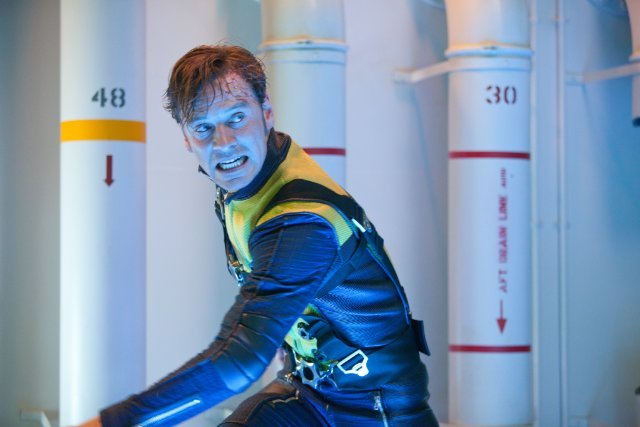
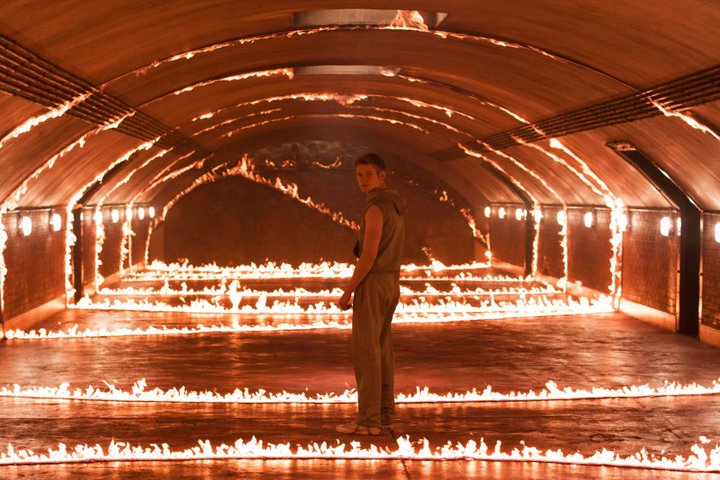
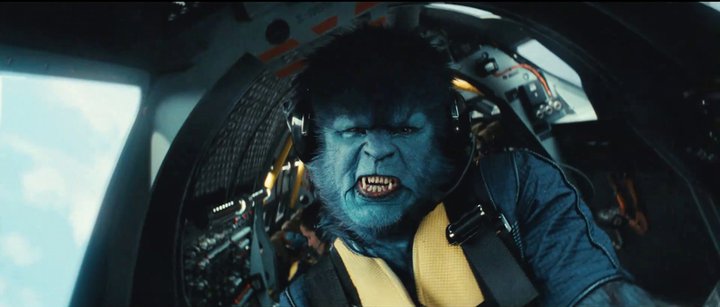
So, here's the fourth "X-Men" Movie (we won't talk about X-Men Origins: Wolverine—we already have) X-Men: First Class, a sort of re-boot of the series, although keeping elements from the original films that everybody seems to like.  They could have easily made it an "X-Men Origins" film.  It starts where the first film began—at a concentration camp in Poland as Erik Lensherr (here Bill Milner, but he'll grow up to be Michael Fassbender**) watches helplessly (for the moment) as his parents are imprisoned in a concentration camp.***  The parallel story is of young Charles Xavier (Laurence Belcher, then James McAvoy ) who finds a metamorph in his kitchen (Morgan Lily, but she'll be played as a young adult by the ubiquitous Jennifer Lawrence), whom, recognizing a fellow mutant-traveler, he takes in as a sister.  Their lives progress and Lensherr, who has developed powers over metal, hunts down the Nazis (particularly Kevin Bacon) who killed his parents and tortured him, while Xavier attends Oxford with his "sister" Raven, achieving top honors—and why wouldn't he, as
he can read minds and project thoughts. 
What is nice about X-Men: First Class is it takes real-world events of the time that
Lee and Kirby were creating the series in the early 1960's—in this case, the nuclear gamesmanship of 1962 when the U.S. planted missiles in Turkey, which was then challenged by the Russians planting nukes in Cuba, thus lighting the match for the Cuban Missile Crisis in October of that year, which came within a sub-crew's breath of a nuclear X-change between the two very real "super-powers."  Singer is credited with the story, and however counter-intuitive it might have been to place it there (and it does create a couple of continuity errors), it "works" and works gang-busters.  With Singer's story and the direction of Matthew Vaughn (getting stronger and stronger with each movie), it feels more like a 60's groovy spy story than your standard super-hero fare, and for once—save for a poignant moment in X-II—the consequences of the plot really seem to matter.
Those familiar with the "X-Men" comics will know of "
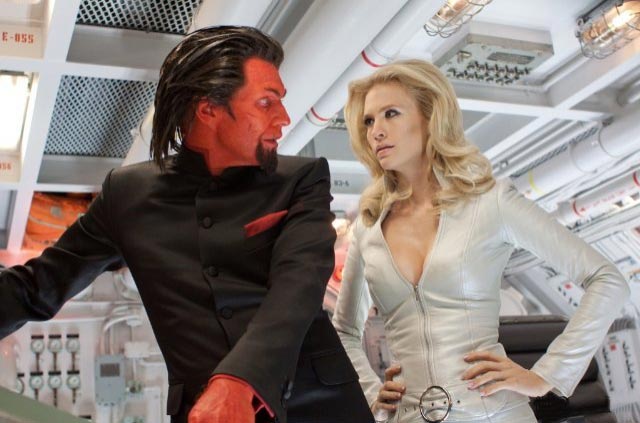
The Hellfire Club"**** and it turns out that organization of nefariousness and debauchery fits in well with the swinging '60's.  Led by Sebastian Shaw (Bacon), with henchmen Azazel (Jason Flemyng), Riptide (Álex González) and Emma Frost (January Jones), they've pulled the mental strings of military puppets on both sides to set up the nuclear stand-off, and as Shaw absorbs energy, a nuclear holocaust wouldn't kill him, it would only make him stronger.
Banding together with the CIA, (uneasily, except for agent Moira McTaggert—
Rose Byrne and another played by Oliver Platt), Xavier joins forces with Lensherr, in classic "the enemy of my enemy is my friend" style, and begin recruiting other mutants to form a secret society of operatives hiding in the shadows to do undercover work against the Hellfire Club. Pretty soon, things become dire enough that they must come out of the cold and overtly take a stand, certainly taking their place among "the best and the brightest."
It's your classic "oppressed minority" story (something Lee and Kirby knew all too well when they were doing the comics—both were Jews, which was common among the pioneers of the creators of the superhero comics genre), but during the 60's it was a civil rights metaphor that only became more overt as the years went on.  Singer pitched his initial The X-Men concept as a "meeting between
Martin Luther King and Malcolm X," but it was more than that; Singer gave it a "hiding in plain sight" slant towards gay rights that involved not only opposition to the mutants but out-right hysteria (something the scenario buys into with the "recruitment" angle, long a charge of anti-gay paranoia).
So, you have a superhero flick that acknowledges its comics roots by employing a style from the movies of its origin's time-frame, with a rather clear-eyed look at a real-life crisis (mutants weren't involved, although I've always had my suspicions about Robert McNamara), some nice performances, grand-standing direction, good action set-pieces, and a few nice surprises for fans of both the comics and the previous films.  X-Men: First Class manages to be more than the sum of its parts, certainly the best of the series and among the best of the genre, thanks to its scope and style and its own undefinable, uncanny "X"-factor.

The First "X-Men" comic (from 1963)

* Iron Man being an exception.

** Fassbender is terrific, playing contained rage and menace throughout, but when he lets go with the emotional histrionics, there is just enough control to it to make you worry what would happen if he "really" let go.

*** They even use Michael Kamen's music from the first film in the scene.

**** Although writer Chris Claremont and artist John Byrne cite "A Touch of Brimstone"—a controversial episode of the British TV series "The Avengers" (and it's important to make that distinction with Marvel)—there's been a long history of actual Hellfire Clubs. 

Tuesday, November 16, 2021

The Big Picture

The Big Picture
(Christopher Guest, 1989) Every film-maker who has ever made a film in Hollywood has had a sneaking desire to make a film about the absurdities of making a film in Hollywood. There's just a considerable smaller amount who have the balls to risk reprisals in the company-town. One doesn't shit where one eats. There's an even smaller amount who have the talent, wit, and lack of invective to point out the absurdities without making it a hatchet job...or a crashing bore. 

Wilder. Keaton. Sturges (Preston). Kelly and Donen. Cukor (and Wellman). Kazan. Minnelli. Rush. Altman. The Coen's. Welles. That's a considerable list and the results have every color of attitude from wonder-blushing red to ultra-purple put-down. 

Chris Guest's 1989 film falls somewhere in-between, retaining the wonder-lust of film-making with the soul-crushing corporate low-balling of vision. Having the creative impulse doused by a flood of compromises and bidding agendas.
Budding film-maker Nick Chapman (Kevin Bacon) is "hot", having just won a film-making competition and given the opportunity to pitch ideas for "projects." Taking a meeting with studio producer Alan Habel (J.T. Walsh) gives him flashing hope until Habel wants to make changes to his ideas more in line with Habel's peccadilloes. Then, there's the "Catch-22" of not having an agent—he can't be taken seriously without one but can't get one until he's taken seriously. So, he takes a lunch with a prospective agent (Martin Short), more interested in being seen than seeing what he can do.
Then, he gets invited to a Hollywood party given by Habel and his wife (Fran Drescher), but it's less about working than distraction—touring the house, socializing, networking. One of the biggest distractions is Gretchen (Teri Hatcher, her first film), aspiring actress, who further pushes Nick from his artistic visions by suggesting that he write his movie with her in mind. Her efforts further complicate Nick's life by making his girlfriend Susan (Emily Longstreth) jealous, driving a wedge in their relationship. Gretchen becomes the embodiment of every Hollywood enticement, moving him further from making HIS movie and compromising his aspirations. Pretty soon, his potential movie is so far afield from his intentions that his enthusiasm starts to wane, and ultimately, his film is canceled, forcing him to take entry-level jobs in Hollywood just to make ends meet.
Oh, how far the lofty intentions fall. It's hard to drum up much sympathy for Nick—sure, the Hollywood system is corrupt and capricious, but Guest at least makes his downfall as much about the weakness of Nick's character as the environment he's stepped into.
 
That story, thus, is not that involving, and it has a hard time competing with the opening of the showing of student films vying for Best of Show, which is a hilarious look at the pit-falls of student film competitions; they involve a film by an agent's son—loaded with recognizable stars, but clearly shot at a time when those actors are available, with mismatched shots showing that nobody was on the same set at the same time—or a full-of-itself vanity project by a young filmmaker with an outsized ego featuring himself in a starring role. The satire of the sequence is sharp and cruel and the rest of the film never lives up to the potential of the opening sequence—an inadvertent portent for what is to come for its hero.

Tuesday, June 2, 2020

A Few Good Men

A Few Good Men (Rob Reiner, 1992) This a time before "The West Wing." It was before "JAG." It was before anybody knew about Aaron Sorkin and the tropes of his writing. It was the third play that Sorkin wrote and his first big success, sold to producer David Brown for an amount "well into six figures" and a tenure as a writer-for-hire at Castle Rock Entertainment—he would work on the screenplay for A Few Good Men, Malice, and The American President.

But, A Few Good Men was the first one that launched the Sorkin brand. Based on a true incident (told to him by his JAG-sister Deborah) about a near-fatal hazing incident at Guantanamo Bay, the script is both a detective story and a story of personalities under pressure. It was turned down by Tri-Star Pictures for lack of star interest, but that all changed when Reiner, one of Castle Rock's founders, expressed interest in directing it.
Lieutenant Commander Joanne Galloway (Demi Moore), a lawyer of the NIS has been following up a complaint by PFC William Santiago about an incident at Guantano Bay, Cuba, but Santiago has turned up dead—supposedly at the hands of the subject of the complaint, Lance Corporal Harold Dawson (Wolfgang Bodison) and PFC Louden Downey (James Marshall). But, Galloway looks into the two's records, and finds them spotless and begins to suspect some foul-play. 
Dawson and Downey are transferred to a Washington D.C. prison for subsequent trial and Galloway requests the case, but it is assigned to Lieutenant JG Daniel Kaffee (Tom Cruise) a Navy JAG lawyer who has never litigated a case, preferring to plea deal, instead—that may be because he's a bit of a flake, but also because his father was considered a great trial lawyer and that reputation sets a very high bar. Galloway, despite reservations signs on as Dawson's lawyer and Kaffee picks Lt. Sam Weinberg (Kevin Pollak) as legal advisor.  
Galloway is convinced that Santiago died as a result of a "Code Red," an internal disciplinary action not sanctioned by the military, a "hazing" of sorts to put peer pressure on a soldier not meeting expectations. The team begin investigations: Kaffee meets with the defendants and finds them good soldiers, but Dawson's attitude towards Kaffee holds a slight contempt for Kaffee being a less than spit-and-polish officer; the defense team gets the go-ahead to fly to Guantanamo where they meet with base commander Colonel Jessup (Jack Nicholson), executive officer Lt. Col. Markinson (J. T. Walsh) and Lt. Kendrick (Keifer Sutherland), Santiago's commanding officer. In the interview. Jessup denies ordering a "Code Red" (even though he does see it as a means of strengthening the ranks), but did approve Santiago's leaving the base "for his own safety" once the report to the NIS was made. The meeting is cordial by flinty.
The matter is complicated by Jessup's regard in the military—he is in line to take an important position with the National Security Council, and there's more than a whiff of evidence to suggest that Kaffee was picked to head the team for his proclivity for plea deals, thus ensuring that the matter never makes it to trial. Indeed, Kaffee brings up the matter with Dawson as prosecutor Jack Ross (Kevin Bacon), knowing Kaffee's inclinations, has made an offer of six months in prison for the pair along with dishonorable discharges. Dawson refuses the offer as cowardly—he was following orders—refusing to salute Kaffee when their meeting concludes.
Knowing he is not playing his strengths, Kaffee tries to resign from the case, but is convinced to go through with the case. At the grand jury hearing, Kaffee offers a plea of nor guilty, setting up a formal trial for which he is ill-prepared while the minutiae of details pile up and Markinson—Jessup's executive officer—goes missing. It becomes clear that—as Kaffee sums up—"We're going to get creamed, aren't we?" and he's going to have to do battle with well-ordered, disciplined—and colluding—witnesses. The participants and the atmosphere are hostile.
A Few Good Men—and Reiner—benefit from a cracker-jack cast, many working outside of their comfort zone. Reiner, with a solid script and a solid cast, seems to up his game and, benefiting the military formalism, demonstrates a disciplined directing style, more than displayed in the restrictive courtroom scenes where the drama intensifies into shouting matches and acting fireworks, particularly between Nicholson and Cruise—Jessup's testimony, which is the fulcrum and climax of the story; the only false note is the series of shots that suggests Kaffee doesn't know what he's doing and doesn't have the evidence needed to goad Jessup into a confession (of course he does and it's false drama to suggest he doesn't). 
Nicholson is 100% on point—even sitting in a witness chair and shot from his chest-medals up. Cruise, on the other hand, was going through his "awkward phase"; he quickly became a star in Risky Business, but his next few years he spent trying to prove himself as an actor, frequently overdoing the histrionics, like a high jumper trying not just to clear the bar, but set records.* 
And it's funny:  A Few Good Men is famous for that "You Can't Handle the Truth" scene with its fiery speeches and dagger-projecting looks. It's good stuff. So good that Jessup's speech defending his actions frequently turns up as inspirational memes. The words may inspire. But, Jessup is a flawed human being and a flawed commander, because simmering under the speeches is an overriding arrogance. 

It's actions, not words that define character. Military leaders lead by example, lest their orders be seen as empty directives. While thinking of this film, John Ford's Cavalry Trilogy burbled up in me memory—particularly his 1948 film, Fort Apache and 1950's Rio Grande—and the character of Captain Kirby York (played by John Wayne in both films), who, in the first film is passed over for the command of a frontier fort by an arrogant commander (played by Henry Fonda), who is subsequently killed in a massacre by his own foolhardiness and rigidity. For the good of the Cavalry and "the Corps," York defends the man whom he had disagreements with, and in the second film, York—now in the position of leadership—is in danger of becoming the very same type of martinet commander played by Fonda in the earlier film. That conflict forms the emotional spine, and the qualities of character and leadership were very much a consideration of Ford, who struggled with those same issues in his own life as a commanding director on-set.

What makes A Few Good Men an interesting exercise is that Cruise's Kaffee can be accused of the exact same flaw of arrogance. That the two should lock horns makes for compelling drama and makes the film just a bit more mature than a cursory look would reveal.


* When I did a "Don't Make a Scene" of the Jessup—"You can't handle the truth!"—testimony, it was rough going: I could always find a frame where Nicholson looked great, but Cruise—trying to act up a storm—frequently was caught looking a bit silly. I poured over his shots frame by frame trying to present him at his best—I think I accomplished it—but, the asides and mugging (which might be effective on the screen) was, when frozen, looked like he was preparing to get to his good part without actually getting there. He's calmed down quite a bit—even if he's now constantly in motion hanging onto the sides of airplanes and being batted around on wires—but his tendency to over-do was a real issue for years. The thing is that star-making turn in Risky Business showed just how good an actor—and charismatic a star—he is.