A Few Good Men (Rob Reiner, 1992) This a time before "The West Wing." It was before "JAG." It was before anybody knew about Aaron Sorkin and the tropes of his writing. It was the third play that Sorkin wrote and his first big success, sold to producer David Brown for an amount "well into six figures" and a tenure as a writer-for-hire at Castle Rock Entertainment—he would work on the screenplay for A Few Good Men, Malice, and The American President.
But, A Few Good Men was the first one that launched the Sorkin brand. Based on a true incident (told to him by his JAG-sister Deborah) about a near-fatal hazing incident at Guantanamo Bay, the script is both a detective story and a story of personalities under pressure. It was turned down by Tri-Star Pictures for lack of star interest, but that all changed when Reiner, one of Castle Rock's founders, expressed interest in directing it.
Lieutenant Commander Joanne Galloway (Demi Moore), a lawyer of the NIS has been following up a complaint by PFC William Santiago about an incident at Guantano Bay, Cuba, but Santiago has turned up dead—supposedly at the hands of the subject of the complaint, Lance Corporal Harold Dawson (Wolfgang Bodison) and PFC Louden Downey (James Marshall). But, Galloway looks into the two's records, and finds them spotless and begins to suspect some foul-play.
Dawson and Downey are transferred to a Washington D.C. prison for subsequent trial and Galloway requests the case, but it is assigned to Lieutenant JG Daniel Kaffee (Tom Cruise) a Navy JAG lawyer who has never litigated a case, preferring to plea deal, instead—that may be because he's a bit of a flake, but also because his father was considered a great trial lawyer and that reputation sets a very high bar. Galloway, despite reservations signs on as Dawson's lawyer and Kaffee picks Lt. Sam Weinberg (Kevin Pollak) as legal advisor.

Galloway is convinced that Santiago died as a result of a "Code Red," an internal disciplinary action not sanctioned by the military, a "hazing" of sorts to put peer pressure on a soldier not meeting expectations. The team begin investigations: Kaffee meets with the defendants and finds them good soldiers, but Dawson's attitude towards Kaffee holds a slight contempt for Kaffee being a less than spit-and-polish officer; the defense team gets the go-ahead to fly to Guantanamo where they meet with base commander Colonel Jessup (Jack Nicholson), executive officer Lt. Col. Markinson (J. T. Walsh) and Lt. Kendrick (Keifer Sutherland), Santiago's commanding officer. In the interview. Jessup denies ordering a "Code Red" (even though he does see it as a means of strengthening the ranks), but did approve Santiago's leaving the base "for his own safety" once the report to the NIS was made. The meeting is cordial by flinty.

The matter is complicated by Jessup's regard in the military—he is in line to take an important position with the National Security Council, and there's more than a whiff of evidence to suggest that Kaffee was picked to head the team for his proclivity for plea deals, thus ensuring that the matter never makes it to trial. Indeed, Kaffee brings up the matter with Dawson as prosecutor Jack Ross (Kevin Bacon), knowing Kaffee's inclinations, has made an offer of six months in prison for the pair along with dishonorable discharges. Dawson refuses the offer as cowardly—he was following orders—refusing to salute Kaffee when their meeting concludes.

Knowing he is not playing his strengths, Kaffee tries to resign from the case, but is convinced to go through with the case. At the grand jury hearing, Kaffee offers a plea of nor guilty, setting up a formal trial for which he is ill-prepared while the minutiae of details pile up and Markinson—Jessup's executive officer—goes missing. It becomes clear that—as Kaffee sums up—"We're going to get creamed, aren't we?" and he's going to have to do battle with well-ordered, disciplined—and colluding—witnesses. The participants and the atmosphere are hostile.

A Few Good Men—and Reiner—benefit from a cracker-jack cast, many working outside of their comfort zone. Reiner, with a solid script and a solid cast, seems to up his game and, benefiting the military formalism, demonstrates a disciplined directing style, more than displayed in the restrictive courtroom scenes where the drama intensifies into shouting matches and acting fireworks, particularly between Nicholson and Cruise—Jessup's testimony, which is the fulcrum and climax of the story; the only false note is the series of shots that suggests Kaffee doesn't know what he's doing and doesn't have the evidence needed to goad Jessup into a confession (of course he does and it's false drama to suggest he doesn't).

Nicholson is 100% on point—even sitting in a witness chair and shot from his chest-medals up. Cruise, on the other hand, was going through his "awkward phase"; he quickly became a star in Risky Business, but his next few years he spent trying to prove himself as an actor, frequently overdoing the histrionics, like a high jumper trying not just to clear the bar, but set records.*
And it's funny: A Few Good Men is famous for that "You Can't Handle the Truth" scene with its fiery speeches and dagger-projecting looks. It's good stuff. So good that Jessup's speech defending his actions frequently turns up as inspirational memes. The words may inspire. But, Jessup is a flawed human being and a flawed commander, because simmering under the speeches is an overriding arrogance.
It's actions, not words that define character. Military leaders lead by example, lest their orders be seen as empty directives. While thinking of this film, John Ford's Cavalry Trilogy burbled up in me memory—particularly his 1948 film, Fort Apache and 1950's Rio Grande—and the character of Captain Kirby York (played by John Wayne in both films), who, in the first film is passed over for the command of a frontier fort by an arrogant commander (played by Henry Fonda), who is subsequently killed in a massacre by his own foolhardiness and rigidity. For the good of the Cavalry and "the Corps," York defends the man whom he had disagreements with, and in the second film, York—now in the position of leadership—is in danger of becoming the very same type of martinet commander played by Fonda in the earlier film. That conflict forms the emotional spine, and the qualities of character and leadership were very much a consideration of Ford, who struggled with those same issues in his own life as a commanding director on-set.
What makes A Few Good Men an interesting exercise is that Cruise's Kaffee can be accused of the exact same flaw of arrogance. That the two should lock horns makes for compelling drama and makes the film just a bit more mature than a cursory look would reveal.

* When I did a "Don't Make a Scene" of the Jessup—"You can't handle the truth!"—testimony, it was rough going: I could always find a frame where Nicholson looked great, but Cruise—trying to act up a storm—frequently was caught looking a bit silly. I poured over his shots frame by frame trying to present him at his best—I think I accomplished it—but, the asides and mugging (which might be effective on the screen) was, when frozen, looked like he was preparing to get to his good part without actually getting there. He's calmed down quite a bit—even if he's now constantly in motion hanging onto the sides of airplanes and being batted around on wires—but his tendency to over-do was a real issue for years. The thing is that star-making turn in Risky Business showed just how good an actor—and charismatic a star—he is.

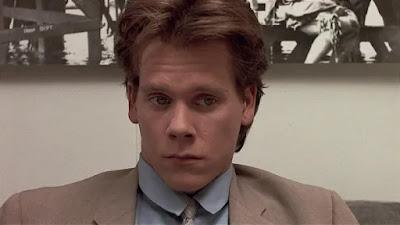 Budding film-maker Nick Chapman (Kevin Bacon) is "hot", having just won a film-making competition and given the opportunity to pitch ideas for "projects." Taking a meeting with studio producer Alan Habel (J.T. Walsh) gives him flashing hope until Habel wants to make changes to his ideas more in line with Habel's peccadilloes. Then, there's the "Catch-22" of not having an agent—he can't be taken seriously without one but can't get one until he's taken seriously. So, he takes a lunch with a prospective agent (Martin Short), more interested in being seen than seeing what he can do.


