Showing posts with label Meta-movie. Show all posts

Wednesday, January 3, 2024

May December

Watching Me Watching You
or
Persona Non Grata
 
It's a little bit of an invasion, really. The actress (Natalie Portman) "doing personal research" on your life. Seems there's going to be an "independent" film about the notorious past of you, Gracie Atherton-Yoo (Julianne Moore), and the notorious affair with a 13 year old friend of her son's, got pregnant, was tried very publicly for child-rape, was convicted and sent to prison where she delivered their child, and, when released, married her now "of age" lover, Joe (Charles Melton). They've tried to live a normal life, but it's practically impossible, with the tabloids, the photographers, the neighbors. And with those who'd rather not forget. 
 
Now, 20 years later, "this film" is being made (an earlier, exploitative TV Movie was made years ago without their participation or consent), and the Atherton-Yoo family is co-operating with this one in the desperate hope that it might make the film more sympathetic...or at least do no harm.
 
Do no further harm.
So, the family has welcomed this woman, this actress Elizabeth Berry (Portman) to their home, and at a busy time: "the twins" (
Gabriel Chung, Elizabeth Yu) are graduating high school, and that will leave Gracie and Joe, for the first time, empty-nesters. Their first daughter—you know, that one—(Piper Curda) is coming home from school for the first time since she left for school. For family. Special occasion. And...she's there. The actress.
But, the actress is just clueless enough that when she arrives at their doorstep for a meet-and-greet dinner that she (helpfully, of course) brings in a package she found left at the door-step of the house. That package is just another poop-a-gram from a harassing neighbor (or maybe it's not even a neighbor—they get them every week). She'll learn. It's her job to. Still, it's not a good start.
And Elizabeth is good at first. She hangs back, observing, talks to the sympathetic friends, makes notes, preliminary research. She witnesses son Charlie at dinner get a little belligerent and leave the table. Things are kind of tense. Elizabeth is sensitive to this and worries about her presence and reassures them that she is doing the research because she wants to portray them honestly and make it a "human story" (what else would it be?). She asks Gracie how they met, and when dinner's over, gets Joe's side of it and asks if she can visit him at his work. Then she starts to do some digging.
She interviews Gracie's ex-husband, the one she cheated on. She goes to the pet shop where Joe and Gracie were working and talks to the manager there, asking if she can go into the back-room where the two were caught, and when the manager goes back out front to check on a customer, Elizabeth tries to re-enact the scene where it happened. She goes to the lawyer who represented Gracie, and meets, by accident, the son who was friends with Joe (but is no longer) and he has issues.
But, he's not the only one, apparently. Elizabeth goes to visit Joe at work and she's deliberately provocative, almost like she's re-enacting what might have led up to the affair at the pet shop. She speaks at daughter Mary's drama club and (of course) the first question from the students is about filming sex scenes and Elizabeth's answer makes Mary more than uncomfortable. Then, she asks Gracie to show her how she does her make-up.
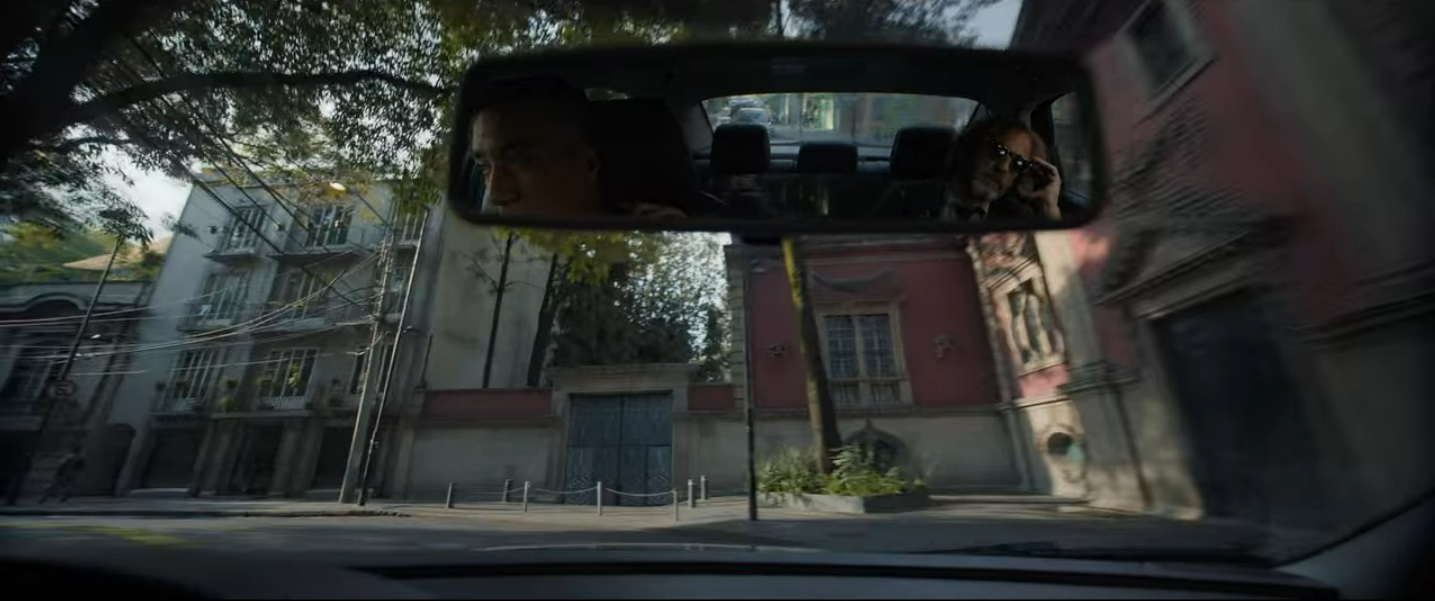
It's one of two sequences that director Todd Haynes sets up in front of a bathroom mirror. But, there's no mirror. Elizabeth and Gracie stand side-by-side playing as if a mirror was before them, but they're facing forward on screen, with us sitting in the place of the mirror. It's as if one isn't necessary because at this point, the two women are becoming reflections of each other. 
We've already seen Elizabeth going through old tabloids, studying pictures of Gracie and imitating her poses, the way she folds her hands, the way she holds her mouth. Gracie acts differently around Elizabeth and is more capable of holding things together because that's the image she wants to give Elizabeth—it's how she wants to be portrayed. But, it's a tough act to pull off. In private with Joe, she is more flinty and breaks down often. But, with Elizabeth, she's thoughtful, calm, and nurturing.
And, at the same time Elizabeth is learning to "play" Gracie, she is "playing" Gracie, complimenting her, ingratiating, trying to get on her good side (even while not knowing that that is precisely the side Gracie is giving her). The two women start to meld into each other's psyches, becoming a third person, the "best" Gracie each can achieve. Both are acting "towards" that version, it's "the job," one for the family, one for the film.
There's an amusing story in the "Trivia" section of imdb's listing for May December that "
Julianne Moore (Gracie) did not notice Natalie Portman (Elizabeth) was improvising by mimicking her mannerisms in some scenes until later into filming." That's amusing if it's true, but Portman is doing it so subtly—even while her character is doing it more blatantly in the film—that Moore probably caught on when she was looking. Portman usually saves the mimicry for when Moore is out of eye-line and it's slightly spooky. But, then Portman's actress is "spooky," doing things for verisimilitude that most actors (I hope) wouldn't do.
It's one of Haynes' most subtle films about the act of watching and being watched and how scrutiny changes things and not in an altogether good way. Layers and layers of scrutiny abound until the whole thing feels like it's under a microscope, at a time when we are all voyeurs, while simultaneously wanting our 15 minutes of fame...until we get it.

Thursday, March 2, 2023

Bardo: False Chronicles of a Handful of Truths

Everybody 8½'s Once in a While
or
Maybe Your Navel Isn't As Interesting As You Thought It Was (Please Don't Eat the Dieties)
 
There are only three directors in Academy Award history who have won back-to-back Oscars for Best Director: They are John Ford (one might expect that—he won four BD's in total, the most of any director), Joseph L. Mankiewicz, and Alejandro G. Iñárritu (yes, for Birdman in 2014 and The Revenant in 2015). That is quite an accomplishment—or, more precisely, achievement—and is one of those distinctions that will (as award-winners mock) lede their obituary ("Oscar winner George Clooney—Sexiest Man Alive 1997, "Batman"—died today in a freak accident..."). That is, ultimately, the most those things will affect your life—they don't guarantee work or continued success or even "top-shelf" status—but, there is the perceived burden of living up to it, despite what happenstance tilted the odds and eventuated the win. 
 
And you can't discount Iñárritu's talent; even when his narrative is shredding, there are still images of such resonance in his films that you just want to stare at for awhile, whether to admire them for their beauty, imagination or just to wonder "how in the hell did he make that happen?"
That's the case with his new one—it's on Netflix now—Bardo: False Chronicles of a Handful of Truths, which follows a journalist/documentarian of dual nationality traversing a void of magic realism through his life, relationships (with his family, his fame, and his country), and seeking answers. Sounds familiar. Feels like veiled auto-biography. And as for seeking answers, I'm right there with you, brother.
Shot (by the eclectic Darius Khondji) in wide-angle lenses that fold and bend space around the central protagonist, film-maker Silverio (Daniel Giménez Cacho), sucking you into his vantage point, the film follows a journey through various scenarios concerning his life, all linked by surrealistic transitions—for example, he could never walk from a nightclub-bathroom meeting with his dead father directly to the Asilo de ancianos where his alzheimic mother exists in one leisurely stroll—where memory and fantasy merge and coagulate to form the narrative. Figuring that narrative out (or even if you need to) is part of the point—and the problem—with the film.
One clue is the opening. A desert landscape. The shadow of a man runs and lifts into the air, his shadow no longer attached to the ground. It's a shot hop. He does it again. He's in the air a little longer. Third times the charm as he never falls back to Earth, but merely glides over the desert and the movie begins. I've had that dream. I've enjoyed that dream, and the most amazing thing about that dream is the unconscious thought while flying that it was the simplest thing in the world to do. But, I've seen that dream played out in other movies.
Specifically, Fellini's 8½—a movie so diffuse in subject matter that it doesn't even have a title, it's just the eighth (and one-half) movie that Fellini made. Fellini didn't go into complex bifurcated titles, but so many of the navel-gazing movies ("Take a swig of success. Swish it around, spit it out. Otherwise, it'll poison you.") that have been generated over the past few months (was it the pandemic?; too much time in your own head?) that so many of them, especially when they point out hardships with their privileged lives, could all be subtitled with the one that adorned the meta-Nicolas Cage movie from last year, "The Unbearable Weight of Enormous Talent." But, they are all "flights of fancy." Whatever the director fancies, of course.
I have no problems with this, really. I think a movie is really—really—successful when it tells it's story through images, rather than spelling everything out in dialog. This is probably to do with the first "whack-you-over-the-head" moment about the unique communicative power of film, which, for me, was 2001: A Space Odyssey. I couldn't figure that thing out, but after some research I had an epiphany where the movie grabbed me by my theoretical collar, shook me, and said "Everything you need to know to figure out the story is right up there on the screen because I deliberately decided what to show you without any hand-holding dialog, okay? O-kay?" From then on, I was hooked for life.
So, fine, let Iñárritu wander about the "twilight zone-ish" "liminal state between death and rebirth" touching on such things as grief for a life that's barely begun (or one beyond its shelf-life), dual-citizenship, national identity, the battle of Chapultepec, the conquering of the Aztecs by Cortes, the philosophy of Octavio Paz, and the symbolic death of Centéotl (research), and discovering that what a bunch of extras on a movie-set are chanting is actually the name of a popular Mexican game show. All grist for the mill. But, if there's a grain of truth at the end of it, well, as somebody in the film says: You always want to explain things. Somethings are just what they are."
Is it all just the flashes of thought generated by a stroke-fueled coma? Does it have to mean anything so concrete? Is there a mystery that needs to be solved, or are we just hanging out in Marienbad waiting for something to happen—a murder, a scandal, an exploding helicopter, or even just a car smashing a fruit-cart?
Or is it just "Bardo: Stray Thoughts Realised with a Big Budget?"
Iñárritu knows, and, evidently, he's not telling.

Saturday, January 21, 2023

Babylon (2022)

I admire writer-director Damian Chazelle's work, so it pains me to say that Saturday is traditionally "Take Out the Trash" Day.
 
Angels and Ghosts of Toxic Nostalgia
or
Make Hollywood a Cesspool Again 
 
Yeah, well, nostalgia isn't what it used to be. 
 
Damien Chazelle's Babylon tries to be many things in its break-neck, inarticulate way: a love-sonnet to "Cinema", an hysterical screed about ambition (the uphill) and the Fickle Finger of Fate—and Fashion (the downside), an impotent rage about the inevitability of Change, and an excremental wallow in excess "just because we can."
 
It's also a bit of a litmus test on how you feel about Hollywood: starry-eyed dreamy or worm-at-the-bottom-of-a-tequila-bottle cynical. You can love the taste of sausage, but you don't want to see how it's made. 
 
Movies about movie-making rarely make a lot of coin at the box-office, but the industry does love to bestow them with Oscars. Babylon has failed at the former, and, because it's not properly rose-Technicolored besotted with The Art, it won't win any bling, either.
It's 1926, and Kinoscope studio head Don Wallach (Jeff Garlin) is throwing a wild party—security is loose, morals are looser, and everybody is either tight or flaccid—at his palatial Bel Air estate high atop a graded mountain with nothing around it but steppe and orange groves. The house looks like it fell out of the sky to the most desolate place on Earth. Thus, it's quite a task to transport anything to the place. We meet Manuel Torres (Diego Calva)—"Manny" to just about everybody who can give him a job—who has convinced one of Wallach's assistants (Flea) that he can deliver an elephant to the party. An elephant. This proves problematic and particularly perilous as the pachyderm's poundage prevents purchase. The solution? Roughage. The subsequent eruption of elephant diarrhea—which Chazelle stages like a famous silent film clip (thanks, Damien! This won't influence my review at all!)—blows enough ballast to allow everyone to get all the way up the hill.
That serves as a warning shot for the next 30 minutes as Chazelle presents his version of the "Godfather wedding", where he introduces all of the principal characters attending this orgiastic party of excess. But, where Coppola stages his sequence with snapshots of telling detail, Chazelle glides his camera in, up and around the frontal and backal nudity bumping and grinding to obfuscate the- something-to-offend-everyone anything goes-ery of his bacchanal.
We meet: Manny (of course), Mexican immigrant, who is the ultimate volunteer ("I'll do it!") to get ahead; the gossip columnist Elinor St. John (Jean Smart), who's seen a lot ("I knew Proust, you know..."), but only divulges the choice bits when it's to her highest advantage; star Jack Conrad (Brad Pitt), a reigning light at M-G-M, slumming it at the party which he attends on his wife (Olivia Wilde) just announcing that she's divorcing him as the capper to their latest spat, Lady Faye Zhu (Li Jun Li), the most capable one of the bunch—she does a rich Dietrich routine to a song that's hard to believe was of the period—but is a minor player at Kinoscope because 1) she is bi-sexual (which she can hide) and 2) she is Asian (which she can't). 
There's bandleader Sidney Palmer (Jovan Adepo), who is professional amidst all the madness, but still keeps the energy of the party lively through his work. Late to the party (and not invited) is Nellie LaRoy (Margot Robbie), a New Jersey native who just knows she's going to make it in Hollywood ("Ya either a stah or ya ain't! And I'm a stah!"), and whom Manny instantly crushes on.
After a cocaine-binge with Manny, Nellie's go-for-broke dancing at the party attracts the attention of Kinoscope brass, who are in need of an actress on-set the next day—it seems the one they hired has just died upstairs after a drug-fueled micturating display for star Orville Pickwick. By the morning, Nellie's on her way to the Kinoscope set out in the desert, and a drunken Conrad has been driven home by Manny, whom the star immediately makes his assistant ("He can do anything!").
Conrad tells Mannie the movie set is "the most wonderful place in the world," but when Nellie gets there it's anything but. The "studio" is a large field, fenced off to keep the "Hire me" crowd at bay, and there are 10 sets running simultaneously (there's no sound to interfere with silent movies), orchestras playing to provide "mood music" and a sense of chaos going on everywhere. Nellie is shuffled off to make-up, brought back, made up again and then thrown into the shoot, where she acts and dances with abandon, overshadowing the film's star (
Samara Weaving). Meanwhile, a hung-over Jack takes Manny to the space where they're making his costume epic with 10 cameras filming a battle scene where the knights are played by skid-row bums off the street. One of them gets killed by running into his own spear.
It's anarchy, but, despite that, sometimes magic happens. When Nellie is asked to cry for a scene, the director (
Olivia Hamilton) is amazed that she can produce them on cue. "You think you can cry a little less?" "How many drops and which eye?" Nellie asks, and, as promised, delivers that many drops from that eye. "How do you DO that?" her director asks. "I just think of home." Nellie says matter-of-factly.
You see where this is going: Chazelle the director is in love with "the timeless" image and Chazelle the writer is showing the work, patience, pain, suffering, and craziness employed to achieve it. Even if it kills you. Throughout the time-frame of the movie—1926 through (significantly) 1952—the stars will have their ups and downs, the first become last, the insignificant achieve power, and they all can lose it with a bad headline or a stupid choice...in a land and profession rife with the possibilities of both. Lives and relationships are fragile and are erased and forgotten in the quest for the indelible image made by artifice. 
The advent of talking pictures will be a life and game-changer for the industry. Technicians will be under more pressure, and the performers will have to be all-around actors, not emoters, not just-pretty-faces...and if their voices destroy the illusion the audience has of them, it's a career crusher. We've seen the story before. What Price Hollywood? (or its progeny, the various versions of A Star is Born) The Artist. Truffaut's Day for Night. Bogdanovich's Nickolodeon. Directors get nostalgic for the simpler times of film-making and return to it once they have success. It's as if they have to re-torch the pilot light to remember why they loved making movies in the first place. As the bandleader Sidney Powell says of making movies "I think they got the cameras pointed in the wrong, direction. That's what I think." Directors can't resist the urge of turning the camera.

And there's one more most appropriate example:
 
Singin' in the Rain.
Made in 1952. About the struggles of performers to adjust to "The Talkies." It is no coincidence that Chazelle references it twice in Babylon, and does so directly when Manny goes to see the movie and breaks down in tears. It's a story he lived. But, instead of death and ruin, it's in Technicolor with music and songs and laughs, even in the face of humiliation and tragedy. No one thinks of Clara Bow or John Gilbert or Anna May Wong or "Fatty" Arbuckle while they watch Singin' in the Rain. The film-makers are too good at their jobs. They're having too good a time. If you laugh, the world laughs with you...
Chazelle shopped Babylon around town after Whiplash caused a stir and he was advised it was too big a project too soon. Someone suggested a musical and so he made La La Land, instead—the modern era's version of Singin' in the Rain with music and dancing and aspirations and baked-in nostalgia. But, it's the antithesis of Babylon, just as one could say that, with Babylon, Chazelle made the "anti-Singin' in the Rain," telling the same story, but without the Technicolor-tinted filters, the practiced and fluid choreography, the charm or the illusion. Oh, it's got production value and good performances and period detail and moves like a bat outta hell. It just doesn't leave you with any feelings other than wanting to take a shower.
Babylon tells the story of what happens when you lose success, but, in an unintentionally meta-way, it also tells the story of what can happen if you have too much. You make a bad movie that you think is wonderful and important.
In the pre-showing "vamp", Margot Robbie says she's grateful that Babylon can be seen "as it should be...with an enthused audience." Well, keep wishing, sister.


Thursday, May 5, 2022

The Unbearable Weight of Massive Talent

The Insufferable Height of Perpetual Narcissism
or 
Putting the "Meh" Back in "Meta"
 
I like "meta" in movies, when the Hollywood fantasy machine suddenly turns transparent, and something walks into frame that reminds you that "it's just a movie." The painted back-drop rolls out of frame to show the less-than-inspiring back-lot and makes the point that everything is calculated to make you believe in the situation portrayed and not that everything is "designed" to reinforce the falsehood. "Pay no attention to the man behind the curtain" shouts Oz. Or the gaffer. Or the boom-operator. Or the perpetual green-screen. We want you to see what we want you to see. 
 
As Johnny Carson once joked "I can't believe 'Survivor' because I know that just off-camera there's a camera-grip eating a cruller."
 
But, it's a nice little joke to sometimes see the cruller. To see reality sneak in and wink. Like all the celebrity cameos in The Player. Like Julia Roberts (playing Tess Ocean in Oceans Twelve) trying to pretend to be movie-star Julia Roberts to pull off a scam (until Bruce Willis shows up and wonders why she can't remember their kids' play-dates).* Or when John Malkovich plays himself—or an actor named John Malkovich—in Being John Malkovich. Or, as in another Charlie Kaufman-penned screenplay, Adaptation., which is about the struggles of a screenplay-writer trying to write an "unfilmable" movie. Which starred Nicolas Cage.
Tom Gormicon's film The Unbearable Weight of Massive Talent is one shallow dive into the madness of the "meta"-verse while being a love-letter to the star appeal of Nicolas Cage, its star. The film is plastered and puttied with references and clips of past Cage films and roles as it builds up the character of Nick Cage—not Nicolas, notice—an actor of many iconic roles, beloved by a fan-base, but struggling with finding parts to pay off his massive debts, stemming from a recent (fictional, mind you) divorce.**
The problem is that "Nick"—fictional Nick—is an actor of intense sensibilities who has a tendency to go "all in" in his roles and that can be discouraging to directors who are looking for stable and not mercurial. Nick is a star ("of course, I don't have to do a 'read'") but hovering below the A-list ("Of COURSE, I'll do a 'read'!"), who has had a good run but now is in the doldrums of his career, discouraged by all the film-makers wanting "to go another direction." For a self-involved narcissist like Nick, this is a situation he cannot process and he endlessly obsesses over the unfathomable consideration that he might not be in demand. In another Cage-career reference, he debates with an Adaption.-like twin of his former self, Nicky (
Nicolas Kim Coppola, Cage's birth name), who has all the insufferable grand-standing of...young Nicolas Cage. Nicky wants Nick to remember that he's not an actor, he's a *STAR* and the id/ego clashes between the two are the best parts of the movie (and though my view of the film is marginal, kudo's to real-life actor Nicolas Cage for being so brutally satiric in doing a brilliant imitation of himself!)
With a sizable hotel bill mounting up and no prospects, he decides to take an offer from his agent, Richard Fink (
Neil Patrick Harris) to appear at a millionaire's birthday party for a sizable fee, despite his artistic ambivalence to the idea ("I'm not a trained seal!"). The millionaire is Javi Gutierrez (Pedro Pascal, at his puppy-dog best), who has made his fortune in olive oil (sounds familiar...), but under surveillance by the CIA in the form of agents Tiffany Haddish and Ike Barinholtz who suspect Javi of being a drug kingpin and the mastermind behind the kidnapping of a local politician's daughter.
Javi is, in fact, a massive fan of Cage's—maybe more so than Cage, himself) and, after some initial truculence on the actor's part, they bond over movies ("Paddington 2—it made me want to be a better man"), their mutual love for Nick Cage, and the possibility to collaborate on a screenplay. But, soon, Nick is in conflict as he's approached by the CIA agents to help their kidnapping investigation by being their inside man at Javi's compound, a task that he's thoroughly incapable of handling. No amount of "nouveau shamanic" acting can prepare him for "spy-craft, subterfuge, what-have-you."
The first blush of the movie and its premise is enjoyable, sometimes even brave, but pretty soon the movie is too meta for it's own good—especially when it starts to follow the two main characters' screenplay breakdown of "character driven opening—typical Hollywood blockbuster—we need to clear our heads and work on the third act." Boy-Howdy! That third act consists of a deliberately (but not amusingly) clumsy action chase that culminates in Cage suddenly proving competent—at gun-point—even while suffering from a vicious knife wound in his leg. What starts out as a mildly interesting little satire of narcissism and fan adulation finally succumbs to a by-the-numbers plot that would only energize a rom-com...or the vehicle for a flavor of the month comedic actor graduating from television.
Oh, the potential was there. And every once in a while there's a glimmer that either the writers or the director were waking up to the idea that this could lead up to something interesting...but the movie finally succumbs to formula and wasted potential, like an actor "settling" for a project, finally showing that it doesn't even have the courage to have anything less than an "everybody's happy" ending. Paddington 2 took more chances. You think massive talent has unbearable weight, consider that there's no heavier burden than a great potential.
One has to review the movie that's there, though, not its possibilities or its potential, so leave any worthless suggestions in the "might've been" section of the blog (there isn't one). But, one story intrigues me—that Nicolas Cage (the real one) liked the script but kept turning it down, and once he agreed, really wanted to play the "Javi" part.
 
Another reason that Nicolas Cage should keep working.

* On television, two of the best "meta" shows were "It's Gary Shandling Show" where Gary Shandling played himself in a sit-com or the blisteringly satirical high-wire act of "The Colbert Report" where Stephen Colbert played a windy blow-hard news reporter named Stephen Colbert.
 
 ** Cage in real life is in his fifth marriage. The ex-wife he's talking about in the movie is a fictional make-up artist he met while making Captain Corelli's Madolin, which is a real movie Cage made in 2001. Yeah, I know, it's confusing, but just keep in mind that the real-life Nicolas Cage is playing a fictional actor named Nick Cage, who looks, sounds and acts like Nicolas Cage and starred in all of Nicolas Cage's films. Got it?