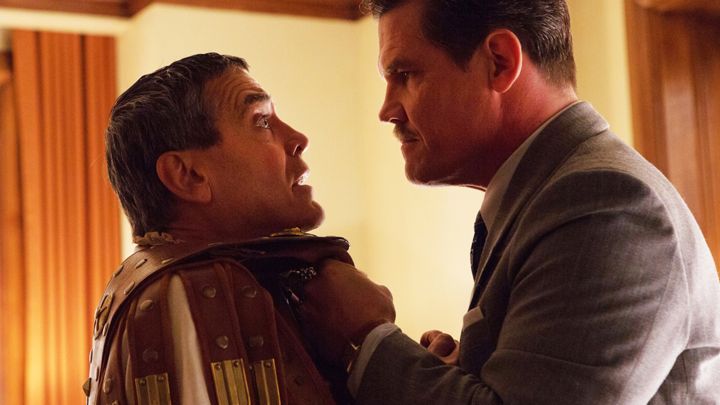
The Hollywood Tenet
or
Mannix Depressive (Art and Artifice and Commies, the Movie)
The Coen Brothers return to Hollywood (and specifically Capitol Pictures, which figured in their Barton Fink) in Hail Caesar!, their latest production and it is an all-star affair. One also gets the impression that, after toiling in the Big Studio fields for awhile, it is also something of a purge for the film-making brothers. Because, however much they love movies and making movies, the business of movie-making turns the love bittersweet and sour.
Hail Caesar! has both those aspects in mass (entertainment) quantities. It looks gorgeous—it's photographed by their frequent shooter Roger Deakins and pops with technicolor hues. The movie stops dead in its momentum for a couple of giddy production numbers: one featuring Scarlett Johansson as an Esther Williams-type who's America's sweetheart, so much so that she's pregnant and not sure who the father is; there's a sailors-on-leave song and dance number front-lined by Channing Tatum that's so clever and choreographed so well it rivals the M-G-M dance numbers in their zenith. It's great Hollywood-style stuff, and the movie perks up a hundred-fold when those sequences, however ironic they are, happen on-screen.

But, they're small parts—the tent-poles that keep up the fabric of the movie, serving the same functions as the numbers did in the old musicals. The trouble with Hail, Caesar! is the fabric those tent-poles are supporting is pretty saggy, a bit tattered, and is constructed of barely held together parts, like a bad quilt. It's a good idea for a movie—showing the artifice that goes on behind the curtains of art. It's been done before, this showing of how glittery sausage is made (whether Day of the Locust or The Last Tycoon or The Big Knife or The Bad and the Beautiful and its European cousin Two Weeks in Another Town), and what they all say is the same old saw, the movies are great, they make you feel good, but the behind-the-scenes of the manufactured beauty and quest for perfection is pretty ugly and cut-throat.

"Yeah, yeah, sure it is, Mr. critic. Can we see the movie, please, instead?" That's the problem: the fantasy is so much more compelling than seeing how it got that way. It's the problem with all the other movies; it's the problem with Hail, Caesar!, too. We're so in love with the movies, we just don't care what goes on behind the scenes, despite the tabloids. We dig the illusion, want to believe in it. Klieg lights blind us, sure, but we're attracted to them like moths to a flame.

It is 1951. Eddie Mannix* (Josh Brolin), an executive with Capitol Pictures, goes to confession—the second time in twenty-four hours, much to the weariness of the priest on the other side of the screen, the father who must bless him for he has sinned. Seems he's been sneaking cigarettes after telling his wife that he'd quit, and he's heartily sorry. Not sorry enough that he'll change, but sorry enough that he'll be back at the confessional in another 24 hours. But, it is a good show of remorse, nonetheless. A couple "Hail Mary's" will solve it.
So, give unto Mary what is Mary's and give unto Caesar what is Caesar's. Back to work. A check of his watch—he's got a meeting. Eddie has time management almost down, despite working 18 hour days for the studio. First stop after the confessional is getting to a house pre-dawn to nix one of Capitol's starlets from making questionable modeling choices ("She's young, she needed the money") before the cops bust in and cause a tabloid scandal. Next, back at the studio, is a phone call from Capitol's President, Mr. Skank, to tell him that, rather than put another more expensive star in its place, he wants to cast Capitol's rootin'-tootin' cowboy star, Hobie Doyle, (Alden Ehrenreich, who's a real find, like Johnny Depp's dimmer little brother) as the lead in a sophisticated drawing room comedy "Merrily We Dance." **

Yes, boss. Sure, boss. Next up is a summit of LA religious leaders (Catholic, Protestant, Greek Orthodox, Jewish) about their "respectful, serious" religious drama "Hail, Caesar!" There is much debate, much doxology, but the Truth of the matter is that it's Capitol's most expensive film in production and headlines Capitol's biggest star Baird Whitlock (George Clooney). The purpose of the meeting is to ensure that, after reading the script,*** they will give their approval and not protest the film at its opening, which they grudgingly agree to as long as "there is no portrayal of the godhead."

That over, Mannix visits Capitol's aquatic musical star DeeAnna Moran (Johansson) who's got a serious case of the hormones and is distressed (no, "pissed" would be the word) that she may be getting too big for her mermaid's tail. She's pregnant, not sure who the father is, and wants to keep the baby without anybody finding out that...well, that she's pregnant and not sure who the father is. Hey, call back the earlier ecumenical council and they might suggest "Immaculate Conception," (but think of the pressure on the kid!).

"Hail Caesar!" (the movie within the movie) has a lot riding on it. So much so, that the biggest problem for Mannix to solve is when Whitlock, its star, is kidnapped for ransom by a group called "The Future." Fending off twin-sister gossip columnists (both played by Tilda Swinton) who want the story, Eddie must get Baird back and keep the movie in production, while also talking to the Lockheed corporation about taking a corporate job with them. The pitch from the aerospace boys is that Lockheed is the future—they just had a hand in doing the latest H-bomb test, something far more important than the trivial glamor of Hollywood.

Mannix is conflicted. He spends 18 hours a day managing that trivia and the Lockheed job would, supposedly, cut that time that could be spent on his family. And that job has more "real" use than the manufacturing of fantasy. But, it's the '50's. America has just come through a devastating war that decimated humanity and displayed the worst that human beings are capable of. And now, America is in a propaganda war (and a potential devastating real war) with the forces of communism—and impacts him with Union negotiations and a vocal group of screen-writers who see no profit from their work (save for a pay-for-hire salary)—and America needs that fantasy of glamour and the potential for the best things in life to inspire the American populace to turn the wheels of Industry. Isn't that important, too?

Wellllll....this all makes Hail, Caesar! sound more important than it is. It's one of the least of the Coen Brothers movies, feels less fully formed, and more scattered, and with less of an over-arching theme. Even if they make you grasp for it, you usually get the sense from them, that there's an important thesis to their works, but this—this just feels trivial (appropriately, I guess). And speaking of trivial, if you're going to see this for Scarlett Johansson or Channing Tatum or Jonah Hill or Ralph Fiennes, they have glorified cameo's, single scenes, actually. They're good ones, but they're basically guest stars here. Most of the movie is spent on Brolin, Clooney and Ehrenreich and the rest are...atmosphere? Padding?

And the best part of the movie (besides those musical numbers and the sharply written meeting with the clerics) is the Coen's playing around with History—specifically with the role the Communist Party played in 1950's Hollywood. What they imagine is Joe McCarthy's worst nightmare: that the Hollywood Ten was more than a bunch of barking chihuahua's just trying to find work and WERE actively agents for the Soviet Union, trying to subvert the government and planning an imminent attack. Maybe that work with Spielberg on Bridge of Spies gave them the inspiration, and they transplanted a bit of the director's 1941 into the mix for some subversive spice. It amuses me to think so.
But, it's not quite there; it is a couple sub-plots and connecting tissue short of a good movie...well, actually a good Coen Brothers movie (which usually is better than most movie-product these days). Even if you exit one, depressed by the story or the negative or nihilistic conclusions, you still walk out knowing you've seen something fully formed and solid—a well-conceptualized and realized project. Hail Caesar! isn't that, though. It's a good idea for a movie, and great to look at, but not very satisfying to watch, despite the efforts made to produce it. The craft does not add up to content.
Maybe those commie screenwriters are right. If it wasn't for them...you might get a movie like this one.

 * Eddie Mannix. He really existed, but not the way he is in the movie. Mannix was a "fixer" for M-G-M, a problem-solver, the studio plumber fighting leaks. It was his job to keep the product safe, making the actors look good in the press, keeping the workers in line, feeding stories to the gossip columnists while keeping them away from ones that would harm the studio's product, and thus, the studio. Mannix worked for M-G-M from 1923 to 1962, working his way up to general manager and vice-president (an apt title given his activities). Mannix worked the press and the LAPD to keep M-G-M's "more stars than there are in the Heavens" out of the scandal sheets and was very successful doing it. He was Roman Catholic. He was not a family man, allegedly conducting many affairs during his lifetime, was married twice, and rumors swirl about how he actually wielded his power, and his most notorious rumor is that he may have had something to do with the "suicide" of George Reeves, TV's "Superman," who had just broken off an affair with Mannix's socialite second wife. The Coen's conception of Mannix is primarily fiction, because Mannix was as good as keeping his own secrets as he was with others'.
** John Wayne once told Dick Cavett he'd always wanted to do a Noel Coward play, but "I guess they figured spurs and 'Blithe Spirit' wouldn't go together."
*** Which is generally approved with one exception—"The jumping between chariots...is a little 'fakey.'"
 |
| Robert Taylor in Quo Vadis. Look familiar? |

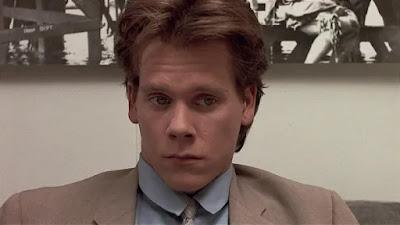 Budding film-maker Nick Chapman (Kevin Bacon) is "hot", having just won a film-making competition and given the opportunity to pitch ideas for "projects." Taking a meeting with studio producer Alan Habel (J.T. Walsh) gives him flashing hope until Habel wants to make changes to his ideas more in line with Habel's peccadilloes. Then, there's the "Catch-22" of not having an agent—he can't be taken seriously without one but can't get one until he's taken seriously. So, he takes a lunch with a prospective agent (Martin Short), more interested in being seen than seeing what he can do.