We looked at Chris Sanders' new film, The Wild Robot, yesterday, so here's a look at one of his previous efforts, written at the time of the film's release.
It should be noted that How to Train Your Dragon has gone on to have two sequels, five shorts based on it, and a live action remake scheduled for late next year that will star Gerard Butler—one of the voices of the first one! (Is that a first? Does James Earl Jones in both versions of The Lion King count? Yeah, I guess it does.)
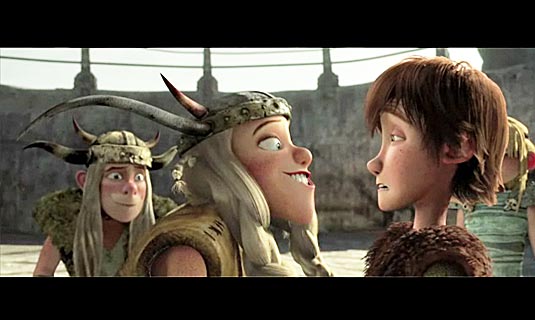
"Dragon Everyone to Your Level" Okay, it's "Old Yeller" done in fire-breathing naugahyde. It's a kid's animation movie, so it's going to be fast-paced, lively and have a "Can't We All Just Get Along" ending (in a creepy Rumsfeldian "the enemy of my friend/enemy is also my enemy" way). The casting is terrific, especially of Craigy Ferguson as a Viking machinist (Wait a tick...Vikings were Scottish?). Gerard Butler has the role of father to the protagonist and plays it as if he was always pointing to Sparta on a map. Jay Baruchel (the star of She's Out of My League) does voice-cracking wonders with the voice of our hero, Hiccup, who is just not Viking material, but manages to subdue—even win the trust of—a dragon (seems the flying butane-breathed lizards have traits just like house-dogs and cats). Still, keep the extinguisher handy in case of fur-balls.
No points toHow To Train Your Dragonfor originality (as I haven't read the book, I don't know if that's where the problem flies, but I suspect it's merely that DreamWorks animations—2-D or 3-D, line or pixel—are so formulaic in construction at this point, splicing pop-culture and source, that they have a tendency to blend together at the same point in time as your eyes cross—is this a Katzenberg trait?). There's always an out-of-time attitude displacement to these things where every character has the traits of a stand-up comedian and the homogenized values of a sit-com, that you have to keep reminding yourself—"Viking, Vikings, Vikings."
However, major points for execution. The technology of these things increases with one being released every six months, and How To Train Your Dragon has a nifty design scheme that reminds one of impossibly constructed children's play sets—the Viking village is the niftiest little chock-a-block city since "Sweethaven" in Robert Altman's Popeye. The dragons are cartoon lunacy out of Tex Avery and the full-blown Vikings, like Hiccup's Viking-father, Stoick, are madly out of proportion humans who'd wobble and flail if there weren't some pen-and-ink gravity keeping them up-right and bounding.
Conversely, the other extreme is impressive, as well. The look of clouds and ocean waves has never looked more real—the look of coastal waters has never seemed more real, whatever coding and algorithms used to simulate the wave action are spot-on and indistinguishable from photo-realism. I saw How to Train Your Dragon in 2-D, but the 3-D must be quite impressive, it certainly was in Monsters vs. Aliens, and there seemed to be no over-loading of nose-brushing effects that has been the bugaboo of the process.
All around it's a satisfying effort that will please the kiddies, and provides enough entertainment value to keep adults from nodding off, or rolling their eyes. The cookie-cutter nature of the plot is the only thing that keeps it from being an absolute must-see.
But,
ask a farmer about global warming and they get serious. Or a gardener.
They've seen the time-shifts. They've seen annuals sprout too early.
Crops lose their "window" and you compensate by shifting the planting earlier, risking the
prospect of freezing. They know. You can't count on the Earth anymore.
You can't count on anything...except maybe on one hand the number of
friends you have that actually might be sane.
It
used to be "If You Don't Stand For Something, You'll Fall for Anything."
Now, with the internet the harder you stand, you'll fall even harder.
So, with that little sanctimony out of the way...what's the scoop onDon't Look Up, Adam McKay's look at "problem-solving" in a modern "connected" world?
McKay's conceit is to look at the "climate change" debate in a metaphorical way—what if we knew an "extinction-level" sized body was going to hit the Earth and we couldn't depend on our leaders, political or business, to save us for any reason?
Michigan State doctoral candidate Kate Dibiasky (Jennifer Lawrence) is spending a quiet night at an observatory studying trace gasses in dead galaxies for Astronomy Professor Dr. Randall Mindy (Leonardo DiCaprio) when she sees something weird on the screen. It's a comet...and it's moving. Mindy is called and he and his grad students celebrate what will be the Dibiasky Comet, and start working the orbital path...when Mindy starts to get nervous and tells all the other students to go home. Except for Kate. She sees what he saw: that the comet is heading for Earth. It's 5-6 km long and it will hit Earth in 6 months and 14 days. Call it 26 weeks.
They call NASA, who conference calls them in with Dr. Teddy Oglethorpe (Rob Morgan) of the Planetary Defense Coordination Office. The link says it's real. And shit just got real; Oglethorpe mutters "that's a big boy" and then goes quiet when he realizes it signals "an extinction-level event." And while NASA advises caution, Oglethorpe orders a plane to bring Mindy and Dibiasky to the White House to tell the President. Dibiasky sees the Oval Office through an open door and grabs Mindy: "Are we really about to tell the President of the United States that we have just over six months until humankind—basically every species—is completely extinct?" Getting a shaky affirmative, she promptly throws up in an executive waste-basket.
They're kept waiting for seven hours because the Executive Branch is in crisis mode: their nominee for Supreme Court justice has been revealed to be a pervert. Coming back the next day, they're given 20 minutes to explain what's going on and it doesn't go well: Mindy is nervously hyperventilating and that's off-putting to the coke-head Chief of Staff (Jonah Hill), who got the job because he's the President's son. The President (Meryl Streep) is a hot mess, unable to focus on the potential disaster for need of a smoke, and saying that the timing of this "is atrocious" (mid-terms). She cuts to the chase: "What's the 'ask' here?" "Save us" is the reply. The decision is made to have "her people" look into it and "Sit tight and assess."
The three scientists can't believe it—they only have six months—so, they decide to take it to the press, the Washington Herald, who sets up a segment on it at the end of "The Daily Rip" (hosted by shiny anchors played by Tyler Perry and Cate Blanchett) after a segment on the disasterous Supreme Court pick and then on the break-up of two "important" pop stars (Ariana Grande and Scott Mescudi). Warned that they don't have "media training" Dibiasky and Mindy have trouble negotiating the happy banter of the hosts until Dibiasky cracks and melts down on-camera: "Are we not being clear? Maybe the destruction of the entire planet isn't supposed to be FUN! Maybe it's supposed to be terrifying." The hosts are affronted. That's just bad form. And bad television. Dibiasky becomes a snarky meme, and interest in the Herald's story on the internet drops like a comet from the sky. So, they stop covering it.
But, because they've gone on national TV with national secrets Dibiasky and Mindy are arrested by the FBI, and the White House has to scramble. President Orlean goes on television in an elaborately staged event on a naval vessel to announce an emergency spending bill to launch a space mission to try and blow up the comet—a space mission that is manned by a single astronaut (Ron Perlman) because "Washington needs a hero." All well and good until a cell-phone/tech pioneer, Peter Isherwell (Mark Rylance), is told by his team that the comet is a source of Earth-depleted minerals that are critical for making cell-phones. The mission is scrubbed—he's a big donor to the President's campaign—and another mission is planned to break up the comet and have it's pieces fall into the Pacific so they can be recovered and resourced.
One sees the point: nobody is going to do anything about it while there's time enough for people to figure out a way to make money from it, because that's the only "killing" they're concerned about. If there was a way to take carbon out of the atmosphere that wasn't deemed fiscally expensive and would make a fortune, we'd be worrying, instead, that there was too much ice at the poles, rather than selling our waterfront property. Don't Look Up merely converts that to the disaster scenario of Armageddon—at times the movie looks like Michael Bay's "this would look great in a car commercial" style of film-making—or Deep Impact.
The satire veers all over the place, sometimes sharp (of course people wouldn't believe it until they saw it with their own eyes, and, of course, a television chat show would cock up such news and, of course, a screaming fit on-air is going to be dismissed and the stuff of internet jokes) and heavy-handed (the political stuff is baldly aimed at the last administration, with the difference being that the Orlean team look a bit more competent and decisive). It falls somewhere between Hitchhiker's Guide to the Galaxy smart and Tropic Thunder dumb without ever achieving Dr. Strangelove brilliance. One grimly concedes McKay's aiming for the fences but he sometimes gets distracted by his own gee-wizardry and sarcastic weltschmerz to score a home-run.
Some of it is performance issues: Perry and Blanchett are rather one-note, but that seems appropriate for chat hosts. Hill's performance is as obnoxious as it's supposed to be, but Streep wears her tweet-hurt a bit too far, although it is reminiscent of Sarah Palin-subtlety. DiCaprio tries to achieve his Wolf of Wall Street comedic heights at times and falls short, but impresses in his dramatic scenes. Lawrence is terrific as the audience stand-in for expressing incomprehension and Rob Morgan stays out of comedy territory completely and frequently becomes a life-raft of reason. Best of all is Mark Rylance, who makes his tech entrepreneur suggestive but not an imitation, with just the right touch of Asperger's, child-like wonder, and child-like malice.
The reviews for Don't Look Up have been horrible, accusing McKay of condescension and being supercilious—social critics usually are—and there's a whiff of that here. But, there's also an earnestness that his heart is in the right place, if slightly broken, railing like a mad prophet to an ignoring, apathetic crowd. Despite the brickbats, I found myself enjoying it much more than I suspected I would, recognizing its weaknesses but appreciating the strengths.
Now, about the message. Maybe by clothing "climate change" in a more direct disaster scenario is too subtle. There is a scene in the last season of "The Newsroom" ("Main Justice" Season 3 Episode 3) where there's an interview with a scientist from the EPA who has been prevented from issuing an alarming report about the environment (involving CO2 levels measured in Hawaii), and when asked to sum up the findings replies "a person has already been born who will die due to catastrophic failure of the planet" The anchor is taken aback and tries to walk it back to a less alarming conclusion, "Let's see if we can find a better spin...people are starting their weekends."
There isn't one. The only counter-argument is denial and that's just deflection and a stall to action. And we're doomed anyway. It's funny and it's a gut-punch. A sick joke that punches right in the nose.
On the much grander scale of things—pale blue dot-wise—cosmic catastrophes happen all the time—we just haven't heard about it since we haven't gotten television from there (yet)...because it's a messy Universe, despite all the space. We postulate the supernovas, the gravity collisions, but cannot grasp the implications, like imagining what happens to an ant colony when developing condo's. But, think of it in the "if Helen Keller fell down in a forest, would she make a sound" kind of way: "What if there was a cataclysmic event, and nobody did anything about it?"
The cosmic punch-line is "They deserved their fate."
Bruce Almighty was a gently humanistic take (more like the director's Liar, Liar and Patch Adams, than his anarchic Ace Ventura, Pet Detective) on God and Godliness, a bit like having your eucharistic wafer and abstaining from it, too. Jim Carrey, a frequent Shadyac collaborator, played Bruce Nolan, a rubberly-mobile human interest TV reporter who's became tired of reporting fluff and covets the anchorman's chair. Thinking his lot being...well, like Lot's (or Job's), he blames God for his sorrows, despite having Jennifer Aniston as his supportive live-in girlfriend, a brownstone in New York, a dog who loves him, and—dare we say it—a cushy goddamn reporter's job!
Not only that, God actually answers his prayers. And not just any God, it's God in the form of Morgan Freeman (type-casting, admit it), the most denominationally-friendly choice for the role, other than Eric Clapton. Bruce Almighty delivered a lot of laughs. Carrey was not so much over-the-medication that he was funny, rather than alarming, and the feel-good message of "we're all just a little bit God" is just theologically mushy enough to satisfy everyone from the self-flagellators to the shakra zulu's....and keep the picketers at bay.
Parting of the tomato soup
But one does wonder: a look at the DVD's "Special Features" shows a definite softening of the material. Carrey with "God" powers goes a bit "Old Testament" in the out-takes, including a sequence that would have fit right in with The Mask featuring Divine Intervention with some car-jackers, some extreme "if-it-bleeds-it-leads" stories, and the further torturing of Steve Carell's rival anchor Evan Baxter, that includes setting his hair on fire during a newscast. Not quite so heart-warming. It would have tilted the film a little bit into the zany/cruel category, that might have upset the Faithful. Still, it's a fun-film that is genuinely funny, and does have its heart in the right place.
So, what in Hell happened to Evan Almighty? There were reports of problems, that the film went waaaaaaaay over-budget, threatening to turn it into the most expensive comedy ever made, and, of course, where Carell was featured only briefly (and brilliantly) in Bruce, it was his cross to bear to stand in for Jim Carrey for the sequel. Carell is an incredible talent who can—actually—cross the territories between comedy and drama and do so credibly—given the right material. But he's not good at everything. Bruce Almighty showed a gift for slapstick—his Tourette's news-anchor was one of the funniest things in it, but he's at his best as a low-energy Buster Keaton, standing stone-faced while the house falls around him. Evidently having everything that can possibly go wrong in the "Noah" scenario didn't result in a laugh riot. There are just so many poop jokes you can wring out of the "ark."
As an experiment, I have had folks who have seen Evan Almighty—and not found it funny—sit through Bruce Almighty and howl. Comedy is, of course, subjective, and what will work in one movie doesn't necessarily work when done again. But,to have such disparate reactions?
So, Evan Almighty is just genuinely un-funny.
Isn't there a Bible story about going to the well one too many times?
We, as movie-goers (and parents) have had to suffer through two liveaction adaptations of beloved Dr. Seuss books, that took them, stretched them to ungainly proportions making them loud and obnoxious, tossed in the obligatory fart and sex jokes with self-indulgent Jim Carrey and Mike Myers performances, and probably, most egregious of all, drained as much of the Seussian outlandishness in design to make it all work in a "real" world. I'm looking at you, Ron Howard, and Bo Welch! You destroyed my childhood!!*
Actually, what they did was make crappy films out of very good, inspiring source material. It takes some real lack of talent to do that. The Seuss estate has tried mightily to make who-hay out of the Good Doctor's (real name: Theodore Geisel-RIP) post-war output**with their web-sites and Broadway seussicals and elephantine films, and have been largely successful, ca$h-wise, even if their value as far as representations in other media have been failures.
Somebody must have realized that, because someone had the wise idea to return Geisel to the medium to which he has successfully worked in the past—animation***A brilliant idea that, if a no-brainer, and it will hopefully save the rest of the Seuss library from destruction at the hands of auteur's with big budgets and few ideas. Imagine what Pixar could do with a Seuss film?**** As it is, Horton Hears a Who! was in good hands with the Ice Agecrew--they seem, in sensibility, the ones who are studying the Looney Tunes model for making animated entertainment, and the resulting film, though stretching the premise to its breaking point, is never less than entertaining, and frequently fiendishly brilliant in how it has represented Seussian ideas and concepts.Okay, the casting is a bit top-heavy. Jim Carrey is the elephant in the room, but he's just as adept at vocal gymnastics and although Horton now seems to be on a perpetual coffee jag, it gooses the pace of the material in a not-inoffensive and practical way. The fact that he isn't "live" and stuck in some faux-Seuss costume probably helps restrain him, as well. Steve Carrell, who one worries about how far he can stretch, is equally good as the bumbling mayor of Who-ville who has trouble making his presence known just about anywhere. Here's perfect casting--the "concerned mother kangaroo" who becomes increasing strident to "protect the children"--Carol Burnett. Seth Rogan is there and Will Arnett, but I doubt folks will be clamoring to see the movie because of them--the voice-casting is spot on, with only one possible exception. The somewhat unctuous narration is by CBS Neuss' Charles Osgood--possibly Dr. Seuss's biggest fan. He's fine. But his warm, soothing tones seems to be assuring the entire time that everything will be all right, and that everything is lovely, when what is needed is a voice that has some grit in it--which is why Boris Karloffas the Narrator for the animated "Grinch" was such a brilliant stroke. And the design--the design of the thing is beautiful and so Seuss. It would take another viewing (or three) to see all the details and great ideas (and Seuss in-jokes) filling the frames. Fortunately, the film is good enough to bear up to repeat viewings. And it does one brilliant, little snarky thing: It co-opts a 70's rock-ballad to make fun of most cartoons' tendencies to end with a heart-felt song. It's hilarious. Dr. Seuss was not only employed to help kids read, he wrote his stories to make kids think. "Horton Hears a Who" was written as a plea for tolerance in an intolerant time,***** and its message "A person's a person no matter how small" has been co-opted by the anti-abortion crowd--Mrs. Dr. Seuss was quite miffed when the premiere was disrupted by chanting protesters, whereas the good Dr. would have tried to kick their collective asses (he threatened to sue one group for using the quote on their stationary)--and this movie is full of messages for all to read into. There's a climate change theme, there's the intolerance theme, there's the "be-yourself" theme, the "tyranny of the mob" theme, the impotent figurehead-non-democratic council-strength in numbers democracy theme, the "make yourself heard" theme, and the fact the mayor has 97 children (96 girls and 1 boy) and uses a timer to allocate only so many seconds of attention to each should say something to somebody. It tends to put a fuzzy edge to "I meant what I said, and I said what I meant"
But Dr. Seuss'Horton Hears a Who! is faithful. Almost 100%.
* Well, not really, but I've always wanted to write that, seeing as how so many "chat-room fan-boys" out there have written the phrase every time somebody has done something that doesn't fit into their limited "world-view." It's the semi-adult version of stamping your little foot. Frankly, I'd rather they held their breath until they turned blue.
**We won't see anything done with Private Snafu--with which he collaborated with the Termite Terrace crowd--that would make an interesting law-suit if Warner Brothers decided to cash in on the Seuss name--or some of his more racy material.
**** Jimmy Hayward, who along with Steve Martino, directed Horton... was a Pixar animator.It's their first feature...well done.******
***** Geisel was a leftist--but his buzzard Vlad Vladikoff, is surely Soviet-based, and, supposedly the Wikersham Brothers--the ape-boys (who are animated splendidly in this) are based on Sen. Joseph McCarthy.
****** Cool! The asterisks get an asterisk. As a post-script, the two directors took wildly divergent paths: Jimmy Hayward went to live-action, where he directedJonah Hex (anybody remember that one? John Brolin as DC's disfigured western anti-hero? Didn't think so); Martino stayed with animation, supervising the "Ice Age" franchise and directing the rather lovely new Peanuts movie.
Okay, everybody has to mess with the material in some way (Clampett's cartoon had a fish that looked like Peter Lorre shooting its brains out), and this is how Martino and Hayward mess with this version—but it's so weird I like it.
The Hollywood Tenet or Mannix Depressive (Art and Artifice and Commies, the Movie)
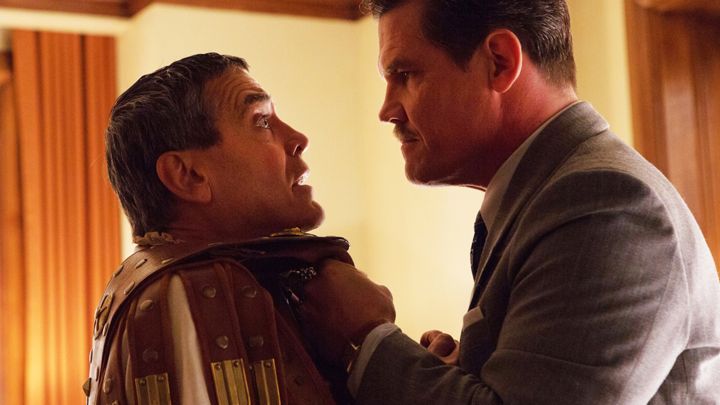
The Coen Brothers return to Hollywood (and specifically Capitol Pictures, which figured in their Barton Fink) inHail Caesar!, their latest production and it is an all-star affair. One also gets the impression that, after toiling in the Big Studio fields for awhile, it is also something of a purge for the film-making brothers. Because, however much they love movies and making movies, the business of movie-making turns the love bittersweet and sour. Hail Caesar! has both those aspects in mass (entertainment) quantities. It looks gorgeous—it's photographed by their frequent shooter Roger Deakins and pops with technicolor hues. The movie stops dead in its momentum for a couple of giddy production numbers: one featuring Scarlett Johansson as an Esther Williams-type who's America's sweetheart, so much so that she's pregnant and not sure who the father is; there's a sailors-on-leave song and dance number front-lined by Channing Tatum that's so clever and choreographed so well it rivals the M-G-M dance numbers in their zenith. It's great Hollywood-style stuff, and the movie perks up a hundred-fold when those sequences, however ironic they are, happen on-screen.
But, they're small parts—the tent-poles that keep up the fabric of the movie, serving the same functions as the numbers did in the old musicals. The trouble with Hail, Caesar! is the fabric those tent-poles are supporting is pretty saggy, a bit tattered, and is constructed of barely held together parts, like a bad quilt. It's a good idea for a movie—showing the artifice that goes on behind the curtains of art. It's been done before, this showing of how glittery sausage is made (whether Day of the Locust or The Last Tycoon or The Big Knife or The Bad and the Beautiful and its European cousin Two Weeks in Another Town), and what they all say is the same old saw, the movies are great, they make you feel good, but the behind-the-scenes of the manufactured beauty and quest for perfection is pretty ugly and cut-throat.
"Yeah, yeah, sure it is, Mr. critic. Can we see the movie, please, instead?" That's the problem: the fantasy is so much more compelling than seeing how it got that way. It's the problem with all the other movies; it's the problem with Hail, Caesar!, too. We're so in love with the movies, we just don't care what goes on behind the scenes, despite the tabloids. We dig the illusion, want to believe in it. Klieg lights blind us, sure, but we're attracted to them like moths to a flame.
It is 1951. Eddie Mannix*(Josh Brolin), an executive with Capitol Pictures, goes to confession—the second time in twenty-four hours, much to the weariness of the priest on the other side of the screen, the father who must bless him for he has sinned. Seems he's been sneaking cigarettes after telling his wife that he'd quit, and he's heartily sorry. Not sorry enough that he'll change, but sorry enough that he'll be back at the confessional in another 24 hours. But, it is a good show of remorse, nonetheless. A couple "Hail Mary's" will solve it.
So, give unto Mary what is Mary's and give unto Caesar what is Caesar's. Back to work. A check of his watch—he's got a meeting. Eddie has time management almost down, despite working 18 hour days for the studio. First stop after the confessional is getting to a house pre-dawn to nix one of Capitol's starlets from making questionable modeling choices ("She's young, she needed the money") before the cops bust in and cause a tabloid scandal. Next, back at the studio, is a phone call from Capitol's President, Mr. Skank, to tell him that, rather than put another more expensive star in its place, he wants to cast Capitol's rootin'-tootin' cowboy star, Hobie Doyle, (Alden Ehrenreich, who's a real find, like Johnny Depp's dimmer little brother) as the lead in a sophisticated drawing room comedy "Merrily We Dance."**
Yes, boss. Sure, boss. Next up is a summit of LA religious leaders (Catholic, Protestant, Greek Orthodox, Jewish) about their "respectful, serious" religious drama "Hail, Caesar!" There is much debate, much doxology, but the Truth of the matter is that it's Capitol's most expensive film in production and headlines Capitol's biggest star Baird Whitlock (George Clooney). The purpose of the meeting is to ensure that, after reading the script,***they will give their approval and not protest the film at its opening, which they grudgingly agree to as long as "there is no portrayal of the godhead."
That over, Mannix visits Capitol's aquatic musical star DeeAnna Moran (Johansson) who's got a serious case of the hormones and is distressed (no, "pissed" would be the word) that she may be getting too big for her mermaid's tail. She's pregnant, not sure who the father is, and wants to keep the baby without anybody finding out that...well, that she's pregnant and not sure who the father is. Hey, call back the earlier ecumenical council and they might suggest "Immaculate Conception," (but think of the pressure on the kid!).
"Hail Caesar!" (the movie within the movie) has a lot riding on it. So much so, that the biggest problem for Mannix to solve is when Whitlock, its star, is kidnapped for ransom by a group called "The Future." Fending off twin-sister gossip columnists (both played by Tilda Swinton) who want the story, Eddie must get Baird back and keep the movie in production, while also talking to the Lockheed corporation about taking a corporate job with them. The pitch from the aerospace boys is that Lockheed is the future—they just had a hand in doing the latest H-bomb test, something far more important than the trivial glamor of Hollywood.
Mannix is conflicted. He spends 18 hours a day managing that trivia and the Lockheed job would, supposedly, cut that time that could be spent on his family. And that job has more "real" use than the manufacturing of fantasy. But, it's the '50's. America has just come through a devastating war that decimated humanity and displayed the worst that human beings are capable of. And now, America is in a propaganda war (and a potential devastating real war) with the forces of communism—and impacts him with Union negotiations and a vocal group of screen-writers who see no profit from their work (save for a pay-for-hire salary)—and America needs that fantasy of glamour and the potential for the best things in life to inspire the American populace to turn the wheels of Industry. Isn't that important, too?
Wellllll....this all makes Hail, Caesar! sound more important than it is. It's one of the least of the Coen Brothers movies, feels less fully formed, and more scattered, and with less of an over-arching theme. Even if they make you grasp for it, you usually get the sense from them, that there's an important thesis to their works, but this—this just feels trivial (appropriately, I guess). And speaking of trivial, if you're going to see this for Scarlett Johansson or Channing Tatum or Jonah Hill or Ralph Fiennes, they have glorified cameo's, single scenes, actually. They're good ones, but they're basically guest stars here. Most of the movie is spent on Brolin, Clooney and Ehrenreich and the rest are...atmosphere? Padding?
And the best part of the movie (besides those musical numbers and the sharply written meeting with the clerics) is the Coen's playing around with History—specifically with the role the Communist Party played in 1950's Hollywood. What they imagine is Joe McCarthy's worst nightmare: that the Hollywood Ten was more than a bunch of barking chihuahua's just trying to find work and WERE actively agents for the Soviet Union, trying to subvert the government and planning an imminent attack. Maybe that work with Spielberg on Bridge of Spiesgave them the inspiration, and they transplanted a bit of the director's 1941 into the mix for some subversive spice. It amuses me to think so. But, it's not quite there; it is a couple sub-plots and connecting tissue short of a good movie...well, actually a good Coen Brothers movie (which usually is better than most movie-product these days). Even if you exit one, depressed by the story or the negative or nihilistic conclusions, you still walk out knowing you've seen something fully formed and solid—a well-conceptualized and realized project. Hail Caesar! isn't that, though. It's a good idea for a movie, and great to look at, but not very satisfying to watch, despite the efforts made to produce it. The craft does not add up to content. Maybe those commie screenwriters are right. If it wasn't for them...you might get a movie like this one.
* Eddie Mannix. He really existed, but not the way he is in the movie. Mannix was a "fixer" for M-G-M, a problem-solver, the studio plumber fighting leaks. It was his job to keep the product safe, making the actors look good in the press, keeping the workers in line, feeding stories to the gossip columnists while keeping them away from ones that would harm the studio's product, and thus, the studio. Mannix worked for M-G-M from 1923 to 1962, working his way up to general manager and vice-president (an apt title given his activities). Mannix worked the press and the LAPD to keep M-G-M's "more stars than there are in the Heavens" out of the scandal sheets and was very successful doing it. He was Roman Catholic. He was not a family man, allegedly conducting many affairs during his lifetime, was married twice, and rumors swirl about how he actually wielded his power, and his most notorious rumor is that he may have had something to do with the "suicide" of George Reeves, TV's "Superman," who had just broken off an affair with Mannix's socialite second wife. The Coen's conception of Mannix is primarily fiction, because Mannix was as good as keeping his own secrets as he was with others'.