Showing posts with label 2016. Show all posts

Saturday, October 19, 2024

The Neon Demon

It's still October, still Hallowe'en month, and today is "Take Out the Trash" Day. But, instead of a trash-bag, this garbage has a highly stylish wrapping. It's still garbage, though.

The Neon Demon
(Nicolas Winding Refn, 2016) I remember this hitting theaters and purposefully not seeing it for a couple reasons—1) it was directed by Nicolas Winding Refn, whose Drive I found half-baked and a bit pretentious (looked nice, though...) and 2) because it was getting a reputation for being "sick"—never a good word-of-mouth for me. And its star was 16 year old Elle Fanning, whose acting I've found competent but not compelling. The fledgling Amazon Studios bought it for distribution and that signaled to me that if I missed it in theaters, it would show up—and quickly—in their streaming service.
 
It did. But I never watched it. That's on me, not the film.

I occasionally do podcasts where the host, guests, and I talk about movies—they being articulate, me being hesitant, umming and uhhhing and nattering on until I forget the point of what I was saying (Thank God for editing!) and The Lambcast had me scheduled for one of their Movie of the Month podcasts, where people submit films they want to talk about and it gets voted on by folks with the Large Association of Movie Blogs, the winner getting its time in the spotlight. Last March, The Neon Demon was voted to be the MOTM and I dutifully watched it, so that I might give my thoughts on it.
Those thoughts were pretty damn dark. "I hate it with the heat of a thousand suns" I recall saying. Hyperbolic that may be, but it was only a matter of degree. For Refn's film, under the guise of making a point of exploitation, only reflects that exploitation while not saying anything new, unique, or even realistic about its subject. "The Demon" that the movie tangentially and unsuccessfully tries to make some sort of analogous reference to (the title's use of "neon" suggests the city) is basically the film itself, and it's just as clumsy, despite its scrupulous framing and art direction. It's a gilt-wrapped presentation that opens to find...absolutely nothing, lovely to look at (on occasion), but hollow not only to its core, but everywhere.
Stylish—but to a fault—The Neon Demon follows the path of 16 year old Jesse (Fanning) who's come to Los Angeles following the death of her parents and the film opens with a blood-soaked static photo-shoot she's having with a photographer she's met on the internet. As it's the first thing we see, we wouldn't be surprised that Jesse is already dead, as she lies lifeless on a couch, blood dripping down her arm onto the floor. That's all that's required of her—no personality, no expression—she's just an image, a concept, a commodity to sell something (god knows what...). After, Jesse is struggling to wipe the red Karo syrup off her body and is helped by her makeup artist Ruby (Jena Malone), who doubles as a mortuary cosmetician (natch!).
♪I love L.A.♫
Through Ruby, she gets a room at a fleabag hotel (run by a sleazy Keanu Reeves in one of his "please, don't speak" roles) and an interview at a modeling agency. She falsely signs a parental consent form and is told she should answer to 19...as 18 is a little..."you know." She then starts to make the rounds of cattle-calls, where she runs into two models in particular, Gigi (Bella Heathcote)—who's all about cosmetic surgery—and Sarah (Abbey Lee)—who's all about sleeping around to get jobs. They're catty and jealous and more than a little aggressive in their judging Jesse (I mean why not, the job's all about judging), who's a neophyte, probably a virgin, and has nothing going for her except her looks...like them.
But, Gigi and Sarah are more so. After one of those casting sessions that Jesse gets but Sarah is passed over for, Jesse cuts her hand in the bathroom and is shocked when Sarah tries to suck her blood. See where we're going with this?
The toxic male gaze; the female ambivalence to it
Yeah, that's where it's going...so I'd find the nearest cut-off (believe me, there'll be plenty of that later in the movie). Refn is portraying a predatory L.A.—something I admit I've always felt deep in my bones whenever I would visit the city—where the young models must contend with the predations and the manipulations of agents, the whims of self-designated artistes, and the jealousies and resultant scorn of their competitors and its products visited upon them. The predators being both male and female, there's plenty of blame to go around.
But, the movie only works as a metaphor and The Neon Demon gets it ass-backwards. Most horror films use the horror as a metaphor for everyday life, but Demon uses real-life to get to the horror. I don't see it as spoiling anything by revealing what eventually happens, but more of a public service. In their covetousness and jealousy, Ruby, Sarah and Gigi kill Jesse in a swimming pool and eat her. That's not a euphemism or a typing error. They eat her. Apparently to consume her youth, which they want. Great metaphor, huh?
Now, we don't see this past Jesse bleeding out at the bottom of the pool, but at the next photo-shoot, during a break, Gigi hoarks up one of Jesse's eyeballs...which Sarah then eats (waste not, want not, apparently). One might "buy" this, but the fact of the matter is Jesse was...what 5'9" and weighs 54 kg (according to some Elle Fanning web-site or other) and it beggars the imagination that the two rail-thin, near-anorexic models who supposedly consumed her don't look like they've had any more caloric intake lately than what one could suck from a celery stick. Argue all you want that they probably did some purging in the meantime, but...c'mon. Ozempic couldn't have solved this one.
I mean, yuck. The Neon Demon doesn't work as body horror, metaphor, or "pieces-of-meat" societal critique and for all the professions of "the cinematography is great" that is true in only some instances throughout the film's length and even then, those images are static, stylized, and sporadic. Most times, Refn is just "getting the shot" that he can. And although I hate to use this Pauline Kael quote (because when—panning Barry Lyndon—she used it she was wrong) but sometimes it's true that a director "
isn’t taking pictures in order to make movies, he’s making movies in order to take pictures."
 
And Refn has a great future filming obtuse perfume commercials.
"The Neon Demon...only at Macy's"

Saturday, December 10, 2022

The Founder

The Founder
(
John Lee Hancock, 2005) "Build a better mouse-trap and people will beat a path to your door." That's how the old saw goes to inspire a capitalist economy. But, old saws can become rusty with the new tools of business acquisition, mergers, takeovers (hostile and non) and buy-outs. They're enough to take those better mousetraps and have their builders snapped by their own inventions.
 
Take McDonald's. The world-wide phenomenon had humble beginnings...but few locations. At the beginning, it was successful—the efficiency and fine-tuning that went into it producing Mcburgers on an industrial scale like Henry Ford's assembly lines almost insured it. But efforts to expand it fell by the way-side like so many paper wrappers due to consistency issues, as in quality control or an arbitrary change of menu on the part of the manager. The originators—Richard and Maurice McDonald—could manage their one San Bernardino location. But, out of sight/out of managerial control was the order of the day. Without the McDonald boys riding herd, the others were the Wild, Wildly Unprofitable West.
Which is when Ray Kroc (Michael Keaton) wanders into town. John Lee Hancock's peripatetic little film tells the story of how Kroc made a multi-national corporation out of a hamburger stand and created an empire that straddles the oceans with golden arches. Kroc starts the film out as a salesman for "5-spindle" milkshake mixers for the company Price Castle. We watch as he goes down the road, lugging his mixer sample going from drive-in to drive-in, delivering his message of positivity and opportunity: "You increase the supply, and the demand will follow... Increase supply, demand follows. Chicken, egg. Do you follow my logic? I know you do because you're a bright, forward thinking guy who knows a good idea when he hears one."
But, even Ray is starting to sour on it, as he goes from crappy drive-in to crappy drive-in where the service is shoddy, the wait is frustrating, and the scenery is a bunch of JD's hanging out with nothing better to do. He props up his no-sales attitude with "Power of Positive Thinking" motivational records until he follows up an order for eight of his multi-spindle milkshake mixers at a location in San Bernardino, California. What he sees is different. People are lining up to get food. He goes up to a window, orders a burger, fries and a shake, all for 35¢...and it's given to him right there right then. "What's this?" "It's your food." Knife, fork? Nope. Just eat it. Where? "Anywhere you want."
Ray is dazzled, not only by the efficiency, but also the line of people who get served pretty darn quick. He goes to meet the managers Dick (Nick Offerman) and Mac (John Carroll Lynch), who are only too proud to show him their set-up (and grateful for the mixer order being delivered), but also are dying to tell him their story of failure after failure...movie theaters, other restaurants...until they came up with the formula, their "Speedee Service System" a designed, engineered, even choreographed assembly line that guarantees a steady supply of product with no customer-waiting and an iron-grip on quality control that ensures cleanliness of the facility and consistency of product.
Kroc is besotted with the earning possibilities of the restaurant and spends his return trip thinking up angles. The McDonald's formula is basically set-and-forget and is a money-maker and he wants in. But, these guys, the McDonalds, have shown him everything, every secret that they have, and detailed plans for a prototype restaurant design (with attention-getting "golden arches") that is small, efficient and easily copied. He doesn't steal all of this information. Instead he suggests franchising the thing with the McDonalds in a partnership—they already tell him that franchising doesn't work, that there are other "McDonalds" restaurants, but with varying menus and a lackadaisical approach to efficiency and quality control. Kroc convinces them, after info-gathering visits to those owners, that their success CAN be repeated...if only their plans are followed to the letter. To the very proud and meticulous thinker Dick, this is music to his ears, and they go into business with their apparently like-minded partner. 
Kroc mortgages his house (without telling his wife, played by
Laura Dern) and starts to make plans to open those "golden arches" restaurants in the mid-West to much fanfare, with his face as the main booster for the new locations—with Dick and Mac already busy with their original place in San Bernardino. He follows their plans, their hiring practices, their choreography, everything, but insinuates himself with the powers-that-be that okay the locations and see him as each community's "rain-maker," a role that the salesman in Kroc likes. He wants to expand further, faster, but the profit margin of each restaurant is too low to build at the pace he wants, so he proposes changes. He gets firm "no's" to the changes by Dick, but Ray goes ahead with the changes at every location...except the brothers' San Bernardino location. 
Already the partnership is starting to fracture. But, it was doomed to fail from the beginning, even as it began to explode. Dick and Mac are inventors; Ray is a salesman. Dick and Mac take pride in their work and are content to maintain the status quo; Ray never had to do the work they did, but appreciates the brilliance of the ideas, recognizes it's a winner and wants to be the man behind the dream. Dick and Mac are thinking about McDonald's; Ray is thinking about himself. A quote in a book I just read* says "Ideas are the trash of the business. Execution is everything." And Ray knows how to execute...in all senses of the term.
Ray will eventually and literally "drink their milkshake" (in the psuedo-profunditry of the line from There Will Be Blood) through a series of agreements and one out-of-the-box thought given to him by an accountant (
B.J. Novak)("You're not in the hamburger business...you're in the real estate business") that would never have occurred to the original McDonalds, so concentrated are they on maintaining their original business that they can't see the future for the present. It's the difference between givers and takers and evolution is a bitch. And learning new lessons can be hard.
It's a wonderful film about the American Dream and the Individual's Nightmare, and how a good idea can be stolen right out from under you. Hancock's direction is straightforward and fast-moving, enhanced by a wickedly fast-paced editing style. And acting honors go to Offerman, but especially Keaton, who easily transitions from huckster to shuckster to diabolical kingpin without seeming to show the difference between them. Keaton is always fun to watch, even when his characters turn your smile into a toothsome rictus, and the film is an amazing thing to watch.

Just don't be surprised that your next meal at MickeyD's might have a bitter taste you didn't notice before.
 
* The Big Bang Theory: The Definitive, Inside Story of the Epic Hit Series" by Jessica Radloff 

Tuesday, April 20, 2021

Moana

Moana (Ron Clements, John Musker, Don Hall, Chris Williams, 2016) I missed this in the theater, and I will regret that until I have the opportunity to rectify it (which is certainly on my list of things to do). Given the evidence on the inadequate video screen on which I saw this, Moana deserves, even begs, to be seen as big as it can in order to truly appreciate the beauty of the thing and to wonder at the details of it and to be whacked upside the eyeballs with its color palette.

Why the reluctance? I'd say "Frozen burn-out" (a variation of "Freezer Burn") even though I truly enjoyed that movie and thought it did a lot of good in rectifying some inherent issues with the fabled "Princess Movie." "Been there/Done That/Let it Go." Bad mistake. Because Moana does a lot of interesting story-telling things (like bridging the gap between fairy-tale, folk-tale and myth) and expanding the magical realm to take on broader themes than just personal satisfaction—all those "I Want" songs!—and taking up the theme of stewardship and responsibility. This is Disney (under John Lasseter's mentorship), but cousin Pixar Studios was putting its toe into that same ocean with its short, "Lava," released in 2014.
One may assume they were checking each other's work. Moana challenges and occasionally tops the photo-realism that was being attempted in "Lava," but pops with more detail and texture. One can argue the efficacy of making everything picture-postcard-perfect,* but one can't be anything but amazed at such imagery in motion. CGI can make magic realistic, but it very rarely makes it the visual poetry that Moana accomplishes.
The story starts a bit traditionally mixing the "Princess" mythology with "The Hero's Quest." We get a preamble of "what went wrong" when the shape-shifting (and vain-glorious) demi-god Maui (voiced eventually by Dwayne "The Rock" Johnson) sought to possess the pounumo stone, the heart of the mother island Te Fiti, with which she could create life from the oceans. Attaining the stone, Te Fiti collapses and Maui is attacked by the volcano-demon Te-Ka, who knocks him out of the sky, breaking his magical fish-hook and sending the stone into the depths of the sea. Legend has it that powerful forces still search for the stone that might still restore Te Fiti before the dark times befall the islands, unless a chosen warrior can find the heart, and travel past the island's reef, and convince Maui to restore the stone to its rightful place.
Cue Moana, who, if we're to believe the opening has been chosen by the sea to be that warrior, even if her parents, Chief Tui (Temuera Morrison) and Sina (Nicole Scherzinger), choose to ignore the signs and insist the their daughter stay at home and learn how to be the next chief. They're also ignoring the signs of blight on the island, ruining the crops and shrinking the fish-catches. Moana's already thinking ahead, arguing with her father to take their nets beyond the reef, and is determined to show him she's right by taking a skiff out herself, only to to be scuttled, her boat destroyed and her nearly drowning in the attempt. Her parents forbid her from ever taking another boat out into the ocean again. What's the Ma'ori word for "grounded?"
But, Moana's grandmother Tala (the amazing Rachel House) doesn't discourage her. She tells Moana the story of Maui and Te Fiti and leads her to a cave that houses the boats that originally brought her people to the island and how the demi-god's actions caused the oceans to turn against her people and never again leave the island. She gives her the "heart" stone and points to a hook in the stars, telling Moana to follow them to find Maui. Moana goes back to the cavern and takes one of the boats and heads out to sea to accomplish the task of saving the island and her people.
After a terrifying journey, guided by the spirit of her grandmother, Moana's craft capsizes in a storm and she and the craft are washed ashore on the island. But, hook drawings on the rocks assure her that she has actually reached the island where Maui, having lost the hook that allows him to shape-shift, has been stranded for a thousand years. Maui, understandably, is glad to see her—she has a boat; he can get off the island. Moana tells her of her plan but he won't have any of it; he's a demi-god, after all, and he's used to doing what he wants to do, and not taking orders from natives. Praying to him might help, but being out of activity for so long he's more than likely to ignore her.
Much bickering, much attitude. Moana thinks he's a jerk; he thinks she's ungrateful. Finally, he just takes her boat and leaves her stuck in a cave while he sails off. But, he's just a demi-god, and Moana has a powerful ally in the ocean, which is only too happy to deposit Moana back on the boat no matter how hard Maui can throw her off of it. He tries to throw the heart away. The ocean throws it back. He jumps overboard and starts swimming. Not for long before he's thrown back onto the boat. He's fighting a losing battle and he, understandably, does want to take on another one, liking returning the heart back to its source and confronting Ta Ka.
Despite it being a Disney movie, the course of those never run smoothly, and, besides the two sailors wanting to go in different directions, they have to deal with Kakamora pirates, regaining Maui's hook from a monster crustacean named Tamatoa (Jemaine Clement), and then, and only then, with Maui's powers intact, maybe taking on Te Ka, so that Moana can return the heart to Te Fiti—if it were only that easy. Oh, yeah, and there's a crazy chicken that keeps getting in the way. What would a Disney princess by without a "familiar?"
The songs are less traditional, more snappy with more patter, more rhythm and less melody, as they're crafted by Lin-Manuel Miranda, and, although the film is free of Broadway/Vegas showstoppers, they bounce along, don't outwear their welcome, and never impede the narrative. The animation department also compensates by ramping up the speed during those moments. The film never drags, although there are times the visuals are so gorgeous that you want to hang just a little bit longer.
It's also a solid story, combining folklore, anthropology, sociology, ecology, and fairy tale and myth. Tall order for a cartoon. Everything is hitting all cylinders and a joke never falls flat. Nor did the animation skimp on the scenery for the characters and vice versa. Vistas are photo-realistic (or better), and the expressions are rubbery and recognizable as human beings'. 
It all works amazingly well, enchanting entertainment for young and old alike. It's just that I wish I could have seen it on a big screen where all the amazing handiwork could be appreciated in all its glory. We'll make it a life-goal.

*

Monday, February 3, 2020

Don't Make a Scene: Loving (2016)

The Set-up: I have this little test. I do it every so often. When I get to know a young person, millennial or not, I ask them if they know what "miscegenation" means. 

The last few years, nobody's known. And they ask me what does it mean, and I tell them it's not important, that's it's a "dead" word and it deserves to die and stay dead, never to be uttered by another human being for the rest of time.

It is almost inconceivable to me that until 1967, fully one-third of the United States had laws on the books against "mixed race" marriages. It was illegal in a third of the country. And it took the Supreme Court of the United States to make those laws unconstitutional...which they did in 1967,* on the appeal of a case with the entirely appropriate title "Loving vs. Virginia".

Because the name of the couple convicted of a "mixed race" marriage was Loving. Richard and Mildred Jeter Loving.

And they took the steps. They took the actions. They suffered the consequences. They fought the fight. They won the right to be married without being arrested because of it.

It's a great story and a great movie that I highly recommend and when I saw it, this scene hit me right in the gut and brought tears to my eyes. That doesn't happen much. But, the simplicity of the scene and its words just moved me.

But, here's an aside. At the time that decision happened, there lived a boy who was (and still is) the product of one of these "mixed race" marriages that was illegal in one third of the country, and 32 years later that child, named Barack Obama, was sworn in as President of the United States...of all the United States. 32 years. That's a generation. A single generation.

It seems like change doesn't happen quickly enough, and it can't happen quickly enough on things like basic human issues and the elimination of old ideas and prejudices. That usually takes evolution and extinction and that's a long process.

But one generation? There are times when this country which, if you listen to the news (I don't care what channel you listen to), every day seems threatening to back-slide into the Dark Ages, amazes me and makes me proud. 

This is one of those instances.

When, in "Loving vs. Virginia," the Law took the side of "Loving."

The Story: Loving tells the story of Richard and Mildred Loving (played by Joel Edgerton and Ruth Negga) who get married in Washington D.C., despite both living in Virginia, owing to its racial laws. Knowing they can't live in Virginia, lest they be arrested they live in Washington, but Mildred longs to move back to Virginia, back to the country. Finally, she writes a letter to the Attorney General and is referred to the ACLU. Their lawyers (Nick Kroll and Jon Bass), having spent months winding its way through the court system, finally have some good news.   


Action.

154 EXT. KING AND QUEEN COUNTY FARMHOUSE - DAY 154 
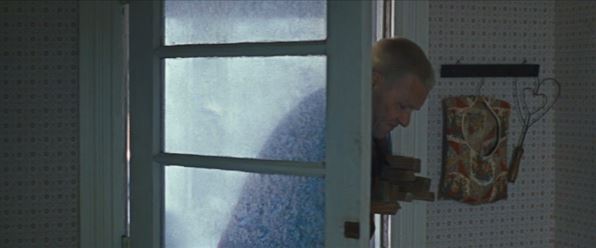
The ground is covered in snow. The fields and trees are all white with ice. 
Richard crunches across the yard to a wood pile and begins gathering up a stack. A shiny black Lincoln is parked in the yard.
155 INT. KING AND QUEEN COUNTY FARMHOUSE/KITCHEN - DAY 155 
Richard enters the kitchen with the wood. 
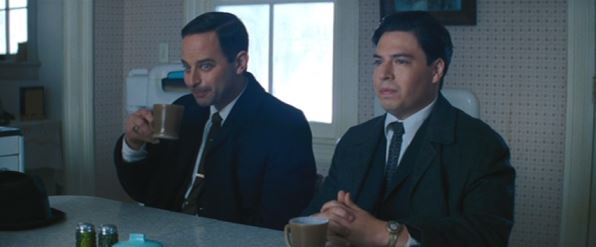
Bernie and Phil are seated at the kitchen table across from Mildred.
Bernie sips a hot cup of coffee. 
BERNIE COHEN: It’s very good. 
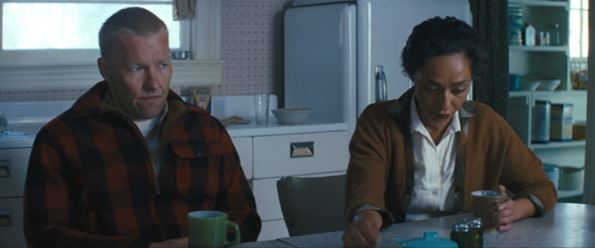
Richard adds the wood to the stove and takes a seat at the table next to Mildred.
Bernie can’t contain his smile. 
BERNIE COHEN (CONT’D) So I have some really... 
BERNIE COHEN: ...terrific news. The Supreme Court of the United States has agreed to hear our case. 
MILDRED: Oh! 
Mildred’s hands go to her face, ecstatic. 
PHIL HIRSCHKOP: Of course, the state of Virginia will mount their defense,
PHIL HIRSCKOP:...but we are feeling very good about our chances here. You’ve got the full weight of the ACLU behind this. 

MILDRED: It’s a miracle. 
Mildred grabs Richard’s hand. Richard has not moved, nor smiled. 

RICHARD: What’s their defense? 
BERNIE COHEN: I’m sorry? 
88. 
RICHARD: Virginia. 
RICHARD: How are they gonna defend what they done to us? 
BERNIE COHEN: I guess we won’t really know... 
BENIE COHEN: ...until the hearing, but it’s expected they’ll use a defense similar to something they’ve used before. 
RICHARD: And what’s that? 
Bernie looks to Phil. They realize they can’t avoid it. 
PHIL HIRSCHKOP: It’s your kids. 
RICHARD: Our kids? 
BERNIE COHEN: Yes. The state of Virginia will argue that it’s unfair to bring children of mixed race into the world. 
BERNIE COHEN: They believe they are bastards. 
Richard stares at Bernie on this point. It’s rare for him to make this much eye contact. 
Bernie looks down. 
After a moment, Bernie tries to pick things up. 

BERNIE COHEN (CONT’D) Now, as the defendants in this case, you both are allowed to come hear the arguments. 
RICHARD: No. 
RICHARD: We won’t need to do that. 
BERNIE COHEN: Well it’s a very big honor to sit in front of the Supreme Court. Very... 
BERNIE COHEN: ...few people... 
RICHARD: No. 

RICHARD: That’s fine. 
RICHARD: Scuse me. 
Richard stands and leaves the room. 
Bernie looks at Mildred, who just smiles. 
BERNIE COHEN: Mildred? 
89. 
MILDRED: I wouldn’t go without him. 
156 EXT. KING AND QUEEN COUNTY FARMHOUSE - DAY 156 
Richard stands on the porch smoking a cigarette. He looks out over the cold landscape. 
Bernie exits the house and takes a place on the steps. 
BERNIE COHEN: You know, Richard, it’s of course up to you not to attend, but you should know, the Supreme Court only hears maybe 1 out of 400 cases. 
BERNIE COHEN: It’s historic. 
RICHARD: Thank you Mr. Cohen. 
Bernie is stumped. 
BERNIE COHEN: Well. Is there anything you want me to tell them, and of course by them I mean the justices of the Supreme Court of the United States? 
Richard thinks on this for awhile. He nods. 
RICHARD: Yeah. 
RICHARD: Tell the judge, tell the judge I love my wife. 
This strikes Bernie. He understands Richard, possibly for the first time.


Loving

Words by Jeff Nichols

Pictures by Adam Stone and Jeff Nichols

Loving is available on DVD and Blu-Ray by Universal Pictures Home Entertainment.
 
By the way, "Loving Day" is June 12th, the anniversary of that Supreme Court decision—I was going to say "landmark" Supreme Court decision, but decency of any kind should not be a "landmark"—it falls on a Friday this year, and is celebrated by many cities throughout the country and so I chose to do this "Don't Make a Scene" in February, the month of lovers. If it were up to me, Valentine's Day would be moved from February 14th to June 12th.