Showing posts with label Dr. Seuss. Show all posts

Wednesday, November 14, 2018

Dr. Seuss' The Grinch (2018)

Suess Cheese
or
♫ You're a Not-Altogether Embarrassing One, This Year's Grinch ♫


Dr. Seuss' "How the Grinch Stole Christmas!" is as much a staple of the Holiday season as Dickens' "A Christmas Carol." There have been all sorts of versions of that, so my heart would be three sizes too small if I were to complain there have been too many adaptations of Ted Geisel's slim little classic. 

There is, of course, your grandfather's "Grinch," directed by my hero, Chuck Jones—and which runs on television umpteen times, to this day, every Christmas season. Then, there's Ron Howard's elephantine, rude little live-action version of it (without the exclamation mark in the title, to which I heartily agree!) starring—and dominated by— Jim Carrey. The less said, the better—which should have been the first thing the producers told the writers before they started the script, as it was encumbered with an extended origin story and an awful lot of Who-oey in Whoville, when audiences probably wanted to see more of Carrey in his hairy Grinch costume. My memory of it was that it was interminable, loud, and had way too much padding in just about every aspect of production...including the costuming. The prospect of another "Grinch" movie—even an animated one, as they've been doing lately to more of the Suess-series—and to better effect than the live-action versions—did not exactly make my heart grow a size.
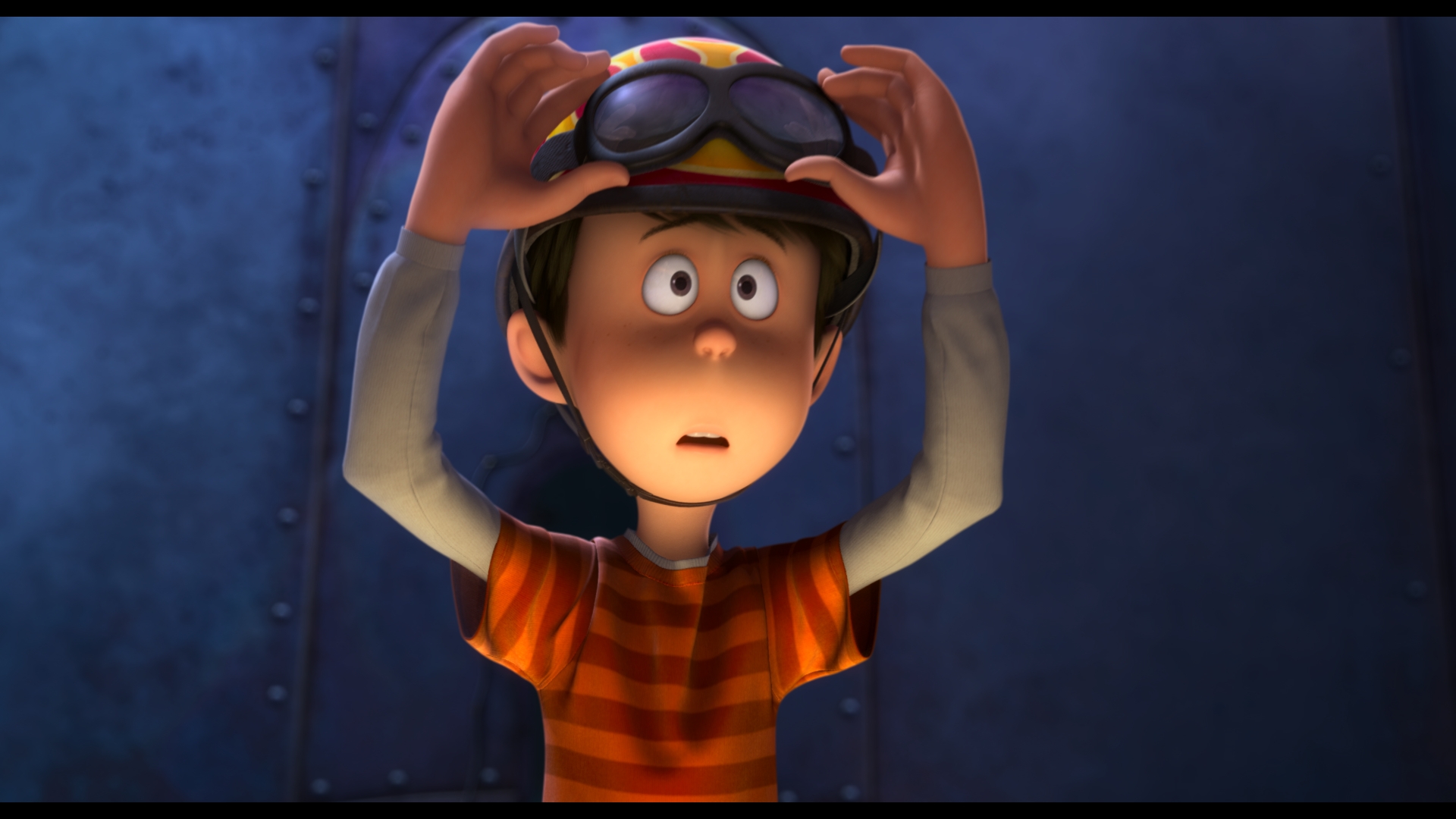
Well, Illumination Studios, which has done the Despicable Me series and the last Seuss adaptation, The Lorax, decided to tackle Seuss' "Big Gun," simplifying the title to simply Dr. Seuss' The Grinch, but retaining the plot, adding more prose (spoken by Pharrell this time), and keeping The Grinch's back-story to a minimum, and adding an interesting little sub-plot (which is rather ingeniously sneaky, although it will hardly be noticed) and adding a couple of amusing side-characters. 
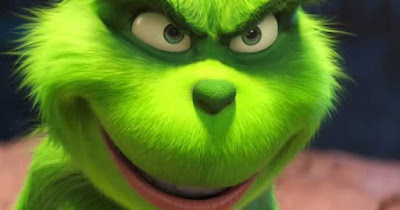
As per job-title, the Grinch (voiced this time by Benedict Cumberbatch—yes, he CAN do an American accent, Black Mass notwithstanding) is an un-diagnosed depressive, three bumper-stickers shy of being a postal bomber, living in his multi-level town-house of a mountain, overlooking the metropolis of Whoville, which is not the socialist collective as it's usually depicted, but a city with its share of desperation. We see this is as Mrs. Who (Rashida Jones) nearly has a breakdown trying to catch a bus home from working her night-shift to get home to tend to her kids—Cindy Lou Who (Cameron Seely), who is no longer "no older than two" but is in elementary school, and is far more scrappy than in Geisel's version.
It is three weeks before Christmas and all the alarm clock plays to wake up the Grinch is Christmas songs—starting with the Jackson 5 screeching "Santa Claus is Coming to Town" then "Feliz Navidad" by Jose Feliciano (I was ready to throw a book at the screen, myself), going through his wake-up routine—his dog Max does all the work—before finding out that his cupboard is bare "How much emotional eating have I been doing?" he laments. Apparently, a lot. And he and Max decide to go into Whoville to stock up.
It's never a pleasant prospect for the Grinch, but this trip, being so close to Christmas, is particularly galling, especially since the Mayor of Whoville (Angela Lansbury) has decided that this year's decorations and festivities are going to be three times bigger than last year's. The Grinch and Max barely survive a Christmas choir that starts coming after them like the Jets in West Side Story, before they run into Cindy Lou Who, in the midst of sending a letter to Santa Claus with a special request. He dashes any hope that he'll respond to her "list of demands," and then passes the house of the most enthusiastic Christmas decorator, Mr. Bricklebaum (Kenan Thompson), who has such a positive attitude that he even sees the Grinch as a friend.
After some therapy time playing his appropriately, Seussian pipe-organ—the song made me laugh out loud—the Grinch comes up with a plan—a wonderful, awful plan—to steal Christmas from under the noses of the Who's in a terrible midnight run diametrically opposed to Santa Claus'—rather than delivering presents in a single night, he's going to rob Who-ville of any sign of Christmas, right down to the last can of Who-hash.
So, he makes himself a Santa suit, steals a sleigh from Mr. Bricklebaum's elaborate Christmas decorations, then goes off a-hunting for reindeer to drive the sled. Unfortunately, Nature being Nature, he is only able to secure the slowest reindeer of the bunch—Fred, the reindeer—and takes him back to his mountain lair to coordinate how he's going to accomplish such a dastardly, grinchian heist.
You know the story (at least I hope you do). It plays out very much like the book and the previous versions did. And the line "maybe Christmas doesn't come from a store" is replaced in sentiment by the line—"He didn't steal Christmas! He just stole stuff!" It's a subtle distinction, maybe, but my Grinch-like withered heart tells me they didn't want to discourage consumerism and undermine the purveyors of it (after all, they ARE merchandising the heck out of this thing), so much as give the impression that said "stuff" is less important and should be held in less regard than the concept of togetherness and glad tidings (besides, The Lorax got enough backlash over a perceived anti-capitalist spirit). But, there's a couple other differences...
There's a parallel plot running throughout the movie alongside the Grinch's and it comes from a very unlikely source. Yes, ladies and gentlemen, Cindy-Lou Who is an unindicted co-conspirator. Heavens! Geisel is either turning in his grave or cackling over this turn of events. It seems sweet little Cindy-Lou has a special request of Santa and it's very important that he gets the message. It's too late to send a letter, trudging to the North Pole is too far, so she and some school-chums decide that they are going to Claus-nap Santa on Christmas. Oh, the delicious irony of the Grinch being nabbed in a Home Alone type kid-trap.
The other thing is a slight softening of the Grinchiness of the Grinch. There are hints that he's not quite as hard-hearted as, say, Jones' television version, which was ferociouslessly mean and revelled in his dirty work—it helped that he was voiced by Boris Karloff—whereas this version of the Grinch actually displays an act of kindness a bit earlier in the movie than in other versions of the story, that sort of undercuts his ultimate un-Scrooging at the film's climax. It makes the story a bit less heartening in the overall scheme, certainly less of a Christmas Miracle as was the intent. It makes him less of a Grinch than just a Grump.
Still, it's not a bad effort, helped immeasurably by Danny Elfman's music, with its combination of cooing innocence and bombastic deviltry—sort of a slam-dunk for Elfman, really, nobody else should have done it—just the right tone of Christmas Nightmare (which he's done before). He also did the music for Charlie and the Chocolate Factory, contributing the best parts to it, and managing to bring something new to the piece without the ghost of the previous version crowding it out. Those Ghosts of Grinch's past (good and bad) can't help but haunt this one and makes it, no matter which of the others you may prefer, at least a middling effort.

*—so much so that there should by an additional day added to "The Twelve Days of Christmas" that includes "Thirteen showings of Chuck Jones' version of "How the Grinch Stole Christmas!...." 

Tuesday, November 13, 2018

Dr. Seuss' The Lorax

Written at the time of the film's release...

Geiselling Up the Wrong Tree
or
What the Dr. Ordered (What the Patient Thneeded)

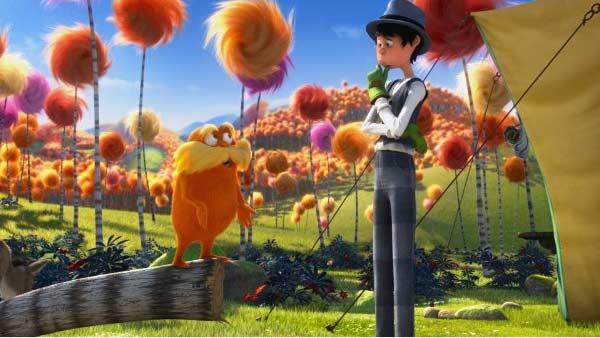
The Dr. Seuss library was getting a bad shake from the movies when they started. How the Grinch Stole Christmas (actually an expansion—and declination—of the excellent Chuck Jones Christmas special) was a live-action mess directed by Ron Howard. Then, the studio actually raised the ire of the estate (in the form of Geisel's widow, Audrey) with the live-action version of The Cat in the Hat. Then, someone had the brilliant idea of making them computer cartoons, starting with Horton Hears a Who (which did the book justice and stood out on its own as quite a good flick, being the closest representation of Seussian architecture, or lack thereof). Now, comes Suess' cautionary (and controversial) ecology tale The Lorax in the same format "from the creators of Despicable Me," Chris Renaud and his animation supervisor on that film, Kyle Balda.
And it's not bad. Despicable Me had a weird way of looking at the world all its own, and the creators have a tendency to take the "edge" off Seuss, (although preserving his architectural view of "no right angles") while still making a film that is lively, and with a comic timing that depends on the "ol' switcheroo" for laughs, not unlike a perpetual motion "Roadrunner" cartoon.
The expansion is interesting. Ted (Geissel's Christian name and voiced by Zac Efron) lives in a polluted plastic community of Thneedeville, run by a corporate overlord named O'Hare (Rob Riggle), who's a "zillionaire" from producing bottled air—a necessity since all the real trees have been cut done, owing to (and this where the book comes in) The Once-ler (voiced by Ed Helms) who used them all to make his fortune producing and selling Thneede's, which appear to be a scarf/sweater/hat contraption, which became a sensation. 
His initial tree-toppling leads to the appearance of The Lorax (cackled by Danny DeVito) who "speaks for the trees"—sarcastically, I might add—to try to set the young entrepreneur onto a more green-path when it comes to business (like that ever works without tax-breaks, cute woodsy animals be damned).
Ted, meanwhile, wants to grow a single, solitary tree for the woman of his dreams, Audrey (played by the woman of my nightmares, Taylor Swift, and despite my prejudices, she's quite good!) and the only way he can do that is to get by O'Hare, his burly security guards and escape Thneedville to find the Once-ler and let Nature take its course, Lorax or no Lorax.
It's not a bad translation of Seuss, story-wise. But one wishes that the visuals could be a little less plasticene looking, given the ecology story, which leads one to wonder if such a subject should even be rendered with pixels (and makes one cynical enough to note how much the End Title tune is auto-tuned to a semi-quaver of its unnatural life). Such thoughts should not be creeping into one's thoughts when one is watching a movie about how wonderful Nature's way is, and nature has nothing to do with it, no matter how "green" the movie declares itself to be.

Thursday, September 7, 2017

Dr. Seuss' Horton Hears a Who!

Written at the time of the film's release in 2008

Who Put the Pixels in my Seuss?

Frankly, it's about time!

We, as movie-goers (and parents) have had to suffer through two live action adaptations of beloved Dr. Seuss books, that took them, stretched them to ungainly proportions making them loud and obnoxious, tossed in the obligatory fart and sex jokes with self-indulgent Jim Carrey and Mike Myers performances, and probably, most egregious of all, drained as much of the Seussian outlandishness in design to make it all work in a "real" world. I'm looking at you, Ron Howard, and Bo Welch! You destroyed my childhood!!*

Actually, what they did was make crappy films out of very good, inspiring source material. It takes some real lack of talent to do that.
The Seuss estate has tried mightily to make who-hay out of the Good Doctor's (real name: Theodore Geisel-RIP) post-war output** with their web-sites and Broadway seussicals and elephantine films, and have been largely successful, ca$h-wise, even if their value as far as representations in other media have been failures. 

Somebody must have realized that, because someone had the wise idea to return Geisel to the medium to which he has successfully worked in the past—animation*** A brilliant idea that, if a no-brainer, and it will hopefully save the rest of the Seuss library from destruction at the hands of auteur's with big budgets and few ideas. Imagine what Pixar could do with a Seuss film?**** As it is,
Horton Hears a Who! was in good hands with the Ice Age crew--they seem, in sensibility, the ones who are studying the Looney Tunes model for making animated entertainment, and the resulting film, though stretching the premise to its breaking point, is never less than entertaining, and frequently fiendishly brilliant in how it has represented Seussian ideas and concepts.Okay, the casting is a bit top-heavy. Jim Carrey is the elephant in the room, but he's just as adept at vocal gymnastics and although Horton now seems to be on a perpetual coffee jag, it gooses the pace of the material in a not-inoffensive and practical way. The fact that he isn't "live" and stuck in some faux-Seuss costume probably helps restrain him, as well. Steve Carrell, who one worries about how far he can stretch, is equally good as the bumbling mayor of Who-ville who has trouble making his presence known just about anywhere. Here's perfect casting--the "concerned mother kangaroo" who becomes increasing strident to "protect the children"--Carol Burnett. Seth Rogan is there and Will Arnett, but I doubt folks will be clamoring to see the movie because of them--the voice-casting is spot on, with only one possible exception. The somewhat unctuous narration is by CBS Neuss' Charles Osgood--possibly Dr. Seuss's biggest fan. He's fine. But his warm, soothing tones seems to be assuring the entire time that everything will be all right, and that everything is lovely, when what is needed is a voice that has some grit in it--which is why Boris Karloff as the Narrator for the animated "Grinch" was such a brilliant stroke.
And the design--the design of the thing is beautiful and so Seuss. It would take another viewing (or three) to see all the details and great ideas (and Seuss in-jokes) filling the frames.


Fortunately, the film is good enough to bear up to repeat viewings. And it does one brilliant, little snarky thing: It co-opts a 70's rock-ballad to make fun of most cartoons' tendencies to end with a heart-felt song. It's hilarious.
Dr. Seuss was not only employed to help kids read, he wrote his stories to make kids think. "Horton Hears a Who" was written as a plea for tolerance in an intolerant time,***** and its message "A person's a person no matter how small" has been co-opted by the anti-abortion crowd--Mrs. Dr. Seuss was quite miffed when the premiere was disrupted by chanting protesters, whereas the good Dr. would have tried to kick their collective asses (he threatened to sue one group for using the quote on their stationary)--and this movie is full of messages for all to read into. There's a climate change theme, there's the intolerance theme, there's the "be-yourself" theme, the "tyranny of the mob" theme, the impotent figurehead-non-democratic council-strength in numbers democracy theme, the "make yourself heard" theme, and the fact the mayor has 97 children (96 girls and 1 boy) and uses a timer to allocate only so many seconds of attention to each should say something to somebody. It tends to put a fuzzy edge to "I meant what I said, and I said what I meant"

But Dr. Seuss' Horton Hears a Who! is faithful. Almost 100%.


* Well, not really, but I've always wanted to write that, seeing as how so many "chat-room fan-boys" out there have written the phrase every time somebody has done something that doesn't fit into their limited "world-view." It's the semi-adult version of stamping your little foot. Frankly, I'd rather they held their breath until they turned blue.

**We won't see anything done with Private Snafu--with which he collaborated with the Termite Terrace crowd--that would make an interesting law-suit if Warner Brothers decided to cash in on the Seuss name--or some of his more racy material.

*** Even before the Chuck Jones-produced "The Grinch Who Stole Christmas" or the original cartoon version of "Horton Hears a Who," Geisel worked with Bob Clampett and Warner Brothers to make a short of "Horton Hatches an Egg" in 1942.


**** Jimmy Hayward, who along with Steve Martino, directed Horton... was a Pixar animator. It's their first feature...well done.******

***** Geisel was a leftist--but his buzzard Vlad Vladikoff, is surely Soviet-based, and, supposedly the Wikersham Brothers--the ape-boys (who are animated splendidly in this) are based on Sen. Joseph McCarthy.

****** Cool! The asterisks get an asterisk. As a post-script, the two directors took wildly divergent paths: Jimmy Hayward went to live-action, where he directed Jonah Hex (anybody remember that one? John Brolin as DC's disfigured western anti-hero? Didn't think so); Martino stayed with animation, supervising the "Ice Age" franchise and directing the rather lovely new Peanuts movie.

Okay, everybody has to mess with the material in some way (Clampett's cartoon had a fish that looked like Peter Lorre shooting its brains out), and this is how Martino and Hayward mess with this version—but it's so weird I like it.

Friday, March 13, 2015

The 5,000 Fingers of Dr. T

The 5,000 Fingers of Dr. T (Roy Rowland, 1953) Marvelously odd-ball, bizarre fantasy film for kids that's as much fun for adults, and has the added benefit of a crazed performance by Hans Conreid and a script, songs and design (after a fashion) the eccentric Theodore Geisel, whose nom de plume was Dr. Seuss. Seuss was a definite, defiant genius,* in that he maintained throughout his complicated adulthood, the simplistic child-view, with all its neurotic simplicity, the well-ordered conservative traditionalism, swirled with a wildly anarchistic streak.

Dr. T is a bit like The Wizard of Oz in that it's a vividly imagined fever-dream that reflects the real world pureed in eye-popping colors and shapes through a child's trauma filter. For Dorothy Gale, it's brought on by familial stress instigated by head-trauma. For Bartholomew Collins (Tommy Rettig), it's familial stress instigated by exhaustion created by piano drills imposed by the unholy alliance of his mother (Mary Healy) and his music teacher, the snooty Dr. Terwilliker (Conreid). The kid's got no allies, save for his dog, the audience—whom he regularly addresses—and the local plumber, Mr. Zabladowski (Peter Lind Hayes), whom he respects for his control over his life and his ability to fix stuff—fixing stuff is important when you're a kid seeing the world broken. Bart sums up his predicament for us, then falls into a horrific exhausted slumber, where he pictures himself the lone victim in the machinations of Dr. T, secluded in his impossibly architectured institute, the first specimen in a regimented experiment to lead a slave-team of 500 kids to realize his ultimate composition.  
Bart hides in plain sight in T's complex—making him look bug-like and squashable
For Bart, the job is simple: get out of the castle, rescue his mother (who is in thrall to the Professor as his assistant) and barring any escape, sabotage the Doctor's magnum opus. 

It may be the weirdest, most enjoyable leftist agenda movie that producer Stanley Kramer ever produced (even over It's a Mad, Mad, Mad, Mad World), If.... without machine guns, creating a passive-aggressive (through a "very atomic" silence producer) explosion of revolt to decimate the forces of regimentation and create a nuclear family out of the resulting chaos. Even if Bart can't escape his lot, he can at least do some damage in it, and make it work to his advantage. Sounds like any skill-set a kid would, should, and could have use of.  

Bart climbs to the top of an impossible ladder, only to be found out by a searchlight.
Regimentation and the individual's right to be one's self—by any means necessary—is the story's theme, one that runs throughout Geisel's work through various guises and creatures. And even though Dr. T's denizens are fairly standard bi-ped's, the universe of Bart's Dr. T nightmares is one of wrong angles with no standard rules of design—a free-flowing construction, in danger of collapsing in on itself, even without a kid's help. The songs are fine, the language is wonderful, and the acting whimsical and uneven, but, who cares?  It's the LOOK of the thing that creates the magic of the film, and makes it recognizable, along with some peripheral like the freakish "happy-hands"-beanies the kids are forced to wear, as Geisel...or, rather, Seussian.

Geisel thought little of the film, either because he thought the product compromised, or because the response to it was lackluster to the extreme. And kid-star Tommy Rettig went on to become the first "Timmy" on the Lassie TV show, an unpromising career with drugs, but ended strong by becoming a pre-eminent software programmer, specializing in DBaseIII. All of which seems rather Seussian, as well.
Dr. Terwilliker's castle is full of oddities and Gehrey-esque angles

* For example, he labeled the film a "debaculous fiasco."