Showing posts with label Amy Poehler. Show all posts

Friday, June 21, 2024

Inside Out 2

Pardon Our Dust. Puberty is Messy.
or
Taking Inside Out 2 Twice a Day Will Take the Place of Xanax

It's nice to see that Disney* is permitting Pixar out of its streaming jail-cell and letting its movies open in theaters again. It seems to have paid off as Inside Out 2 has out-performed expectations—certainly Disney's—and has generated Barbie-land box office. One took the hopeful sign that allowing the only-streaming releases to have a theatrical run made them re-think what they were doing with its best—and longest-held—assets. Pixar product is just too good to be restricted to home theaters, and Inside Out 2 is a good example of why.

Sure, a couple of the sequels have been less than spectacular—Monsters University, Cars 2, and Lightyear (although not technically a sequel) had a creative lethargy backing the stunning visuals, but this sequel to 2015's Inside Out takes advantage of the inevitable march of time to expand and deepen its particular cartooniverse. That it is all contained in the mind of our gal-pal Riley (now voiced by Kensington Tallman), who survived her move to San Francisco and flourished, retaining her passion for ice-hockey (a big story-point in this one) and keeping it together with some help from her humors in Head-quarters.
They are Joy (
Amy Poehler), Sadness (Phyllis Smith), Anger (Lewis Black), Fear (Tony Hale taking over for Bill Hader), and Disgust (Liza Lapira taking over for Mindy Kaling), who have negotiated Riley's emotional life in the intervening years and managed to make a go of it, despite outgrowing clothes, getting braces, and the near-occasion of pimples. Of course, she's had help from her supportive gal-pals on the hockey team, Grace (Grace Lu) and Bree (Sumayyah Nuriddin-Green). Her school has just won State and grabbed the attention of Coach Roberts (Yvette Nicole Brown) of a local high school who has invited the three to a weekend hockey camp.
Pretty easy for five emotions to handle, one would think. Especially as Joy has worked out a new doohickey that allows her to take bad memories and vacuum-tube them to the back of Riley's mind, where they won't do any harm to her burgeoning "Sense of Self." All very neat and orderly...just like kids are (he said with a wink).
But, remember how I dropped the mention of a "pimple"—well-rendered subtly by Pixar pixelators)? The night before she goes off with her friends to the camp, Riley's "Puberty Alarm" goes off, sending everyone into a panic, and requiring a crew to come in and do a "mitigation" on Riley's head-space, leaving the old crew with a new console that—shall we say?—is a bit..."sensitive". Plus, there are all sorts of new gizmo's and buttons no one's ever seen before.
Those "upgrades" are for a quartet of new emotions generated for Riley by her hormones and they are Anxiety (Maya Hawke), Envy (Ayo Edebiri), Embarrassment (Paul Walter Hauser) and Ennui (Adèle Exarchopoulos), who show up and decide they're going to run the place...that is, Riley...during her hockey weekend. This, of course, complicates matters, and one notices that having these guys around makes describing what happens in the story sounds a little too "on-the-nose." It's far more subtle—and entertaining!in the Pixar presentation than the summation, which reads like symptoms in a psychological post-mortem.
To wit: Anxiety manages to rip away Riley's Sense of Self and locks away Joy (and her comrades) in an effort to push Riley to achieve her ambitions on the ice. Sounds a bit clinical, doesn't it? It's not, but shows how cleverly director Kelsey Mann and his co-scenarists Meg LeFauve and Dave Holstein manage to integrate human turmoil into an adventure story that's enjoyable for kids and relatable for adults (who'll be answering questions with a smirking "just you wait..."). The kids watching this movie will grow up into the answers that had previously sailed over their heads.
It all feels like a natural progression to the original. Changes are made, but they're well-integrated (even if, in the story, the new emotions have to be shown some tough love) and one is propelled along with the assurance that the film has been nuanced to within an inch of perfection. And, of course, one is always amazed at the artistic leaps that Pixar makes between films; Inside Out 2 feels richer in its animation than the original with nice ethereal edges to inhabitants of Riley's head-space and one can appreciate the little details like the way Riley's teeth are crooked to the way ice erupts from the edge of a skate.
Those details are not what's flocking audiences to theaters to see this, but it's a value-added that can only be appreciated on a large screen. Inside Out 2 may not have the holistic concept brilliance of the first one, but it's a worthy sequel that builds on it, maintaining the train of thought while not derailing it (see how lame the concept could get?).
 
Inside Out 2 will get you right in "the feels."

* Although one notices that the House of Mouse has put on an ultra-long company logo (that might actually qualify as a short subject) onto the beginning and the end of this one as if to emphasize who's in charge. The Pixar logo is same as it ever was. Don't let that discourage you from missing the tag-line at the very end of the movie, though.
 
Caption quiz: "Anxiety...."

Thursday, September 7, 2017

Dr. Seuss' Horton Hears a Who!

Written at the time of the film's release in 2008

Who Put the Pixels in my Seuss?

Frankly, it's about time!

We, as movie-goers (and parents) have had to suffer through two live action adaptations of beloved Dr. Seuss books, that took them, stretched them to ungainly proportions making them loud and obnoxious, tossed in the obligatory fart and sex jokes with self-indulgent Jim Carrey and Mike Myers performances, and probably, most egregious of all, drained as much of the Seussian outlandishness in design to make it all work in a "real" world. I'm looking at you, Ron Howard, and Bo Welch! You destroyed my childhood!!*

Actually, what they did was make crappy films out of very good, inspiring source material. It takes some real lack of talent to do that.
The Seuss estate has tried mightily to make who-hay out of the Good Doctor's (real name: Theodore Geisel-RIP) post-war output** with their web-sites and Broadway seussicals and elephantine films, and have been largely successful, ca$h-wise, even if their value as far as representations in other media have been failures. 

Somebody must have realized that, because someone had the wise idea to return Geisel to the medium to which he has successfully worked in the past—animation*** A brilliant idea that, if a no-brainer, and it will hopefully save the rest of the Seuss library from destruction at the hands of auteur's with big budgets and few ideas. Imagine what Pixar could do with a Seuss film?**** As it is,
Horton Hears a Who! was in good hands with the Ice Age crew--they seem, in sensibility, the ones who are studying the Looney Tunes model for making animated entertainment, and the resulting film, though stretching the premise to its breaking point, is never less than entertaining, and frequently fiendishly brilliant in how it has represented Seussian ideas and concepts.Okay, the casting is a bit top-heavy. Jim Carrey is the elephant in the room, but he's just as adept at vocal gymnastics and although Horton now seems to be on a perpetual coffee jag, it gooses the pace of the material in a not-inoffensive and practical way. The fact that he isn't "live" and stuck in some faux-Seuss costume probably helps restrain him, as well. Steve Carrell, who one worries about how far he can stretch, is equally good as the bumbling mayor of Who-ville who has trouble making his presence known just about anywhere. Here's perfect casting--the "concerned mother kangaroo" who becomes increasing strident to "protect the children"--Carol Burnett. Seth Rogan is there and Will Arnett, but I doubt folks will be clamoring to see the movie because of them--the voice-casting is spot on, with only one possible exception. The somewhat unctuous narration is by CBS Neuss' Charles Osgood--possibly Dr. Seuss's biggest fan. He's fine. But his warm, soothing tones seems to be assuring the entire time that everything will be all right, and that everything is lovely, when what is needed is a voice that has some grit in it--which is why Boris Karloff as the Narrator for the animated "Grinch" was such a brilliant stroke.
And the design--the design of the thing is beautiful and so Seuss. It would take another viewing (or three) to see all the details and great ideas (and Seuss in-jokes) filling the frames.


Fortunately, the film is good enough to bear up to repeat viewings. And it does one brilliant, little snarky thing: It co-opts a 70's rock-ballad to make fun of most cartoons' tendencies to end with a heart-felt song. It's hilarious.
Dr. Seuss was not only employed to help kids read, he wrote his stories to make kids think. "Horton Hears a Who" was written as a plea for tolerance in an intolerant time,***** and its message "A person's a person no matter how small" has been co-opted by the anti-abortion crowd--Mrs. Dr. Seuss was quite miffed when the premiere was disrupted by chanting protesters, whereas the good Dr. would have tried to kick their collective asses (he threatened to sue one group for using the quote on their stationary)--and this movie is full of messages for all to read into. There's a climate change theme, there's the intolerance theme, there's the "be-yourself" theme, the "tyranny of the mob" theme, the impotent figurehead-non-democratic council-strength in numbers democracy theme, the "make yourself heard" theme, and the fact the mayor has 97 children (96 girls and 1 boy) and uses a timer to allocate only so many seconds of attention to each should say something to somebody. It tends to put a fuzzy edge to "I meant what I said, and I said what I meant"

But Dr. Seuss' Horton Hears a Who! is faithful. Almost 100%.


* Well, not really, but I've always wanted to write that, seeing as how so many "chat-room fan-boys" out there have written the phrase every time somebody has done something that doesn't fit into their limited "world-view." It's the semi-adult version of stamping your little foot. Frankly, I'd rather they held their breath until they turned blue.

**We won't see anything done with Private Snafu--with which he collaborated with the Termite Terrace crowd--that would make an interesting law-suit if Warner Brothers decided to cash in on the Seuss name--or some of his more racy material.

*** Even before the Chuck Jones-produced "The Grinch Who Stole Christmas" or the original cartoon version of "Horton Hears a Who," Geisel worked with Bob Clampett and Warner Brothers to make a short of "Horton Hatches an Egg" in 1942.


**** Jimmy Hayward, who along with Steve Martino, directed Horton... was a Pixar animator. It's their first feature...well done.******

***** Geisel was a leftist--but his buzzard Vlad Vladikoff, is surely Soviet-based, and, supposedly the Wikersham Brothers--the ape-boys (who are animated splendidly in this) are based on Sen. Joseph McCarthy.

****** Cool! The asterisks get an asterisk. As a post-script, the two directors took wildly divergent paths: Jimmy Hayward went to live-action, where he directed Jonah Hex (anybody remember that one? John Brolin as DC's disfigured western anti-hero? Didn't think so); Martino stayed with animation, supervising the "Ice Age" franchise and directing the rather lovely new Peanuts movie.

Okay, everybody has to mess with the material in some way (Clampett's cartoon had a fish that looked like Peter Lorre shooting its brains out), and this is how Martino and Hayward mess with this version—but it's so weird I like it.

Saturday, June 27, 2015

Inside Out (2015)

Humor Me
or
"Forget it, Jake.  It's Cloud-Town."

One should never make an assumption going into a movie because it will cloud the experience and make you not appreciate what is really up there on the screen as a personal experience, rather than by, say, assessments of critics, studio-hype, or the impressions evoked by a trailer.

Pixar's latest, Inside Out, looked to be not much. The characters are cartoon-y, and not impressive in their rendering, like (you know) Minions or like a lot of the output of Dreamworks Animation. Pixar movies are events, pushing the form of animation, digital graphics and for just plain story-smarts, and the only time they've failed (I'm thinking the Cars movies and Planes) they've really dumbed down the artistry on all fronts. Inside Out looked to be like that, a place-holder until they could get The Good Dinosaur finalized.

Silly me. Inside Out may be the best Pixar movie yet, and that is saying a very Big Something. One of the best things about the studio's output has been its story-sense—that story comes out of character. Here, they do the flip-side: character comes out of story.


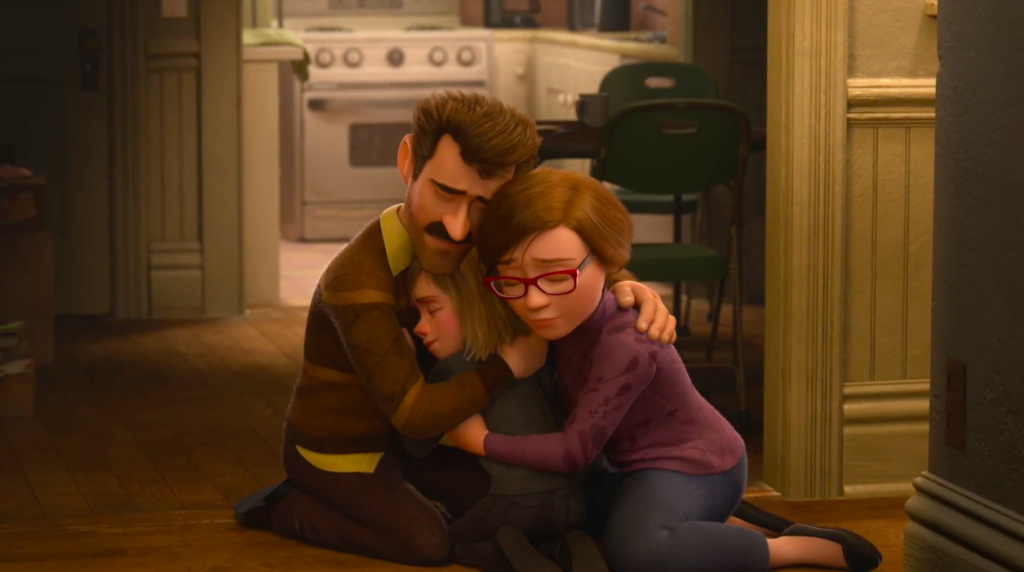
One doesn't want to talk too much about the particulars in depth because there is a lot of that, and part of the joy of Inside Out is discovering that depth and just how far the writers (especially) and the Pixar team go to achieving it.  So, here's a gloss: Inside Out is about Riley (voiced by Kaitlin Dias), an 11 year-old girl living in Minnesota, into ice-hockey, and living a fairly normal life.  Her family (Mom and dad are voiced by Diane Lane and Kyle McLachlan) move the family to San Francisco, uprooting Kiley's normal, changing schools, leaving friends and on a basic level shattering her "normal."
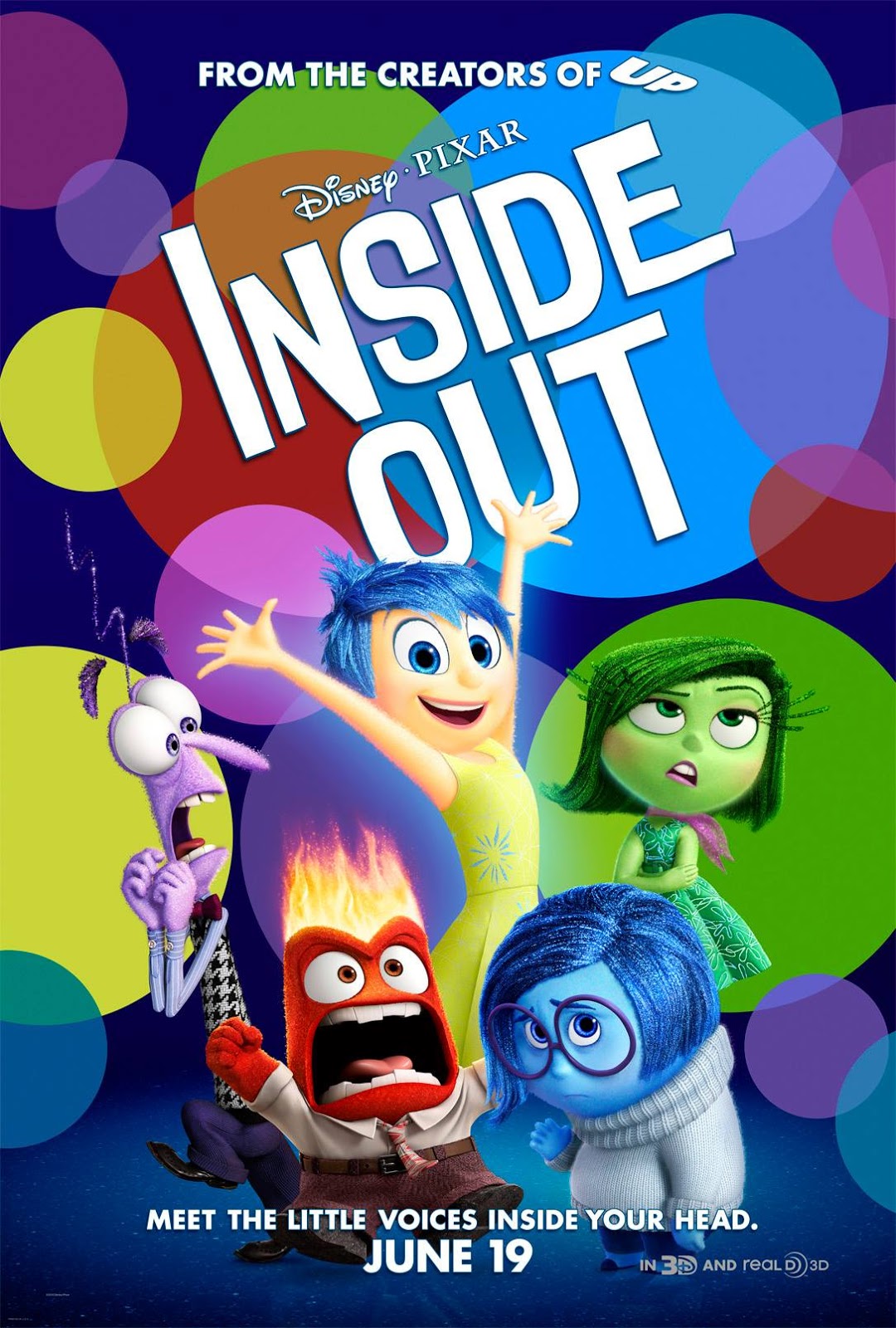
That "normal" began as an infant when she first opened her eyes and experienced "Joy" (voiced by Amy Poehler). The emotions that drive Riley throughout her childhood are brilliantly imagined and worked out on a mechanical level, but "Joy" is soon joined by "Sadness" (Phyllis Smith of "The Office"—brilliant). "Fear" (Bill Hader), "Disgust" (Mindy Kaling—ditto), and "Anger" (Lewis Black—of course). These five emotions mix and commingle, fight and compromise, getting Riley through her day, then call it "a day" when she goes to sleep. (One of my favorite lines is this summation from "Fear": "Okay, we did not die today. I call that an unqualified success!")
Anger, Disgust, Joy, Fear and Sadness monitoring in Head-quarters.
But "The Move" has put a serious whammy on the life of Riley, taking her completely out of her comfort zone, creating a crisis of her unconscious and throwing her emotions into a tizzy—see where this is already going? It will take some serious adjustment in her head for things to be set right, and that quest is where the bulk of Inside Out if focused. It's an animated psychology lesson (that won't freak out the Scientologists, as they say the same things at their molten core), a philosophy strategem (that can't be accused of social engineering) and probably does as much as a library of self-help books to get your head on straight (and, even in 3-D, it only charges $10.50 an hour—the chairs are comfortable, too). 
It won't affect the Greek's, either, who saw personality in the same way, although controlled by four "humors," each one tied to a body function. In decreasing orders of "Joy," they are sanguine, phlegmatic, melancholic, and choleric. These four aspects controlled personality and informed their medicine, their social interactions, even their arts. Inside Out continues the long tradition of breaking personality into aspects which control our behaviors, our actions, and, ultimately, our lives. It examines character and motivation, not as merely a means to create drama, but to explain our selves.
It does all this and it's a flippin' cartoon!  A flippin' cartoon that looks as sophisticated as Gerald McBoing-Boing.* But, then when has a flippin' cartoon tackled childhood angst and the complex dynamic of personality? Of how past experience informs and shapes us, and ultimately guides us, whether we are aware of it or not. It's a cartoon that will entertain children with its bright colors and simple concepts and educate adults, while not preaching, but entertaining, teaching by example and inspiring a path. A warm feeling of familiarity spread through me while watching Inside Out and I can't believe I would be alone in this feeling.
This is what is amazing about the group of artists that make up Pixar, who pioneered the techniques and pitfalls of dimensional computer graphics, only to see their accomplishments copied and emulated. What nobody else has been able to grasp, though, is their story-telling sense. Because, even though the graphics sensibility is a technique that can be copied, their way of combining comedy with a solid lesson-learning prospectus, with the risk of injecting drama—heart-wrenching drama—into their films, whether its the melancholy 'When She Loved Me" sequence of Toy Story 2, the remarkable life-story prelude of Up, the basically-silent first section of Wall•e, or the furnace sequence of Toy Story 3, has taken narrative and emotional risks that only make the films far richer than any technological advance or artist's technique could create.  This is also something inherited from the Greeks.
I can't recommend this one highly enough. The most praise I can heap on it is to merely so "go." Do not hesitate. Go see it. Whatever version you see, however much you spend on it, will be worth it. 

Inside Out is "dedicated to our kids. please don't grow up. ever."

May Pixar do the same.


If you want to see Pixar's amazing graphics capabilities, the short preceding it, Lava, will fulfill that need.

* Okay, I'm simplifying there, although the characters of the emotions are definitely mindful of basic UPA cartoons.  The home scenes are the same artfully detailed images Pixar lavishes attention on.