Showing posts with label Jennifer Jason Leigh. Show all posts

Tuesday, November 16, 2021

The Big Picture

The Big Picture
(Christopher Guest, 1989) Every film-maker who has ever made a film in Hollywood has had a sneaking desire to make a film about the absurdities of making a film in Hollywood. There's just a considerable smaller amount who have the balls to risk reprisals in the company-town. One doesn't shit where one eats. There's an even smaller amount who have the talent, wit, and lack of invective to point out the absurdities without making it a hatchet job...or a crashing bore. 

Wilder. Keaton. Sturges (Preston). Kelly and Donen. Cukor (and Wellman). Kazan. Minnelli. Rush. Altman. The Coen's. Welles. That's a considerable list and the results have every color of attitude from wonder-blushing red to ultra-purple put-down. 

Chris Guest's 1989 film falls somewhere in-between, retaining the wonder-lust of film-making with the soul-crushing corporate low-balling of vision. Having the creative impulse doused by a flood of compromises and bidding agendas.
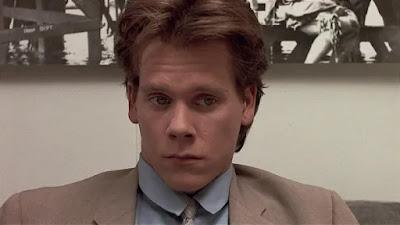
Budding film-maker Nick Chapman (Kevin Bacon) is "hot", having just won a film-making competition and given the opportunity to pitch ideas for "projects." Taking a meeting with studio producer Alan Habel (J.T. Walsh) gives him flashing hope until Habel wants to make changes to his ideas more in line with Habel's peccadilloes. Then, there's the "Catch-22" of not having an agent—he can't be taken seriously without one but can't get one until he's taken seriously. So, he takes a lunch with a prospective agent (Martin Short), more interested in being seen than seeing what he can do.
Then, he gets invited to a Hollywood party given by Habel and his wife (Fran Drescher), but it's less about working than distraction—touring the house, socializing, networking. One of the biggest distractions is Gretchen (Teri Hatcher, her first film), aspiring actress, who further pushes Nick from his artistic visions by suggesting that he write his movie with her in mind. Her efforts further complicate Nick's life by making his girlfriend Susan (Emily Longstreth) jealous, driving a wedge in their relationship. Gretchen becomes the embodiment of every Hollywood enticement, moving him further from making HIS movie and compromising his aspirations. Pretty soon, his potential movie is so far afield from his intentions that his enthusiasm starts to wane, and ultimately, his film is canceled, forcing him to take entry-level jobs in Hollywood just to make ends meet.
Oh, how far the lofty intentions fall. It's hard to drum up much sympathy for Nick—sure, the Hollywood system is corrupt and capricious, but Guest at least makes his downfall as much about the weakness of Nick's character as the environment he's stepped into.
 
That story, thus, is not that involving, and it has a hard time competing with the opening of the showing of student films vying for Best of Show, which is a hilarious look at the pit-falls of student film competitions; they involve a film by an agent's son—loaded with recognizable stars, but clearly shot at a time when those actors are available, with mismatched shots showing that nobody was on the same set at the same time—or a full-of-itself vanity project by a young filmmaker with an outsized ego featuring himself in a starring role. The satire of the sequence is sharp and cruel and the rest of the film never lives up to the potential of the opening sequence—an inadvertent portent for what is to come for its hero.

Thursday, February 6, 2020

Margot at the Wedding

Written at the time of the film's release....

Margot at the Wedding (Noah Baumbach, 2008) Margot (Nicole Kidman) is a short-story author living in Manhattan with her estranged husband Jim (John Turturro). For reasons best known to herself, she takes a train upstate to attend the wedding of her estranged sister Pauline (Jennifer Jason Leigh) to Malcolm (Jack Black), an "artist" of no specific discipline. With Margot is her son Claude (Zane Pais), who along with a scriptwriting colleague (the great Ciarán Hinds), are probably the only people she's not estranged from.There's no pleasing Margot. If you try, she'll think you're trying to pull something over on her. Everything's a plot. Nothing is satisfactory. She is brutally honest, even when she's not being honest about it. If she can't probe a weakness, she'll create one to provoke one. And she's only too happy to purloin life-incidents for her fiction.Although one wonders if she recognizes what fiction might be.

Noah Baumbach's last film was the critically acclaimed
The Squid and the Whale which astutely recreated the eddies and shoals and snags of conversations that are the dripping water torturing a marriage or any relationship. Things either wear down or they break under such a test, there is no middle ground, and there is no respite from the constant flow. In Squid the human beings were just trying to survive. Here, with Margot, survival's a foregone conclusion, it's just a matter of how many people she can take down in the process. There is no tying her down, it'd be like nailing Jell-o to the wall or having a pleasant conversation with Ann Coulter—it's not done.

You can't reason with a sociopath.

This sort of stuff is indie film gold, and Baumbach is a master at the circular conversation that goes nowhere, and the humor that can be found in absurd power struggles. But there's almost too much of a bad thing here, you can probably time the intervals between the incidents of cast-members breaking down, getting slapped, or getting punched. And Baumbach also is alarmingly unsubtle about the glaring Big Symbol of It All—another "Nature" metaphor that threatens to literally knock the audience over the head with its obviousness. But Baumbach gets one thing exactly right—the only one with any sense is the family dog.
The cast is uniformly excellent and unselfish in spreading the unpleasantness around. If there is one weak link it's Jack Black, but only because he will hammer the joke home, rather than let the words speak for themselves. Everyone else excels at leaving things unsaid when their characters can't leave well enough alone.

Tuesday, February 4, 2020

Greenberg

Written at the time of the film's release...

"The Boy in the Spastic Bubble"

The latest film by Noah Baumbach, Greenberg is a tour de force for actor Ben Stiller, who knows how to marginalize audiences himself (he directed The Cable Guy and Tropic Thunder, after all). Combine him with the writer-director of The Squid and the Whale and Margot at the Wedding and you have two individuals creating something capable of making you squirm uncomfortably (in your comfortable theater seat) for its entire two hours, waiting for (if it were so formulaic) a reckoning of devastating proportions.

That would be letting you off easy.

Roger Greenberg (Stiller) is recovering from a nervous breakdown, and is house-sitting his brother's place and dog in L.A.—a place where he can relax in the hills above the smog and try to put his life back together. A carpenter by trade,
it is his goal to build the dog a dog-house. "I'm really trying to do nothing for awhile," is his stock answer. "That's brave at our age," says an old flame (Jennifer Jason Leigh, who co-wrote the story) that was extinguished long ago. Greenberg tries to connect with old friends from school days, but as he didn't communicate with anybody while he lived in New York, there's not much in common anymore. 


Greenberg is essentially stifled. Not capable of moving forward and paralyzed at the thought of doing something to change that ("I woke up one morning and literally my legs couldn't move. They said it was psychological."), he exists through the day not calling people, then wondering why nobody talks to him. He's insensitive to other people's needs, wants or emotions—he can't see past his own smog drifting through his mind.
Because there's nothing else to do—he doesn't drive, not terribly convenient in L.A.—he ends up seducing his brother's nanny (Greta Gerwig), herself a fairly directionless person, numbed by a recent break-up and a tendency to be too compliant.
But, the relationship is one way and it all sucks towards Roger. A psycho-narcissist, he is so self-absorbed that any empathy perspective or ambition save for animal imperatives have been consumed and purged. A nanny is perfect for him, as he hasn't grown up. At all. And seems doomed to drive off any kind soul, sympathetic enough to put up with his bullying in-denial bullshit.

Now, let's pause for a second. We've been talking about Greenberg this whole time. let's talk about YOU for a moment.


YOU are NOT Greenberg.*

Oh, you might be in your worst moments—everybody can reach their limits of tolerance, have a crisis or a bad hair day and be less than 20%. And Greenburg can be a litmus test for anyone the least bit self-absorbed (but not in denial). I've already read a couple of reviews that seem to cast the writer's own issues onto a scenario that don't suggest them. So, yes, you will recognize yourself and others in this movie (all except for you, Mother Theresa), but you are not Greenberg. If you were, you'd already be dealing with it by subsisting on some anti-psychotic, anti-hysteric, anti-depression pharmaceutical to get past it. And understand, this is Greenberg's behavior ON Zoloft.

So, this movie can make you crazy. I had waves of wanting to strangle this 40 year old infant...if he weren't already doing it to himself. Reactions to a movie like this can be healthy; at least, I didn't want to walk out. And there is the least amount of some resolution to this guy who isn't happy unless he can hear himself talk.

Still, this is one to take in stages...at home.


* I succumbed to this. I can be insensitive, self-absorbed (I write...duh), and fail to recognize the needs of others. The one that hit me the hardest is that Greenberg occupies his time writing complaining letters to...everyone. And what have I been doing? Writing movie reviews (I blame you, you read them). But, I've been doing other things as well. I have the most finely buffed and polished resume in town. My dog has his waist back (it's been a long Winter), and the taxes were done sooo long ago. I am not Greenberg. You are not Greenberg.

But THAT guy? Oh, man! (*tsk*) Def-initely.

Tuesday, March 13, 2018

Annihlation (2018)

Morph and Mindy
or
Ch-Ch-Ch-Changes (Turn and Face the Strange) 

There are flashbacks within flashbacks in Alex Garland's adaptation of "Annihilation" (the first book of Jeff VanderMeer's "Southern Reach" trilogy), part of a school of speculative fiction dubbed "The New Weird" and is one of those novels considered "unfilmable"—mostly because the book is written as a first-person journal of an expedition and is short on details (names, for instance) to the point where VanderMeer didn't get around to fleshing out the characters, which garnered criticism for the casting due to its lack of specific ethnicity, the clues to which didn't occur until the second book was published.

It's also an experiment in making its readers do the hard work of imagining, the literary equivalent to radio's conceit of a "Theater of the Mind,"* where suggestion sparks completion in that venue, creating a wily co-conspiracy of writer and reader. This has its dangers because "fans" (especially these days) take a personal stake in these things and become vocal (or take to what is ironically called "social" media) if their "vision" is not represented—not that anybody knew what that vision might be. This puts Garland in a touchy situation as it his job to make concrete what has previously been merely "airy-fairy" to the point of being deliberately vague. Every director has to do this to a certain extent, and producers put up the money for the "vision" that will make a return on their investment.** The business dictates that the only "vision" that matters be tinted green.
Best, then, to start with the basics; the first scene is a "just the facts" de-briefing between the protagonist (Natalie Portman), here named Lena, and three guys in hazmat suits who have a lot of questions. "What did you eat?" "What?" "You had rations for two weeks. You were there for four months." "I don't remember eating..." "How long do you think you were in there?" "Days. Maybe weeks." "What happened to Josie Radek (Tessa Thompson)?" "I dunno..." "What happened to the others?" "I dunno..." "What DO you know?" 

Not much, evidently. But, we do know that she's the sole survivor. Call her Ishmael.
With the mystery properly whetted, we cut to a comet heading for the Earth from the comet's perspective. VenderMeer never gives a cause for what becomes known as "the Southern Reach," but here it's a comet that strikes an area of beach with a lighthouse on it, it's impact causing no damage...not yet, anyway.

Cut to a cell dividing. In a classroom, Portman's character is talking about the process, but not in clinical terms of interphase stages or chromatin condensation. She's talking philosophically, not telling her class anything they don't already know, making the point that it's a single organism in the Universe, poor thing. Lena has a lot on her mind and she rebuffs an attempt by a comrade (David Gyasi) to attend a get-together. We learn that her husband has been missing for a year with no explanation of why, where, how...nothing.
But, that night he (Oscar Isaac) shows up unannounced...and without a word of explanation. She badgers him with questions, but he can only look at her hollow-eyed and be vague about where he's been and what happened to him—he doesn't know. All he knows is he was outside their house and it looked familiar. He takes a drink of water, and begins spasming, coughing up blood. An ambulance is called, but before they can get to the hospital, they are overtaken by a clutch of anonymous vehicles and forced off the road. Lena is knocked out.
She awakes in a spare hospital room and greeted by Dr. Ventress (Jennifer Jason Leigh) with "You must be feeling dreadful." Yeah, but Ventress is evasive about anything that her husband is stabilized but his organs are shutting down and they don't know why. But, over the next few days, Ventress will open up: her husband, Kane, was part of a mission to investigate "Area X"—they're in a facility outside "X" right now—and he is the only person to have emerged from the evacuated area. Something has happened in "Area X," what, they don't know—Ventress murmurs something about "a religious event, an extraterrestrial event..." what, she doesn't know, exactly—but "Area X" has been around for a few years...and it's growing, having already taken over an earlier compound in the swampy area. She's sent a team in, contact was lost, but only Kane emerged, and Ventress wants to know what's inside what she calls "The Shimmer" and what happened to the other men—were they killed or did they kill each other?
She assembles a team of soldier-scientists: herself—she's a psychologist, Anya Thorenson (Gina Rodriguez) a paramedic, Cass Sheppard (Tuva Novotny) an anthropologist, and Josie Radek (Tessa Thompson) a physicist. She needs a biologist and as Lena has a job teaching that at Johns Hopkins, Ventress asks that she join the team. Lena accepts—she wants to know what happened to Kane—but she keeps that information from the other team-members. Ventress, agreeing with the decision, maintains her silence about it.
The five enter "The Shimmer" and it is disorienting. Compasses don't work, radio's get scrambled, the flora and fauna are weirdly exotic and not entirely knowable, plus they have a tendency to lose track of time. Nerves are high, but they're able to focus on the routine. At a dilapidated boat-house, Lena is able to take some samples of the exotic vegetation vining around the house, but as she starts to take a closer examination, Josie is pulled into the house and she starts screaming.
Lena and the others run into the house which has been partially submerged in the swamp and are able to get Josie out fast, but, guns drawn, they see a huge albino alligator emerge from the house sink into the swamp and then turn and attack the party. Lena distracts it by firing at it, but the thing lurches towards her and she determinedly fires round after round point blank into the creature before it finally dies. An examination of the creatures mouth shows that it's teeth are more like shark's teeth. The party starts to be a bit freaked out. The Shimmer has somehow mutated the plants and animals inside it, scrambling GPS and radio waves, but also the very DNA of the flora and fauna. If that's so, then what is it doing to them?
To talk about it any further will be to rob any brave, potential viewers of one of the very palpable things that makes Annihilation work—its ability to evoke unease. I could mention a couple things and get away with it, but the element of surprise—and the dread of surprise—in such an environment really sets the nerves on edge. The unseen and unknowable is more tension-inducing than the seen and given the icky eerie imaginings in that place which have the "what else could happen" creepiness of the original Alien set in a landscape that is just as enveloping and throbbingly tense as those of Deliverance, Southern Comfort, and Apocalypse Now and you have an exercise in dread that takes you right down to the cellular level.
"And then, people start dying." Maybe, they're the lucky ones. It becomes clear that "The Shimmer" is messing with their DNA, and as nerves and minds becomes strained and the survival odds get lower, the team decide to "bug out"—if they can make it, but their judgment of time and distance doesn't make the job any easier. For Lena, the key to it all is the lighthouse at the center of it, and she's determined to get there. If not to find answers, hopefully, to find a solution...maybe, a cure.
And that's where things get really interesting. Not explicable, perhaps, but very interesting. In fact, more questions are raised than are probably answered, but there is an all-purveying sense that things have changed...irrevocably and there's no "reset" button to go back to pre-"Shimmer" days. You hope for the best in the outcome, but you're never really sure what "best" might be. Once Annihilation "hits the beach" everything is done by suggestion and imagery just specific enough to keep the momentum going, but there's no narration or voice-over to explain what is going on and that may unnerve the already nervous. But, it gives you a definite sense of the "unknowable" while telling its story purely by what you see.
It's challenging, both for the viewer, but also for the writer-director. Garland's job in this is to make what was suggested in the concept concrete. He has done that, while preserving a sense of "the definite ambiguity" in the film. I remember my first experience of watching 2001: a Space Odyssey and not having a clue what was going on and running to Arthur C. Clarke's book to get the answers. Clarke provided them. VanderMeer, not so much. I think that readers of the book may be just as confounded as those without the CliffNotes (which could make some backlash—along the lines of the way fans of Stephen King's "The Shining" were put off by the changes made in Stanley Kubrick's film adaptation. 
It makes me wonder how audiences will react to something this challenging (but worth it). I tend to see movie audiences being really dumbed-down these days from having been force-fed solutions and explanations, while, at the same time, being capable of handling ambiguity and "woo-woo" concepts that might stagger the imagination. Annihilation says a lot of things about embracing change and adaptation, while also being a thinly-veiled comment on accepting the immutable, like, say, global disaster. While not a complete invitation to blind acceptance, Annihilation will appeal to folks who like their science fiction scrambled rather than over-easy.

* My favorite story of "Theater of the Mind" is when Rod Serling (speaking of speculative fiction) was asked whether he preferred writing for television or radio and he mentioned that if he wrote "there was a castle on the hill" for television it would go to the budget department, then to the production department, to the art department, to the drafters, to the carpenters and set-dressers and painters and finishers and scenic decoration and at the end of it he'd get one castle on one hill. "But if I write 'there was a castle on the hill' in a radio script, it costs nothing and I get a thousand castles on a thousand hills."

** Garland had final cut and a producer (Scott Rudin) powerful enough to guarantee it, which he did when Skydance Productions demanded that Natalie Portman's character be made more "sympathetic" and the final parts of the film made more...oh, what's the word?..."obvious" (Reports say that it was considered "too complicated" and "too intellectual") after an earlier test-screening did not produce the approval numbers that were hoped. Rudin scotched that idea, forcing Paramount to set up a distribution deal with Netflix in the international markets. Paramount kept the domestic market distribution.

Wednesday, April 20, 2016

The Spectacular Now

Written at the time of the film's release...

The Sins of the Sons of the Father
or
What if the Hokey-Pokey IS What It's All About?

(500) Days of Summer was one of my favorite movies a couple years back, a smart combination of naiveté, winsomeness, and cynicism about the whole "love" thing...especially from the needy/selfish male point of view, and was very charitable to the elastic female point of view...something you wouldn't find in your basic Woody Allen (or any male-written) love story.

The director, Marc Webb is off (er...) web-slinging on the re-booted "Spider-man" series, but writers Scott Neustadter and Michael Weber have done a new screenplay of Tim Tharp's National Book Award finalist The Spectacular Now, directed by James Ponsoldt, who's less flashy than Webb, a little less assured technically (especially in the sound department), but has a great casting eye as he's gotten a spectacular ensemble cast for this film.

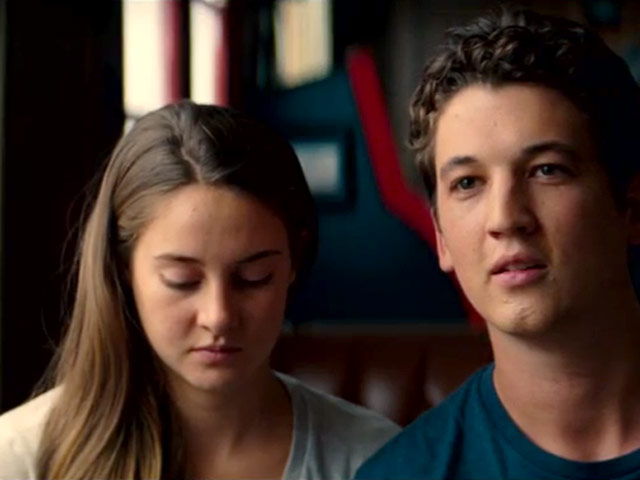
When we first meet Sutter Keely (Miles Teller, who is brilliant in this, his face morphing between man and boy with split-second speed), he's filling out a college entrance question: "Describe a misfortune, hardship or challenge in your life: How did it affect you, and what did you learn from it for the future?" Sutter doesn't even hesitate: "Dear Dean of Admissions: Up until yesterday, I had the best fucking girlfriend in the world. Sorry, I probably shouldn't say 'fuck' in this..."

Miles Teller, the breakout performance of The Spectacular Now

It's true.  Sutter's just gone through a bad break-up with Cassidy (Brie Larson), who, in his eyes, was the perfect girlfriend and they were the perfect couple, the hit at every party (and there are a lot of them), but it's all come crashing down when she says "I'm done!" over Sutter helping his buddy get a girl, by giving a couple of fellow high-schoolers some of the ice-cooler'd beers he regularly stashes in his trunk. Sutter's good for that, but for Cassidy that's not good enough. They're through, so over and done.

Cut to the title. Next thing we know, we're looking up at a sun-blocking silhouette saying: "Hey!  Hello?  He-lllooo!  Oh my God, you're alive!"
It's 6 am. He's passed out on a lawn of a house he's not familiar with, his car is nowhere to be found, and standing over him is Aimee Finecky (Shailene Woodley, proving that her instinctually felt performance in The Descendants was no fluke), who is out doing her Mom's paper route, only to find a body on the way. They know each other from school. Aimee helps Sutter up, and the two continue the route with two missions: delivering the papers and looking for his car. The goals are short-term, which suits Sutter just fine.

It's clear early on that Sutter is a boat without a rudder (or even a paddle), and the women in his life, be they his Mom (Jennifer Jason Leigh, welcome back), Cassidy or the new Aimee, keep him focused and on the true. Or as true as Sutter will let himself be (and Teller has a wonderful ambling gait, which I started calling "The Sutter Strut" that is both assured yet not going altogether fast, keeping anything approaching at a measured pace). Fairly early on, we learn that Sutter may indeed be "the life of the party," but he's also considered a flake and unreliable. A heated discussion in the family kitchen produces a "Sometimes, you remind me so much of your father..." comment (and not in a complimentary way) from his mother and he's annoyed because a) his father, having left the family early with no subsequent contact, leaves a void about how that should be taken; and b) he harbors the notion that the reason Dad's gone is that it's Mom's fault, all evidence to the contrary gone missing. In the meantime, and for the moment, he is spending his critical senior year in High School marking time, regretting Cassidy and "hanging out" with Aimee.

"Dude, she's not a rebound!" he assures a buddy, but it's pretty clear she is, at least at the start, using her as an excuse to go see Cassidy at a kegger. It's a quid pro quo kind of arrangement: she can help him with algebra, he up's her social quotient—she's never had a boyfriend and he's an established arm to hang on. But before long, the conversations start to get deep, the facile conversations ("what's your 'thing?'") turn personal, the "maybe-I'll-see-ya's" become orchestrated "bump-into's" and the period apart starts to become a noticeable measure of time. They're starting to fall into something: for her it means someone to share her plans for the future and college; for him, a long-term commitment is asking her to the prom.
She already knows what he's just beginning to suspect.
Now, before we go too far into this, let me say what a joy it is to watch Teller and Woodley riff off each other. The lines are established, sure, but the way they stumble, falter, eke out, and fly from each other's mouths colliding in awkward crashing cadences and emotional ranges between feigned self-assurance to tip-toeing fear is truly something to see and enjoy. Both actors are top of the line working with the other actors, but, with each other, there's a yearning sparring that feels like the magnetism of puppy-attraction. If it ain't convincing as love, it sure is convincing as fresh conversation that feels real (and spoken for the first time), and is as fine as any movie bantering I've seen in years between young actors.*
So, with all that raw talent going for it,** where does the movie go? There's been so much writing here, one worries that too much is going to be given away, and any particulars in subject matter and how it is revealed will result in the spoilage of any sort of subtle enjoyment of the film and how it subtly ingratiates and glad-hands you into darker territory. It skirts Afterschool Special territory, but does it in so circumspect a way that you may not even be aware of The Problem, until you are confronted with it in the same way Sutter confronts it, in reflection, but he sees it, not when he looks in the mirror, but when he is especially focused on something other than a short-term goal, but rather on the realization of a dream. Sutter has no depth, except in what he avoids, and he only realizes it to his horror and imagined shame. The Spectacular Now includes author Tim Tharp's original ending for the book, but the screen-writers give Sutter an "out" to end on an up-beat note in the grand Hollywood "bauble" tradition, but at least they take a page from Mike Nichols' play-book, and don't make it a comfortable one, but leaves him...and the audience hanging on a precipice, leaving the Spectacular Now and entering an Uncertain Future.***
"Stumble, falter, eke out and fly..."- Teller and Woodley


* Come to think of it, they remind me of the Andrew Garfield-Emma Stone hemming-hawing in The Amazing Spider-man.

** And I haven't even told you about Kyle Chandler, who plays against "type" and does it so unnervingly well, you want to start a barroom brawl with the guy.

*** The view from the "Now:" Talk about an uncertain future—Marc Webb got bumped off the "Spider-man" series after the under-performing Amazing Spiderman-2, Teller gained a more reputable role in Whiplash and doused it with Fantastic Four, and Shailene Woodley has very nearly wasted her talent with the "Divergent" series (Teller has co-starred in those). These are all talented people—what are they doing wasting their talents on "tent-poles?"

Saturday, February 13, 2016

The Hateful Eight

Just a Liar's Promise
or
Tarantino's Wasteland

The tag line says it all: "The 8th Film by Quentin Tarantino." And in the cackling obviousness that now seems to be part and parcel of what passes for the film output of Quentin Tarantino (except when he's doing in-jokes that are only discernible to the slavish) the title of it is The Hateful Eight. Hateful it is, a movie dominated by good actors playing the worst people in the world in what can only be called a Western torture porn with delusions of drawing-room-detection. Every one in it is the lowest of the low with pretensionss of forthrightness that only serve as fodder for the other characters to stick pins in or blow away with more shots than necessary. Oh, there are good people (and by that I mean non-desperate socio-pathic characters) in it, in but one chapter of the six that the writer-director segments his movie into, but their screen-time is the bare minimum. Like the blacklist in the speech that finalizes Trumbo, The Hateful Eight has no heroes or villains, only victims. 

And an audience member could easily identify with the victimization.


Look, I've always been on the fence about Tarantino. His early films I found flashy, but forced, the dialogue clever in a sophomoric and frequently irrelevant way. He was a kid showing off, usually at the expense of the talents of others as he would "borrow" from the cob-webbed end of the video aisle for his ideas. Nothing wrong with that. There's a lot of "cribbing" going on in the first films of directors. And sometimes, he does something surprising—I'm a big admirer of Jackie Brown and Inglourious Basterds. I thought his half of the double-bill, Grindhouse, Death Car, was a wickedly conceived—if drawn out—feminist tract. Those and pieces of Pulp Fiction, that's all I like. Two and half, maybe three films. The rest of them?

"Got room for one more?"
There's not much to enjoy or admire here, save for a few performances that stand out—Samuel L. Jackson's best acting in years, the return of Jennifer Jason Leigh who has always been a fearless actor, Kurt Russell's bravura performance, and a slippery, inconsistent one by Walter Goggins. The rest is Tarantino writing dialogue that goes on forever, punctuated by gun-fire and blood-spatter by the gallon, often with the intention of comic effect.
 
And to photograph this thing in 70 MM is the highest form of pretense.
The 70 mm format was designed for wide open spaces and vast vistas-(as well as snakes, trains, and funeral corteges). But more importantly, for horizons (and the more majestic the better) to take advantage of the sharpness and clarity of image the larger format provides. It's ideal for nature in the raw, less so for cities that strain and grow on the wrong axis out of frame. It is certainly a waste of format for a set-bound movie that does it's best to invoke cabin fever for 90% of it's nearly 3 hour length. Using 70 MM for this type of film is like using a SCUD to shoot down a duck. It's less a good artistic choice than a case of "Master"-envy on Tarantino's part.
The opening (and it's shot by the eccentric, but extraordinarily talented Robert Richardson, who Tarantino's been using for a while now) tries to cram as much scenic beauty as it can to last, but it is then followed up by such unremitting ugliness in image and spirit, that the effect is like putting a bow on a tarantula.
 
It's all downhill from the first line: "Room for one more?" says Major Marquis Warren (Jackson), the first of many characters to be revealed by the upturning of a hat-brim—wide-screen is good for that, too—as he echoes the line of the hearse-coach in Dead of Night
The Major is a bounty-hunter and he's sitting on some work as he's approached by a stagecoach bearing two passengers, John "The Hangman" Ruth (Russell) a shaggy-dog of a bounty hunter hand-cuffed to Daisey Domergue (Leigh) the spitfire sister of outlaw Jody Domergue. He's taking her to the town of Red Rock to be hanged for her crimes—that is, if she survives the trip. One of the running gags of The Hateful Eight is that Daisey is such a disagreeable little cuss that Ruth regularly punches, pistol-whips and clobbers her at every snarling offense (At one point, Ruth says: "Now, Daisey, I want us to work out a signal system of communication. When I elbow you real hard in the face, that means: shut up" as if he hasn't already worked out this system by example earlier than the movie began). Our first sight of her takes in a busted lip and a black-eye. Over the course of the movie, she suffers every non-lethal injury associated with the movie until, by the end, she bears a striking resemblance to Carrie at the prom, caked in blood acquired from all manner of splatters from nearly every member of the cast. If they had pattern analysis back in the day, all investigators would need for a thorough study of the crime scene would be her.
The coach acquires another passenger as a mountain blizzard starts to impede its progress, forcing it to stop at a "in-the-middle-of-nowhere" way station called Minnie's Haberdashery. That would be Chris Mannix (Goggins), caught wandering in the snow, who claims to be the new Sheriff of Red Rock. What he's doing in the middle of a blizzard in the highlands of Wyoming does look a little suspicious. Mannix was a Southern soldier in the Civil War, and that sets up a splintering dynamic on the coach. The Hangman and Major Warren fought for the North, so there's immediate animosity that is constantly brought up throughout the movie and allowed to simmer before it is acted on.
But, like the lousy coffee the coach-passengers find at Minnie's, it's been on the boil a little too long. Ten minutes can't go by without the War between the States being brought up, and then add four other characters to the mix—played by Bruce Dern, Tim Roth, Michael Madsen, and Demián Bichir (as Bob)—and it turns into a four-walled circle jerk in which precious little is discussed besides The War and "what are YOU doing here?" Those long dialogues are then snapped by gunfire, so much of which happens inside Minnie's four walls it's amazing that anyone could even hear what anyone's saying after so many indoor concussive sound-waves.
It's tedious, eventually. Tedious to the point where Tarantino must toss in a mystery that he plays out like a Hercule Poirot "j'accuse" monologue, a voice-over narration (voiced by Tarantino himself) that tries to bridge some gaps in the narrative—it's eight people in a room by this point, so why is he incapable of showing it?—and a flashback sequence to throw in some fore-shadowing after he has made the "Big Surprise" that he telegraphs seconds before he unleashes it. It's confusing, clumsy and more than a bit ham-fisted, as if he shot the sequences, but couldn't figure out where it would go in the movie until he had to, by means of explanation.
You wonder exactly what might have happened to the guy, who despite his promise, wasted so much of his time on hack-work that merely sought to recreate the junk he used to like (in his painful DGA interview with Christopher Nolan, he reveals that the inspiration for The Hateful Eight was television westerns—what would happen if you tossed together the suspicious-acting guest-stars that would show up and disappear every week? That may be the shortest reach for any film-maker who ever did more than just turn on a camera and let it run).
It's disappointing. And tedious. Not entertaining, and, in fact, maddening. This is Tarantino running on fumes and desperately trying to make a 70 MM silk purse out of a sow's ear. Perhaps it's time to walk away and not encourage him anymore. He's an abject lesson in what can happen to a director who becomes a media darling to the point where he thinks he pisses perfume. It's time to point out that the Emperor has no clothes, and that Quentin Tarantino has nothing to say.
I left The Hateful Eight wondering whether Quentin Tarantino is/was a talented filmmaker or the gibbering little troll with a knife in Don't Look Now.

 *