Written at the time of the film's release...Notes on a Scandal (Richard Eyre, 2006) There's a  sub-category of movies that always sends K. and I into fits of giggles. It started when we saw (take a breath) Kenneth Branagh's film of Francis Ford Coppola's production of Mary Shelley's 'Frankenstein.' (whew!) We'd enjoyed Coppola's Bram Stoker's 'Dracula', and liked Branagh's earlier films. But something about this "Frankenstein" went seriously off-the-rails. It seemed like every performance was delivered at fever-pitch (except for John Cleese, who drastically underplayed to avoid Python-esque associations), Branagh's direction was a combination of Brian DePalma swoop-and-carousel moves and Michael Bay "shudder-shots," and Brian Doyle's score was dialed up "to 11." After awhile, she and I turned to each other with our eyes wide, and I said "I think everybody in this movie needs a good night's sleep!" and from then on, we couldn't take the movie seriously anymore. Everybody in Notes on a Scandal needs a good night's sleep. It's a bit like Snow White done as an urban British drama. Except "Snow" isn't quite as pure. Here's the gist: Judi Dench plays Barbara, an embittered veteran school teacher, who develops a fixation on Bathsheba (Cate Blanchett), a new art-teacher in school. Sheba, as she's know, begins an affair with one of her young students, which becomes known to Barbara quite early on. Barbara then devises a scheme to blackmail a relationship with Sheba and drive a wedge between her and her family, with the aim of having Sheba for herself. It's a joy (and a scary thing) to see Judi Dench turn on the after-burners and go into full "battle-axe" mode. Her Barbara is the creepiest creation since Anthony Hopkins' Hannibal Lecter, with the added element of a pathetic (calculated?) vulnerability, and she's matched by Blanchett's distracted portrayal of the flibbertigibbet Sheba. There's one scene where both women go into an acting fever-pitch and its a bit like watching the performances fuse into one that's fascinating to watch, but makes you want to pull the "Emergency Stop" cord. And the hysteria is pushed at every hint of motion by Philip Glass' galloping score, even when it seems entirely gratuitous. It makes you want to back away slowly, get behind a locked door...and get a good night's sleep.
Written at the time of the film's release...
"The Boy in the Spastic Bubble"
The latest film by Noah Baumbach, Greenberg is a tour de force for actor Ben Stiller, who knows how to marginalize audiences himself (he directed The Cable Guy and Tropic Thunder, after all). Combine him with the writer-director of The Squid and the Whale and Margot at the Wedding and you have two individuals creating something capable of making you squirm uncomfortably (in your comfortable theater seat) for its entire two hours, waiting for (if it were so formulaic) a reckoning of devastating proportions.
That would be letting you off easy.
Roger Greenberg (Stiller) is recovering from a nervous breakdown, and is house-sitting his brother's place and dog in L.A.—a place where he can relax in the hills above the smog and try to put his life back together. A carpenter by trade, it is his goal to build the dog a dog-house. "I'm really trying to do nothing for awhile," is his stock answer. "That's brave at our age," says an old flame (Jennifer Jason Leigh, who co-wrote the story) that was extinguished long ago. Greenberg tries to connect with old friends from school days, but as he didn't communicate with anybody while he lived in New York, there's not much in common anymore.

Greenberg is essentially stifled. Not capable of moving forward and paralyzed at the thought of doing something to change that ("I woke up one morning and literally my legs couldn't move. They said it was psychological."), he exists through the day not calling people, then wondering why nobody talks to him. He's insensitive to other people's needs, wants or emotions—he can't see past his own smog drifting through his mind.
Because there's nothing else to do—he doesn't drive, not terribly convenient in L.A.—he ends up seducing his brother's nanny (Greta Gerwig), herself a fairly directionless person, numbed by a recent break-up and a tendency to be too compliant.
But, the relationship is one way and it all sucks towards Roger. A psycho-narcissist, he is so self-absorbed that any empathy perspective or ambition save for animal imperatives have been consumed and purged. A nanny is perfect for him, as he hasn't grown up. At all. And seems doomed to drive off any kind soul, sympathetic enough to put up with his bullying in-denial bullshit.
Now, let's pause for a second. We've been talking about Greenberg this whole time. let's talk about YOU for a moment.
YOU are NOT Greenberg.*

Oh, you might be in your worst moments—everybody can reach their limits of tolerance, have a crisis or a bad hair day and be less than 20%. And Greenburg can be a litmus test for anyone the least bit self-absorbed (but not in denial). I've already read a couple of reviews that seem to cast the writer's own issues onto a scenario that don't suggest them. So, yes, you will recognize yourself and others in this movie (all except for you, Mother Theresa), but you are not Greenberg. If you were, you'd already be dealing with it by subsisting on some anti-psychotic, anti-hysteric, anti-depression pharmaceutical to get past it. And understand, this is Greenberg's behavior ON Zoloft.
So, this movie can make you crazy. I had waves of wanting to strangle this 40 year old infant...if he weren't already doing it to himself. Reactions to a movie like this can be healthy; at least, I didn't want to walk out. And there is the least amount of some resolution to this guy who isn't happy unless he can hear himself talk.
Still, this is one to take in stages...at home.

* I succumbed to this. I can be insensitive, self-absorbed (I write...duh), and fail to recognize the needs of others. The one that hit me the hardest is that Greenberg occupies his time writing complaining letters to...everyone. And what have I been doing? Writing movie reviews (I blame you, you read them). But, I've been doing other things as well. I have the most finely buffed and polished resume in town. My dog has his waist back (it's been a long Winter), and the taxes were done sooo long ago. I am not Greenberg. You are not Greenberg.
But THAT guy? Oh, man! (*tsk*) Def-initely.
Written at the time of the film's release.
 "See You Next Thursday..."
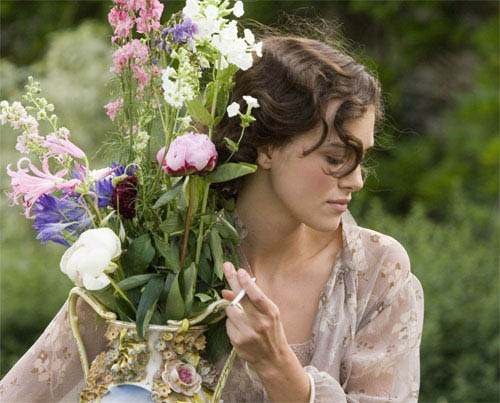
Atonement is Joe Wright's masterful film of Ian MacEwan's novel about the responsibilities of authorship and ownership. A tricky novel to adapt, it manages to become just as valid as a film as it does on the printed page. Wright's last film was the umpteenth adaptation of Pride and Prejudice and both he and Keira Knightly managed to make the adaptation relevant and seem needed, though Wright, in an effort to breathe life into it, would sometimes go a bit overboard in his camera tricks.
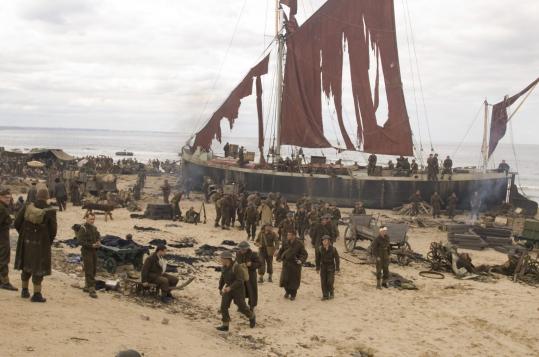
Here he's much more assured, still suffusing the film with a restless energy, but also getting out of the way of the actors when the drama goes quiet. His "big trick" this time is a five minute continuous shot of the beach at Dunkirk that keeps time with the soldiers, dodges the vehicles in a panic, the muck and the mire, winds around a choir and gives you a hint of the simmering panic of the soldiers stuck on the last patch of land between the enemy and salvation.
"See You Next Thursday..."
Atonement is Joe Wright's masterful film of Ian MacEwan's novel about the responsibilities of authorship and ownership. A tricky novel to adapt, it manages to become just as valid as a film as it does on the printed page. Wright's last film was the umpteenth adaptation of Pride and Prejudice and both he and Keira Knightly managed to make the adaptation relevant and seem needed, though Wright, in an effort to breathe life into it, would sometimes go a bit overboard in his camera tricks.
Here he's much more assured, still suffusing the film with a restless energy, but also getting out of the way of the actors when the drama goes quiet. His "big trick" this time is a five minute continuous shot of the beach at Dunkirk that keeps time with the soldiers, dodges the vehicles in a panic, the muck and the mire, winds around a choir and gives you a hint of the simmering panic of the soldiers stuck on the last patch of land between the enemy and salvation.

But, as he proves a master of space, Wright also plays with time and memory in Atonement, sometimes starting the movie again a reel back to give you an added detail, another viewpoint, a fuller story than one unreliable narrator can provide. His camera snakes along with the participants meeting them stride for stride in their careless haste, and eking out humor in the frailties and shows of civility. And if Wright's work isn't enough to bring home the point, Dario Marianelli's chattering, propulsive score provides a sonic counter-point, blending seamlessly with the sound design and characterizations.

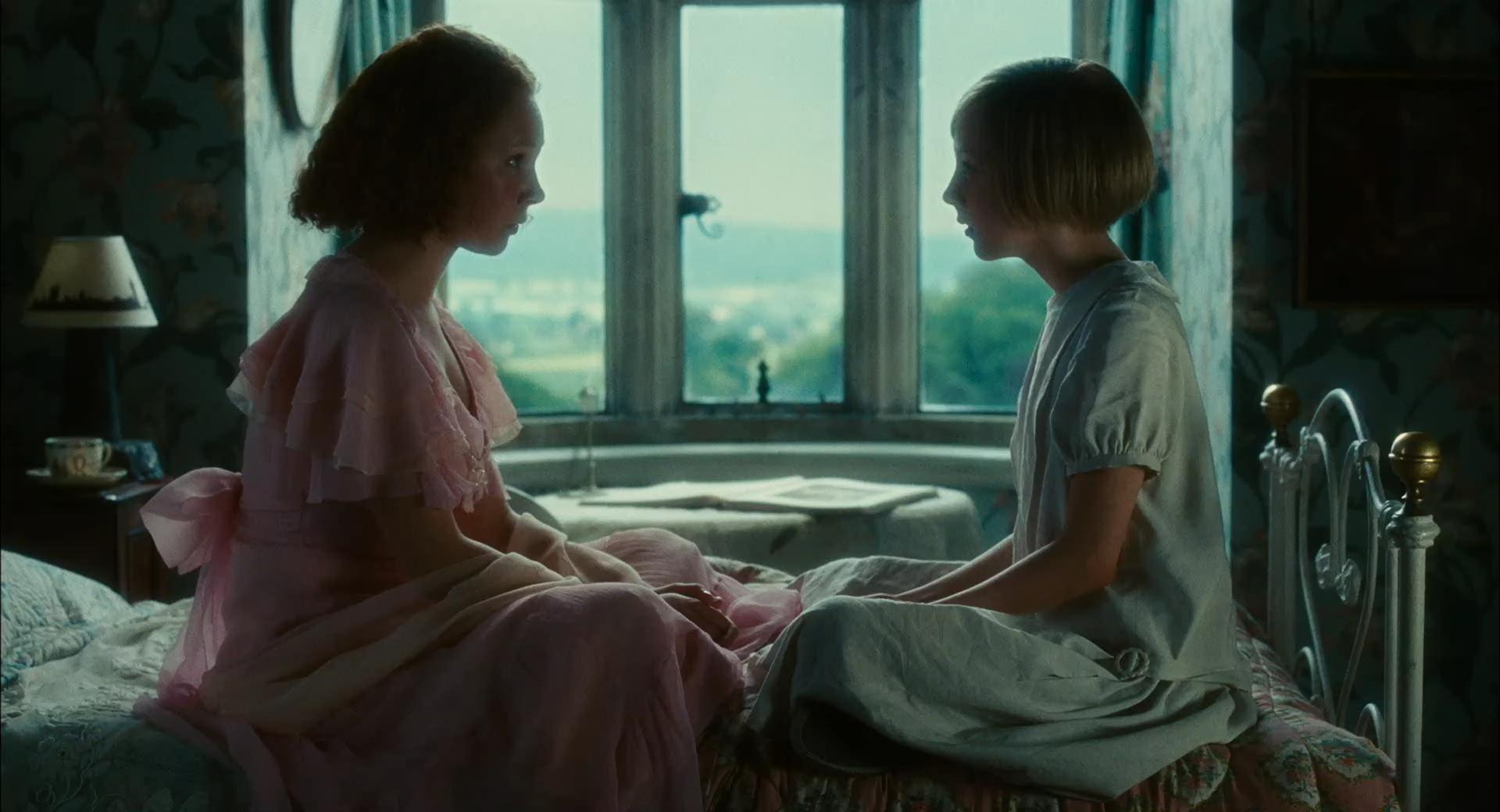
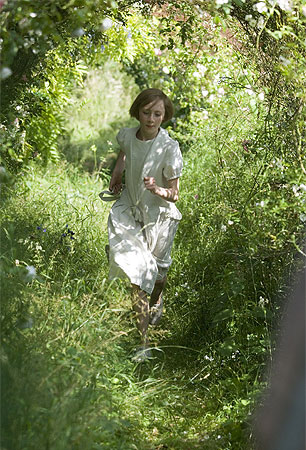
Keira Knightley and James McAvoy (he's never been better) are getting the lion's share of acting accolades, but the true miracle of this movie are the trinity of actresses playing authoress Briony Tallis--Saoirse Ronan, Romola Garai, and Vanessa Redgrave--at various stages of her life. They are united by their haunted eyes, seeking out the truth, desperate for comprehension...or what they accept as comprehension. Those eyes grow more feeble with age, more unsure and tremulous, and garners an empathy that helps leaven sympathies for the characters involved, and in doing so Wright provides an "Atonement" of his own.
Alliance
or
The Flea-Bitten Bulger Instigation
The old saying goes that if you lie down with dogs, you wake up with fleas. Black Mass tells the story of how misguided loyalty can make a hash of good intentions when combined with vicious ambition and the manipulations of psychopathy.
It tells the mostly true story of a "Southie" law enforcement officer, John Connolly (Joel Edgerton) in the Boston racketeering unit of the FBI. The focus of their investigation was La Cosa Nostra—the Mafia—but there was a rival Irish mob called the Winter Hill gang, that was composed of a second-generation gang of street toughs who supplanted their bosses after they were convicted of gambling and bookmaking. This group expanded into drugs and money-laundering by expanding their reach out of state, while concentrating on eliminating any rivals in the local area. They weren't that "much," until Connolly used them to break up the Italians, protecting them from prosecution or investigation, leaving the Irish to fill the void left by the Mob and increase their influence and profits.
One of them stood out—Jimmy "Whitey" Bulger (played here by Johnny Depp) had done a stretch in Atlanta Penitentiary and Alcatraz and came back to Boston with an increased ruthlessness that was indiscriminate in who it targeted. It didn't matter if you a rival or part of the gang, if you looked at Bulger funny it was a death sentence. One of the ironic things about the story is that Bulger's older brother William (played in the film by Benedict Cumberbatch) was a fixture in Boston politics, a state Senator who would become Senator Majority Leader and President of the State Senate while his brother was essentially the power behind the most ruthless organized crime mob in his district. It is through William that Connolly reaches out to Jimmy agreeing to what semantically they agree to call "an alliance"—Whitey will give them pertinent information about the Angiulo mob, while Connolly provides interference with the feds' finding out about Bulger's activities. It's not being an informant, it's not "snitching," it's doing each other turns that will be mutually beneficial and helping a fellow local advance in their respective fields. One hand washes the other. But one of them is soaked in blood.

The film is told in chronological order in the form of deposition interviews with captured members of the Winter Hill Gang, presumably in an ongoing investigation into the whereabouts of Bulger who skipped town just as he was about to be arrested by the Bureau. Although the crimes and "hits" are the most inflammatory of the incidents in the movie, it runs a parallel path of telling Bulger's story of how he increased his stranglehold on crime and the Boston area to the point where he thought he was untouchable.
Absolute power corrupts absolutely...but if you're corrupt to begin with?

So, how's the film? Not bad, actually. It may remind one of Martin Scorsese's The Departed (a film I didn't particularly like, but it did give Scorsese his first Oscar for directing so that's significant) which was a remake of the Japanese Infernal Affairs (and actually the series of Infernal Affairs movies, which, in turn, was inspired by Scorsese's gangster films) but incorporated the Irish mob of Bulger (with Jack Nicholson's Frank Costello inspired by the erratic Bulger) as the center of the gang activities. The Departed told the story of two informants—one for the police, one for the mob—that did a deadly dance around each other, trying to keep their identities hidden. There are no such complications in Black Mass. There's the mob and the FBI and they have "an understanding" to cooperate as long as they stay out of each others' way. Bulger can reveal Connolly's "deal" at any time; Connolly can merely choose to renege on his deal and let the FBI do its job. But, for neighborhood loyalty, and a chance to advance each other's careers, the "alliance" is allowed to proceed.

Connolly's immediate boss (David Harbour) goes along with the idea, but the division head (Kevin Bacon) has several degrees of misgivings about it and wants to keep Connolly—and Bulger—on a very short leash. With Connolly's co-workers running interference, the FBI manages to take down the Angiulo mob in what is seen as a triumph, which only cements the unholy deal between Bulger and law enforcement. Even though the Angiulo ledger gets erased, Bulger's Winter Hill gang starts to rise in power, with a sharp spike in protection...by murder. Bulger's grab for power isn't subtle, and pretty soon the body count rises precipitously, with no regard to any consideration other than "you shouldn't've crossed Whitey." Only until a new broom Boston prosecutor (Corey Stoll) comes to town does the tangled web start to unravel and the truth comes out.

The strength of the film comes from the script (by Mark Mallouk and Jez Butterworth) which manages to keep a very complicated story simple and on-the-rails and in several key performances, the most prominent of them being Johnny Depp's. For fans of Depp, it may not be an entirely enjoyable experience. The chiseled pretty boy, that always seems to be below the surface no matter how elaborate his make-up, is gone. The high cheekbones and shaved hair gives it the appearance of a skull, and every time Depp shows off his teeth, there's an elaborate dental prosthetic that completely deglamorizes Depp, something he rarely does—even his John Dillinger in Public Enemies didn't mess with his looks.

It's a steel controlled performance, that in its quieter more threatening moments, has more than a suggestion of older, restrained Jack Nicholson to it. It's in marked contrast to most of the other actors'—chief among them Cumberbatch and Edgerton—whose performances are a bit too "brahd" due to their florid "Bahston" accents that seem to travel all over Massachusettes. But Harbour, Stoll and especially Peter Sarsgaard, manage to seal the truth of their performances without worrying about whether they sound like townies.
There's one scene in particular that works like gangbusters in showing the creepy malevolence of the situation, especially when dealing with a manipulator like Bulger. At one point, Harbour and Edgerton's agents are having a sit-down dinner with Bulger and his lieutenant, a little meet-and-greet among collaborators. The conversation (which is the basis of the preview clip below) turns to the meal and there's a palpable malevolence to the performances that turns casual conversation into threat—a little demonstration of what the consequences might be if Bulger decides that his "good buddies" might have any doubts about their conspiracy of silence. It's in small moments like it where Black Mass rises above its cops-and-robbers roots.
 sub-category of movies that always sends K. and I into fits of giggles. It started when we saw (take a breath) Kenneth Branagh's film of Francis Ford Coppola's production of Mary Shelley's 'Frankenstein.' (whew!) We'd enjoyed Coppola's Bram Stoker's 'Dracula', and liked Branagh's earlier films. But something about this "Frankenstein" went seriously off-the-rails. It seemed like every performance was delivered at fever-pitch (except for John Cleese, who drastically underplayed to avoid Python-esque associations), Branagh's direction was a combination of Brian DePalma swoop-and-carousel moves and Michael Bay "shudder-shots," and Brian Doyle's score was dialed up "to 11." After awhile, she and I turned to each other with our eyes wide, and I said "I think everybody in this movie needs a good night's sleep!" and from then on, we couldn't take the movie seriously anymore.