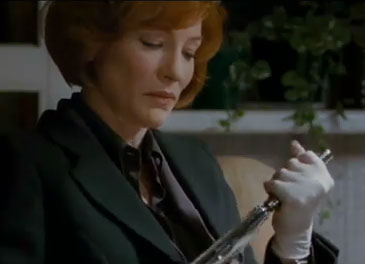
Lady Bard
or
"Who Wrote 'Little Women'?"*
It's the umpteenth remake of "Little Women" (Let's catalogue and differentiate them by "Jo's"- there's the 1917 and 1918 silent versions, 1933—the Katherine Hepburn version directed by George Cukor, 1949—June Allyson's directed by Mervyn LeRoy, CBS-TV musical version in 1958, 1970 BBC version, 1978 TV version, 1994—Winona Ryder's directed by Gillian Armstrong (a woman, fancy that!), PBS Masterpiece did one in 2017, 2018—a "modern re-telling", and that's not even counting the handful of TV series and an opera based on Louisa May Allcott's 1868-1869 classic novel about the March sisters, growing up and surviving love, war, societal pressures, class disparities—not to mention inherent entrenched sexism—during the U.S. Civil War and its aftermath. Pa March is a pastor by profession and away during the war and the March women have to fend for themselves in times of privation in a small rural town in Massachusetts...with no man in the house.
Despite that last part, the book became a classic, much to the surprise of Alcott and her publisher, who only went forward with its publication when his niece found and read the uncompleted manuscript and asked him "What happens to the little women?"

What doesn't? The daughters of Marmee March (Laura Dern in Greta Gerwig's new 2019 version) are as different as could be: oldest Meg (Emma Watson) is a beauty and is the most responsible of the girls, graceful and who should be an actress if she had such frivolities in mind; next is "Jo"—Josephine (Saoirse Ronan), the drama queen and tomboyish, who wants more to be a writer than a wife, writes plays for her sisters and holds aspirations outside the home—she is closest to the author in spirit; next is Beth (Eliza Scanlen), shy, domestically skilled and musical—she plays the piano—she is the most tranquil of the March girls, serves as the voice of reason in their squabbles and has no aspirations for a future career or husband and lives in the moment; the youngest is Amy (Florence Pugh), mercurial, vain and selfish and in a perpetual up-hill battle to make herself noticed apart from her sisters. She has a constant sense of being handed down and, to escape the shadow of her sisters, aspires to painting and achieves a new found maturity when she is taken by her Aunt (Meryl Streep) as a companion on a trip to Europe.

The film is familiar in incident if you've seen any film version or read the book. The Marsh's are taught to be empathetic to their neighbors and are rewarded by the attention of neighbor Mr. Laurence (Chris Cooper, never sentimentalizing) and his charming "black-sheep" grandson Theodore—who prefers the less formal "Laurie"—played by a brilliant Timothée Chalamet. The Laurence's will rotate in and out of the Marsh's orbits during the course of the story, if not impacting them at least having a gravitational influence on their actions. There will be squabbles and jealousies and defiance and regrets, some that are quickly resolved and others that will forever simmer. One of them will die of scarlet fever. Two of them will travel and grow in the process and the survivors will find love but not in the places they (or the readers) expect.

What has always intrigued about "Little Women" is Alcott's subversive way of answering the publisher's daughter's question of what happened to the little women. And the versions that have been presented previously have gone down the path of a regular timeline following the Marsh women from adolescence to adulthood in the same way Alcott presented it in the story. If it's good enough for the author, after all...
But, I think Alcott would have been intrigued by Greta Gerwig's version just for its defiant way of trying to find a better means to tell the story, and in so doing, taking the book and making it an experiment in literary quantum mechanics.
Yeah, I know. Stay with me here.
When we first see Saoirse Ronan (and she's terrific in this but nobody's not), it is later in the timeline. She's in New York at a publisher's, screwing up her courage to present a story that she has written and the appointment that she has with the fellow in charge is not going well. What she's writing is not to buyers' tastes she is man-splained: "Morals don't sell these days. Make it short and spicy and if there's a woman in it make sure that, by the end, she's married...or dead." How Brönte. But, not entirely daunted, she goes back to her boarding house and is so distracted by her putting notes to page that she has to be told that she's on fire as she's standing too close to the grate.

At the same time, youngest March, Amy, is in Paris accompanying her dowager Aunt when she runs into Laurie all the way from Conchord, Mass. where he is drifting and she invites him to a party to which, as he has tended to be with one exception, noncommittal. Meanwhile, Jo, back in New York, is struggling with her writing and seeks the opinion of a Frederich Bhaer (Louis Garrel), a professor and fellow boarder, who has expressed interest in her work. His opinion, to Jo, is damning with faint praise. Another man, another set-back. But, a telegram from Conchord informs her that younger sister Beth is sick and not improving, and Jo sets her mind to returning home to help her sister's recovery. After all, she's done it before.

It is only then that Gerwig begins the story of "Little Women" in a semi-chronological and traditional manner, but she will interrupt that chronology at optimum times of contrast to deepen how things have changed between the girls' past and their present situations, providing back-story and insight as the Marsh women go through the toughest life-and-death situation of their lives, the one that will impact them the most, the repercussions of which effectively ends their childhoods and set their futures on a more sure track.

To my mind, this is the best version I've seen of "Little Women," and the best version of a "classic" since the Ang Lee-Emma Thompson version of Sense and Sensibility. It adheres to the times and constraints of the period in which it's based—no one goes around saying they're going to "throw someone under the bus" or some other hogwash-anachronism to satisfy contemporary audiences. It doesn't pander to modern audiences to buy cheap currency, and it does make sure that "the stakes" of the story conform to the limited status of women in the 1860's, almost out of desperation. There is no goal of emancipation shining at the top of the hill for the characters to reach. They are stuck with their lot and must make the best of it. At one point, Pugh's Amy comes right out and says it at a moment of desperation—she has been challenged by young Master Laurence over the man she has been seeing and from whom she expects a proposal (it is his way of worming his way into her affections after being turned down by Amy's older sister Jo):

Amy March: Well, I believe we have some power over who we love, it isn't something that just happens to a person.
Theodore 'Laurie' Laurence: I think the poets might disagree.
Amy March: Well. I'm not a poet, I'm just a woman. And as a woman I have no way to make money, not enough to earn a living and support my family. Even if I had my own money, which I don't, it would belong to my husband the minute we were married. If we had children they would belong to him not me. They would be his property. So don't sit there and tell me that marriage isn't an economic proposition, because it is. It may not be for you but it most certainly is for me.
Meanwhile, half a world away, Ronan's Jo ("I can't get over my disappointment at being a girl!") is arguing the other side of the coin (although she has always been the more independent of the two), is weakening, and is reconsidering young Master Laurence, more because she has been on her own and she misses her childhood and its possibilities rather than her lot as an adult and merely "being":
Marmee March: What is it?
Jo March: Perhaps... perhaps I was too quick in turning him down.
Marmee March: Do you love him?
Jo March: If he asked me again, I think I would say yes... Do you think he'll ask me again?
Marmee March: But do you love him?
Jo March: [Tearing up] I know that I care more to be loved. I want to be loved.
Marmee March: That is not the same as loving.
Jo March: Women, they have minds and they have souls as well as just hearts. And they've got ambition and they've got talent as well as just beauty, and I'm so sick of people saying that love is just all a woman is fit for. I'm so sick of it! But... I am so lonely.
And her choices are few. And within her own family there are limited options. To quote her publisher, end up either married or dead. Jo comes back to Conchord because her next-youngest sister Beth has had a reoccurrence of the scarlet fever she'd had years earlier, and Jo, thinking her singular care and devotion helped her previous recovery charges back. "You can't stop God's will," says Beth. "God hasn't met my will yet," she imperiously shoots back. "What Jo wills shall be done." And it's here where Gerwig's back and forth story-telling has its largest pay-off, emotionally and directorially and moves the story to its best gambit.

To help Beth's condition, she takes her to the seaside, where this exchange takes place:
Beth March: I love to listen to you read, Jo, but I love it even better when you read the stories you've written.
Jo March: I don't have any new stories.
Beth March: Why not?
Jo March: Haven't written any.
Beth March: You have pencil and paper. Sit here and write me something.
Jo March: Uhh. I can't, I don't think I can anymore.
Beth March: Why?
Jo March: It's just, no one even cares to hear my stories anyway.
Beth March: Write something for me. You're a writer. Even before anyone knew or paid you. I'm very sick and you must do what I say. Do what Marmee taught us to do. Do it for someone else.
And she does. In a weeks-long effort, she writes, re-writes, edits, and organizes her story—which is a semi-autobiographical account of the life of the March family, her family, and submits it to her publisher who is less than enthusiastic, but it is found by his daughters who are enchanted and ask the question of him—"What happens to the little women?" And so the publisher takes a gamble—hedging the bet with some (of course) editorial suggestions, but Jo gets her book published and watches as the inks are mixed, the pages printed, folded and cut, the binding stitched and the title etched: "Little Women by Louisa May Alcott."

And that's what the cover of the book says: "Little Women by Louisa May Alcott." It's not the character of "Jo." It's Louisa...and Gerwig, by doing that, explodes her "Little Women" adaptation, not just telling the story of Jo and the March sisters and Marmie and Laurie and all the others, but providing the inspiration—as Alcott's life truly was—for the story, for the publication...and for the classic, before it became a classic and a "must-read" and then atrophied to be part of a list on someone's syllabus.
It was a life. And it's publication as fiction changed things, not only in the prejudices of publishing, but what could be written of, what could be appreciated by children (and adults) and in the aspirations of women (even if the story ends in either marriage or death). Gerwig not only makes the best adaptation of the novel in her Little Women, she also shows how the book that she has adapted nudged things just a bit forward in a patriarchal society—even if the patriarch isn't present—and how women could be more than just fated to be the ingenue in a romance, but rather the vehicle of her fate. That's big. That's revolutionary. And it's been missing from other versions.
It's an adaptation made with considerable love...and considerable respect.
* This is a running gag they used to do on the old spy-comedy television show"Get Smart!", where they had rather insane passwords and call-signs, one of which was "Who Wrote 'Little Women'?" the contact usually said "The book or the picture?" or "The book or the Broadway musical?" and Maxwell Smart, Agent 86 of CONTROL would inevitably blurt out, incredulously "It was a BOOK?!" But, then, when the head of CONTROL first introduced the call-sign "Who wrote 'Little Women?'" to him, 86 replied "Lonely little men...?" Of course, he would.

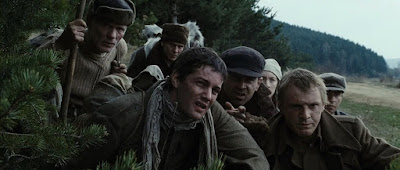 One could speculate—for the length of such a journey—why it had never come to the screen before: too depressing—but think what it would do for soda and popcorn sales! Elvis wasn't interested, indeed, what star would take on such a rugged movie, Burt Lancaster's brief interest notwithstanding; the movie has a lot of explaining to do about socio-political situations; the Russian market might not be too pleased with the film, and on and on. Weir made it (reportedly for less than $30 million, which seems incredible), but so few studios were interested in it that it almost went straight to video...which would have been a shame, as this is one of those movies demanding to be seen on a big screen.
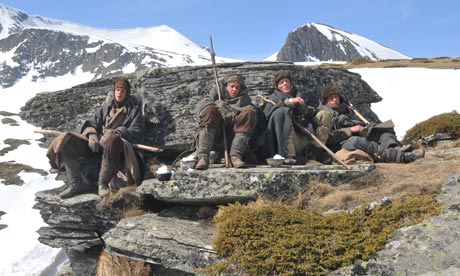
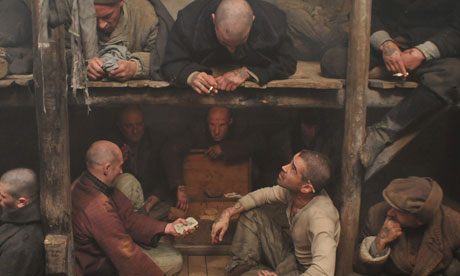
 Janusz (Jim Sturgess) begins the film under interrogation in occupied Poland. The year is 1940. He has been turned in (reluctantly) by his wife under torture, and he is sent to a Soviet gulag in the mountainous regions of Siberia. After a period of learning the ropes (and the whips of the guards and the barbed wire of the camp), he becomes a part of a loose group of prisoners of differing skills and supplies to make a fast surgical escape from the gulag and make their way to Mongolia. Based on a loose plan of prisoner Khabarov (Mark Strong), they plan to make it to Lake Baikal, following it to the Sino-Russian railway. Their supplies will run out in mere days, but Janusz is convinced they can live off the land, walking the entire way. Among the group of escaping stragglers are "Mr. Smith" (Ed Harris)—"First name: Mister"—a particularly mysterious American (he tells Janusz, "you have a weakness I can use: kindness"), and, as it seems all movie escape attempts must have, a plays-by-his-own-rules maybe-criminal named Valka (Colin Farrell). The group begins suspicious of each other, but soon forms a close-knit, surprisingly democratic structure, sharing ideas and resources, voting when they're at a crossroads—despite the occasional individual insurrection.
 Watching the movie is a slog. At 2 hours, 20 minutes, with the principal characters pushed to their endurance, the film feels longer than its running time, but one is never tempted to do a watch-check. The Way Back is one of those films that keeps you guessing, intrigued and involved every minute, like you were involved in the long walk, craning to see what is around every corner. Weir keeps the pace moving quickly, cutting scenes briskly from one episode to the next, so the film develops a natural rhythm.
 But, it's the director's eye for detail—as always—that is striking, with scenes of stark, natural beauty that astonish: taking refuge in ancient caves, the camera pans up, following a bedraggled Mr. Smith's gaze, to two large holes in the ceiling, like the angry eyes of God; walking up a scrabble hill, Weir directs our view up and over the weary travelers to a screen-stretching shot of the expansive Gobi desert; at one point, they find a single solitary structure—a gate with no walls—absurdly marking their goal, while announcing another set-back.
 It is a grueling adventure story with fine performances all around, interpreted through Weir's talent for keeping things real, even when they turn startlingly surreal. Go prepared for a tough movie, but a satisfying one, that, like all escapes, becomes a journey of the individual will and spirit, covering all manner of obstacles in physical space, mental discipline, and the longest journey...of time.