Showing posts with label 2009. Show all posts

Wednesday, August 13, 2025

Will the Real Alfred Hitchcock Please Stand Up?

It's Alfred Hitchcock's birthday today—he would have been 125. And there was a day last year, when I suddenly became besieged with a lot of Hitchcock documentaries, all purporting to use his words to get at the mystery behind the director of so many mysteries and thrillers. Even the names of the documentaries were creepily similar, confusingly so, which would have made the old guy sniff at the lack of originality, rather than chuckle.
But, the name is the thing. The name "Alfred Hitchcock" was a brand and more people knew his name and the type of entertainment he made than any other director. Like an irony in one of his movies, it was both a blessing...and a curse.


I Am Alfred Hitchcock
(John Ashton McCarthy
, 2021) A career overview, the type you're likely to see if someone has no real access to the subject and merely a large collection of clips to cull from. Think of it as an "Entertainment Tonight" career overview...with a little bit of speculation about what made Hitch "tick." But, not much.
 
And it's extensive: from home movies to his interviews—both filmed and merely audio as well as with some confederates, old and new—starting from Hitchcock's childhood, including (invaluably) his time in early British silents and German studios. And a lot of unseen talking heads. A couple of snatches of past Spielberg interviews are included, but most of the comments are from Eli Roth (for some reason), William Friedkin, Edgar Wright, and John Landis. Ben Mankiewicz weighs in. Much mention is made of Joan Harrison (as it probably should be, given the work she did for him in his American transition and on his television shows) and there is a lot of nice footage from the AFI salute to the man, including his extensive tribute to his secret weapon, wife Alma Reville. There are nice touches throughout, and it's quite entertainingly put together. But, as an exploration of the man, his movies, and how they all relate, it's pretty basic stuff.
 
 
My Name is Alfred Hitchcock
(Mark Cousins, 2023) The iconoclastic Irish documentarian (he made The Story of Film: An Odyssey and The Eyes of Orson Welles) makes his look at Hitchcock (for his first film's 100th anniversary) with a conceit that he's used in some of his lesser-known films, as a conversation between the filmmaker and the director-subject (voiced by Alistair McGowan and quite convincingly). Oh, some of the things that McGowan-Hitchcock says in the film are a matter of record, but Cousins uses this conversational version of "Alfred Hitchcock Explains It All To You" to build on themes that might have gotten lost in the chases and cameos, the Blondes and the wrong men and the usual accoutrements of a Hitchcock film—"the core of things" (as the faux-Hitchcock states). These are Cousins' personal thoughts and observances being seduced and manipulated by Hitchcock, who used the mechanics of cinema, the psychology of photography, and his own neuroses to dredge up our fears, raise our blood-pressures, and ponder our natures (while pandering to them, as well).
And so, though they're Cousins' observations through the voice of Hitchcock, one could hardly help thinking that Hitchcock is being misinterpreted ("You do know that movies are lies, don't you?" says the faux-Hitchcock at one point) as he was one of the most obvious of directors—what he intended he put on the screen. It's just that nobody had done things quite like that before, made movies like that before, thought thoughts like that and confessed them so nakedly like that before.
Cousins is generous with clips as he focuses on six themes that thematically run through the director's films: Escape, Desire, Loneliness, Time, Fulfillment, and Height. Just reading that list, one can tick off random instances from Hitchcock films that will prove the point, but that they run consistently through his work, even fleetingly more than proves Cousins' point.
 
At the same time, Cousins' Hitchcock has a marketer's point of view on making films. This version emphasizes "stars and glamour" as the motivator for attracting audiences, as they already have a sympathetic, empathetic view of the actors, doing a lot of the leg-work to get them on "their side." To the point where Cousins' Hitchcock avatar never mentions character's names in his movies, only the thespians. "When Cary Grant" does this or "when Grace Kelly does that."

 
"You think all the way through that cinema is going to be killed by television or television is going to kill cinema or America is going to kill Russia or Russia is going to kill America. But at the end, it’s the third one, the new one, the younger one, the YouTube version, that comes along and kills them all."
 
"They say that if you meet your double, you should kill him. Or, that he will kill you. I can't remember which, but...the gist of it is...that two of you is one too many. By the end of the script, one of you must die."
 
The wildest of the Hitchcock documentaries, Double Take is a "found-footage" documentary using even the very grain of the image to tell the story. Based on a Jose Luis Borges short story, "August 25, 1983" and expanded from Grimonperez's* earlier short Looking for Alfred, it is a long story, narrated by another Hitchcock sound-alike, Mark Perry, of an encounter a fictitious Hitchcock has in 1963 with himself from 1980. It's a shaggy-dog story, recreated with a Hitchcock lookalike, and a lot of editing between Hitchcock footage...from "Alfred Hitchcock Presents" and other sources, interspersed with news coverage of geo-political events and Instant Folgers commercials (which turn bad coffee into domestic drama). It's a bit of a satire about the new replacing the old, but not changing much for the transition. It doesn't precisely nail its thesis, events being difficult to bend to one's advantage. But, there are moments of wit and some lost opportunities.

 
Becoming Hitchcock: The Legacy of Blackmail
(
Laurent Bouzereau, 2024) Writer-director Bouzereau has made a career out of directing films in support of other films; watch any DVD of any "important" film of the last 30 years and Bouzereau has directed or produced it, even producing anniversary-soundtrack expansions of some film scores. His work has given him a rolodex of contacts and access to some of the great directors and the archives of many a film. His style is breezy, entertaining and imaginative—when he wants to get to the bottom of a story, he'll get there and make it as memorable as its subject. And when doing a documentary of, say, Mark Harris' Five Came Back, he'll shed the customary upbeat promotional stance required to gloss up the subject to a glittering press-release, and risk being too revelatory, even to the subject's disadvantage, in order to drive home his point and make it the definitive word on the subject. He's good. Very good. It's no wonder so many high-profile directors and producers trust him telling the story of their work.
And in his film for StudioCanal and TCM, Becoming Hitchcock, he also tries to get to the depths of what made Hitchcock not only unique but "a brand."  His thesis being that Hitchcock's 1929 film Blackmail was the first of what one could call "a Hitchcock film" with the tropes of wronged people, distinctive weapons, arresting blondes, landmark chases, eroticism, food fetishes and such being firmly in place as they would be for the rest of Hitchcock's career (what, no mothers or enclosed places?)
It's true to a certain extent, even considering there is some cherry-picking going on. But, if one is looking for "the" first "Hitchcock" film, Blackmail is the most likely suspect (the only reason it doesn't loom larger in peoples' memories is it was in his British period, on the cusp of the sound era, and—being in the public domain—it seems less valued as a marketable property than his other films (which is a bit ironic).
 
But, some elements that are discussed—the tropes—are in his earlier films, because what made Hitchcock Hitchcock were his obsessions and his neuroses, which were there in little sparks at the beginning with even his first film, his vulnerabilities only growing full-flower when he had more confidence in the control of his films (how's that for irony?).

But, sure, say it was Blackmail because of the chase through the British Museum (all done in studio, by the way). But, the film is also notable for being the director's first sound film—he did another version for silent cinemas that were not speaker-wired-up while making this one, sometimes shooting alternate footage for scenes where title cards needed to do the talking. There are, frankly, radical transitions using only sound, showing how freakishly ingenious Hitchcock could be playing with new toys. 
 
And how's this for radical? Hitchcock's "blonde" for this one was a Czech actress named Anny Ondra whose English was so heavily-accented that she was directed to just mouth the words while actress Joan Barry performed the vocal part out of sight of the camera. The illusion is almost flawless, noticeable only if you're looking (and listening for it). You come away from Bouzereau's film maybe not so assured that Blackmail set the template for what was "Hitchcockian" in the future, but certainly convinces that the man was a genius for figuring out ways for telling stories pictorially, psychologically...but also sonically.

But, then...we already knew that.
* Grimonperez was nominated for the "Best Documentary Feature" Oscar last year for his documentary Soundtrack to a Coup d'Etat


Tuesday, December 24, 2024

Everybody's Fine

Written at the time of the film's release...

"Everybody's Fine. But the Film? N'yeah, Not So Much!
"
 
Widower Frank Goode (Robert De Niro) has a big family reunion planned when all the kids at the last minute cancel. Assuming, as do we, that they're just avoiding seeing "the old man," he packs his bags, his keys and his pills, and buses and trains across the country to drop in, unannounced, on each and every one of them, with a mystery note. He doesn't fly, you see, as he's suffering from pulmonary fibrosis, which he's acquired from his job of weather-coating phone-cable with PCB's. It is the very nature of this movie to let no plot-detail go underutilized in this bubble-world of a movie, so, of course, that becomes important later.

When visiting each kid, he realizes that they're leading somewhat less successful lives than they and his late wife had led him to believe. And he's determined to get everybody back together for a big get-together at Christmas. It sounds like the excellent Christmas "ABC Movie of the Week," "The Gathering," in which a dying Edward Asner attempts to have one last Christmas with all his estranged adult kids before he goes to the Great Gift Return in the Sky. But this is actually based on an Italian film by Cinema Paradiso director Giuseppe Tornatore called Stanno Tutti Bene (or "Everybody's Fine") and de-cultured, simplified, sweetened and topped by an ineffectual Paul McCartney song by Kirk Jones (who made Waking Ned Devine and Nanny McPhee and should know better).
I haven't seen the original (shame on me,
I loved ...Paradiso*), but I know it wasn't as slick and as simple-minded as this version. For example, it hinges on the false premise that nobody ever talks in this family...ever.
The entire movie could have been solved in an hour by
Dr. Phil. Everybody keeps secrets, sure. But usually not very well. How long did these kids think they could keep their charades going, especially with the major life-changes they entail? The machinations that daughter Rosie (Drew Barrymore) has to go through are herculean and more than a little uncredible for what she's hiding, and also speak of a lack of feeling that the rest of her performance belies.
Added to that, the plot device of inflating your importance to your parents has been used in every sit-com ever conceived—but pulling it off on an elaborate movie budget tends to make the concept explode like shrapnel. It's especially frustrating, after seeing a mature film for adults like
Up in the Air to see froth like this, designed for the eye-candy-and-blue-hair crowd, where no opportunity for closure goes unachieved with an unsubtle slam.

The cast in uniformly great, however. De Niro (man, he looks plasticized in that poster—they airbrushed out all his wrinkles to attract a younger crowd?) schlumpfs around the country, asking, ironically, "Are you not talking to ME?" and still manages to find simple, interesting ways to be "a joe." The kids are played by Barrymore,
Kate Beckinsale and Sam Rockwelll
**, who all do fine jobs given the paucity of material, though Rockwell looks particularly frustrated with his role.

Who could blame him? This isn't a film. It's a "project," gussied up with an all-star cast of available talent who have nothing in common other than they wanted to work with De Niro; a constuct that looks good on the surface, but has no underlying thought to it that would make it legitimate in its own right, and plausible as a story. It's
Meet the Fockers done as drama, a collection of parts that don't fit for a coherent film, much less as a representation of real life. Everybody involved should be sentenced to a year of working in theater where they might stumble on some actual characters to play and thoughts to express. Their aspirations are too low, and need to be adjusted.

* That's another thing: there's no way De Niro could have had these three kids without marrying three different wives. Nobody looks like they belong in the same family. It looked good on paper on the Miramax ledger-sheet, I'm sure, but it looks like sham on the screen.

Wednesday, July 31, 2024

Internatio-noir: Mother and The Square

Written at the time of the films' American releases. Since then, Bong Joon-ho directed the film Parasite, which won the 2020 Best Picture Oscar, as well as awards for best script and best direction.

"The Knots of the Heart"
 
"A boy's best friend is his mother."

Mother Yoon (Hye-ja Kim) ekes out a living dispensing naturopathic herbs and running an underground acupuncture practice, all for her backward son Do-joon (Bin Won), 28 and a perfect example of not knowing what he doesn't know. With severe ADD, he has problems with memory retention; the least little thing, shiny or not, will distract him. The phrase "Hold that thought" is lost on him, an impossibility with his sieve-like mind. His type never learns.

You'd think his mother would. Mother Yoon watches her son like a hawk, and though she doesn't approve of him running with "a bad crowd," she can do nothing, or else the boy will storm off and get into some other trouble, or go drinking until all hours, or get beat up. Something...and usually bad. The cops know all about him. He's crossed their paths more than once.
So, when a young girl ends up dead on the night Do-joon goes on a bender, the police arrest him and hold him for trial. And he has no answers for what he was doing that night. This sends Mother into a maternal tizzy, and she works the neighborhood, trying to make nice with the victim's family, obtaining the services of a shady lawyer, but when those avenues prove unrewarding, she begins to investigate the case on her own, pursuing every blind alley and path paved with her Good Intentions.

And you know where that leads.
One could say that this is a Hitchcockian nightmare with
its themes of dangerous Moms and wrong-man incarcerations, but Mother (aka "Madeo"), directed by Bong Joon-ho (who directed the monster hit The Host) hails from Polanski-town,with its themes of obsessiveness, self-delusion and destruction. As played by the internalized Kim, the title character is so wrapped up in her maternal self-sacrifice that that she doesn't see how much she's giving up to save her son. As she digs deeper into the victim's past, she must come to grips with her own, and for all the searching her final destination is her own Soul.
Sounds grim, and even a little cruel. Cruel, it is. But, Bong—as he showed with his previous monster movie—has created an intricate little trap of a film, with moments of horror and humor combined, sometimes with their arms so tightly wound each other, they could strangle, whether from love or malice. One senses an ironic glee from the director, who keeps inserting little touches of humor into the proceedings to keep things from getting too heavy, and makes one think that maybe God puts us through such trials, because it's such good sport to see us flail.
_______________________________________________________________________________________

"Thank Christ for infidelity, I say"
 
If Bong is having a good time torching the ants in Mother, Australian director Nash Edgerton is chortling and cracking open a Foster's, making life miserable for the denizens of The Square. It, also, is a tightly wound thriller—more in the classic film-noir mode—with its Aussie blue-collar workers effortlessly slipping into "tough-guy" mode. It begins, as many noir's do—with an illicit affair, and the attempt to make it legit—but it soon crumbles around its own foundation, turning into quicksand. Like construction, it's not a good idea to go in and throw away the blue-print.

Foreman Raymond Yale (
David Roberts in a fine "everyman" performance) is building a resort of "honeymoon suites" for Hubbard Construction in Sydney, Australia. He's getting a bit of side-work in, as well, (or "a bit of mischief" as is the phrase) in an affair with Carla Smith (Claire van der Boom). Both are trapped in loveless marriages: he's just "middle-age-crazy" and her husband (Anthony Hayes) is a low-life criminal. One day she discovers hubby has stashed a bag of cash in the attic—a sizable sum. She decides to tell Ray in an attempt for them to skip out and start anew with a nest-egg. Ray's hesitant. Carla takes that as a sign that an affair is all it's going to be and dumps him.
And if everything was going to be fine..that's where the movie would end. Ray can't give up Carla, so they plan their escape and to hide the theft of the loot, they arrange to burn down the Smith's house—the evidence of the switched bag will burn up, and no one will be the wiser.
Well, the last part's true, anyway. The Square is a noir deep in the tradition-ditch of such illicit classics as
Double Indemnity, The Postman Always Rings Twice, and Body Heat. The perfect plot starts to unravel before it can be set in motion, and soon both Carla and Ray are hip-deep in complications that get worse and worse, and messier and messier—the perfect trial for a relationship. For all the efforts to "make things better," things simply couldn't get worse...until they do.
Director Edgerton, who, before he started turning out short films
* worked as a stunt-man, always finds the good angles to shoot from, and is more than happy to lead the audience into several very uncomfortable situations that have a gritty realism to them, all to make the audience squirm as much as the characters do, then tops it off with a neat little irony that twists the knife. Like his protagonists, this director might be too clever for his own good. It will be interesting to see what he does in the future and whether he'll deepen his material. For now, though, as an exercise in noir, this one is pretty special.

* The Square is preceded by Edgerton's 2007 short Spider, which is a good preparation for how sadistic a film-maker he can be to his audience. The less said the better, but don't be surprised if the film leaves you wary of the director, and tempted to walk out before the feature starts.

Wednesday, June 26, 2024

The Fighter (2010)

Written at the time of the film's release...

"Put Back What You Use"
or
"I-Yi-Yi-Yi-Yi'm Not Your Stepping-Stone"

The family that preys together, stays together.  For the extended family of boxer Micky Ward (Mark Wahlberg), the preying is mostly internal although they have the illusion that they're getting the best of everybody else.

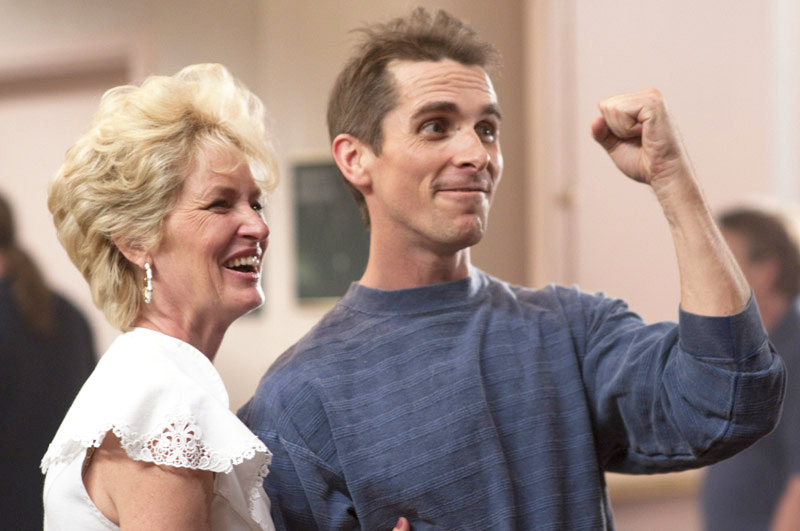
Micky is the younger brother (step-brother, actually) of Dickie Eklund (Christian Bale), former up-and-coming boxer, who had one glory moment: knocking down Sugar Ray Leonard in a match some years before. Now, he's a part-time trainer for his half-brother and a full-time crack addict. HBO is making a documentary about Dickie, who, despite his years and habits, still thinks he's on the comeback trail. But the pipe keeps him missing training sessions with Micky, leaving the heavy lifting to his trainer (Mickey O'Keefe playing himself). While the boys' lioness of a mother (Melissa Leo) manages Micky and enables Dickie, it leads to some bad decisions on matches for Ward, leaving him battered and disillusioned.
The higher-ups at the sports networks have Ward pegged as a "stepping-stone," the fall-guy they use to advance other fighters in the winning circle to boost ratings, and that reputation follows him around his home-town of Lowell, Massachusettes. Ward's on a downward spiral,
and any outside help is treated with suspicion. "You can't trust that guy. He ain't family." says Dickie, lounging in the limo his brother's money rented, sucking a beer.


Yeah. About that...
Perspective is all in
The Fighter.  And the boxing motif is the perfect setting. Micky is caged by his relations with his family, but every time he tries to strike out on his own, he gets attacked by Mom (playing the suffering card), step-brother hangs back and then takes his licks, and a coven of sisters and half-sisters are a unified greek-chorus of mom-ditto-speak. All you need to make this a match is a soft canvas to fall on, so Micky's a fighter always on the defensive. It's no reason he doesn't say much, but the eyes are far away, looking for a way out, looking for an opportunity to make a move, looking for anything.

"Your fahther looks at my ass, too, but at least he tawks ta me," says Charlene (Amy Adams, while not looking at him), the "bah-girl" Micky keeps staring at. Micky's so down for the count, he thinks even she's out of his league. And she might be, but she keeps showing up in his corner, alarmed at the punishment he's taking. When she questions it, Micky tells her everybody's not concerned. "Who's 'everybody?'" she asks. "My mother, my brother," he replies.

Yeah. About that...
The Fighter
is a mostly true story. Ward is a better, tougher fighter than the movie wants to give credit for (the underdog status makes for a better story, I'm sure, but the dismissive commentary on the soundtrack during the fight sequences is the real thing...taken from the actual broadcasts...Ward was considered an underdog), and Dickie DID do all those things,
but his timing was a bit better in real life. One wants to say that the best character arc in the movie is Dickie's, but that would be falling into the appreciation trap the movie sets up.

Because Micky's is the best character arc, although it seems a very simple Rocky-like success story on the surface. It's the approach that Micky takes with the forces in his life that are tearing each other apart which is the most interesting aspect of the story. Micky has been wronged by his family, but he won't discount their worth, or their place in his life, even over the objections of his new supporters—they have to find a way of dealing with each other and their conflicts, with or without him.
For a fighter to take the stance that he does, reaching compromise with the warring factions in his life—to stand up and take control, risking everything from everybody—is a complete negation to what he does for a living and how he was raised.
*
The acting kudos are going to go to
Bale (who is incredible, not to slight him) and Leo and Adams (who has two great scenes involving an intercom, and throws some nice punches in a chick-fight), but Wahlberg is the champ in this movie, with the tougher part (he trained for this through his last six roles), which he does almost purely physically.
Micky is a man of few words, and not too many moods, but Wahlberg, restrained and less showy, does all of it with body language and does the difficult fight scenes, as well—in the latter taking a lot of body-blows that are not hidden with oblique camera angles or trickery.
Wahlberg has worked with director
David O. Russell before—in fact it was Russell's war pic Three Kings that first showed how good an actor "Markey-Mark" could be. Russell keeps the movie on edge with quick cutting and an improvised feel, even managing to make the final fight scenes nerve-rattling, despite the suspicion that one is going to see a typical boxing picture ending. But, his assurance with good material, performed by such a dedicated cast, manages to keep the movie on its feet, even at the final bell.

Micky and Dickie at the time of the events of the film

* The real-life Ward did much the same thing, often befriending his opponents, including Arturo Gatti, the fellow he boxed in his last three epic fights, often described as the greatest in the sport.  Ward was a dedicated, fearsome fighter, but admired his opposites in the ring, and their talents.  The two fighters, who put each other in the hospital, continue to be good friends.  I find that amazing...and admirable.

Friday, April 19, 2024

Whatever Works

Written at the time of the film's release...

"And Sometimes, Finally, a Cliche is the Best Way to Make a Point"
or
"Mommy, That Man is Talking to Himself" ("Come Along, Justin")


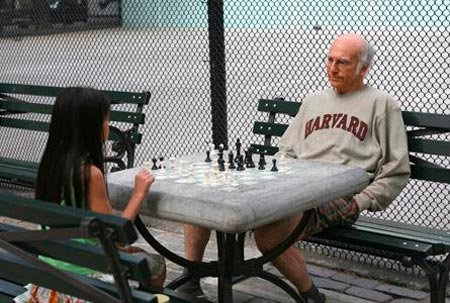
Boris Yellnikov (Larry David) is a genius. A misanthropic genius, to be sure, but a genius; he's only too happy to tell you that he almost won a Nobel Prize for his work in quantum mechanics, specializing in string theory. He's also only too happy to tell you that you're sub-normal, a microbe!, an inchworm!, a potzer!, a troglodyte!, a mouth-breather!—and in fact, at a couple points during the film he turns to the audience and turns on them...us...to tell us what he thinks of us. A lot of movies choose to insult its audience these days (sometimes directly, sometimes by what the makers think they can get away with), but Yellnikov has the courtesy of treating anyone who chooses to listen to him the same disparaging way. >He has a lot of views about quantum theory, the Heisenberg Principle, but never mentions the Konigsbergian Bubble Theory, in which the world is essentially a sub-set of forty individuals restricted to a single geographical point, 15 of whom have speaking parts.
Whatever Works is a return to Woody Allen's World, and its story of a young girl turning the heart of a beast is familiar ground, coming across as a "Woody's Greatest Hits" film—you'll find bits of Annie Hall, Manhattan, and particularly Hannah and Her Sisters—with its scenes of turmoil in the marriage between intellectual Frederick (Max von Sydow) and sensitive former-student Lee (Barbara Hershey). And Whatever...'s Melodie St. Ann Celestine (Evan Rachel Wood) is the latest in a long string of naive young waifs portrayed by Diane Keaton, Mariel Hemingway, Mia Farrow, Mira Sorvino, Samantha Morton, Juliette Lewis, and Scarlett Johansson. One could make some excuse about Allen returning to themes he explored earlier in order to form a more perfect coalescence of his ethos and it would be as pretentious as it sounds. Allen says that Whatever Works is an early screenplay he wrote in the 70's with the intention of it starring Zero Mostel. When Mostel died, Allen shelved it. So, the truth is Allen has been cherry-picking from this script for years to make some of his earlier, better pictures.
Although this is one stretch of New York City pavement worn a bit thin, there is something unique about it. One thing you can count on in Allen's movies is his autobiographical characters,
the passive aggressive smart-asses played by Allen or a surrogate (past stand-in Woody's have been Mia Farrow, Mary Beth Hurt, Kenneth Branagh, John Cusack and Edward Norton). But Yelnikoff isn't passive at all, and David plays him as he does much of his work...at 110%. This should get tiring, but it doesn't, and that's a very tricky thing to pull off. Mostel could do it, with his razor's edge timing and comic flailing, but David doesn't have his gifts as an actor. David merely sends off "vibes" that he could actually be this self-absorbed (he did co-create "Seinfeld," after all), and as with George Costanza, the entertainment value is in watching the train wreck. He's the reason to see Whatever Works (and his character is of the opinion that's the main motivation of the audience).
So, if you're going to go, go already, but understand that you'll see a lot of the same themes that have come before: of the chameleon nature of personality due to environment, of universal impermanence and the embracing of it, that it's a long, long way from May to December, and that it's not such a stretch for a physicist to move on from string theory, and pursue post-doctorate work on the ties that bind.