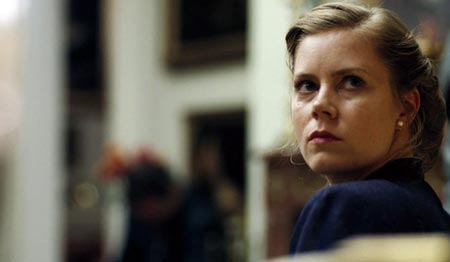
Showing posts with label Amy Adams. Show all posts

Wednesday, June 26, 2024

The Fighter (2010)

Written at the time of the film's release...

"Put Back What You Use"
or
"I-Yi-Yi-Yi-Yi'm Not Your Stepping-Stone"

The family that preys together, stays together.  For the extended family of boxer Micky Ward (Mark Wahlberg), the preying is mostly internal although they have the illusion that they're getting the best of everybody else.

Micky is the younger brother (step-brother, actually) of Dickie Eklund (Christian Bale), former up-and-coming boxer, who had one glory moment: knocking down Sugar Ray Leonard in a match some years before. Now, he's a part-time trainer for his half-brother and a full-time crack addict. HBO is making a documentary about Dickie, who, despite his years and habits, still thinks he's on the comeback trail. But the pipe keeps him missing training sessions with Micky, leaving the heavy lifting to his trainer (Mickey O'Keefe playing himself). While the boys' lioness of a mother (Melissa Leo) manages Micky and enables Dickie, it leads to some bad decisions on matches for Ward, leaving him battered and disillusioned.
The higher-ups at the sports networks have Ward pegged as a "stepping-stone," the fall-guy they use to advance other fighters in the winning circle to boost ratings, and that reputation follows him around his home-town of Lowell, Massachusettes. Ward's on a downward spiral,
and any outside help is treated with suspicion. "You can't trust that guy. He ain't family." says Dickie, lounging in the limo his brother's money rented, sucking a beer.


Yeah. About that...
Perspective is all in
The Fighter.  And the boxing motif is the perfect setting. Micky is caged by his relations with his family, but every time he tries to strike out on his own, he gets attacked by Mom (playing the suffering card), step-brother hangs back and then takes his licks, and a coven of sisters and half-sisters are a unified greek-chorus of mom-ditto-speak. All you need to make this a match is a soft canvas to fall on, so Micky's a fighter always on the defensive. It's no reason he doesn't say much, but the eyes are far away, looking for a way out, looking for an opportunity to make a move, looking for anything.

"Your fahther looks at my ass, too, but at least he tawks ta me," says Charlene (Amy Adams, while not looking at him), the "bah-girl" Micky keeps staring at. Micky's so down for the count, he thinks even she's out of his league. And she might be, but she keeps showing up in his corner, alarmed at the punishment he's taking. When she questions it, Micky tells her everybody's not concerned. "Who's 'everybody?'" she asks. "My mother, my brother," he replies.

Yeah. About that...
The Fighter
is a mostly true story. Ward is a better, tougher fighter than the movie wants to give credit for (the underdog status makes for a better story, I'm sure, but the dismissive commentary on the soundtrack during the fight sequences is the real thing...taken from the actual broadcasts...Ward was considered an underdog), and Dickie DID do all those things,
but his timing was a bit better in real life. One wants to say that the best character arc in the movie is Dickie's, but that would be falling into the appreciation trap the movie sets up.

Because Micky's is the best character arc, although it seems a very simple Rocky-like success story on the surface. It's the approach that Micky takes with the forces in his life that are tearing each other apart which is the most interesting aspect of the story. Micky has been wronged by his family, but he won't discount their worth, or their place in his life, even over the objections of his new supporters—they have to find a way of dealing with each other and their conflicts, with or without him.
For a fighter to take the stance that he does, reaching compromise with the warring factions in his life—to stand up and take control, risking everything from everybody—is a complete negation to what he does for a living and how he was raised.
*
The acting kudos are going to go to
Bale (who is incredible, not to slight him) and Leo and Adams (who has two great scenes involving an intercom, and throws some nice punches in a chick-fight), but Wahlberg is the champ in this movie, with the tougher part (he trained for this through his last six roles), which he does almost purely physically.
Micky is a man of few words, and not too many moods, but Wahlberg, restrained and less showy, does all of it with body language and does the difficult fight scenes, as well—in the latter taking a lot of body-blows that are not hidden with oblique camera angles or trickery.
Wahlberg has worked with director
David O. Russell before—in fact it was Russell's war pic Three Kings that first showed how good an actor "Markey-Mark" could be. Russell keeps the movie on edge with quick cutting and an improvised feel, even managing to make the final fight scenes nerve-rattling, despite the suspicion that one is going to see a typical boxing picture ending. But, his assurance with good material, performed by such a dedicated cast, manages to keep the movie on its feet, even at the final bell.

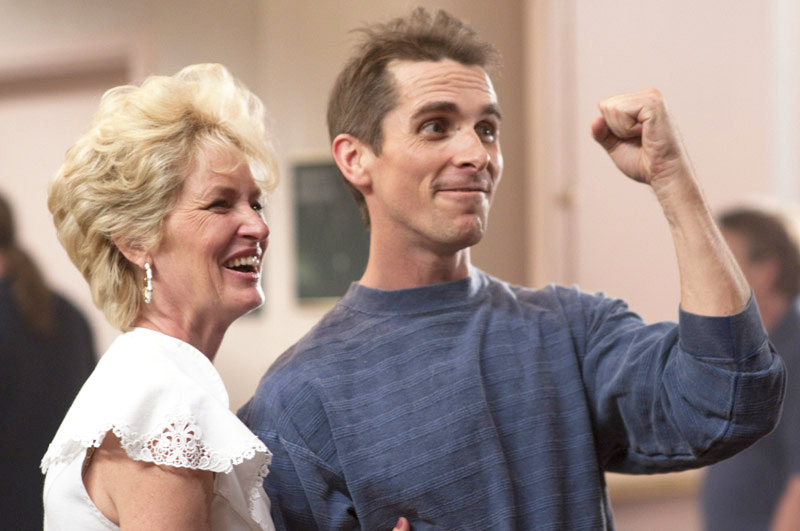
Micky and Dickie at the time of the events of the film

* The real-life Ward did much the same thing, often befriending his opponents, including Arturo Gatti, the fellow he boxed in his last three epic fights, often described as the greatest in the sport.  Ward was a dedicated, fearsome fighter, but admired his opposites in the ring, and their talents.  The two fighters, who put each other in the hospital, continue to be good friends.  I find that amazing...and admirable.

Wednesday, September 20, 2023

Sunshine Cleaning

Written at the time of the film's release. I still have fond memories of this film ever since its release in 2008.

Oh! And give Amy Adams an Oscar, for crying out loud!


"Blood in the Seams/Heaven on TV/God on the CB/and the Spirit in the Sky"

Where do they come up with these things, these independent movie-makers?

First off, the poster with the chirpy "From the producers of
Little Miss Sunshine" didn't help matters any; I'm not a fan of Little Miss Sunshine
thinking it hit all the right "indie" crowd-pleasing ingredients (Alan Arkin + Gay depressive + quirky family + so-ugly-she's-cute-kid + passive-aggressive marriage + "bizarre" normals + a beater-van = "WARMTH") in the same "by-the-numbers" way James Bond fires off all his gadgets in the same order "Q" introduces them.

Sunshine Cleaning hits the same formulaic construction, but the finesse with which it's performed and the sheer weight of its "downer" concepts manages to make it bob cheerily higher in the dank waters it's been pushed into in a life-affirming defiance.
What are we talking about here? Single mom Rose Lorkowski (Amy Adams, all dewy eyes and iron jaw) is a former Cheerleading Queen in her Albuquerque, New Mexico High School who made all the wrong choices. Knocked up, no prospects, she now cleans the homes of the less popular, stabler girls from her class. She's carrying on a going-nowhere affair with a married cop who won't leave his wife, who just got pregnant again-(yay!) Her OCD son just got kicked out of school for obsessively licking things (including his teacher). Her worthless sister Nora (a brilliant Emily Blunt-not betraying a hint of her Britishness) just got fired from her worthless waitress job. And Dad (Alan Arkin)...is played by Alan Arkin.
To pay for her kid's private education
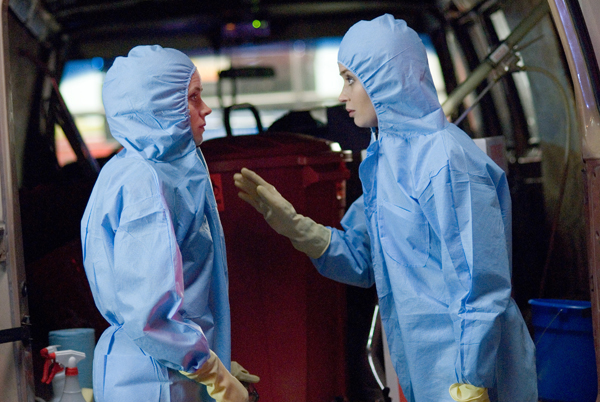
(or anything), she decides to take her cleaning skills up a notch—there's good money to be made cleaning up the "blood and body fluids" from recent crime-scenes. Soon, Rose and Nora are a going concern as their "Sunshine Cleaners" does a fast turn-around of suicide clean-ups, "de-comp's" (as they say in the trade), and every other obnoxious, toxic, disease-ridden scouring job that comes down the pike. "It's a burgeoning field" says Rose, the whites in her eyes showing all-around as she explains it at a baby shower. "We come into people's lives when they're going through something ... profound."
Indeed.
And the intertwining skeins of those lives weighs as heavily as the various crises in their own lives. It all is a bit messy. Amy Adams spends a lot of time looking into mirrors, sometimes chanting a mantra: "You are strong. You are powerful. You can do anything. You are a winner." One night, in a motel room that she's occupying alone, she'll have a new coda for that litany and burbling up will be a half-strangled cry/half-hysterical laugh.
It's brilliant. Adams rarely disappoints, and only does when she's got something she's trying to stifle (like her nun in
Doubt that threatens to turn into her Princess Giselle from Enchanted if she cracks a smile.) Not here. Give this girl an Oscar, quick. In fact, director Christine Jeffs gets a great performance out of everybody, that elevates its basic plot (which reminded me a bit of Happy Gilmore) and stifles one's urge to apply the film's last line to casually toss it onto the indie "also-ran" pile. Films that click this well happen rarely.

Tuesday, August 16, 2022

Trouble With the Curve

Written at the time of the film's release...

I Am, I Said/To No One There
or
Becoming Eastwood

Amy Adams is amazing, really. Clint Eastwood has had many female co-stars, from Shirley MacLaine to Meryl Streep, and directed a bevy of others, some of whom have given great performances—Laura Linney, Marcia Gay Harden, Hilary Swank, Angelina Jolie, two of them to Oscars—all have studied at the Eastwood school. The results have been a combination of actress' gifts and Eastwood guile. But, none of them have taken to heart that state of naturalness, the implacable restraint and mandarin ironic humor that the actor has demonstrated in the past like Adams does in Trouble with the Curve, Eastwood's latest project (produced but not directed—that job going to Eastwood's assistant director Robert Lorenz) about the relationship between an aged baseball scout and his estranged-but-not-fallen-far-from-the-tree daughter. Linney has played Eastwood's screen-daughter in the past, and she was terrific, but Adams imbues so much of Eastwood's game that one actually believes in the symbiosis, and their scenes together crackle with a lived-in familiarity, a mutual passive-aggressiveness, and a sense of shared past and unspoken tensions. 
Eastwood is the top-liner but it's the daughter's story. Mickey Lobell (Adams) is on track to partner at a law firm (nice line up of of Bob Gunton, George Wyner and Jack Gilpin—in fact, the film is top-loaded with good character actors, not only in the firm, but also in the Braves organization—Robert Patrick—and among the veteran scoutsEd Lauter, Raymond Anthony Thomas, and Chelcie Ross) when she gets wind from family friend, Atlanta Braves scouting coach Pete Klein (John Goodman) that her scout father (Eastwood) is about to be brushed back in the organization—he's old, his eyes are going, and there's a new scout (Mathew Lillard) who's more into stats and remote-controlling his decisions than doing the leg-work of seeing and hearing what the talent can do (this one would make a fine double-bill with Moneyball if double-bills still existed). 
Lobell is given one last chance—check out a kid with a killer swing (Joe Massingill) who looks to be a high draft pick. Lobell's job is on the line, and Klein recruits Mickey to follow the old man on-deck and pinch-hit for him if necessary as a seeing-eye daughter. Against her better instincts, she heads to North Carolina to dog her father by day and work on her client-presentation at night (the film sends mixed messages on the thesis of remote-working, as it seems to be fine for her), the father and daughter trading mutual scowls and muted growls, trying to "get closer" while they couldn't seem more like each other.
That's a lot of scenario for a deceptively simple story about relationships and the importance of "being there" in them.  It is also complicated by the mutual interaction between a fellow scout (Justin Timberlake) that the older Lobell has a past with, and the younger might have a future with—Timberlake does fine, relaxed...even charming...work here, not so strong on the dramatics, but hitting solidly on the humor (best line: "Poor Bruce..."), finding a nice line between Eastwood and Adams and making the most of a convenience role to show growth between the two characters.
It works and works solidly if you, like Eastwood's character, don't look too well at it. And there's some late inning contrivances that come out of left field that tie everything up a little too conveniently and nicely, managing to retire the side and take care of every issue in only three pitches. I smelled a rigged game—we really didn't need a Grand Slam on the last pitch to put up a "W" for this one, and, to my mind, took away from the good things that had come before.

Maybe I was feeling that way, anyway. Personally, I'd've been happy if Clint Eastwood had stuck to his lack of guns and retired from acting (as he said he was doing) with
Gran Torino. The grace-note of that particular character's last act served as a "period" to the syntax of Eastwood's career, full of so many unrealistic face-offs with clusters of opponents throughout the years.  It was the perfect bow and the perfect statement. But, he had to do a friend a favor—get his buddy a director card—and so he came back. I found it a little disappointing to find out that even Eastwood didn't know when the quitting was good. But, his work here is good, even if the eyes are squinting down to a lack of expressiveness (he does a wink here that is probably only visible in HD), and the voice has been reduced to a burned-out husk. The gravitas and irony are still there, though, enough for Adams to latch onto and take advantage of. And it makes for a pretty good show, while it lasts.

Tuesday, August 9, 2022

The Master

Written at the time of the film's release. As a bit of context, the incident in the first paragraph referred to the 2012 attack on American facilities in Benghazi, Libya, which was initially blamed on Islamists fired up by a video trailer for a film called Innocence of Muslims, The attack was lately determined to be pre-meditated.

The Master: Scientologist-Baiter
or
"Tom and I Are Still Friends"


One wonders why, if a (laughable) movie trailer was so important to cause bloodshed in the Middle East, The Master isn't causing a ruckus in Los Angeles, the home of Scientology. Perhaps Scientologists have thicker skins (and more tolerance) than radical Islamists, who seem to find any excuse to cause harm at the drop of a Koran, or perhaps it would cause a worrisome spike in the members' auditing, or because—really—it has less to do with Scientology than other issues...like what would draw someone to a situation like Scientology—or any belief system—in the first place.

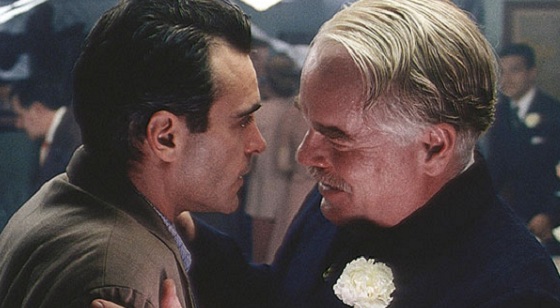
Paul Thomas Anderson's latest film has a similar theme to his previous films—the combustibility of individuals in a collective, and takes a similar tack—get the best individuals in their fields, wind them up and let them go, producing an oblique open-ended vessel into which audiences can pour their interpretations. It's not that Anderson doesn't have anything to say, so much as he'll be damned if he comes right out and says it, and sets up situations that suggest relevancy, waiting for the happy accident that will inform the whole. It's not that there isn't a directorial hand here—there's a reason there are so many close-up's—it's that there's isn't a sure directorial stance.
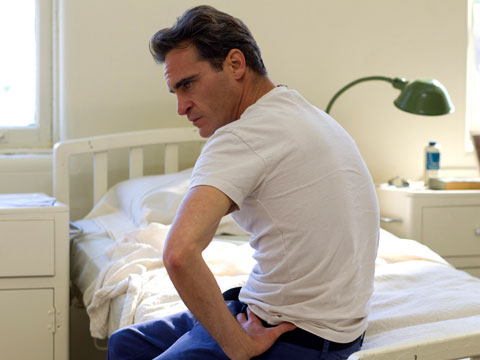
After useless psychoanalysis, Freddie turns the examination on others. 

So, you have a lot of surface, the brilliant spot-on "feel" of the production design by Jack Fisk and David Frank, the crisp cinematography of Mihai Malairemare Jr. , the individual performances of Philip Seymour Hoffman, Amy Adams, and (especially) Joaquin Phoenix on display, to an amorphous end that challenges, and often begs for, interpretation. Fortunately, the material is strong enough, and Anderson's contextual thesis is rich enough that one can throw all manner of thoughts into the stew, and make one's own meal out of it. 
We first encounter Freddie Quell (Phoenix) in the Navy during the battles in the South Pacific during World War II.
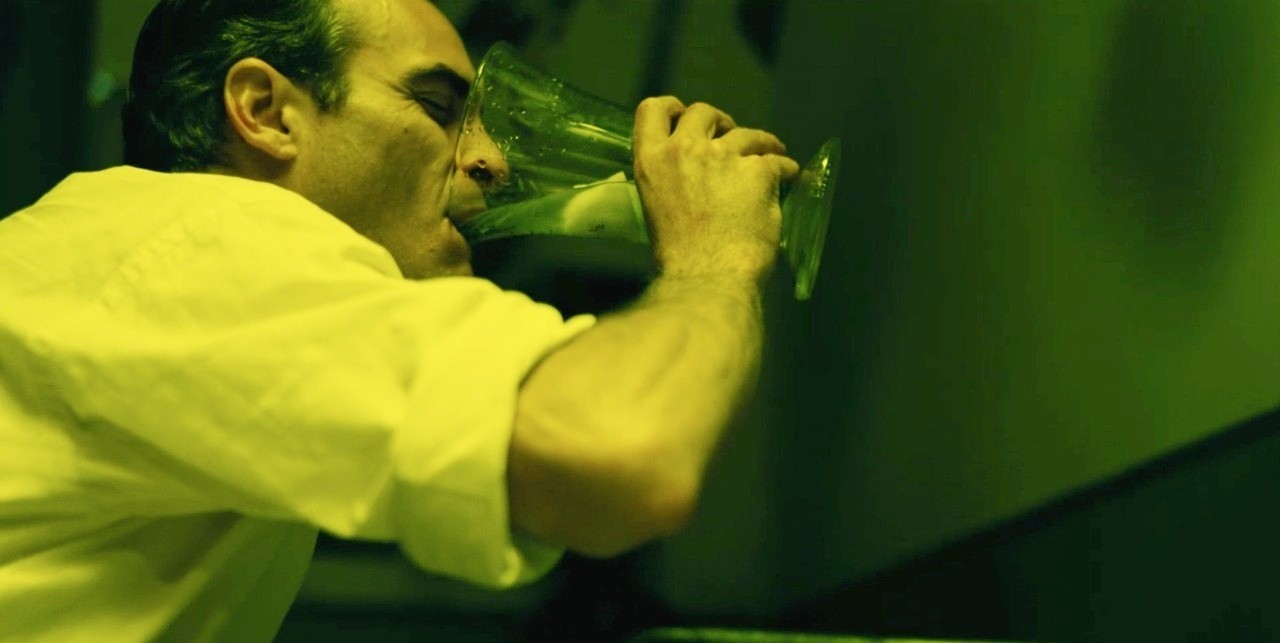
* Even there, in the midst of hundreds of young men in close quarters, he's an outsider, a loner connecting with no one except for his one discernible skill-mixing noxious brain-cell killing concoctions out of anything handy. He spends his time isolated, in some form of inebriation, the limits of behavior and humor blurred to indiscernibility, and when he's out of the service, he's immediately transferred to a psych division, where he is examined endlessly to no avail—the doctors are spending all their time trying to find the answer to what's wrong. 
It's all too obvious what's wrong—he's a barely functioning alcoholic obsessed with sex—but there's no cure for a complete lack of self-awareness or perspective, and Quell is released to the world, unchanged and unremorseful, just another problem that can't fixed and so is dispatched out of anyone's responsibility, to let Nature or Darwinism deal with him. He's a perpetual outcast on the edge of functionality, unstable and instinctually acting out. A job as a department store photographer ends up as an ironic choice—he spends his days looking in, trying to document normalcy, while on breaks, he uses his darkroom chemicals to create some bizarre cocktail to fry his brain and ease his isolation, while trying to make time with a store model. 
Phoenix is brilliant in this
, a raw nerve and not just mercurial, but mercurial at a high boil. The photography job ends with a violent incident of his own making, and he winds up as a migrant worker where, again, he moonlights with moonshine, and has to go on the lam where he stows away on a boat that has been commandeered for a wedding party.
It's here that he meets Lancaster Dodd (Hoffman in a varied, extravagant performance that feels a bit like Orson Welles in Citizen Kane) self-described as "a writer, a doctor, a nuclear physicist and a theoretical philosopher. But above all, I am a man, a hopelessly inquisitive man, just like you."

 
"Just like you."
Yes and no. Dodd is the gypsy-evangelist of something called "The Cause," a nebulous philosophy for which he is the architect and messiah. The rules of The Cause change a bit according to need and the whims of Dodd (who erupts in petulant anger when challenged on it, by believers and non- alike) even though the origins of it supposedly date back "trillions of years" (later, his son will tell Quell "he's just making all this up as he goes along").
He's drawn to Quell for his potent concoctions, for his raw contrariness, which Dodd finds a challenge to his self-improvement methods (called "processing"), and because Quell's feral anti-social fury is a reflection of Dodd's free-thinking, but with the irresponsibility that he doesn't have the freedom to practice. Both men are self-medicating outliers, unable or unwilling to fit in—square pegs in the rounded holes of society.

For Quell, Dodd's processing is a tonic, though not as bracing as what he can make himself, a form of questioning self-examination that, instead of making one feel bad about oneself, makes one feel good. And for Quell, seeming to belong for the first time in his life, The Cause feels like home and family.

What color are her eyes?  You decide.

Not all the family is happy, though. Dodd's followers, including his Lady McBeth of a wife (Adams), fear Quell's aggressiveness and unpredictability, she especially questions whether Quell will ever improve and worries about the effect he will have on her husband and their cottage industry. Quell may be the best patient for the very therapy that they espouse, but the danger lies in how much damage he will prove to their house of cards in the process. It's a battle of co-dependents for The Cause, while the two men find the limits to their visions of paradise. There's a lot of room for mis-interpretation here, most especially in Dodd and Quell's scene in which the older man seeks to calm the emotions of both of them by singing, as if it was a lullaby, "(I'd Like to Get You on a) Slow Boat to China" which ends with the phrases "All to myself/Alone," emphasizing the isolation of both the Messiah and the acolyte, as they set themselves adrift.
So, in the end, once the credits have rolled up, what does it all mean? What's the point?** I'm honest enough with myself to say I don't have a flippin' clue, except what I've laid out here as themes and observations, but will admit that it is all up there on the screen, ready to be interpreted in as individual a manner as any audience member can provide, which is what makes Anderson (along with Terrence Malick, who is a bit more focused) one of our most enigmatic of filmmakers. Whether that makes him a visionary or a charlatan—like the filmmakers, captains of industry, and religious leaders he portrays, making it up as he goes along—depends on our interpretation, as well. And it is enough for me that he continues on the path he takes—not going for the easy superhero flick, or facile rom-com—without compromising anything...not even his intentions. It makes him brave, admirable...and always watchable. Challenging to be sure, but I like a challenge.
No, really. We're all together in this.

* One of the running motifs of the film is the time spent on ships of some sort, adrift.

** It's been amusing to read film critics struggling with this one, some finally merely knocking over their king to just call it a "character study."  It's a tough one, alright.  But, it is trying to say something about the human condition, even if only to say it has no easy answers, either, not even for those who espouse and specialize in easy answers.  I like that, but one wishes there was more provided by the film-maker, rather than just providing a rorschach test for us to throw our interpretations onto.

Friday, March 11, 2022

Underdog

Underdog (Frederik Du Chau, 2007) Cute little adaptation of the humorous (which is the polite word when something is not funny) cartoon show of the 60's that featured Wally Cox as the voice of the anthropomorphic pooch, "Shoeshine Boy," who becomes the crusading canine of courage whenever Society is threatened by the Forces of Evil--personified by the mad scientist Simon Bar Sinister. "Underdog" was limited animation of the "Rocky and Bullwinkle" codec, and one would have mistaken "U-dog" as a Jay Ward Production if it had managed to produce even a half-hearted chuckle or two.

As it is the film struggles mightily to work as a live action quickie--the effects work starting with Babe and continuing on with every talking animal movie since probably convinced the producers to not go the expensive CGI animation route. Plus, they'd miss another opportunity to star Jim Belushi in a lackluster movie. I kid, but actually...okay, I don't like Jim Belushi. But casting is not the film's problem. As the designated audience surrogate Alex Neuberger isn't all that bad--he does have to play most of his scenes with a dog (that, hate to break it to you, isn't really talking), but there is much joy to be had in the way the villains have been cast. As Simon Bar Sinister, Peter Dinklage gets to show off his comedy chops, and given that his sidekick is played by the dry as dust Patrick Warburton, one begins to pine whenever this mutt-and-jeff act is not on-screen.

Along the way, the filmmakers do some nice little parodies of Superman's greatest hits--scaring a cat-burglar off his suction cups, taking a flight among the stars with his favorite bitch (look, sorry, it's accurate), and because it's Disney, even throw in a plug for Lady and the Tramp. With Jason Lee providing U-Dog's voice and the ubiquitous Amy Adams as gal-pal Polly, it's pretty good for a talking dog movie, and quite good for a flying, talking dog movie.

As anything else...well, there's a need to fear.

Wednesday, September 15, 2021

Zack Snyder's Justice League

Zack Snyder's Justice League
(Zack Snyder, 2021) Buying the DVD of Zack Snyder's Justice League—his sanctioned "taking-back" of the Warner Brothers "studio-notes" theater version—cost as much as two months of HBOMax, and I must say, in comparison, it was a bargain. I have been reluctant to be swayed into buying into streaming services, maintaining that theaters will come back, and there are very few enticements for having them take money out of my accounts month after month, when the economic model necessitates other means of seeing them.
 
So...(I hear you ask) "is it better?" Yup. And by a wide margin. My initial review of the theatrical version of Justice League was somewhat laudatory—more concerned with knee-jerk backlash towards it—but, in seeing it again a couple times one could see the pacing issues, grating inconsistencies of tone, a certain desperation in the product to compress the content gracelessly and be winsomely attractive. "The Snyder Cut" takes more chances and takes a lot more time doing it. The Warner mandate to cut Snyder's intended two-part 4 1/2 hour opus into a single 2 hour film must have seemed an impossible feat to accomplish (and one must give kudo's to Joss Whedon for even attempting it and managing to meet their specs despite the ham-fisted result), especially when the evidence shows just how much of Snyder's film wasn't in the theatrical version (which we'll simply call "Josstice League"). The story is basically the same, but, good Lord, there are whole completely different versions of scenes throughout the thing, with nary a line repeated. There are bits and pieces in the story-line—the first Earth-war with Apokolips, the Gordon scenes, the confrontation at the "Superman memorial"—but for the most part the shot choices and dialogue are unique to this version. There are far fewer "oh, yeah..." moments than "that's new" moments. And, for me, there weren't any "I miss that" moments...at all.
The length is daunting, which is why I think it was never, ever intended to be one film (that and Snyder has a tendency to make super-hero films that are already prepping for sequels). Still, the overall experience of watching it feels much more organic than the cropped mess of the "Josstice League." Segments progress naturally—they "feel" right. And more importantly, the big action set-pieces—like the fight under the Gotham harbor—finally "work" in how they're shot and edited in sequence—they have geography and you see how things are playing out among all parties and how the stakes rise and fall as they intensify.
What's more, the film hinges on the characters given short-shrift in "Josstice League"—those being Jason Momoa's Aquaman, Ezra Miller's Flash, and especially Ray Fisher's Cyborg. Sure, there's plenty of scenes with Gal Gadot's Wonder Woman and a lot more with the Amazon's, a couple of tid-bits with Ben Affleck's Batman (with even more taken out), less haggling among the heroes, more of Alfred (Jeremy Irons), more of Joe Morton's Silas Stone and his co-hort at StarLabs, Ryan Choi (Ryan Zheng)—these are all improvements utilizing good actors—and you get representations from Jack Kirby's gallery of "Fourth World" villains (most prominently, Kirby's "Big Bad Guy" Darkseid), and a considerable "Steppenwolf" upgrade.
It's the three heroes-in-hiding from Batman v. Superman: Dawn of Justice, that get a lot more coverage and a bit more respect. Momoa's Aquaman has a lot more scenes with Mera (Amber Heard) and now, also Vulko (Willem Dafoe) and there's a bit of a continuity gaff in that here, nobody can talk underwater as in the Aquaman stand-alone film (they have to make air-bubbles to communicate). The Flash is given more background including a rescue of young Iris West (Kiersey Clemons) and the character's annoying geeking is toned down substantially and slightly matured. But, it's the story of Victor Stone/Cyborg that is the most expanded and the most from which the film benefits. Fisher is given much more chance to shine as he goes from bitter accident victim to reluctant super-paraplegic to confident team member.

But, it's not all roses. This version is rated "R" for a reason. There are a couple of prominent "f"-bombs* that may be earned but won't impress the parents of young superhero fans. And the level of carnage is greater with prominent blood spatters (that would have been digitally removed for theaters) and the final disposition of Steppenwolf by Wonder Woman (she is an sword-wielding Amazon, after all) that is far more MPAA-adverse than just letting the bad guy be dispatched by his own minions off-screen. Edgier, but not the way parents, censors (or even the Comics Code Authority) would like. One is always aware that in the movie-world, the film creators are always less concerned with body-counts than the comics-heroes (as dictated in the comics by parental watch-groups) would be.
This prompts the question for whom film-makers are making movies, even though, in this special case, Snyder has had the supported mandate to please himself. With the content far more unconstrained than the behavior displayed in the four-color versions, are they making it for themselves, for the fans, or for the studio? One would say the first, less the second, with the third being the cranky arbitrator between the two. Snyder makes them for himself—what he'd like to see—and for that imagined film audience that wants more realistic, mature versions of childhood heroes (ala the Christopher Nolan model—Nolan is still the exec. producer of this one)** It's interesting to think about, given the many hands involved.
So, I was pleased with what I saw, tarnished slightly by the fact that I'd seen a bastardized version before.*** But, what a difference it does make to have a singular vision, whatever issues one might have with it, rather than an elephant made by committee. In a subtle way the film makes that point, and one hopes that Warner learns it, and that Marvel takes the lesson as a cautionary tale.

 
* One was deliberately added by Snyder in his "new footage" shot for the Snyder version. If he doesn't have to fight over it with the studio, I suppose he said "why the fuck not?" So, Batman says it. And Cyborg says the other one at the height of his bitterness.
** Nolan has been working exclusively with Warner for almost two decades, but the recent rifts over the super-hero movies he and his wife have shepherded there (and the studio's insistence on simultaneous streaming) have had a consequence—Nolan's next film (involving J. Robert Oppenheimer) is being made with Universal. Warner wasn't even being negotiated with.
*** One curiosity I had was the way the theatrical version photographed Gadot's Wonder Woman—it's more sexualized, seeming to concentrate on her posterior than apparent when Snyder and director Patty Jenkins called the shots. And, yes, Snyder had no such prurience in his cut.

Batman gets Frank Miller's goofy Bat-tank.