Showing posts with label Z. Show all posts

Friday, February 9, 2024

The Zone of Interest

One Man's Ceiling is Another Man's Floor/One Man's Heaven is Another Man's Hell
or
"Heil Hitler. Etc."
 
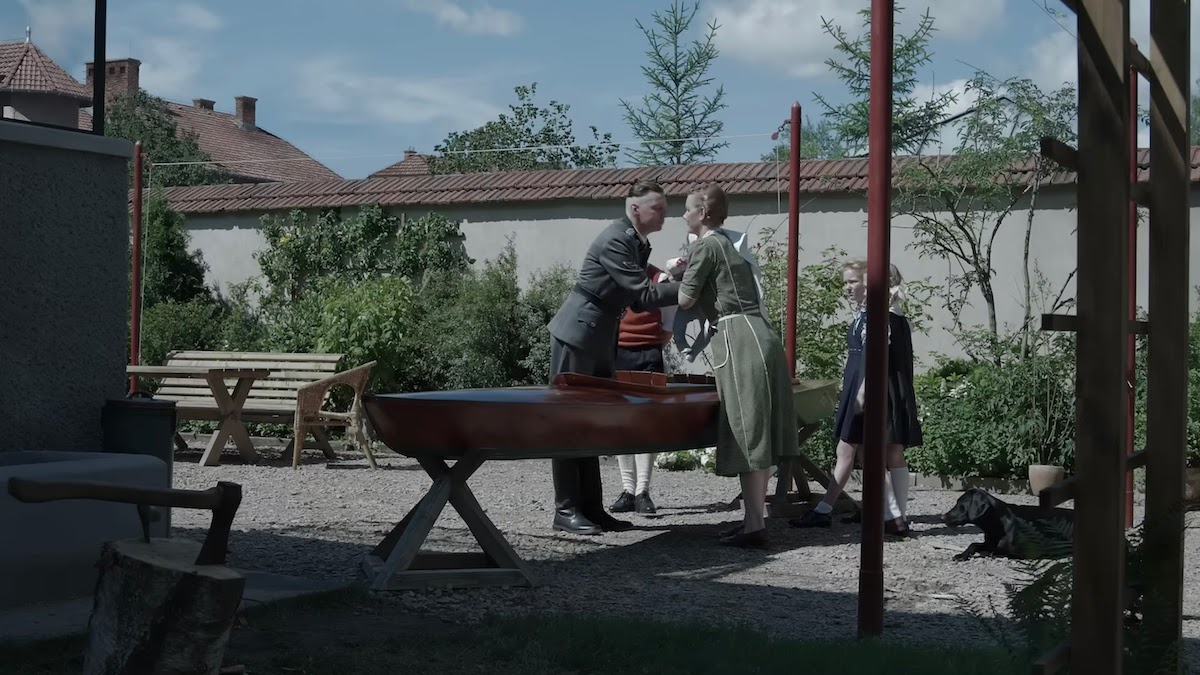
The Höss family are a typical middle class German family making their way through the second World War in 1943. They're living the good life and father Rudolf (Christian Friedel) and mother Hedwig (Sandra Hüller) are raising their five kids a stone's throw from his work. Mom tends the garden and sees to the children while keeping a close eye on the servants, all Jewish, all frail. Dad gets on his horse every day and rides to his work as commandant of Auschwitz-Birkenau.
 
Martin Amis—who died last year—wrote the book of The Zone of Interest, and Jonathan Glazer, who made Birth and Under the Skin, bought the rights before publication. Then, he threw out Amis' story, with its marital complications, and took the book down to its essentials, scrapping the fictional characters and replacing them with the real-life husband and wife living next to the camp that he supervised. Reality is often stranger than fiction and more horrifying, and when one looks at the situation as it was, to add anything else to it would be to reduce the significance of the basic horror of it all—to live a normal, even prosperous life, close to—and because of—a self-evident crime against humanity. To that end, he did an awful amount of research, interviewing servant-prisoners and making available all the resources he could find including at the Auschwitz museum.
Life for the H
öss family is pretty banal, but the true devil is in the details. Their lovely courtyard with garden and pool has a high privacy wall...but it's topped by barbed wire. The armed security tower peeks up over it, as does the smoke-stacks. The day to day maintenance of the garden is done by Jewish prisoners, and the servants are, as well, doing the cooking, cleaning, laundry, and the cleaning of blood from work-boots. There are daily deliveries of supplies, clothes, articles are picked over for what is useful—Mrs. Höss is seen trying on an elaborate fur coat, and finding a lipstick in the pocket, tries that, as well...applying it to her hand before applying it to her lips (its source, not used directly for being considered toxic). Her son, at bed-time, examines his collection of gold-laden dental-bridges.
As segregated as the family is from the horrors from which they prosper, the atrocities, though out of sight, can never be out of mind (Höss locks the doors every night, despite so many guards). The Zone of Interest has an intricate sound-scape—starting with an overture of sorts—over a black screen a chorus of voices, echoing strings...and whispers...emanate for minutes, sensitizing us to what will be an ever-presence of aural clues to the horrors that can't be entirely drowned out. Amidst bird-sounds and conversation, are rumbles of trains, furnaces roaring, dogs aggressively barking, shouted commands, gun-shots...and in one instance screaming. It becomes part of the fabric of life, omnipresent, noticeable when a new sound escapes.
So, what's the plot? What's it about? Not much. And a lot. Day-to-day living and day-to-day dying. Hedwig's Mother comes by for a visit and marvels at the house and the garden ("Of course, I like it. How could I not? You really have landed on your feet, girl"), but the glow emanating from the smokestacks and the noises disturb her sleep and she cuts her visit short.
Rudolf, who is supervising the construction of a newer more efficient crematorium, is doing such a good job with his "numbers" that he is being sent to a better position in Oranienburg—"structural changes" he's told; Hedwig is extremely upset and refuses to move with him from the paradise they've made for themselves ("They'd have to drag me out of here! Everything we want at our doorstep!"). He goes and is put in charge of all the concentration camps—they have to step things up as transports are now coming from Hungary.

A celebration is made with dancing and music, but on a phone-call back home, Hoss admits that viewing the party from a balcony "I was just trying to figure out how much gas it would take to kill everyone because of the high ceilings."
Some of the most extraordinary sequences are photographed using thermal imaging. Under the cover of darkness, a local girl hides fruit and other comestibles in the construction sites of the camp for the prisoners to find...at one point, she finds a piece of music hidden in a tin-can, takes it home and plays it on her piano. These scenes are eerie, like watching undeveloped negatives, their acts of charity in stark contrast to the scenes of indifference to suffering that are shown in full-color.
It's almost like there are two movies going on: the one Glazer made and the one that goes through your head as you're watching it, filling in the information that the movie leaves out—the awareness of the extermination on an industrial scale, the conditions all well documented and preserved for our education and as a reminder to never again walk that path to Hell (Glazer shows us the museum in the present day and even that sequence fills one with a sickening irony that makes one realize that even good intentions can have unforeseen consequences). The audience is left to fill in the blanks, a co-conspirator to the filmmakers' intentions to show just how commonplace true evil can become when it is ignored, or, worse, to somebody's benefit.
One walks out of the movie a little numbed—isn't that the point? It is ironic from beginning to end, with no limit to its repercussions as far as a person's responsibility to the plights of others. You may be reading this on a cell-phone made in a factory that is basically a sweat-shop, where the workers are making nowhere near a living wage and no thought given to the safety of those workers. The computer I'm typing this on might have been, as well.
 
We are all complicit in some way, if we go about our daily lives without consideration of others going about theirs. You cannot look at a scene in which human ash is used as fertilizer in a garden and not be horrified. And beyond that, to thinking that the human race, for all its accomplishments and marvels, can still surprise and shock with its capacity to undermine itself as just another animal, using its intellectual prowess to ignore, look the other way, and not think at all. The potential for greatness is staggering and offset by its potential to lay it all to waste by seeing human lives merely as commodities.
Höss family portrait

Wednesday, September 15, 2021

Zack Snyder's Justice League

Zack Snyder's Justice League
(Zack Snyder, 2021) Buying the DVD of Zack Snyder's Justice League—his sanctioned "taking-back" of the Warner Brothers "studio-notes" theater version—cost as much as two months of HBOMax, and I must say, in comparison, it was a bargain. I have been reluctant to be swayed into buying into streaming services, maintaining that theaters will come back, and there are very few enticements for having them take money out of my accounts month after month, when the economic model necessitates other means of seeing them.
 
So...(I hear you ask) "is it better?" Yup. And by a wide margin. My initial review of the theatrical version of Justice League was somewhat laudatory—more concerned with knee-jerk backlash towards it—but, in seeing it again a couple times one could see the pacing issues, grating inconsistencies of tone, a certain desperation in the product to compress the content gracelessly and be winsomely attractive. "The Snyder Cut" takes more chances and takes a lot more time doing it. The Warner mandate to cut Snyder's intended two-part 4 1/2 hour opus into a single 2 hour film must have seemed an impossible feat to accomplish (and one must give kudo's to Joss Whedon for even attempting it and managing to meet their specs despite the ham-fisted result), especially when the evidence shows just how much of Snyder's film wasn't in the theatrical version (which we'll simply call "Josstice League"). The story is basically the same, but, good Lord, there are whole completely different versions of scenes throughout the thing, with nary a line repeated. There are bits and pieces in the story-line—the first Earth-war with Apokolips, the Gordon scenes, the confrontation at the "Superman memorial"—but for the most part the shot choices and dialogue are unique to this version. There are far fewer "oh, yeah..." moments than "that's new" moments. And, for me, there weren't any "I miss that" moments...at all.
The length is daunting, which is why I think it was never, ever intended to be one film (that and Snyder has a tendency to make super-hero films that are already prepping for sequels). Still, the overall experience of watching it feels much more organic than the cropped mess of the "Josstice League." Segments progress naturally—they "feel" right. And more importantly, the big action set-pieces—like the fight under the Gotham harbor—finally "work" in how they're shot and edited in sequence—they have geography and you see how things are playing out among all parties and how the stakes rise and fall as they intensify.
What's more, the film hinges on the characters given short-shrift in "Josstice League"—those being Jason Momoa's Aquaman, Ezra Miller's Flash, and especially Ray Fisher's Cyborg. Sure, there's plenty of scenes with Gal Gadot's Wonder Woman and a lot more with the Amazon's, a couple of tid-bits with Ben Affleck's Batman (with even more taken out), less haggling among the heroes, more of Alfred (Jeremy Irons), more of Joe Morton's Silas Stone and his co-hort at StarLabs, Ryan Choi (Ryan Zheng)—these are all improvements utilizing good actors—and you get representations from Jack Kirby's gallery of "Fourth World" villains (most prominently, Kirby's "Big Bad Guy" Darkseid), and a considerable "Steppenwolf" upgrade.
It's the three heroes-in-hiding from Batman v. Superman: Dawn of Justice, that get a lot more coverage and a bit more respect. Momoa's Aquaman has a lot more scenes with Mera (Amber Heard) and now, also Vulko (Willem Dafoe) and there's a bit of a continuity gaff in that here, nobody can talk underwater as in the Aquaman stand-alone film (they have to make air-bubbles to communicate). The Flash is given more background including a rescue of young Iris West (Kiersey Clemons) and the character's annoying geeking is toned down substantially and slightly matured. But, it's the story of Victor Stone/Cyborg that is the most expanded and the most from which the film benefits. Fisher is given much more chance to shine as he goes from bitter accident victim to reluctant super-paraplegic to confident team member.

But, it's not all roses. This version is rated "R" for a reason. There are a couple of prominent "f"-bombs* that may be earned but won't impress the parents of young superhero fans. And the level of carnage is greater with prominent blood spatters (that would have been digitally removed for theaters) and the final disposition of Steppenwolf by Wonder Woman (she is an sword-wielding Amazon, after all) that is far more MPAA-adverse than just letting the bad guy be dispatched by his own minions off-screen. Edgier, but not the way parents, censors (or even the Comics Code Authority) would like. One is always aware that in the movie-world, the film creators are always less concerned with body-counts than the comics-heroes (as dictated in the comics by parental watch-groups) would be.
This prompts the question for whom film-makers are making movies, even though, in this special case, Snyder has had the supported mandate to please himself. With the content far more unconstrained than the behavior displayed in the four-color versions, are they making it for themselves, for the fans, or for the studio? One would say the first, less the second, with the third being the cranky arbitrator between the two. Snyder makes them for himself—what he'd like to see—and for that imagined film audience that wants more realistic, mature versions of childhood heroes (ala the Christopher Nolan model—Nolan is still the exec. producer of this one)** It's interesting to think about, given the many hands involved.
So, I was pleased with what I saw, tarnished slightly by the fact that I'd seen a bastardized version before.*** But, what a difference it does make to have a singular vision, whatever issues one might have with it, rather than an elephant made by committee. In a subtle way the film makes that point, and one hopes that Warner learns it, and that Marvel takes the lesson as a cautionary tale.

 
* One was deliberately added by Snyder in his "new footage" shot for the Snyder version. If he doesn't have to fight over it with the studio, I suppose he said "why the fuck not?" So, Batman says it. And Cyborg says the other one at the height of his bitterness.
** Nolan has been working exclusively with Warner for almost two decades, but the recent rifts over the super-hero movies he and his wife have shepherded there (and the studio's insistence on simultaneous streaming) have had a consequence—Nolan's next film (involving J. Robert Oppenheimer) is being made with Universal. Warner wasn't even being negotiated with.
*** One curiosity I had was the way the theatrical version photographed Gadot's Wonder Woman—it's more sexualized, seeming to concentrate on her posterior than apparent when Snyder and director Patty Jenkins called the shots. And, yes, Snyder had no such prurience in his cut.

Batman gets Frank Miller's goofy Bat-tank.

Friday, September 11, 2020

Zero Dark Thirty

Written at the time of the film's release.

"You Know That Thing We Talked About"
or
How Are Things in Tora Bora?

Writer Mark Boal and director Katheryn Bigelow have made the two most important dramatic films about The War on Terror: the 2009 Best Picture Oscar Winner The Hurt Locker and now, Zero Dark Thirty, which covers the behind the scenes investigations to track down Usama bin Laden and the subsequent Operation Neptune Spear in Abottabad, Pakistan.

The film originally started as a feature about the carpet bombing of Tora Bora, and the field work leading to the decision and was scheduled to begin filming when the raid occurred. Immediately, the other film was shelved, and Boal began writing this, incorporating his research from the previous work which dovetailed with the earlier effort. It's a fascinating, troubling story of human beings waging war on an intimate level, trying to secure threads of information on a specific target, while also trying to keep track of new terror acts that might occur any time, any where.

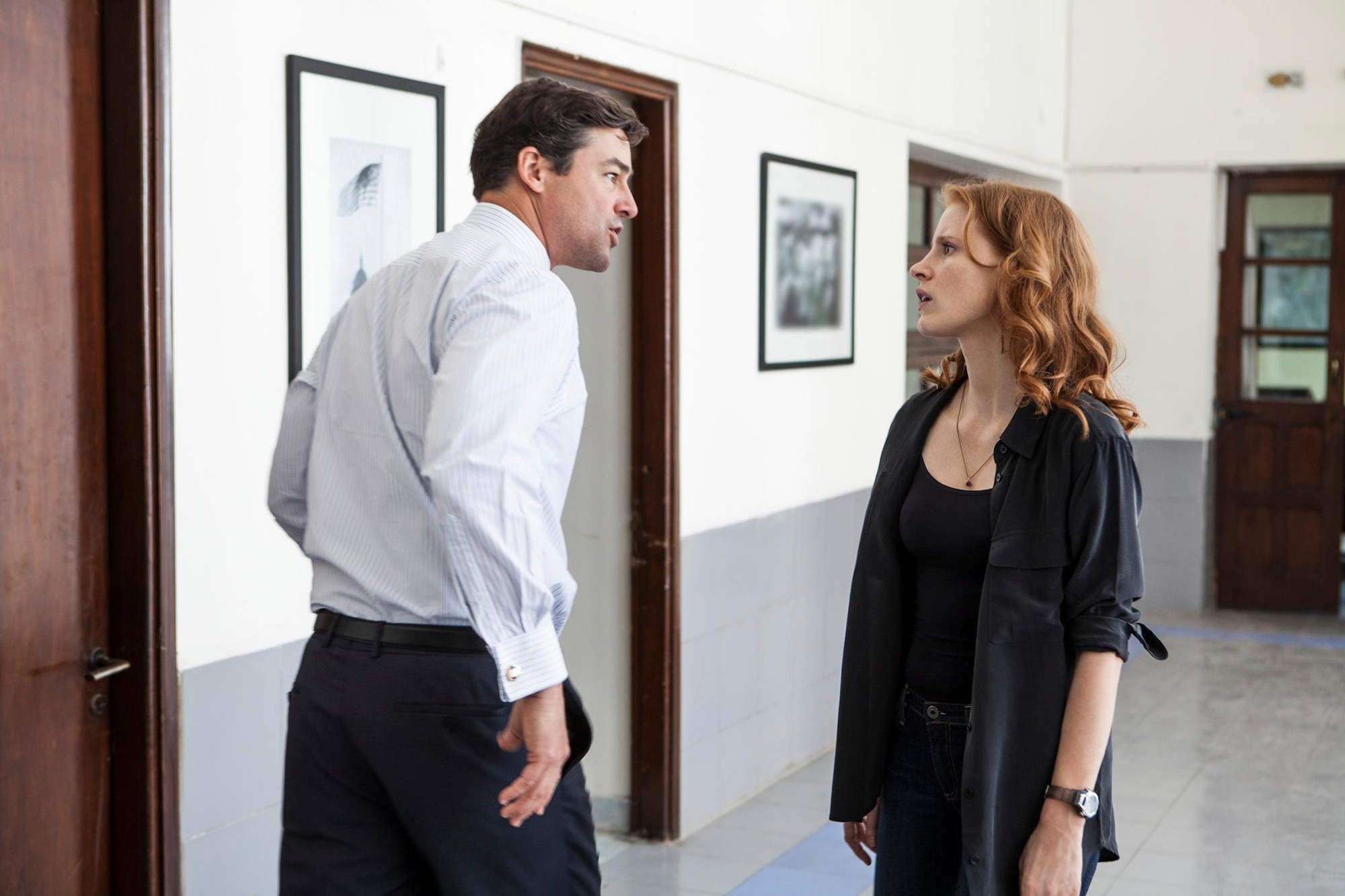
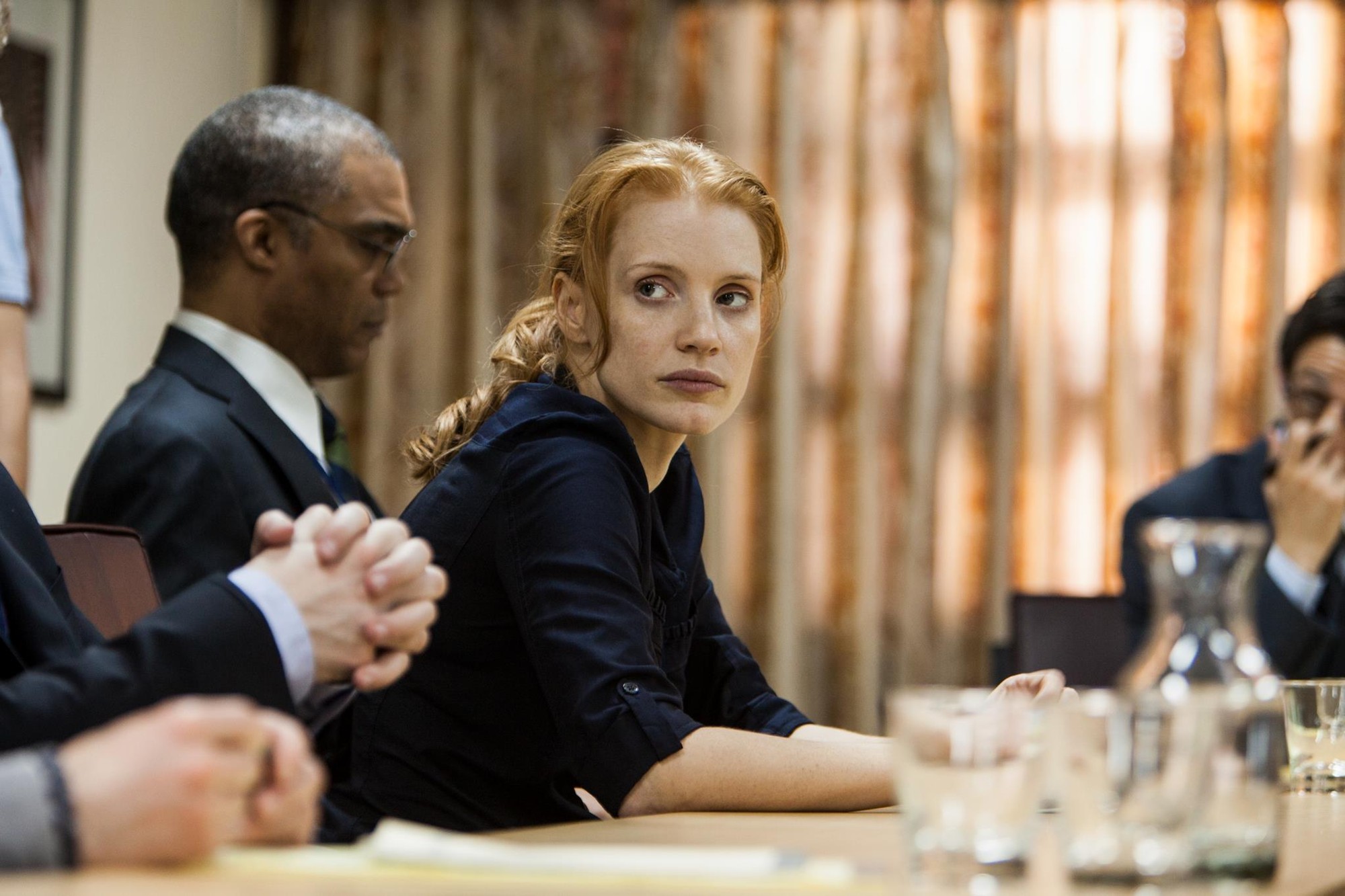
It focuses on one woman, a CIA analyst named Maya (played by Jessica Chastain)—her IM handle is "Maya173", but "Mark Owen," the nom de plume of one of the Navy Seals participating in the raid, refers to her in his book "No Easy Day," as "Jen." Maya is book-smart, street-savvy, but must learn "the ropes," literally, of interrogation by any means necessary. She is trained in the way of torture by Dan (Jason Clarke), who has been at this for awhile and has it down to a science—the speech "If you lie to me, I will hurt you," the loss of control, the humiliation, the physical and mental stresses, the releases from which information may come. Dan offers to keep Maya out of it, but she demurs. She will participate. She will actively sweat information out of the "detainees" in the euphemisms for prisons like "CIA Black Sites." "You are not being fulsome in your replies" she yells as she slams her hand in the interrogation table.  And when she's not participating, she's poring over other interrogations, reams of intelligence, and being a general pain in the rear to her superiors and colleagues. For station chief Joseph Bradley (Kyle Chandler), the job is to walk the razor's edge of politics and prevent more terrorism—he doesn't even care about bin Laden anymore, as there are too many attacks he's trying to prevent—every attempt that gets by is a failure.
But, for Maya, bin Laden is an obsession, her white Muslim whale, and it takes a zealot to find another zealot. She'll veer off into other investigations, particularly when some of her own are killed in an attack, but time only intensifies her resolve, almost becoming a mania, and her patient investigation is off-set by a gloves-off approach to her superiors (when asked her role in the briefing by the C.I.A. director—at the time, Leon Panetta—played by James Gandolfini, she replies "I'm the m#####-f##### who found this place, sir"), almost as if her persistent pressure torture techniques are being applied up the chain.* The Obama White House dithers over action until absolute proof is obtained that bin Laden is held up at the Abottabad compound, but Maya is resolute. When more cautionary analysts give the odds at 60%, she defiantly ups the odds to 100%—"Okay, 95%, because I know certainty freaks you guys out." But, it's that certainty that fuels Seal Team 6 in their mission—in the videos below, she's specifically mentioned and lauded in Mark Owen's account.
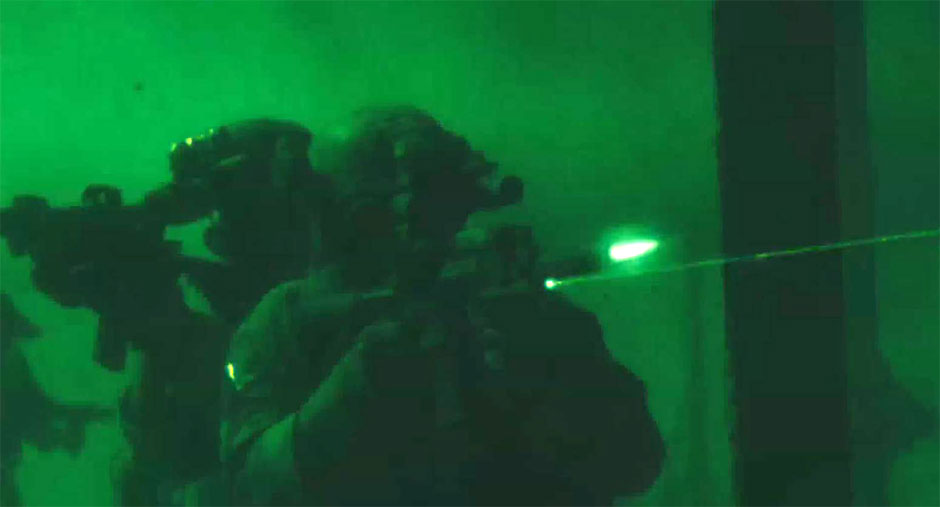
It is a fascinating movie, but a draining one, starting with torture scenes and ending with a recreation of the raid as it went down, shot mostly in tense disorienting night-vision. The character of Maya, or "Jen" or whoever she is, is a fascinating one, a portrait of obsession and the toll it bears—she's repeatedly told that she looks "terrible" throughout the movie—and when she lashes out at her superiors for their lassitude, or just plain pusillanimousness, there is a definite sense of someone unhinged—controlled, but pushed to the breaking point. A fury waiting to unleash, she is our version of a Holy Terror, a match for her enemies, and one can't help but wish her peace...suspecting that it will never happen.
2020 Addendum: Zero Dark Thirty came under some attack at the time of the release for its presentation of torture and its techniques and the implication that information obtained by it led to the critical information that led to the Abottabad raid. The movie is vague enough and the information so voluminous that one comes away with the impression that it wasn't critical to the intel (indeed, the location was confirmed by other means). As for the portrayals being an endorsement of torture, that's a little hysterical—to not portray it would have been 1) a whitewash of what was going on and 2) leaving out a specific chunk of the shaping experience of Chastain's "Maya"—one might just have well kept out the car-bomb attack that killed her colleagues. The character is driven by her experiences, hardened by them...and by her personal need for revenge. Her torture training is part and parcel of it. 

I came away from the film seeing a revenge drama that ended up, not in triumph, but in hollowness. The dead are still dead and the threat is just as real. There's no "Mission Accomplished." Just an "X" placed in a ledger that never empties.

I'll repeat what I said in the asterisked point. Zero Dark Thirty walks such a fine line that one can see whatever they want to in it.

The FBI's notice of bin Laden's death and the Situation Room during the raid.
Bear in mind, one helicopter went down during the raid.

* There are torture scenes, but they're not commented on, and any politicizing of it is so much hot-air—one can see in the film any position they want.  It walks a very fine line, merely presenting, and if someone tries to see their point of view in it, they're merely counter-projecting.  

Tuesday, November 12, 2019

Zombieland: Doubletap

You Might Want To Put Down Your Milk-Duds For This One...
or
"If You Love Someone, You Should Shoot 'Em in the Face So They Don't Become a Flesh-Eating Monster."

"Hey! Welcome to Zombieland: Chapter Two!" Columbus (Jesse Eisenberg) chirps at the beginning of Zombieland: Doubletap, the sequel to the hit Zombieland from way back in 2009. "Thanks for waiting!"

Sure thing, Jess.' Sorry what happened to your career in the meantime.


It's great he came back, so that everyone could appreciate what an eccentric live-wire performer he is, given the right part, and how he can energize a movie just by being in it. But, then, Z:D in an exercise in precise nostalgia. 


Precise because the things that were established in the first go-'round are repeated: Columbus' "Rules" with their accompanying intrusive 3-D graphics, the credit-scattering Main Title montage, the "Bill Murray" cameo—wait until the very last frame on this one—the splintering of the group and the third act brightly lit night-time zombie-splatter orgy are all in place, just like you remember. That's some comfort food among the grisly fare.
But, also the Zombieland teams are back, the ones both in front of* and behind the camera. That Emma Stone (again playing "Wichita") turned down a big movie to return to the franchise says a lot about her affection for the filmmakers and the actors involved, as her star has risen considerably since that time, even winning an Oscar for La La Land. That says something.
My own reaction to the first Zombieland was an admiration for its fresh take on the well-chewed zombie concept. It helped that the characters in the film are a bizarre family of out-casts who probably wouldn't have anything to do with each other if the world hadn't gone to dead people who want a piece of your mind. 
Things haven't changed that much since the zombie apocalypse, other than that Darwin's theory seems to keep working on walking corpses. Either that or the winnowing of zombies makes typing the remaining ones that much easier. What is most troubling is that there are some strata that are tougher to kill, making them tougher to knock down than, say, Star Wars storm-troopers. There aren't many, but it would seem that late-model zombies need more than a simple double-tap to take them down. It doesn't make logical sense, but it does have a tendency to stretch out some of the splatter-fests to be more marathons than short sprints. It's all well and good to increase the challenges to the main characters, but it kind of goes off the proverbial cliff in the third act when the numbers start to increase. 
For the four main characters, the issue centers around the wishes of  Columbus to impart some stability on their rag-tag band of zomb-busters. He wants to establish a home, as the four—Tallahassee (Harrelson), Columbus, Wichita (Stone) and Little Rock (Abigail Breslin)—have already established a loose-knit family and their identities (they're still following the "no names" rule) are based on their home-towns. So, where's home when society has completely broken down? Well, in the United States, they set up shop at The White House (or "Casablanca" as Tallahassee calls it).That's good for awhile, and everybody gives it a shot. But, we're talking about four alpha-wolves trying to live together in peace and harmony: Tallahassee tries to be a father-figure, Wichita and Columbus try to be a couple—even if she's leery of settling down—and Little Rock is just tired of being around old people and wants to find friends (non-dead kind) her own age.
So, as in the first film, the group splinters—it's not like any of the members can't take care of themselves—sisters Wichita and Little Rock, feeling trapped and wanting freedom, take off, leaving "the boys" to their own devices, if both hurt by their desertion. Tallahassee also starts to feel a bit of wanderlust, wanting to go to Graceland, and Columbus, bitter over Wichita's leaving, runs into another survivor, Madison (a hilarious Zoey Deutsch), who is just as pink and girly-girl as can be. And...well, any port in the zombie-storm. She moves into the White House with Columbus and his "father" (as she calls Tallahassee, to his annoyance), and so, it's a little embarrassing when Wichita comes back to arm up, as Little Rock has run off with a namaste Berkeley pacifist (Avan Jogia)—this enrages Tallahassee ("It's not that I hate pacifists, I just wanna beat the shit outta them!").
So, the dynamic changes a lot. Wichita loathes Madison and despises Columbus for his quick rebound dalliance with somebody else...so..."Madison" after his previous matrimonial-bound devotion ("Wow...just...wow") and the four set off to find Little Rock as there is no way that she can defend herself with a pacifist in tow. With a little difficulty finding the proper vehicle to do their road-trip, they start to track down Little Rock by following the lead where she wants to go—that being Graceland, former domicile of Elvis "The King" Presley
When they get there, they are disappointed—Graceland is in ruins. But, nearby, they find the stolen Tallahassee-mobile, the Beast, parked outside an Elvis-themed shrine called the Hounddog Hotel. Little Rock had been there. But, exploring the place, they find that though they were there, they've left. But, they're not alone. Fearing they're about to be overrun by zombies, they find themselves assaulted by the Hotel's caretaker, Nevada (Rosario Dawson) to whom Tallahassee is instantly attracted. 
It's reciprocated, but then, maybe Nevada is reminded of somebody else—like her current squeeze, a western ruffian named Albuquerque (Luke Wilson), who...kinda...reminds you of Tallahassee and, actually, reminds everybody of Tallahassee, except for (of course) Tallahassee, who takes an instant dislike to the man. And—to make the conceit even more precious, Albs (please don't make me spell it again!) has a nervous, nerdish compadre named Flagstaff (Thomas Middleditch), who Columbus thinks is a really-together guy...with his commandments instead of rules and his unlikely skills at zombie-dispatching. As if knowing they've gone a little too far with the doppelganger bit, the two get eliminated fairly quickly. 
There's nowhere the two could go, anyway, it's a silly conceit and the jokes wear out their welcome pretty quickly...plus it eliminates a rival for Nevada's affections and she's pretty necessary to the plot, as everybody moves on to find Little Rock, who has been persuaded by "Berkeley" to find a mythical place called "Babylon," an oasis in the zombie-desert, where there is nothing but peace and harmony and hacky-sack, and no weapons—you just know that that is where the last confrontations in the movie are going to take place, like the big amusement park set-piece in the first one: it raises the stakes for the heroes and gives them a handicap, as well. But, it provides little suspense and hardly any danger. You know that everybody's going to come out of it alright, no matter how much danger is pretended.
Yes, it's fun, more in the smaller moments than in the large ones: you have a lot of really good actors who are enjoying playing their characters, even if they all could be playing better roles, and their idiosyncratic performances are always a pleasure to watch. They manage to evoke pleasure out of recycled materials and make fresh conceits that are beyond their sell-by date. If another Zombieland is made, one knows where it will go—splintering the group again and reforming them with a third act action set-piece. And, no doubt, they'll be just as good even though the vehicle itself will have become as charmless as an animated corpse.

* Zombieland: Doubletap's trailer makes comedic hay of the fact that Harrelson, Eisenberg and Breslin are all Oscar nominees and that Stone is an Oscar winner, juxtaposed with shots of them firing all sorts of weaponry. Hey, Helen Mirren rocks a machine-gun.

Thursday, November 7, 2019

Zombieland

There are a lot of new movies I've seen and reviews are coming up, slowly but surely. Patience.

Written at the time of the film's release...

"Woulda...Coulda...Shoulda."

The University of Florida, being on a pan-handle with nowhere to run, was recently thoughtful enough to include in their on-line instructions dealing with hurricanes and pandemics, a section on what to do in case the area was attacked by zombies, or as they put it, "life-impaired individuals."

The section was quickly expunged.

Some folks have no sense of humor.

It's a good thing
Zombieland does. Ruben Fleischer's zombie comedy has traded knife-sharp horror timing for sledge-hammer comedy timing, and the results are giddy, gory ghastly fun. At some point, the gangly slavering zombies just become targets and rarely are posed as threats and become merely a means to many grisly perforated punch-lines. The result of a fast-food outbreak of mad cow disease ("then mad human, then mad zombie" relates the film's geeky narrator "Columbus"), the flesh consuming zombies pass on the disease to their victims, and so on, ad nauseum.* 

Our narrator is on a one-man trek from his college room in Austin, Texas to try to find his parents in Columbus, Ohio, dodging zombies who are fast, but not very bright (at one point, he evades them by just running around a deserted parking lot in a circle, while they slavishly chase him like...zombies). Walking the highways with his carry-all on wheels he meets up with another fellow human, a rough-neck, well-armed and driving a Cadillac Escalante, and they pool their resources, conditionally. 
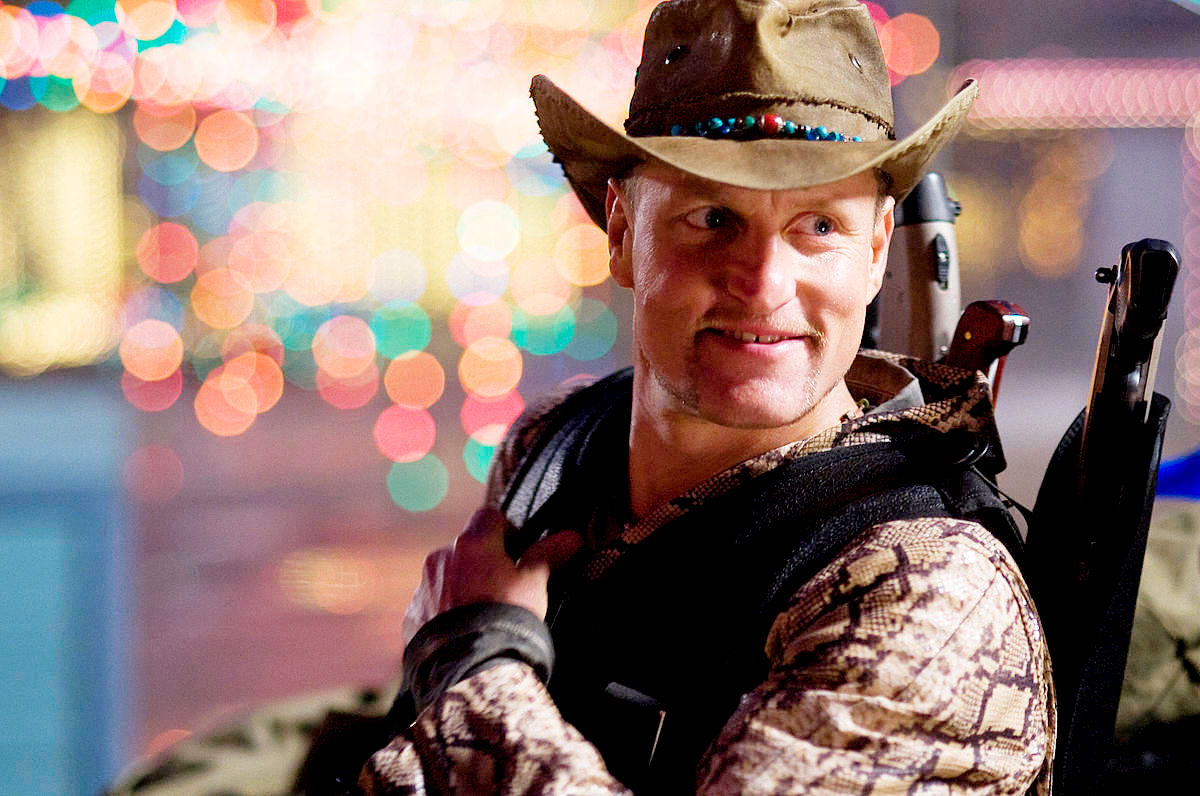
"No names" is the rule, so they call each other by their home-towns: "Columbus" (Jesse Eisenberg—combine Michael Cera with Hugh Grant's stammering timing and that's him) and "Tallahassee" (Woody Harrelson, who's extremely funny), and the film becomes an "armed-to-the-teeth" road-movie searching for the mythical "safe zone" that always seems to provide a goal for these movies.**
All the characters are smart (or dumb) enough and funny enough that everyone has their fair share of laughs. Ultimately, that's the final goal, along with a slice of relationship-therapy, as the movie can't come to any real resolution of the zombie problem (which would be...running out of bullets...or zombies). The best one can do is compromise on the "I wouldn't if you were the last (whatever) on Earth" as that's become an attainable goal.
It's a funnier movie than Shaun of the Dead, which gnawed on the same material, but Zombieland trades in its laughs for a Hollywood slickness that feels as if its going down well-worn storyline grooves of character resolution. The movie is given a seventh inning stretch by a gracious cameo by Bill Murray (no, really...he must owe Sony Pictures a movie) and wonderful graphic work, which solves the University of Florida problem by providing the "Columbus'" rules for dealing with zombies by pop-up graphics that regularly illustrate an example. As a public service, I provide them here:
Rule #1: Cardio ("the fatties" went first)
Rule #2: Double-Tap (don't trust the first shot)
Rule #3: Beware of bathrooms
Rule #4: Seat-belts (wear them)
(Here, things get a little sketchy)
Rule #7: Travel light
Rule #17: Don't be a hero
Rule #18: Limber Up
Rule #22: When in doubt, know your way out
Rule #31: Check the back-seat
Rule #32: Enjoy the little things

* And one would think "ad internecionem." Since these zombies are flesh-eating, that would mean that a lot of the zombies are missing limbs and would make lousy zombies, and eventually, well, supply and demand being what it is...wouldn't they basically eat themselves to extinction? In the words of "Tallahassee:" "Pretty soon life's little Twinkie gauge is gonna go empty." But I digress...


** The movie has such a fun time dealing with zombie and movie cliche's that it even addresses the issue:
Columbus: You know there's a place untouched by all this crap?
Tallahassee: Out east, yeah?
Columbus: Yeah.
Tallahassee: Out west, we hear it's out east, out east they hear it's out west. It's all bullshit. It's like you're a penguin at the North Pole hears the South Pole is real nice this time of year.
Columbus: There are no penguins in the North Pole.
Tallahassee: (pause) You wanna feel how hard I can punch?