Showing posts with label World War II. Show all posts

Thursday, March 13, 2025

Run Silent, Run Deep

Run Silent, Run Deep (Robert Wise, 1957) One of those general entertainment movies that manages to do so many things exceptionally well that one comes away grateful for the experience. Directed by Robert Wise with a true sense of claustrophobia, the script by John Gay maintains a strict military accuracy while displaying a keen sense of drama, psychology and brevity. A psychological drama, a war film, a story of mystery as well as redemption, the film manages to pull everything off with a propulsive rhythm and fine performances throughout.

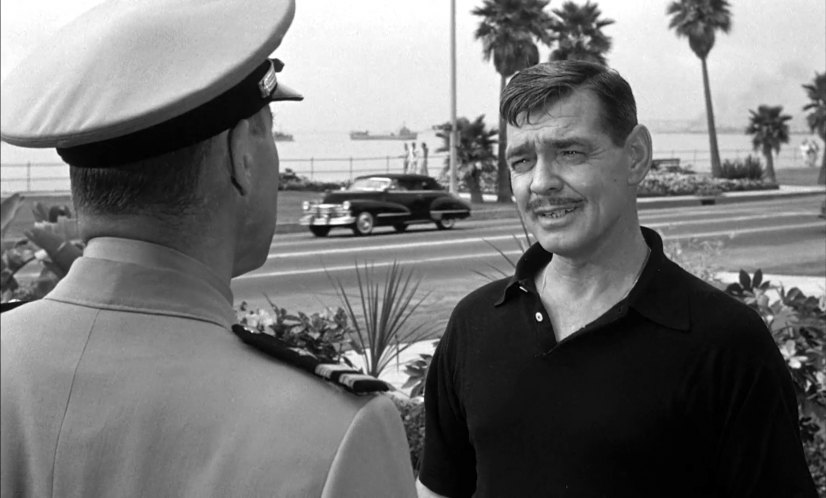
Produced by Hecht-Hill-Lancaster, Burt Lancaster the producer takes a back-seat to his star, Clark Gable, the older actor in one of his understated roles that takes into account his age. Gable's the flawed figurehead with shades of Ahab who finagles his way into the command of the S.S. Nerka patrolling the Pacific during World War II, having already lost one sub and and a frustrating convalescence at a desk-job.
Lancaster
's exec Jim Bledsoe is torqued because Gable's Cmdr. "Rich" Richardson has pulled rank to get command—his command—and is
now drilling the men to dive and shoot a torpedo within a record 35 seconds. The already suspicious crew starts to snarl about all this practice with nothing to show for it. Then a lucky strike convinces some of them the new Captain is golden, while the other half think he's out to torpedo their mission. Lancaster turns into a reluctant arbiter.
But, in their first attempt to sink Richardson's unsinkable Japanese war-ship things don't go so well leaving crew-members dead and injured and Lancaster in command.

Robert Wise
is a master of filming people at work with a story-teller's eye for finding the perfect angle (without calling attention to it and himself) and an editor's sense of pace and construction. Wise is also a chameleon of style tamping down his presentation of professionals doing their jobs while also being able to ramp up the spectacle for the unreal worlds of musicals and science fiction. Given his work on this film, you could see why he'd be the perfect choice for the similarly set-bound Star Trek: The Motion Picture.

He also makes goods use of the usual crew of character actors who make up the Nerka's lovable mugs: Jack Warden, Brad Dexter, Don Rickles, Nick Cravat and Joe Maross. The close quarters of a submarine makes the authentic plainness of their faces all the more important and brings them to a prominence near the bright lights of Gable and Lancaster. Both those lights are shaded somewhat, with Lancaster doing subtle, measured work, the kind that would dominate his later career. Gable, even subtler, is the King, here in his twilight, still burning brighter than the vast majority of actors. By this time, Gable was moving slower and had learned the power of economy and his Captain Richardson draws you in.

Finally, the story is a cracker-jack construction. Just when you think you've got it figured out, screenwriter Gay throws in an added complication that ramps up the idea that these are men strategizing in chaos and only repeated dips into the boiling oil of battle can make them seasoned enough to think clearly through the smoke and death.


Run Silent, Run Deep is an intelligent tribute to the fighting services without resorting to jingoism, racism or choired flag-waving. The film-makers' respect for the professionalism under duress of sub-crews runs silent and deep.

Tuesday, December 17, 2024

A Canterbury Tale (1944)

A Canterbury Tale
(The Archers
, 1944) Directors Michael Powell and Emeric Pressburger (known collectively as "The Archers") begin their tale where Chaucer did in his "The Canterbury Tales" (their lines only slightly different in translation than the text):

WHEN APRIL with his showers sweet with fruit
The drought of March has pierced unto the root
And bathed each vein
  with liquor that has power
To generate therein and sire the flower;
When Zephyr also has, with his sweet breath,
Quickened again, in every holt and heath,
The tender shoots and buds, and the young sun
Into the Ram one half his course has run,
And many little birds make melody
That sleep through all the night with open eye
(So Nature pricks them on to ramp and rage)—
Then do folk long to go on pilgrimage,
And palmers to go seeking out strange strands,
To distant shrines well known in sundry lands.
And specially from every shire’s end
Of England they to Canterbury wend,
The holy blessed martyr there to seek
Who helped them when they lay so ill and weak.
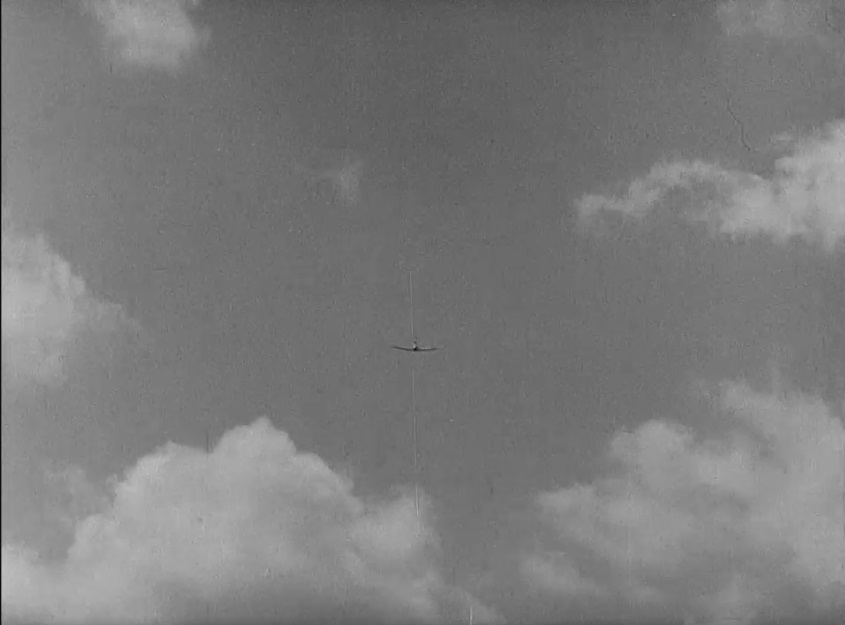
They're setting place, showing ancient maps, and then—at the appropriate verse—show us the pilgrimage as it was, with ox-carts and donkeys, and peasantry making their ways over the hills, then the close-up of a nobleman who sees a falcon high in flight. And—cut! (24 years before Kubrick did something similar)—the falcon is replaced by a fighter-plane that zooms towards us and over the head—cut!—of a British soldier circa 1944 who watches it (in the same frame composition and is probably the same actor, now in modern military dress) and the narration begins again...with another verse over landscapes not too far afield from what we saw before:


600 years have passed. What would they see, 
Dan Chaucer and his goodly company today? 
The hills and valleys are the same.
Gone are the forests since the enclosures came.
Hedgerows have sprung. The land is under plow, 
and orchards bloom with blossoms on the bow.
Sussex and Kent are like a garden fair,
but sheep still graze upon the ridges there.
The pilgrims still wends above the wield,
through wood and break and many a fertile field.
But, though so little has changed since Chaucer's day.
Another sort of pilgrim walks the way.
 
And a tank heaves into the frame and a line of those mechanized vehicles starts to wend its their own way along the pilgrim's trail on the way to Canterbury. As subtle and artistic as The Archers could be, they could also be brutal in how they juxtaposed for contrast, sometimes uncomfortably so, even for modern audiences thinking that sophistication can only be found in late-model movies. But, with A Canterbury Tale, the filmmakers linked the past and the present, while also acknowledging the omnipresence of change. For no matter whether its war or peace, or what happens to the landscape, the one constant are the pilgrims in need of hope and maybe a miracle.
Three people are in the town of Chillingbourne, Kent, a village on the train-track to Canterbury. Two are soldiers, one a Brit, one a Yank, and a "land-girl" who's taking part in helping farmers while men-folk are away to war. They are all "in-service" but beyond that they have nothing in common...except that they're stuck in Chillingbourne. They meet by happenstance when the Yank, Sgt. Bob Johnson (played by Sgt.
John Sweet, chosen for "authenticity" rather than, initially, Burgess Meredith) gets off the train too early being lurched awake by the conductor's announcement of "Next stop...Canterbury." He's a stranger in a strange land at the wrong stop in the middle of the night and he recruits help from the other two, Sgt. Peter Gibbs (Dennis Price) and Alison Smith (Sheila Sim) to find lodgings for the night.
One complication, however: while making their way through town to get their bearings, Alison is attacked from the shadows by a stranger who throws glue in her hair. Evidently, there's a lot of that going around as she's the eleventh victim of such an attack—she'll meet other such girls in her farm duties. While she goes through numerous shampooings to try to rinse out the gunk, Sgt. Johnson reports the attack to the local magistrate Thomas Colpepper (Eric Portman), who is curiously unmoved and suggests that women should not be out at night after a black-out curfew. After all, Canterbury itself has just been bombed by the Germans.
Johnson is convinced to stay the weekend and the three determine to investigate who the mysterious "glueman" in town could be. The town is full of potential suspects, clues abound, and it does help to take the minds off things like the war, one's part in it, and its consequences past and future. A little mystery can distract from things of great import, and yet, there's the countryside and its history and the current residents of that storied real estate, which managed to survive Kings, Queens, technologies and even the German war machine. Instead of being a mere stop-over, their encounters and walkabouts bring out a resonance and maybe even a communion with the past.
Bombed out buildings, but Canterbury remains untouched.

For, despite the distraction, these three are in need. Each is suffering a loss, a regret, a yearning that makes them incomplete, even as an indeterminate future threatens all of them. It may be coincidence that they are all there at that time and at that place, but without seeking it out—hell, they don't even know the history of it—for those acres and shrines to echo what they did in Chaucer's time for those who made their own pilgrimages in their time of need. It is Colpepper who clues them in to the storied land and serves as unofficial chaperone for the trio, and indirectly guides them to the path that they don't know they seek.
The Archers, of course, lean into Chaucer and the romance of the land and its past (and the value and benefit of the pastoral existence—which they would continue in the next year's I Know Where I'm Going!—Powell called these films their "anti-capitalist period"), but there's another influence, cinematically. A Canterbury Tale was made in 1944, 5 years after The Wizard of Oz and the story of strangers, bonded together, off on a heroes' quest traveling to a source for "reward or penance" is shared by both.*   
Of course, Wizard is fantasy, a fairy tale. A Canterbury Tale is fanciful. But, both have rich denouements that strike the heart and do so in quite different ways. Even though all the characters in both stories realize their hearts' desires, they come to them not knowing what they do not know. Oz and Canterbury provide the realization of their dreams, but Canterbury has no definite ending (despite an American-bound re-edit by Powell that has more of a conclusion—fortunately, I saw the original British version), the last act is open-ended, with hope for the future, if an uncertain one.

A Canterbury Tale is one of the best movie experiences I've seen this year. It left me completely enchanted.

 * The story even shares the element that both sets of heroes have already possessed what they lack—they just don't know it yet.

Friday, April 26, 2024

The Ministry of Ungentlemanly Warfare

"Boys Own"
or
"I Have Good News and I Have Bad News"

The Second World War makes for fascinating history and fascinating reading. The convergence of warfare, technology, and the dark arts of espionage fairly boggles the mind that so much was going on in the background while foot-soldiers and pilots and sailors were slugging it out on the battlefields. The Allies would do anything to gain an advantage. Whether it was Operation Mincemeat, or Operation Crossbow, or Operation Anthropoid or "The Ladies" at Bletchley Park or Alan Turing's "computing machine" or the spies and conspirators at "Camp X", so much was done behind the scenes of "the lines" to disrupt enemy operations or lead them astray that soon the conspirators got caught up in their own chicanery. When secrets were discovered of enemy bombing runs, the information could not be used to save lives lest the enemy discover the Allies' advantage. One cannot calculate the lives that were lost...and needlessly...in order to preserve that most transitory of things, military secrets.
 
They make for good reading,* but Hollywood never seems to think that they'd make good stories unless they're blown up (and real good) to cartoonish proportions. That Operation Crossbow film is a good example of that.
Gus March-Phillips in the hirsute form of Henry Cavill

And so is
The Ministry of Ungentlemanly Warfare, Guy Ritchie's new film, which tells the story (sort of) of "Operation Postmaster" an "unofficial" British operation to disrupt the supply chain to German U-boats (or anything else) by dispatching ships that the Special Operations Executive suspected were running arms for the Germans. It was a short operation—roughly 30 minutes—where what was called The Small Scale Raiding Force, under the command of Gus March Phillips, hijacked three ships from the Spanish harbor of Fernando Po in Spanish Guinea, while the ships' officers were being thrown a party ashore (by an SOE agent). The SSRF delivered the ships to the Navy a few days later.
Lassen, March-Phillips and Hayes update a German war-ship on the floppy state of its captain.
Well, that sounds exciting enough, but the screenwriters aren't happy with that, so they invented rescues, subterfuges, feints, a honey trap, and various bloody attacks to complicate the story and make it more of an episode of "Mission: Impossible" than what actually happened, no matter the "Based on a True Story" card that starts the film. The filmmakers take it too far and not far enough—the actors hardly resemble their real-life counterparts and their fighting skills are far more athletic and balletic than the training required of what was called a "butcher and bolt" unit. And although much play is made of the crew being "'A'-Team" "mad," the SSRF has been more described as amphetamine-popping sociopaths (all in a good cause, of course).
In the movie, that's Ian Fleming in the middle and Gubbins on the right.
(Fleming wasn't even in this branch, although he did do some spy-work)

So, don't believe what you see—it's not a true story in the way its being portrayed—and I'll shut up about the discrepancies and just talk about what's there on-screen, although don't be surprised by a pervasive grumbling tone.
It seems that England is having difficulties with German U-boats patrolling the Atlantic, disrupting shipping lines and destroying relief efforts sent from the United States—which is still reluctant about entering the war with troops, despite Germany goose-stepping all the way to France. For Prime Minister Winston Churchill (
Rory Kinnear, unrecognizable in make-up), this is infuriating: even if America did send troops, there's a good possibility that the troop transports would be sunk, and any aggressive action is opposed by His Majesty's Government and by the British Navy. Churchill decides to take covert action through the SOE—"Hitler is not playing by the rules and so neither are we"—to take out any boats they can find at sea and try to disrupt the German's supply lines to the U-boats.
SOE's head Brigadier Colin Gubbins (Cary Elwes), with help from his adjutant Ian Fleming (Freddie Fox) spring Gustavus March-Phillips (Henry Cavill) out of irons and tells him of their plans to sink the Duchessa d'Aosta, an Italian merchant ship docked at the port of Santa Isabel on the Spanish island of Fernando Po that reconnaissance has determined is a supply ship for the German U-boats. March-Phillips is informed that two SOE agents, the already established-in-Fernando Po Heron (Babs Olusanmokun, who has become a favorite of mine since playing the ship's doctor on "Star Trek: Strange New Worlds") and Marjorie Stewart (Eiza González, who I'm glad is there even though Marjorie Stewart had no part of the mission) are already on their way to Fernando Po by train to lay the ground-work for their operation.
March-Phillips, while taking the time to mooch booze, cigars and Fleming's lighter, is understandably skeptical ("We both know I'm not very popular with this current administration) and he warns that the troops he wants to gather for the mission are a bit unorthodox ("You won't like them...they're all mad"), and is reassured that he has discretion as the job doesn't officially exist (nor will it ever exist, seeing as they're going to be attacking a Spanish port and Spain is being obstinately neutral in the war as its Prime Minister, Franco, is obstinately a fascist).
One of his proposed team, the master planner of his outfit, Geoffrey Appleyard (Alex Pettyfer) is a prisoner of the Nazis, and March-Phillips and his crew—Anders Lassen (Alan Ritchson, streaming's "Reacher"), Henry Hayes** (Hero Fiennes Tiffin), and explosives expert Freddy Alvarez (Henry Golding)—do a side-trip rescue on the way, using their Brixham fishing trawler, Maid of Honour, as their transport.
That's a lot of set-up exposition, but one of the strengths of Richie's direction—and of the screen-writers—is that it all gets taken care of quickly, amusingly, and lets you know who's who and what's what before settling into the details and taking care of the action, which is fast, brutal, and probably far beyond what the actual team doing the mission did. Oh, they were perfectly capable of filleting a man with a knife—as happens frequently in the movie—but, the action is just too choreographed to be in any way realistic. Efficient and fast, certainly, but, once a jugular is slit, why keep stabbing?
There's also an air of pushing the "aren't we crazy" throughout, an inherent smugness that carries on throughout the movie. Usually, Cavill is the most visible culprit of this in whatever he plays, and, yes, in the film's first 45 minutes, he succumbs to that—Florence Pugh's line "What a poser..." kept coming to mind—but, eventually he settles down, stops grand-standing, and towards the end, is a welcoming commanding presence and then, towards the end, exquisitely delivers a good James Bond-ish line: "Marjorie! Over-dressed and under-dressed at the same time...as usual."
An aside: Here's an issue that irked me—The "James Bond" angle. Sure, they uncomfortably shoe-horned Ian Fleming (Bond's creator) into the narrative, then capped the movie by saying that Cavill's character, March-Phillips, was Fleming's inspiration for Bond, but I've heard others, including William Stephenson, were Fleming's model—there has been so much speculation and it's usually based solely on trying to make some correspondent's subject matter more important (or at least "buzz-worthy") than it would be without it. Fleming saw a lot of spy-craft during the war, but I think he got his main inspiration by looking in the mirror and fantasizing.
It's a good adventure flick with the added bonus that SOME of it is true, and, surprisingly, in some of the details that they don't make a point of, but it's a bit of over-kill on many levels. War is butchery, after all, and there's quite a bit of evisceration in this film. At one point, in taking over the ships, Ritchson's Anders goes through picking off crew-men, starting with bow and arrows (his specialty), then knives, then an axe, all done with a blood-thirsty glee. "Good times". But, maybe that wouldn't have been as entertaining as what the "mad" "crazy" "sociopathic" members of the SSRF really did when the took over those ships in 1942.

Those crew-men that didn't put up a fight they took prisoner, 29 in all, and turned them over to the British Navy.
The Small Scale Raiding Force—No. 62 Commando
 
Top: Maj. Gustavus March-Phillips, Geoffrey Appleyard,  Graham Hayes, Anders Lassen
Bottom: Marjorie Stewart, Major Colin 'M' Gubbins
The Target


* One of my most enjoyable times reading one of these histories is "The Man Called Intrepid" by William Stevenson, published in 1976, about William Stephenson. It's fascinating reading, but some of its validity has been called into question.
 
** The man's name was actually Graham Hayes, and can't think of a logical reason why they might have changed it.

Wednesday, April 10, 2024

The Reader

Written at the time of the film's release...

"Thus Conscience Doth Make Cowards of Us All"

I'm quoting Shakespeare there, so obviously this is a very "serious", and "important" film. But just to raise the hackles of any Weinstein Co. "readers" out there, here's a snarky little blanket quote to start things off:

Take The Summer of '42 and strip all the fun out of it and you have The Reader.

No, really. You've got the moony kid, but instead of 40's Nantucket, move it to early 60's Berlin. Instead of said moony kid having friends who provide the comedy relief, this kid is absolutely friendless, so there is no comedy or relief to be found, and instead of the lovely nubile widow-to-be showing him the ways of the world, you have the dour, nubile former SS-guard showing him just about every position in the book (I counted).
Still, I saw
The Reader with a nearly sold-out crowd, possibly because it's nearing the end of its run in theaters, but also because Kate Winslet is nominated for an Oscar for it (and is most likely to win).
* Stephen Daldry's previous film was The Hours, and this shares that film's chilly demeanor, and emotional opaqueness. But where The Hours resonated over several story-lines to come to a dramatically satisfying conclusion, The Reader moves along its clear-cut path, as the principles age, but seem not to mature. One would think that wisdom would creep into any of these creatures at some point, but it is not to be found. One is left to sit in frustration while actions are carried out—or more specifically, not carried out—despite some ample history lessons contained therein teaching the folly of such a philosophy. Relationships do not alter, although a lifetime of experience may be contained within the boundaries of them. And finally, the film makes a mockery of the word "responsible."
One comes away impressed by a line of dialogue every once in a while (David Hare wrote the script), the period detail seems right, the performances are "correct" (as they both play different ages of the same character, they seem to have found a perfect actor in David Kross who can match Ralph Fiennes for miserableness), but ultimately it's all for naught. This is a film without lesson, without moral, rightly or wrongly, but insists on trying to instill some shred of sympathy for a person responsible for inhuman behavior, based on their shame of a condition that they have the power to change at any time. What a waste.

* Man, you can get cynical with this, but the part has everything: the character is sympathetic/unsympathetic; has an affliction (illiterate, so no appliance-work, or physical moods to use) and a role that requires a lot of de-glamming make-up, as the character is required to age from 40 to 80. I tell ya, it's got everything to grab the gold...and then there's this YouTube video, that refers to this YouTube video.

Friday, February 9, 2024

The Zone of Interest

One Man's Ceiling is Another Man's Floor/One Man's Heaven is Another Man's Hell
or
"Heil Hitler. Etc."
 
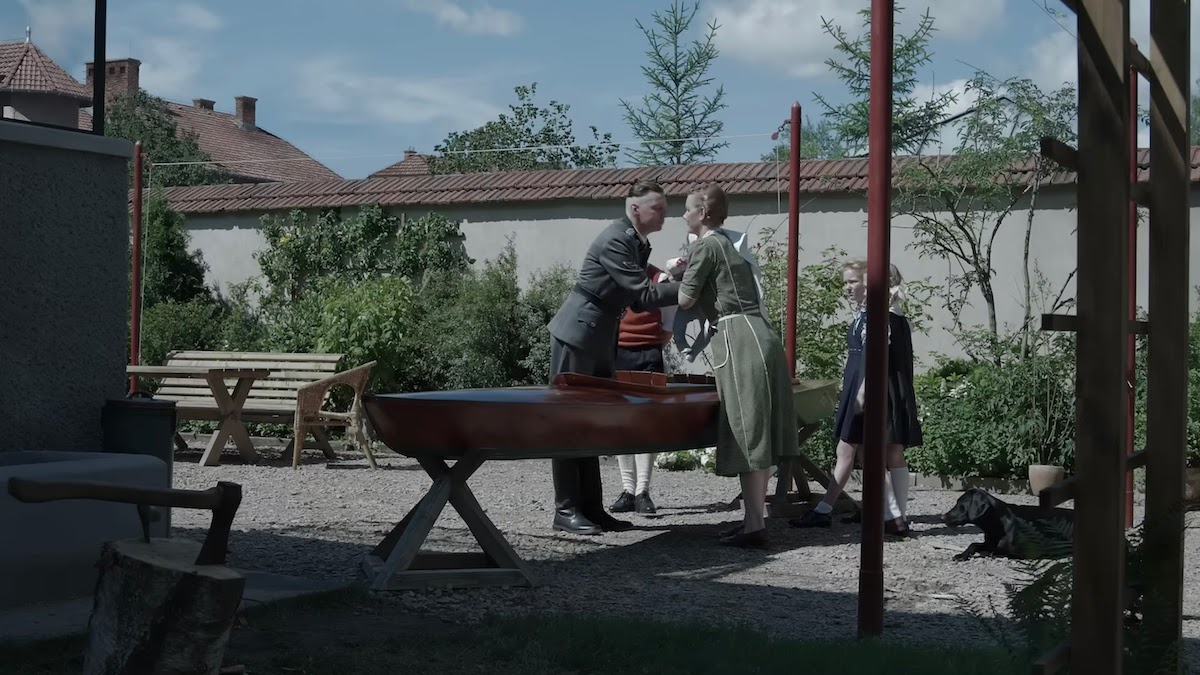
The Höss family are a typical middle class German family making their way through the second World War in 1943. They're living the good life and father Rudolf (Christian Friedel) and mother Hedwig (Sandra Hüller) are raising their five kids a stone's throw from his work. Mom tends the garden and sees to the children while keeping a close eye on the servants, all Jewish, all frail. Dad gets on his horse every day and rides to his work as commandant of Auschwitz-Birkenau.
 
Martin Amis—who died last year—wrote the book of The Zone of Interest, and Jonathan Glazer, who made Birth and Under the Skin, bought the rights before publication. Then, he threw out Amis' story, with its marital complications, and took the book down to its essentials, scrapping the fictional characters and replacing them with the real-life husband and wife living next to the camp that he supervised. Reality is often stranger than fiction and more horrifying, and when one looks at the situation as it was, to add anything else to it would be to reduce the significance of the basic horror of it all—to live a normal, even prosperous life, close to—and because of—a self-evident crime against humanity. To that end, he did an awful amount of research, interviewing servant-prisoners and making available all the resources he could find including at the Auschwitz museum.
Life for the H
öss family is pretty banal, but the true devil is in the details. Their lovely courtyard with garden and pool has a high privacy wall...but it's topped by barbed wire. The armed security tower peeks up over it, as does the smoke-stacks. The day to day maintenance of the garden is done by Jewish prisoners, and the servants are, as well, doing the cooking, cleaning, laundry, and the cleaning of blood from work-boots. There are daily deliveries of supplies, clothes, articles are picked over for what is useful—Mrs. Höss is seen trying on an elaborate fur coat, and finding a lipstick in the pocket, tries that, as well...applying it to her hand before applying it to her lips (its source, not used directly for being considered toxic). Her son, at bed-time, examines his collection of gold-laden dental-bridges.
As segregated as the family is from the horrors from which they prosper, the atrocities, though out of sight, can never be out of mind (Höss locks the doors every night, despite so many guards). The Zone of Interest has an intricate sound-scape—starting with an overture of sorts—over a black screen a chorus of voices, echoing strings...and whispers...emanate for minutes, sensitizing us to what will be an ever-presence of aural clues to the horrors that can't be entirely drowned out. Amidst bird-sounds and conversation, are rumbles of trains, furnaces roaring, dogs aggressively barking, shouted commands, gun-shots...and in one instance screaming. It becomes part of the fabric of life, omnipresent, noticeable when a new sound escapes.
So, what's the plot? What's it about? Not much. And a lot. Day-to-day living and day-to-day dying. Hedwig's Mother comes by for a visit and marvels at the house and the garden ("Of course, I like it. How could I not? You really have landed on your feet, girl"), but the glow emanating from the smokestacks and the noises disturb her sleep and she cuts her visit short.
Rudolf, who is supervising the construction of a newer more efficient crematorium, is doing such a good job with his "numbers" that he is being sent to a better position in Oranienburg—"structural changes" he's told; Hedwig is extremely upset and refuses to move with him from the paradise they've made for themselves ("They'd have to drag me out of here! Everything we want at our doorstep!"). He goes and is put in charge of all the concentration camps—they have to step things up as transports are now coming from Hungary.
A celebration is made with dancing and music, but on a phone-call back home, Hoss admits that viewing the party from a balcony "I was just trying to figure out how much gas it would take to kill everyone because of the high ceilings."
Some of the most extraordinary sequences are photographed using thermal imaging. Under the cover of darkness, a local girl hides fruit and other comestibles in the construction sites of the camp for the prisoners to find...at one point, she finds a piece of music hidden in a tin-can, takes it home and plays it on her piano. These scenes are eerie, like watching undeveloped negatives, their acts of charity in stark contrast to the scenes of indifference to suffering that are shown in full-color.
It's almost like there are two movies going on: the one Glazer made and the one that goes through your head as you're watching it, filling in the information that the movie leaves out—the awareness of the extermination on an industrial scale, the conditions all well documented and preserved for our education and as a reminder to never again walk that path to Hell (Glazer shows us the museum in the present day and even that sequence fills one with a sickening irony that makes one realize that even good intentions can have unforeseen consequences). The audience is left to fill in the blanks, a co-conspirator to the filmmakers' intentions to show just how commonplace true evil can become when it is ignored, or, worse, to somebody's benefit.
One walks out of the movie a little numbed—isn't that the point? It is ironic from beginning to end, with no limit to its repercussions as far as a person's responsibility to the plights of others. You may be reading this on a cell-phone made in a factory that is basically a sweat-shop, where the workers are making nowhere near a living wage and no thought given to the safety of those workers. The computer I'm typing this on might have been, as well.
 
We are all complicit in some way, if we go about our daily lives without consideration of others going about theirs. You cannot look at a scene in which human ash is used as fertilizer in a garden and not be horrified. And beyond that, to thinking that the human race, for all its accomplishments and marvels, can still surprise and shock with its capacity to undermine itself as just another animal, using its intellectual prowess to ignore, look the other way, and not think at all. The potential for greatness is staggering and offset by its potential to lay it all to waste by seeing human lives merely as commodities.
Höss family portrait