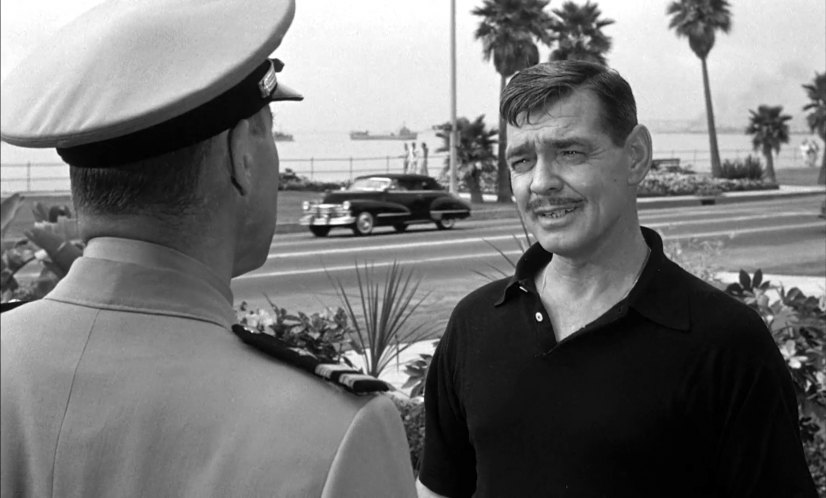
Run Silent, Run Deep(Robert Wise, 1957) One of those general entertainment movies that manages to do so many things exceptionally well that one comes away grateful for the experience. Directed by Robert Wise with a true sense of claustrophobia, the script by John Gay maintains a strict military accuracy while displaying a keen sense of drama, psychology and brevity. A psychological drama, a war film, a story of mystery as well as redemption, the film manages to pull everything off with a propulsive rhythm and fine performances throughout.
Produced by Hecht-Hill-Lancaster, Burt Lancaster the producer takes a back-seat to his star, Clark Gable, the older actor in one of his understated roles that takes into account his age. Gable's the flawed figurehead with shades of Ahab who finagles his way into the command of the S.S. Nerka patrolling the Pacific during World War II, having already lost one sub and and a frustrating convalescence at a desk-job.
Lancaster's exec Jim Bledsoe is torqued because Gable's Cmdr. "Rich" Richardson has pulled rank to get command—his command—and is now drilling the men to dive and shoot a torpedo within a record 35 seconds. The already suspicious crew starts to snarl about all this practice with nothing to show for it. Then a lucky strike convinces some of them the new Captain is golden, while the other half think he's out to torpedo their mission. Lancaster turns into a reluctant arbiter.
But, in their first attempt to sink Richardson's unsinkable Japanese war-ship things don't go so well leaving crew-members dead and injured and Lancaster in command.
Robert Wise is a master of filming people at work with a story-teller's eye for finding the perfect angle (without calling attention to it and himself) and an editor's sense of pace and construction. Wise is also a chameleon of style tamping down his presentation of professionals doing their jobs while also being able to ramp up the spectacle for the unreal worlds of musicals and science fiction. Given his work on this film, you could see why he'd be the perfect choice for the similarly set-bound Star Trek: The Motion Picture.
He also makes goods use of the usual crew of character actors who make up the Nerka's lovable mugs: Jack Warden, Brad Dexter, Don Rickles, Nick Cravat and Joe Maross. The close quarters of a submarine makes the authentic plainness of their faces all the more important and brings them to a prominence near the bright lights of Gable and Lancaster. Both those lights are shaded somewhat, with Lancaster doing subtle, measured work, the kind that would dominate his later career. Gable, even subtler, is the King, here in his twilight, still burning brighter than the vast majority of actors. By this time, Gable was moving slower and had learned the power of economy and his Captain Richardson draws you in.
Finally, the story is a cracker-jack construction. Just when you think you've got it figured out, screenwriter Gay throws in an added complication that ramps up the idea that these are men strategizing in chaos and only repeated dips into the boiling oil of battle can make them seasoned enough to think clearly through the smoke and death.
Run Silent, Run Deep is an intelligent tribute to the fighting services without resorting to jingoism, racism or choired flag-waving. The film-makers' respect for the professionalism under duress of sub-crews runs silent and deep.
This was part of a series of reviews of the ASUW Film series back in the '70's. Except for some punctuation, I haven't changed anything from the way it was presented, giving the kid I was back in the '70's a break. Any stray thoughts and updates I've included with the inevitable asterisked post-scripts.
Rosemary's Baby(Roman Polanski, 1968)Rosemary's Baby opens with this theme:* it's a lullaby, sung charmingly off-key by Mia Farrow, its star, but underscored with even more off-key, sometimes baleful accompaniment. And as this lullaby oozes out on the soundtrack, the image we see is of a line of New York apartments--not an unusual opening shot for the beginning of a movie, in fact, it's pretty much of a cliche.
And so is the opening situation--two young newly-weds-in-love house-shopping. We've seen it hundreds of times. It's an everyday occurrence. The apartment is lovely, the couple buys it, and everything is quite normal.
Until a new-found friend of Rosemary's commits suicide, and Rosemary's relationship with her eccentric neighbors turns rather familial, and a bizarre fate befalls the fellow who got her husband's job. Now, that it looks like success for them, they decide it's time to have a kid...and see, there's this chocolate mousse...
Well, I don't have to go any further for I'm sure the legend of Rosemary's Baby has preceded it.
But what separates Rosemary... from other gothics is the perverse outlook of its director, Roman Polanski. Yes, everything's normal, and it is that very normalcy that makes the intrusion of Demonic Forces so doubly terrifying. One can accept odd happenings on a dark and stormy night on a cliff-top castle, but on a sunny day in a New York apartment complex?**
It makes the horror so much more palpable to be surrounded by normalcy for it increases the possibility of something happening to you. And thus, Polanski places threats in such "normally" innocent and reassuring things as a chocolate mousse, or Ralph Bellamy (who had hawked aspirins for years on the tube) playing a "witch" doctor, if you'll excuse the pun.
It's an unorthodox approach to the Gothic Horror Story...at least it was in 1968, when it was released, and to paraphrase an ad for Polanski's latest film, The Tenant, "No one does it to you like Roman Polanski."***--not William Friedkin in The Exorcist, or Richard Donner in The Omen. Polanski's Rosemary's Baby is head and shoulders...and horns, above them.
Broadcast on KCMU-FM on October 22 and 23, 1976
Still true, but, my God, after Polanski's conviction of child-rape, that's one hell of a movie tag-line on The Tenant! Polanski's arrest, trial and conviction would come later, two years after The Tenant was released, but it sure is the ultimate sick joke.
As for Rosemary's Baby, it still tops the lists of "Movies No Pregnant Woman Should Watch" and it still takes the prize as the best "Devil Walks Amongst Us" movie (sorry, Damien and Regan), and it's no small part due to Polanski's sick sense of humor—Orson Welles, in one of his conversations with Peter Bogdanovich, referred to him as "one of those morbid boys"—and his way of mixing the mundane and the sacrilegious.
The most entertaining parts of Rosemary are the elderly and uncomfortable neighbors—the "legacies" of the Bramford Hotel, and the best of them is sprightly Ruth Gordon, who won an Oscar for her role. It resurrected Gordon's career, and she went on to star in a long list of films in her twilight years. But, there are others, like Patsy Kelly, Ralph Bellamy (the joke in his early roles was that he was always the dullest of leading men and Polanski makes full use of that reputation here), Elisha Cook, Jr. (a favorite of producer William Castle), Hope Summers, and Phil Leeds (he would end up a fixture on "Seinfeld"), all semi-familiar faces that, in other circumstances, might provide comfort, all part of a conspiracy to make an anti-domestic situation to welcome the Anti-Christ.
Add to it the presence of Mia Farrow, the urchin break-out star of TV's "Peyton Place" who'd just married...Frank Sinatra!...and had a quality that could charitably be called "odd." You're not sure if she's going crazy, has a pre-postpartum depression, or if something weird is actually going on, and it keeps audiences on a tightrope tension of sympathy for/suspicion of Rosemary, the yin and yang of our sympathies and cynicism. And, of course, Polanski (out of Ira Levin, who cloned Hitler and roboticized housewives in other thrillers) turns that into your worst nightmare.
Producer William Castle had a carnival-barker-showmanship to him, gimmicking customers into screenings of his goofy-creepy thrillers and horrors and after Hitchcock (inspired by Castle's box-office receipts and asking "what if someone good did it?") managed to best his efforts with Psycho, he wanted to do the Master of Suspense one better. With the solid story-ideas of Rosemary's Baby, head and tails above what he could conceive, he was able to get that much better and gain some industry clout, although he ultimately had to cede most of the creativity to Polanski, and his Paramount studio-bosses. He would always be a B-movie-maker, but Rosemary's Baby made him see the promised land of the A-list.
* Yeah, there's nothing wrong with your computer--there is no song. I usually backed my radio-reviews with an appropriate piece of music, and for this one, I used the actual theme on the soundtrack (that I recorded on cassette from a TV broadcast...I used to do that).
Here it is:
** Ironically enough it's the high-end and rather exclusive Dakota building, standing in for the "Bramford." John Lennon would be shot in front of the Dakota a decade later.
*** EEE-Yikes!
Legendary producer-showman William Castle appears outside the telephone booth for a cameo.
So...is "Real Time with Bill Maher" on tonight? (Answer: Nope)
Written at the time of the film's release.
Religulous(Larry Charles, 2008) It may seem a bit like preaching to the choir (or rather fomenting to the heretics) for this critic that he follows the anti-creed* of this roughly assembled documentary featuring Bill Maher. Yes, yes, I believe.
But, at the same time, one can't just look at the film and not find the hoariest manipulations of the documentary footage by Maher and director Charles (the "director" of Borat, but really, what is he doing in these films except keeping people in shots, and staying out of the way of the other cameraman?). You think Michael Moore is manipulative? Watch these guys. Maher is the most inclusive of interviewers—if it's including him. He's only too happy to derail a conversation in order to toss in a smart-assed remark, relevant or not. A comedian with an insatiable desire to be noticed and appreciated, Maher is his own best audience. And one frequently wants to slap his hand when he perks up to toss in a punch-line—he's too busy thinking of his next joke than to actively listen and build on a conversation.
Concurrent with that is the manipulative editing (baldly manipulative editing, as Charles tosses in reaction shots from other places in the conversation to get his comedic timing-points), that makes one seriously dis-believe what one is seeing on the screen.
It works in the short-format "Daily Show" interview, but for a long-form documentary, it's just manipulating reality far beyond what is necessary to make your point, and in some cases, make your interview subject look like a fool. That's their job.
Still, there are a couple of good sequences, particularly one of Maher and his skeleton crew driving up to a double-wide ministry and just engaging the men in debate—one guy stomps off in protest—but the others genuinely step up to respectably talk the issues Maher brings up, and they close bringing Maher into a prayer circle to thank their Lord for the opportunity. Karma runs over dogma, and the groups part ways, both satisfied with the results. It's that sort of level-headedness and confidence that is missing in this documentary, where both sides are pushing their God, be they Jesus, Mohammad, Buddha, (or Bill Maher) in front of the camera.
* That being: At a time when human knowledge now has the inescapable capacity to destroy itself in all sorts of clever ways, that the clinging to divisive religious myths by a genuinely intelligent populace, thus inspiring the shutting down of rational thought at a time when we need it most, is not only dangerous, it will be the flash-point that determines our destruction. Amen.
Saturday is traditionally "Take Out the Trash" Day, but this Saturday, we'll make an exception with this wonderful little animated film.
"Do You Remember..."
or
The Counter-point to "Rust Never Sleeps"
"What a piece of work is a man!"
William Shakespeare
Interesting way that Shakespeare says that. "Piece of work"...like a construction. A machine. And what is our relationship with our machines, to whom we are both master and slave?
When Stanley Kubrick was working on the story that would be completed by Steven Spielberg as A.I.: Artificial Intelligence, one of the push-backs he got was whether human beings could love mechanical beings. He found nothing odd about it. How many of us anthropomorphize our devices: how many of us name our cars or festoon our work-stations with family pictures and beloved ephemera? A high percentage in my experience.
Pablo Berger's amazingRobot Dreams(based on the graphic novel/children's story by Sara Varon) looks very retro, employing a deceptively limited animation style (but within a complex background of New York, circa 1980's) to tell a tale of emotion, companionship, complexity and Fate without a word of dialog...a feat that belies any lack of sophistication in the process. That the world is populated by animals, well, that's a once-remove to push a point, the same way Zootopia does.
Dog (that's his name..."Dog") lives in New York City, and it's dull, solitary existence. He plays pong. He makes a TV dinner in his micro-wave (which he drinks with "TaB"). He watches TV. He looks out the window and sees happy couples. He's lonely, as lonely as one can be in the most populous city in the country. An ad pops up asking "Are you alone?" and before you can say "but, wait, there's more!" he's ordering what they're selling—a robot companion, the "Amica 2000." It arrives and he spends much time on the construction and deciphering of the instructions.
But, once Robot's lights all turn green, they become fast friends, walking around Manhattan, Central Park, and doing the things one does in New York—eating hot dogs, roller-skating in the park, sight-seeing, going home, watching TV...it's Fun City, and all set to the happiest song ever written:Earth, Wind and Fire's "September" (the movie makes great use of the song, breaking it down, and using it in various forms throughout the movie). Dog and Robot became constant buddies and inseparable friends. Then, Dog takes Robot to Playland, where they spend a great day on the beach, flying kites and swimming. A nap in the sun for both of them ends with Dog indicates it's time to go. But, Robot can't move. He's rusted. Dog tried to get Robot off the beach, but he's much too heavy, so they agree that Dog should leave Robot there, find a way to repair Robot, and in the morning, they can go home. But, when Dog rushes out there to get Robot, he finds the beach shut down for the season and he can't get to Robot and is charged with trespassing. Another attempt, he gets arrested. When he appeals to the Parks department, he is denied. All he can do is wait until next year when Playland opens again.
In the meantime, Robot is left on the beach...and he dreams. What else can he do?
Pretty simple story-line, but Berger imbues it with detail and much humor, reminding one of the ingenuity employed by directors of the silent age—while also paying homage to such diverse directors as Hitchcock, Kubrick, and Allen.
We'll leave the synopsis there, as where Berger and his co-scenarist Varon take the story becomes more complex and richer, having to do with experience and nostalgia and how you never really lose those no matter what else you lose along the way. it could be a fanciful rom-com if the trajectory of events didn't run counter to the expectations of that genre. It's sweet and sad, but has a particular life-affirming quality that warms the heart and is instantly relatable, even if you're nothing like the denizens of this animated New York and merely a poor player of a human being.
I can't recommend this one highly enough and one hopes that you get the chance to catch it in a theater where it should be seen.
And as for the question of emotional attachments to our devices, it's not so fanciful an idea, either. Every computer, lap-top, smart-phone, and pad you own has memory. And it's all about you.
Saturday is traditionally "Take Out the Trash" Day...
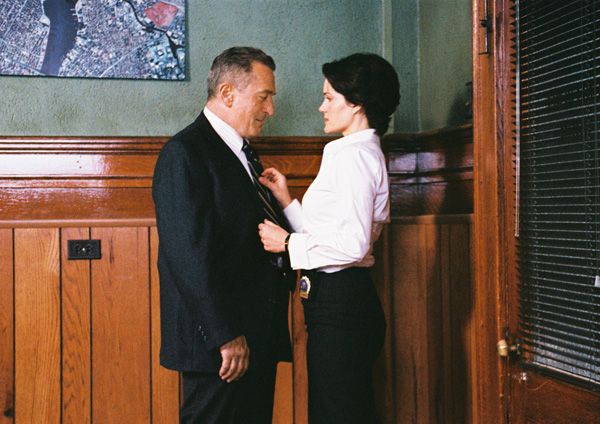
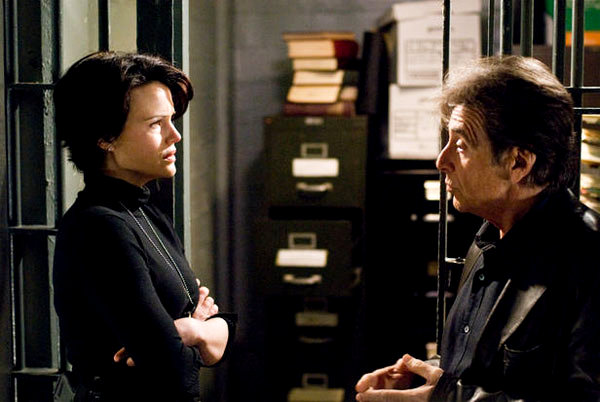
Righteous Kill(Jon Avnet, 2008) Someone is killing "Scott Free's"—those scum-bags that you just know are guilty but have some smooth-talking fancy-pants lawyer or some milque-toast judge who lets 'em walk, sneering, to prey on Society again...until they show up with a bullet-hole in the middle of their forehead. Two buddy cops, Turk (Robert De Niro) and Rooster (Al Pacino) start to add things up when one of the perps they arrested shows up deader than a Keanu Reeves performance. Looks like it's murder "and somebody's responsible." A vigilante? Certainly. But, if its revenge they're after, why are so many of these guys showing up dead? It's then that they think that the killer may be a cop.
But who? Complicating matters is that most of the cops, including De Niro, Pacino, plus Carla Gugino, John Leguizamo, plus Donnie Wahlberg-o are creeps, so it could be any of 'em, except for the Captain of the squad (Brian Dennehy) but only because you couldn't believe Dennehy could sneak up on anybody but a bed-ridden quadriplegic. So the question is: which of the crazy actors is playing the crazy character killing all these people?
The answer: who cares? With a movie this terrible, and victims painted so sneeringly evil they're cartoons it's hard to work up much sympathy or even interest in finding their killer.That's the problem of the writer. But director Avnet is so ham-fisted, he can't seem to hold a shot or light a set without sabotaging the drama of a scene. He's so busy "nuancing" things that you have trouble following the plot. He's not even talented enough to get out of the way of De Niro and Pacino (or, God forbid, rein them in) to make a scene play.
And, let's face it, having those two legends on the screen should be a treat: they didn't work together in The Godfather: Part II (obviously), but their scenes in Michael Mann's Heat were tantalizingly short. Here, they're in almost every scene together (although Avnet can't seem to find the wherewithal to keep them in the same shot), and you realize they're like oil and water, or Mumbles and Loudmouth—they're two actors who've known each other for years, but their characters don't seem to. Or else the movie would be over in five minutes. But no, the suspicions and subsequent doubts must be fully explored, the red herrings must stink up the joint, and the script-writer must throw in a couple of feints that make no sense once the movie is over—they're there just to con the audience.*
What a waste. The big mystery is given this script, how could it attract two of the most iconic, respected and (when paired) legendary actors? Sounds like the biggest con was going on behind the scenes. Righteous Kill is the last thing you would expect a film starring De Niro and Pacino would be—a very pedestrian run-of-the-mill movie.
2024 Update:The story goes that at the premiere of this film, De Niro approached Pacino and said that they should never do another movie like this again, that they should find properties they could be proud of appearing in together.
* Now, movies are by nature, the manipulation of reality—and the audience—to tell a story. But, there's doing it well, and there's doing it the Righteous Kill way.
I'm quoting Shakespeare there, so obviously this is a very "serious", and "important" film. But just to raise the hackles of any Weinstein Co. "readers" out there, here's a snarky little blanket quote to start things off:
Take The Summer of '42 and strip all the fun out of it and you have The Reader. No, really. You've got the moony kid, but instead of 40's Nantucket, move it to early 60's Berlin. Instead of said moony kid having friends who provide the comedy relief, this kid is absolutely friendless, so there is no comedy or relief to be found, and instead of the lovely nubile widow-to-be showing him the ways of the world, you have the dour, nubile former SS-guard showing him just about every position in the book (I counted).
Still, I saw The Reader with a nearly sold-out crowd, possibly because it's nearing the end of its run in theaters, but also because Kate Winslet is nominated for an Oscar for it (and is most likely to win).*Stephen Daldry's previous film was The Hours, and this shares that film's chilly demeanor, and emotional opaqueness. But where The Hours resonated over several story-lines to come to a dramatically satisfying conclusion, The Reader moves along its clear-cut path, as the principles age, but seem not to mature. One would think that wisdom would creep into any of these creatures at some point, but it is not to be found. One is left to sit in frustration while actions are carried out—or more specifically, not carried out—despite some ample history lessons contained therein teaching the folly of such a philosophy. Relationships do not alter, although a lifetime of experience may be contained within the boundaries of them. And finally, the film makes a mockery of the word "responsible."
One comes away impressed by a line of dialogue every once in a while (David Hare wrote the script), the period detail seems right, the performances are "correct" (as they both play different ages of the same character, they seem to have found a perfect actor in David Kross who can match Ralph Fiennes for miserableness), but ultimately it's all for naught. This is a film without lesson, without moral, rightly or wrongly, but insists on trying to instill some shred of sympathy for a person responsible for inhuman behavior, based on their shame of a condition that they have the power to change at any time. What a waste.
* Man, you can get cynical with this, but the part has everything: the character is sympathetic/unsympathetic; has an affliction (illiterate, so no appliance-work, or physical moods to use) and a role that requires a lot of de-glamming make-up, as the character is required to age from 40 to 80. I tell ya, it's got everything to grab the gold...and then there's this YouTube video, that refers to this YouTube video.
I was going to post this next week—the start of the 2024 baseball season—but, according to PBS News Hour (and other confirming sources), the season actually starts today with a series going on in Korea. So...we'll bunt.
Written some seasons ago...
The Rookie(John Lee Hancock, 2002) With all the fuss being made over The Blind Side, attention must be paid to the director's previous sports-film that proved popular, like The Blind Side, also based on a actual story that's just this side of incredible and told with a clear-eyed lack of pretension.
John Lee Hancock's first film in the Majors,*The Rookie, is a double-header of a sports film that manages to tell its male-weepie "dreams do come true" stories, both of them essentially true, with a minimum of sentimentality—the principals are actually quite bitter throughout the film, weighed down by the burden of "what might've been," and to a certain extent paralyzed by it. Coach Jim Morris, a former Big League prospect makes a deal with the High School team he coaches he'll "re-up" if they win their division. It then moves on to top itself to tell the consequence of that first story to the coach who must fulfill a promise to his team...and himself...to try out—again—for the Majors at the age of 39, a time when most pitchers are eyeing retirement, not opposing pitchers.
And because it's situated in Texas (for the most part), there's not an awful lot of talking about it, but, instead, there is a lot of scowling and stewing and time spent in solitude beating themselves up by transference in the form of hurling a baseball in frustration as fast as can be at some woe-be-gone target.
It might have been that baseball abuse added a few feet per second to Jim Morris' pitch, or it might be an arm strengthened by scar-tissue that can top his fast-ball at two ticks shy of a hundred mph. Whatever the reason, the science teacher/baseball coach in the arid football town of Big Lake, Texas must put-up or shut-up to his high-school team after his exhortation to pursue their dreams (and some batting practice with his blazing fast-ball) sharpens them up to become division champions.
That's story one. Story two is Morris' old-man hoofing it through try-outs and the farm system at the off-chance of being called to "The Show." It is an unlikely scenario, but Morris manages to do it, the film ending on the fairy-tale night that he must pitch in his first Major League game in his home state in front of his team and friends and family.
The movie could have been a sob-fest, but instead Hancock hinges it on dark nights of the soul and doubts about responsibility. This isn't some up-beat Rudy story where "wishing makes it so," (despite being produced by Disney). Morris (Dennis Quaid) must make a personal journey of dealing with a lifetime of disappointment and what might-have-been to accept the result of his efforts. After a life of compromise and making-do (and blaming others), he has to learn the grace to accept the gifts he has been given and the opportunities he's been afforded. Whatever pain goes behind each pitch, he must also put behind him. Grace? Sacrifice? Forgiveness? Where do you go to learn such traits? Such inspiration usually is found at the Cathedral, the Temple, or the Mosque, but in the sports-world the big stadium is the source of humility. Hancock stages Morris' first walk into the Texas Rangers stadium as if he was walking into the Vatican, the high-arched entryway with the sun streaming through that stretches to a vanishing point that evokes a long journey, but also the long history of a game that, more than any other sport, is a competition with the ghosts of the past as well as the Boys of that particular Summer. The arches reach to the sky to define the goal but also press down with the weight of tradition, dwarfing the new recruit, challenging him to fill the space. In the distance, his fellow rookie, half his age, looks on in amusement at the old duffer hanging back in awe, anxious to start his journey and not thinking he may be looking at a flash-forward to a future of regret. It is a poignant moment of film, that says volumes in a single image and no words.
It's a good story told well. The characters are not larger than life, merely as large as they need to be. And no decision is made with a self-serving speech and heraldic trumpets—decisions and their consequences are agonized and fretted over. It's a story of people who not only have a lot to lose—they know it—but take the chance anyway for whatever amount of time it may last. The Rookie manages to make it look not quixotic, but essential.
But, getting to that point was a long, involved road. It originated with Dalton Trumbo, who, following a year-long stint in prison for contempt of Congress for not "naming names" to the House Un-American Activities Committee, was living in Mexico City. He was in financial straits, not being able to sell scripts to Hollywood—who'd provided a good income to him since 1935—owing to being "blacklisted" by the industry. He still wrote, producing 10 screenplays, and forwarded them to "fronts" who would sell the ideas to the studios for a cut of the proceeds. Trumbo's reverse-Cinderella story, Roman Holiday, was sold to Frank Capra's Liberty Films by one such front, Ian McLellan Hunter for $50,000 (all of which he paid to Trumbo), and Hunter was hired by the studio to work on the script.
The first director attached to it was Frank Capra himself, who wanted Cary Grant and Elizabeth Taylor for the parts of the deceptive reporter and princess, respectively. Taylor was unavailable and Grant, after reading the script, decided his part would be overshadowed by the part of the princess. Capra left the project when his budget demands would not be met, and he sold the script back to Paramount.
George Stevens was briefly attached, but it ended up with director William Wyler, who had some stipulations: a larger budget, Jean Simmons and Cary Grant to star, and filming to be done totally in Rome. Grant—again—wouldn't do it and Simmons was under contract to RKO and its owner Howard Hughes wouldn't loan her out except for a sizable fee. So, Wyler opted to cut his losses—he insisted on filming in Rome (and Paramount had some frozen funds that could be utilized and Rome's studio Cinecittà was back up and running). Gregory Peck—who was looking for lighter roles than he was being offered—was signed (although he, too, was worried about being overshadowed by the female lead), and Wyler decided to look for an unknown actress, which is when he heard about a new European actress, who was doing theater in small parts in movies.
Wyler left instructions to keep the camera rolling after the screen test—so the story goes—and the young actress was asked questions about her background, including her time growing up in Belgium during World War II. Everyone who saw the test was charmed by it. Hepburn got the role. But, first, she had a commitment to a Broadway role starring in "Gigi"—she had been picked by Collette herself for the role—and as Peck was held up in over-runs shooting The Snows of Kilimanjaro, the production was delayed.
In the meantime, many writers' hands worked on Roman Holiday besides Hunter, including Ben Hecht, Preston Sturges, Valentine Davies, and—when in Rome—John Dighton, who was there to punch up scenes whenever a location found by Wyler would peak his interest.Cast and crew were not afraid to make changes or make suggestions.
The film begins with a Paramount Newsreel examining Princess Ann (Hepburn) from "one of Europe's oldest ruling families" (although they never mention of what country*) on a tour to "improve trade relations" and although she projects a serene calmness publicly she's starting to crack. She's 19, royally supervised and expected to amiably meet and greet hundreds of dignitaries, all of whom seem to belie the term. And although this is a reverse-Cinderella story, she does have one thing in common with her fairy-tale predecessor—she has shoe problems. There's only so much time you can spend standing in the damn things! Plus, although she is touring Europe, she sees very little of it, cloistered in luxurious quarters with her only bed-time reading her full itinerary for the next day. And yet outside her window, life is happening, people are partying and enjoying life. And Rome, even though it's the Eternal City, can't wait forever.
She melts down. to the point where she has to be sedated to get some sleep so she can keep up the busy tour. And maybe it's the sleep-drug talking, but the princess gets it in her crowned head to escape her gilded dignitary's cage and go out into the night, un-escorted, unchaperoned, and unceremoniously. Where Cinderella wanted to see how the other 2% lived, Ann wants the 98% of possibility the world just within her regal wave can offer. She sneaks out of her embassy and finds her way into town.
And then, the sedative kicks in.
Lucky for her, Joe Bradley (Peck), a reporter for a Rome-based wire service is late coming home from an evening poker game among colleagues and happens upon her. Thinking her drunk, he tries to get her on her feet, then pours her into a cab and, with no place else to put her, takes her to his apartment ("Is this the elevator?" she bleerily asks when they get there) to sleep it off. There is some chaste teasing about sleeping arrangements that ends up with Bradley being late for his day's assignment—an interview with Princess Ann—only to discover...she's been sleeping in his bed. And suddenly he concocts a scheme to get a big story, given his special "access."
Her government has put out a cover story to explain her mysterious disappearance has had to cancel all activities due to a "sudden illness"...so Joe makes a bet with his boss that he can get an exclusive with the princess. All well and not exactly good. A lot of subterfuge has to be done to get that story. The princess wants to have her adventure but not let on that she's at any way royal. Joe conspires to get his story without letting on that he's a reporter—and he wants pictures, which he gets with the third wheel of the adventure, bohemian photographer Irving Radovich (an ebullient and funny Eddie Albert), who is constantly taking photographs with camera concealed in a lighter.
The production was, basically, a working holiday for cast and crew, and the incidents on the princess' "day off" center on aspects and sights of an elaborate tour of Rome with the Colosseum, the Trevi Fountain, the Spanish Steps, with stops for gelato, vespa-hopping, dinner and dancing and, ironically, "the Mouth of Truth" which might prove to be daunting to two people who spend the day under false identities.
Peck has rarely been allowed to be this light—and he's surprisingly subtle and slyly humorous playing a roguish Prince Charming, and Hepburn is perpetually adorable as a princess with the crown off. As Pauline Kael remarked "when she smiles, we're all goners," but leavened somewhat by eyes that always have a shade of melancholy—her wartime childhood probably had something to do with that—and it comes in handy for her scenes as a princess trying to escape the weight of her heritage while knowing that she'll never be able to get away with it...or from it.
Just as Cinderella had to return from the ball and back to the ashes, Princess Ann's fantasy has to come to an end and she must return to her origins. But, Cinderella got to have a happy ending. For Princess Ann, no ending can be completely happy. But, Roman Holiday does, at least, provide a modicum of satisfaction where the lies fall away along with the fantasies. If someone can only acknowledge the truth...however painful it might be...one can at least admit that they're being true...to themself.
And that's the lovely thing about Trumbo's story. It's not a sad ending (although not a happy one), but there is a level of satisfaction in the warm glow of memory, free of fairy tales, despite all the pomp and circumstances getting in the way. And the memory of Roman Holiday always brings an admiring smile to my face.
Dalton Trumbo was finally acknowledged to have written the story that won the 1953 Academy Award and in 1993 an Oscar was given to his widow. Trumbo died in 1976.
"...She has us all in thrall, and when she smiles we're all goners."
Pauline Kael
* The film never says, but one can assume that it isn't any of the stops on the tour which include London, Amsterdam, Paris or Rome. Although I did find an example of a script excerpt, which names the country as "Coravia" (wherever that is).


.jpg)