Showing posts with label Brian Cox. Show all posts

Wednesday, March 20, 2024

The Rookie (2002)

I was going to post this next week—the start of the 2024 baseball season—but, according to PBS News Hour (and other confirming sources), the season actually starts today with a series going on in Korea. So...we'll bunt.

Written some seasons ago...


The Rookie (John Lee Hancock, 2002) With all the fuss being made over The Blind Side, attention must be paid to the director's previous sports-film that proved popular, like The Blind Side, also based on a actual story that's just this side of incredible and told with a clear-eyed lack of pretension.

John Lee Hancock's first film in the Majors
,* The Rookie, is a double-header of a sports film that manages to tell its male-weepie "dreams do come true" stories, both of them essentially true, with a minimum of sentimentality—the principals are actually quite bitter throughout the film, weighed down by the burden of "what might've been," and to a certain extent paralyzed by it. Coach Jim Morris, a former Big League prospect makes a deal with the High School team he coaches he'll "re-up" if they win their division. It then moves on to top itself to tell the consequence of that first story to the coach who must fulfill a promise to his team...and himself...to try out—again—for the Majors at the age of 39, a time when most pitchers are eyeing retirement, not opposing pitchers.
And because it's situated in Texas (for the most part), there's not an awful lot of talking about it, but, instead,
there is a lot of scowling and stewing and time spent in solitude beating themselves up by transference in the form of hurling a baseball in frustration as fast as can be at some woe-be-gone target.
It might have been that baseball abuse added a few feet per second to
Jim Morris' pitch, or it might be an arm strengthened by scar-tissue that can top his fast-ball at two ticks shy of a hundred mph. Whatever the reason, the science teacher/baseball coach in the arid football town of Big Lake, Texas must put-up or shut-up to his high-school team after his exhortation to pursue their dreams (and some batting practice with his blazing fast-ball) sharpens them up to become division champions.

That's story one. Story two is Morris' old-man hoofing it through try-outs and the farm system at the off-chance of being called to "The Show." It is an unlikely scenario, but Morris manages to do it, the film ending on
the fairy-tale night that he must pitch in his first Major League game in his home state in front of his team and friends and family.
The movie could have been a sob-fest
, but instead Hancock hinges it on dark nights of the soul and doubts about responsibility. This isn't some up-beat Rudy story where "wishing makes it so," (despite being produced by Disney). Morris (Dennis Quaid) must make a personal journey of dealing with a lifetime of disappointment and what might-have-been to accept the result of his efforts. After a life of compromise and making-do (and blaming others), he has to learn the grace to accept the gifts he has been given and the opportunities he's been afforded. Whatever pain goes behind each pitch, he must also put behind him.
Grace? Sacrifice? Forgiveness? Where do you go to learn such traits? Such inspiration usually is found at the Cathedral, the Temple, or the Mosque, but in the sports-world the big stadium is the source of humility. Hancock stages Morris' first walk into the Texas Rangers stadium as if he was walking into the Vatican, the high-arched entryway with the sun streaming through that stretches to a vanishing point that evokes a long journey, but also the long history of a game that, more than any other sport, is a competition with the ghosts of the past as well as the Boys of that particular Summer. The arches reach to the sky to define the goal but also press down with the weight of tradition, dwarfing the new recruit, challenging him to fill the space. In the distance, his fellow rookie, half his age, looks on in amusement at the old duffer hanging back in awe, anxious to start his journey and not thinking he may be looking at a flash-forward to a future of regret. It is a poignant moment of film, that says volumes in a single image and no words.
It's a good story told well. The characters are not larger than life, merely as large as they need to be. And no decision is made with a self-serving speech and heraldic trumpets—
decisions and their consequences are agonized and fretted over. It's a story of people who not only have a lot to lose—they know it—but take the chance anyway for whatever amount of time it may last. The Rookie manages to make it look not quixotic, but essential.

Jim Morris' baseball card
* After writing two quirky off-beat films for Clint Eastwood: A Perfect World (1993) and Midnight in the Garden of Good and Evil (1997).

Tuesday, September 12, 2023

Match Point

Match Point (Woody Allen, 2005) The box office was good for Match Point, Allen's first hit in years, and one wonders why. The film is accomplished and assured, simple in execution but morally complex, one of those little Woody Allen morality puzzles that update the classics (in this case, "Crime and Punishment", as well as any number of "bad-boy makes good" novels, where all you need is a compromised conscience to make it in the world). The BBC put in money, so the locations are in Great Britain (it's good to get out of New York once in awhile). The actors are young and skew to a lower movie-going demographic (although except for Scarlett Johansson, the actors are not box-office draws)--but there are no "tunes" on the soundtrack, merely ironically chosen opera extracts sung by Caruso (complete with vinyl surface noise).

Allen considers it one of his best films.
Despite the accents and strange new territory, it's undeniably Allen-town with its
chilly empty spaces pointedly deliberately composed, its couples colliding and splintering, an act of insanity out of the blue, and a late touch of magic that chills.
But it's one of those Allen movies where the literary seams show,
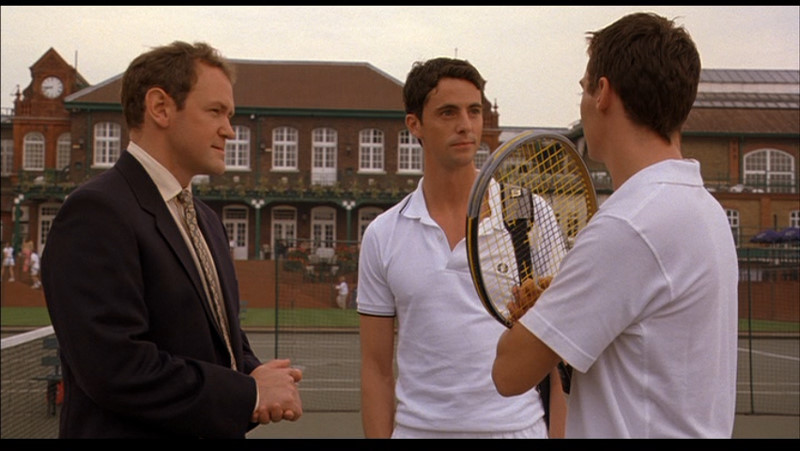
his long empty corridors reverberating with the classics of the past informing his movie, with some of the echoes coming from his old Brooklyn haunts; I kept thinking that Chris Wilton, the slippery tennis pro (the only thing that's true about him is, surprisingly, he is a tennis pro!) reminded me of Leonard Zelig, the "human chameleon," who, in his insecurity, would conform to whatever group he was with, even physically changing to accomplish it.
But more than the literary seams show.
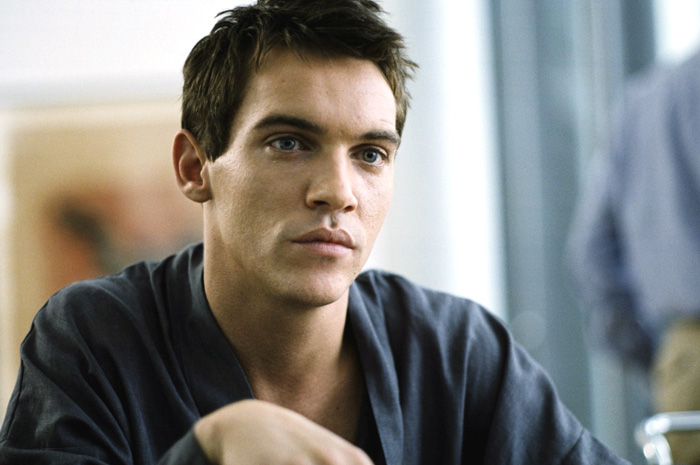
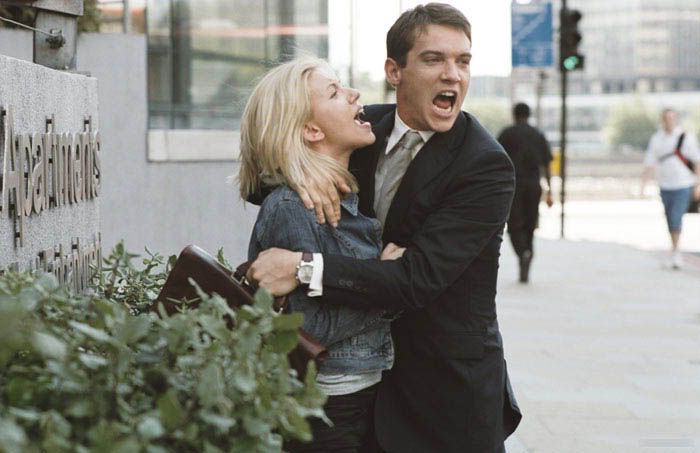
Jonathan Rhys Meyers, who plays Wilton, isn't a fast enough actor to make his sudden shifts of tone and snap-excuses sound credible; there needs to be an ad-libbed looseness to his answers, rather than the studied RADA responses Meyers provides. The rest of the cast play their parts as required: Brian Cox (always good), as Wilton's chief enabler; Matthew Goode (interesting to see him in this role after Watchmen—in this part, he's much snappier playing a member of the effete elite); Emily Mortimer, thanklessly perfect in a thankless role; Scarlett Johansson as the Victim of Fate, smart enough to know herself, but not know her role in the world.

So, what's different? Why this Woody Allen movie doing well, when the previous ones hadn't? Allen had been, piece by piece, removing the musty-Woody-Allen-tropes from his movies to no effect at the box office. What made
this one different?
Then, it hit me.


There's no "Woody Allen" character in it. No stand-in's with comically stuttering neuroses. No "fools" that make a point. No sad clowns in the corner. This time, Woody Allen is behind the camera. For good.

Wednesday, March 3, 2021

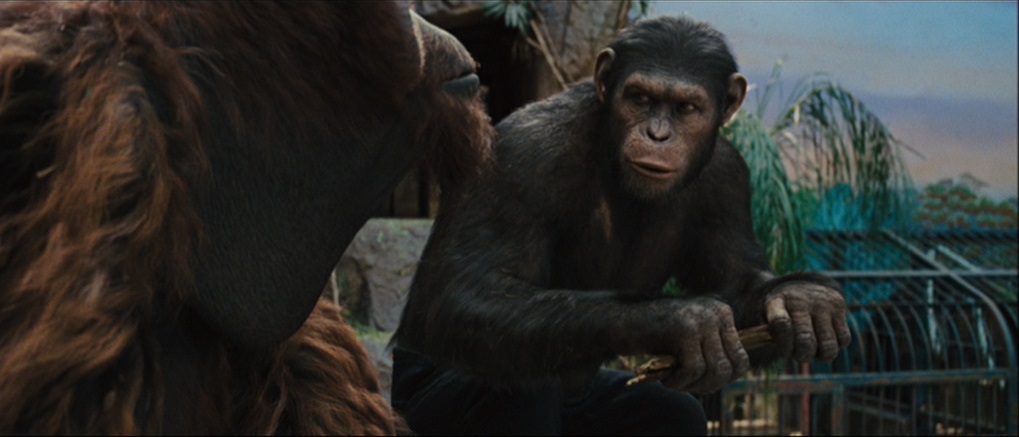
Rise of the Planet of the Apes

I was about to run a past review for another film when I realized I hadn't re-run the review of the first film of the "Planet of the Apes" re-boot. Great Caesar's Ghost, how could I have missed that? 

Herewith, written at the time of the film's release.

"Running the Serkis from the Monkey Cage"

or
"Well...That was Fun..."

Conquest of the Planet of the Apes was always the controversial one in the "Apes" series. Test audiences were so upset at the carnage—rioting apes bludgeoning government officials with rifle-butts—that a drastic re-write and edit was demanded by 20th Century Fox (it's why, when you watch Caesar—Roddy McDowall—delivering his "let's be merciful" speech at the end, you only see his eyes to avoid any lip...er...mask-sync problems).

Tonally, it's jarring...as well as being a load of bananas. Conquest could have been good...in the disquieting way that the "Apes" movies could be. But, instead, the studio ham-strung it's simian rights leader.

It's different times now.  The cities aren't burning down, only our 401K's.  So, along comes Rise of the Planet of the Apes—as unnecessary and pointless as any movie could be in this dull Summer Season for movies—after all, it's not a "tent-pole" franchise and arriving rather late in August. The "Apes" series had already run dry in its first go-'round, and in 2001, Tim Burton put out a "re-imagining" of the original that only proved that a "re-imagining" with better FX and make-up doesn't improve on something that depended on some good ideas first and the rest second. This new one seemed like a too late after-thought, and although the trailers looked intriguing, the ad campaigns and posters were uninspiring—there were no "character" posters, no tie-in cups at the 7-11, no "franchise" buzz—just another "Apes" movie long past its relevancy.
Except it has one thing going for it—good ideas. And when I say "good ideas," I don't mean the lines are clever (they aren't—Caesar gets the best lines, and
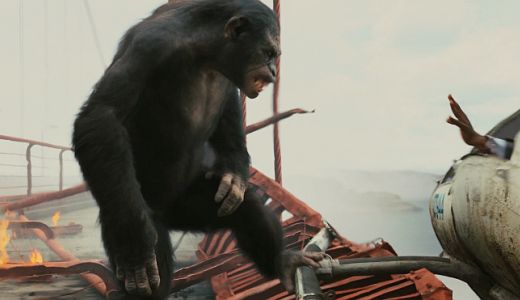
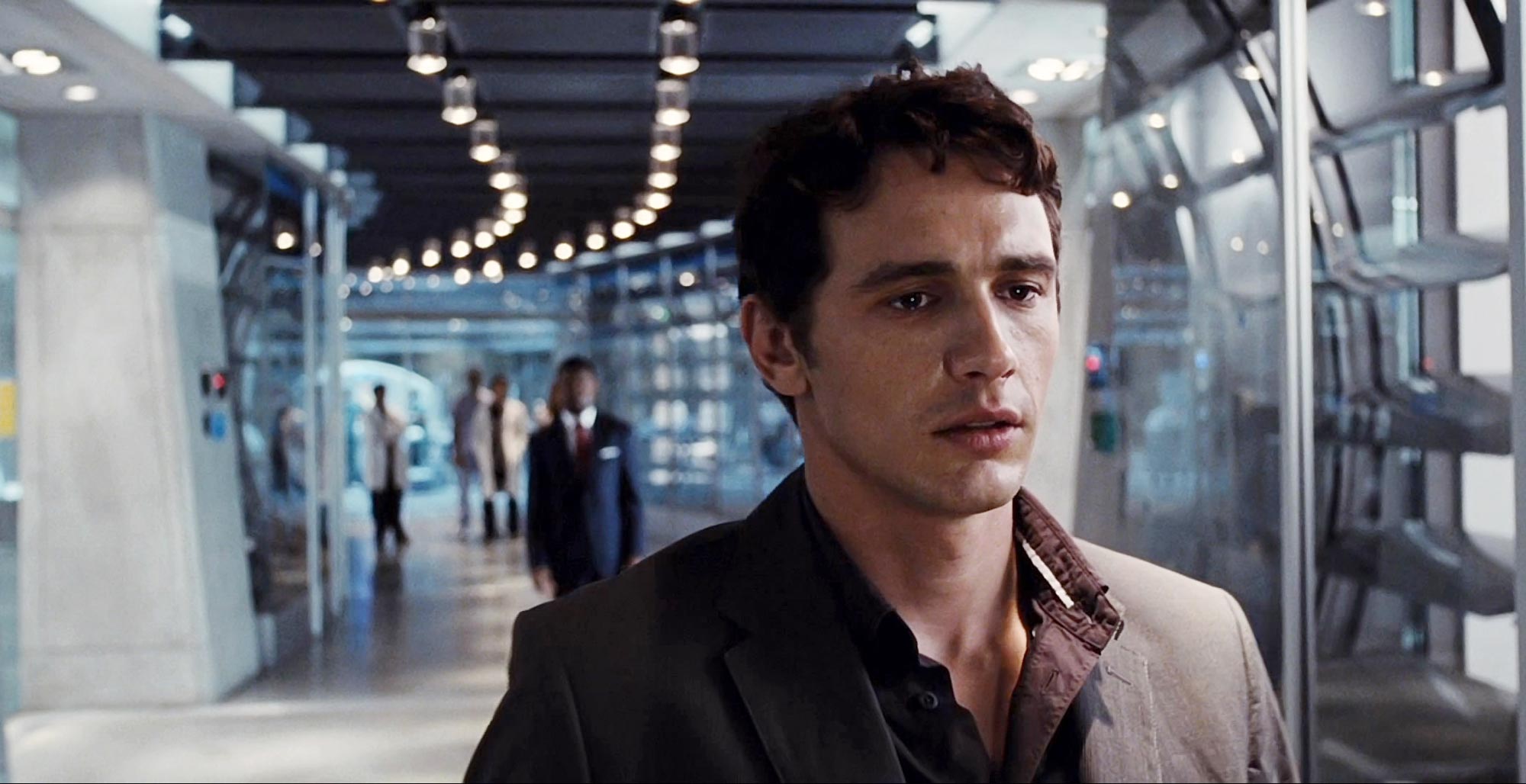
the most effective scenes are played without dialogue) or the acting is anything that will get James Franco another Oscar nomination (he plays it absolutely straight—he has to, and given what surely were bizarre circumstances on the set, that is quite the accomplishment and there's no "hip" attempt to distance himself from the subject). But, at the basic story-telling level of Rise, there are good ideas that play out and lead the audience along, incrementally ramping up the circumstances until you can accept the anarchic and truly mind-blowing with a straight face. Where Burton's Planet billed itself as a "re-imagining," Rise truly is one, turning the circumstances of the first film on its ear, as the circumstances of the Charlton Heston classic turned the evolutionary relations of man and monkey on theirs.
The film starts with a sequence cleverly patterned after "The Hunt" sequence from the 1968 film, and follows its hero's journey through the cruel circumstances of living in Man's World, after having a fairly free existence for most of its growing life,* paralleling Astronaut Taylor's cynically-smug attitude (and subsequent come-down) from the first film. That it goes into different territory, quickly and strategically, is where this film strikes out on equally sure footing.
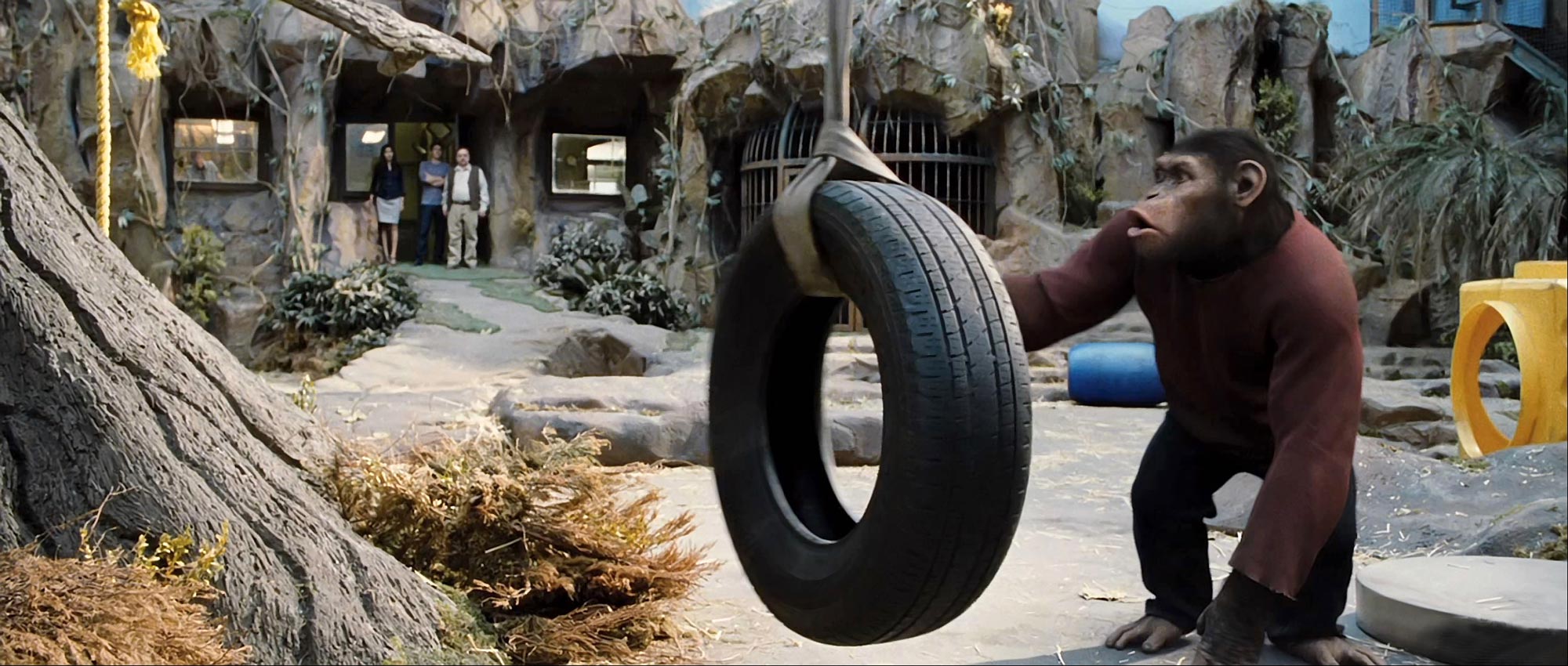
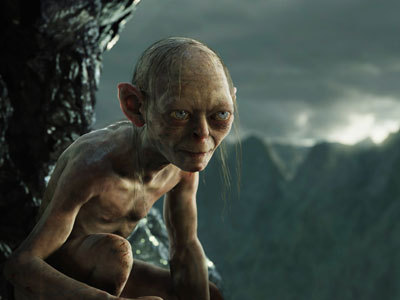
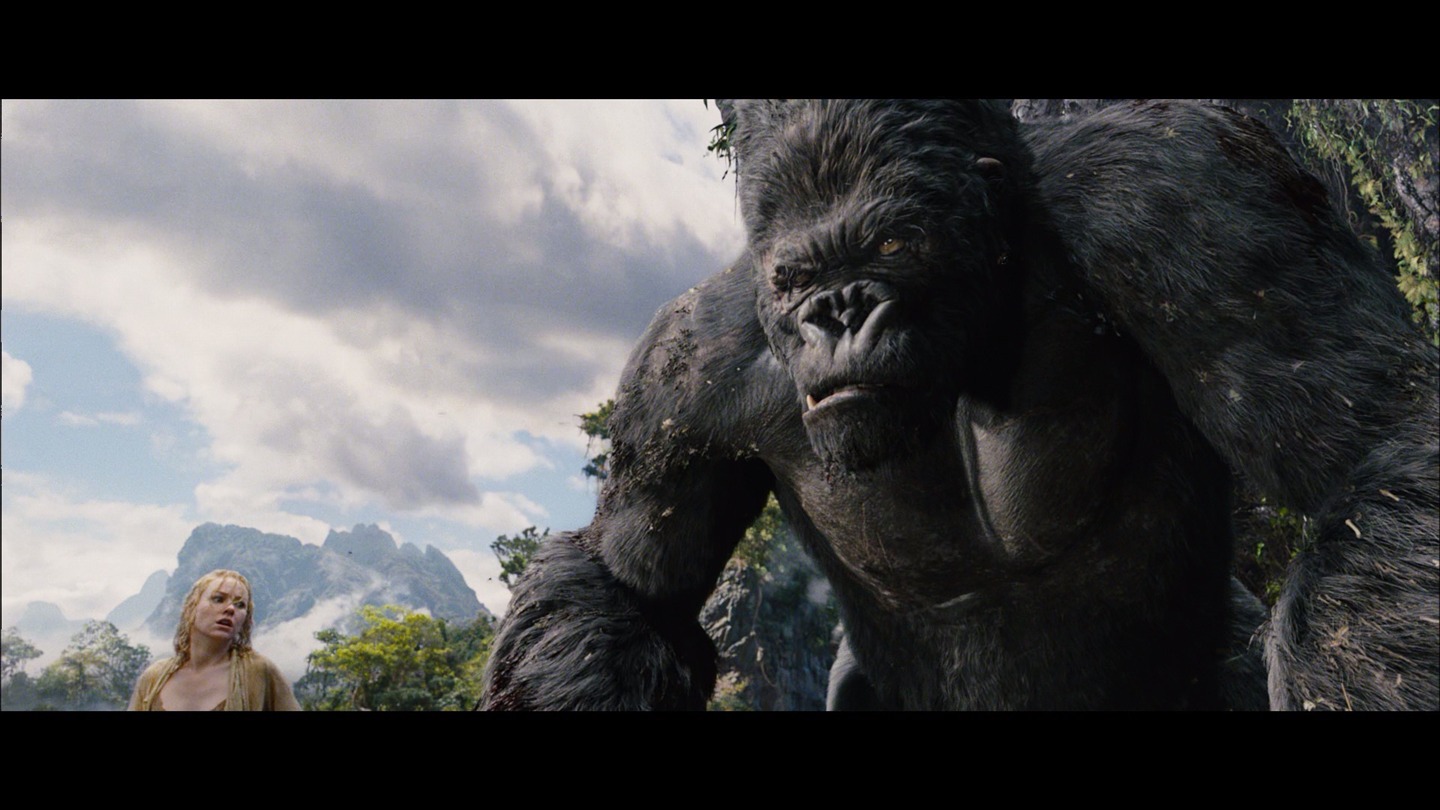
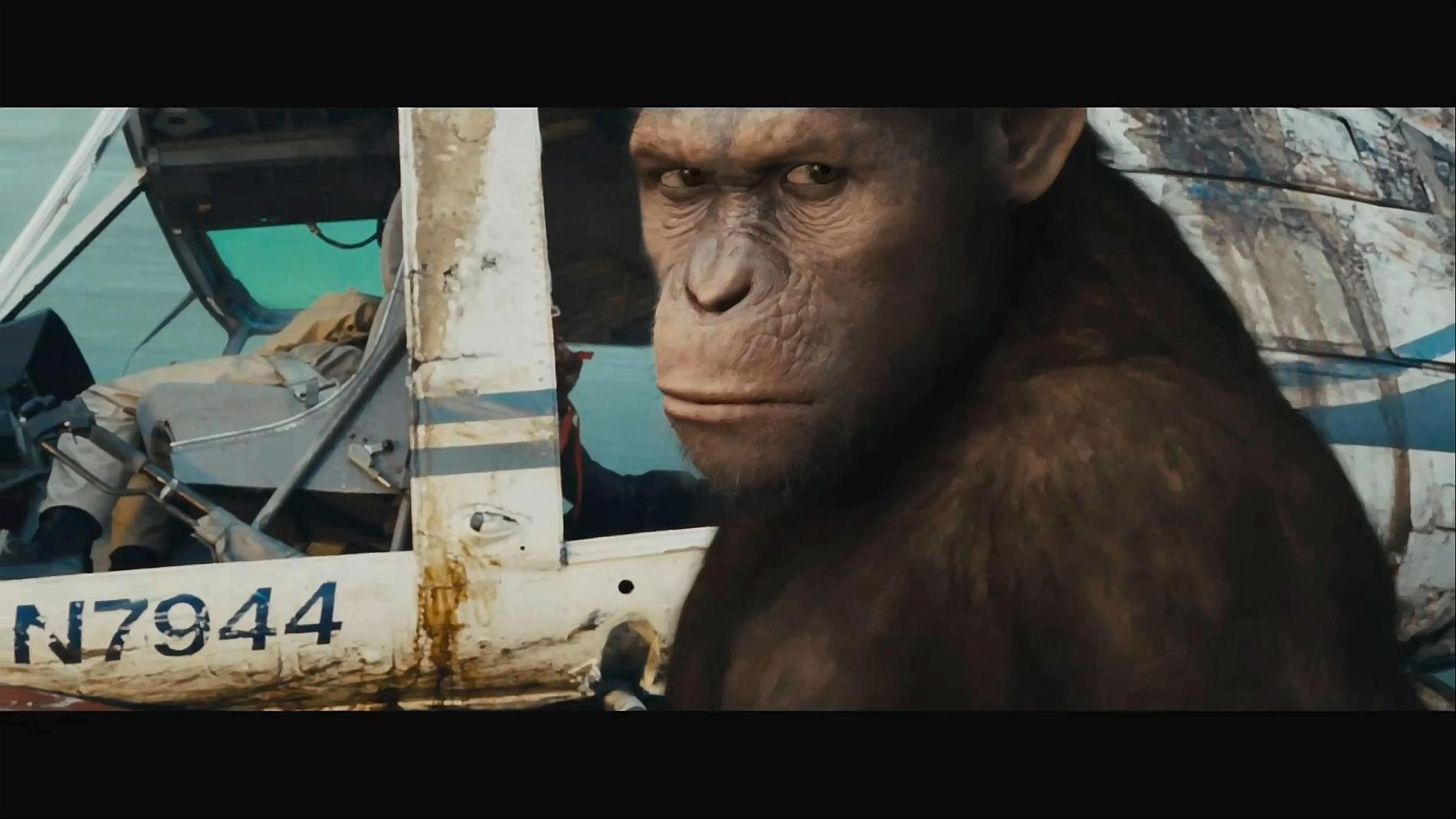
It couldn't have come at a better time, really, when motion capture technology allows abandoning the use of the monkey make-up that has gone before to achieve its animal effects—as well as having Andy Serkis (he was "Gollum" in the Lord of the Rings trilogy and played "Kong" in Peter Jackson's version of King Kong) mime-playing the lead Ape, Caesar,** which elevates the film, and pays off in strange (and surprisingly subtle) ways one couldn't imagine before. Also, that a lot of it hinges on basic silent movie techniques raises this one considerably in my eyes. Kudos to director Rupert Wyatt (only his second feature) for his good, strong story-telling and to writers Rick Jaffa and Amanda Silver for cracking this "Planet" wide open.***
One appreciates the big picture (man's technological hubris is again his downfall as in the first film) and the small (Caesar's symbol for freedom is nicely arced through the film, and it's not coincidence that the lab where Franco's Alzheimer's cure is developed and the primate facility at the Animal Control compound are structurally the same) that neatly draws parallels within itself and the franchise, taking what was good in concept, expanding on it and breaking out from it. The result is a rip-roaring film that stands on its own, yet makes one anticipate, even beg for, a continuation if it can be done as well as this one.
"...paying off in strange (and surprisingly subtle) ways."

Dawn of the Planet of the Apes

* There may be a little too much of that, actually. The structure of the film so complements the first film—to a point—that it seems unnecessary to "gild the lily" with so many call-backs from the original—we didn't need a word for word utterance of the first film's iconic line...and do you think the dullards at the Animal Control facility would REALLY be watching The Agony and the Ecstacy? (They'd be better advised to watch Spartacus, although it isn't owned by 20th Century Fox, nor does it star the appropriate actor). Now, Agony/Ecstacy would work...if the one guard was particularly religious...which could inspire in Caesar the whole concept of "The Lawgiver" that was presented in the original series. But, I digress (fan-boyishly)...

** The same motion-capture process that was employed with Serkis for Gollum and Kong was used here by WETA, Peter Jackson's New Zealand FX company. Some of the early scenes are a bit dicey, but once things start galloping along...the FX work becomes truly amazing. Now, with motion-capture, it's become a unique combination of the mime-work done to portray the pre-human apes in 2001 and John Chambers' enhanced theatrical make-up (Arthur C. Clarke ruefully noted that Chambers won a special Oscar that year for his POTA work, rather than 2001: A Space Odyssey, as the Academy "didn't realize our apes were actors."). And back to the point of Franco's job here (and frankly, everybody's), he had to play it completely disciplined in his scenes with Serkis, even though the latter was surrounded by one of the those crazy "motion-capture" suits, while on location (rather than a green-screen stage), which is a movie first.

*** Glenn Kenney, who writes for MSN Movies, fairly nailed it in the expansion of his review. Kenney's no slouch, but called the film "very nearly close to completely awesome" in the review, and noted that the film had four "Holy Shit!" moments, where something so unexpected happens that you wonder what could happen next (at the packed showing I attended, there were audible gasps at one particular happenstance—even though it parallels something that happens in the first film—followed by very nervous laughter). I counted six (but I have a low threshold for "Holy Shit!" moments), where most of the movies this year have had precisely zero.

Wednesday, July 1, 2020

Red (2010)

Written at the time of the film's release.

"Better Dead Than Red"
or
"Who Wouldn't Want to See Helen Mirren with a Sniper Rifle?"*

Cute.**

That's the word for Red. Not good. Not bad. Just "cute." I mean, what's not to like? A movie top-heavy with talent in front of the lens—in fact, there are so many Emmy/Oscar-winning actors (including Ernest Borgnine and Richard Dreyfuss buried in the credits) that one wonders why there wasn't a better project for them to do than this. Yes, it's entertaining (if you turn the brain off). Sure, it's occasionally funny—it's especially nice to see Bruce Willis back in his lighter mode, reminding one of how damned good he was in his "Moonlighting" days, and John Malkovich taking full advantage of his "crazy coot" part without pretensions of doing anything serious. And it's nice to see a full cast of "mature" actors in a movie based on a comic book series, so that the potential audience demographic is as wide as Morgan Freeman's smile. For a reviewer of my advanced age (55), it is a little disconcerting to see these storied thesp's I've grown up watching (often from their first filmed roles) being sold as "old farts in the pasture,"*** despite how easily they deal with their younger counterparts, like fine actors Karl Urban and Mamet collaborator Rebecca Pidgeon, though it's presented in a somewhat condescending manner.
The main problem I have with the movie is that (timing aside), it's just another in the series of "Dirty Dozen" discarded mercenary movies we've seen so many of this year, and it's an uninspired entry, at that. Oh, sure, it's tricked up with animated post-card location bridges (that get tedious), a coy break-away editing style, and a pyrotechnic fetish that mushrooms every explosion into a lens-searing extravaganza, and the occasional "see-this-I-wonder-how-they-got-this" shot that is, basically, the director trying to draw attention from his actors ("I'm helping!!"). Wish he'd paid a bit more attention to what was going on in the script, rather than in how to present it.
There's a little too much reliance on exposition that telegraphs what will happen in the movie (and it doesn't help that the actors tend to "wink" the importance of those lines at times). And if there's a script problem, the director just figures out a way that he can draw attention away from it, rather than make it better.

Take, for example, an early shot of a line of gun-men—a nice, easily raked-over straight line of gun-men (wouldn't even need to go through a whole clip!)—advancing on a house that Willis' character Frank Moses lives in a quiet suburban neighborhood.  It looks impressive, until you realize how damn dumb it is. These jack-booted thugs (and in a NRA wish-fulfillment, they are government ops) advance on the house, not breaking formation, swiss-cheesing the house back to its foundation in the dead of night. Wow! Cool! One could make a case for "stylized comic action," if it wasn't so stupid-looking at first glance.
But, remember, I said "quiet suburban neighborhood?" You actually, earlier, do see neighbors. So, where is everybody? No one comes outside, the sequence goes on for many minutes, without a dog barking, a siren in the background, someone clappering-on the lights, or an actual NRA member shouting protest. That's just dumb. And it's the first of many "fish-bowl" sequences where things happen in only a world where this movie exists, as it has nothing to do with how "the real world" works—despite playing on the populace's paranoid delusions about "how the real world works." One wishes that one could forgive the contrivances, but you can't, as the movie hinges on them. And as sure as a bullet wound that was excruciating a few minutes ago, will be forgotten in the next few minutes, the director will find a way to wave something shiny at the camera (right before it explodes) to make you forget. I don't mind having my disbelief suspended, so long as someone isn't constantly cutting the cable to sabotage it.
Director Schwentke (The Time Traveler's Wife) is more interested in the kill-shot (with minimal blood-loss) than story-logic. But, lest one think I'm unappreciative, there is a neat shot, however it was done, of Willis stepping outside his skidding car firing his gun as the vehicle cantilevers around him.  Nice.
That's fun and all...even cute...but, I tend to like my spy stories to have a little more substance than cotton-candy to it, a bit more fiber, something at risk, so that when folks do go in harm's way, they do so because it is necessary to do so and the personal risk matters. So that they matter. Or else, what's the point of all the point-and-shoot? I'm not interested in watching a bunch of good actors having fun picking up a paycheck.
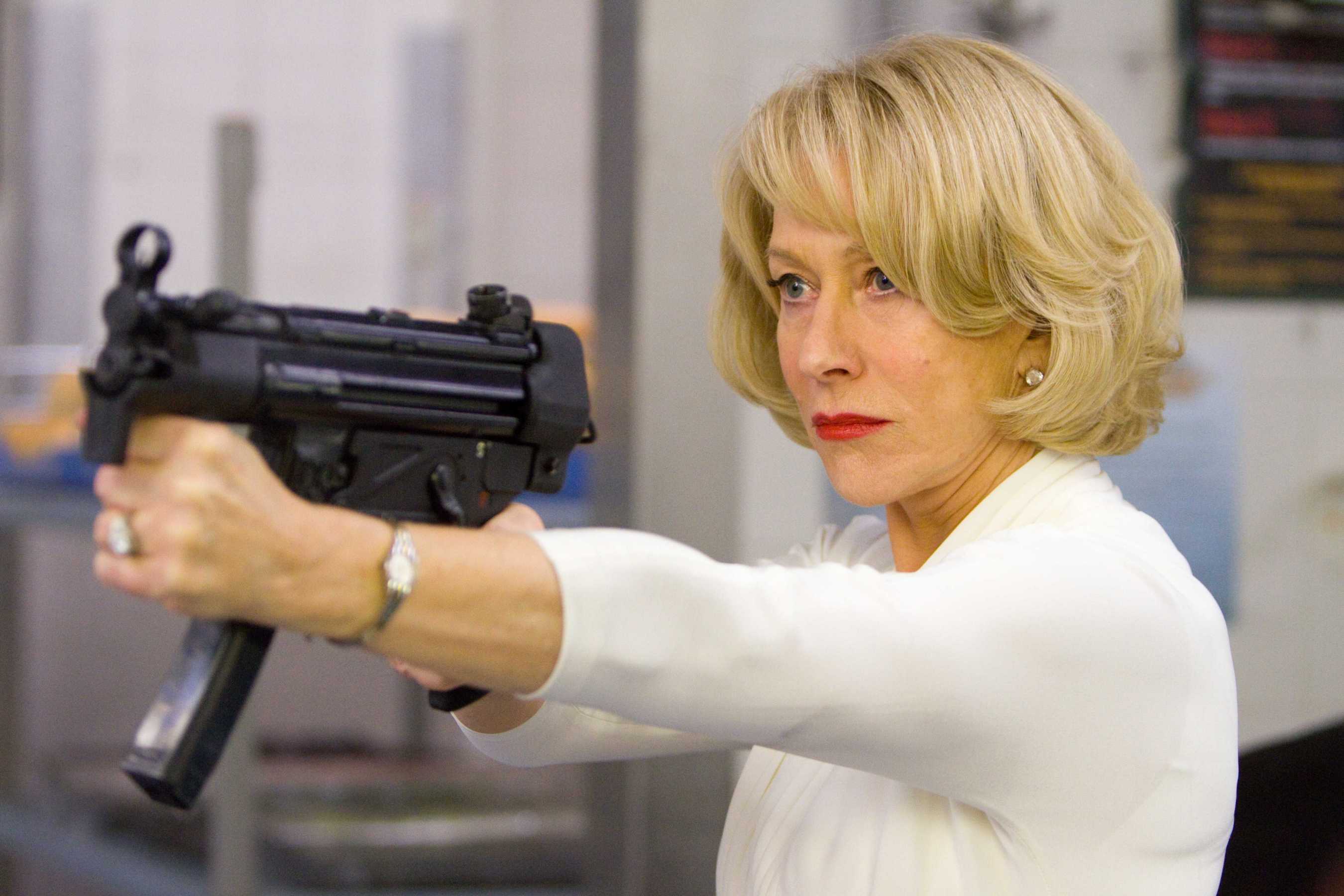
Still, want to know the coolest thing about Red? Seeing Helen Mirren firing an automatic weapon without so much as a flinch or an eye-blink, deliberately keeping those flinty eyes wide open, while the burly male extras playing the disposable agents firing back are fluttering their eye-lids right and left. Now, that's a Dame.****


* A quote from "Red" comic series writer Warren Ellis.

** Tommy Lee Jones revealed this (with a sneer) to be his least favorite word on "Inside the Actor's Studio." Yup.

*** The title refers to the group's designation as "Retired: Extremely Dangerous."

**** There was a sequel, that eliminated Urban and added Lee Byung-Hun and Academy Award winners Anthony Hopkins and Catherine Zeta-Jones. Haven't seen it and haven't because life is short.