Showing posts with label Matthew Goode. Show all posts

Tuesday, September 12, 2023

Match Point

Match Point (Woody Allen, 2005) The box office was good for Match Point, Allen's first hit in years, and one wonders why. The film is accomplished and assured, simple in execution but morally complex, one of those little Woody Allen morality puzzles that update the classics (in this case, "Crime and Punishment", as well as any number of "bad-boy makes good" novels, where all you need is a compromised conscience to make it in the world). The BBC put in money, so the locations are in Great Britain (it's good to get out of New York once in awhile). The actors are young and skew to a lower movie-going demographic (although except for Scarlett Johansson, the actors are not box-office draws)--but there are no "tunes" on the soundtrack, merely ironically chosen opera extracts sung by Caruso (complete with vinyl surface noise).

Allen considers it one of his best films.
Despite the accents and strange new territory, it's undeniably Allen-town with its
chilly empty spaces pointedly deliberately composed, its couples colliding and splintering, an act of insanity out of the blue, and a late touch of magic that chills.
But it's one of those Allen movies where the literary seams show,
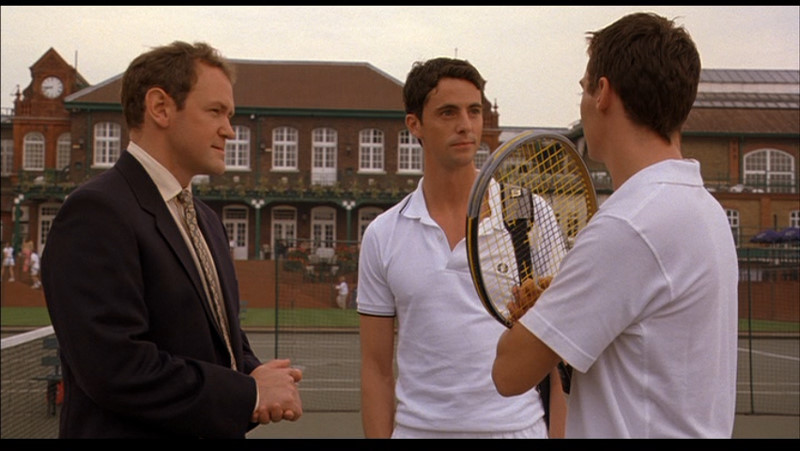
his long empty corridors reverberating with the classics of the past informing his movie, with some of the echoes coming from his old Brooklyn haunts; I kept thinking that Chris Wilton, the slippery tennis pro (the only thing that's true about him is, surprisingly, he is a tennis pro!) reminded me of Leonard Zelig, the "human chameleon," who, in his insecurity, would conform to whatever group he was with, even physically changing to accomplish it.
But more than the literary seams show.
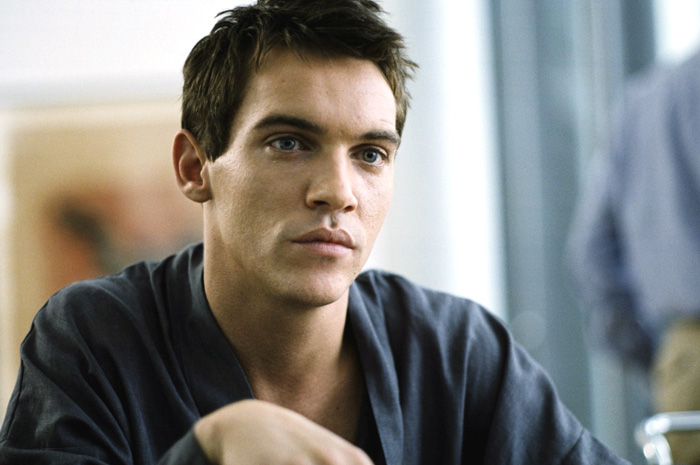
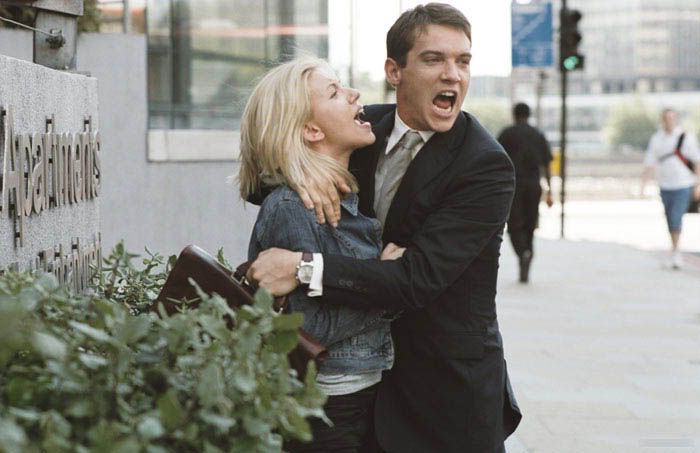
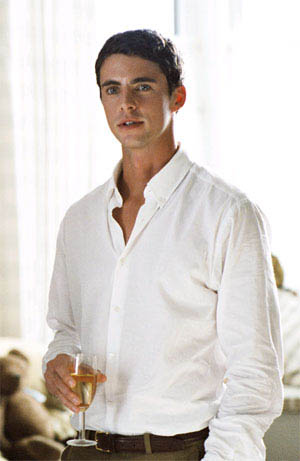
Jonathan Rhys Meyers, who plays Wilton, isn't a fast enough actor to make his sudden shifts of tone and snap-excuses sound credible; there needs to be an ad-libbed looseness to his answers, rather than the studied RADA responses Meyers provides. The rest of the cast play their parts as required: Brian Cox (always good), as Wilton's chief enabler; Matthew Goode (interesting to see him in this role after Watchmenin this part, he's much snappier playing a member of the effete elite); Emily Mortimer, thanklessly perfect in a thankless role; Scarlett Johansson as the Victim of Fate, smart enough to know herself, but not know her role in the world.

So, what's different? Why this Woody Allen movie doing well, when the previous ones hadn't? Allen had been, piece by piece, removing the musty-Woody-Allen-tropes from his movies to no effect at the box office. What made
this one different?
Then, it hit me.


There's no "Woody Allen" character in it. No stand-in's with comically stuttering neuroses. No "fools" that make a point. No sad clowns in the corner. This time, Woody Allen is behind the camera. For good.

Saturday, May 14, 2022

The Duke

"Not That Sodding Painting Again!"
"Be discreet in all things, and so render it unnecessary to be mysterious." 
The Duke of Wellington
Kempton Bunton (Jim Broadbent) is an embarrassment. A retiree, he never seems to be able to keep a job, much to the consternation of his beleaguered wife, Dorothy (Helen Mirren) who is a house-cleaner for the ministerial Gowlings. No, instead Kempton keeps writing plays for the BBC to produce and they're always rejected. Perhaps in revolt or retribution, he's removed the coil from his telly so he doesn't have to pay the tax imposed to get the government station, which he has to pay whether he receives it or not. It's a tax revolt, he says. Pensioners and veterans shouldn't have to pay a bloody tax to get the National News. And he doesn't give a fig who knows and, in fact, instead of getting a job, he'd rather sit in the street to get petitions signed for free BBC. On top of that, son Jackie (Fionn Whitehead) is spending less time at home, wanting to become a shipbuilder, while other son Kenny (Jack Bandeira) supposedly works construction in Leeds, but might actually be doing some things unlawful in his free time. Dorothy, with so much on her shoulders is fit to bust, with her taking most of the load and him off on his do-gooder campaigns, compensating.
Compensating?  Well, it isn't discussed in the house, but there was another Bunton—Marion—dead at 18 from a bicycle accident and it was Kempton gave her the bike. He blames himself, and doesn't tell Dorothy about the visits to her grave, as she won't discuss it in her house, and Marion's portrait is itself buried...in a desk drawer. Dorothy is the bread-winner and she's the wife and that is respected, even if things happen that she doesn't need to know about.
But, a 13 day stretch in Durham prison for not paying the television tax is her last straw. Now, he's a felon and bringing dishonor to the household.
Kempton, to keep the peace, asks for one last indulgence: he wants to go to London to talk to "the Beeb" about his plays and take his tax initiative before the Parliament—after all, they just paid £140,000 for a ruddy Spanish portrait of the Duke of Wellington, it's the least they can do to hear him out. And after that, he'll get a proper job...and keep it. No more quixotic campaigns, no more lying. He'll do his bit and Helen is relieved.
The trip to London, however, does not go well. No one at the BBC will see him, and at Parliament, the guards do see him...out...onto the street. Maybe it was the bullhorn. Anyway, when he returns, there's a new resident under the roof—that portrait of the Duke of Wellington that Kempton's been grousing about. To keep Dorothy from finding out, he hides it making a false back for the bureau in Kenny's room. Nobody'll find it there.
Certainly not the authorities, who think it's commando's or super-sophisticated art thieves behind the theft and haven't a clue as to who's behind it. Certainly not the cheerfully cantankerous old duffer who is protesting in plain sight and is outspoken enough that it gets him fired from every job he's lucky enough to land.
It's "based on a true story" which means nobody could make this stuff up. Not the circumstances, not the psychological underpinnings, and certainly not the quixotic nature of its main protagonist, who, for all his bluster, is at heart a good soul. In a film full of fine performances—Mirren and Goode are especially winning—it is Jim Broadbent's fusty performance that anchors the movie even while trying so hard to rock the boat. This is one of those movies that charm "the blue-hairs" but is so winning without pushing the twee factor that one respects it for all the chuckles it induces.
Credit the excellent script—which throws in an added mystery and motivation that adds depth rather than obfuscation—and the direction of Roger Michell, who didn't live long enough to see the film released. Michell's use of split-screen might seem like a concession to 1960's period-style, but it does produce one essential grace note that moves the heart, while also locking in the notion that everyone has their own framing, whether self-induced or imposed, that we reside in, that keeps us at arm's length.
The Goya's "not all that good, is it?"  But The Duke is something of a masterpiece.

"The Duke" makes a cameo.


Friday, December 24, 2021

The King's Man

Mannered Maketh Malarkey (Dulce et decorum est cogitare hanc pelliculam sugit)
or
The Prequel To End All Prequels
 
I wasn't a fan of Kingsman: The Secret Service, although I enjoyed most of the performances, particularly Taron Egerton's, I felt that it was pretty sloppy without much holding it together, although the satire was there and recognizable as such. It was meant to be a breezy jocular look at spy thrillers,  located somewhere in between the Bond Series and Austin Powers, hewing closer to the latter in terms of cleverness (or lack of it) and amping up the violence to the point that—despite containing the adage that "manners maketh man"—it became decidedly unmannerly.
 
One couldn't take it seriously and so any connection to a thriller goes right down the chute as the stakes are as high as they are in a "Looney Toons" cartoon. Samuel L. Jackson had it right in the first one by playing the arch-villain with a silly lisp, which has become his signature tic for showing he has no respect for the material he's playing—he certainly doesn't use it when hawking Capital One.
So outlandish actions and jolly good manners was the joke of the first two films, but director
Matthew Vaughn's latest, The King's Man—boasting original material from Vaughn and Karl Gajdusek (good villain name, that)—goes back in time to show the origins of the secretive Kingsman organization that bypasses political discussion and goes right for the jugular. Why this was thought necessary is anyone's guess, but I suspect—with another movie featuring Egerton in the works at the same time—they may be offering material that will relate to the next sequel. There are a couple of prominent names in cameo's and perhaps they'll be part of the next one.
The film concerns the exploits of Orlando Oxford (
Ralph Fiennes and bloody good, if seeming like he's in the wrong movie), the Duke of Oxford, who, at the time of the film's opening is a former war officer now working for the Red Cross and inspecting a concentration camp in South Africa in 1902. He is there to see General Herbert Kitchener (Charles Dance) about the deplorable conditions and talk strategy. In the course of the visit, the party comes under attack and Oxford's wife Emily (who encouraged Oxford's humanitarian duties) is killed before the eyes of Oxford—who has been wounded in the attack—and their young son Conrad. With her dying breath, Emily swears Oxford to "protect our son, protect him from this world, and never let him see war again."
When Conrad grows to the age of 17 (and embodied by
Harris Dickinson) is looking for a life of adventure, which his father vehemently opposes. He wants to join the Army when of age, but Oxford keeps him at home under the watchful eyes of associates Shola (Djimon Hounsou) and Polly (Gemma Arterton), who are crack spies and soldiers of fortune, but hide in plain sight as part of the Duke's staff. Presumably, it was so hard to hire good marksmen in that day. Oxford has good reason to be worried. Somewhere on an improbably high, flat and unscalable escarpment a group of terrible people are plotting to destroy the world and make money doing it. Headed by a Scottish separatist code-named The Shepherd, the group contains as members from around the globe including Grigori Rasputin (Rhys Ifans), Mata Hari (Valerie Pachner), Vladimir Lenin (August Diehl) and Gavrilo Princip (Joel Basman). 
Who? Well, I'll bet most audience-members don't know who Rasputin is, so don't feel bad. And I'm sure that a lot of them don't know the significance of Arch-Duke Ferdinand (played in the film—briefly, which is historically accurate, by Ron Cook).
Hell, ask the common man about World War I and you'll get a response like "World War II had a prequel?" or "Yeah, Wonder Woman was in it" Be that as it may, the group is trying to exacerbate the already bad relationship between three head-strong cousins, King George V (of England), Kaiser Wilhelm II (of Germany), and Tsar Nicholas II (of Russia), all played amusingly by Tom Hollander (bravo, sir!),* starting with the assassination of Arch-Duke Ferdinand, and the poisoning of Nicholas' son Alexei.
In his attempts to protect his son Oxford nearly gets him killed protecting the Arch-Duke and taking out Rasputin. But, then, this film has a habit of having people saying things and doing something that is contrary to their words. Oxford makes grand speeches about colonialism and imperialism and the exploitation of the indigenous people, but his comfort in his class and power has him being a very good example of all that. The only folks who seem to actually mean what they say are the villains, who are all so single-mindedly evil that they barely register as real characters—these were all very powerful and influential people and they're treated like puppets in this film's Grand Scheme.
But, at least they're consistent. The movie, on the other hand, careers between goofiness and sanctimony. Words are meant to be taken seriously, but the action sequences not so—deft (and unbelievable) as they are. Rasputin, Oxford, Conrad and Shola have a three-to-one duel set to Tchaikovsky's 1812 Overture, there's a weirdly impractical assault on that villain lair, and there's a World War I trench assault that, as completely unbelievable as it is, is still meant to be taken seriously if we're to have any feelings for the character.
It's a film of duplicity and two-facedness, delighting in "hilt-cams" and elaborate torpedo shots and a flash-zip of two years of World War I to see the the reduction of a hamlet town into a No Man's Land. Jeez, there's even an mustache to mustache edit in the thing. One starts to think that the film-makers are just so pleased with themselves and their own cleverness that they can do such little miracles that they don't see that the movie is clumsy and ham-fisted. So ham-fisted that the "surprise reveal" of "The Shepherd" is easily guessed just by the way shots are held unnecessarily before cutting away from them. Clever.
 
 
So clever it's stupid.
 
* Yes, it's true. Those heads of state were all related to each other (and you thought the Daniel Craig Bond movies were too in-bred!) No wonder the 20th century was so fucked up. And no wonder people wanted to do away with the Right of King's.

Tuesday, October 12, 2021

Stoker

Gosh, it's October 12th and I haven't started putting up the usual collection of Horror-style movies that have been moldering in the crypt...

Written at the time of the film's release...
 
"Creepy Carrie, Creepy Carrie"

or
There's Just One Hitch...

There is such an air of oppression in Chan-wook Park's Stoker ("from the acclaimed director of Oldboy") that it completely tractors over any pretensions of accomplishing what the intent is...to make a film in the style of Alfred Hitchcock.

Well, to do that you have to have an understanding of what Alfred Hitchcock did as a director...and you also have to have an understanding of what "style" is. Not the stylization of what we see here—all oblique angles  and off-kilter cutting, movie-making that "suggests" a story rather than just coming right out and saying it in movie terms. But, also you have to know that Hitchcock's "thrillers," when he made them, took the opposite tack of Stoker, presenting "normal" life invaded by aberration, rather than making it the norm. Hitchcock might have been obsessed with the creepy, but the gourmand in him knew that a steady diet of it would make it dull.


Which is what Stoker is.

On her 18th birthday, the father of India Stoker (Mia Wasikowska) is killed in an automobile accident, devastating her family, and introducing to them her father's brother "Uncle Charlie" (Matthew Goode) at the funeral. Charlie stays with the family inserting himself into every aspect of the Stoker household, still in shock over Richard Stoker's (Dermot Mulroney) death, taking a particular interest in gardening, the servants, and mother Evelyn (Nicole Kidman). Soon, the head caretaker goes missing, as does great-aunt Gwendolyn (Jacki Weaver), explained away by Charlie, who then turns his laser-like gaze on India.  As is the trait of Uncle Charlies, he sees a kindred spirit in his brother's daughter, and if the man had any sense, he'd be afraid of that, which is the only aspect of Stoker that doesn't pay homage to the Master of Suspense—this is a movie that has no redemption and no hope.

There's a child's primer of Hitchcock throughout: bad "mother" relationships, a creepy "Uncle Charlie," odd dispassionate deaths, the callow, uncomfortable-making young man, the swinging light, the "secret" basement, the masquerading gardening activities, the imposing staircase (circular), the rather irrelevant but "convenient" ability of India. It's a Hitchcock movie for those who've only seen Psycho, and are stuck in that film's deliberate pace and motivation. It's designed to shock, but not to move (and not even out of one's seat...unless of course, it's to walk out).
And there's no humor. Not even a nervous titter. Oh, sure, there is dark "irony" scattered hither and yon with all the subtlety of a hammer swing, but there is no lightness of touch anywhere, not even as an antidote to all the mock serious portent that shrouds the thing, that makes it travel the dead man's walk from too-heavy seriousness to unintended self-parody. It's as if Alan Ball had written Shadow of a Doubt, directed by a too-eager-too-please director who knows nothing about sub-text, and the fun ways that one can infuse the abnormal into normal, or what passes for it.

It's all in the trailer, kids.

Tuesday, January 13, 2015

The Imitation Game

Performing a Blood-Soaked Calculus
or
"We're Going to Break an Unbreakable Nazi Code and Win the War."  "Oh."

Alan Mathison Turing was finally awarded a posthumous pardon for "crimes of indecency" by Queen Elizabeth II in 2013, 59 years after his apparent suicide by allegedly eating (in a morbid reflection of his favorite childhood fairy tale) a cyanide-laced apple. He had been a year into taking a chemical castration drug after being convicted of acts of homosexuality, at the time illegal in England.

If he had failed in his activities during the second World War, it is very likely that a Nazi court would have done the same thing, albeit executing Turing. But, instead, a grateful surviving nation turned on the one man whom Winston Churchill stated "made the single biggest contribution to Allied Victory"—the breaking of the Nazi Enigma codes with which they encoded radioed messages to its forces. And, in peace and freedom, I'm typing on the keyboard of a descendant of one of Turing's constructs created during that endeavor. 


The Imitation Game is the first film that can actually say it is "based on the True Story"* of those code-breaking efforts—kept secret until 1973** at the dawn of the new age of computers.
It is 1951, and there is a flurry amid military, intelligence and academic circles: Alan Turing's apartment has been burgled. The police come to investigate (in the form of Inspector Rory Kinnear) and discover nothing has been stolen, and Turing (Benedict Cumberbatch) is dismissive. The detective finds this suspicious—usually crime-victims want "bobbies" around investigating; that Turing doesn't means he has something to hide.

No shit, Sherlock. Alan Turing has more things to hide than you could shake an Official Secrets Act at. And your first clue is that he gets a lot of respect...but you can never find out why. "Paying attention?" Turing asks at the beginning of the film. "Good. If you're not paying attention, you'll be missing things."


It's 1939. Turing applies for a job at Bletchley Radio manufacturing. The person conducting the interview is Cmdr Denniston (Charles Dance), who takes an almost instant dislike to the humorless, arrogant, socially-unskilled young man sitting in front of him who states he really doesn't want the job, but he wants the challenge. Denniston opens the door to escort the creep out and Turing says one word: "Enigma." And everything stops.


It won't be the last time that happens.

Turing is hired.  From the start, he's an irritant. While the others in the group are trying to break codes, tackling the problem head on, Turing is designing a machine to do the process. To the others, he's doing nothing but wasting time. But to Turing, that's exactly the problem he's trying to tackle. The Germans change their codes at midnight; first messages appear at 6am—meaning the code is only good for 18 hours, and then is changed. The process begins again—daily—to break the code out of 159 million million million possible variations. Turing's solution is not to find the needle in the haystack, but to eliminate the haystack. To do that, he goes over everyone's head to secure the funds to make his decoding machine (not historically accurate, but it seems the filmmakers intention is to show Turing as a particularly nettling outcast, as opposed to an idiosyncratic obsessive), which vexes his superiors and annoys his peers. The siphoning of resources and man-hours in an all-or-nothing boondoggle makes Turing the target of all sorts of invective—except for the person of Stewart Menzies (Mark Strong, in an especially focused performance) of MI6, who seems to not only condone, but encourage the creation of the machine, which Turing calls "Christopher."
Knightley, Strong and Cumberbatch:
Sounds like a '60's folk trio...
Menzies also encourages Turing's recruitment activities, which produces an unexpected dividend, a mathematician named Joan Clarke (Keira Knightley, in a restrained—for her—very British performance that only reveals any negative emotion, specifically, through her eyes), who becomes Turing's closest confidante and co-conspirator, as well as his strongest bridge to getting along with his co-workers.***  Cumberbatch is charmingly daft in an unpleasant way, showing a vulnerability that evokes sympathy, but survivors of Bletchley Park describe Turing as not such an insufferable "Sheldon Cooper"-type, but as someone who, though he had eccentricities, was not without humor or charm, but never let anyone suspect he was not a genius.
That's a distraction. But the best thing about The Imitation Game is its portrayal of the world of secrets as being a very (very) complicated place. For once the code is cracked (I'm not giving away any secrets here, myself—the Nazis did lose the war), there comes the complicated issue of what to do with that knowledge. If the Nazis ever suspected that their unbreakable code was compromised, it would be as bad as never cracking it at all; a new system would be created and the allies would be back to the designing board, trying to crack a new code system.
And that's the moral quandary facing the code-breakers and strategists during World War II. Yes, you may know what the enemy is planning. But, to act on that information stopping their efforts and potentially saving thousands of lives would only alert the enemy to their vulnerability. At that point, the worth of cracking the code becomes nil, and so battles must be chosen, plans thwarted through misinformation and sabotage, by any means other than letting the enemy know that you know. At that point, World War II became a secret war fought on two fronts: on the field of battle and the back-rooms, reading the reports and calculating the costs and choosing the least destructive result.

The code-breakers saved incalculable lives...because there's no way of knowing how many would have been saved...or lost...if the cracking of Enigma was exposed.
That horrific reality informs the final stages of The Imitation Game as the battle must continue, not on moral grounds, but on logical ones. Even the purest of efforts can be sullied. Even the black and white of 1's and 0's can be compromised to stark shades of gray and crimson. Reality blurs and bleeds. And the quest of The Imitation Game—to determine whether a correspondent is human or machine—may be clear in theory, but questionable in reality.
His Memorial plaque in Manchester reads:
Father of Computer Science,
Mathematician, Logician
Wartime Codebreaker,
Victim of Prejudice
The statue to Turing at the Bletchley Park Museum.


* Another film, Enigma (2001) told a highly fictionalized story with a script written by Tom Stoppard, directed by Michael Apted (and produced by Lorne Michaels and Mick Jagger).

** Actually, the British efforts didn't become known in detail until 1974.  The Polish team of cryptographers wanted their part in the process known and so one of them published in 1973.  Is it "indecorous" to suggest that as these men were reaching the end of their lives they wanted the real story told, despite the intentions of their states' secrets mandates?  Britain released a number of documents in 2011.

*** Example: when fellow code-breaker Hugh Alexander (Matthew Goode) hands Turing a way to increase "Christopher's" speed, he replies "That's not an entirely completely terrible idea," she interprets: "That's 'Alan' for 'thank you'."