Showing posts with label Tom Hollander. Show all posts

Wednesday, March 9, 2022

The Soloist

Struggling with writing a review of Cyrano, the latest from director Joe Wright. So, in the meantime, here are a couple reviews from his past work that I haven't put up yet.
 

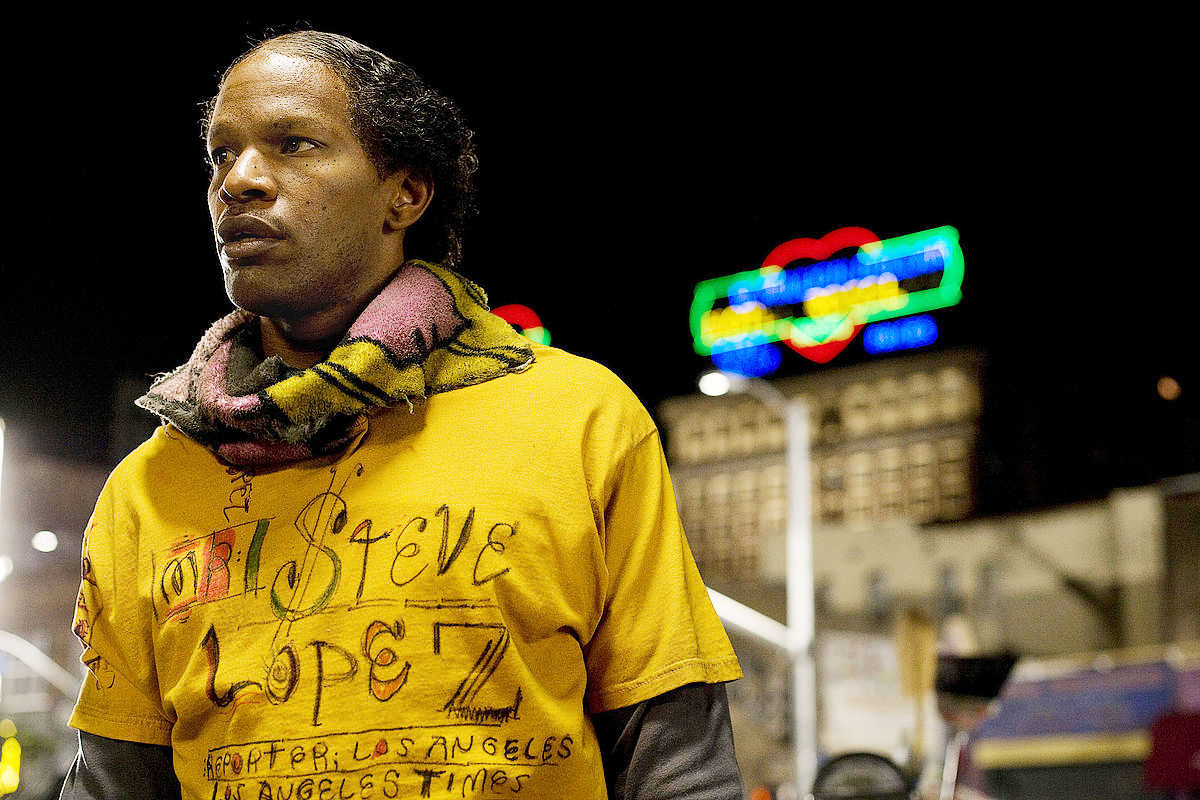
The Soloist (Joe Wright, 2009) The Los Angeles of Joe Wright's The Soloist is an alien landscape of clover-leaved asphalt, caves of concrete, and dwellings like jail-cells, overlain with a constant muffled roar, punctuated with neon- and police-bar-lit nights through which the homeless meander in surrealist tableaux that would give Federico Fellini pause.

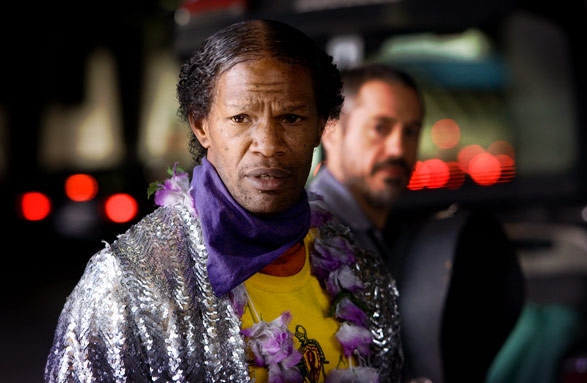
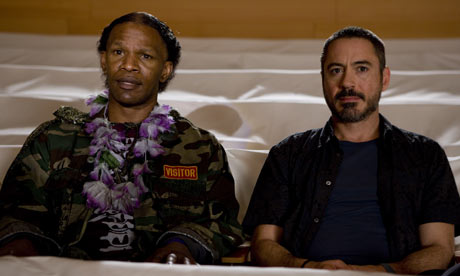
In this environment, while recovering from a nasty bicycle accident Los Angeles Times feature reporter Steve Lopez (Robert Downey Jr.) is contemplating another failed idea for a column, when he hears, echoing, a high sonority piercing the white noise. It emanates from Nathaniel Anthony Ayers (Jamie Foxx)—homeless, schizophrenic, sawing out pure tones from a violin with only two strings, the sounds of the others only imagined in Ayers' head. It's the stuff human interest columns are made of: a Julliard drop-out, cast adrift amidst the flotsam and jetsam on economic beachrocks, whose music cuts through the din.  Soon, Lopez's column puts a face on the L.A. homeless community (numbering 90,000) and the public responds, including the donation of a no-longer-used bass-cello, Ayers' original instrument, and Ayers' simple existence gets complicated.

Joe Wright has made two rarefied films set in the English gentry (Pride & Prejudice, Atonement), but this urban tale of harmony amidst grinding chaos, propels his gifts into a new arena. No longer able to settle on the classical symmetry of English estates, this film is jagged, off-kilter, and sonically and visually complex, both in exterior spaces and in the echoing interiors of Ayers' mind. Music soon supplants the chattering roar of the film, softening and simplifying it, finally allowing it to soar, sometimes literally, evoking the peace that soothes Ayers' mind. But those moments are all-too brief, as the two men are both impacted by each other's demons.  
That jagged, off-kilter quality is also necessitated by the editing rhythms Wright is forced into by
his principal stars, two of the better "riffers" of the current crop of young actors. Downey, Jr. and Foxx intersect each other, the latter, in a constant stream of focused non-sequiturs, while the former interjects whenever he can, like Ayers' music trying to find structure in the jumble of words and thoughts.  The editing of their scenes together is tight and, frankly, a little daunting to consider how difficult it must have been. Like the rest of the film, it succeeds if, in not bringing order to chaos, it offers a respite from disorder.

Mr. Ayers

Friday, December 24, 2021

The King's Man

Mannered Maketh Malarkey (Dulce et decorum est cogitare hanc pelliculam sugit)
or
The Prequel To End All Prequels
 
I wasn't a fan of Kingsman: The Secret Service, although I enjoyed most of the performances, particularly Taron Egerton's, I felt that it was pretty sloppy without much holding it together, although the satire was there and recognizable as such. It was meant to be a breezy jocular look at spy thrillers,  located somewhere in between the Bond Series and Austin Powers, hewing closer to the latter in terms of cleverness (or lack of it) and amping up the violence to the point that—despite containing the adage that "manners maketh man"—it became decidedly unmannerly.
 
One couldn't take it seriously and so any connection to a thriller goes right down the chute as the stakes are as high as they are in a "Looney Toons" cartoon. Samuel L. Jackson had it right in the first one by playing the arch-villain with a silly lisp, which has become his signature tic for showing he has no respect for the material he's playing—he certainly doesn't use it when hawking Capital One.
So outlandish actions and jolly good manners was the joke of the first two films, but director
Matthew Vaughn's latest, The King's Man—boasting original material from Vaughn and Karl Gajdusek (good villain name, that)—goes back in time to show the origins of the secretive Kingsman organization that bypasses political discussion and goes right for the jugular. Why this was thought necessary is anyone's guess, but I suspect—with another movie featuring Egerton in the works at the same time—they may be offering material that will relate to the next sequel. There are a couple of prominent names in cameo's and perhaps they'll be part of the next one.
The film concerns the exploits of Orlando Oxford (
Ralph Fiennes and bloody good, if seeming like he's in the wrong movie), the Duke of Oxford, who, at the time of the film's opening is a former war officer now working for the Red Cross and inspecting a concentration camp in South Africa in 1902. He is there to see General Herbert Kitchener (Charles Dance) about the deplorable conditions and talk strategy. In the course of the visit, the party comes under attack and Oxford's wife Emily (who encouraged Oxford's humanitarian duties) is killed before the eyes of Oxford—who has been wounded in the attack—and their young son Conrad. With her dying breath, Emily swears Oxford to "protect our son, protect him from this world, and never let him see war again."
When Conrad grows to the age of 17 (and embodied by
Harris Dickinson) is looking for a life of adventure, which his father vehemently opposes. He wants to join the Army when of age, but Oxford keeps him at home under the watchful eyes of associates Shola (Djimon Hounsou) and Polly (Gemma Arterton), who are crack spies and soldiers of fortune, but hide in plain sight as part of the Duke's staff. Presumably, it was so hard to hire good marksmen in that day. Oxford has good reason to be worried. Somewhere on an improbably high, flat and unscalable escarpment a group of terrible people are plotting to destroy the world and make money doing it. Headed by a Scottish separatist code-named The Shepherd, the group contains as members from around the globe including Grigori Rasputin (Rhys Ifans), Mata Hari (Valerie Pachner), Vladimir Lenin (August Diehl) and Gavrilo Princip (Joel Basman). 

Who? Well, I'll bet most audience-members don't know who Rasputin is, so don't feel bad. And I'm sure that a lot of them don't know the significance of Arch-Duke Ferdinand (played in the film—briefly, which is historically accurate, by Ron Cook).
Hell, ask the common man about World War I and you'll get a response like "World War II had a prequel?" or "Yeah, Wonder Woman was in it" Be that as it may, the group is trying to exacerbate the already bad relationship between three head-strong cousins, King George V (of England), Kaiser Wilhelm II (of Germany), and Tsar Nicholas II (of Russia), all played amusingly by Tom Hollander (bravo, sir!),* starting with the assassination of Arch-Duke Ferdinand, and the poisoning of Nicholas' son Alexei.
In his attempts to protect his son Oxford nearly gets him killed protecting the Arch-Duke and taking out Rasputin. But, then, this film has a habit of having people saying things and doing something that is contrary to their words. Oxford makes grand speeches about colonialism and imperialism and the exploitation of the indigenous people, but his comfort in his class and power has him being a very good example of all that. The only folks who seem to actually mean what they say are the villains, who are all so single-mindedly evil that they barely register as real characters—these were all very powerful and influential people and they're treated like puppets in this film's Grand Scheme.
But, at least they're consistent. The movie, on the other hand, careers between goofiness and sanctimony. Words are meant to be taken seriously, but the action sequences not so—deft (and unbelievable) as they are. Rasputin, Oxford, Conrad and Shola have a three-to-one duel set to Tchaikovsky's 1812 Overture, there's a weirdly impractical assault on that villain lair, and there's a World War I trench assault that, as completely unbelievable as it is, is still meant to be taken seriously if we're to have any feelings for the character.
It's a film of duplicity and two-facedness, delighting in "hilt-cams" and elaborate torpedo shots and a flash-zip of two years of World War I to see the the reduction of a hamlet town into a No Man's Land. Jeez, there's even an mustache to mustache edit in the thing. One starts to think that the film-makers are just so pleased with themselves and their own cleverness that they can do such little miracles that they don't see that the movie is clumsy and ham-fisted. So ham-fisted that the "surprise reveal" of "The Shepherd" is easily guessed just by the way shots are held unnecessarily before cutting away from them. Clever.
 
 
So clever it's stupid.
 
* Yes, it's true. Those heads of state were all related to each other (and you thought the Daniel Craig Bond movies were too in-bred!) No wonder the 20th century was so fucked up. And no wonder people wanted to do away with the Right of King's.

Thursday, April 18, 2019

Hanna

They're making a TV series of "Hanna" for some unfathomable reason (probably money) and it has been promoted with all the regularity of a water torture if you've seen a movie in the last couple months. But, nobody ever talks about the film it's based on...directed by the splendid Joe Wright. This was written at the time of the film's release.

"Grimm's Fairy Spy"
or
"Better Living Through Chemical Brothers"

Hanna isn't like any movie you've seen, that is unless you managed to catch some of the more stylish spy thrillers at the end of the 1960's. When the spy-craze went more mainstream, more A-list directors started to get into the fray and suddenly the thrills started to be taken over by style as those film-makers attempted to impose some of their own creative instincts into the genre. Sometimes the results made for merely a sub-par thriller, with style winning the cold war over substance, while others of their ilk were just plain pretentious.  Some...were interesting (like this one is, and like The American was last year).
Joe Wright is one of the better British directors coming out BBC television work.  He's done his bit for the classics, old and new (Pride & Prejudice, Atonement) quite deftly handling the drawing room choreography and even putting a nicely modern spin on things. But, his 2009 film of The Soloist showed a director who wanted to experiment with the form, break out of the stodgy "Beeb" way of doing things and shake the story-telling up a bit (in that film, he turned Los Angeles into a living, breathing, rumbling sci-fi character looming over its strata of citizenry). It was interesting to see him attached as director to what looked like a common "actioner," and one wondered what he might bring to it, given his three previous films and how he appeared to be changing his style.
Change it, he did. Hanna is a weird mixture of gloss and QT-perversion, with some very strange camera work that, somehow, never manages to not tell you what is going on, to whom, where and why. No matter how over-the-top the theatrics become, Wright never forgets the basic job of keeping the audience informed, and with a screenplay spare on details and depending on the visual to tell the story, his discipline is critical (imagine, for instance, if Tom Hooper had directed it!) for any basic understanding of the film. 
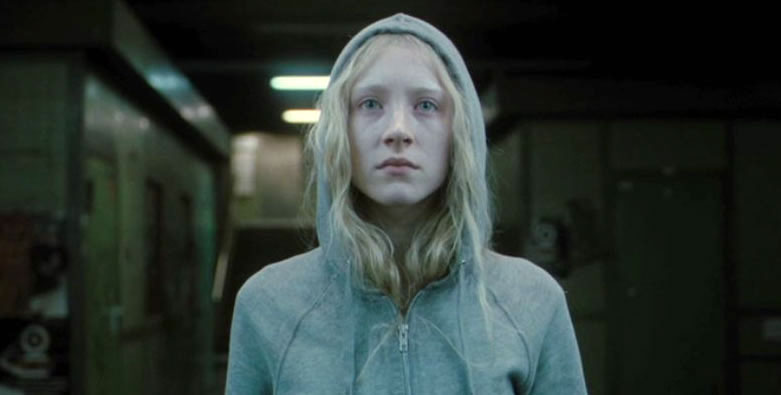
Hanna  heaps on the atmospherics, not only with a brazen fairy-tale sub-text, but an all-encompassing sound-design/Euro-electronica musical score by The Chemical Brothers,* that recall some of the '60's/'70's work of such composers as Mikis Theodorakis and Giorgio Moroder.  But the thumping, edgy noises permeate the entire soundtrack, not just the music, from the sweet tune that one of the Hanna-hunters (Tom Hollander, cast completely against type) whistles, quite nullifying any element of surprise,** to the pounding chase music that keeps the attention focused while Wright spins his camera or shifts perspective, *** to the creepy metal noises and animal sounds that permeate this world. 
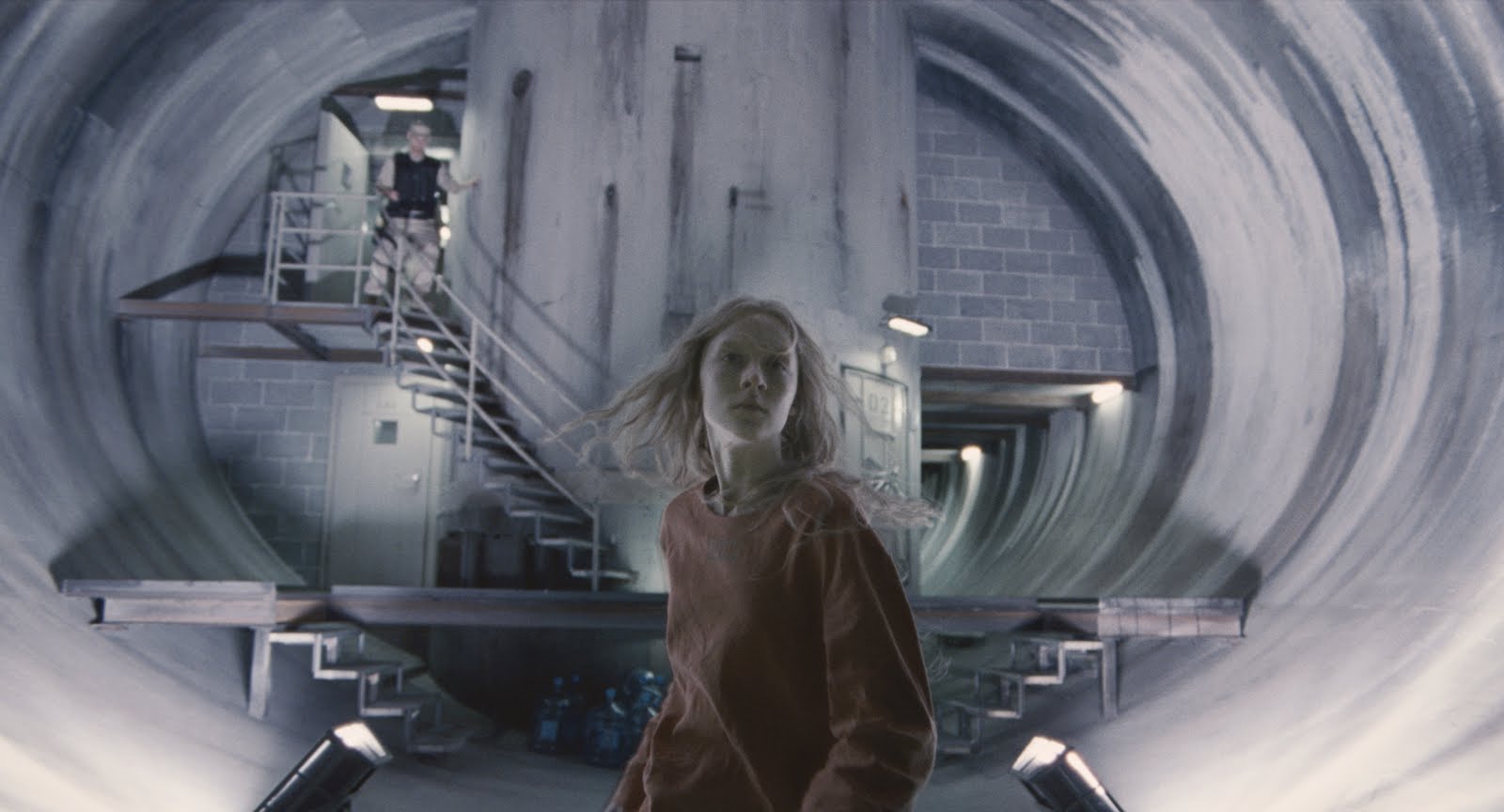
It begins in Finland, in the snow as a caribou is being hunted by a lone figure in fur. She dispatches the animal with one arrow shot ("I just missed your heart"), and begins to dress the animal for food. "You're dead!" says a figure behind her, and a rapid brutal fight breaks out, dependent less on fast editing than rhythm, and she is soon slammed to the ground, a snow angel against her will. "Drag the deer back yourself," says the man, who it turns out is Hanna's father (Eric Bana).
She is Hanna Heller (Saoirse Ronan—pronounced "Seersha"—and she worked with Wright in Atonement, and specifically asked that he direct this) and it is all survivalist training. Hanna has been raised to live on the land, kill and cook her own food, have an encyclopedic knowledge of everything (except electronics, apparently) given that her schooling is from the encyclopedia, speak several languages and have a detailed history that is nothing like her own.
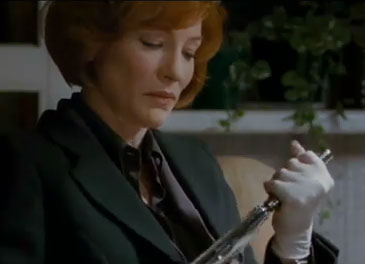
What is her history? What is her father's? We don't get too deep into the film before we learn he's a rogue security agent gone missing, and he's a bee in the bonnet of Marissa Viegler (Cate Blanchett—imagine her being creepy and then go a few steps further), an operative high up the chain of command. And she is Hanna's target. And Hanna must get to her before Marissa can find her.  The why's will come, eventually, but already we've invaded a fairy-tale landscape with the sheltered princess (who can snap your neck) and an evil step-mother who stays only a few evil steps behind the whole movie. And given Ronan's goose-like grace throughout the film, one can't help but call to mind all sorts of folk-tales of changelings and bargains and revenge.  But it's a spy thriller, too, as cold as they come, so don't expect "happily ever after."
For me, it was a simple story told well that impressed me throughout.

But it just missed my heart.


* Their impact on the film is incredible. I kept imagining what the film would be like with a "standard" thriller score, and always came up with a duller, less propulsive film.

** This recalls Peter Lorre's child killer in Fritz Lang's M (1931). Hollander vaguely recalls Lorre's look, and, later,  Wright stages a fight to the tune "M" whistled from Peer Gynt—"In the Hall of the Mountain King," (after The Social Network, this piece is getting a lot of traction).

*** "What does music feel like?" Hanna asks at an early stage of the script. Here, it feels like having a heart attack in zero-g.  One of the reasons this film DOESN'T have a traditional score is that Hanna, the character, doesn't know music, and as we're following her struggles, the music reflects her mood, whether placid or on the run.  It's rather interesting where those moods show up.

Thursday, November 8, 2018

Bohemian Rhapsody

Power Ballads, False Notes (Is This the Real Life/Is This Just Fantasy)
or
Mercury Rising (Buddy, You're a Boy/Make a Big Noise/Playing in the Street/Gonna Be a Big Man/Some Day...)

They've been working on the story of the pan-sexual rock band "Queen," which is now called Bohemian Rhapsody, for quite a long time now, starting with a treatment by the amazing Peter Morgan (who also wrote THE Queen—maybe that's why they changed the name) and somehow being pureed into the Hollywoodized fairy tale that the movie ultimately becomes—a cautionary tale of all the trouble you can get yourself into by being yourself, no matter how brilliant and talented you might be.

Harsh? Maybe. But, there are so many conveniently conventional falsehoods in the telling of the story that one wonders just what the agenda was here. Buttressed by scenes of Queen's appearance at Live-Aid—considered by many the greatest performance by a rock band seen by millions (and I've included it below because it IS amazing—I thought so when I saw it live oh-so-many years ago—but also to show some truth about just how good that band was/is), it tells, rather fictionally, how Farrokh Bulsara (played by a prosthetic-toothed Rami Malik) joined the rock band "Smile" and turned it into "Queen" and himself into Freddie Mercury, rock legend.
Not to disparage Malik—he does a damned good job in the part, despite being much too short and slight to play the part and, frankly, too odd looking, especially in the eyes, to really pull it off—and Bryan Singer's direction is competent, if a bit perfunctory for him (he was fired from the project and the reasons why are conflicting depending on who is asked and the film was completed by Dexter Fletcher*, who was attached to direct until Singer was hired) but, it's the story that's a let-down; it just didn't happen this way.
Really—does this look like Freddie Mercury to you?
Bohemian Rhapsody takes the easy (and dramatically quick) route out every time it comes to explaining any of the highlights in the Queen story, frequently portraying legend rather than fact in order to gin up conflict for a story of the price of fame and unconventionality that is...very conventional in terms of a cautionary Hollywood tale of getting everything you want "except *sob* happiness."
Bulsara did not just happen upon the band "Smile" on the very night their lead singer decided to quit for another band—he'd been following them for quite some time, was a fixture at their performances, and friends with the band-members, even with their turn-coat singer. In the film on the same night, he meets his "love of his life," Mary Austin (Lucy Boynton) at the same venue during a chance meeting (the reality is it was anything but chance, she came into the band's circle when she was dating Brian May, but that is never mentioned). In the film, the fractures within Queen that lead to their break-up (which never happened) is blamed on Paul Prenter (Allen Leech), who, after being rejected by Feddie Mercury, makes himself useful as an assistant to the band, then just the lead singer, isolating him, driving a wedge between him and anyone Prenter sees as a threat, making him the "Iago" of the story. 
Prenter is finally let go when Mercury finds out that he's been scuttling any chance of the band reuniting for 1985's Live-Aid concert, necessitating an unhealthy Mercury to clean up his act and get his voice back, risking disaster at the world-broadcast concert; In real life, he didn't need to, as the band had been touring for a year (August 24, 1984 to May 15, 1985) in support of their album "The Works." Then, of course, there is the tragedy of Mercury being diagnosed with AIDS before the concert, making it more like a triumphant swan song (or it would have been, except Mercury was diagnosed in April 1987, two years after the concert—still, it is a tragedy).

They (the film-makers) get the music right—they bloody well better—but the story is all false notes and in the wrong order.
All of this is like making a film about The Beatles and blaming the break-up on Yoko. Sure, it's in the zeitgeist (however trumped up it is), but it ignores the creative differences, the money issues, and just the fact that The Beatles were too talented to stay "The Beatles" after living together in conditions of "display-case isolation" for years. It may be true, but is it entertaining...and fun? Better to make Yoko a shrew.
And that is a shame. Queen should have a celebratory movie. They pushed boundaries across the board in their art and their manner, creating complicated music with ingeniously elemental, contagious hooks—I can't walk along these days without the bass-line of "Another One Bites the Dust" throbbing in my head—and Mercury's pan-sexuality was a bridge, of sorts, to bringing gay matters out of the shadows and into the klieg lights where they belonged and fabulously so. Their concerts were also known for being giant jam sessions between audience and performers, with a rhapsodic call and response that caromed between the two, enervating both.

And their message said "We Will Rock You" while allowing the audience to rock themselves.

Thump-Thump-CLAP Thump-Thump-CLAP Thump-Thump-CLAP Thump-Thump-CLAP


The real Feddie Mercury-with his parents and with Mary Austin

* Fletcher is currently making a film about Elton John, called Rocketman. Oy.

Saturday, June 25, 2016

In the Loop

Written at the time of the film's release.

"You Might Have Heard Him Say it, But He Didn't Say it, and That's a Fact!"
or
Oh, Tell me "Who are YOU?"

They say you don't want to see government at work just as much as you don't want to see sausage being made. The implication is that both involve grinders and a certain amount of evisceration. And the dropping of blood, metaphorically, and in some cases, literally.

In the Loop, the smart, funny movie version of the British comedy "In the Thick of It" manages to bludgeon home that point, but also draw parallels with the most drop-dead dysfunctional of office settings. In the Loop employs the same "caught on the fly" filming and editing techniques of "The Office" and they're played out by a cracker-jack group of actors who give the impression that they're ad-libbing the whole thing (led by a startlingly brilliant performance by Scotts actor Peter Capaldi*). Only it's "The Office" with a vindictive murderous glee and what, if it had gone through the Ratings Board,** would be described as "pervasive language."

It is also an episode of "Yes, Minister" on meth-amphetamines set in an abatoir, where the civil servants—the guys who never get voted out of office—run the show, and the show is the pantomime of a representative government working on the people's behalf. The lobbying people. The people in power. Those people. You know. There's enough invective in this movie to launch a thousand Uni-bombers, and most of it is hilarious—the kind of hilarity you feel guilty about laughing at. Especially if you didn't vote (not that it would do you much good, ultimately).
In this expansion of the series, the British Secretary of State for International Development Simon Foster (Tom Hollander) burbles through an innocuous press interview that an anticipated war conducted jointly by the U.S. and Britain is "unforseeable" and the Prime Minister's Director of Communications Malcolm Tucker (Capaldi) begins running interference ("I'm sweating spinal fluid here!") for Foster, the PM, and American functionaries creating damage control by causing as much destruction as possible (not too unlikely a scenario). That he does it by some of the most creative uses of the Anglo-Saxon tongue makes it hilarious, cruising through the labyrinths of power filled with ass-covering lackeys like a shark through a school of puffer-guppies—battering through so many non-functionaries "on defense" by being as offensive as possible.
This is not your father's Mr. Smith Goes to Washington, or even "The West Wing"—both those political dramas assume that civil servants are servants, rather than being self-serving, doing their jobs for the public good, not seeing it as a public nuisance. Those films assume the core of public service as "Love Thy Neighbor," rather than the reality of all-knowing governments—but only in the biblical sense.

* Capaldi may not be familiar to American audiences, but you've seen him before—deny it all you want, but you have—maybe in Local Hero (at the time of the writing Capaldi has appeared in a "Doctor Who" episode but he hadn't yet become "the twelth and existing Doctor" in that long-running series). In fact, he won an Oscar for writing and directing the very odd and very funny Franz Kafka's It's a Wonderful Life. Also in the cast are James Gandolfini—as good as you'd expect him to be—Mimi Kennedy, the always entertaining David Rasche, and...anybody remember Anna Chlumsky..."My Girl?"

** It didn't, and so it arrives at theaters with the "NR" rating, the "nolo contendre" of the MPAA system.

Tuesday, August 11, 2015

Mission: Impossible—Rogue Nation

Murphy's Law Enforcement
or
Join the IMF and See the World. On a Screen. From a Closet.

Tom Cruise is nuts.  Let's come right out and say it. He is flat-out bat-shit. In the first ten minutes of Mission:Impossible-Rogue Nation, he does this stunt where he is hanging on the side door of a very large Airbus turbo-prop as it ramps up and takes off from a runway in Belarus.  We watch as the plane taxi's down the runway and then takes off the scenery behind receding in the background.  You can do wonders with computer graphics these days, but the pristene nature of those effects immediately tells your brain "not happening." This, though, is real, because it is rough and less than the ideal that producers* and directors insist on.  Of course, Cruise is harnessed, attached to something with a parachute under his clothes, and the restraints have been CGI'd out, but DAMN! that's really 53 year old Cruise at cruising altitude, photographed by IMAX cameras to reassure you that, yes, that is really him on the edge of the plane. Like the previous film, where he did a short scaling of the tallest building in the world, the sequence is breath-taking, over-the-top, and just plain stupid. The only thing more stupid is the insurance company that underwrote the project, and let the star of the movie do something that ludicrous for real.
I hope they filmed it last, at least.**
M:I-5 (which is what this one is numerically, making it match the name of an actual intelligence agency) sees most of the known M:I operatives—Ethan Hunt (Cruise), Benji Dunn (Simon Pegg), William Brandt (Jeremy Renner) and Luther Stickell (Ving Rhames) endeavoring to keep a "package" from leaving Belarus via said Airbus.  It is your typical Impossible Missions Force strategem (a formula made famous in Bruce Geller's TV-series), with much malice aforethought, gadgetry galore and split-second subterfuge. It's brilliant...until it goes wrong, and it inevitably does. Then the team, so close to the goal, has to punt, improvise, and suck up the bromide mentioned a couple times in the film—"desperate times, desperate measures." Like clinging to a soaring airplane, while your tech-guy is waiting to be in satellite range, so he can auto-remote the Airbus with instructions written in Russian.  It's no wonder a Senate sub-committee meeting in secret opines that "the success rate your unorganized methods garner look suspiciously like chance," and one has to agree.
"Your organization is incompetent, but I want all of you working
for me in the CIA," says Jack Ryan Alan Hunley (Alec Baldwin).
For instance, what was the plan going to be if it was successful and didn't need Hunt to jump on the plane so precariously? Were they going to blow up the plane remotely?  Since the plane is carrying nerve gas, "Bye-Bye, Belarus." Were they going to try to fly it remotely? Given they're using Russian satellites to communicate with the plane, and they're having reliability problems, not such a good idea. The problem is there is no plan, other than to somehow get Hunt on the plane in order to perform the stunt, or else...what is he doing in the neighborhood, anyway? It's another instance, post-Nolan "Batman", where a terrific visual trumps story-logic (and to be fair, Skyfall had the same leaps in story-logic—its villain Silva allowed himself to be captured in order for his plan to work? Why didn't he just stay on his island and let somebody else do it?

M:I-5 has a lot in common with Skyfall—a government committee is looking into defunding the head-less organization (the latest leader played by Tom Wilkinson, was killed in Ghost Protocol) and folding its assets into the CIA (headed by Alec Baldwin, who spends most of the movie at least a few steps behind IMF's Ethan Hunt, trying to capture him and disprove that a criminal spy organization called "The Syndicate"*** exists). That "Syndicate" is described as an "anti-IMF" (presumably because everything they do succeeds without a hitch) made up of presumed killed or "disavowed" agents who are working for a spy-mastermind (Sean Harris), who begins this movie by infiltrating one of the IMF's message-centers and hijacking one of the org's notoriously self-destructing mission-statements. As a result, Hunt is captured (is this guy working for the CIA?), and readied for torture to reveal...what, exactly?  Hunt isn't even sure "The Syndicate" exists until they expose themselves by kidnapping him. What can he tell them? How he did the plane stunt?
"I'm not telling..." says Ethan Hunt (Tom Cruise)
At least, the torture sequence introduces us to Ilsa Faust (Rebecca Ferguson), who works for the Syndicate (but actually—shhhh!—is working undercover for M:I-6—no, not the next movie, the British secret service) and has won the trust of its leader, despite managing always to be there whenever things don't go according to plan). Ilsa is fast, lethal, and lots of fun to watch in fights and, frankly, you care about her more than anybody else in the movie. In fact, she's so good that after freeing himself and aiding in busting up his torturers Hunt can only look at her and go "I don't know you, right?"  Maybe he has her confused with the Emily Blunt character in Edge of Tomorrow.
Hunt goes missing for awhile after escaping, while both "The Syndicate" and the CIA are trying to find him, and he's trying to find the rat-faced head of "The Syndicate." He recruits Benji for help in Vienna where it is suspected that the Chancellor of Austria will be assassinated at the Vienna Opera House during a performance of "Turandot." It's at this point that the movie begins to really take off as writer-director Christopher McQuarrie (he wrote The Usual Suspects and Cruise's Valkyrie, and wrote and directed Jack Reacher) begins to borrow chock-a-block from other movies.  The "Turandot" sequence is straight out of The Man Who Knew Too Much with a couple added twists—there are three assassins prowling the opera house, and Hunt (with Benji monitoring from an electrical room) has to figure who's who...are they going to assassinate the Chancellor, or are they going to assassinate the assassins? In which case...who do you shoot? Talk about triangulation. The drama plays out while Puccini plays below on-stage all the while waiting for that one note where the bullets will fire. Even the gun-men are following the sheet-music waiting for the note circled in red (there's a direct correlative shot to the one Hitchcock devised in The Man Who Knew Too Much gliding over the notes to that one section.
The entire film is not wholly original (is anything, anymore?), but like any assassination film, it's all in the execution, something that McQuarrie does very well. It helps that he has a star who's nutso and so gung-ho that he doesn't have to do a lot of sloppy editing to make a cohesive action sequence. Just pump him up and let him go, and he's like an excited puppy with a chew-toy. And Ferguson if a fine, subtle actress capable of not-so-subtle fight moves who is fun to watch throughout.
So, there's that plane sequence, and the Opera stage-piece (which has a lovely moment when Hunt is nearly run over by a piece of scenery containing one of the marksmen he's looking for, a credit to McQuarrie that he's set the geography enough that you can appreciate it), and a brilliant extended sequence where Hunt has to hold his breath in a submerged tank for 3½ minutes (that is, if everything goes *cough* right) to replace a key programming card to a security system that won't detect Benji as an imposter as he walks into a secure vault—it isn't enough that Hunt could simply drown. He also has to avoid large spinning something-or-others that are supposed to keep either the water or suspense churning. 
This is followed by a car-chase with driver Hunt a little the worse for wear for his underwater stunt, the mayhem caused by his inability to drive, rather than by any skill, and after he and Benji end up skidding along via the roof of the car, it is followed by a motorcycle chase...because it seems to be in Cruise's contract that he has to ride a motorcycle in every single one of his movies. These are inter-cut with little reaction shots, the stunned silence of someone on the other side of the communication device rendered speechless, and occasional set-up shots for pay-offs later in the movie.  All engineered to appear un-engineered.  
Because Tom has to ride one in every...single...movie.

Then, there's a neat little confrontation sequence that feels out of place: the final confrontation in a London outdoor cafe between Hunt, Ilsa, and the bad guy who remains unseen, but who speaks via headphone through Benji, who is wired with explosives. Supposedly this sequence wasn't scripted at the time shooting began; nobody knew how (exactly) the movie was going to end. Oh, they knew how it was going to end-end—with a pair of nicely book-ended call-backs of earlier sequences—but that confrontation sequence has a nicely unpolished feel to it for all involved; where most of the movie feels like it is on well-oiled rails, this sequence feels rough and could go anywhere and wrongly with the next cut. It's surprisingly effective at keeping an audience's complacent doldrums away.
Really, this latest Mission: Impossible is a well-done little actioner, not wholly original, but entirely professional—an entertainment machine that runs on all gears, even slipping a few of them, just for the sheer loopy enjoyment of it, brightened by the full wattage smile (that has only slightly dimmed with a shade of world-weariness) of its Peter Pan-ish star, who seems to have no fear...and no shame. Bravo.

But Tom...Tom, there must be EASIER ways to leave The Church?

Maybe the next one should be called "Mission: Impossible—Death Wish."

* Have you noticed lately that producers are tagging onto their names "p.g.a." (for the Producer's Guild of America).  Is this another ego-grab for the most ego-driven profession in movie-making (like a doctor of Philosophy insisting on having P.h.D. behind his name?) or is this a requirement.  I've only seen it showing up this Summer, even though the PGoA has been around since 1962.  Still think it's odd that an organization that used to fight Unions...has a Union.

** They didn't. According to a New York Times video , director Christopher McQuarrie insists this was the last shot:
*** "The Syndicate" is a throwback to Bond's "S.P.E.C.T.R.E." or UNCLE's "T.H.R.U.S.H" or "Get Smart's" K.A.O.S., and was a part of the original "Mission: Impossible" TV series when the IMF wasn't going after dictators, generalissimo's, and villains who resembled Martin Landau or Leonard Nimoy.