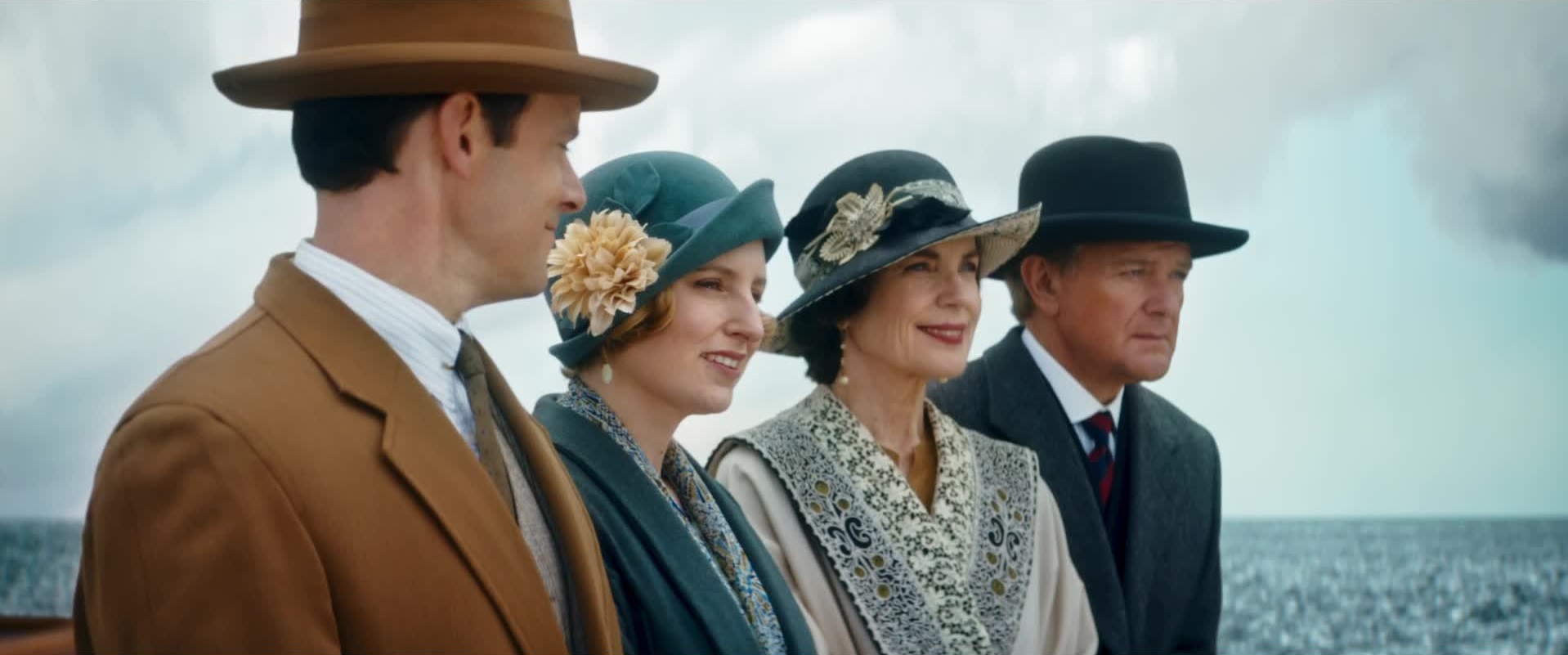
Well, if it is to be my fate to be addicted to SOME soap-opera, it might as well be "Downton Abbey." After all, I'm of the age for it—elderly and impatient with commercials.
Plus, it always was impressively cast, performed, and smartly written (by creator Lord Julian Fellowes), with enough intrigues amid the family (while also negotiating historical events) to keep the considerable cast going for six seasons of episodes.* Yes, it's soapy, and far too nostalgic for the past while also acknowledging that the way of life is, without a doubt, past its sell-date and will be replaced with less familial trappings and a more (Lords help us!) egalitarian sense that would be self-evident if one didn't live in a huge estate with a peerage and a schedule that wasn't filled with breakfasts, lunches, dinners, tea, and high tea that one can barely squeeze in a cracking round of croquet. Why, it's so precious that one could even forgive Fellowes for writing The Tourist.
No. No. There are SOME things that just shouldn't be allowed...even in the most liberal of households.
So, as change is inevitable, one notices that things are quite a bit different in Downton Abbey: A New Era, since the first movie which was derived from the series a couple years ago. The first thing I noticed was that the film opens on a bloody hectic "drone" shot, not the quaintly hovering aerials taken from hot-air balloons as previously. I suppose there's so much plot in this one that one felt the need to rush into it a bit with a jarring anachronistic approach with a shot through a stained glass church window. We're attending the marriage of Tom Branson (Allen Leech) and Lucy Smith—née Bagshaw—(Tuppence Middleton). Once doesn't want to get too far into the weeds here (one can attest from looking at the lingering shots of lawns that Downtown Abbey doesn't HAVE weeds) but Tom is the Irish former Downton chauffeur who married the youngest Crawley daughter (who died, leaving him with a legitimate Crawley heir) and we left the last movie with him promising to write to Lucy—maid to Imelda Staunton's Maud Bagshaw (Lady-in-Waiting to the Queen), but actually Maud's illegitimate daughter. Those letters must have been some hot stuff as, in the time one can do pre-production of a sequel, they've gone from admiring flirtation to walking down the aisle.
Oh, dear me. We ARE in the weeds, aren't we? And so soon. This is what happens when one tries to explain soap-ish operas to any level of understanding. One is conflicted between trying to be informative while also employing brevity. One can't have one without the other without appearing devoid of either. Shall we move on? To the Cliff's Notes version?
There are two plot-threads in ...A New Era (a quite neat little title), one involving the revelation that the Dowager Countess of Grantham, Violet Grantham (Maggie Smith) has been bequeathed a villa in the French Riviera by an acquaintance from her past—a past that brings up many questions that go unanswered but much speculated on—and that comes with it an invitation to visit by many of the Grantham's to see what's what and why, while, at the same time, (in a move that surely seems "meta" to the Lord and Lady Carnarvon, who own Highclere Castle, which serves as Downton Abbey) the family has received a request to use Downton as a film location which, although on the surface feels distasteful, comes with it a generous sum that would aid in much needed repairs to the estate's leaky roof. So, while some members go off to the south of France, Lady Mary (Michelle Dockery), the Earl's oldest daughter, remains behind to oversee the prevention of chaos by the invading film production.
The Dowager Countess herself is too frail to travel, but is resigned to stay at home, leaving the past in the past, and the villa in the future hands of her great grand-daughter, both of whose parents are now not of her blood. It's a legacy to a family member who would otherwise receive nothing.
Her son, Robert (Hugh Bonneville) is curious to learn what the story is and begins to worry about his actual parentage, all the while being soothed by his American wife Cora (Elizabeth McGovern), who may have medical issues of her own.
Back at the Abbey, the staff is all agog at meeting the stars of the film, a silent pot-boiler called "The Gambler," primarily dashing Guy Dexter (Dominic West) and the porcelain Myrna Dalgleish (Laura Haddock)—who, it must be said, is something of a diva. Her manner is in stark contrast with her background, for though she is, indeed, a beauty, her accent reveals her to be a Cockney. This causes complications as the film is canceled mid-shooting as the studio is no longer interested in making silent pictures, as the market is now demanding "talkies."
Yes, they use the Singin' in the Rain gambit, where the starlet has a voice completely unsuitable to her image and post-production "dubbing" is used to temporarily solve "the problem." This is such a minor plot-point in the movie that I don't think I'm spoiling anything by mentioning it. Certainly, there are other bombshells that I won't reveal as mentioning them would surely rankle.
There is one little thing that popped into my head hours after the film, stemming from this film showing Bonneville's Lord Grantham breaking down into tears, not once but twice. It is always done in private and always in anticipation of some heart-wrenching event. And then it occurred to me—"Ah! That's how he does it!" With all the vagaries that life bestows upon him, Robert has always been something of a rock, although able to appreciate humor and irony, and quite capable of taking umbrage. But, he gets his weeping done out of the public eye, so that when disaster strikes and he must be the "7th Earl of Grantham," he can keep a stiff upper lip and present a stoic facade to the public. Jolly good show, Earl!
And Downton Abbey: A New Era is a jolly good show. It all goes down like comfort food, with just enough spice to make it memorable, but not too much to make it unpalatable. And it provides a good repertoire of memorable "catty" lines that one can use to sound snarky while appearing high-toned. There may be some continuity jumps a couple times—I think that is due to cramming so much material into a little over two hours that some connective tissue hit the cutting room floor—but, all in all, the Empire of Downton Abbey remains strong and may the sun never set on it.
* Just to show how well-cast—and inhabited—these roles are, I always find it a shock to see pictures of the actors on the red carpet in contemporary fashions. So many of them seem unrecognizable out of period clothes.
Power Ballads, False Notes (Is This the Real Life/Is This Just Fantasy)
or Mercury Rising (Buddy, You're a Boy/Make a Big Noise/Playing in the Street/Gonna Be a Big Man/Some Day...)
They've been working on the story of the pan-sexual rock band "Queen," which is now calledBohemian Rhapsody, for quite a long time now, starting with a treatment by the amazing Peter Morgan (who also wrote THE Queen—maybe that's why they changed the name) and somehow being pureed into the Hollywoodized fairy tale that the movie ultimately becomes—a cautionary tale of all the trouble you can get yourself into by being yourself, no matter how brilliant and talented you might be. Harsh? Maybe. But, there are so many conveniently conventional falsehoods in the telling of the story that one wonders just what the agenda was here. Buttressed by scenes of Queen's appearance at Live-Aid—considered by many the greatest performance by a rock band seen by millions (and I've included it below because it IS amazing—I thought so when I saw it live oh-so-many years ago—but also to show some truth about just how good that band was/is), it tells, rather fictionally, how Farrokh Bulsara (played by a prosthetic-toothed Rami Malik) joined the rock band "Smile" and turned it into "Queen" and himself into Freddie Mercury, rock legend.
Not to disparage Malik—he does a damned good job in the part, despite being much too short and slight to play the part and, frankly, too odd looking, especially in the eyes, to really pull it off—and Bryan Singer's direction is competent, if a bit perfunctory for him (he was fired from the project and the reasons why are conflicting depending on who is asked and the film was completed by Dexter Fletcher*, who was attached to direct until Singer was hired) but, it's the story that's a let-down; it just didn't happen this way.
Really—does this look like Freddie Mercury to you?
Bohemian Rhapsody takes the easy (and dramatically quick) route out every time it comes to explaining any of the highlights in the Queen story, frequently portraying legend rather than fact in order to gin up conflict for a story of the price of fame and unconventionality that is...very conventional in terms of a cautionary Hollywood tale of getting everything you want "except *sob* happiness."
Bulsara did not just happen upon the band "Smile" on the very night their lead singer decided to quit for another band—he'd been following them for quite some time, was a fixture at their performances, and friends with the band-members, even with their turn-coat singer. In the film on the same night, he meets his "love of his life," Mary Austin (Lucy Boynton) at the same venue during a chance meeting (the reality is it was anything but chance, she came into the band's circle when she was dating Brian May, but that is never mentioned). In the film, the fractures within Queen that lead to their break-up (which never happened) is blamed on Paul Prenter (Allen Leech), who, after being rejected by Feddie Mercury, makes himself useful as an assistant to the band, then just the lead singer, isolating him, driving a wedge between him and anyone Prenter sees as a threat, making him the "Iago" of the story.
Prenter is finally let go when Mercury finds out that he's been scuttling any chance of the band reuniting for 1985's Live-Aid concert, necessitating an unhealthy Mercury to clean up his act and get his voice back, risking disaster at the world-broadcast concert; In real life, he didn't need to, as the band had been touring for a year (August 24, 1984 to May 15, 1985) in support of their album "The Works." Then, of course, there is the tragedy of Mercury being diagnosed with AIDS before the concert, making it more like a triumphant swan song (or it would have been, except Mercury was diagnosed in April 1987, two years after the concert—still, it is a tragedy).
They (the film-makers) get the music right—they bloody well better—but the story is all false notes and in the wrong order.
All of this is like making a film about The Beatles and blaming the break-up on Yoko. Sure, it's in the zeitgeist (however trumped up it is), but it ignores the creative differences, the money issues, and just the fact that The Beatles were too talented to stay "The Beatles" after living together in conditions of "display-case isolation" for years. It may be true, but is it entertaining...and fun? Better to make Yoko a shrew.
And that is a shame. Queen should have a celebratory movie. They pushed boundaries across the board in their art and their manner, creating complicated music with ingeniously elemental, contagious hooks—I can't walk along these days without the bass-line of "Another One Bites the Dust" throbbing in my head—and Mercury's pan-sexuality was a bridge, of sorts, to bringing gay matters out of the shadows and into the klieg lights where they belonged and fabulously so. Their concerts were also known for being giant jam sessions between audience and performers, with a rhapsodic call and response that caromed between the two, enervating both.
And their message said "We Will Rock You" while allowing the audience to rock themselves.

 So, as change is inevitable, one notices that things are quite a bit different in Downton Abbey: A New Era, since the first movie which was derived from the series a couple years ago. The first thing I noticed was that the film opens on a bloody hectic "drone" shot, not the quaintly hovering aerials taken from hot-air balloons as previously. I suppose there's so much plot in this one that one felt the need to rush into it a bit with a jarring anachronistic approach with a shot through a stained glass church window. We're attending the marriage of Tom Branson (Allen Leech) and Lucy Smith—née Bagshaw—(Tuppence Middleton). Once doesn't want to get too far into the weeds here (one can attest from looking at the lingering shots of lawns that Downtown Abbey doesn't HAVE weeds) but Tom is the Irish former Downton chauffeur who married the youngest Crawley daughter (who died, leaving him with a legitimate Crawley heir) and we left the last movie with him promising to write to Lucy—maid to Imelda Staunton's Maud Bagshaw (Lady-in-Waiting to the Queen), but actually Maud's illegitimate daughter. Those letters must have been some hot stuff as, in the time one can do pre-production of a sequel, they've gone from admiring flirtation to walking down the aisle.