Showing posts with label Joaquin Phoenix. Show all posts

Wednesday, October 16, 2024

Joker: Folie à Deux

Doubling Down on a Pair of Jokers
or
The Roar of the Greasepaint (The Smell of the Crowd)
 
Folie à deux (French for 'madness of two'), also called shared psychosis or shared delusional disorder (SDD), is a psychiatric syndrome in which symptoms of a delusional belief are "transmitted" from one individual to another.
 
Re-reading my review of Joker—a film which earned a billion dollars in revenues and secured Joaquin Phoenix a Best Actor Oscar—I soft-pedaled my major reservation to the film, which was "if you're going to make a movie about a comics fan-favorite with a proven track record, maybe you should stick a little closer to the source?" The Joker, of course, was a villain—some would say THE villain of The Batman series—but the Joker without Batman is a bad guy with no opposition, a villain without redemption, and the stomping grounds of Gotham City merely a 'burg without hope...not someplace you want to go to have a good time. Director Todd Phillips went a different route through town, basing his version of "Joker" on two Martin Scorsese movies (Taxi Driver and The King of Comedy), but without that director's Catholic horror at the consequences of dwelling incessantly in an isolated mind with delusions of grandeur. Centering your film around such a character was always going to be morally questionable and never on the side of the angels.
The movie, however, was a hit. And in the movie business, when you have a hit, you make a sequel, because, in Hollywood, lightning always strikes twice in the same place, despite overwhelming evidence of diminishing returns, both artistically and financially.
 
So, here, we have that sequel, Joker: Folie à Deux, which was trumpeted as a continuation of Phillips' Joker story, but adding another character from the Batman series (initially "The Animated Series" actually), the Joker's hench-woman and moll, Harley Quinn—probably the most toxic relationship in any comics setting, even more than the brick-throwing antics in Krazy Kat. But, Phillips puts the same anti-clockwise spin on the story, leaving behind the comics and the arcana. And starting fresh with old jokes.
The new film starts with a cartoon made by the animation team directed by Sylvain Chomet who made The Triplettes of Belleville as well as the unrealized Jacques Tati project, The Illusionist
. It's a deflection—a lot of the movie is (as was the last one)—for when the blood-red curtains ending the cartoon open, we cut to the reality: Arthur Fleck (Phoenix) incarcerated in a wing of Gotham City's Arkham Asylum (done in full Titticut Follies grimness). Every morning, the wards are opened up by the guards (including Brendan Gleeson's Jackie Sullivan) so that the inmates can empty their bed-pans and get their requisitioned meds. Sullivan always begins the day by asking Fleck "Got a joke for me, Arthur?" but lately the erstwhile "Joker" has been silent.
You see, he's awaiting trial for the murder of talk-show host Murray Franklin, as well as three toughs who assaulted him on a subway, and for an unnamed orderly at Arkham (all presented in the first film). His attorney (Catherine Keener) has been diligently working on his case trying to keep Arthur appearing normal so she can plead insanity at his upcoming trial to keep him from being executed. But, Arthur's reputation precedes him like a shadow—he did, after all execute Franklin on live-television. And, there are those "Joker" fans in Gotham, fanning his flames—there was even a made-for-TV movie about him that gets mentioned a lot. Things are not looking good for Arthur.
That is until his relatively good, albeit drugged, behavior allows him to participate in a music-therapy program in another wing, where he meets Lee Quinzel (Lady Gaga), and their mutual attraction begins to perk him up. Just like in the cartoon at the beginning, Arthur starts to break into song—but just in his imagination—old standards like "If They Could See Me Now," "For Once in My Life," "They Long to Be (Close to You)," "To Love Somebody,""Bewitched," "That's Entertainment!" and even "The Joker" from the Newley-Bricusse musical "The Roar of the Greasepaint! The Smell of the Crowd!" (which is a little too on-the-painted-nose) others start popping up whether it's just Arthur standing in front of a TV, or director Phillips goes off on some extravaganza set-piece (he's already made a shot call-back to The Umbrellas of Cherbourg, so it isn't unsuspected.
The trouble, though, is pacing. Just as Joker would stop-cold whenever Phoenix had a chance to improvise for the camera, Folie a Deux stutters to a stop—or at least a slow crawl—whenever the music starts. The songs aren't delivered as bouncy show-stoppers, but slow internal monologues with hesitant half-hearted voices (even the Gaga), so there's a slight cringe factor whenever someone starts to break into song, off-set somewhat by the anticipation of what musical style Phillips will borrow (will it be La La Land? M-G-M? The Sonny and Cher Show?), and long after the joke wears a little thin, it will still be crooning along until somebody snaps out of the reverie. It tries the patience.
It will try the patience of comic book fans, as well. Just as Arthur is not "The Joker" of the comics (no, really), Lee is not Harley Quinn in any sort of incarnation, animated, live action, or four-color. The original Harley was a psychologist at Arkham Asylum, who fell under the Joker's spell during evaluations of him at the facility, and then things get a little muddled as she acquired above-human abilities and an acrobat's agility. For the longest time, she was attached to Joker's hip as a moll, henchwoman, girlfriend, soul-mate, but, eventually, that relationship became so damned toxic—they're both crazy, after all, and homicidal—that to keep Harley Quinn a viable character, keeping them apart seemed the only answer with DC Comics acting as the aggrieved parents pushing the couple apart. But, Lee in  Folie 
à Deux is somebody else. She's initially a fellow inmate, a firebug committed by her parents who happens to meet Arthur by accident and the sparks (heh) fly. But, even that's not right. In this, Lee is a hanger-on, like those souls who marry incarcerated prisoners for whatever reason—"in love with being in love" (but without conjugal obligation) reflected glory, "I can save them" fantasies, or just plain "bad wiring"—and she had herself committed with the intention of sharing his glory.
But, when Arthur is on trial, eventually serving as his own defense attorney (with Harvey Dent—played by Harry Lawtey serving as prosecutor), he's confronted by the reality of what he's done, and seems less the mythic failure of chaos and societal retribution, but, a flawed, screwed-up schlub, Lee dumps him, taking away the last shred of fantasy he has—even his fan-base becomes threatening to him, leaving him a good deal less better off than he was before.
Fantasy versus reality comes to a hard truth: that maybe the love of his life isn't what he thought it was (but, then, they did this in the first movie) and that the thronging crowds supporting him are merely a slathering mob there for their own self-aggrandizement (I've seen that one, too; I watch politics). Fleck has to confront the horrors of both of those realities and when they hit, there's no song or fantasy sequence to play him out.
Now, this all plays right into my film-philosophical wheel-house where love is a form of insanity and musicals are a false form that breaks the agreed-upon screen/reality wall to have characters break into unchallenged song to express internal emotions they're incapable of with mere dialog. What Phillips has done seems perfectly natural to me in the crazy-illusion film-world, especially when combined with lunatic characters like Joker and Lee. Sure, the film has flaws—I've brought up the pacing issue—but all the actors are great in it, including Phoenix and Gaga, and the concept is just enough "out-there" to maintain the themes of the first film and build on them.
And what is the theme? I'd contend that it's a cock-eyed continuation of a couple expressed in
Christopher Nolan's Batman series—"You either die a hero or you live long enough to see yourself become the villain" (even if you actually start out as a villain but are a hero in your own mind) and where the symbol is the powerful thing, not the man inhabiting it. In the movie, Arthur Fleck isn't competent to carry on the mantle of "Joker" and he gets rejected.
Remember what I said about basing a movie on a villain unopposed, without redemption? There's no future in it. But "The Joker" is a popular character, some poor souls might say he's more popular than "The Batman" himself. So, you make a movie about him. But, "The Joker" that everybody (meaning the fan-base) likes is the agent of chaos, the contrarian, the one who's in control of things and leads the heroes on a merry—if deadly—chase. The Joker That brings in the box-office bucks is the one ahead of the game. That's the Joker that people respond to. That's The Joker that has fans.
This "movie-Joker" is not him; he's never in control. And I think that was always Phillips' intention with Arthur Fleck. A guy who fell between the cracks and by acting out inspired mob-hysteria among the anti-social. Joker: Folie 
à Deux—the name means so much more when you consider all this—is the the natural continuation of this premise and the logical conclusion. The movie does exactly what it wanted to do, bless its twisted little heart.
The result, of course, is the last riotous laugh: the movie is being rejected by its fan-base. Not because it's musical, but because this Joker is a loser. In many fan-circles, you can do bad things—horrible things—but, you can't be "a loser". That does nothing for fans wanting to identify with an agent of chaos, or see The Joker as the guy in charge manipulating the "order" of things. So, the sheep are rioting...or doing what sheep do when they protest, they find another patch of grass to gnaw away on and ignore what's not working for them anymore. As in the Who song "Let's forget you/better still" and find some other power symbol for their needful mimicking narcissism.
 
And that's the truth of it. Power fantasies are merely that. Fantasies. And when the fantasy fades away, well, as Arthur says "You get what you f-ing deserve."
 
"You can say that again, pal!"

Friday, December 22, 2023

Napoleon (2023)

Napoleon Blown Apart
or
Ridley Scott Tells Complaining Historians To "Get a Life" (Presumably One With Just the Highlights)
 
I'd been vacillating whether to see Ridley Scott's film of Napoleon (was it really originally called "Kitbag"?)—did I want to see the 2 hour 38 minute version in the theaters, or did I want to subscribe to Apple television and watch Scott's already-made "Director's Cut" which is more than 4 hours long?* 
 
I tend to favor "Director's Cuts" because a lot of movies cut to theater-length are sometimes near-incomprehensible once the connecting tissue of themes and sub-plots get eliminated for time. But then, some "Director Cuts" are just plain indulgent. A movie's "first cut" is always a disaster (Martin Scorsese has said “If you don't get physically ill seeing your first rough cut then something's wrong."), but films are supposed to find their shape and their rhythm during the editing process and sometimes the more brutal the better.
There's a "Hollywood story" where director Robert Rossen wasn't happy with the length of his film All the King's Men (and neither was the studio), so he merely took "the center" of each scene and cut 100 feet from the front of it and 100 feet from the back and released it like that. The film went from a length of 250 minutes to 109, and won the 1950 Best Picture Oscar (and was nominated for the editing).
The decision for me was seconds long in the thinking—all this other stuff was back-story—I went with the theatrical version (I could always look at the longer one) and Scott is usually pretty good at getting the gist of the story he wanted to tell in the shorter running times. And his films at the shorter length tend to be "snappier" and less padded and one doesn't get the sense that one is missing anything. With a subject like Napoleon Bonaparte (played by
Joaquin Phoenix), though, there is bound to be omissions, whole swaths of them. Scott's film follows Bonaparte from the French Revolution in France in 1789 until his death in 1821.
Toulon
The highlights are his witnessing of the death of Marie Antoinette (didn't happen) during the Revolution, his Siege of Toulon, his controversial quelling of a civilian rebellion in 1795, his campaign against Egypt in 1798, his taking control of France in a coup in 1799, his coronation as Emperor in 1804, and a bit of the Napoleonic Wars, particularly the Battle of Austerlitz, and his ill-fated Invasion of Russia in 1812, leading to his exile in Elba, his subsequent return to France, the Battle of Waterloo, and his final exile on St. Helena. That's a lot of territory and politics to cover with a big gap in places before his becoming Emperor and during the Napoleonic Wars, although those battles listed are given quite a bit of depth.
Swirling around all of this is Napoleon's obsessive marriage to
Joséphine de Beauharnais (played in the film by Vanessa Kirby), whom he meets at a Survivor's Ball after the Reign of Terror—her first husband was guillotined and she was in prison during it—and begins an affair that informs and influences some of Napoleon's decisions (yes to some, no to others the movie would have you think). Those scenes have less fire-power, but they're still battles of wills as they bicker and bite over who has control over the other, Joséphine's indiscretions (and Napoleon's, too), her inability to provide him a male heir leading to their marriage annulment and his subsequent political marriage to the Austrian Emperor's daughter, Marie Louise. (It's rather amazing that Scott's film is only 2½ hours long! Abel Gance's "definitive" cut of his Napoleon film ran for nearly 9½ hours and only got up to the marriage of Joséphine!)
Performances are good throughout, the standouts are Kirby and 
Rupert Everett's Duke of Wellington. The big pressure, of course, is on Phoenix, as Napoleon has always had a Sphinx-like quality to him, and what we know of him is his accomplishments, his many portraits, flattering and unflattering depending on the nationality of the painter, and his letters to Joséphine (many of which are quoted in voice-over in the film). Phoenix manages to keep his Napoleon as unknowable after the film as before—imperious in matters of State and war, but almost petulantly child-like in moments of lust or humiliation, very much in command backed by great numbers, but a bit panicky when having to act solo. There is the whiff of "keeping up appearances" when given to a grandiose equating of his fortunes with those of France, but, there are times in the private chambers when Phoenix can't overcome some lame dialog ("Destiny has brought me here. Destiny has brought me this lamb-chop.")
Some of Scott's more arresting shots are based on period paintings.
Phoenix could have been a cardboard cut-out for all Scott cares during the battle sequences. They're staged brilliantly with the emphasis on numbers and the only identifiable character is Napoleon, whether he's catching a cat-nap on his feet before a battle or deciding the fate of many with just the drop of an arm. Scott has had lots of research to draw on, and one sees the way they unfold without any coaching about tactics. The Austerlitz battle is particularly impressive. Scouts signal by lights the positions of the enemy, which Napoleon enables to come to a seemingly sleep encampment. Then once his enemies are deep within their territory, he unleashes camouflaged infantry from the hills, provoking a retreat. But, the battle isn't over. The cannon are uncovered and fired deep into their own camp, forcing the troops into another direction...onto a frozen lake, allowing Bonaparte to unleash cannon-fire that either kills troops or breaks the ice, sending them to a watery frozen grave with no escape. Brutal.
The trap of Austerlitz
I'm always a little suspicious going into a Ridley Scott movie (violating a rule to enter a theater without prejudices). There are a lot of good ones and there are some quite bad ones. All are made with an attention to detail and artistic zeal—if I haven't written it, I've thought it: he's a better art director than a director, which is a little harsh—but, the quite good ones are those where the stakes might be a little lower than the "buzz"-generating ones. In one year, he made two movies—The Last Duel and House of Gucci—the first was quite good, but was little-seen, while Gucci was a self-generating publicity machine that was a mess. And one can go through his entire output and look at the ones that were triumphs (whether humble or not) and audacious failures, quite the checkered career. But, they always looked good. That much is consistent.
Moscow burns, but not by him.
And I tend towards saying Napoleon is good, despite its eccentricities. The battle sequences are amazing whether channeling the battle approaches of Kubrick, Welles, or Jackson, and some will be impressed with how Scott really goes for re-creating famous Napoleon tableaux into living, breathing set-pieces. But, I like it for following the Kubrick model** for considering Napoleon—the same theme that informed a lot of Kubrick's work: no matter how smart or able a human being might be, they can be undone by their own faults. Successful people can be destroyed by their very nature. Geniuses can be very stupid.
 "Well...shall we vote?" No recounts necessary.
It's a comedy. Not a very funny one, but certainly an ironic one. There is some black comedy to be had with such a person as publicly arrogant and as privately sniveling as Napoleon could be, whose ambitions were the world, but could be cowed in the bedroom. Scott follows that model to a fleur-de-lis. It is said that Scott considered making the Kubrick script, but passed on it for "creative differences", and made something of his own. But, it still has the spine and the thesis of the unmade Napoleon film at its core, and something of the French 2002 mini-series in its portrait recreations.
If I have a quibble it would be with the last scene, presumably showing Napoleon's death at St. Helena. Dramatically, it doesn't work, although it does work visually—Napoleon seen from behind, eating a mid-day meal, merely falls over out of frame. It's almost absurd. But, it does make a point: this powerful man, a former emperor of a great and powerful nation, who once had the world playing defense against his every move merely disappears, and the scene goes on—life goes on—as if he never existed. It visually makes the point that death makes us all equal, even irrelevant. Still, it's a bit underwhelming.
An underwhelming death for such a world-shaking individual. Irony, again. And then, Scott and his screen-writer (
David Scarpa) tally up the deaths from his battles and campaigns. Three million. Three million souls. We know very little about them—their numbers are just too great—but they all have something in common. They were all people whose deaths were the results of the actions of one man, a man of consummate ambition, with his own vision of what the world should be, not satisfied with his own borders or the extent of his domain. They were caught up in the gears of one man's machinations.
And when given the first opportunity, when his reach exceeded his grasp, the world found a way to deal with him that was far less costly in political capital, and the various monetary denominations he would waste, and the blood that he would spill. They sent him away, exiled him, found a little rock that he could rule over, and when he escaped from that, they found a farther-away little rock with no rule at all and left him there to rot. After all, better him than them.
Waterloo
What else could they do with such a man? His punishment and possible execution would have caused too much unrest, and might have even made him a martyr to his supporters. No, the best punishment was to get him out of their sight and out of his spheres of influence. For such a man of power, the worst thing they could do was take his power away. Napoleon was just one man who so destabilized the world that he was just too dangerous to the peace and tranquility to not be exiled to a place where he could do no harm. The world would be better off without him and there would maybe be better things to think about and act on. The world might actually be improved, rather than merely re-shaped to suit a man's ego. 
Wellington and  Napoleon 
St. Helena is still out there, and I'm sure it has some vacancies.

Got anybody in mind?
Napoleon and Joséphine
* I still find it unfair that George Lucas has perpetually been criticized for tinkering with his movies (usually because the special effects looked sub-par on better TV's, or because he wanted to add things that he didn't originally have the budget for). But, Scott's been doing it for years and years and years, and because he always had to shred his movies to get them to an acceptable run-time in theaters...or because he was dithering with them long after the fact. See also Oliver Stone, Francis Ford Coppola, and Zack Snyder.
 
** Stanley Kubrick worked on a screenplay on the life of Napoleon for some ten years. He did extensive research, logistics, costume tests, location scouting, and had a full screenplay ready to shoot.*** He'd just had two successful films with Dr. Strangelove and 2001: A Space Odyssey and negotiating with M-G-M to finance it. They rejected it. The reason? The financial failure of the film Waterloo. Kubrick abandoned the idea, but it influenced his next two films: he made A Clockwork Orange to use the new wireless audio technology in audio, and to really make an independent film with a minimum crew, and Barry Lyndon with the idea of trying to achieve painterly compositions photographically, simulating the pace of the 18th century, and staging large artillery battles. Steven Spielberg is executive producing a mini-series for HBO, and (as of this writing) it's still on track, with Cary Joji Fukunaga directing. We'll see if the project gets derailed again by a rival production (as it was the first time). However, if one checks out their movie history, there's usually some "take" on Napoleon every decade or so. 

*** The screenplay sits on my home-screen half-read, but a deluxe box-set of the script and all the pre-production material can be purchased.

Tuesday, August 9, 2022

The Master

Written at the time of the film's release. As a bit of context, the incident in the first paragraph referred to the 2012 attack on American facilities in Benghazi, Libya, which was initially blamed on Islamists fired up by a video trailer for a film called Innocence of Muslims, The attack was lately determined to be pre-meditated.

The Master: Scientologist-Baiter
or
"Tom and I Are Still Friends"


One wonders why, if a (laughable) movie trailer was so important to cause bloodshed in the Middle East, The Master isn't causing a ruckus in Los Angeles, the home of Scientology. Perhaps Scientologists have thicker skins (and more tolerance) than radical Islamists, who seem to find any excuse to cause harm at the drop of a Koran, or perhaps it would cause a worrisome spike in the members' auditing, or because—really—it has less to do with Scientology than other issues...like what would draw someone to a situation like Scientology—or any belief system—in the first place.

Paul Thomas Anderson's latest film has a similar theme to his previous films—the combustibility of individuals in a collective, and takes a similar tack—get the best individuals in their fields, wind them up and let them go, producing an oblique open-ended vessel into which audiences can pour their interpretations. It's not that Anderson doesn't have anything to say, so much as he'll be damned if he comes right out and says it, and sets up situations that suggest relevancy, waiting for the happy accident that will inform the whole. It's not that there isn't a directorial hand here—there's a reason there are so many close-up's—it's that there's isn't a sure directorial stance.
After useless psychoanalysis, Freddie turns the examination on others. 

So, you have a lot of surface, the brilliant spot-on "feel" of the production design by Jack Fisk and David Frank, the crisp cinematography of Mihai Malairemare Jr. , the individual performances of Philip Seymour Hoffman, Amy Adams, and (especially) Joaquin Phoenix on display, to an amorphous end that challenges, and often begs for, interpretation. Fortunately, the material is strong enough, and Anderson's contextual thesis is rich enough that one can throw all manner of thoughts into the stew, and make one's own meal out of it. 
We first encounter Freddie Quell (Phoenix) in the Navy during the battles in the South Pacific during World War II.
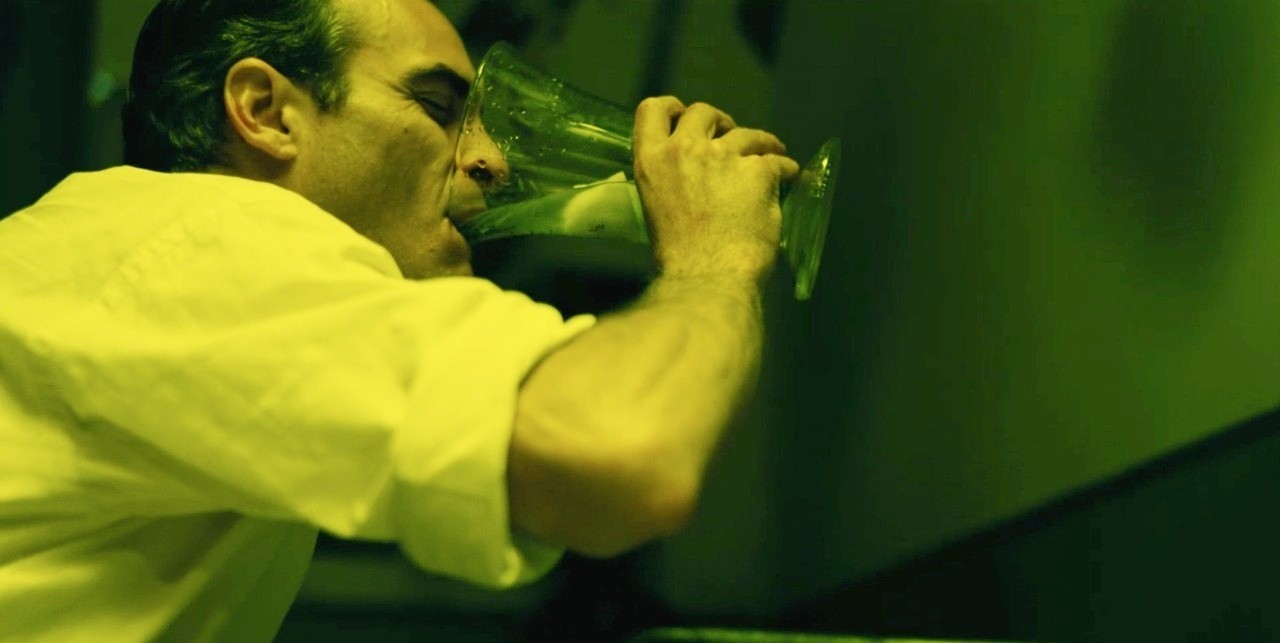
* Even there, in the midst of hundreds of young men in close quarters, he's an outsider, a loner connecting with no one except for his one discernible skill-mixing noxious brain-cell killing concoctions out of anything handy. He spends his time isolated, in some form of inebriation, the limits of behavior and humor blurred to indiscernibility, and when he's out of the service, he's immediately transferred to a psych division, where he is examined endlessly to no avail—the doctors are spending all their time trying to find the answer to what's wrong. 
It's all too obvious what's wrong—he's a barely functioning alcoholic obsessed with sex—but there's no cure for a complete lack of self-awareness or perspective, and Quell is released to the world, unchanged and unremorseful, just another problem that can't fixed and so is dispatched out of anyone's responsibility, to let Nature or Darwinism deal with him. He's a perpetual outcast on the edge of functionality, unstable and instinctually acting out. A job as a department store photographer ends up as an ironic choice—he spends his days looking in, trying to document normalcy, while on breaks, he uses his darkroom chemicals to create some bizarre cocktail to fry his brain and ease his isolation, while trying to make time with a store model. 
Phoenix is brilliant in this
, a raw nerve and not just mercurial, but mercurial at a high boil. The photography job ends with a violent incident of his own making, and he winds up as a migrant worker where, again, he moonlights with moonshine, and has to go on the lam where he stows away on a boat that has been commandeered for a wedding party.
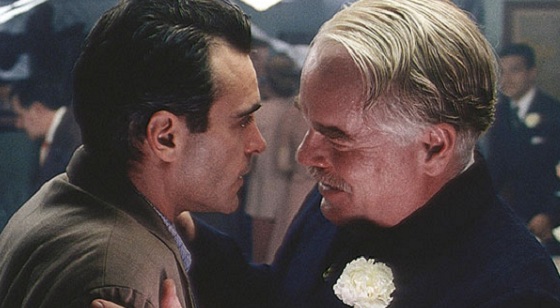
It's here that he meets Lancaster Dodd (Hoffman in a varied, extravagant performance that feels a bit like Orson Welles in Citizen Kane) self-described as "a writer, a doctor, a nuclear physicist and a theoretical philosopher. But above all, I am a man, a hopelessly inquisitive man, just like you."

 
"Just like you."
Yes and no. Dodd is the gypsy-evangelist of something called "The Cause," a nebulous philosophy for which he is the architect and messiah. The rules of The Cause change a bit according to need and the whims of Dodd (who erupts in petulant anger when challenged on it, by believers and non- alike) even though the origins of it supposedly date back "trillions of years" (later, his son will tell Quell "he's just making all this up as he goes along").
He's drawn to Quell for his potent concoctions, for his raw contrariness, which Dodd finds a challenge to his self-improvement methods (called "processing"), and because Quell's feral anti-social fury is a reflection of Dodd's free-thinking, but with the irresponsibility that he doesn't have the freedom to practice. Both men are self-medicating outliers, unable or unwilling to fit in—square pegs in the rounded holes of society.

For Quell, Dodd's processing is a tonic, though not as bracing as what he can make himself, a form of questioning self-examination that, instead of making one feel bad about oneself, makes one feel good. And for Quell, seeming to belong for the first time in his life, The Cause feels like home and family.

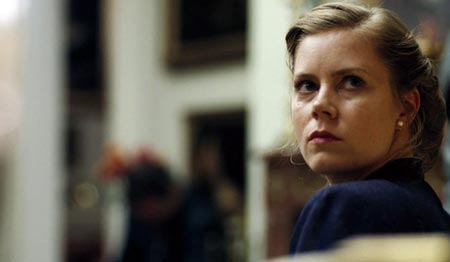
What color are her eyes?  You decide.

Not all the family is happy, though. Dodd's followers, including his Lady McBeth of a wife (Adams), fear Quell's aggressiveness and unpredictability, she especially questions whether Quell will ever improve and worries about the effect he will have on her husband and their cottage industry. Quell may be the best patient for the very therapy that they espouse, but the danger lies in how much damage he will prove to their house of cards in the process. It's a battle of co-dependents for The Cause, while the two men find the limits to their visions of paradise. There's a lot of room for mis-interpretation here, most especially in Dodd and Quell's scene in which the older man seeks to calm the emotions of both of them by singing, as if it was a lullaby, "(I'd Like to Get You on a) Slow Boat to China" which ends with the phrases "All to myself/Alone," emphasizing the isolation of both the Messiah and the acolyte, as they set themselves adrift.
So, in the end, once the credits have rolled up, what does it all mean? What's the point?** I'm honest enough with myself to say I don't have a flippin' clue, except what I've laid out here as themes and observations, but will admit that it is all up there on the screen, ready to be interpreted in as individual a manner as any audience member can provide, which is what makes Anderson (along with Terrence Malick, who is a bit more focused) one of our most enigmatic of filmmakers. Whether that makes him a visionary or a charlatan—like the filmmakers, captains of industry, and religious leaders he portrays, making it up as he goes along—depends on our interpretation, as well. And it is enough for me that he continues on the path he takes—not going for the easy superhero flick, or facile rom-com—without compromising anything...not even his intentions. It makes him brave, admirable...and always watchable. Challenging to be sure, but I like a challenge.
No, really. We're all together in this.

* One of the running motifs of the film is the time spent on ships of some sort, adrift.

** It's been amusing to read film critics struggling with this one, some finally merely knocking over their king to just call it a "character study."  It's a tough one, alright.  But, it is trying to say something about the human condition, even if only to say it has no easy answers, either, not even for those who espouse and specialize in easy answers.  I like that, but one wishes there was more provided by the film-maker, rather than just providing a rorschach test for us to throw our interpretations onto.

Thursday, January 20, 2022

C'mon C'mon

So, Who's Watching Jesse?
or
"I Don't Like Feeling This, But I think He's Spoiled...or I Am"

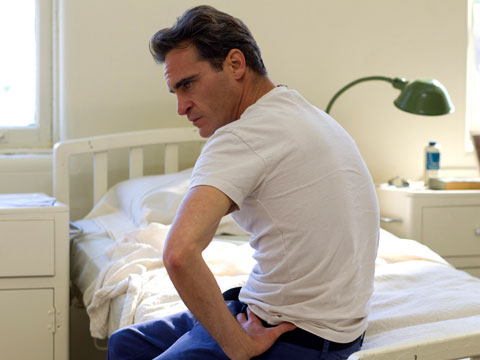
Radio producer Johnny (Joaquin Phoenix) has a full schedule of recording kids' questions that will make up one of those radio essays that show up all the time. He's a good listener, but his interactions are generic, asking open-ended questions to get a response. But, he gets a cry for help from his sister Viv (Gaby Hoffmann)—he hasn't heard from her for a year since their mother's death following an extended term of dementia and on the anniversary of it, they're talking, catching up. Viv's husband, a musician, has moved to Oakland for a job, and he's not coping, suffering from extreme bipolar disorder and she feels the need to help before something really bad happens. Johnny asks what she's gonna do with her kid (Woody Norman).
 
It's only for a week so Johnny flies from New York to Los Angeles and he'll stay with the kid, Jesse. Jesse's high maintenance and Johnny's low output—but he is a good listener. It's just the kid never stays in place, has a lot of energy, has a lot of questions, and although Johnny's moody, he's not always in the mood. He's never had kids, and in his "big" relationship, she left him. Now, he just sort of records...
Then, there's Jesse. He has a lot of questions, but most of them he keeps to himself because he's scared of them. He acts out, pretends he doesn't care, and plays "the orphan game," where, instead of being Jesse he pretends to be an orphan asking to be taken in. He's smart as a whip, but doesn't have any friends. He knows that Johnny's only temporary, but he misses his Mom and wonders why she's in Oakland and he's with Johnny. He asks Johnny why he and his mother don't get along. But, Johnny is better at asking questions than giving answers. Then, Johnny shows him his recording equipment.
"It's really cool in here!" he says, referring to the space in his head between the headphones. And, it is. It's also isolating, which can be good for concentration, but bad for interaction. But, during the "getting-to-know-each-other" phase, it comes in handy. And then Johnny's called and told he needs to do some recording in New York. "Would you like to go to New York?" he asks Jesse. "Yes" is his reply.
 
It's a bit of an open-ended question.
But, not to Viv. "You do NOT ask a child if he wants to go to New York without asking his mother first!" But, the ex is not improving, and without any other choices, and with Johnny's advocacy, she relents and Johnny takes Jesse to New York City to stay in his apartment, go to his recording sessions, and hang out, under Johnny's supervision. But, New York is a city that never sleeps and neither, evidently, does Jesse in New York. The city energizes him, makes him hyper and a little unruly, and Johnny snaps at him a couple times. This sends Jesse into a tail-spin—he's the farthest from his mother that he's ever been, he's spending time with strangers, and nothing is familiar. And Jesse's a little kid, and hasn't had the experience of handling his emotions for very long. It's difficult.
I loved C'mon C'mon, but then there is no way that I couldn't. Its elements are hard-wired into my DNA. My mother died of Alzheimer's. I know the pressures of dealing with lack of identity from them, and letting go of reality to keep them safe and happy...but more safe than anything. It's straight out of Lewis Carroll living with that disease and more times than you'd think you find yourself doing something counter to what makes sense. Because it's better for the person you love that you do.
And I did radio work and audio post-production for many (many) years, and I, too, thought it was "really cool" to live in the space between headphones. I became hyper-aware of sound, of it's qualities, it's speeds, it's up-ramps and fades, it's colors and qualities and textures. I took an audio recorder everywhere—on trips, on errands—trying to find that perfect sound (tough to do, as you never record what's making the sound so much as you're recording the space that it's in). Acoustically perfect rooms—with "dead" ambience—made me uncomfortable (nothing strange there, it does everybody, especially when you become aware of your own pulse!). I was much more comfortable being in "that" space.
And I was lousy at expressing my emotions. I suppressed them...until they exploded. Couldn't regulate them; I didn't think you had to. But, personality and mental status are like old cars. They don't work very well without some maintenance work. And sometimes—like with Alzheimer's—you have to let go of reality and look at the world objectively instead of subjectively, because sometimes the subjective is just plain wrong. And full-on brain repair? That's expensive. Maintenance is better. You get a lot more mileage that way.
Oh. And I love New York, too.
So, this one was as familiar and as comfortable as an old sweater and ratty slippers and there was no way that I could not be tickled by it. Sometimes you're challenged by a movie, sometimes you are taken someplace new—or some thought new—that you realize why you love movies so intensely. Sometimes, you're just moved by the proximity to life that art can achieve, even when presented in unfamiliar ways (like in black and white, for instance). Or the beauty of the image in a frame thoughtfully composed, but still giving you all the information you need.
That is being objective, though. Subjectively, I think it's one of the best movies of the year and I can't wait to show it to other people.