Showing posts with label Black and White. Show all posts

Saturday, January 18, 2025

Deadline at Dawn

Deadline At Dawn
(Harold ClurmanWilliam Cameron Menzies , 1946) One of those movies that, I'm sure, grows on you over time, once all the shocks have worn off.
 
But, if you're peeping at it in for the first time...well, all I can say, pally, is it's a lot to take in. Oh, it's got a lot of familiar tropes of the noir-type: everything takes place at night, shadows seem to be the popular decor, there's good people and bad people, good people get accused of doing bad things, there are a couple of desperate chases between desperate people, and it's entirely black-and-white, the only color being the complications along the way which are, more times than not, red herrings. And if you can't follow it too well, that's understandable because it starts getting confusing with in the first ten minutes. Watching it drunk or sober won't help you with the film's terrain—you're going to be bumping into walls either way. Oh, and don't get attached to characters because most of them will disappear before the sun comes up. It's not that they die or anything, it's just that they have their fifteen seconds in what passes for a spotlight in a film-noir and then they just go away, never to be seen again. That's life in the big city.
Enough with the opening narration (there isn't any, that would be too helpful). A sailor-boy (Bill Williams) is gonna be shipped off to his next hell-hole and he spends the eve of it getting black-out drunk. He wakes up at a newsie's where he's been sleeping it off with no idea where he's been or what he's been doing. All he knows is that he's got $1400 bucks he didn't know he had. "Found money" is always a nice surprise, but not when there's four hours to kill and you're a possiible target. What better thing to do than hide in the arms of a frail (you could always use her for cover!), so he goes to a dance club and ends up with a handful of a hostess named June Goffe (Susan Hayward) who's dead-on-her-feet and doesn't get interested until sailor-boy shows her his $1400 wad. Naturally, she invites him over to her place for a sobering sandwich and the story of how he got it...if he can remember.
Pretty soon, things start going "Hayward". The sailor isn't as much of a shoe-cruncher as she thought he was but insists on thinking of him as "a baby." But, he had managed to crawl to a drinks-provided poker game (not sure if that's a euphemism or not) at the apartment of Edna Bartelli (Lola Lane), who, with her brother (Joseph Calleia) regularly ran a scam of luring rubes off the street and then robbing them of their wits and their bankroll. Somehow, he'd gotten the better end of the deal with more money than he could spend in four hours. But, he's "a baby" and he wants to return the money because it's the right thing to do (even to people who'd rolled you) and he doesn't want to spend his last four hours of furlough looking over his duffel bag to see if the cops are looking to pick him up for theft. He is in uniform, after all.

Yeah, well, no good deed goes unpunished and sometimes you get exactly what you're trying to avoid, especially in noir movies. June and Alex ('the baby") go over to the address and instead of finding the woman dead-drunk (like he left her), they find her just plain old dead. Like he left her? Well, that's the question. Either June's running around with a killer or there's a killer somewhere else running around after them. That's the question. And they only have a shrinking four hours before Alex gets deployed.
"I hear a whistle blowing" says June, metaphorically
...or is that "Odetically"?
It has the simple par-boiled "jeopardy" plot one comes to associate with its original author Cornell Woolrich (he wrote the original stories for Rear Window, The Bride Wore Black, The Window, Mississippi Mermaid and Phantom Lady) where "trust" (or lack of it) is the one thing drum-soloing through the characters' minds as they try to unravel the plot. But, Deadline at Dawn doesn't so much provoke a sense of associative paranoia as "what in the black-and-blue-blazes are you talking about?" It's scripted by Clifford Odets, who wrote it as a favor to his old Group Theater pal, director Harold Clurman, and it is Odets at his Fink-iest, feeding lines to the cast that are all starch and pepper. Odets took theater out of the drawing-room and into the tenements—and a lot of Deadline at Dawn takes place on the streets and back-alleys of early-hours New York.
Oh, it begins interestingly enough, as we watch a blind ex-husband (Marvin Miller) of future murder-victim Edna Bartelli hammer on her door to collect the $1400 she promised she had for him (the very money the sailor-boy had made off with)—and our introduction to her is properly sordid for the "Code" days where she's so stinking drunk that a fly is pirouetting around on her face. The ex is blind-mad: "You'll never change, Edna. You're bad. I loved you very much. But you're bad." 
But, once we leave the place for the murder to happen, "
Golly, the misery that walks around in this pretty, quiet night." Everybody's kvetching, philosophizing, giving you their dime's worth when all you wanted was a nickel. And complaining about the heat even though nobody's sweating much. Everybody's an overripe wise-guy even the cabbie (Paul Lukas) who hears June's "misery" comment replies with "the logic you are looking for... the logic is that there is no logic. The horror and terror you feel, my dear, comes from being alive. Die, and there is no trouble. Live, and you struggle." I don't know that she was searching for any "logic" there, just making idle conversation. But, everybody's over-explaining in Odets-burg, like when another cabbie bleats "Listen, I don't wanna get in no trouble. I work. I'm just a parasite on parasites." TMI, buddy! Especially with a paying customer in your hack.
Deadline at Dawn is filled with such distractions and so many blind-alleys that you can get lost very easily, but despite the density of the population on display, the solution returns you to the same bubble-world that feels a little too neat for all the obfuscation of the community-building going on. Maybe that was to enrich the plot, but it does nothing to ramp up the tension or unease one usually finds from Woolrich. One shouldn't substitute "overwritten" for "overwrought."

Friday, October 11, 2024

Frankenweenie (2012)

In this recycled review, I spend a lot of time complaining about Tim Burton recycling material...("...the nerve!")

Speaking of nerves and things, this was written at the time of the film's exhumation....

Recycled Material From the Grave
or
"I Can Fix This..."

Really, it's a little soon for Tim Burton to be re-making one of his own films—albeit his first live-action short for Disney. One worries that maybe he's run out of ideas, or that he's simply doing what he's always done—take a property and combine it with that goofy blend of the kinky and ghoulish that he has made his own...it's just that this time the property is his...and he's already made it his own once. Maybe, he looked at this product of his younger self with limited resources and thought "I can do better. I can do more." Or along the lines of young Victor Frankenstein, he looked at it his earlier creation and vowed "I can fix this."
At the time of the live-action short, Disney looked at the product of their young animator...and promptly dumped it...only acknowledging it when Burton became an A-list director (with some studio hesitancy) with the first "Batman" film.
* Now, Disney is crowing about its brand new Burton movie, and one can only imagine the wry smile that must produce for the director. It was natural for Disney to want an expansion—they owned the property—and although this new version of Frankenweenie has a lot of (dare I say) re-animation of material, it did give Burton a chance to give it a little more depth and play around without the inhibitions of live action.
I say inhibitions rather than limitations because the differences are exhibited in a weird and rather contrary way, given that the film is done with puppet figures: emotion. The character of
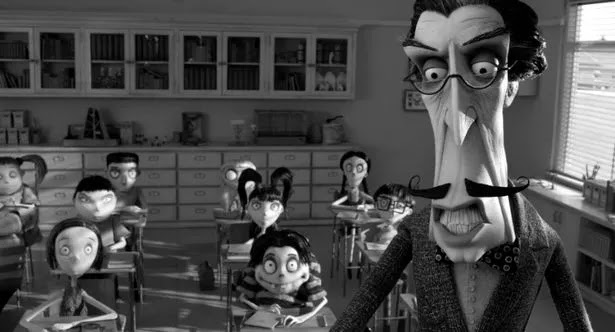
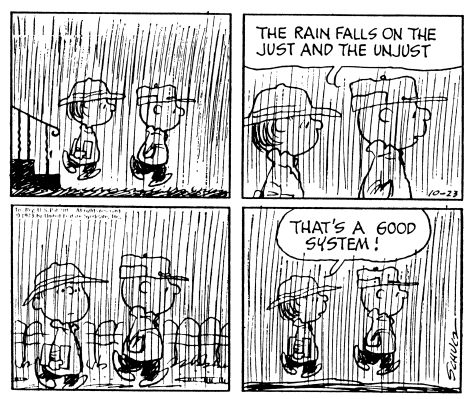
Sparky exhibits a far greater depth of moods than a trained pit-bull terrier could exhibit in live action, not only in its darker moments, but especially in moments of joy—the animation of the dog running elicits fond feelings immediately, as the puppet is rarely touching the ground in motion, not unlike Charles Schulz's "Peanuts" kids who hover over the ground in transit. And although the human figures are Burton cyphers (resembling the human character designs of his first film Vincent) they are still soulful, their eyes expressing more emotions than their faces will betray.
Given that the subject matter is about a mad scientist of a little boy who runs the parallel path of his literary namesake to re-animate his beloved dog, killed in a traffic mishap, there's a lot of room for high emotion there, and far more than in the motivations of the original story.

But, Burton takes it further and makes it more than about young Victor. Taking pages from The Nightmare Before Christmas and Batman Returns, he stages the denouement at a city festival that brings all parties together in one spot, the communal experience gone awry.
Seems that Victor's work has attracted a lot of attention among his classmates, and as there's a science fair going on, all the kid's are doing the same thing—literally, the same thing, bringing to life their dead pets with very mixed results, and providing Burton a chance to explore other species of monster movies (and recreating scenes from them) than just the one, paying tribute to each, just as he does by including a scene from friend Christopher Lee's turn as "Dracula."
Like Victor's experiment, this is a labor of love as Burton—just as with the earlier short—resurrects the movies he loved as a kid, long-buried memories that never really leave, and have influenced Burton throughout his career. It's a fun, resonant electrification of his earlier work, with just enough fresh in it to make it worth the effort and bring it back to new life in leeched black-and-white (which Burton always manages to make look sumptuous). Now, if only we could see something wholly new and original from him, that would be some experiment.

The original Frankenweenie


Brad Bird's "Family Dog" (from Steven Spielberg's "Amazing Stories") based on animation designs by Tim Burton

* It did find it's way to Paul Reubens who'd been trying to find a suitable director to collaborate on his long-in-the planning Pee-Wee Herman movie he'd been dreaming about.  Frankenweenie convinced him to contact Burton.


Friday, May 3, 2024

Hundreds of Beavers

Beavers and Butting Heads
or
Frankly, My Dear, I'm Gonna Build a Dam!

Doldrums. You get stuck in them and circle around not making any progress. This kind of drudgery can lead to a lack of enthusiasm, depression (if it goes too far), and the missing of posting opportunities because...meh...why bother? It makes you do things like take a negligible romp such as The Ministry of Ungentlemanly Warfare and try to apply some critical rigor to it. Such activity should be punished by writing 100 times on a blackboard the old Alfred Hitchcock line "Ingrid, It's Only a Movie!"
 
The solution, of course, is to slap yourself around a little, get the hell out of your rut and do something different. Take a chance. 
 
Like going to your local art-house theater to see a movie that looks so nuts and so juvenile that any attempt at critical pretentiousness is a completely pointless exercise. 
Such a movie is Hundreds of Beavers, a sort of mixed-media "Looney Tune" of live action and anything else that could be thrown onto the screen, be it animation, stop-motion and line-drawing, CGI, green-screen, puppets, people in costumes, and what-not ("what-not" encompassing things I couldn't figure out—it goes by so fast!). None of it is done with what you would call "finesse," feeling at times that it has the technical look of a "Clutch Cargo"® cartoon*; it's definitely "lo-dig'".
Hundreds of Beavers
tells the story of Jean Kayak (
Ryland Brickson Cole Tews), a North American settler and prosperous apple-jack distiller and seller (and consumer), who has his business destroyed when beavers weaken the supports for mammoth kegs, sending them careening down a snowy mountain to crash into his house and explode in his fireplace, destroying his business and his apple orchard. Jean is, at once, homeless, work-less, thirsty and dang hungry, but finds that all his attempts to survive are undone by Fate and his own clumsiness. Somehow he must survive in the wintry wilderness by only his wits. Or half of them, anyway.
Because Jean is not the most adept outdoorsman. Food is abundant, but he can't fish, he can't hunt, nor does he have the tools to accomplish much. He must live off the land—starting fires (the wind blows them out), hunting rabbits (they beat him up), stealing eggs (always out of reach and birds like to peck his head), fishing (no bait), and anything he finds by accident are soon consumed by the local wildlife. Plus, his learning curve is nearly flat, requiring much trial and error, but mostly error, each go-'round a new and painful lesson.
Finally, he manages to land some fish, taking them to the local merchant (
Doug Mancheski) for trade. At the post, he meets the merchant's lovely and provocative daughter (Olivia Graves), a furrier, as well as a Master Fur Trader (Wes Tank), who takes him under his wing to teach him the ways of the wild.
It could be Jeremiah Johnson done as a silent comedy (although it's not silent, the film is almost purely visual), by way of Buster Keaton done through a Chuck Jones lens, and cavorts into Fritz Lang territory as Kayak learns the true nature of what the busy beavers are up to in his neck of the woods. Imagine a Peter Sellers comedy (re-imagined by Terry Gilliam) with the reckless disregard for the laws of Nature—and physics—of a "Roadrunner" cartoon played at double-speed and you'll get the idea.
At times, it gets a little too complicated and maybe there are a few too many call-backs, but excess doesn't seem to be something the filmmakers were worried about. One can't deny that at many points it's just laugh-out-loud funny and endlessly inventive to the point of being ingenious, and one's affection grows as the film builds and builds until you finally give yourself over to the film while admitting that Beavers might have bitten off more than it can chew.
But, then, there is nothing wrong with that. One would rather see a movie "swing for the fences" than merely get by, leaving wasted potential like so much popcorn on a theater floor. By embracing old and new technology and with its dedication to cramming as much goofiness into its comparatively meager one hour forty-right minutes, Hundreds of Beavers manages more laughs per nickel spent than any movie release I've seen in the last ten years.

A selection of "Hundreds of Beavers" posters....
    
Clearly, these guys have a lot of time on their hands...
 
* Clark Haas