Showing posts with label Emily Blunt. Show all posts

Friday, May 24, 2024

The Fall Guy (2024)

"That Happily-Ever-After Stuff? Unsubscribed!"
or
"What's the Message of My Films?" "Nihilism is a Valid World-view?"
 
Watching Ryan Gosling and Emily Blunt's prickly banter when they were presenting at the Oscars this past year made one actually think that their upcoming movie The Fall Guy might be somewhat entertaining. Bear in mind that I'm one of those crusty souls with no heart and no sense of humor (and no taste, apparently) who is not a fan of director David Leitch. Or of producer David Leitch. I stopped watching the "John Wick" series after the first one, which I did not enjoy and I suffered through it wondering if it was, in fact, meant to be a comedy. I mean...c'mon...the stunts were only believable if you weren't considering what would logically be the collateral damage outside the frame. And Wick goes off because someone kills his dog. Really? That would be funny...if it wasn't so damned dumb. I mean, they made fun of it in Deadpool. You know, the good Deadpool...the first one...the one David Leitch didn't direct. I figure you have to have a screw loose to really get off on these films. That they're successful and have spawned their own series of films only further makes me hang my head and despair about the future of the medium.
In this, a loosely-based spin-off of "The Fall Guy" TV show from the 1980's, Gosling plays Colt Seavers (played on TV by 
Lee Majors*). At the beginning of the film, he's a successful stunt-man, doubling for star Tom Ryder (Aaron Taylor-Johnson), a big box-office draw, and he is having a heating-up relationship with camera op Jody Moreno (Blunt) until he's called to repeat a stunt—a wire-drop inside a high-rise edifice—that goes wrong and he's put in the hospital with a busted back. He emerges 18 months later parking cars at an L.A. Mexican restaurant and swearing off his stunt-man career. 
 
Besides, his phone isn't ringing, the one sure sign that nobody wants you in L.A..
Until, one day, the producer of those Tom Ryder movies, Gail Meyer, (Hannah Waddingham) calls to implore him that his services are once again needed—apparently Ryder has disappeared, whereabouts unknown (something Colt could care less about), but the signing bonus is the movie is being directed by first-time director Jody Moreno—former camera op, former flame. Colt gets on a plane to Australia where the film is shooting.
Told by Meyer that old flame Jody requested him specifically, Colt is sucker-punched when he finds out a) Jody didn't ask for him and b) she's surprised to see at all and c) she's pissed at how they broke up by not breaking up—Colt didn't return phone calls, didn't reach out, didn't do any of those things that men don't like to do, especially when they're fragile, physically and mentally. She proves her affection for him by having him repeatedly set on fire** and trip-wired to be slammed into a rock. Over and over again. Colt's way of responding to all of this is with his laconic "thumbs up" after surviving each take. Jody hates that. But, she still makes him do all that stunt work with a broken back. ("Get...on...a...plane, Colt!")
Um...you can see the crew in the sunglasses..."Props!"
So, immediately I began to question why Colt doesn't just leave as he was obviously there under false pretenses, and, if not the first thing, the second thing I would do after finding that out would be to verify if I was getting paid. Because, obviously, somebody in the front office is lying to him and if they're lying to him about that, there are probably all sorts of things they can't be trusted on. But, by this time, I had given up on the movie being any good and just hoping that it would eke out some entertainment.
It is, on occasion, because Gosling and Blunt are pro's and they can squeeze out entertainment no matter how necrotic the script is.
But, that's not how movies work these days. Entertaining as that may be, what the movie audience apparently wants, and the movie is determined to give them, is wall-to-wall practical action sequences. Things go boom, guys do gymnastic falls and fights, big puffs of smoke and dirt go up in the air for no real apparent reason, sparks fly. A lot. There are spectacular falls where Gosling pops up into the frame as if he did the stunt. Standard Operating Procedure. The movie is a professed love-letter to stunting people and, sure, I'm all for that. I'd rather see practical effects than CGI animation any day. Employ the hell out of 'stunt-people. But, pay them a living wage and make sure they have insurance, first. I mean, stunting is NOT a lost art. The only difference is it's being done in front of green-screens now.
It just doesn't look all that impressive when it's shown being filmed. Leitch doesn't exactly pull off the stunt that the story-stunts are more dangerous than the in-the-movie stunts (and they're still trying to make us believe the guy who cracked his spine a year and a half ago can do these things).
Two things did strike my mind while I was watching the thing scroll in one cortex and out the other: Movies save SO...MUCH...MONEY making a movie about making movies! You don't have to have sets, just people milling around with cameras and eating craft services, and walkie-talkies and cell-phones. You don't have to hide anything, or make believe it's real, and you can even shoot the dressing-trailers. It's so cost-effective as to be ridiculous.
The Fall Guy doesn't have a plot, so much as a thin thread to string between stunt sequences, like some of the really bad Roger Moore James Bond movies or the Mission: Impossible series...or like the Wick films. That seems so ass-backwards a way of making movies—well, of making movies that mean anything, anyway. For someone who sees movies as an art form, and its own unique form of communication, it's really a drag to see a movie like this.
 
The best you can say is: "Well, people were employed..."
Humor example: Blunt and Gosling are talking back and forth about story-approach, 
when she suddenly asks "What about split-screen?"
And before you can say "Oh, they're not..." (which I did),
they go split-screen. 
Laugh? (I didn't)

 
I never watched the TV version of "The Fall Guy"; this is as far as I ever got....
 
* Does Lee have a cameo? Yes, along with Heather Thomas in the post-credit scene (if you haven't walked out by then!)

**  Because she's an "old flame" "carrying a torch"? ...am I looking for sub-text that isn't there? Yeah, pretty sure I am!


Saturday, January 13, 2024

Salmon Fishing in the Yemen

Swimming Upstream
or
The Fish, The River, and The Games We Play

You look at the title and already the questions start. Salmon Fishing in the Yemen? What's up with that? It sounds quixotic—salmon fishing in a desert environment. Impossible. Useless. Theoretically possible, certainly. "Like a manned mission to Mars is theoretical," says Professor Alfred Jones (Ewan McGregor), but not very practical. But a rep agency has a sheikh client (Amr Waked) who wants to do it. It will generate a lot of things: money into the coffers of the fisheries and wildlife people; publicity for the P.M. (as orchestrated by Patricia Maxwell, played with a vibrating steeliness by Kristin Scott Thomas); electricity for the sheikh's kingdom. So it has its practical side—it gets bureaucrats functioning, people working, so who cares about the feasibility, even if its a crap-shoot (or more properly, a carp-shoot). Like fishing.
Even Jones, the functionary put in charge of the project, needs some luring to wrap his mind around the project. "I have a standing with the scientific community—a reputation!" "A mortgage.." counters his wife in a practical marriage. He thinks everyone spear-heading the project needs a net. And his demands start to loom large, asking the sheikh's representative, Harriet Chetwode-Talbot (
Emily Blunt) to get the engineers who designed the Three Gorges Dam in China to do the blue-printing and then "get two of those big Russian transports—Antonovs?—One for the fish and another for all the money we'll need."
He gets the engineers (which impresses), but a little research and
a talk with the sheikh and a tour of the building site gets Jones hooked and convinces him that it just might work—a blind cast, to be sure, but he's made a lot of those. And like angling, it takes a lot of patience. As his benefactor says, you've got to have faith. Any faith will do. Even if it's the faith one has putting your hook in the water.

Not unlike the faith you have to have going into any
 Lasse Hallström movie. He burst onto the international film scene with My Life as a Dog (a film I still haven't waded through, despite sitting on my desk for a month*) and he became Miramax's "go-to" guy for prestige pictures for "blue-hairs"—a director of such discriminating taste, that one could actually accuse him of avoiding the subject, so as not to offend.**  The effect can either be good or bad, and I approach a Hallström chronicle with caution.
For every The Shipping News, there's a Once Around. Every What's Eating Gilbert Grape is matched by An Unfinished Life. Something to Talk About isn't, really, and Chocolat feels a bit hollow. "Yeah, it was fine," you say when it was over, "but..." Not exactly thrilling. Tamped down. Safe. Unexceptional. The story gets told, but it doesn't move the senses or the emotions. The movie gets made, gets seen, but disappears from the mind like spun sugar in water. But every few movies, the elements jell.
Salmon Fishing in the Yemen
is one of his better efforts, but is still very restrained, though the elements of terrorist drama that pop up tend to disrupt the generally genial tone of the thing. And like a fine day of fishing, it all comes down to the casting. McGregor is terrific here, lilting accent intact, and feeling more genuine than he has since
The Ghost Writer. Blunt is given a bit more emotion than she's been allowed her last few movies, and Waked is a sage, calm presence. And as far as the movie goes, one is charmed with the conceit of the film as a love metaphor—of taking a flyer in relationships, and committing to something beyond yourself, even if the odds are long and the obstacles high. But, ultimately, it's in one's nature to swim upstream, to rise above, because it is our nature.

* Actually, I did make it through it. My review is here.
 
* I always remember conservative commentators talking about what a fine film The Cider House Rules was—because it was about an abortion doctor who established an orphanage for "unwanteds"—most probably because they hadn't seen it, for if they had they might not have had such high praise for a film dealing with child and sexual abuse and incest.

Wednesday, September 20, 2023

Sunshine Cleaning

Written at the time of the film's release. I still have fond memories of this film ever since its release in 2008.

Oh! And give Amy Adams an Oscar, for crying out loud!


"Blood in the Seams/Heaven on TV/God on the CB/and the Spirit in the Sky"

Where do they come up with these things, these independent movie-makers?

First off, the poster with the chirpy "From the producers of
Little Miss Sunshine" didn't help matters any; I'm not a fan of Little Miss Sunshine
thinking it hit all the right "indie" crowd-pleasing ingredients (Alan Arkin + Gay depressive + quirky family + so-ugly-she's-cute-kid + passive-aggressive marriage + "bizarre" normals + a beater-van = "WARMTH") in the same "by-the-numbers" way James Bond fires off all his gadgets in the same order "Q" introduces them.

Sunshine Cleaning hits the same formulaic construction, but the finesse with which it's performed and the sheer weight of its "downer" concepts manages to make it bob cheerily higher in the dank waters it's been pushed into in a life-affirming defiance.
What are we talking about here? Single mom Rose Lorkowski (Amy Adams, all dewy eyes and iron jaw) is a former Cheerleading Queen in her Albuquerque, New Mexico High School who made all the wrong choices. Knocked up, no prospects, she now cleans the homes of the less popular, stabler girls from her class. She's carrying on a going-nowhere affair with a married cop who won't leave his wife, who just got pregnant again-(yay!) Her OCD son just got kicked out of school for obsessively licking things (including his teacher). Her worthless sister Nora (a brilliant Emily Blunt-not betraying a hint of her Britishness) just got fired from her worthless waitress job. And Dad (Alan Arkin)...is played by Alan Arkin.
To pay for her kid's private education
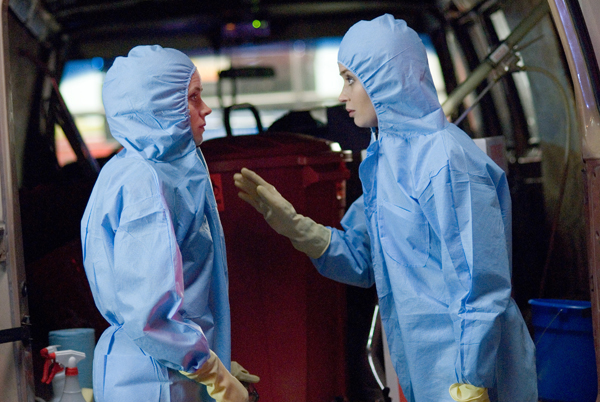
(or anything), she decides to take her cleaning skills up a notch—there's good money to be made cleaning up the "blood and body fluids" from recent crime-scenes. Soon, Rose and Nora are a going concern as their "Sunshine Cleaners" does a fast turn-around of suicide clean-ups, "de-comp's" (as they say in the trade), and every other obnoxious, toxic, disease-ridden scouring job that comes down the pike. "It's a burgeoning field" says Rose, the whites in her eyes showing all-around as she explains it at a baby shower. "We come into people's lives when they're going through something ... profound."
Indeed.
And the intertwining skeins of those lives weighs as heavily as the various crises in their own lives. It all is a bit messy. Amy Adams spends a lot of time looking into mirrors, sometimes chanting a mantra: "You are strong. You are powerful. You can do anything. You are a winner." One night, in a motel room that she's occupying alone, she'll have a new coda for that litany and burbling up will be a half-strangled cry/half-hysterical laugh.
It's brilliant. Adams rarely disappoints, and only does when she's got something she's trying to stifle (like her nun in
Doubt that threatens to turn into her Princess Giselle from Enchanted if she cracks a smile.) Not here. Give this girl an Oscar, quick. In fact, director Christine Jeffs gets a great performance out of everybody, that elevates its basic plot (which reminded me a bit of Happy Gilmore) and stifles one's urge to apply the film's last line to casually toss it onto the indie "also-ran" pile. Films that click this well happen rarely.

Wednesday, September 13, 2023

The Adjustment Bureau

"I Guess The Lord Must Be in New York City"
or
"Dicking Around with People's Lives..."

The stories of Philip K. Dick have provided all sorts of story-fodder for the movies for both good or ill: Blade Runner, Total Recall, Minority Report, Paycheck, A Scanner Darkly, Next, and Impostor.
 
They feature the sort of high-concept story-spine that easily translates into genre-bending sci-fi/fantasy films that are the easiest thing to translate to the screen short of a superhero property. Just put a slight spin on a story concept—a police force that stops crimes before they happen, spies and detectives who are mentally undercover, a guy who can see into the future, but just eight minutes out—all odd concepts that illuminate the character dilemma in a way that a straight story might not highlight. You don't have to be a genius to "get" what the movie says. And the inevitable SFX look great on trailers.
So, here's
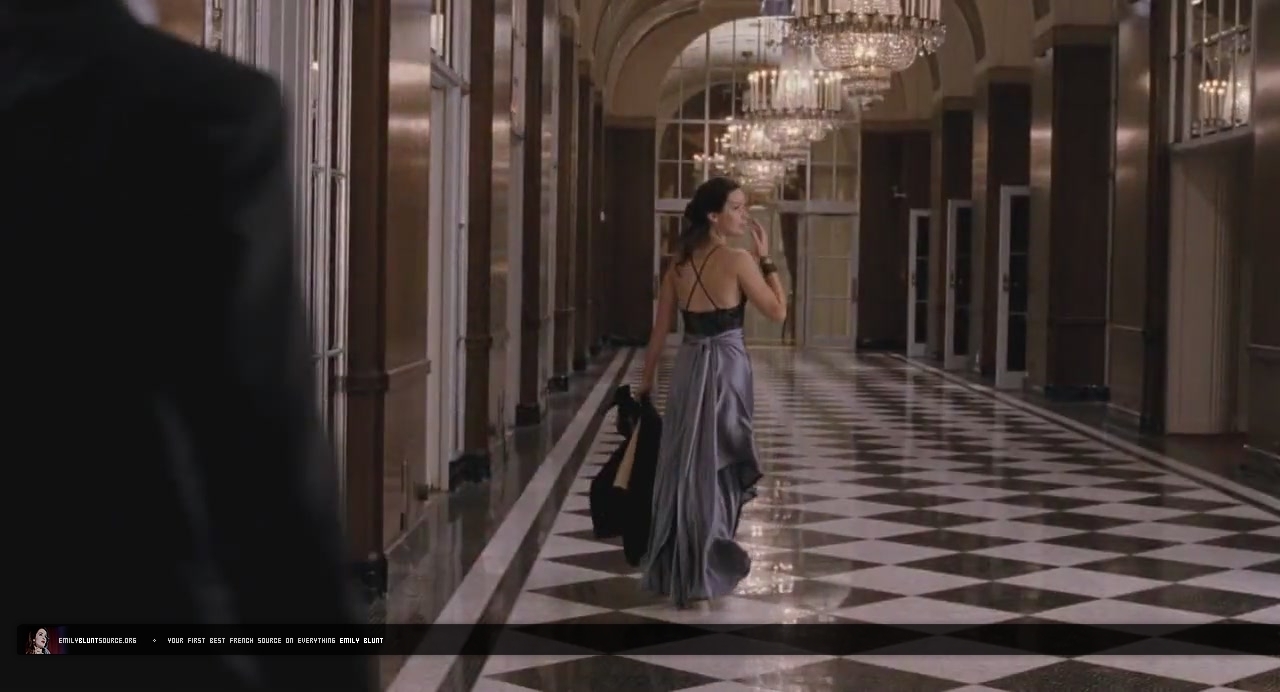
The Adjustment Bureau, a paranoid conspiracist's validation of all things manipulated. Young senatorial candidate David Norris (Matt Damon) is about to lose an election big-time, due to some ill-considered party-decisions earlier in his life. In the men's room of the Waldorf, he practices his contrite, yet defiant acceptance speech, only to find that he is being overheard by Elise Sellas (Emily Blunt), who is evading hotel security after crashing a wedding upstairsIt's a "meet-cute" as the two banter about Norris' loser-status and Elise becomes intrigued enough to plant a lip-lock on him. His campaign manager (the always welcome Michael Kelly) walks in just in time to catch this and bust it up to get Norris to the ballroom to admit defeat. I'd've fired him on the spot.

It's some time later and Norris is working for an investment capital firm with his manager. He's running a little late, so he doesn't notice a team of angular men in business suits and fedoras are shadowing him. One in particular—Harry (Anthony Mackie)—has an assignment: Norris must spill coffee on his shirt by 9:05 am, not any later. It's his job, says Agent Richardson (John Slattery), so don't screw it up. 

But, if he didn't, there wouldn't be a movie.
There's no use crying over un-spilled coffee, but as a result, the rest of the movie is the Team attempting to solve the mess the non-mess creates: Norris is able to catch his bus on-time,
where he once again encounters Elise, and gets to work just in time to see the Pre-Destinators (my term) sweeping the office, the personnel frozen, and key players receiving a "mind-wipe." Norris catches on quickly, and tries to evade the invaders, only to find them around every office corner, calmly telling him that, really, he should take it easy and cooperate and "this" will all go a lot easier.

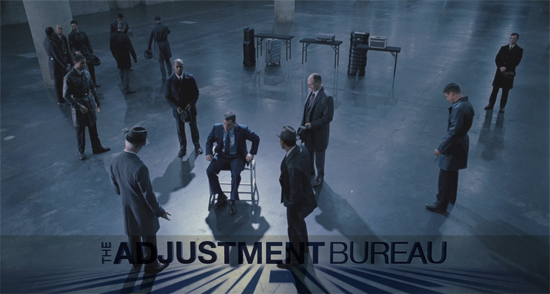
He wakes up in an empty warehouse
, with his pursuers deigning to tell him the truth about things: "You've just seen behind the curtain you never knew existed."  They're a team of agents who manipulate events among humankind—a kind of Uber-illuminati ('"sometimes it's chance, sometimes it's us
")—at the behest of "The Chairman." They lay down the law: He can't have a relationship with Elise, which David objects to ("Your entire world just changed and you're thinking about a woman?") as it's not in "the plan," and if he tells anybody about what he's seen, they'll make everyone think he's crazy, and "reset" him, leaving him basically lobotomized.
* 
Norris is too much a free-thinker
to obey the "button-down men of Fate" and the rest of the movie entails him "changing the curtains," as it were. It's very clever and director George Nolfi, (who wrote the screenplay for the similarly time-trippy Timeline, had fun adapting his screenplay "Honor Among Thieves" into what would become Ocean's Twelve, and was one of the team who wrote—and re-wrote—The Bourne Ultimatum) ingeniously keeps things moving at a good clip, while also staying one jump ahead of the story-complications inherent in the plot...while also doing enough cinematic sleight-of-hand to keep the Doubting Thomases in the audience from falling into plot-holes. He gets good performances out of everyone—allowing enough ad-libbing in the scenario to make it seem real and fresh, sort of a real-life version of the film's conceit of re-writing History in pencil before the Cosmic Ink dries. It's fast, fun, and fresh and avoids pretentiousness or taking itself too damn seriously. It is only after a little Time has passed that it feels a bit slight, but who could have anticipated that?

One thing is for sure:
I gotta get me one of them hats!

* At that point I flashed on former CBS news-anchor Dan Rather walking down a New York Street and being attacked by men and all they said was "What's the frequency, Kenneth?"  Everybody acted like Rather had had "a spell," but I wonder if his attackers were wearing hats.

Tuesday, September 5, 2023

The Young Victoria

Written at the time of the film's release...

 "Her Serene Highness"
 
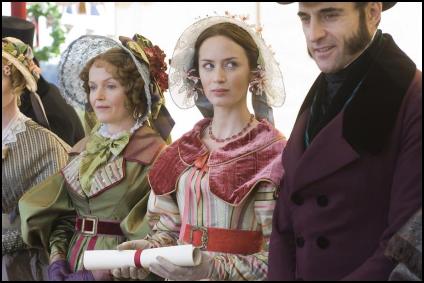
William Jefferson Clinton famously called The White House the crown jewel of the U.S. prison system. Young Queen Victoria (Emily Blunt) says early on in The Young Victoria, "Even a palace can be a prison." As the only heir to England's throne in the Royal House of Hanover, the young princess is managed and controlled, ostensibly for her safety, but also for the power that an unprepared and naive queen can offer her advisers. The last image we see before the title of the film is a gate swinging towards us and slamming shut with a bang.

Go to black. Title up.

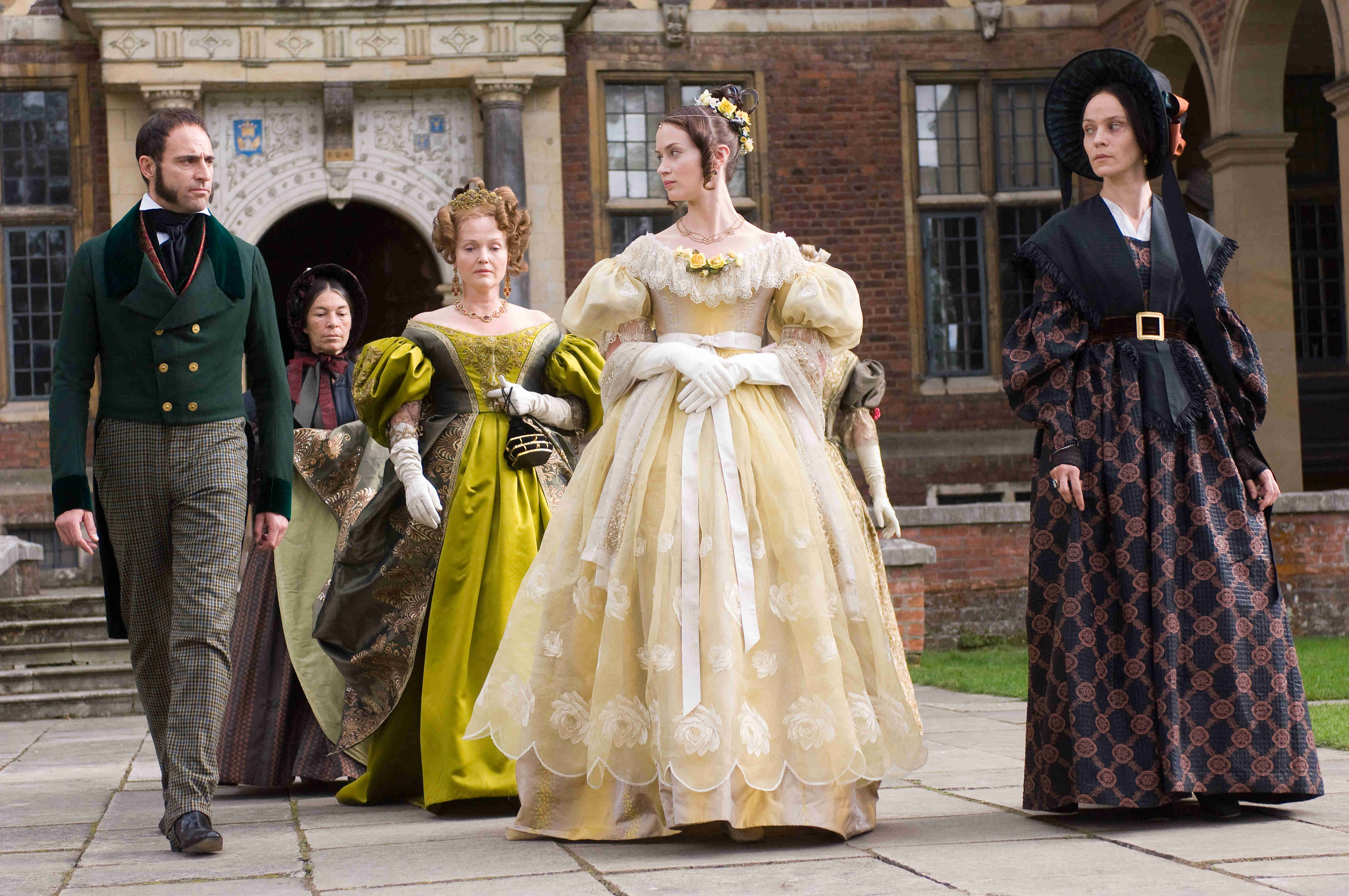
There are a lot of shuddering doors in The Young Victoria, as the upstart princess, well aware of the red carpet ahead, defies her manipulaters and her mother (Miranda Richardson), who is cowed by their presence, especially that of Lord John Conroy (Mark Strong—his second villain role this year after Sherlock Holmes—risking typecasting, he'll be playing Sir Godfrey in the upcoming Robin Hood) who viciously seeks to be made regent in case of the death of King William (Jim Broadbent). Ambition is on everyone's mind, except the one who will be getting the power. And ambition is what the young queen must learn, if only to be used as a weapon.
Director Jean-Marc Vallée (and his script-author Julian Fellowes, who wrote Gosford Park and a little something called "Downton Abbey") spend a lot of time concentrating on Victoria's noggin. It is focussed on, framed and discussed. "Look at that demure little head," says Lord Melbourne (Paul Bettany) at her coronation. "And all of us wondering what's inside it." He, like the rest of the court, really couldn't care less. If her mind can be changed, then it doesn't matter. But there is enough rebellion, and enough fighting the gold shackles binding her, that can be used to sway her.
It should be noted at this point that one of the producers of The Young Victoria is none other than Sarah Ferguson, the Duchess of York, who endured her own time of constraints while married to Prince Andrew. "Fergie" was known to be quite feisty, herself, and one looks at the movie and wonders how much of its editorial stance originated with her, as it is pretty sly in its view of the monarchy as being both a blessing and a curse. Whatever animosities Ferguson has incurred with the current Royal family, there seems to be an understanding of just what is asked of a monarch, and with The Queen, it shares a similar visual touch—the Royal de-focussing of the eyes that appear to see nothing, but are merely providing a non-commital mask for the public to see, the eyes looking, instead, inward.*
Given that,
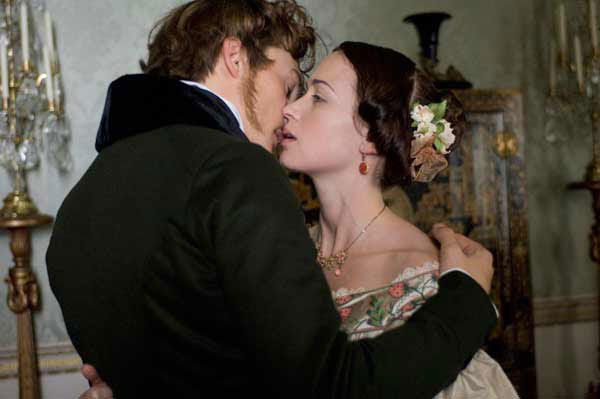
enter Prince Albert (Rupert Friend) of the Belgians. Groomed as a suitor by his father King Leopold (Thomas Kretschmann), the young Prince also resents being kept in a can, and upon meeting Victoria goes off-script, showing himself to be of equal mind. During a supervised chess game, they compare notes on their similar circumstances. "I know what it means to live inside your own head," he offers. "You must learn the rules of the game, so you can play it better than they can," and as if we don't get the point, he takes her Queen and sweeps it off the board, captured.
Vallée keeps things properly ornate and unfussy in his direction, save for some odd little rack-focuses interrupting the continual focus on Emily Blunt's head of restrained expression. At one point, though, he does indulge. At the Queen's entrance to a Royal Ball, upon seeing Albert, he keeps Blunt locked in position and then yanks her away from her party, as if pulled, floating to her paramour. A neat little trick that, and very dependent on Blunt keeping her muted expression while having her transport taken completely away. It's indicative of Vallée knowing that his best weapon in the movie is Blunt's subtle whisps of expression; one is drawn to her face to see how she'll react, even if, until the last frame, it is reluctant to reveal.

* At the end, there is a title stating that Victoria was the longest reigning British monarch (that would be be 63 years and 216 days). And as if to tweak the ex-mother-in-law a bit, with a wink, a new title emerges below it—"To date." 

Elizabeth II surpassed her great-great-grandmother's reign on September 09, 2015.  She went on to serve 70 years and 250 days. Only the reign of Louis XIV of France was longer.

Saturday, July 29, 2023

Oppenheimer

Ch-Cha-Chain (Reactions) of Fools
or
Fallout: If the Radioactive Doesn't Get Ya, The Political Will 
 
I took a course in college called "The History of the Atomic Bomb," so I already knew about J. Robert Oppenheimer and the Manhattan Project, and Lester Groves, and Edward Teller, and Enrico Fermi, and Niels Bohr, and Richard Feynman. Our best and brightest...as well as Germany's best and brightest, having escaped the Nazis.

I've listened to the plays, seen previous adaptations, know the story backwards and forwards. I got a C+ on my final paper around the subject of "Should we have dropped the bomb on Japan?" (I don't remember which side I took, but I believe it was favoring the Demonstration scenario).
 
But, I've been interested in seeing Oppenheimer, because I wanted to see what director Christopher Nolan would do with it. J. Robert Oppenheimer led a life that could have filled a few movies, but Nolan has compressed it into one three hour film, with the highs and the lows, and of the parallel tracks and rippling occurrences that underscored and undercut his career, and made the man who oversaw the construction of an atomic bomb from theory to reality become a pariah to the very country he handed it to on a desperately sizzling platter.
And Nolan in the past has been a wizard of sorts playing with the possibilities of story-telling and film-making, and juggling and parsing scenarios so as to create  adrenaline-generating third acts that brings everything together for a thematic jolt. One could say he creates these puzzles in the editing room, if the conceits of the films weren't so inextricably linked to the construction.
But, here, Nolan keeps it rather simple: two stories running parallel to each other, both involving hearings on their subject matters. They're sub-titled 1: "Fission" (in which atoms are split): in color, involving an older Oppenheimer in 1954 being grilled by a back-room secreted committee over whether he would retain his top security clearance; 2: "Fusion" (in which atoms are combined): in black and white, involving the very public hearing of Lewis Strauss to become Secretary of Commerce in Eisenhower's cabinet in 1959.
Two seemingly unrelated stories, but tied together so deeply that to split the two would be like splitting atoms, as they both deal with brilliance, arrogance, ego, and their limitations. There couldn't be one story without the other. And just as you can't have a nuclear explosion without fallout, both men—Oppenheimer and Strauss—would learn of consequences, that will haunt them to the end of their days.
Nolan starts the movie with a peaceful image—rain falling in water—but, as serene as it is, it's the natural image to describe the film. Just as rain falling will ripple out in concentric circles, actions will have reactions and those will spread without much control, a chain reaction that will only dissipate until it runs out of energy. And Oppenheimer is a film interrupted with small moments—a spark, a ripple, the sound of stamping feet, a line of poetry—that will echo throughout the film as mysterious fragments until we see them in context and realize their importance to the whole, like little figments of conscience that haunt until they are reasoned into clarity.
We see the the path of Oppenheimer (brilliantly played by
Cillian Murphy) to Los Alamos—a terrain he loves ("If I could combine physics with New Mexico, my life will be perfect"), through European studies—he gives lectures in Dutch—meeting the great minds of physics—Heisenberg, Bohr—then re-enters the U.S. to teach at Berkeley, hoping to initiate a field of study in quantum physics, which starts with one student, then many. Concerned with unionizing the colleges for faculty and techs, he flirts with the Communist Party, but, does more with one of their members, Jean Tatlock (Florence Pugh), who will challenge him, mystify him, and ultimately be used against him.
He marries Kitty Puening (
Emily Blunt), has a child, and although he's playing with things nuclear, he can't seem to manage a nuclear family. He's approached by General Leslie Groves (Matt Damon) to lead the Manhattan Project to develop a nuclear bomb before the Nazis, and although Groves knows Oppenheimer's leftist leanings, he still wants "Oppie" to lead the project—"I wonder if you could tell me how the Army would treat a humble physicist" "I would if I ever met one"—and as part of the project, Oppenheimer figures out the best rail-access for delivering fissionable material from three corners of the country and winds up with New Mexico, isolated, empty of population and surveillance, to build something that is only a theory...before the Nazi's do. "We have one advantage," Oppenheimer tells Groves. "Antisemitism." Germany has driven out its top nuclear physicists.
Well, you know the story. We've all lived in a world with constant nuclear brinksmanship, and the few souls who remember a time before "The Bomb" are dying off. We're used to it now (which seems inconceivable to me) and we're at a time of such complacency that you still hear mentions on the news of "nuclear options" and "tactical nukes." But, Oppenheimer takes us back to a time when the Atom Bomb was not only apocalyptic, but also inconceivable. At the time of its creation, there were a lot of "unknowables" about the Bomb. All they knew was that it would be big and cause a lot of destruction in a wide area—a city destroyer. But, at the time of the Trinity test, nobody knew if the chain reaction in the air would stop or if it would keep feeding on itself, incinerating the area, and possibly more. And, they didn't know anything about fallout.
The fallout—of all kinds—is the new thing here. With the responsibility of building a weapon with so much destructive power—with the complete agency of the government to do it—comes with it the emergence of those who see that power and covet it. And this is where the Strauss story comes in. Played quite amazingly by 
Robert Downey Jr., Lewis Strauss is a political operative and functionary, whose ego cannot merely appreciate the accomplishments of Oppenheimer and his team, so he must control it, harness it, and by doing so, subvert it to his own ends. As Oppenheimer did to nuclear fission, Strauss does to Oppenheimer and does so with a cold-blooded zeal. And given Oppenheimer's past propensity to fill any intellectual void with affairs and radical politics, Strauss is given the very weapons needed to undermine any attempts to prevent the scientist's efforts to keep the destructive genie contained, slowing nuclear proliferation and ever-increasing mega-tonnage. "Amateurs chase the sun and get burned," Strauss says at one point "Power stays in the shadows."
Oppenheimer is a solid three hours long, packed pillar to post with detail and small roles by very good actors—Nolan newbies like
Rami MalekCasey AffleckAlden Ehrenreich, Josh HartnettJames RemarJason Clarke, and vets of past films like Kenneth Branagh, David Dastmalchian, Matthew Modine, Tom Conti, Gary Oldman—and one may begin to think that the Strauss story gets a bit superfluous and should even be cut, but it is essential to the story and theme of how one man can make a difference, for good, evil or both. And of how power corrupts—even the pursuit of power corrupts—and though one may blaze with brilliance like a nuclear flash, it is not self-perpetuating...and fades...even if it consumed by itself.
Yeah, I took a course in college. But, you learn something new every day...if you're doing it right.
 
Nolan wrote the screenplay, based on the 2005 biography "American Prometheus: The Triumph and Tragedy of J. Robert Oppenheimer" and starts with these apt words: "Prometheus stole fire from the gods and gave it to man. For this he was chained to a rock and tortured for eternity."
The haunted gaze of the elder Oppenheimer
—a look both accusing and guilty