Showing posts with label Best Picture. Show all posts

Friday, February 28, 2025

Anora

The Girlfriend Experience (and Transactional Relationships)
or
"She Happened..." ('Tis a Pity...)
 
Anora—"Call me 'Ani'"—Mikheeva (Mikey Madison) is a Brooklyn stripper working in "The Tenderloin" section of Manhattan. She's very, very good at her job working as a "hostess" getting to know the clientele, encouraging their drinking and their desires, even going so far as to escorting patrons to the nearest ATM when they run out of cash. If the "mark" is really friendly, the "VIP" treatment might be suggested to an area upstairs where the stripper can do a lap dance to make some extra dollars. There's no touching during the lap dances, although given the near-privacy of the area, rules can slip as easily as a halter-top.
 
We learn a lot about "Work-place Ani" in the first few minutes of the film, which is short on exposition but long on nudity. We see her backstage where she has little patience with bullshit. She has one good friend, Lulu (Luna SofĂ­a Miranda), but has a somewhat competitive relationship with the other girls. And she's good at acting: acting interested, acting sensual, acting like she cares, finding the weak spot, using rapier-like flattery, and is quite creative at it. You have to be to score a buck.
But it's only acting. Once the club-wear is off and she's out the door of the HQ Club, she's a dead-eyed street urchin in hoodie and sweats making her way back to her home in the Russian-American community of Brighton Beach, where she rooms with her sister (
Ella Rubin)—their relationship can best be described as passive-aggessively strained—and her hobbies appear to be...sleeping. Being a sex-worker in Manhattan is exhausting work. 
So, she's less-than-thrilled when the owner of the club, Jimmy (
Vincent Radwinsky) wants her to pay special attention to a "high-roller." This turns out to be 21 year old Russian student Ivan "Vanya" Zakharov (Mark Eydelshteyn), who is in the United States for a college education, but that he spends, largely unsupervised, drunk, stoned, obsessively playing video games and shacking up at the huge Brighton Beach mansion owned by his Russian oligarch father. "Vanya" is a child with little impulse control and he falls head over heels for Ani, who, once she sees how free the kid is with Dad's money and doing a little negotiating, agrees to a week-long extracurricular activity at his place for $15,000 cash upfront.
Ani is rarely impressed, but she's awed by the Zakharov complex and the kid is putty in her hands. He gives her clothes, jewelry, the best wine, the best food, and she's charmed by "Vanya's" drunken joie de vivre and his generosity towards her—she could get used to this. She meets his friends, becomes part of a group, all bankrolled by "Vanya", who—impulsively, again—decides to take his posse to Las Vegas on a private jet.
The group stay at a high-end suite, living the highest of lives, when "Vanya" does the craziest thing yet—he asks Ani to marry him. She scoffs. But, he's serious; if they get married he can get a green card and stay in America—he won't have to go back to Russia and work for his father. They can live at his father's American property, and things will just go on as they have been. Ani agrees and they go to a Vegas wedding chapel and seal the deal. He buys her a very expensive wedding ring.
They return home and Ani quits her job at the Club; the other girls are thrilled, but there is the underlying suspicion: "give it two weeks." Things like this, they only happen in the movies. But, the two are clearly besotted with each other and they set up house at the mansion. Life is good.
Until...
 
Until, "Vanya's" parents get wind of the marriage all the way from Russia through social media, and they decide to travel to the States to take their son home. A frantic mother Galina (Darya Ekamasova) calls "Vanya's" Armenian godfather Toros (Karren Karagulian) to get the marriage anulled, get the ring back, kick "the prostitute" out and get their kid ready to get on a plane. Toros is the Zakharov lap-dog—he's been keeping "Vanya" out of trouble and being the family "cleaner" for any mis-deeds—so he sends his henchmen, his brother Garnik (Vache Tovmasyan) and Igor (Yura Borisov), to get the ball rolling and Ani out.
And that's when things start to go South. "Vanya" won't let in the bodyguards, but he's so slight that they manage to get in, anyway. Ani begins to protest and Garnik and Igor try to cool things down, but still get things done...which doesn't actually happen. "Vanyas" lamely protests and fusses that he's not getting his way; Ani protests they're married and there's nothing anybody can do about that, then "Vanya" runs out of the house and Ani starts attacking the bodyguards, who, though they outweigh her by two can't seem to corral her—while doing some physical damage to the living room. Finally, Ani just screams and the two guys get so freaked out that they end up tying her up and gagging her.
 "Everything's going to be alright....Yeah."
And that's what the "godfather" sees when he manages to show up at the mansion. Everything's a disaster. They don't have his godson (and they need him to have the marriage annulled) and they have the most uncooperative person in the world as their only hope of finding him before the Zakharov's arrive (which won't be good even if Toros and crew manage to accomplish everything the parents want).
Anora is several things but running in ironic circles. It's funny, it's anarchic, it's dramatic, and it's a bit of a tragedy. It's also a character study. Because as finely drawn as the cluster of characters is, the whole thing revolves around Ani—Anora—and how she copes (and doesn't) with the situation while losing what she considers a good situation. She wants the fairy-tale (okay, he's an oligarch's son and not a king's, so the world's not perfect, okay?) and fights for it, even when she's way over her head. She's not a "hooker with a heart of gold" except for this one guy, and as cynical and worldly as she appears she's a sucker for her own happy ending. She's not helpless, not by a long shot, but she won't be anybody's victim, either. And as coarse and as conniving as she can be, you root for her all the way. Madison's performance goes a long way in accomplishing that.
This isn't Pretty Woman—it's a much more raw world, where few things are implied and the language is "persistent" (I think it gives The Wolf of Wall Street a run for its money in "f" bombs), not is it coy about sex, or even romantic about it. But, it has the verve and the sting of a Preston Sturges movie that pokes at your assumptions and makes you laugh at them at the same time. It's a comedy with the DNA of a drama and you may be questioning why you're laughing at what's being portrayed, but Sean Baker has made the kind of movie that keeps you on the fence while wondering about what could happen next.
 
Anora hooks you.
"Really? You ended with THAT line?"

Saturday, January 11, 2025

Marty

Marty
(
Delbert Mann, 1955) It was a strange dichotomy—the motion picture studios were fighting off the insurgency of television sets into American house-holds, competing against it by offering exotic locations, widescreen aspect ratios and other innovations like 3-D and stereophonic sound (we won't even get into what William Castle was doing!), even air-conditioning, in an attempt to get people off their convenient couches and away from the primitive flickering black and white images on their square TV sets and back into theaters for their distractions. At the same time, writers and other craftsmen were finding work in the nascent television field where home-grown stories with a less spectacular dimension requirement could be produced quickly and with less studio interference (for them, sponsors were the problem).
 
Marty began as a television play broadcast in 1953 on The Philco-Goodyear Television Playhouse, starring Rod Steiger in the titular role. Movie rights were bought up by the Hecht-Lancaster Production company (formed by Burt Lancaster and his agent Harold Hecht) and it was their first project without Lancaster starring. Steiger bowed out, not wanting to be tied to a multi-picture contract to Hecht-Lancaster and the part went to an unlikely candidate, Ernest Borgnine, with whom Lancaster had worked on From Here to Eternity and Vera Cruz, and who had just finished filming Bad Day at Black Rock. The casting couldn't have been more against "type"—Borgnine was usually being cast as heavies, bullies, villains, or even (in From Here to Eternity) a downright sadist.
But, Marty was different. Marty Piletti (Ernest Borgnine) is an approaching-middle-age butcher (he's 35) in the Bronx. He makes an okay living—he gets by, has some money saved and could see himself buying his own place—but still lives with his mother (Esther Minciotti) for the usual reasons: Dad's gone, Mom's living alone (except for him), she's a bit of a noodge, and he has a severe failure to launch.
Not that he doesn't want to. He's just not the sort of man who attracts attention. "I gotta admit, whatever it is women like, I ain't got it!" He's a butcher, fercryinoutloud, he doesn't even get any respect from his customers who don't even expect a thumb on the scale when they tell him he "oughta be ashamed of himself" for not being married when his younger siblings got married long ago. He's a nice guy. But "an ugly, fat" nice guy. And "time goes on, boy" and the years pile up and before you know it, you haven't done nothing.

But, what do you expect when the weekend comes and you end up with the same crowd on the same street-corner and you say the same thing over and over again like a mantra (but a mantra that doesn't DO anything): "Whadaya wanna do tonight, Marty?" "I dunno, Anj' (
Joe Mantell), whadda YOU wanna do?" His contemporary pals are basically running in place, not going forward with their lives for fear of rejection or just plain lethargy. You develop a hard skin, like an antipathy towards women, or, worse, an antipathy towards yourself. Why have your worst faults thrown in your face again and again? Why have it proven again that you don't measure up? Why get your hopes up only to have them dashed? Why risk the pain? Better to just drift with what you're used to. It may be boring, and it may even be irritating, but it's comfortable.
Marty is a movie about being alone in a city of millions, where the opposite of love isn't hate—it's indifference. People collide into each other and don't even notice the collision. But, the next day they'll notice the bruise and wonder where that came from. It's intimate. It knows people. And it recognizes how you can want the best AND the worst for someone, if it comes out a little bit in your favor. There's something a little sweet and a lot of sour about it.
There's a lot of irony there. But, the big irony is that it wasn't something in widescreen Vistavision and Hi-Fidelity sound. It wasn't even in color, but the same black-and-white you'd find on your humming television set back home (and it was in Academy ratio too, which is what the TV tube was).
And the biggest irony is that this product of television—that looked a lot like television—won The Best Picture Oscar for its year (and the Palme D'Or at Cannes!) over the movies that were being put out to compete with television. And Best Actor. And Best Screenplay. And Best Director.
 
Writer Paddy Chayevsky must have had a good laugh at that. The heads of the studios probably didn't get the joke.


Wednesday, February 21, 2024

2023 Academy Award Best Picture Nominees

The Oscars will be awarded on March 10, 2023. I've seen all the Best Picture nominees. This is the list. Click on the link for my review of them.

May the Best Picture win.
 

Thursday, February 1, 2024

The Lost Weekend

We're getting down to the bitter dregs of reviews I wrote for the "old" web-site, so, appropriately, here's another one directed by Billy Wilder, that—cautionary tale that it is—still manages to hold up through force of writing and some astringent direction.

The Lost Weekend (Billy Wilder, 1945) Don Birnam (Ray Milland) is an aspiring writer, drunk and sober, caught in a self-defeating loop of dependence and neurosis. His dependence on, and devotion to, alcohol has put him into a tail-spin of false confidence and self-loathing where his dreams are only out of reach because he can't pick himself off the floor. His "rye" attitude drowns his dreams and feeds his nightmares and without it, he's brittle, paranoid and living in the future, waiting for the shot-glass aimed at his destruction.

Sounds like so much fun. Sounds like a "speech" or a lecture coming on. Sounds like one of those movies "for your own good." Sounds like I'd rather have a drink. Fortunately, Billy Wilder's in charge, and yes, it's preachy at times, but most of the time, it's tough as nails and doesn't hold back on what a louse Birnam is without alcohol, and how pathetic he is with it.
But, it's not "Pity-Party: The Movie." Wilder makes it clear that Birnam is his own worst enemy and the alcoholism is just a symptom. At the movie's start with Birnam barely through a week of sobriety and packing for a trip in the clean country upstate New York with his brother (Phillip Terry), it's all he can do to keep from eyeing the bottle he has hanging out his apartment window. Milland's performance is brittle, officious—like Cary Grant without the stick pulled out. But, once his brother and girlfriend (Jane Wyman, pathetically co-dependent) are out of the way, Milland's eyes go snaky looking for alcohol in his apartment's old familiar places. Then, once he's got a burn going on, Milland is in full glory as an actor—an amazing performance, eerily reminiscent of Gloria Swanson's Norma Desmond four years in the future (and also directed by Wilder).
There are joys aplenty in this film, not just from some cracker-jack writing, but also Wilder's direction—putting Milland in front of a subtly discombobulating projection-screen for his long "wild turkey" chase to find a liquor store open on a Jewish holiday, the nightmare sequence of the alky ward and the subsequent "screamin' meemie" sequence in his apartment. There are also great performances by
Howard Da Silva as a particularly wary bartender, and a wonderfully creepy performance by Frank Faylen, who is eerily complacent telling Birnam about the tortures of DT's.
Part tract, part horror film, but without the absurd homilies of Reefer Madness hysteria, The Lost Weekend lets you off with a warning this time.The Lost Weekend was a co-winner of the Grand Prix at the very first Cannes Film Festival (Ray Milland won Best Actor), and it went on to win Oscars for Best Picture, Best Director, Best Screenplay and Best Actor. Only two films in history have won both the Palme and the Best Picture Oscar.*

Premiere Magazine voted it one of it's "25 Most Dangerous Movies."
**
* This was written many years ago—see the addition below—but since that time, it's only happened one other time since, with the Korean film Parasite in 2019. It's still a pretty damn rare happenstance.

* Paramount was pressured by both the alcohol industry AND temperance societies not to release the film. It did so on a very limited basis to critical acclaim, encouraging the tee-totaling studio to take a chance and open it in more theaters. I originally ended the piece by saying  "All that, and it has yet to be chosen for the National Film Registry.(What are they? Drunk?)" . It was voted into the National Film Registry in 2011

Saturday, July 29, 2023

Oppenheimer

Ch-Cha-Chain (Reactions) of Fools
or
Fallout: If the Radioactive Doesn't Get Ya, The Political Will 
 
I took a course in college called "The History of the Atomic Bomb," so I already knew about J. Robert Oppenheimer and the Manhattan Project, and Lester Groves, and Edward Teller, and Enrico Fermi, and Niels Bohr, and Richard Feynman. Our best and brightest...as well as Germany's best and brightest, having escaped the Nazis.

I've listened to the plays, seen previous adaptations, know the story backwards and forwards. I got a C+ on my final paper around the subject of "Should we have dropped the bomb on Japan?" (I don't remember which side I took, but I believe it was favoring the Demonstration scenario).
 
But, I've been interested in seeing Oppenheimer, because I wanted to see what director Christopher Nolan would do with it. J. Robert Oppenheimer led a life that could have filled a few movies, but Nolan has compressed it into one three hour film, with the highs and the lows, and of the parallel tracks and rippling occurrences that underscored and undercut his career, and made the man who oversaw the construction of an atomic bomb from theory to reality become a pariah to the very country he handed it to on a desperately sizzling platter.
And Nolan in the past has been a wizard of sorts playing with the possibilities of story-telling and film-making, and juggling and parsing scenarios so as to create  adrenaline-generating third acts that brings everything together for a thematic jolt. One could say he creates these puzzles in the editing room, if the conceits of the films weren't so inextricably linked to the construction.
But, here, Nolan keeps it rather simple: two stories running parallel to each other, both involving hearings on their subject matters. They're sub-titled 1: "Fission" (in which atoms are split): in color, involving an older Oppenheimer in 1954 being grilled by a back-room secreted committee over whether he would retain his top security clearance; 2: "Fusion" (in which atoms are combined): in black and white, involving the very public hearing of Lewis Strauss to become Secretary of Commerce in Eisenhower's cabinet in 1959.
Two seemingly unrelated stories, but tied together so deeply that to split the two would be like splitting atoms, as they both deal with brilliance, arrogance, ego, and their limitations. There couldn't be one story without the other. And just as you can't have a nuclear explosion without fallout, both men—Oppenheimer and Strauss—would learn of consequences, that will haunt them to the end of their days.
Nolan starts the movie with a peaceful image—rain falling in water—but, as serene as it is, it's the natural image to describe the film. Just as rain falling will ripple out in concentric circles, actions will have reactions and those will spread without much control, a chain reaction that will only dissipate until it runs out of energy. And Oppenheimer is a film interrupted with small moments—a spark, a ripple, the sound of stamping feet, a line of poetry—that will echo throughout the film as mysterious fragments until we see them in context and realize their importance to the whole, like little figments of conscience that haunt until they are reasoned into clarity.
We see the the path of Oppenheimer (brilliantly played by
Cillian Murphy) to Los Alamos—a terrain he loves ("If I could combine physics with New Mexico, my life will be perfect"), through European studies—he gives lectures in Dutch—meeting the great minds of physics—Heisenberg, Bohr—then re-enters the U.S. to teach at Berkeley, hoping to initiate a field of study in quantum physics, which starts with one student, then many. Concerned with unionizing the colleges for faculty and techs, he flirts with the Communist Party, but, does more with one of their members, Jean Tatlock (Florence Pugh), who will challenge him, mystify him, and ultimately be used against him.
He marries Kitty Puening (
Emily Blunt), has a child, and although he's playing with things nuclear, he can't seem to manage a nuclear family. He's approached by General Leslie Groves (Matt Damon) to lead the Manhattan Project to develop a nuclear bomb before the Nazis, and although Groves knows Oppenheimer's leftist leanings, he still wants "Oppie" to lead the project—"I wonder if you could tell me how the Army would treat a humble physicist" "I would if I ever met one"—and as part of the project, Oppenheimer figures out the best rail-access for delivering fissionable material from three corners of the country and winds up with New Mexico, isolated, empty of population and surveillance, to build something that is only a theory...before the Nazi's do. "We have one advantage," Oppenheimer tells Groves. "Antisemitism." Germany has driven out its top nuclear physicists.
Well, you know the story. We've all lived in a world with constant nuclear brinksmanship, and the few souls who remember a time before "The Bomb" are dying off. We're used to it now (which seems inconceivable to me) and we're at a time of such complacency that you still hear mentions on the news of "nuclear options" and "tactical nukes." But, Oppenheimer takes us back to a time when the Atom Bomb was not only apocalyptic, but also inconceivable. At the time of its creation, there were a lot of "unknowables" about the Bomb. All they knew was that it would be big and cause a lot of destruction in a wide area—a city destroyer. But, at the time of the Trinity test, nobody knew if the chain reaction in the air would stop or if it would keep feeding on itself, incinerating the area, and possibly more. And, they didn't know anything about fallout.
The fallout—of all kinds—is the new thing here. With the responsibility of building a weapon with so much destructive power—with the complete agency of the government to do it—comes with it the emergence of those who see that power and covet it. And this is where the Strauss story comes in. Played quite amazingly by 
Robert Downey Jr., Lewis Strauss is a political operative and functionary, whose ego cannot merely appreciate the accomplishments of Oppenheimer and his team, so he must control it, harness it, and by doing so, subvert it to his own ends. As Oppenheimer did to nuclear fission, Strauss does to Oppenheimer and does so with a cold-blooded zeal. And given Oppenheimer's past propensity to fill any intellectual void with affairs and radical politics, Strauss is given the very weapons needed to undermine any attempts to prevent the scientist's efforts to keep the destructive genie contained, slowing nuclear proliferation and ever-increasing mega-tonnage. "Amateurs chase the sun and get burned," Strauss says at one point "Power stays in the shadows."
Oppenheimer is a solid three hours long, packed pillar to post with detail and small roles by very good actors—Nolan newbies like
Rami MalekCasey AffleckAlden Ehrenreich, Josh HartnettJames RemarJason Clarke, and vets of past films like Kenneth Branagh, David Dastmalchian, Matthew Modine, Tom Conti, Gary Oldman—and one may begin to think that the Strauss story gets a bit superfluous and should even be cut, but it is essential to the story and theme of how one man can make a difference, for good, evil or both. And of how power corrupts—even the pursuit of power corrupts—and though one may blaze with brilliance like a nuclear flash, it is not self-perpetuating...and fades...even if it consumed by itself.
Yeah, I took a course in college. But, you learn something new every day...if you're doing it right.
 
Nolan wrote the screenplay, based on the 2005 biography "American Prometheus: The Triumph and Tragedy of J. Robert Oppenheimer" and starts with these apt words: "Prometheus stole fire from the gods and gave it to man. For this he was chained to a rock and tortured for eternity."
The haunted gaze of the elder Oppenheimer
—a look both accusing and guilty

Tuesday, September 20, 2022

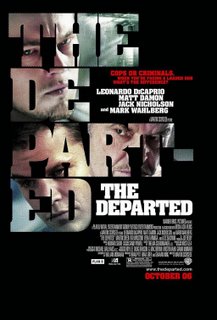
The Departed

Written at the time of the film's release...

Institutionalized Ball-Busting  
 
Call it the Scorsese Thesis: First a guy tells you what he's gonna tell ya, then Marty shows ya, then you're on your own. 
 
In the case of The Departed "the Guy" is Jack Nicholson's Frank Costello, a seedy Boston crime-lord from "some years ago." "I don't want to be a product of my environment," says the shadowy Frank (Scorsese's way of showing Frank as a younger man). "I want my environment to be a product of me."
 
Nicholson's Costello makes good on that promise on two fronts—in the scenario of The Departed, and the movie, itself.  Costello's control over his Boston turf (or, using the accent Martin Sheen employs here, "too-urf") is so absolute, his reach extends from his surly band of criminals to the police department, culminating in one of his own crew (Matt Damon) infiltrating the very task force investigating his activities. Simultaneously, the player on the other side, Captain Queenan (Sheen) has trolled the new recruits to find his own mole (Leonardo DiCaprio) to infiltrate Costello's crew. 
It turns into a complicated
Spy Vs. Spy with both moles straddling the moral fence, while completely unsure of their footing on either side. And while trying to rat out their suspected counter-part while not drawing attention to their own treacheries. They're mutually duplicitous. As Costello says in the Thesis: "When I was growing up, they would say you could become cops or criminals. But what I'm saying is this. When you're facing a loaded gun, what's the difference?"
It's a complicated game of
Jack's Straws...set in a house of mirrors. Drop Nicholson's weight into the middle of it, and the whole thing threatens to pancake...much like the movie. This first collaboration with Scorsese is similar to
Marlon Brando's eccentric performance in The Missouri Breaks, where an actor so drapes himself in business that he attracts the eye in the same way as a car-wreck—you wonder what in Hell this crime-clown (it is much like Nicholson's Joker in Batman without the make-up) is going to do next. Damon and DiCaprio were not clued into his on-set antics and so their scenes are played with the right touch of paranoid hesitancy. There's a strained wariness behind their eyes and they've rarely been better.
As good as they are (and excessive as Nicholson is) best among the cast is
Alec Baldwin as a fast-talking division head, but the real revelation here is Mark Wahlberg. Marky-Mark walks away with the picture and dominates every scene he is in, no matter who's in it with him. In fact, in the one scene Baldwin and Wahlberg share, Scorsese throws in a couple of Raging Bull camera moves for a verbal feint and parry between the two. It's a director's nod to two extraordinary actors doing solid work, free of gimmicks.
As for Scorsese, if you're looking for a return to his greatest efforts, this isn't it. It makes you wonder what he's up to. This story is nothing new, and is in fact based on a Chinese film (and its two sequels, actually) that owes more to the early personal style that he fails to deliver on here. What's the fascination? We've seen the cop/criminal discotomy, as well as the conflicts of working undercover in better films. He's doing program work, not personal work. This isn't Raging Bull or Mean Streets or KunDun or Goodfellas. This is Alice Doesn't Live Here Anymore. Or New York New York. Or The Aviator. One senses he's pacing himself, keeping his hand in the game doing agency "package" movies until the next inspiration comes along. Perhaps he should ditch DeCaprio, and find that last, good DeNiro project. He's too good a film-maker to waste on remakes and empty biographies. Maybe after the struggles he went through to bring his last personal project to the screen he's asking himself at this point in his career "What's the difference?"

Thursday, April 14, 2022

Everything Everywhere All at Once

The Cosmic Comedy
or
"It's Going To Be So Hard To Explain This To You!"
 
For the longest time, the IMDb description for it was "a woman tries to do her taxes." Not something to create a surge at the box office (although I found I couldn't get a seat in a theater for it this weekend).
 
Oh, Everything Everywhere All at Once is about that. But, it's a lot of other things, too.
 
The best way I can describe it is as a negative. Imagine the pitch to Michelle Yeoh: "So, Michelle (I can call you Michelle?)...what kinds of movies HAVEN'T you done? And do you want to do them all in one movie?"
 
That makes it a little bit easier to categorize it than by the seemingly infinite series of hyphenated genres I was coming up with by the end of the thing. Or, by the seemingly infinite number of references and "inside" jokes that permeate through it.
 
No, EEAAO* is it's own thing. Let's create a new genre: Dizzying.
Evelyn Wang (Yeoh) is having a crisis.  Well, okay, several crises in various stages of resolution. It's a mid-life crisis—she's a Chinese immigrant, caught between languages and cultures and married to a man, Waymond (
Ke Huy Quan and yes, he was Short Round), who is cheerily ineffectual, whom her father (James Hong) warned her not to marry. She has a daughter, Joy (Stephanie Hsu) who's adolescent and gay—not culturally...cultural. She helps run the family laundromat and they are late on their taxes and there are questionable deductions that are being spotted by the sharp-eyed, sharp-tongued Mrs. Deirdre Beaubeirdra** (Jamie Lee Curtis), who wants all the documentation by the end of the day. The laundromat had a water leak and it's stained one of the ceiling tiles, and her father—the one who disowned her?—has just moved over to the U.S. from China and is living with them, and Evelyn is planning a birthday celebration for him. Plus, she doesn't know...or hasn't noticed...that Waymond has just filed divorce papers.
 
Life happens, am I right?
And whatever doesn't kill you makes you stronger. But, instead of having a nervous breakdown, Evelyn has an intervention of sorts. At the headquarters of the IRS, a suddenly very focused Waymond tells her to put on some ear-buds that look like blue-tooth, and gives her a list of instructions to do if things go awry. And while listening to her auditor drone on and on about documentation and receipts, Evelyn suddenly has her attention pulled away...that blue-tooth thingy beeps and, soon, following those written instructions, her attention isn't alone.
As any nerd will tell you, there is a multiverse of possibilities created every time we make a decision in our lives, and Evelyn has been visited by the Waymond of the Alpha Universe to implore her help in a desperate crisis. The Alpha-Evelyn of that Universe is dead, having developed a technology that allows jumping between universes and employing the skills of other similar entities in alternate realities. In other words, Evelyn can download the skills and experiences of those other Universe-Evelyn's in order to defeat the purposes of an entity called Jobu Tupacki.
Why isn't the Alpha-Evelyn doing this? She's dead because she jumped Universes so much her brain fried. Why is this Evelyn being tasked with it? Because of all the Evelyn's in all the Universes, she is the biggest failure, and so her potential is much bigger and she's in less danger of having her brain crisped. So, with the help of Alpha-central and the control room that is feeding her instructions and coordinates—all while they are being attacked by this Jobu Topacki, by the way—she is able to tap into this seemingly infinite number of Evelyns and their skills and experiences.
And they are legion—there's the Evelyn who is a master of martial arts (and a separate one who has learned the mastery of "pinky-fu"), the Evelyn who's an expert at sign-twirling, the master chef, the singer, the actress, the dominatrix, all the Evelyns that have ever been, in all walks of life and forms and sexual orientations, all available to be used, perused and abused, depending on what's available and whether she can perform the actions necessary to receive them. All in the service of circumventing the all-powerful Jobu Topacki.
And the film-makers, Dan Kwan and Daniel Scheinert (call them "Daniels") have a seemingly endless supply of ideas and references to call upon, be it "The Twilight Zone" and Brainstorm and The Matrix and The Wizard of Oz, the malleability of Charlie Kaufman, and the anything-goes zen of "The Hitchhiker's Guide to the Galaxy", the movies of Stanley Kubrick and Wong Kar Wei, Disney/Pixar cartoons, horror movies, teen angst meltdowns, Amy Tan, martial arts, pop-culture, even Japanese porn, in a story that boils down to a domestic drama where the stakes are literally life and death. All done as a comedy; I haven't giggled so much in a movie in years.
Nor have I been as thrilled with the inventiveness of cinema at the hands of film-makers who never let go of the fact that they can do absolutely anything to tell a story. In a way, they have spoiled the multiverse pool for everybody else using the concept for the rest of time. It may even become its own genre after this.
The cast, of course, is perfect. Michelle Yeoh has always been a deft performer, only held back by the reticence of her characters who express themselves more in action. Here, she has a chance to do everything, titularly, and she is amazing, conspiring with film-makers who have  built a love-letter to a performer who has always been superb, but rarely allowed to stretch things to show just how superb she can be (Jackie Chan was the original choice to star and the film-makers sagely changed tacks to create a film of more depth).
Quan is a revelation, utilizing his child-star enthusiasm with a more mature presentation, but still keeping that playfulness and total commitment. Stephanie Hsu is a genuine find and traverses seamless transitions from drama to comedy and back with the mastery of an old pro. Speaking of whom, James Hong is here—it is always a pleasure to see him—and, having done literally everything in his 78 year career, this is a welcome opportunity to see a master, still in his prime at 93. Then there's Jamie Lee Curtis, giving a comedic performance (that at times allows her to show her inner "Jason") that is sometimes horrific, sometimes buffoonish, always funny, and always recognizably human. She's a treasure. They all are.
It's a tough movie to sum up, or even let go of, to put "30" to it and not have it careening through your head, assaulting your synapses and simultaneously tickling and tugging your heart, but I think the best to do so is in this distillation of its after-glow penned by Jake Coyle of The Chicago Sun-Times: "And though Everything Everywhere All at Once (a movie that very much lives up to its title) can verge on overload, it’s this liberating sense of limitless possibility that the movie leaves you filled with, both in its freewheeling anything-goes playfulness and in its surprisingly tender portrait of existential despair."

 
*Now, that I think about it—they didn't make a joke about "Old McDonald's Farm" in it. Maybe they did. I may have to see it a fifth time before I catch it.
 
** And I just realized while typing that that it's a reference to the song, "The Name Game"--this movie is DEEEP.