Showing posts with label Oscar-Winner. Show all posts

Wednesday, April 19, 2023

La Vie En Rose

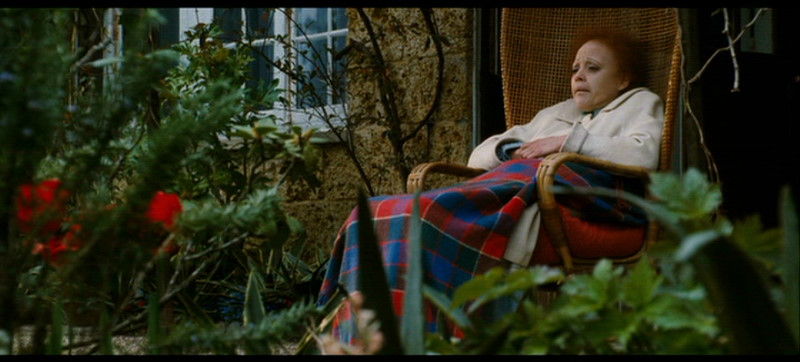
La Vie En Rose (aka La Môme) (Olivier Dahan, 2007) Sentimentality is a funny thing. The world over, people wept for France's "little sparrow" Edith Piaf and the brief life that was snuffed out too soon. 

That she was the instrument of her own demise made no difference. That she started out as a street urchin, singing for her drinks and drugs, was discovered and "cleaned up" for public consumption but never lost the grime of the street from her soul, went through love and loss, then disappeared into a fog of drugs that left her a shell of what she once was, didn't matter. 
 
Driven by ego and the need for acceptance—from an audience she now had contempt for—she continued to perform, collapsing on-stage frequently, and still had the temerity to sing, as her last signature piece, "I Have no Regrets."
Swell. As I said, sentimentality is a funny thing. Watching Dahan's "La Môme," (or La Vie en Rose in this country) K muttered: "...France's Judy Garland." Yes, but I don't think Garland was so ferociously unempathetic. Piaf wore her street-toughness like armor and treated those who tried to manage her...with disdain. They must have really loved her to keep working for her, to the point of self-delusion, to the detriment of their own worth.
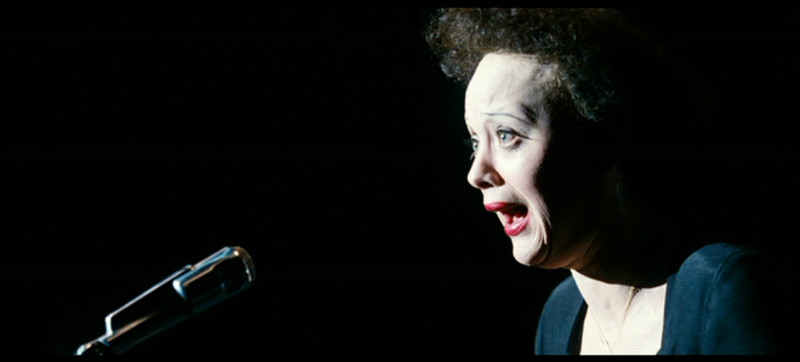
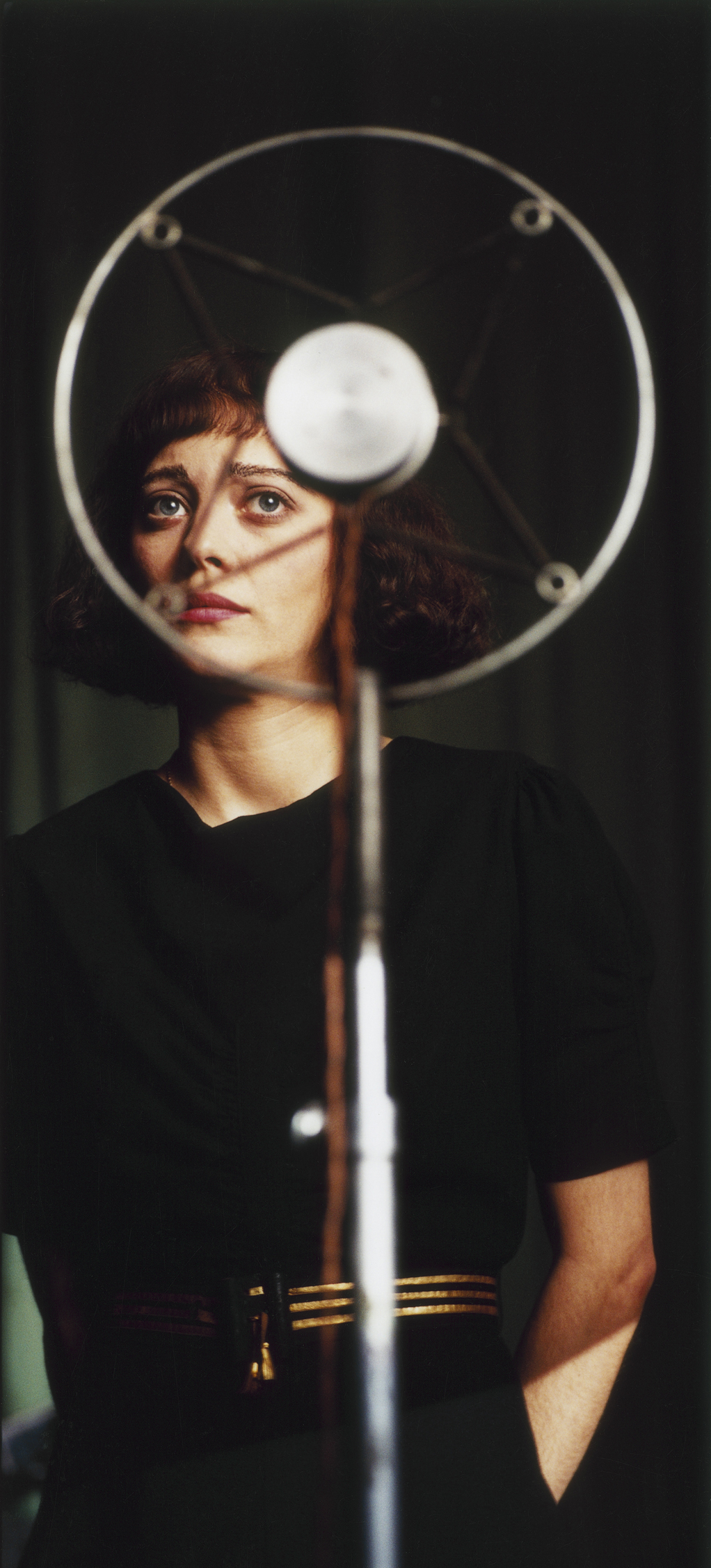
Not very sympathetic thoughts for a celebration of "the little sparrow." But, Dahan made a tough-minded film that still manages to eke out sympathy for its hard-bitten subject. And there are moments of visionary work: I'm thinking of the sequence of Piaf's formal "debut"—with new wardrobe, new presentation, new hand gestures and a hard-taught respect for a song's text—all done in fading montage and a burgeoning score. But Piaf is silent (a practical consideration, as there are no recordings of her during that period). It's a controversial, contrarian move, but all the more powerful because of it.
It showcases Piaf as presentation, and the point could not have been made more forcefully had a singing voice been dubbed in. A lot rides on
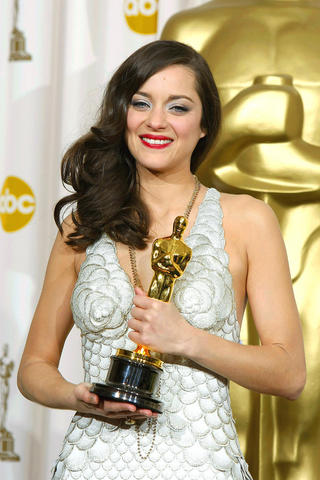
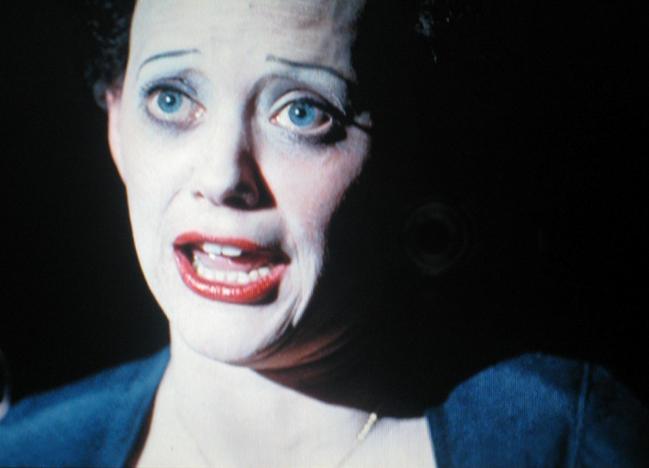
Marion Cotillard's performance of that scene, and she is never less than stubbornly brilliant in the film, brushing away easy sympathy for the character, and conveying her power brutishly. The film also won an Oscar for its intricate make-up work, but Cotillard works far beyond its confines to convey the ravages that life, but mostly Piaf's stubbornness, heaped upon her shoulders.
When Piaf died, I was in grade school and the teacher brought in her records to play for us what the world had lost. Most of us listened attentively, though not comprehending what this had to do with the price of tea in China (as if we cared about that, either!). But a bunch of the kids hid giggles behind hands and snorted at the quavering tones and incomprehensible language. As that old memory came bubbling up, I couldn't help thinking Piaf would be on the side of the urchins and not the sparrows.
C'est la vie.

Tuesday, September 20, 2022

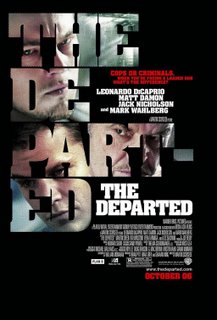
The Departed

Written at the time of the film's release...

Institutionalized Ball-Busting  
 
Call it the Scorsese Thesis: First a guy tells you what he's gonna tell ya, then Marty shows ya, then you're on your own. 
 
In the case of The Departed "the Guy" is Jack Nicholson's Frank Costello, a seedy Boston crime-lord from "some years ago." "I don't want to be a product of my environment," says the shadowy Frank (Scorsese's way of showing Frank as a younger man). "I want my environment to be a product of me."
 
Nicholson's Costello makes good on that promise on two fronts—in the scenario of The Departed, and the movie, itself.  Costello's control over his Boston turf (or, using the accent Martin Sheen employs here, "too-urf") is so absolute, his reach extends from his surly band of criminals to the police department, culminating in one of his own crew (Matt Damon) infiltrating the very task force investigating his activities. Simultaneously, the player on the other side, Captain Queenan (Sheen) has trolled the new recruits to find his own mole (Leonardo DiCaprio) to infiltrate Costello's crew. 
It turns into a complicated
Spy Vs. Spy with both moles straddling the moral fence, while completely unsure of their footing on either side. And while trying to rat out their suspected counter-part while not drawing attention to their own treacheries. They're mutually duplicitous. As Costello says in the Thesis: "When I was growing up, they would say you could become cops or criminals. But what I'm saying is this. When you're facing a loaded gun, what's the difference?"
It's a complicated game of
Jack's Straws...set in a house of mirrors. Drop Nicholson's weight into the middle of it, and the whole thing threatens to pancake...much like the movie. This first collaboration with Scorsese is similar to
Marlon Brando's eccentric performance in The Missouri Breaks, where an actor so drapes himself in business that he attracts the eye in the same way as a car-wreck—you wonder what in Hell this crime-clown (it is much like Nicholson's Joker in Batman without the make-up) is going to do next. Damon and DiCaprio were not clued into his on-set antics and so their scenes are played with the right touch of paranoid hesitancy. There's a strained wariness behind their eyes and they've rarely been better.
As good as they are (and excessive as Nicholson is) best among the cast is
Alec Baldwin as a fast-talking division head, but the real revelation here is Mark Wahlberg. Marky-Mark walks away with the picture and dominates every scene he is in, no matter who's in it with him. In fact, in the one scene Baldwin and Wahlberg share, Scorsese throws in a couple of Raging Bull camera moves for a verbal feint and parry between the two. It's a director's nod to two extraordinary actors doing solid work, free of gimmicks.
As for Scorsese, if you're looking for a return to his greatest efforts, this isn't it. It makes you wonder what he's up to. This story is nothing new, and is in fact based on a Chinese film (and its two sequels, actually) that owes more to the early personal style that he fails to deliver on here. What's the fascination? We've seen the cop/criminal discotomy, as well as the conflicts of working undercover in better films. He's doing program work, not personal work. This isn't Raging Bull or Mean Streets or KunDun or Goodfellas. This is Alice Doesn't Live Here Anymore. Or New York New York. Or The Aviator. One senses he's pacing himself, keeping his hand in the game doing agency "package" movies until the next inspiration comes along. Perhaps he should ditch DeCaprio, and find that last, good DeNiro project. He's too good a film-maker to waste on remakes and empty biographies. Maybe after the struggles he went through to bring his last personal project to the screen he's asking himself at this point in his career "What's the difference?"

Thursday, September 8, 2022

The Queen

Sometimes, what I haven't posted is more surprising to me than what I have. Today's case in point: this amazing film by Stephen Frears with an arch script by Peter Morgan and a terrific cast. The Queen is dead, two days after bringing in a new Prime Minister—her 15th (the first being Churchill) and a short time after celebrating her 70th year on the throne. After years of short-reigned British royalty, Elizabeth II gave a reassuring continuity to a nation going through post-imperial crises, and she managed to walk the edge of being Her Majesty and, contradictorily, Public Servant. Self-sacrifice and Privilege rarely go hand-in-hand, but she did it, and did it well.

Written at the time of the film's release.  Re-published on The Queen's.
 
Sir Paul McCartney
 
And another Beatles quote might be appropriate here, as well. George Harrison's horrified appraisal of Beatlemania: "We gave them an excuse to go mad." Surely that's how
the Royals must have felt seeing the outpouring of grief generated by the death of former Princess Diana over the week that this smart bitchy little film covers. The tone and volume of the crowds that surrounded Buckingham Palace, fueled by the predatory tabloids, approached hysteria and went well past the accepted levels of decorum practiced by its inhabitants. Flying the flag at half-mast for Diana? They hadn't even done it for the death of the King! The idea! There's a telling line QEII says in bewilderment: "But she isn't even an H.R.H.!"—a lovely combination of formality and informality within the Royal Family. But the film has its own opening quote, from Shakespeare--the one half-mocked by Jack Nicholson in The Departed--"Uneasy lies the head...etc, etc." But, in this day and age it can be asked, "Who wears the crown?" 
Is it the Queen, cosseted in formal procedure and pomp, restricted in her powers and budgeted by the government (the first scene of the movie has an arch little discussion between her and a portrait artist regarding democracy and the in-coming Labor party of Tony Blair. "You might not be allowed to vote, ma'am,* but it is your government." "Yes...it is," she replies, smiling at the constancy)? Is it the fledgling Prime Minister Tony Blair (Michael Sheen) who must bow and scrape to the Queen, but who uses whatever power he has to influence her actions? Is it Blair's eager-beaver, though cynical, staff, micro-managing and creating press-releases and agendas that sometimes frustrate, while bolstering the image of, the new PM? The Queen's consort, Prince Phillip, blusters about what is proper and how he'd do things (assuming he was in charge), and son Charles, dithering and deferential (there's a lovely moment as Charles enters a room where James Cromwell, playing Phillip--pointedly crosses his arms without even acknowledging that he knows his son is in the room), tries to sway the Queen emotionally and by proxies. Or is it the rabble with their devastated faces and the endless supply of flowers that becomes a memorial and a substitute for any public display from official sources? 
Then there is the late Princess herself, seen only in vintage news footage, at times clowning, at times vulnerable...and at times, with a look like she's viewing the proceeding with a knowing satisfaction.
 
One wonders how the Royals themselves would see this film
**...no doubt, as an affront to be taken in stoic, stony silence. Yet, one can understand their actions, and even have some sympathy for their dilemma, while also wanting to shake some sense into them.
The Queen is a fine, gossipy movie, with a literate script***(whether any of the things depicted behind closed draw-bridges is anyone's guess) by Peter Morgan—he also wrote last year's The Last King of Scotland, top-of-the-line performances led by Helen Mirren (who has the canny knowledge to know she's playing two roles: Elizabeth and an eerie "Elizabeth-as-Monarch," and, yes, she'll win the Oscar for Best Actress)**** and a direction by Stephen Frears that's smart and canny. The last shot is the most telling. Frears leaves us with an image of the Queen walking in her immaculate formal garden--her unruly Pomeranian dogs jumping and bouncing and using the facilities while Elizabeth pays no mind to the chaos.
Long Live the Queen.


* And make sure you pronounce that correctly. We're told that it is "Ma'am" as in "ham," not as in "harm." One of the conceits of the film is to show the "accepted" ways to present oneself to the Queen--always a prescribed way, no more and no less--surely a main reason for the atrophy the Windsors displayed in not responding to the public's reaction.
 
**I read somewhere in the Golden Globes coverage this morning that the Queen told Mirren "someone finally got (playing her) right."

***There's a funny scene where Blair, flush with his efforts to influence the situation starts to push for his own agenda. Elizabeth will have none of it, and warns her PM not to be too complacent for his crisis will come when he least expects it. It took every ounce of restraint to keep from yelling "Yo, Blair!" at the screen.

**** She did.


Post-script 02/07/07: Slate has quite an informative interview with director Stephen Frears

Friday, February 7, 2020

The Deer Hunter

The Deer Hunter (Michael Cimino, 1978) The Oscars are coming up and, with it, so many posts on Social Media about what "The Oscars Got Wrong." We all have our opinions, and mine is just as valuable (or worthless, in my mind) as anybody else's whose wasting their time reliving the past in an alternate universe where THEIR movie (well, not theirs, but their PREFERRED movie) might have taken home the Oscar for Best Picture—as if that were the arbiter of value. Time is the more deciding factor, away from the campaigning, the parties and the pressures of voting.*

After so many years since its release, and so much acclaim (including winning the 1979 Best Picture Oscar**) as an acknowledged "classic," The Deer Hunter does not seem to have the sustaining power that a classic should have. When it aired on television, it aired reverently uncut and "without commercial interruption"—a sign of "respect" from the tube-jockeys (but it could also indicate a lack of sponsor-spine enough to commit) and as much as I "enjoyed" the film when it came out, finding it "deep" and "meaningful" when I first saw it in theaters, I still have to ask, though, "What in the Hell is it trying to say?"

Or is it actually trying to say anything?
The story of five working class guys from Pittsburgh, and their rituals—marriage, hunting, country—becomes shattered when three of them enlist to go fight in Vietnam and find themselves (in a highly unlikely but dramatically convenient scenario) all prisoners of war in the same North Vietnamese prison camp, where ritualized torture by a daily game of Russian roulette among the prisoners is the order of the day, while their captors bet on the survivor. It's a rather stupid way of torturing your prisoners—giving them a loaded weapon, after all—and it eventually does become a means of escape back to America, where, when they return, nothing is the same, and despite the heroic efforts of one of them (Robert De Niro), things can't go back to the way they were.
Okay. It's a movie "in the tradition" of The Best Years of Our Lives—another "Best Picture"-winner—but, where William Wyler's film takes a real look at the issues facing the returning soldier at the end of World War II—unemployment, disability, PTSD, the lack of discipline and rigor in American life—The Deer Hunter merely takes on the attitude of "that's the way it goes..." and goes ritually, as everybody else gets on with the day-to-day, damaged (as the country was damaged).
The reason might be in its origins; where Wyler was determined to tell a story about returning soldiers and the crises they faced, Vietnam didn't even figure into the screenplay the way it was first envisioned. It started out as a story ("The Man Who Came to Play") about four guys going to Vegas and participating in a game of Russian Roulette. That was the original treatment. Once Michael Cimino and scenarist Deric Washburn got hold of it, it became a treatise on comradeship (and exclusively male comradeship one should point out), war, and self-destruction. 
And patriotism. Or...something. And, again, I think it has something to do with how ritual sustains us and numbs us, simultaneously. But, the screenplay went through so many revisions—and was basically re-written on-set—it's hard to say if anything about it had a solid structure or philosophy. At one point, Cimino wanted to cut out the Russian roulette aspect of it (until he was begged not to by one of the original scenarists). And characters were switched around. Originally, it was the pragmatic Mike—the De Niro character—who stayed in Vietnam, endlessly playing Russian roulette (which makes sense given it was his mental will power and tenacity that got the others through the ritualized torture, and his philosophy of "one shot" would seem to be the mantra of the man for whom hunting was a personal test).
The film, as it stands, focuses on a trio of Pennsylvania steelworkers—Mike Vronsky (De Niro), Nick Chevotarevich (Christopher Walken) and Steven Pushkov (John Savage)—and their friends Stan (John Cazale), Axel (non-actor Chuck Aspegren, a steelworker who'd befriended De Niro and Walken) and John (George Dzundza), who runs a local bar. Mike, Nick, and Steven are all going into the military, but before they do, they have two big events to attend: the marriage of Steven to Angela (Rutanya Alda) and one last weekend hunting trip. During the wedding it is established that both Mike and Nick love the same woman, Linda (Meryl Streep), but at the wedding Nick asks her to marry him when he gets home. Also, Nick promises Mike to bring him back home if something happens to him in Vietnam. 
During the hunting trip (Steven does not attend due to his honeymoon), Mike and Nick leave the others behind—Mike is annoyed that Stan and Axel are unprepared and a little drunk—to hunt a deer. Mike has rules: it is his intention to take down a stag with one shot. If he can't, it shows a lack of discipline and intent and he tells Nick that he is the only one of the party who would understand that and so is the only one he will go hunting with. Mike manages to take down a buck and the group drive into town, triumphant.
In Vietnam, Mike, Nick and Steven are captured by the North Vietnamese and thrown in a river prison camp. During the day, they are taken out by their captors and, for their amusement, made to play Russian Roulette. Steven is very nearly killed and Mike, with Nick, fearing that Steven has had a complete breakdown, decide they will use the torture as a means to escape. They increase the betting odds by convincing the NVN of putting three bullets in the gaming pistol. And, once the odds of getting a live chamber on the first fire are good, Mike turns the pistol on his captors and the three make their escape.
The three are separated: Steven with two broken legs from the escape attempt is sent to hospital, Nick is having trouble coping with the stress and one night is seen by Mike at a gambling den where Russian roulette is played. Mike finally gets home, avoids a welcome home party and is told the next day by Linda that Nick has gone AWOL. Steven is in a local VA hospital, a paraplegic, his wife is catatonic. Mike visits Steven and insists he go home and is also told that Steven is being sent money from Saigon. Being the benefactor to be Nick, Mike travels back to Vietnam to find his friend and fulfill his promise.
The performances in this 3 hour film are strong, despite the thin material. De Niro's performance is magnetic, despite being ultimately unknowable, Walken's is heart-breaking, Streep's performance, in a role that was underwritten and that she ultimately had to fill in herself, is strong, and Dzundza's (in his first film performance of any consequence) is full of heart and verve. It is John Cazale's last film performance before his death and another bold depiction of weakness. If the performances in the film are strong, so, too, are the cinematography of Vilmos Zsigmond, and the detailed editing by Peter Zinner (with an uncredited assist from the rigorous Verna Fields).

Those aspects, and the time in which the film was released (1978, three years after the war officially ended) allowed it to "play" to American audiences, providing a catharsis for the soul-splitting war that had deeply affected the country, with its emphasis less on the war, but its aftermath, something not seen in previous Vietnam-themed films that year, like Go Tell the Spartans and The Boys in Company C and far afield of earlier films like The Green Berets, and without the political baggage of Coming Home, which followed it in theaters. Most Americans could not relate to what was going on in the war, wanted to avoid it (and Hollywood was economically leery of depicting it), and by centering it in the homeland, allowed it to touch hearts, as we all relate to weddings and funerals...and less to jungle-warfare.
And we relate to patriotism. Although, I think the film's coda, with an awkward end-singing of "God Bless America"—although it may seem to mean something—is just as significant as the sing-along to "Can't Take My Eyes Off of You." 

And I mean that. It's not the subject of the song so much as the group-think that goes along with the blending of voices. We've seen a fracturing...of the country...of friendships...of marriages...of lives. But we can still come together...if only with platitudes. And easy touchstones. It's comfort. It's expected. It's ritual.
But, does it mean anything? Perhaps Cimino attempts to give us the answer when he has Michael say to Stan: "This is this." Take it for what it is. It doesn't have to mean anything. It simply is. But...that's not good enough.  
So, okay, then. Forty years (Good Lord!) after the fact. The Deer Hunter. Beautifully shot. Beautifully acted. But ultimately hollow. Stare at the trappings all you like. Heap on your belief-systems and your graspings for significance, like the many awards it garnered, until that is what it is known for. But, "this is this" says nothing—The Deer Hunter is as desperate in searching for meaning as the times in which it was made...and comes up missing the mark.

It isn't so much vogue as vague; it is non-communication posing as artistry. 
"One Shot..."


* Believe me, there is pressure—I used to vote for the Emmy's and the deluge of material (that I felt duty-bound to watch) and the voting by deadline was a headache. Plus, you'd look at the list of nominees and sometimes say to yourself "I didn't like any of those!" And you'd have to vote. Eventually, I just got sick of it and stopped doing it.

** In those days when the Best Picture category was relegated to only five nominees The Deer Hunter competed against Coming Home, Midnight Express, Heaven Can Wait, and An Unmarried Woman. Other films nominated that year—but not for Best Picture—included Superman, Interiors, Days of Heaven, The Wiz, The Boys from Brazil, Grease, California Suite and The Buddy Holly Story. Other films released included National Lampoon's Animal House, Comes a Horseman, Jaws 2, Capricorn One, Billy Wilder's Fedora, Robert Altman's A Wedding, Every Which Way But Loose, and the original Halloween.

Tuesday, August 28, 2018

Olde Review: Closely Watched Trains

This was part of a series of reviews of the ASUW Film series back in the '70's. Except for some punctuation, I haven't changed anything from the way it was presented, giving the snarky, clueless kid I was back in the '70's a break. Any stray thoughts and updates I've included with the inevitable asterisked post-scripts.


This Friday's films in 130 Kane Hall at 7:30pm are Closely Watched Trains and Lacombe, Lucien.

Closely Watched Trains aka "Ostre sledované vlaky" (Jirí Menzel, 1966) Closely Watched Trains is a wry, sometimes hysterical Czech film by Jiri Menzel, a person you've probably never heard of and have already forgotten.* It tells the story of Miloš Hrma, an insignificant young man in the scope of WWII, whose father was retired at 48 and now spends his day lying around and keeping track of the comings and goings of the train. Another relative was a hypnotist and a couple years back, he tried his skills on an advancing Nazi tanke-gruppe and was promptly crushed to a pulp (I am telling you this because there is no way in Hell that you'll be able to read the sub-titles in the opening minutes).** These are only two examples of Menzel's comedy-of-errors style of telling his story.

Menzel takes little incidents of the story of Miloš's work-a-day situation standing at the train platform—a job he wanted "just so he could strut on the platform." And his stories are sometimes hilariously satirical (for an example, there is an hysterical look at a town Nazi explaining the war situation and in a blase manner explaining that withdrawals from the American forces are such wonderful tactical maneuvers). Sometimes (most of the time), the stories are very ribald; one of the sub-plots is Miloš's constant failure with women, which, in context with the habits of a fellow platform-strutter, makes him turn to a suicide attempt in a dilapidated hotel. The hotel is being worked over by a fellow with a pile-driver. In this scene what is going to happen—how the two will intersect—is very apparent, but the sequence's effect is that it displaces the humor of the situation (which passed with the audience's first realization of what, inevitably, will happen) with suspense. Will it happen before Miloš is dead? It's an effective sequence because it anticipates viewer reaction and changes it to the further effect of the film.
In the last half-hour, Miloš is used like a pawn in a chess game in an attempt to head off a Nazi munitions train. It's outcome is consistent with the rest of the film, but there is no sense of real tragedy at the end, more an explosion of fulfillment. You may find Closely Watched Trains a very entertaining film.
Just a reminder (he said, slapping his forehead with his palm) I wrote this back in February 1977, and, although sorely tempted, I didn't change anything besides punctuation (and had to get fairly creative with that!). Closely Watched Trains won the Oscar for Best Foreign Film in 1968, and is one of three films I remember most fondly from the Winter ASUW series—the other two being Hari-Kiri and Il Posto—Trains probably because it's crack comic timing reminded me of my beloved Warner Brothers cartoons, with a dash (a mad dash!) of Buster Keaton thrown in for good measure. And the comedy came from character, not from out of the blue.
This review is more than thirty years old, but it's heartening—in fact, a bit miraculous—that Jiri Menzel is still making movies, his last being I Served the King of England, which was also about young professionals learning their craft to uproarious results.


* This was near the end of the series and I was getting a bit punchy by this time, but that's no excuse for insulting the audience that one is trying to "encourage" to go see a film.

** As I recall they were "white-on-white" and virtually indecipherable. Criterion has put out the DVD of Closely Watched Trains and they're more scrupulous in their translations and making sure that they're legible. Criterion is a great DVD publisher.


Friday, November 4, 2016

All the King's Men (1948)

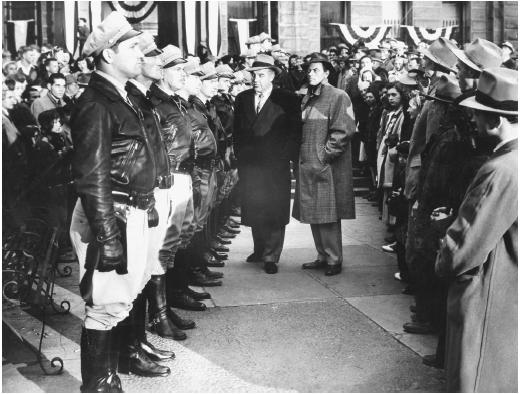
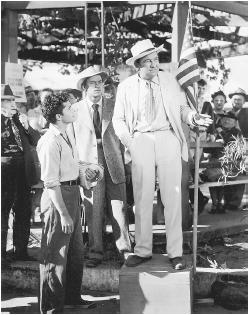
All the King's Men (Robert Rossen, 1948) The Oscar-winner for Best Picture of 1949 and it's hard to argue. Rossen's adaptation of Robert Penn Warren's Pulitzer Prize-winning novel about the corrupting powers of politics, it boasts two powerful (and Oscar-winning) performances: Broderick Crawford as innocent-turned-player Willie Stark (an amalgam of several politicians—as the corruption of power is a fairly universal theme in both the arts and reality—but mostly resembling Huey Long) and Mercedes McCambridge as his cynical-to-the-marrow political assistant.  

McCambridge is so good and so inventive that she might just as well have been given the statue for the next five years. Would that the other performances have been as electric as these two, but one could say that they shine even more brightly next to the lesser lights. 
It's particularly interesting to see Crawford so restrained at the beginning of the film, but once he sees how the game is played he turns on the after-burners and soars over everybody else in the frame with him. Mention should be made of the occasional glimpses of a documentary style in the rally scenes amid the more traditionally blocked studio framing. 
And an interesting stylistic note: the film may seem a bit abrupt in places--but that's because Rossen, determined to get the film below two hours, gave his editor instructions to take most of the scenes and cut precisely thirty seconds from the front of them and thirty seconds from the back (making sure not to clip off any dialogue). What was left was the hard nugget of the scene's core and All the King's Men feels more brutal in its pace and attitude because of this uncompromising strategy. It is a must-see film that shows the dichotomy of the American political system—of appealing to the little guy while also seeking power enough to be able to stand on their necks.
The film was re-made in 2006, with a mind to including the parts that couldn't be utilized in Warren's novel in the more repressed times when the original was made, but ended up looking bloated and shrill. The more soapish aspects of the novel were eliminated from the adaptation of the first film and it has the unanticipated benefit of focusing the film on its larger theme of political corruption and less on human corruption, and, as a result, gives the film a harder, more dangerous edge. Rossen's work is so much more assured and vibrant.

Friday, April 29, 2016

Hamlet (1948)

Hamlet (Laurence Olivier, 1948)

This is the story of a man who could not make up his mind" intones
Laurence Olivier at the beginning of his Production of Hamlet (In a case of over-reach, the man who would be Lord Olivier gets the opening card over Wm. Shakespeare).

Well, yes, that's an easy way to look at it. And while it's essentially true, it negates the fact that Hamlet is struggling with the moral implications of killing, especially since the object of all the daggers he's throwing out with his eyes is, himself, a murderer, traitor, and is sleeping with his mother.* Hamlet tries every trick in the book to expose the treachery, even takes a stab at killing him himself (with collateral damage**) Hamlet is wrestling with his conscience the whole way--while depressed, grieving--and with not good reason: his quest is based on the flimsiest of evidence--the word of a ghost. A ghost that even his
Spock-like friend Horatio saw, to be sure (or not to be), but a ghost nonetheless. Such evidence would never stand up in the Court of Elsinore. The Dark Prince must also wrestle with the consequences of his actions--from his father he knows of the existence of Hell and the damnation murderous actions would lead to.

"Couldn't make up his mind." He wanted to slit the King's throat, not his own.

Every production of "Hamlet" must wrestle with the text *** that ballooned with many versions, asides, and blind alleys. Olivier stripped it bare: No Rosencrantz, no Guildenstern, no Fortinbras, no battle on the plain in Denmark and so, no "Let my thoughts be bloody" speech. In this version, Hamlet does not compare his plight with the futility of war, and in 1948, considering Olivier's "rally-the-troops" version of Henry V, an anti-war statement must have seemed in bad taste, after surviving the blitzkrieg.

And just as every Hamlet must pick and choose what sections to explore, every actor playing Hamlet must contend with ghosts;
**** not the play's, but the players of the past. Like baseball veterans chasing old records, each Hamlet is a reflection of the past, and a portent to other Princes. The current crop of actors taking on the role must have considered Olivier's take, or Richard Burton's, or Nicol Williamson's, just as Olivier must have thought about John's Gielgud and Barrymore. Olivier does take chances given the film medium. His "Frailty, the name is woman" speech is done in voice-over with some choice epithets that burst out of him on-set. That's a good choice for the scene, where Hamlet is in a public space following a celebration and could conceivably be overheard by some hanger's-on. He is much more verbal in his further monologues when he is thought to be crazy, or alone. The "To Be or Not To Be" speech is performed on a parapet overlooking the sea, with dagger in hand. It's a good concept to have the prince "on-edge" at that juncture.

The unique staging of that speech is one of those elements that absolutely separate the filmed Hamlets from each other.***** To me, there are three others: the presentation of the Ghost of the murdered Old Hamlet, the use of Polonius, and the approach to Ophelia. Here's how Olivier treats them.The Ghost: Olivier wraps him in vapors of the real and optical variety, dressed in his battle armor, looking sepulchral, and emaciated, like a classic death figure, with a low-whispered voice--supplied by Olivier (although Gielgud is rumored to be speaking the lines) and played back slowly.
Polonius: As played by Felix Aylmer, and directed by Olivier, Polonius is a comic figure, whose verbosity is played for laughs, and most treat him with a feigned patience, and wish he'd get to the point.
Ophelia: As played by the 18-year old Jean Simmons, Ophelia is very much the traditional Ophelia as delicate flower. She goes crazy with the loss of Hamlet, the death of her father, and no Laertes to bolster her. She is an Ophelia too frail to stand on her own and crushed by the whirl of events, and her cracked sanity is portrayed by a far-away gaze and "fairy-princess" demeanor. How influenced she is by Hamlet's shifting moods is hard to say. But she is "ingenue-as-victim" in the Hollywood tradition.

The other thing I hear about Olivier's Hamlet is that it is somehow a "film noir" interpretation of the play. Except for some fine deep-focus black and white photography, I don't see it. No play of shadows--in fact, everyone is extremely well-lit. And the movie's very set-bound; nobody's walking down the "mean streets" of Elsinore.

Laurence Olivier's Hamlet won the Best Picture Oscar in 1948, with Olivier winning Best Performance by an Actor. He was the first person to ever direct himself to an Oscar-winning performance. Only one other actor has done it: Roberto Benigni.


* Gertrude. One of the interesting things to note about the various "Hamlet's" is the varying ages between mothers and sons. They're starting to get it right, but it wasn't always thus: In the 1990 Hamlet, Gertrude (Glenn Close) is only nine years older than Hamlet (Mel Gibson). In this one, Gertrude (Eileen Herlie) is fourteen years younger than Hamlet (Olivier)! I guess it's an improvement when your realize in the original stagings Gertrude was probably played by a man! And incidentally, Herlie also played Gertrude to Richard Burton's Hamlet--he was five years younger.

** I've always called "Polonius," the verbose father of Laertes and Ophelia, "Collateralous."

***Unless you're Kenneth Branagh, whose 1996 all-star "Hamlet" used the second Quatro version (1604) (with additions from the First Folio version), clocked in at 4 hrs., 2 mins., was filmed in 70mm, with 6 track Dolby sound, but at least had Rosencrantz, Guildensterm, Fortinbras, the "Let my thoughts be bloody" speech, and had a Gertrude who could have conceivably (heh) been Hamlet's mother!


**** There are other ghosts at Elsinore if one is to believe Olivier's camera-work. Elsinore is an enclosed castle with labyrinthine corridors and vast open emoting spaces. Between acts, we flit down corridors and up spiraling staircases as if the audition is, itself, an apparition, seeing everything in turn with an omniscient view-point. And in a reversal of stage tradition, we go to the actors, rather than them coming to us.

***** Most actors address the audience on-stage. Mel Gibson's Hamlet performs it in a burial catacombs, Kenneth Branagh, while looking in a mirror, and Ethan Hawke...at the video store.