Showing posts with label Julia Roberts. Show all posts

Wednesday, January 17, 2024

Mirror, Mirror

Don't Trust Anyone Over Four Feet
or
"No, Snow!  Don't Mess with Traditional Story-Telling!  It's Been Focus-Grouped, and It Works!!"

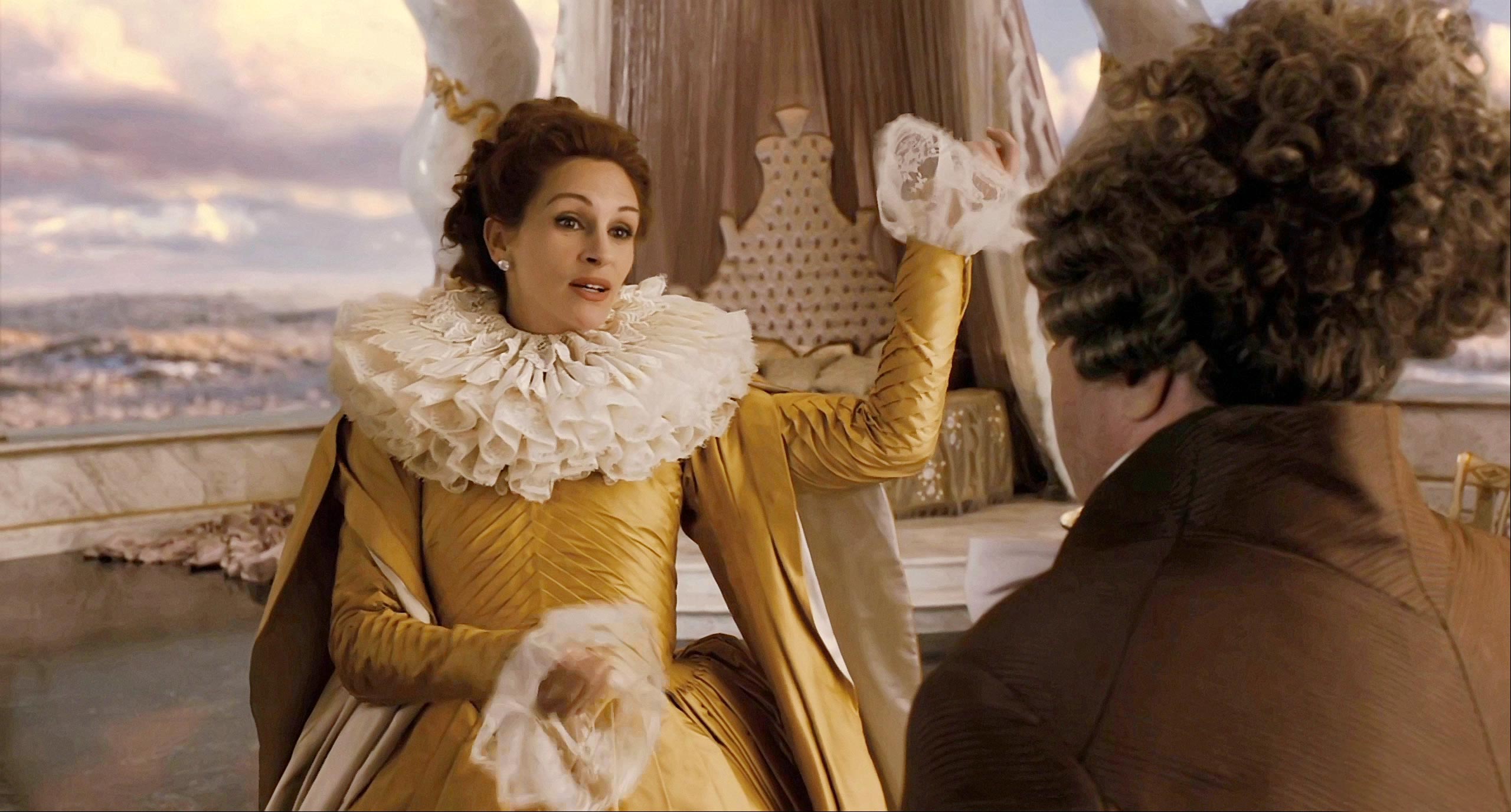
I approached Mirror Mirror with some trepidation. It's the sort of movie that curdles my gray matter—taking a traditional fairy-tale and updating it for modern audiences, with anachronisms, modern slang and catch-phrases, a fractured fairy-tale denying its origins and playing "hip." Also, it's a Julia Roberts vehicle and I don't "buy" Roberts in anything but comedic roles (which this one is).

But the other choice was to see Wrath of the Titans, for which I had no desire (Really? They're trying to make a franchise out of that one?) and so it was the "Snow White" knock-off, even though the prospect seemed rather Grimm.
It did have one thing going for it, however. Even though produced by Brett Ratner, it was being directed by an inspired choice—Tarsem, who vaulted from R.E.M. music videos to
The Cell
,* then rebounded with a fine film no one bothered to see, The Fall. I'd passed on his Immortals last year (though I plan to watch it on video sometime soon, now that it's out), but, as Tarsem can do some visionary work, he just might be able to pull it off.
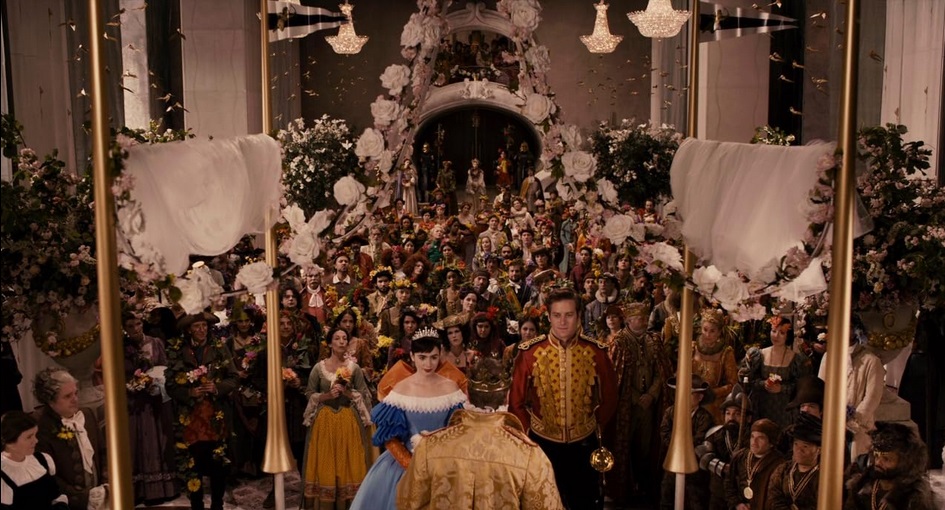
It might well have been lame in any other hands, but the director's spectacular design sense, not only for sets and costumes, but also how to frame them for maximum effect is combined with a breezy comedy style that is never idle, and never hangs for a laugh, so that not only is the frame full, but the soundtrack as well, with one overhanging punch-line that crowds through before each cut.

And yes, it's anachronistic, with such a polyglot of styles that it goes beyond, say, Terry Gilliam-madness into a Moulin Rouge!-ish goofy slap-dashery in which nothing is sacred except the movie's own internal rules of play, stopping just short of the Python-line of anarchy.  There is no single accent in place to latch onto geographically, except for some Anglo-Saxonisms—indeed, Arnie Hammer's Prince Alcott of Valencia, is pure American, but does it with such Ivy-League bravado that you accept he's a prince.

And this variation of the story has just enough "Hamlet" mixed in—Ms. White (an Audrey Hepburn-esque 
Lily Collins—Phil's kid) is the daughter of The King (Sean Bean
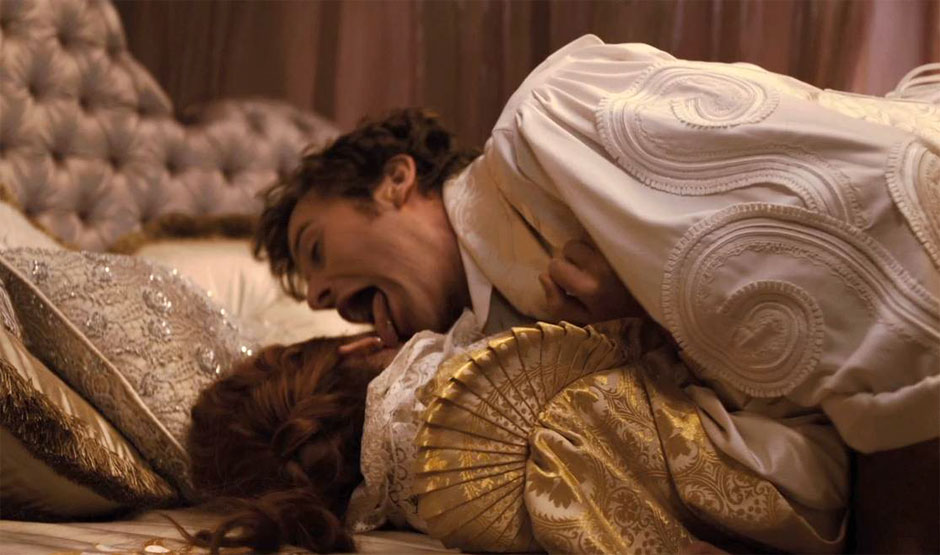
**), who is murdered (unbeknownst to all) by his new step-wife The Queen (Roberts), who then rules the Kingdom into the ground, while White awaits taking the throne on her 18th birthday (that is, if the Queen ever permits it). Instead, she spends it going out to see what's become of her Father's legacy and is distressed to learn there's no singing and dancing in the streets (as she remembers) but begging and poverty instead. This causes a political debate in the family, leading to Snow being banished by The Queen to be dispatched by her lackey Brighton (played with Costello-ish consternation by Nathan Lane).
Along the way, we meet the handsome Prince (Hammer, who is aggressively great here, better than his Winklevoss twins in 
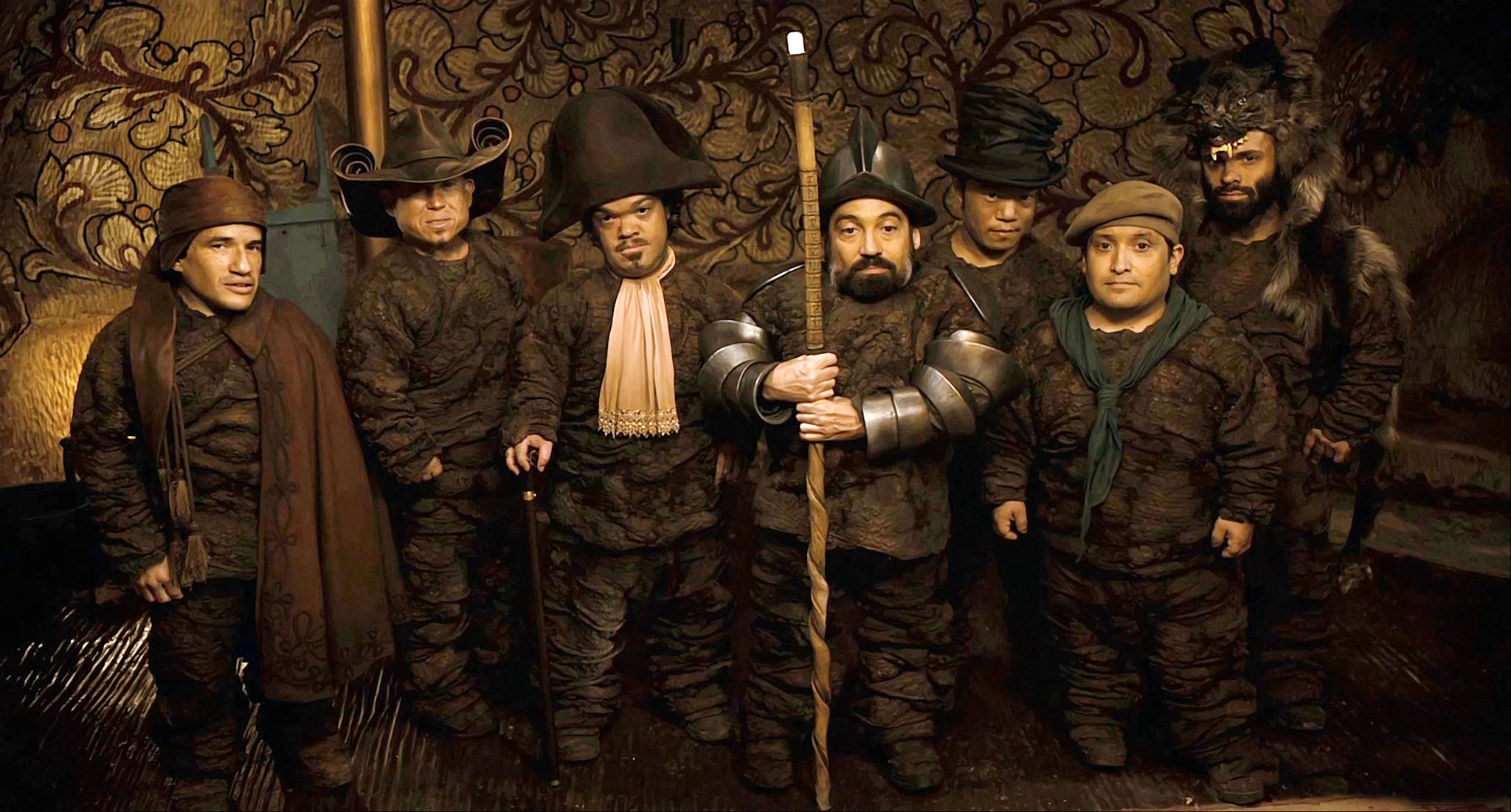
The Social Network, and decidedly better than being cocooned in make-up for J. Edgar, one thinks though that he is doomed to play scions), who is accosted by highwaymen...who just happen to be The Seven politically incorrect Dwarves (Napoleon, Half-pint, Grub, Grimm, Wolf, Butcher, and...Chuck, played with gruff zeal distinctively, by Jordan Prentice,Mark Povinelli, Joe Gnoffo, Danny Woodburn, Sebastian Saraceno, Martin Klebba,and...Ronald Lee Clark, all threatening to steal the show, as well—"beats workin' in a mine," as one of them says).  Before long, everybody's path is crossed once or twice, along with swords and stars in lovers' eyes.

Thing is, in its cartoonish way, it works in live-action, as well as when Disney goes sassy these days with classic tales, and, given the edge by Tarsem's crack sense of timing and way of knowing no bounds in design and camera moves (and Alan Menken's Mickey-Mousing
*** score doesn't hurt in that regard, either) the effect is somewhat the same.

Walked in loathing the idea and walked out kinda lovin' it. Pretty happy about that, given the Grimm prospects. Seems fair, if not the fairest of them all.
The music video in the End Credits, which shows how Tarsem throws things 
in from left field, as in this "Bollywood" style sequence.

*
Another example of Tarsem's work—a cheeky gladiator themed Pepsi commercial, 
featuring Enrique Eglesias, Beyonce, Britney Spears and Pink, with the music of Queen.

** Is there something in Sean Bean's contracts that stipulates that any character he plays not make it to the last reel? The last movie I saw where one of his characters survived was The Martian.

*** © Disney Corporation. I use this in the musical definition of the term (not in its "common, inferior" usage) where the music follows the action on-screen precisely, as in notes that follow foot-steps, say. And now this joke is a bit ironic as, this year, Mr. Mouse is in the public domain. So, now, I can make that animated cartoon of "Maus" starring Mickey.

Thursday, December 14, 2023

Leave the World Behind (2023)

Everything is Disconnected ("Siri, What's This Movie About?....Siri?.........Siri?.....Do I Hear Chuckling?") 
 or
♪"Ain't That a Shaymalan?"♫
 
I just got a new cell-phone. A smart-phone. I'd had a "dumb-phone" before...for like 15 years—can't be that dumb if it's lasted for 15 years, can it? Very dependable. Always worked. Made phone calls. Text. The occasional picture. But, now a year in to smart-phone land, I find myself depending on it more...more time spent on this one than the last one. Too much time, really. I'm at that stage of life where I really shouldn't be wasting the amount of time I have left.

And I do it anyway ("idiot").

And I've been quite amazed on how much I depend on this phone for features that I quite happily lived without for so many years. And how much everything is now so tied up together with the phone, my car, my bank, my messaging...everything. And it scares the crap out of me. What happens when they don't work? Will I be able to go back to "analog mode" in order to get things done? Probably...it will just take more time (hopefully).
So, along comes Leave the World Behind
—this year's end-of-year doom-and-gloom Netflix release (last year's was White Noise and the previous year Don't Look Up)--based on the 2020 best-seller by Rumaan Alam, and written and directed by Sam Esmail (creator of the cult series "Mr. Robot"). In it, a New York couple, the Sandfords, Amanda (Julia Roberts) and Clay (Ethan Hawke)--they have two kids, Archie (Charlie Evans) and Rose (Farrah Mackenzie)--rent an Airbnb for a short vacation out of the city...to Long Island. Amanda's a bit "prickly" from her work (advertising, natch) and Clay's work as a media studies professor is stressing him out, so the "vacay" is spontaneous and short, much like Amanda. 
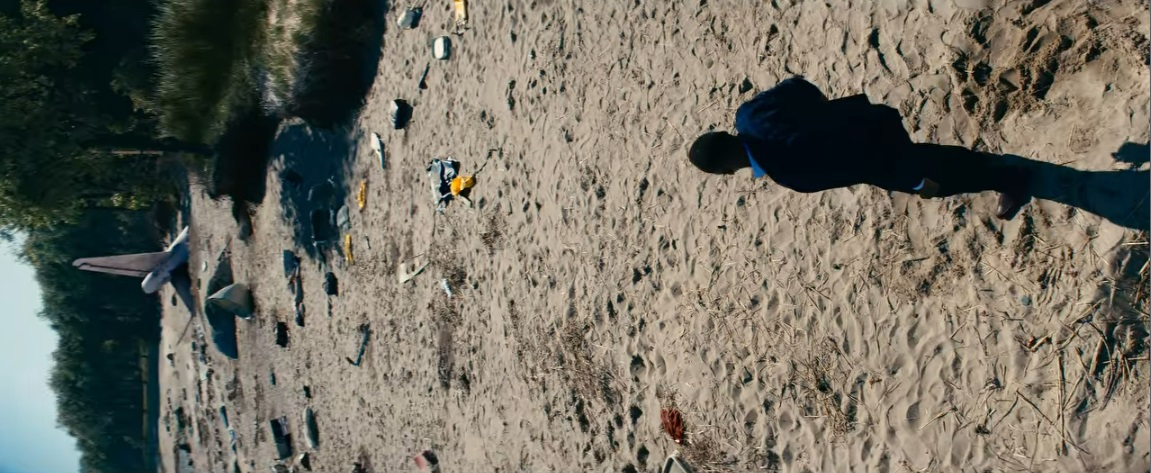
And it's fine...a very neat well-designed house...with a pool...close to a beach. Then things get weird. An oil tanker heads right for the shore without slowing and runs aground. Then, everybody's cell phone goes out. Radio stations stop broadcasting. Computers work but can't connect to the internet, so they're a bit isolated for news. The place is still nice, and they're provisioned if they have to stay longer. Sit and wait. That's the best thing to do given any lack of evidence.
Until there's a knock on the door late at night. It's the house's owner, G.H. Scott (
Mahershala Ali) and his daughter Ruth (Myha'la), dressed to the 10's after an evening at the symphony in New York. They've shown up at the doorstep because New York is in the middle of a blackout and they've come to their Long Island retreat for safe haven from the craziness the blackout has created. Amanda is suspicious—they could be anybody—but Scott has keys to the liquor cabinet and knows the email address Amanda contacted to get the place, and he even offers a bit of a refund for the inconvenience of sharing the place overnight. Some haggling and repercussions are interrupted by a notice that comes over the TV announcing that all stations have ceased functioning due to a national emergency. Reluctantly, Amanda agrees with Clay to let them stay...but there are questions. And nobody has any answers.
Some come through in the morning—Amanda awakes to some brief alerts on her phone's news-feed. The U.S. is paralyzed by a massive nationwide hacking attack on U.S. systems that have darkened New York and interfered with broadcast and navigation systems. But, more things have happened and continue to happen—there are distant explosions and a crippling sonic attack that shatters windows and deafen inhabitants. Wildlife is acting strangely—deer appear out of nowhere and the house pool is invaded by flamingos. Visiting a neighbor's home to commandeer a satellite phone, Scott finds that it doesn't work, indicating that U.S. satellite systems have been compromised. Drones drop leaflets that translate to "Death to America" and airplanes start to drop from the sky.
The Sandfords attempt to leave the island, but find the routes snarled by miles of Teslas drawn to the same spot by self-driving systems (interesting that this week Tesla has recalled models with that system
; the publicity from the movie must not be good). Complications ensue and the Sandfords and Scotts must join forces to seek shelter as advised by Scott's contractor, a suvivalist (Kevin Bacon), who has prepared for the end-times.

It's a clever little conceit that plays on all sorts of modern fears of weak power grids, infrastructure lapses, "Havana syndrome," and hacker gangs and provides all the doom-scrolling you need for the modern world in one neat 2 hour package. That is if one can ignore the temptation of complacency and is paying attention. Snatches of "Special Reports" and recognition of this week's hole of fallibility go off in one's head as one keeps watching things for these people get worse and worse (the flamingos I've never seen covered on "60 Minutes", though) and it's all done for straight tension, not for any satiric purpose as in Don't Look Up.
It's aided and abetted by strong performers who are very good at playing "I have no idea what's going on but I'm not comfortable with it" and with a particular nod to Roberts for daring to risk her reputation as "America's sweetheart" with a performance that is flat-out vexing for its negativity and pure harridanism. One wonders how her character could function in the world of advertising with her ability to say exactly the wrong thing at the wrong time. Her results must vary.
One must also admire the direction of Esmail, who, as if the events in the teleplay weren't off-putting enough, manages to present them in such a disorienting fashion while still keeping you aware of who's where and what their relationship to their surroundings are. One should always be aware of directors calling attention to themselves with camera tricks, but Esmail does them in such a clever way that one follows fascinated to see what he's going to do with it, rather than merely dismissing his tricks with a dismissive "show-off" remark. He also employs a nifty editing scheme: like author Dan Brown's way of ending chapters just as things are getting interesting, Esmail will cut away to another sequence when there's a slight escalation in tension, then cut back once that situation starts getting busy, and continues to see-saw with ever-building tension until a viewer is ready to snap. I've been seeing a lot of dismissive comments saying that Leave the World Behind is boring; there is no way it could be with this editing scheme—maybe those commenters upped their daily medication.
I found it to be a compelling little slow-burn thriller of the M. Night Shyamalan school—every-day situations are up-ended by some weird phenomenon that then goes to great pains to try to explain it all away, however tortured that explanation may be. Here, the speculations seem a bit more plausible, even if they are horrific in scope. Toss in some
Fincher-style transition tricks, and one is slowly pushed to the end of one's seat...with the occasional check to make sure your devices are still online.
Even moreso, it reminds one of one of the better "Twilight Zone" episodes from that series' first incarnation. Leave the World Behind is the "The Monsters Are Due on Marple Street" for the 21st Century, and the coming Trumpocalypse.
 
And it still works.

Wednesday, May 17, 2023

Larry Crowne

Written at the time of the film's release...although...I still remember parts of it that delighted me, despite my half-hearted review at the time.

T. Hanks for the Mediocrity
or
My Big Fat Career Mistake

I'm sure the intentions were better (aren't they always?), possibly saying something about the displacement of late baby-boomers in the job market, and how "it's never too late to learn" belying the "old dogs/new tricks" canard. Maybe co-writer/director/acting lead Tom Hanks just wanted to make something hopeful and sunny in bad economic times...a flare in the night-sky...the proverbial single candle rather than curse the darkness.

Well, it's more like a candle in the wind, and this blows. Formulaic, with an implied "wah-wah" comedy goose at the end of every scene, Larry Crowne has a "made-for-TV" movie feel that gets under your skin like intravenous sand-paper.  Larry (Hanks) is in his early fifties, divorced, a twenty-year Navy vet working at a box-store, where he's received "Employee of the Month" fetes nine times.  He's one of those guys who owns everything he does, taking a certain pride in all aspects of his job, even picking up and disposing the stray trash he finds in the parking lot. The implication is already there: while the rest of the world goes on its self-absorbed way, Larry "cares." And that can't come to any good.
Called in for what he thinks is his tenth EOTM award,
he is fired instead; corporate has crunched the numbers and sees him, as never having gone to college, as not being "advancement" material—he's already been passed over for promotions by duller, but degreed, employees. Adrift, Larry finds no work, and so goes to community college in his '50's, with similar outcasts (though dissimilar aspects) most younger, but without the team-player skills that Larry has acquired.

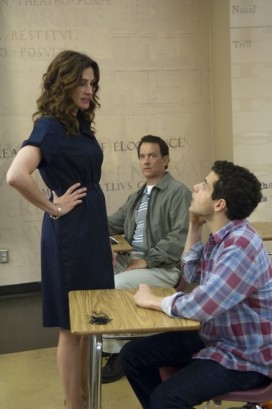
Teaching one of those classes—Speech 217—is Mercedes Tainot (
Julia Roberts), bored, tired, unmotivated, with a dead-beat author-husband (the wonderful Bryan Cranston), who, like Larry at the beginning of the film, doesn't know she's in the process of transitioning, so cynical is her world-view. Her students are an odd collection of rabbits, that she's just trying to keep awake and inspire the one thing she can't seem to muster up—giving a rip. And Crowne is the oddest rabbit in the bunch. She glowers, as she sees him slowly change under the influence of younger students—particularly women, and particularly one student who has it in mind to completely "make-over" Larry to his puzzlement and the vexation of her boyfriend.
This area of the movie has more than its share of "wah-wah" moments
, and as much fun as Roberts' slow-burn is (and she's great at it), they have the feel of sit-com situations that might be fun for the matinee crowd. It's there that the writing hand of Nia Vardalos, she of My Big Fat Greek Wedding, is the most evident. Hanks and his wife, Rita Wilson (who is also in this with a small, rather frightening part) were the ones who took Vardalos' one-woman show and shepherded the development of it into a Big Fat Success. The demographic for Larry Crowne skews a little bit to the same age, with the same toothless observational satire that never offends, even when it tries to be a little "naughty."  It's all for naught.


And yet. And yet...
Hanks and one of his co-studen...
WAIT A MINUTE! That's Rami Malik!
I had the opportunity once to tell a clerk who thought she was "too forward" approaching me in a store aisle: "Take it from an 'old guy:' never regret being delightful." That lesson applies here. Twenty-four hours after "grumping" my way through Larry Crowne, the saccharine had dissolved in my mind and the "good stuff" remained...Larry's unexpected, all-inclusive, concise and perfect final project in class that nicely ties a bow around the movie, a cast of great people getting to be charming (Cedric the Entertainer, Taraji P. Henson—she's a favorite of mine—Wilmer Valderrama—!!, George Takei—!!!, a little spitfire named Gugu Mbatha-Raw—late of "Dr. Who," MI-5, and "Undercovers"—that you just want to hug, and...almost too good to be true...the always-welcome, never-failing Pam Grier). The thing is...for as saccharine as the movie feels going down, it leaves a pretty good after-taste. One forgets just how much one might have suffered through it, and how unsufferable it can be, and is left remembering the good parts. Meaning that Larry Crowne is a similar experience to childbirth.
Not a ringing endorsement...but it could be worse.
But, 12 years later, I still remember how good that final class project was. One may gripe. One may be cynical. But, delightful lasts.

Saturday, February 12, 2022

Valentine's Day

So, Saturday...Valentine's Day on Monday. 
 
Do I write up Al Capone or Valentine's Day?  I'll embrace the "better angels."
 
Written at the time of the film's release
 
"Love, American Style: The Movie"

A movie top-heavy with stars given a limited time-frame in a limited locale (Los Angeles) where lives intersect and the sub-strata of conflicts are put to the test through the separation of instincts and rational thought.

No, that was Crash. But the set-up is the same with less fighting and more clinches. Call it "Squish."
 
Or better yet, "Smoosh.
 
This is Valentine's Day directed by Garry Marshall, whose television career took him from "Love, American Style" through the "Happy Days" Dynasty (or as it's referred, "ABC-TV during the '80's") and into motion pictures, which were usually light comedies. This is a light comedy, too, but with several intersecting stories cross-populated by the stars guesting in other people's stories other than their own, with interstitial vignettes of a comical nature inserted at various places, especially if the ad-libbing gets a little dicey for the editor's sake.
 
By God, it is "Love, American Style."
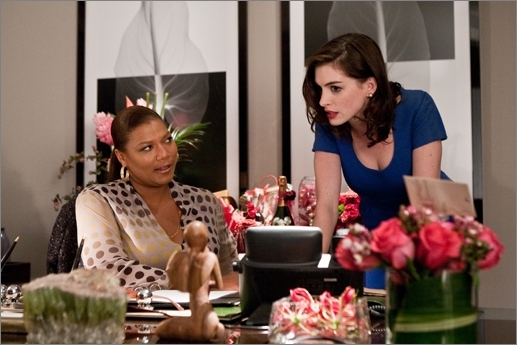
The cast is...amazing, frankly. So much so that a superb actor like Joe Mantegna has a mere cameo of a few seconds (as does the director). Probably just as well, this isn't Mamet material. But there's Alba and Garner and Hathaway and Biel and Roberts and Latifah for the guys. For the girls, there's Dempsey and Dane and Cooper and Foxx and Grace and Kutcher (if L,AS had lasted four more seasons all of these kids would have been on it!).
For the oldsters there's George Lopez and Hector Elizondo (he's a requirement of all Garry Marshall movies) and Shirley MacLaine—the one moment I couldn't resist was MacLaine playing a love scene in front of her own projected image (The movie is 1958's Hot Spell). For the kids, there's Taylors Swift and Lautner, who are both charming and she has a fine comedienne's willingness to make herself look foolish.
It's as frothy as a watered down meringue
, but with the occasional sour lemon bite that keeps it from getting too sticky and could lead to puckering...the good kind. Suffice it to say that everything ties up nicely, with a couple of mild surprises along the way. It is supposed to be cute, and all the actors have the presence to dance around the material with their own peculiar rhythms to make it seem fresher than it is, if not better than it is.

Wednesday, April 29, 2020

Duplicity

Written at the time of the film's release...

"All's Fair in Love and War"

After screenwriter Tony Gilroy's powerful directing debut with Michael Clayton, one looked forward to what the talented triple-threat would come up with next, considering that film's street-smarts, sharp characterizations and deft direction. What we got is Duplicity and it's a wisp of a movie, a comedy without laughs, and a drama without weight; a shell-game; much ado about nothing; more in keeping with Gilroy's in-name-only association with the "Ocean's Eleven" series than his better efforts.

As with
Michael Clayton, the playing field is the backrooms of corporate America, where warring CEO's protect their fiefdoms from interlopers and pitch pre-emptive strikes to keep them at bay. Their knights: a string of white-ops intelligence teams who spy on the competition, using the techniques once used in political battle-fields. That back-drop is nothing new: John le Carré's been using the "corporate espionage is every bit as sordid as political espionage" gambit in his works since the fall of Russia. le Carré even went so far as to suppose spy agencies ginning up threats to justify their budgets and existence, just as they do in the business world. Need a purchase order? Create a threat, and the money rolls right in.

Gilroy sets the tone early by beginning his film with a lo-mo credit crawl where Corporate heads Tom Wilkinson and Paul Giamatti grapple at each other like pawing animals in a zoo. The silliness of these two going at each other in artfully composed tableau should be funnier than it is, but the whole thing feels like such a surreal con that you don't buy it for a second. Hence, the stakes in the story seem minor, even the McGuffin* is tame, as the two adversaries are pharmaceutical companies. In the middle of it are two ex-spies Ray Koval (Clive Owen, nattily rumpled) and Claire Stenwick (Julia Roberts), who know each other only too well, she having stolen some Air Force secrets from him during a one-night stand at a Dubai fete years ago.** 
The encounter stings Koval, and now, years later, he's realizing that Stenwick is the Player on the Other Side in their current Corporate Wars. It's an interesting study of two people so locked in strategic thought that they might drown standing in quick-sand, so pre-occupied are they with motivation and nuance and who might try to move first. Interesting, but not always entertaining. At times, the mind-games approach "Get Smart!" absurdities, as both sides play the "I'm thinking they're thinking I'm thinking that they're thinking" game. A little of that goes a long way, especially if the protagonists don't have a smile on their faces when they're saying it. And the humor is only of the clever variety in Duplicity, not particularly the amusing kind.
Still, it's one of those movies that travels well: to Rome, New York, London and the Bahamas, the costumes are fine, but the whole thing has all the zing of champagne left open overnight (composer James Newton Howard tries to add some zip by tossing in some Spanish dance music). It all seems too familiar and a bit too flat.

It's also one of "those" movies that demonstrates that Julia Roberts' most valuable asset may be her ability to smile under duress. 


* After Hitchcock's name for "the secret" that parties try to retrieve in a suspense film, usually it doesn't matter what it is—after the story of the man who inquired to another man what was in his suitcase: "It's a McGuffin, for trapping lions in the Scottish Highlands." "But there aren't any lions in the Scottish Highlands!" "Then, that's no McGuffin!"

** This also seems overly familiar with Prizzi's Honor, Undercover Blues, and Mr. & Mrs. Smith as previous warring spy-couple films.

Saturday, June 18, 2016

Money Monster

Fostering the Status Quo
or
Crumbs and Clowns, Not Bread and Circuses

Oh, their hearts are in the right place, those makers of Money Monster. Liberals all, they want to decry how the big-money-guys are destroying the little guy by sucking the shekles out of their retirement accounts (if they have them), pension funds (if they have them), life-savings (if they have them) or any amount of disposable cash by relying on the very greed that made them who they are to obtain the "other people's money" they depend on to get rich themselves. 

It's a shell-game for the selfish. The statistics show that we have such a lop-sided social strata that the top 20% of the people have 85.1% of the assets (the largest section, the bottom 40% of the population own 0.2%). You'd think that something that top-heavy would collapse under its own weight, but it resists crashing (or even trickling down) because that's gravity and gravity is Nature, and money has nothing to do with reality, especially these days. It works only because we agree on it for the purposes of barter, but these days—as the movie points out—money isn't even cash anymore, it's only pixels in theory in denominations of 1's and 0's. A bi-polar demarcation, like the "have's" and the "have-not's."
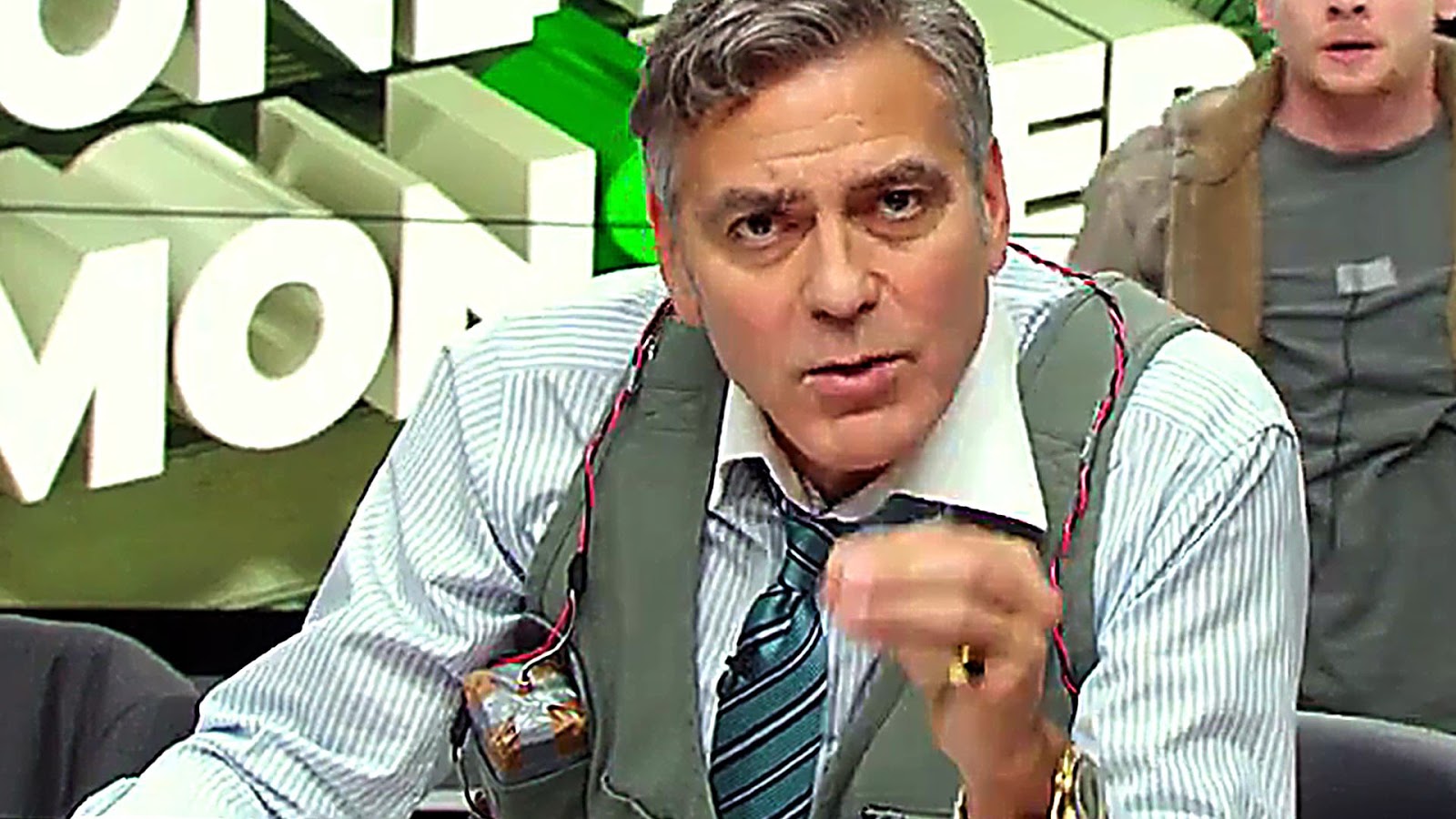
The barker for this circus is Lee Gates (George Clooney, who might be doing another of his "Idiot" roles for the Coen Brothers), a pompous ass of a guy who goes off-script, off-time, and off-color to shuck and jive his audience by proffering investment advice (think a nightmare blend of Jim Cramer, Glenn Beck, and a sports clown) for the good of the masses when actually his celebrity and clout are mostly used to prop up cronies and folks he can use to prop up the show. If somebody in the audience makes money, hey, it can only help ratings. 
Besides "caveat emptor." He's not saying you should actually buy the stuff. it's your decision and if something goes south, tough luck, there's fine print in the terms and conditions that you should have read if you read the prospectus carefully (if anybody had encouraged you to). The responsibility is all yours.
The show thrives on machismo and surface glamour and bling. Plus, there's the implied threat that you're a wimp if you don't take chances. You don't make the green if you're fifty shades of yellow. That sort of thing. And it's glitzed up like a game show with fast talk, goofy graphics, and bright shiny objects that defy analysis because it's all in fun.
But, Gates is a pain in the wallet. He's been doing this for years and the formula works and why change? He basically goes off-script every time the red light goes on and it drives his producer-director Patty Fenn (Julia Roberts) nuts. But, she's good, so she can ride the Gates tsunami every night. She's tired of it, though. She's leaving the gig to go direct somewhere else, so that she can...direct, rather than watch helplessly in the control room while Gates wings it.
If she thought she had lost control before, it's nothing like the day the movie portrays. In mid-broadcast, while Gates is clowning around, a million-dollar grin on his face, the control room sees a guy hiding behind the backdrops and video-screens. He waits just long enough for Gates to see him and think he's part of some "surprise bit." That is, until Kyle Budwell (Jack O'Connell) pulls out a gun and threatens Gates (on live television, one might add) with a bullet in the head unless he "gets some answers."

Budwell had invested his inheritance on one of Gates' recommendations, IBIS corporation—all of it, $60,000, to make a "big score" for himself and his pregnant girlfriend—and when the investment went south, he lost everything. Now, he wants answers as to what happened in the transaction, and he instructs Gates to put on a suicide vest (which Budwell holds the trigger to in a "chicken switch" configuration) to get the officers of IBIS on-camera to admit their failures.

The head of the company, Walt Canby (Dominic West), a favorite name Gates likes to drop on the program, cannot be found—he's out of the country. The company's mouth-piece, Diane Lester (Caitriona Balfe) burbles homilies, platitudes and corporate lines and boiler-plate, but that only causes Budwell to shoot out the video screen she's appearing on. Normally, the talking-head would remove their ear-piece and go have a congratulatory lunch for themselves, but in this fantasy, Lester starts a one woman crusade at IBIS to find answers to what's going on. She doesn't get fired for this, which might make the genre this one is classified under as "science fiction." She makes calls to the original programmers to determine what went wrong with the algorithms of the investment plan. They say there's nothing wrong with the algorithms (proving that they are, indeed, programmers—it's always somebody else's fault) and that something else caused the fund collapse. Lester investigates further, insuring that her pension gets taken away (and forget about a good recommendation).
Meanwhile, locked in the control room, Fenn coordinates with the police, evacuates the studio, negotiates with Budwell, and also has the time to do her own investigating into the IBIS corporate structure and its dealings. I'll bet her salary is a fraction of Gates'.

Gates, for his part, sweats. And, while wearing "the vest of doom" grows something that resembles a conscience, at least under the glare of television lights. He starts back-pedaling and comes up with a plan to take Budwell out of the studio and confront Canby about the apparent fraud.
He should have looked at his own monitor. Money Monster is, itself, a fraud, no "apparent" about it. The movie tries to gin up sympathy by channeling resentment against Wall Street by personifying it with a disgruntled investor who's gone off his rocker and decided to ultimately commit suicide by cop. That's like feeling bad for the Van Heflin character in Airport because he decided to blow a plane up for the insurance (as opposed to the Maureen Stapleton character, who's left behind to pick up the pieces). Thank you, I'd rather have somebody a bit more competent through whom to channel my righteous indignation. But, then, Budwell is always a schmuck throughout this movie, it's only O'Connell's earnestness that makes you take him at all seriously. It's what the movie-makers think of all the consumers of their bright shiny objects and their bread and circuses.
They give lip-service to Budwell's plight, but the sympathies seem to be with the one percenter's among the characters, because, after all, the bad guys still get away with their schemes and Gates gets to continue his job shucking and jiving. How like the economic crisis that the film-makers are wringing their hands about. Unfortunately, wringing your hands is visually indistinguishable from the silent movies' miming for "miserly greed." Frank Capra might have done something with it, making sure that phoniness is pilloried for its cravenness, and the true villains, if not completely thrown to the mob, are, at least, exposed to them. In the end, the movie really has nothing to say other than people are getting screwed, so maybe we ought to pay attention before torch and pitchfork futures go up. In the meantime, that Budwell guy's dead, but, hey, the show must go on. Oh, and Fenn decides to keep her crappy job that she is way too qualified for. Happy ending. All smiles. Cue the "Applause" sign.
The writers might not know better than this crap. But Foster does. Clooney might. Why was this Money Monster of a movie allowed to be released with so little thought attached to it?


Money Monster is a bad investment all the way around, certainly not of somebody's time.

Post-script: it's probably a good idea I had trouble writing this review, because the shooting in Orlando imbues Money Monster with a different perspective, one the writers were insensitive to and should have brought into the mix, if they wanted to make the thing more complex (but one suspects that was never the intention, or else the ending wouldn't be so superficially upbeat. 

Because whatever motivation behind his terrorist attack, Kyle Budwell is a terrorist. What did he think he could accomplish by his actions except suicide? Did he think because his motivations are so transparent, that the actions of the other villain of the piece, Walt Camby, would be equally as transparent? Camby is, after all, in the business of making money from other people's money, and so his motivation is always to keep his machinations in secret, only to reveal the results in an annual report of earnings, the way most businesses do. How they do so, whether it be Volkswagen by rigging emissions tests or Turing Pharmaceuticals (and its reprehensible little wanted poster-creep, Martin Shkreli) raising the price of Daraprim by 5,000% or the private contractors, like Halliburton, bilking the government and the tax-payers by charging $99 to wash a sack of laundry in Iraq, is their business, shady as it is. They do villainous, often obscene, things in order to look like heroes to their stock-holders. They're crooks, one and all, but just because he is victimized by the villains does not make Budwell a hero. He's a villain, too, and a pathetic one.

It's just one more facet to what makes Money Monster a cheat, an empty suit, and a badly thought-out entertainment.