Showing posts with label Mare Winningham. Show all posts

Wednesday, January 17, 2024

Mirror, Mirror

Don't Trust Anyone Over Four Feet
or
"No, Snow!  Don't Mess with Traditional Story-Telling!  It's Been Focus-Grouped, and It Works!!"

I approached Mirror Mirror with some trepidation. It's the sort of movie that curdles my gray matter—taking a traditional fairy-tale and updating it for modern audiences, with anachronisms, modern slang and catch-phrases, a fractured fairy-tale denying its origins and playing "hip." Also, it's a Julia Roberts vehicle and I don't "buy" Roberts in anything but comedic roles (which this one is).

But the other choice was to see Wrath of the Titans, for which I had no desire (Really? They're trying to make a franchise out of that one?) and so it was the "Snow White" knock-off, even though the prospect seemed rather Grimm.
It did have one thing going for it, however. Even though produced by Brett Ratner, it was being directed by an inspired choice—Tarsem, who vaulted from R.E.M. music videos to
The Cell
,* then rebounded with a fine film no one bothered to see, The Fall. I'd passed on his Immortals last year (though I plan to watch it on video sometime soon, now that it's out), but, as Tarsem can do some visionary work, he just might be able to pull it off.
It might well have been lame in any other hands, but the director's spectacular design sense, not only for sets and costumes, but also how to frame them for maximum effect is combined with a breezy comedy style that is never idle, and never hangs for a laugh, so that not only is the frame full, but the soundtrack as well, with one overhanging punch-line that crowds through before each cut.

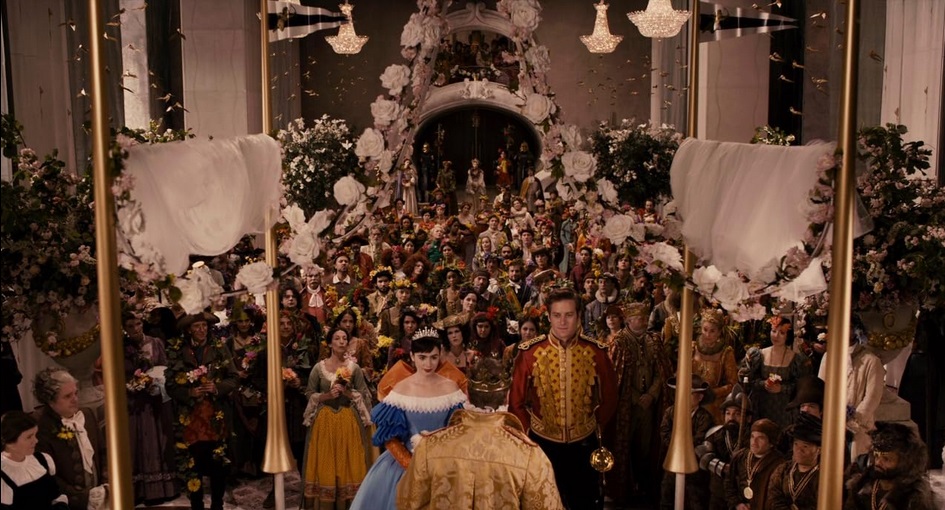
And yes, it's anachronistic, with such a polyglot of styles that it goes beyond, say, Terry Gilliam-madness into a Moulin Rouge!-ish goofy slap-dashery in which nothing is sacred except the movie's own internal rules of play, stopping just short of the Python-line of anarchy.  There is no single accent in place to latch onto geographically, except for some Anglo-Saxonisms—indeed, Arnie Hammer's Prince Alcott of Valencia, is pure American, but does it with such Ivy-League bravado that you accept he's a prince.

And this variation of the story has just enough "Hamlet" mixed in—Ms. White (an Audrey Hepburn-esque 
Lily Collins—Phil's kid) is the daughter of The King (Sean Bean
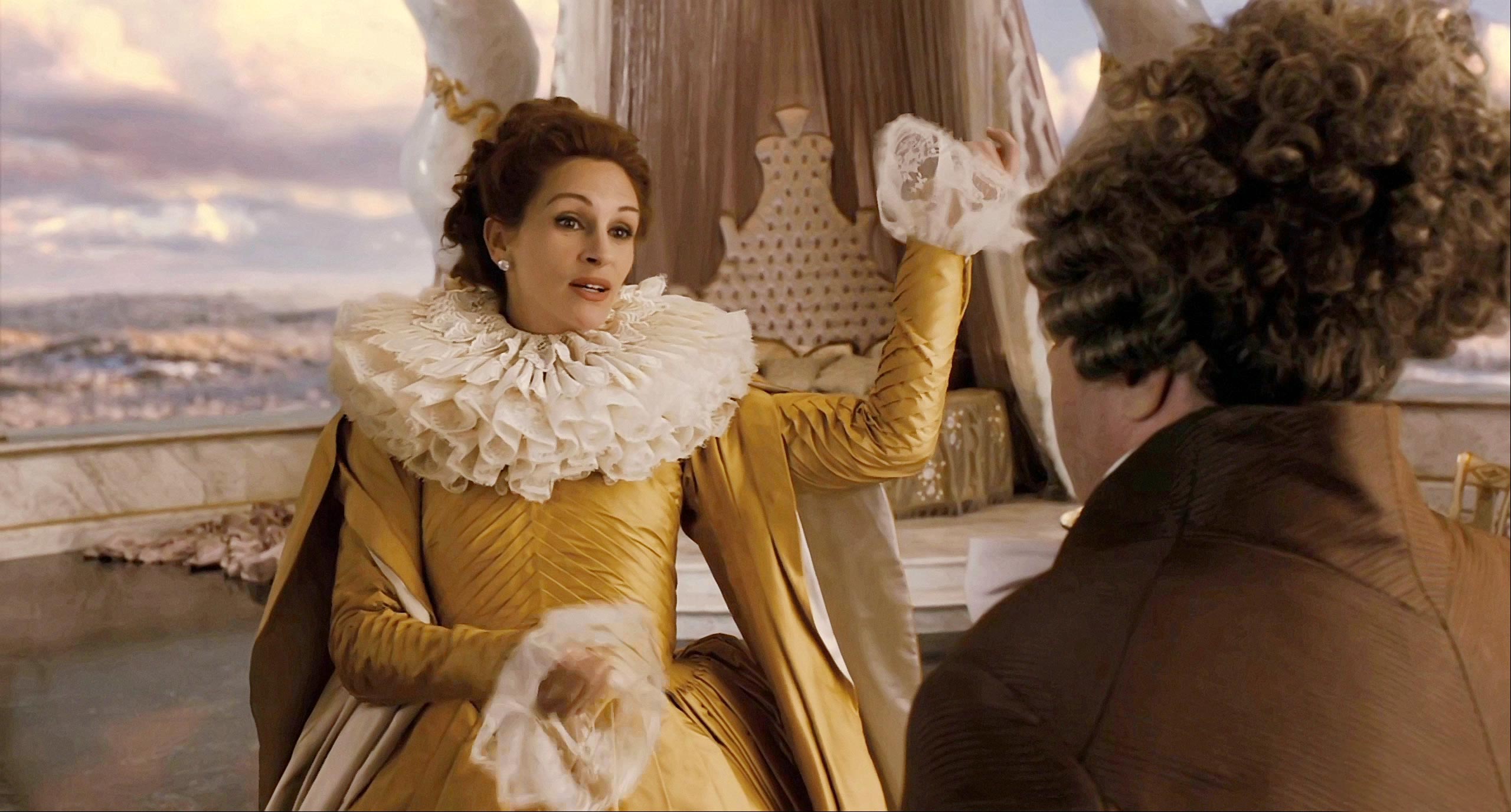
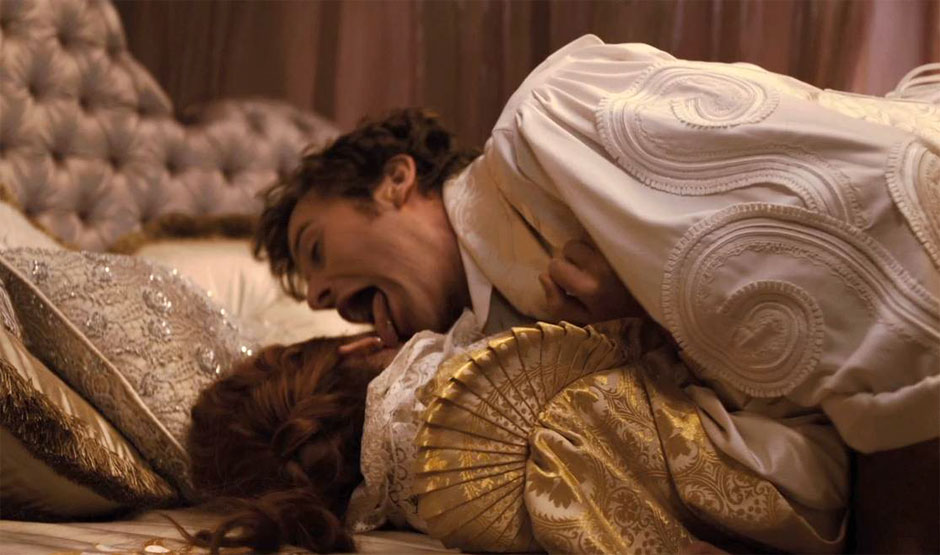
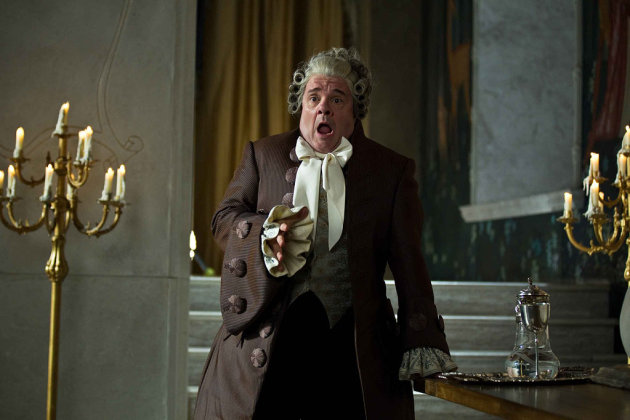
**), who is murdered (unbeknownst to all) by his new step-wife The Queen (Roberts), who then rules the Kingdom into the ground, while White awaits taking the throne on her 18th birthday (that is, if the Queen ever permits it). Instead, she spends it going out to see what's become of her Father's legacy and is distressed to learn there's no singing and dancing in the streets (as she remembers) but begging and poverty instead. This causes a political debate in the family, leading to Snow being banished by The Queen to be dispatched by her lackey Brighton (played with Costello-ish consternation by Nathan Lane).
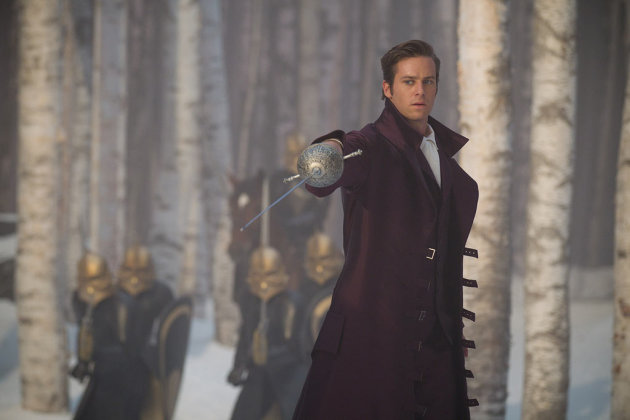
Along the way, we meet the handsome Prince (Hammer, who is aggressively great here, better than his Winklevoss twins in 
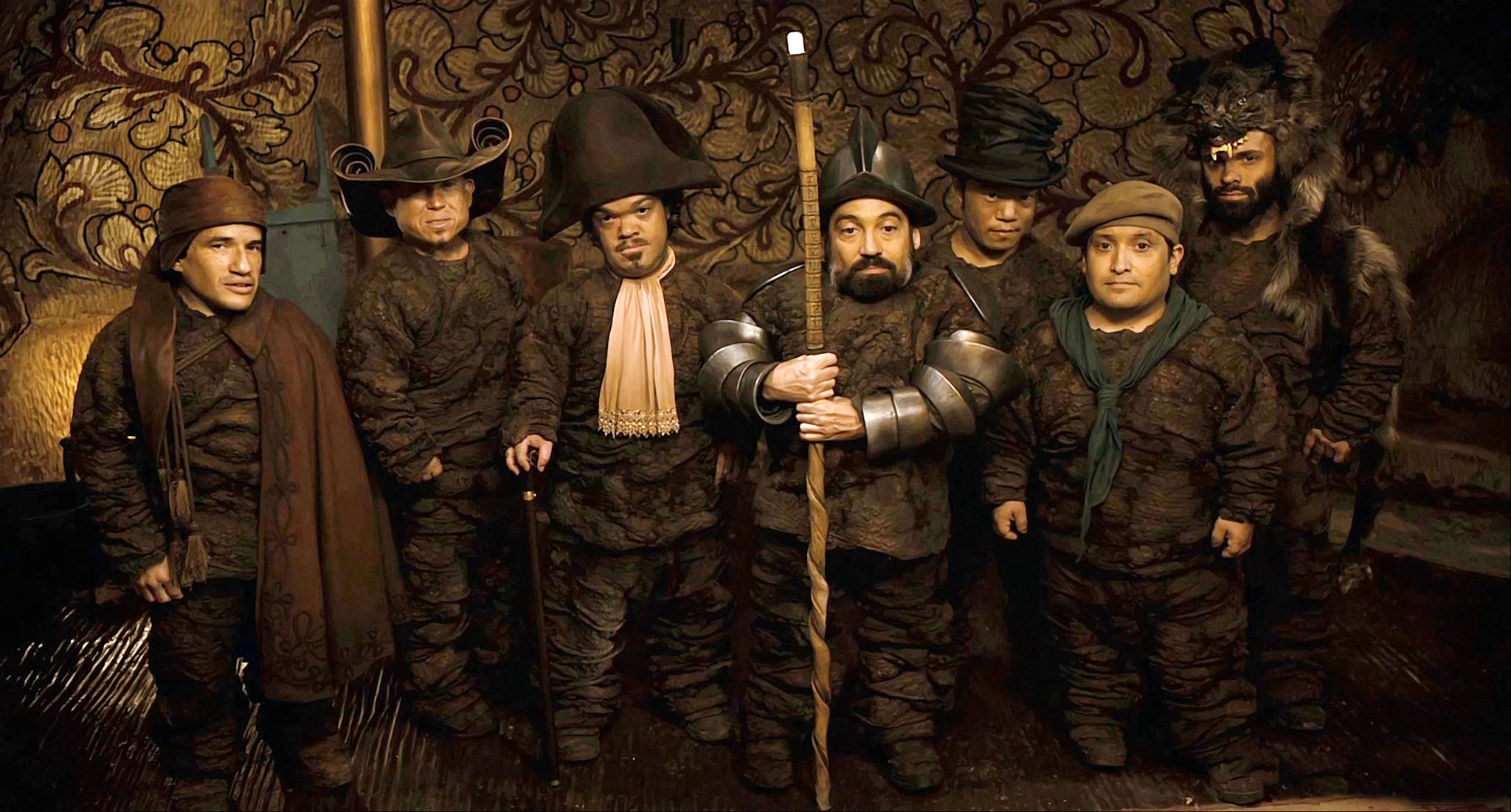
The Social Network, and decidedly better than being cocooned in make-up for J. Edgar, one thinks though that he is doomed to play scions), who is accosted by highwaymen...who just happen to be The Seven politically incorrect Dwarves (Napoleon, Half-pint, Grub, Grimm, Wolf, Butcher, and...Chuck, played with gruff zeal distinctively, by Jordan Prentice,Mark Povinelli, Joe Gnoffo, Danny Woodburn, Sebastian Saraceno, Martin Klebba,and...Ronald Lee Clark, all threatening to steal the show, as well—"beats workin' in a mine," as one of them says).  Before long, everybody's path is crossed once or twice, along with swords and stars in lovers' eyes.

Thing is, in its cartoonish way, it works in live-action, as well as when Disney goes sassy these days with classic tales, and, given the edge by Tarsem's crack sense of timing and way of knowing no bounds in design and camera moves (and Alan Menken's Mickey-Mousing
*** score doesn't hurt in that regard, either) the effect is somewhat the same.

Walked in loathing the idea and walked out kinda lovin' it. Pretty happy about that, given the Grimm prospects. Seems fair, if not the fairest of them all.
The music video in the End Credits, which shows how Tarsem throws things 
in from left field, as in this "Bollywood" style sequence.

*
Another example of Tarsem's work—a cheeky gladiator themed Pepsi commercial, 
featuring Enrique Eglesias, Beyonce, Britney Spears and Pink, with the music of Queen.

** Is there something in Sean Bean's contracts that stipulates that any character he plays not make it to the last reel? The last movie I saw where one of his characters survived was The Martian.

*** © Disney Corporation. I use this in the musical definition of the term (not in its "common, inferior" usage) where the music follows the action on-screen precisely, as in notes that follow foot-steps, say. And now this joke is a bit ironic as, this year, Mr. Mouse is in the public domain. So, now, I can make that animated cartoon of "Maus" starring Mickey.

Tuesday, April 6, 2021

News of the World

When the Reckoning Comes
or
"To move forward...you must first remember"

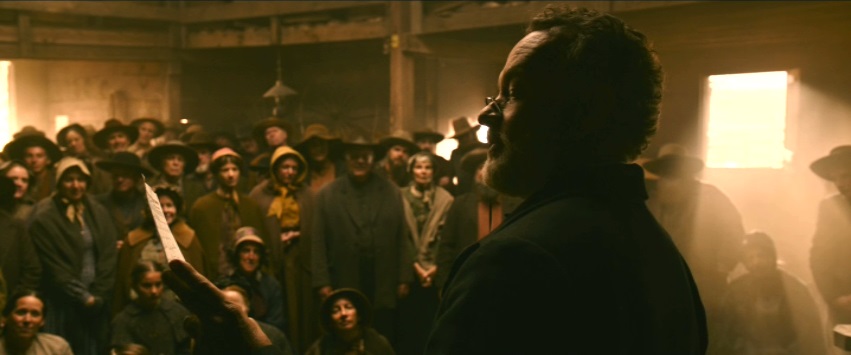
It is 1870, five years after the Surrender at Appomattox Court House, and Captain Jefferson Kyle Kidd (Tom Hanks), late of the 3rd Texas Infantry, is making his way between Indian Territory and Texas with ultimate goal of reaching—maybe—San Antonio. His peculiar job is to read the news as he travels from town to town, charging the attendees a Liberty dime for the privilege of hearing news that might not otherwise reach them by post or by messenger. He's careful about what he reads, as the bitterness of the Civil War still festers in the souls of the Southerners, only enhanced by the presence of "Blue Coats" maintaining military order in the restless, discontented villages. What Kidd finds in his listeners is a belligerence, born of Union occupation without any promised Federal help, if anything, Federal interference. When protests break out, all he can do is assuage and sympathize and encourage. "Times are hard. We all need to do our part. All of us. We're all hurtin'. These are difficult times."

He might as well be speaking to us.
Outside of Wichita Falls, he comes across a wagon overturned by some violent, unnatural means. He dismounts, warily taking his rifle, and moves down the road, ears sharpened and eyes peeled for signs of life...or malice. What he finds is a black man hanging from a tree, with a notice that Texas is a White Man's Territory. He has barely enough time to register this atrocity when a rustle in the scrub alerts him to someone else watching him. It is a young girl (Helena Zengel), blond, dressed in buckskin, and resistant to being captured, although capture her he does. The wagon's contents contain papers from the Bureau of Indian Affairs, giving the responsibility of returning this girl—named Johanna Leonburger—recently survived of a raid on Kiowa land to her nearest kin, allegedly living in Castroville, Texas.
A passing Union patrol provides no help, and just instructs Kidd to take her to the nearest Bureau office and drop her off, even as he protests that he can't be bothered with transporting a child—a child twice orphaned as it happens. The patrol has other concerns and his aren't theirs. At a checkpoint, Kidd talks to the closest Union official and is informed that the Bureau rep is on the reservation and won't be back for three weeks, so Kidd can either stay or deal with it himself. He chooses the latter, grousingly, and gets outfitted with a wagon, supplies, and a contraband gun—Kidd only has bird-shot in his rifle—by a former Infantryman of his, who warns him that the kid is wild, and then is proven right, when "Johanna" disappears while Kidd is off reading the news. Kidd finds her that night in the pouring rain on a riverbank pleading with a passing Kiowa caravan to take her back, that neither hears her, nor seems to care.
That burden, that pilgrimage, takes up the bulk of News of the World, maybe the most leisurely film director Paul Greengrass has ever made (but then he hasn't made a Western before...). Adapted—rather freely—from the best-seller by Paulette Jiles, it follows Kidd and Johanna (her Kiowa name is "Cicada") on the long trip to Castroville, episodically beset by obstructions natural and man-made that impede their journey, usually in the vicinity of some hard-scrabble settlement that will one day turn into a strip-mall suburb in modern Texas.
Greengrass' game-plan is simple: begin with a slow drone-driven shot of the landscape (most of the film was shot in New Mexico), then locate Kidd and kid in it, and take it from there. The hardships include a gang of ruffians who seem hell-bent on buying (if it comes to that) Johanna for their own purposes, an abattoir of a settlement slaughtering buffalo and ruled by an autocratic kingpin, a wagon disaster, a Kiowa band that keeps an eye on them, and a sandstorm that seems to come out of nowhere...all that besides the usual hazards of running out of provisions—especially water—and the usual feeding schedules of horses.
Only in the wagon-wreck is there any semblance of the Greengrass shaky-cam, cuisinart-editing that we've come to associate with his Bourne films or past work. The camera is still a might' restless, but, generally, the film provides good screen-capture material without the customary blurring that usually comes with Greengrass. It's not leisurely, by any means, and the editing still cuts away just before you expect it to, which provides a fair amount of subliminal tension, even if you're wondering just how long this trip is going to be without a bathroom break.
But—as in a lot of Westerns—it's the journey that's important. There's more to Kidd's traveling than news-gathering. He's avoiding something, going back to San Antonio, where he left his wife to go off to war. He hasn't been back since, and the extended travel gives us time to slowly come to terms with Kidd and to Johanna and their shared slice of life and journey. They're both untethered souls—Kidd with his memories and Johanna, twice-orphaned and belonging nowhere, form a bond of necessity and circumstance.
As they travel, Kidd tries to teach her English, and to that end—and because it makes her responses easier—he learns Kiowa, and is stunned to learn that she also can speak a little German, remembered back from before her first family was killed in a Kiowa raid, and, once adapted into a Kiowa family, seeing them killed in a Cavalry ambush. Though they're traveling the same path, Johanna's retraces the past, while Kidd's journey is one trying to forget it. Same route, different destinations.
Hanks' character in the book is supposed to be 71, and that's a far stretch for the actor. The screenwriters make him younger, without the long history of soldiering; Hanks' Kidd has had enough of it with his participation in the most recent one. Hanks does lend a weary, lived-in feel to his Kidd, but is so internalized that he's a bit of a mystery. Hanks is best when he has someone to play off of, and his work and the movie come alive when he comes across his stray charge, who's short of talk. Zengel has a performance both studied and spontaneous, where it seems like she's making it up as she goes—despite having to speak in three languages, English, Kiowa, and German—it is a naked and guileless performance. I don't care how good Hanks is, the movie lives and dies by her work in this film, and the movie seems to heave aloft whenever she's on the screen. 
News of the World doesn't jolt along as most Greengrass films do. It meanders, but doesn't poke. And has that tense element of film-storytelling that entices: with a big frontier out there, wild and loose, what will happen next, what lies around the next bend? With the nation cleaved in two, suspicions of the next stranger you run into, the corrupt grasping for power, and a sizable distance of time and space between rumor and truth, anything can happen, and one's hopes and future can seem, at best, tremulous. 

What strikes one as one watches News of the World unfold is that nothing has changed much...except the guns have gotten better.