Movies from Marvel Studios seem to be running the pattern of "Star Trek" movies (at least in my eyes), the "even"-numbered ones tend to be best, while the "odd"-numbered ones are a little clunky.* That's certainly the case with the "X-Men" franchise. Bryan Singer's first film did a lot of heavy lifting adapting the comic to the screen, but there was a virulent strain of exposition, and some jostled positioning of the characters in what is essentially an action soap opera. The best thing about it was its casting, but its big confrontation was poorly done. X-II, also directed by Singer, with all the introductions out of the way, concentrated on story and moved along smoothly with an emotional end-point that seemed to matter. Singer left to complicate the "Superman" movies, and left X-III in the hands of Brett Ratner, who produced a very expensive film that looked cheap, felt cheap and really screwed up the X-Men line-up. Ratner was required to use an expensive cast which ate up a lot of the film's budget, and the results on-screen suffered, despite the audience familiarity of the stars. There really didn't seem to be anywhere for another film to go, without some heavy gene-splicing of the cast.
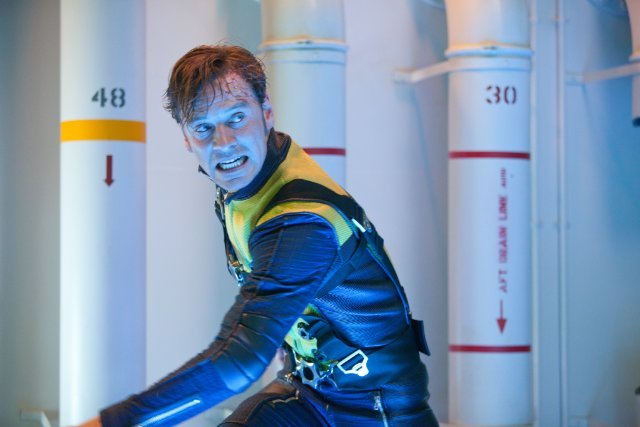
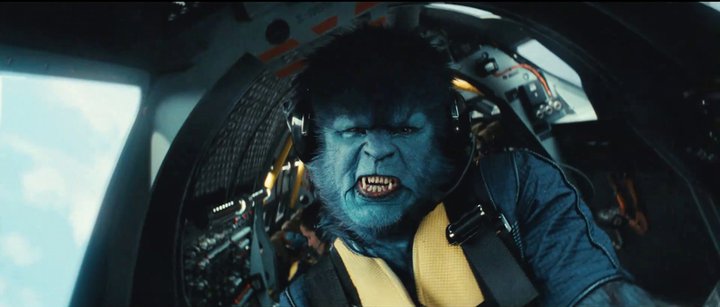
So, here's the fourth "X-Men" Movie (we won't talk about X-Men Origins: Wolverine—we already have)X-Men: First Class, a sort of re-boot of the series, although keeping elements from the original films that everybody seems to like. They could have easily made it an "X-Men Origins" film. It starts where the first film began—at a concentration camp in Poland as Erik Lensherr (here Bill Milner, but he'll grow up to be Michael Fassbender**) watches helplessly (for the moment) as his parents are imprisoned in a concentration camp.***The parallel story is of young Charles Xavier (Laurence Belcher, then James McAvoy ) who finds a metamorph in his kitchen (Morgan Lily, but she'll be played as a young adult by the ubiquitous Jennifer Lawrence), whom, recognizing a fellow mutant-traveler, he takes in as a sister. Their lives progress and Lensherr, who has developed powers over metal, hunts down the Nazis (particularly Kevin Bacon) who killed his parents and tortured him, while Xavier attends Oxford with his "sister" Raven, achieving top honors—and why wouldn't he, as he can read minds and project thoughts.
What is nice about X-Men: First Class is it takes real-world events of the time that Lee and Kirby were creating the series in the early 1960's—in this case, the nuclear gamesmanship of 1962 when the U.S. planted missiles in Turkey, which was then challenged by the Russians planting nukes in Cuba, thus lighting the match for the Cuban Missile Crisis in October of that year, which came within a sub-crew's breath of a nuclear X-change between the two very real "super-powers." Singer is credited with the story, and however counter-intuitive it might have been to place it there (and it does create a couple of continuity errors), it "works" and works gang-busters. With Singer's story and the direction of Matthew Vaughn (getting stronger and stronger with each movie), it feels more like a 60's groovy spy story than your standard super-hero fare, and for once—save for a poignant moment in X-II—the consequences of the plot really seem to matter.
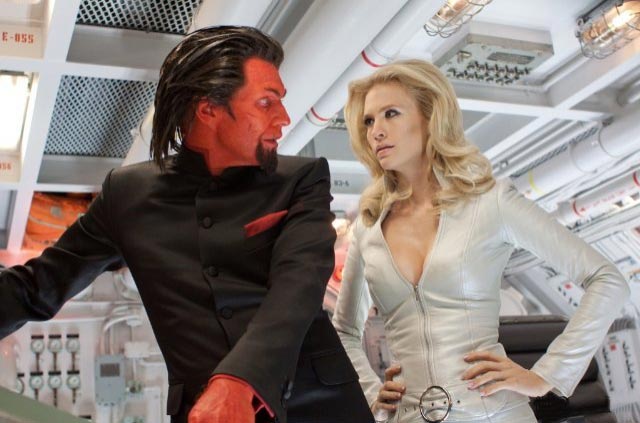
Those familiar with the "X-Men" comics will know of "The Hellfire Club"****and it turns out that organization of nefariousness and debauchery fits in well with the swinging '60's. Led by Sebastian Shaw (Bacon), with henchmen Azazel (Jason Flemyng), Riptide (Álex González) and Emma Frost (January Jones), they've pulled the mental strings of military puppets on both sides to set up the nuclear stand-off, and as Shaw absorbs energy, a nuclear holocaust wouldn't kill him, it would only make him stronger.
It's your classic "oppressed minority" story (something Lee and Kirby knew all too well when they were doing the comics—both were Jews, which was common among the pioneers of the creators of the superhero comics genre), but during the 60's it was a civil rights metaphor that only became more overt as the years went on. Singer pitched his initial The X-Men concept as a "meeting between Martin Luther King and Malcolm X," but it was more than that; Singer gave it a "hiding in plain sight" slant towards gay rights that involved not only opposition to the mutants but out-right hysteria (something the scenario buys into with the "recruitment" angle, long a charge of anti-gay paranoia).
So, you have a superhero flick that acknowledges its comics roots by employing a style from the movies of its origin's time-frame, with a rather clear-eyed look at a real-life crisis (mutants weren't involved, although I've always had my suspicions about Robert McNamara), some nice performances, grand-standing direction, good action set-pieces, and a few nice surprises for fans of both the comics and the previous films.X-Men: First Class manages to be more than the sum of its parts, certainly the best of the series and among the best of the genre, thanks to its scope and style and its own undefinable, uncanny "X"-factor.
The First "X-Men" comic (from 1963)
* Iron Man being an exception.
** Fassbender is terrific, playing contained rage and menace throughout, but when he lets go with the emotional histrionics, there is just enough control to it to make you worry what would happen if he "really" let go.
*** They even use Michael Kamen's music from the first film in the scene.
or My Sister Looks Cute in Her Mech-Arm and Boots, A Hand-full of Grease is Her Hair.*
Kinetic. That one word sums upMad Max: Fury Road—itself a film of few words, made up of a story-line propelled by images of such kinetic energy it feels like an assault.
We've had a lot of those lately, but the difference between this latest "Mad Max" installment, the fourth,** shepherded (the appropriate term) by its originator, the now-70 years old Dr. George Miller, and your typical action movie—say The Avengers: Age of Ultron—is that the action is part and parcel of the story, and rather than being a one hundred twenty minutes-long diversion, with hyper tent-poles to goose the movie along, it is the story, the images communicating the message, as most superior movies do...as most movies should.
The energy is so palpable, in varying frame-rates for emotional intensity, that it almost feels like one of the "Crank" movies of Neveldine and Taylor (except Miller was doing these tricks when they were just kids). But, it's more than frame rates. Miller's post-apocalyptic films feel relentlessly imaginative, sometimes repulsively so—you are frequently shocked by what he shows (and that's been true, even from his first "Max"—shocking, yes, but darned good ideas, nonetheless), and this latest is just as tough and unsentimental, even if the base subject matter is The Movies' most obvious road to sentiment.
Tom Hardy takes over the role of Mad Max from Mel Gibson
The previous Gibson "Max's" have dealt with vengeance (in the first, road cop Max Rockatanski has his family murdered and brings the street racers responsible to pay for it). In the second, the world has gone through a nuclear disaster, and gasoline is a precious commodity. In this one, it's raw power and influence. In the third, it's water...and basic human rights—specifically, women's rights (Stop rolling yer damn eyes, boys. Let me explain).
Not sure where we are in continuity here—methane is a main source of power as well as human labor, but gasoline can still be found in Gas Town and ammunition at a place called The Bullet Farm. Max is alive, hair long and shaggy (as it was in Thunderdome) and still in possession of his MFP Pursuit Special (he was driving a camel-powered wagon in Thunderdome) and is looking out over a bleak landscape of desert. A two-headed lizard appears behind him and Max steps on it and eats it. So much for survival. He gets in the PS and is being pursued by a vehicle gang from The Citadel. Max is out-chased and taken captive, his skills and stats tattooed on his back for reference. His job is to be a "blood-bag," catheterized up to one of the many raiding party "War Boys," Nux (Nicholas Hoult), the sickly son of the Citadel's leader Immortan Joe (Hugh Keays-Byrne), absolute ruler over the many slaves of the Citadel, controlling the only known water supply (from deep underground) and farming breast-milk from the Citadel's women—several of whom are kept aside as "breeders" for Joe. One learns early on in Fury Road that your only identity is by your usefulness
Hugh Keays-Byrne returns to the Mad Max series as Immortan Joe
Joe's lieutenant, the imperator Furiosa (Charlize Theron) is charged with leading a convoy to Gas-Town for supplies. She looks hard and seems very capable despite that her left arm is gone from the elbow and has been replaced (when necessary) by an armored robotic arm. With a variety of vehicles on-guard, she takes the point in a converted 18-wheeler War Machine, but before reaching Gas-Town, she declares to the War-Boys watching for attacks that they're going to take a little detour and veers off the road.
Meanwhile, back at The Citadel, Joe realizes that his breeders are missing. Being no sign of them, he believes Furiosa might be behind their disappearance (especially as she has not kept the appointment at Gas-Town. So, with a flotilla of vehicles, he and the Mad Boys go off to the desert in pursuit. Max is taken along as blood supply, strapped to the front of Nux's car, like a bizarre hood ornament, given a front row seat to the chase.
That chase, like the movie, is relentless, violent, savage...and a lot of brutish fun. Done with little CGI and employing an army of stunt-persons (even some Cirque Du Soleil performers) it is a series of challenges and explosive results, done practically (I use that term semi-seriously—a lot of budget and design work goes up in wanton fiery smoke—hardly practical) with little or no digital enhancement, save for some editing crunches and picture-tinting. The rest of the movie is taken up with the chase, with little respite or breathing room. Like The Road Warrior before it, Fury Road thrills, surprises and horrifies, and sets nervous legs pumping with adrenaline all through the theater, while also hiding in plain sight Miller's message amid the pyrotechnics.
And what is that message? Well, that Immortan Joe is right in his paranoia: Furiosa has, indeed, smuggled the women, all pregnant, in the War Machine, and her ultimate goal is the same as in the other "Mad Max" movies—to find Valhalla among the madness. In this case, it is the home Furiosa was stolen from as a child—The Green Zone. There, the women have a chance of raising their children in a sane environment, out of the control of the male despot who has fathered them. The movie is one hell of a protracted custody battle.
Super-models and Elvis' granddaughter are the precious cargo in Mad Max: Fury Road
Having a feminist message inside Mad Max is hardly surprising. Miller likes strong female characters, whether in this series or any movie he makes—The Witches of Eastwick, Lorenzo's Oil—and he cleverly couches it in an action movie...a bit like hiding runaway brides in a tanker-truck. Miller has said his "Mad Max" movies are basically westerns—and they do recall high-octane versions of John Ford's hell-bent-for-leather cavalry chases through Monument Valley, combined with the more female-empowering leanings (as opposed to his usual worshipful regard) of The Master's last film Seven Women.*** The chasing War Boys are all albino-pigmented (to favor dad) and have all the individuality of crash-test dummies (handy for the stunts!), but the "Mothers of Detention" are all distinctive and diverse (with the exception that they're all attractive)—their very appearance takes them out of the norm and makes them visual rebels.
Summing up Mad Max: Fury Road in one image.
It is Max's role (as it has been in the other "Mad Max" movies, save the first one) to shepherd these new heroes to the point where they can be heroic—to start anew amidst the rubble of the old, to strike a beginning out of the ruins of Man and start fresh, apart from the devastation, and then, having accomplished the task to disappear out of sight, back to the ruins that he still belongs in, becoming a part of History...even of Myth. In a Summer season of movies that has begun rather inauspiciously, the sheer brio and audaciousness of Mad Max: Fury Road is a welcome relief—a bit of oasis in a desert of unremarkable and disappointing entries so far. That it does so with such energy and visual acuity makes it even more remarkable, the work of a true artist of movies, more interested in the power of the medium and reaching its potential, than merely racing to a release date. That it does so with a statement hidden in it just makes it that much more special and appreciated. Remember that it's called "Fury Road," as in "Hell hath no..."
The two release trailers for Mad Max: Fury Road.
Actually, the pace of them is only a little faster than that of the entire film.
* The soundtrack for Mad Max: Fury Road is pretty darned magnificent, but the thing in hindsight seems to jam to "Saturday Night's All Right for Fighting" in its sheer frenetic forward energy.
** They are, in order, Mad Max(1979), The Road Warrior (1981) and Mad Max Beyond Thunderdome (1985), all starring Mel Gibson in the title role. *** ...which, itself, is a tip of the director's fedora to the films of fellow-director Howard Hawks with their girls-will-be-boys bent and the "strength of many" point of attack.
 "The X Factor"
 So, here's the fourth "X-Men" Movie (we won't talk about X-Men Origins: Wolverine—we already have) X-Men: First Class, a sort of re-boot of the series, although keeping elements from the original films that everybody seems to like. They could have easily made it an "X-Men Origins" film. It starts where the first film began—at a concentration camp in Poland as Erik Lensherr (here Bill Milner, but he'll grow up to be Michael Fassbender**) watches helplessly (for the moment) as his parents are imprisoned in a concentration camp.*** The parallel story is of young Charles Xavier (Laurence Belcher, then James McAvoy ) who finds a metamorph in his kitchen (Morgan Lily, but she'll be played as a young adult by the ubiquitous Jennifer Lawrence), whom, recognizing a fellow mutant-traveler, he takes in as a sister. Their lives progress and Lensherr, who has developed powers over metal, hunts down the Nazis (particularly Kevin Bacon) who killed his parents and tortured him, while Xavier attends Oxford with his "sister" Raven, achieving top honors—and why wouldn't he, as he can read minds and project thoughts.