Showing posts with label 1965. Show all posts

Friday, April 25, 2025

Having a Wild Weekend

Having a Wild Weekend (aka Catch Us if You Can)(John Boorman, 1965) If you're old enough to remember "The British Invasion" back in the 1960's, you might remember the name of "The Dave Clark Five", one of the British pop bands that was dominating American air-waves and record charts after the barrier had been broken by The Beatles. The Beatles caused a sensation, making their American TV debut on The Ed Sullivan Show for three weeks in a row, but my memory remembers The DC5 being the group that appeared on Ed's variety show in the weeks following The Beatles' American tour...before The Animals and before The Rolling Stones.
 
They were a great group, with a tougher, fuller sound than their contemporaries, with great "hooks" that had an ability to become ear-worms instantly, even though their lyrics had little depth. But, you didn't care—they were free-wheeling, rocking musicians with throat-bleeding lead vocals by the inimitable Mike Smith.
 
And if you weren't a "rebel" group (like the Animals or the Stones), but pop, there was the standard foray into other entertainment forms, following the shimmying footsteps of Elvis—Herman's Hermits made films and Gerry and the Pacemakers and Freddie and the Dreamers and Cliff Richard* and on and on. The Dave Clark Five made one, too, but it wasn't a hit, barely featured the DC5, but can boast it was the first feature directed by British director John Boorman (Point Blank, Deliverance, Excalibur, Hope and Glory).
Unlike in The Beatles films, The DC5 don't play themselves—indeed, they don't even "perform" any of their songs, but a couple of tunes are used as background for edited hi-jinks—they're stuntmen/extras who are being used in an ad campaign for a British meat-packing plant, the most prominent of the commercials and billboards featuring Dinah (
Barbara Ferris) "The Butcher Girl" extolling the virtues of meat to the British public. That an ad agency would use a swinging Blond "bird" as their symbol for meat is an absurd concept (but one that isn't inconceivable in the advertising world) and Boorman has a fine time larking about London showing more and more of the incongruous campaign, which, evidently, is doing the job as the city seems festooned with billboards.
The plot starts when, on a commercial-shoot with Dinah and the boys, Steve (
Dave Clark) strikes up a conversation with her and discovers that 1) she's bought her own private island in Devon and 2) she's bored and tired with her life. He could tell her that she is fundamentally well-off that she can afford to be bored and actually does have some agency and maybe she should sleep on it and give it 24 hours. Then, there wouldn't be a movie. But, no. He steals the ad agency's Jaguar and the two go off to find her island. Because that's what young, energetic, swinging 60's kids do, dad! And ad agency exec's—who are paying for studio-time—then send the police and whatever goon-squad they can find to bring them back.
Which is just what Dinah's ad-agency pygmalion, Zissell
(David de Keyser) does. Hi-jinks and low social comedy ensue, cutting a swath through a limited number of 60's outliers like vagabond-Brit-hippies and upper-class eccentrics, where if a point was being made it's a bit hard to discern. The trip to the island doesn't prove pointless, but it does have a bit of a let-down in store ("It smells of dead holidays, doesn't it?"). Not the kind of "gas" they were expecting.
But, another way that Having a Wild Weekend separates itself from the usual pop-film fluff (aside from only leaving the band-mates as cyphers and concentrating on Clark's character—he was, after all, the group's manager and impresario) is decidedly down-beat ending, where all the gadabouting and free-thinking comes to naught when confronted by economic reality, power dynamics and the superficial benefits of fame. Hardly the message of peace, love, and understanding associated with the 1960's or rock n' roll. That could be why the film didn't do so well. But it did give Boorman enough attention to get his next gig directing Point Blank, a genre-piece with its own subversive take on noir, business, and corruptibility.
"Tried it once. Didn't fancy it."


* I remember, as a kid, having to suffer through Richard's film Summer Holiday, the first film of the double bill, at the Seattle premier of A Hard Day's Night. I have a vague memory of it as being insufferable and more amused at the Beatles-starved audience being impatient with it. Summer Holiday was directed by another up-and-coming director, Peter Yates. It was a hit in Britain, though, earning the position of the 2nd most popular film of 1963, right behind From Russia With Love.

Wednesday, November 20, 2024

The Bedford Incident

The Bedford Incident (James B. Harris, 1965) A veritable volume of Bartlett's Quotations fills my head after seeing The Bedford Incident. 

For instance, the astronaut's description of his job as "98% tedium punctuated by moments of sheer terror," and Elwood P. Dowd's "You can be 'oh-so-smart' or 'oh-so-pleasant'—I recommend "pleasant." Then, because the story is basically, "Moby Dick in The Cold War," there are all sorts of Melville quotes...and one bad joke: "Cook 'em, Dan-O."

It's that last one that sticks, though. The Bedford Incident is, basically, a terrible, terrible joke with a possible several mega-tonnage punchline. And director James B. Harris, who, before making this film, was Stanley Kubrick's film-making partner, can't have missed the thought as his ex was making an out-and-out comedy of errors out of the nuclear arms race.  

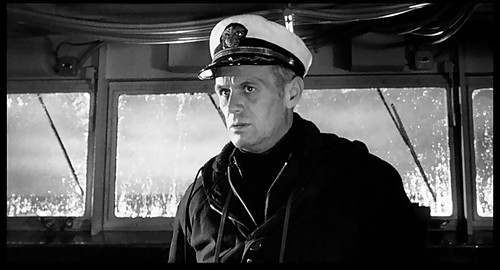
But where that one took to the air, The Bedford Incident plays out at sea in a cat-and-mouse game between a Soviet nuclear sub and a naval destroyer. In command is Captain Eric Finlander (Richard Widmark, steely with just a touch of baleful twitchiness that goes full-on berzerkoid in an interview), a determined commander who takes enormous pride in the proficiency of his crew, and in the hunt and pursuit of his targets. As an advisor is a former Nazi U-boat commander Wolfgang Shrepke (Eric Portman), who was responsible for the most tonnage (ours) sunk during the second World War. Also on board is reporter Ben Munceford (Sidney Poitier), who serves as an exposition conduit and Royal Pain In The Ass. Among the crew are Martin Balsam as the ship's new doc, James MacArthur as a too-eager ensign, Wally Cox as the sonar bat, and if you're watching early and quickly, there's a young Donald Sutherland as a garbage analyst—garbage being clues to conditions on the enemy boat, and age-analysis gives tracking position and history.
It shows how extreme the measures are on the Bedford, how detail oriented, how precise, how strategic and how puckered the thought processes go into keeping an eye on the enemy. And once found, Finlander will pursue chasing Soviet subs out of territorial waters, even forcing them to stay underwater until they're desperate for air, provoking confrontation. When your Nazi adviser tells you he's scared of your methods, it means you might be going so overboard as to pro-actively lower the life-rafts.

If you're immersed at all in pop-culture, you can see elements of Bedford in such disparate strategy plays as "Star Trek" and The Hunt for Red October. And such gamesmanship is all well and good in limited skirmishes. But, when the arsenal is nuclear? Do you really want a cigarette in a room full of gasoline?
 

No, and that the game is played despite the mega-stakes makes the movie and its characters seem not just petty, but a little dim for all the talk of brilliance. The point of hubris is well taken, but the point was better made as an out-and-out black comedy about short-term, selfish interests in the face of global catastrophe.

Friday, June 28, 2024

The Cincinnati Kid

The Cincinnati Kid
(Norman Jewison, 1965) One of the great poker movies, from a novel by Richard Jessup, written by Ring Lardner Jr. (the first studio film bearing his name after being blacklisted during the McCarthy era) and Terry Southern and directed by Norman Jewison.
That's the credits on the final film...and legitimately so. But, at the start of filming, everything was different. The film was originally bearing a screenplay by Paddy Chayevsky—who was warned by Steve McQueen (who had a lot of clout and would throw his weight around on-set) "I'm better at walking than talking"—re-written by Lardner and to be directed (in black and white) by Sam Peckinpah. The Hustler—a film about compulsive gambling (in that case, pool) to the detriment of life—had been a big hit and critical darling...and had picked up quite a few Oscar nominations. So, producer Martin Ransohoff must have had that in mind when this film was being cobbled together in pre-production.

Well, once filming started, Ronsohoff was shocked by the dailies Peckinpah was bringing in—there were scenes that didn't relate to the script—and fired him almost immediately (stories conflict on the details) and quickly hired Norman Jewison, who was most known for directing Doris Day movies, and the production was shut down, giving the new director time to re-assess and make changes. Charles Eastman and Terry Southern were hired to do some re-writing, and Jewison switched to color film—he thought filming red and black playing cards in black and white was counter-productive. 
Talk about gambling.

A New York Times story published Dec. 7th stated: "In trying to put “The Cincinnati Kid” before the cameras, Mr. Ransohoff and MetroGoldwyn ‐ Mayer have run through nearly every possible difficulty that can arise in contemporary Hollywood."
We meet "The Kid", Eric Stoner (McQueen) pitching pennies with a shoeshine boy (Ken Grant), who knows the Kid, knows his reputation and is in a hurry to beat him. Of course, he loses. And the Kid rubs it in: "You're just not ready for me yet." But, the youngster watches him saunter down the street with a lean and hungry look. Everybody will have that look at one point or another.
The Kid, you see, holds markers on everybody in New Orleans, which is fine except that he has to go across the river to dredge up a decent stud game, which—tonight—brought him $194 and the near-opportunity of a shiv between his ribs. But, there's a new game in town: Lancey Howard (
Edward G. Robinson), "The Man", has stepped off a train in the city and is looking for action. The Shooter (Karl Malden), the best dealer in town and who's been bested by Howard in the past, knows The Kid wants to play against The Man, if only to prove he's the best in the game, and the Kid knows he can beat him. He knows it. Shooter had those dreams, too...once.
But, it's making him a bit preoccupied and more self-absorbed than he usually is. So much so that he's ignoring his girl Christian (Tuesday Weld) to the point where she's taking up with Shooter's bad-girl wife, Melba (Ann-Margret), who's so bad that she cheats at jigsaw puzzles. That's not Kitten with a Whip-bad...but it's bad as Chris is naive and Melba is anything but.
The Kid knows all about Melba's habits, but he's focused on the game and all-in. "
Listen, Christian, after the game, I'll be The Man. I'll be the best there is. People will sit down at the table with you, just so they can say they played with The Man. And that's what I'm gonna be, Christian." She can't break through the wall of chips he's seeing, so she leaves town to go back to the folks'.
But, there's another game in town.
Howard has an invitation to play stud with the very wealthy and very competitive William Jefferson Slade (Rip Torn) and the two go at it in a high-stakes 30 hour game that Slade ends up losing...to the tune of  six grand. And Slade doesn't like to lose...to anybody. Oh, he plays the Southern Gentleman just fine. But, he tells Shooter—who dealt the game—that he wants to "gut" the old man the way he feels gutted, and using Melba as a chip, coerces Shooter to slide the Kid the right cards in the inevitable match between them. This goes against everything Shooter believes in, but, with Melba in the mix...
It's gun-slingers meeting over green felt rather than the town square and Robinson is the fast-draw every twitchy trigger-finger kid wants to best. And just about everybody in the movie has skin in the game, if only to see The Man meet his match. With so much interest by outside parties, I come away (after a third viewing) convinced the game is rigged—the odds of the hand being dealt are very long—either
45,102,781 to 1 or 332,220,508,619 to 1, depending who you believe. But, it makes a good story, no matter the odds.
Steve McQueen's poker-face.
Jewison called it his "ugly duckling" film—given his short amount of pre-production time, how could it not?—and considered McQueen the most difficult actor he ever worked with (although he chose to work with him again!), but the film manages to hold up pretty well. There's just enough nodding to New Orleans to give it an exotic air, it's filled with with great actors—Dub Taylor, Ron Soble, Robert DoQui, Joan Blondell (!!), Jack Weston, Jeff Corey, Torn...and Cab Calloway (fer cryin' out loud!), how could it not be entertaining?
 
Yeah, there's issues. Script issues, mostly. But given the paper changing hands so often, and McQueen's way of up-ending tables for the sake of "image," it's surprising that it's as consistent as it is. The Kid zigs when he should zag a couple times—he's supposed to be savvy and be able to "read" people but he gets blind-sided too many times to believe it. 
Steve McQueen's poker-face, when he thinks he's winning.
And there's two endings—the one Jewison had in mind and one mandated by Ransohoff and the studio. The one I've seen the most I don't believe for a heart-beat. I'm out. But the one ending with the freeze-frame? That's aces.


One of the nicest thing about The Cincinatti Kid is the score by Lalo Schifrin, which includes
an End-Title song sung by the inimitable Ray Charles.
It's one of my favorite movie-songs, not only because of Charles
but because it uses the word "pyramid" as a verb.


Sunday, December 17, 2023

Don't Make a Scene: Chimes at Midnight

The Story: I've wanted to do this one for some time, but why I was drawn to it has eluded me.

There are those that will argue that The Chimes at Midnight (or Falstaff, as it was released in some circles) is Orson Welles' finest work, surpassing the "Wisdom of the Tribe" consensus that Citizen Kane is his best film. Made during his long period of limited budgets and maximum ingenuity, it is his most personal work and certainly contains his best performance, combining his penchant for theatricality with his most emotionally vulnerable acting. Welles' bombastic veneer is stripped away, presenting a frail strength that is, frankly, a bit breath-taking.
 
Welles' characters were always larger than life, but, here, that effusiveness is exposed as a facade, a role to be played and then dropped in moments of privacy. It's heart-breaking, even though the character of Sir John Falstaff is considered a comic character in the Shakespeare plays in which he appears. Welles amalgamated those snippets and appearances to form this one film about one of the Bard's most fully-formed background characters.
 
And it's a tragedy. A dressing-down of a boisterous, profligate windbag who's the life of the party...when there is a party to be had, or made. Without one, well, let's just say that he doesn't do well in an empty hall, and will always be the last one to leave, but resists the clean-up and the putting up of chairs. When the revels have ended, he dies in a way.
 
It's a great role for an actor, and for Welles, in particular, who seemed to wear an entourage like a cape.
 
The Criterion Collection put out a lovely presentation of Chimes at Midnight, but one particular Bonus Feature haunts, a talking-head rumination by Simon Callow, who has probably spent more time thinking about Welles than anyone in history. He has written three massive biographies of Welles since 1997, with the fourth...well, he's still working on it. In it, he postulates that Welles saw a lot of his own father in the character of Falstaff; he describes Richard Head Welles as a "Champaign Charlie", who spent his considerable wealth as an inventor on wine, women, and song-halls. Good times. New inventions that went unused, minor successes, but mostly failures, all stewed in an alcoholic haze. When young Orson was enrolled at the Todd School and starting his prolific stage career, his father would show up at the performances, drunk and causing disturbances. Welles was advised to inform his father that he wouldn't see him again until the man stopped drinking.

Of course, that was the last time Welles ever saw his father. There is absolutely no way in which Welles couldn't see the rejection of Falstaff by the newly-crowned King Henry, his former rowdy conspirator, as an echo of the shame of that act. And his Falstaff, rejected, but still brimming with pride at the ascension of the younger man achieving his full potential, is a heart-breaking, bittersweet moment of humiliation.

One other thing about this scene: the character of Shallow—who also appeared in a couple of the Shakespeare plays—is something of a fool, repetitive in speech, and constantly nostalgic for his glory days, which probably never existed in the first place. Falstaff, however, is self-aware enough to know this. But, he lets the older man have his nostalgia...as an act of generosity and empathy. And recognition.
 
And grace.
 
The Set-Up: The film is just beginning, although the story has already happened.
 
Action.
 
1. ELS: two figures silhouetted against a snowy field cross the frame from left to right.
An outcropping of rock in the left foreground and the trunk of a large tree frame the figures. An unaccompanied recorder provides background music. They pass behind the tree.
2. LS: the two figures, one behind the other, approach the camera on the right. The tree now is at the left, and the other trees form a background. The black-clothed figures and the dark trees and rocks are set off against the snow and the light sky. As they approach, the second figure, much larger than the first, can be seen to be walking with the aid of a cane.
JUSTICE SHALLOW:
  Jesus, the days that we have seen.
FALSTAFF: He, he.
SHALLOW: He, he. Do you remember, since we lay all night in the Windmill, in St. George's Field?
(Shallow moves out of the shot frame right)
FALSTAFF:
No more of that, Master Shallow.
(Falstaff follows Shallow out of the shot).
3. LS: Falstaff and Shallow enter a low-roofed building, supported by wooden posts. A brazier with a wood fire is in the right foreground.
SHALLOW:
Ha, ha, ha, ha. 'Twas a merry night. 
(A bell begins to toll in the background and continues intermittently through the scene).
SHALLOW
Is Jane Nightwork alive?
FALSTAFF:
She lives, Master Shallow.
4. ELS: Falstaff and Shallow enter at the far end of a large barnlike room. Its timbered beams and roof are visible.
SHALLOW:
Does she hold her own well?
FALSTAFF:
Old, old, Master Shallow.
(The camera tracks back slowly as Falstaff and Shallow advance toward it diagonally from right to left, crossing the center of the room).
SHALLOW:
Oh, no, she must be old. She cannot choose but be old.
(Falstaff and Shallow are now in MS, having just passed under one of the large beams. Shallow, behind Falstaff, motions him forward.

SHALLOW:
Certain she's old, 
SHALLOW:
and had Robin Nightwork...
5. Falstaff's back is silhouetted in MLS at the left, against the light from a blazing fireplace, 
as he bends under a low beam and prepares to seat himself in front of the fire.
He sits down on a bench, back to the camera, and Shallow, following, prepares to sit down next to him.
SHALLOW: ...by old Nightwork before I came to Clement's Inn.
6. Falstaff at the left in ECU, Shallow at the right in CU, their faces reflecting strong light from the fire.
SHALLOW:
Jesus, the days we have seen. // 
SHALLOW:
Ha, Sir John? Said I well?
FALSTAFF:
We have heard the chimes at midnight, Master Robert Shallow.
SHALLOW:
That we have, that we have, that we have. 
SHALLOW:
In faith, Sir John, we have.// 
SHALLOW:
Jesus, the days that we have seen.
Fade Out.

The Chimes at Midnight (aka Falstaff)

Words by William Shakespeare, Raphael Holinshead, and Orson Welles (Continuity script edited by Bridget Geller Lyons)


The Chimes at Midnight is available on DVD and Blu-Ray from The Criterion Collection.