Showing posts with label Felicity Jones. Show all posts

Saturday, February 22, 2025

The Brutalist

A Hell-hole of His Own Design
or
"I Just Don't Appreciate It. I Cherish It"
 
These days get me down.

Brady Corbet 's The Brutalist (made for an incredibly modest $10 million) comes with all the showmanship brio of those old "roadshow" films of the 1950's and 1960's, back in the day before the trend today where every movie became its own sole inhabitor of a given theater's screen...when movies openly defied the "bargain-prices-for-the-masses" concepts of the now-extinct double-bill for the self-proclaimed "importance" of the single solitary roadshow attraction. Those "big, important" presentations did not survive the decade of the 1960's when the more independent and youth-oriented...and cheaper...films (which defied the portentousness ambitions of their more gaudy studio products) took over both screens and audiences' interests. The Brutalist has the ambitions and trappings of those roadshow attractions: VistaVision photography, an Overture (all 30 seconds of it, really) and an intermission at the 2/3rd mark to give you a recess to escape during its 3½ hour length.
Not that it's really needed. The Brutalist moves along at a quick, if somewhat trance-like pace, but without any of the sweep that you'd expect in the blockbuster format. And that intermission comes at a time when there is an interruption of the story-line—a work-project is stopped—and the film takes up a few years later after everyone has moved on and must once again begin the project after law-suits are settled. A less time-consuming interstitial or an added narration might have been enough to impart that information, but I guess the filmmakers wanted to impart the sense of time being wasted...The Brutalist began production in 2018 and didn't start photography until March 2021 and was delayed by the pandemic until further work in 2023. An intermission probably felt organic to the process.
But, it isn't, really. It just marks the demarcation point where the movie starts to unravel. The "Part 1" of the film--and, yes, it has "chapters"--"The Enigma of Arrival" sees the arrival of László Tóth (Adrien Brody), a Polish architect, who has barely survived the Holocaust and arrives in post-war New York, ahead of his wife Erzsébet (Felicity Jones) and niece Zsófia (Raffey Cassidy), to do what so many refugees and migrants have done—try to make a new life for themselves after leaving a life with little prospects. At this point, Corbet is happy to provide every detail in his story-telling and make some bold choices doing so. Toth's arrival in New York—when he finally is able to emerge from the dark hold of the ship and into the sunlight—is highlighted by his first glimpse  of the Statue of Liberty—but Corbet presents it to us upside-down, as if we were looking back at it from behind. This might have been just for practical purposes—you shoot up at Lady Liberty so you don't have to show the New York skyline, which looked very different in 1946 than it did at the time of filming.* It also says something, vaguely (if one is looking for such things) about the Ancestry.com fairy-tales of immigrants braving the unknown to "make a better life" for themselves than what they would find on their home-soil.
But, The Brutalist takes those stories that have become so familiar on "Finding Your Roots" and turns it—like the Statue of Liberty—on its head. Ship's manifests and census records can tell you the "when" of things, but not the "how" of things—of prejudice by the already-established immigrants (all of them being immigrants, ironically, except for the indigenous tribes and there was a "final solution" reserved for them, as well), of huddled masses forced into "Little" communities of slums, and of hard-scrabble existences, supposedly based of hard work and fortitude, but mostly based on dumb, stupid luck and the seizing of opportunity. And will, a basic will to survive.
The Brutalist rubs your broken nose in it. Toth is initially welcomed in Philadelphia by his cousin, Attila (
Alessandro Nivola) who runs an established design-furniture store, Miller and Sons, and takes him in, hiring him for his design-work and giving him a little room in the back of the storeroom. The cousin has assimilated ("Who's Miller?" "Me" Who are the sons?" There aren't any"), changed his name, become Catholic, married a shiksa wife (Emma Laird) and she is less than pleased with the arrangement. An initial job to design a modernist chair for the store-window produces a tube-dominant functional design that would hardly attract customers.
But, the company gets a commission—the children (
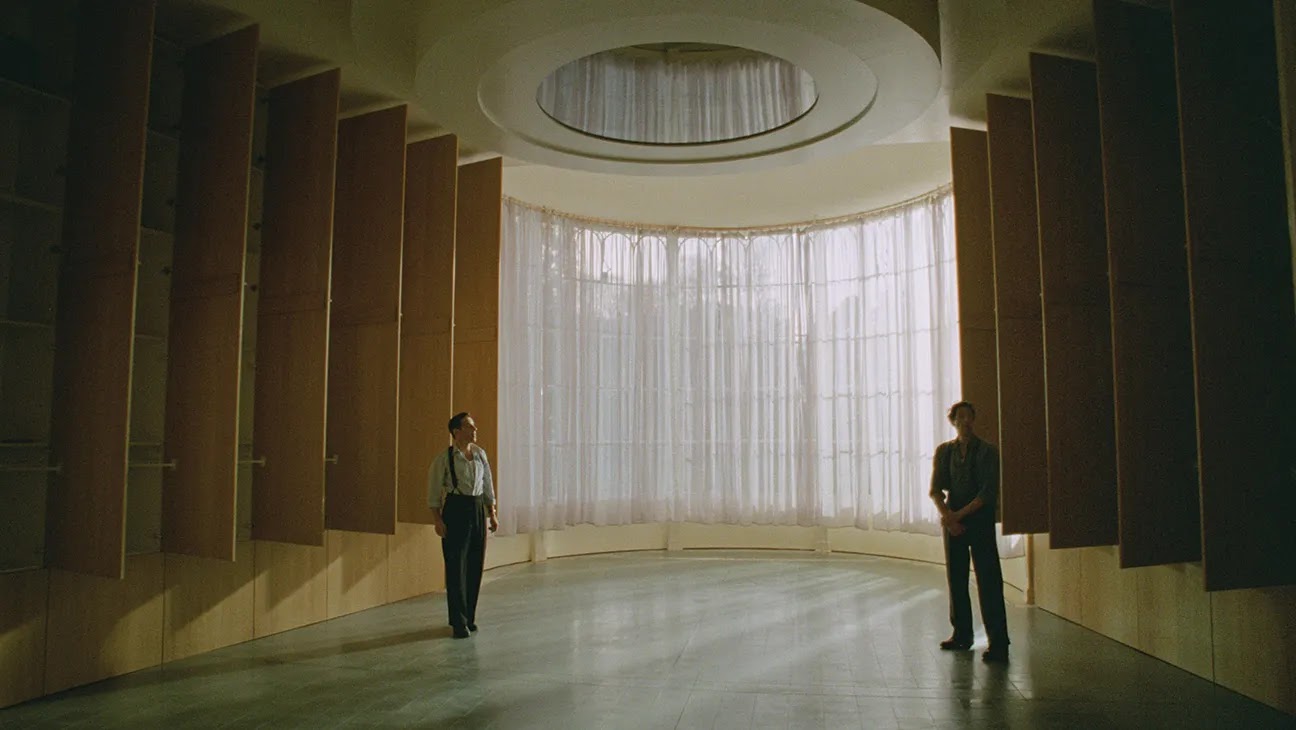
Joe Alwyn, Stacy Martin)of a rich businessman, Harrison Lee Van Buren, Sr. (Guy Pearce), want a library constructed in his mansion while he is tending to his ailing mother. The job has its challenges—the desired location is all vaulted windows letting in sunlight that could fade the valuable first editions. What to do? Toth has a solution and it is a bold one.
Keep the windows. Protect the books. Cantilevered doors hide the shelves and their precious burdens. But when Van Buren the Elder comes back, he isn't pleased ("I don't like surprises!"—Pearce, here, is at his foaming, berzerker best) because there's a BLACK man (one of the workers) in his drive-way, everything's different and his Mother's in the car. Get OUT! Get OUT NOW! No explanation is heard or good enough. "Miller and Sons" doesn't get paid for the commission. They have to pay the expenses. They'll be lucky if they're not sued. So, "of course", cousin 
László gets sacked by his own cousin. The assimilation gets set back a few years...if it was ever going to happen at all.
The Brutalist has a pace, but it's a herky-jerky one, sort of like the phrase a friend reminded me of the other day: "The days go slow, but the years go quick." Flash forward three years. László is a laborer shoveling coal, living in a charity house, addicted to heroin, his only friend is Gordon (Isaach De Bankolé) a single father also down on his luck—he was the guy seen in the driveway that Van Buren was so incensed about—working at the same facility. Then, one day Van Buren the Elder shows up at his work, invites him to lunch, and tells him a story.
At lunch, he shows Toth an article in an architectural magazine, extolling Van Buren and the library's aesthetic, and the magnate has done some digging, found out the name of the man who created the masterpiece he now owns and for which he, the owner, has been lauded. He's researched him, discovered the architectural work he did in Europe before the war, and...pays him for the work he did on the library. Toth's work has made Van Buren an exemplar of an aesthetic—even if he didn't know the name of the man who designed it or anything about why the fuss being made about his library—and he invites him to a dinner the next night so he can meet his society's circle and maybe...how he can be used in the future. Toth celebrates by taking the money and buying heroin.
At the dinner, Toth is fêted by the Van Burens, where he is treated as an honored guest and treated with an air of "your not one of us but we like what you do." He meets Van Burens' lawyer, the only other Jew at the table, who offers his work to try and patriate
Erzsébet and Zsófia out of Eastern Europe to America. And something else. The next day, Van Buren tells him of "a vision" he wants him to design and build. "Something boundless. Something new." There's a site on the highest point of his property overlooking the village of Doylesville, where he wants to build a tribute to his late Mother, a center consisting of a gymnasium, a library, a gathering center...oh, and per Doylesville request...a chapel. A Protestant chapel. Toth, thinks Van Buren—still aglow from his reflected light of Toth's work—is obviously the man for the job.
Maybe he is, but he's certainly the most handy. And, given Van Buren's patronage, if not sponsorship, he's the one who can achieve Van Buren's "vision." But, first, Toth needs to get his own vision approved, which is where Van Buren, who pulls a lot of strings, is at his most useful—besides funding the project.
And why shouldn't he fund it? It's a Van Buren version of a Pyramid, the grandest tombstone his mother—and probably any member of the Van Buren family could have. Toth's designs are different, large, blocky made of concrete and though not really brutalist in design, the brutalist school was very influential in the production of
government buildings and slums—and prisons. But a prominent negative-space crucifix atop it seems to reassure the doubters. The rest of the movie is of Toth's struggles—and they are constant—in trying to keep the integrity of his design (despite middle-men, budget-cuts, capricious "second-thoughts") in a Sissyphussian environment of anti-semitism, xenophobia, and just plain interference for interference's sake.
It's an example of that disease that suffuses American business (and I suppose any business), "office politics." For whatever reasons, egos clash, contrariness becomes the norm and the "Bad CEO" lords over the chaos, letting it happen, because he likes people "doing their jobs" even if it's at cross-purposes ("Leslie is a bastard." "Yes, he is. That's what we pay him for."). Toth tries to negotiate the madness, maintaining his vision of Van Buren's vision, and retreating into heroin when the pain becomes unbearable. Watching it unfold is like being a functionary at a terrible job at a terrible company, choking on its own cholesterol-like dysfunction.
And the building itself, the "Van Buren Institute", that great Pyramid to an industrialist's vain-glory? We never really get to see it. What we get to see are empty corridors and walk-ways, a vast inner chamber at its core, seemingly a shell of a building housing mazes and catacombs that a despondent man can get lost in and die. We never really get to see its scope or the wonders that might have impressed and inspired in the first place. It's a big vacuum in the center of the movie that might have done more than provide ambiguity. It's a "commission," nothing more. An idea, unrealized, at least in terms of the movie.
If that wasn't frustrating enough, the movie has a coda. It's 1980 and Toth is elderly, in a wheelchair, attending another 
fête, a retrospective of his work, and, because he is too weak to speak, his niece speaks for him, and says something that hit me with a thud and make me bitterly leave the theater, questioning the writers and if they knew what they were writing.
"Don't let anyone fool you, Zsófia" he would say to me as a struggling young mother raising my daughter during our first years in Jerusalem, "no matter what the others try and sell you, it is the destination, not the journey."** 
 
Well, that's just bullshit. Only an artist—be they architect or a manipulative director—an entrepreneur or politician (with visions of dictatorship dancing in their heads) can go along with that "the ends justify the means" thinking. Human experience informs us, changes us, manipulates our thoughts and our ideas. Often it is the journey—not the destination—that is important (Erzsébet after coming to America says this: "This place is rotten. The landscape, the food we eat. This whole country is rotten."). Yes, it's good to have goals. But, what do you have to become to achieve them? Is it worth getting what you want by—where you want— by sacrificing everything but the dream?
 
The sportscaster Red Barber had a wonderful rejoinder for the old "whoever has the most toys, wins" mind-set: "God doesn't count the toys. He counts the scars."
But, the edifice will excuse it all. After all, people still flock to the Pyramids; nobody cares what kinds of horrors inspired them or carried them out. Our Edifice Complex negates all that. Why (he says sarcastically) maybe the slavery was worth it, Ozymandias...
 
Tell that to the wrecking ball.
This piece has taken me forever to write—despite "The Last Word" at the bottom of the page I do not always find writing bad reviews "fun"—and I've been listening to and reading rave reviews for this film, trying to understand what they're seeing that I'm not. All I can conclude is that the framing, cinematography, and acting (all of which are quite good) have overwhelmed any critical thinking about content. "Style over substance".*** "Miller and Sons." That old trick. But not for me.
 
I like ambiguity. I cherish it in movies if it's not a stunt (as Hollywood so often makes it). You can even be vague about things. But, The Brutalist asks questions that it doesn't bother to answer, nor does it seem to care, as if a point of view was something beneath it to attempt. I shouldn't have to divine what it's attempting to say (if anything). It should be there on the screen so that I can share the artist's thoughts. That's the very basis of communication and the DNA of film. But, Corbet's film tries so hard not to tell a story, or to advocate for anything, other than that life, even a life devoted to your craft, is misery. In the end, The Brutalist is neither inspirational or aspirational. As such, as a work of art...it is useless.
I wouldn't be at all surprised if this wins the Oscar for Best Picture.
 
These days get me down.

* I've always loved the story Sidney Lumet tells—in his book "Making Movies" (©1995, Vintage Press)—of meeting his hero, director Akira Kurosawa, and asking him why he had framed one particular shot in Ran the way he did and the Japanese Master told him that if he'd panned the camera one inch to the left, the Sony building would have been visible and one inch to the right, an airport, neither of which were appropriate to a samurai movie. It's not all inspiration and artistic intent.
 
** Here's the thing—not even Toth believes that, if we're to believe the screenplay. If he had, why then would his time at Buchenwald inspire the dimensions of the Van Buren Institute (in the same speech, his niece says this: "The building referenced his time at Buchenwald as well as the deeply felt absence of his wife, my Aunt Erzsébet. For this project, he re-imagined the camp's claustrophobic interior cells with precisely the same dimensions as his own place of imprisonment, save for one electrifying exception; when visitors looked 20 meters upwards, the dramatic heights of the glass above them invited free thought; freedom of identity. He further re-imagined Buchenwald and his wife's venue of imprisonment in Dachau on the same grounds, connected by a myriad of secret corridors re-writing their history and transcending space and time so that he and Erzsébet would never be apart again.") So...in other words...his journey through the war years inspired the destination. Or is the niece putting words in the mouth of the elderly Toth, for his benefit to burnish his image, and so is she also a part of the same self-aggrandizement as, say, the nefarious benefactor Van Buren? Is everybody in this movie corrupt?
 
*** I'm reminded of the story Jerry Lewis told about Stanley Kubrick, who was wandering around during the days of making 2001: a Space Odyssey while Lewis was struggling to edit his abortive The Day the Clown Cried. Kubrick was sitting in the back of the editing room just hanging out, taking it all in when Lewis said over a particularly frustrating "cut," "That's it! You can't polish a turd!" To which Kubrick responded (after a thoughtful pause): "You can if you freeze it..."

Thursday, January 28, 2021

The Midnight Sky

It's Lonely Out in Space...
or 
Our Future...Didn't Quite Turn Out That Way

Barbeau Observatory, located near the Arctic Circle, has been evacuated after a global nuclear catastrophe—everyone wanted to go home for the end. Except for Dr. Augustine Lofthouse (George Clooney). Someone has to stay at the observatory watching the night skies and maybe contacting the space missions still out there. And he's dying anyway. As one of the departing techs observes, given the situation, he'll probably outlive them all.

There is one ship out there that hasn't been evacuated and is still occupied and functioning—the ship Æther, which went out to the orbit of Jupiter to explore K-23, a moon of the gas-planet that seems to be—as they say on "Trek"—"Class M". It can sustain human life. They're supposedly on their way back, but nobody knows that because they've been out of contact for a long time. Augustine has a personal stake in the mission as it was his theoretical work that inspired it, and he's completing his life's work trying to reach them to tell them that it's no longer a reconnaissance trip and to go back. There's nothing to come home to. 
Onboard ship, the crew—"Captain" David Oyelowo, Felicity Jones, Kyle Chandler, Tiffany Boone, and Demian Bichir—have successfully scouted the Jovian moon in question and it hits the "Goldilocks" sweet-spot of conditions: not too cold, not too hot, but "just right." Water is plentiful and vegetation abundant. The orange sky will take some getting used to, but the close proximity to Jupiter has its compensations and abundant landscape photo-ops.
The crew has been out of touch with Earth and that's caused some issues. Astronaut Sully (Jones) thinks there might be a glitch in their system somewhere, but the ship is complicated enough with artificially-generated gravity, supplies, greenhouses, and the like that trying to pin-point a fault would be harder than finding a hospitable planet in the Solar System. Now, on the leg home, they're spending a lot of time being nostalgic for Mother Earth and their families on it. A lot of time being spent in therapeutic holo-suites with family-memories. They don't know that anything is wrong on Earth or that there is nobody on Earth trying to contact them.
Except for Augustine, of course.

Now, the only one at the observatory, Augustine settles into a routine of taking pills, daily hemodialysis, the perfunctory meals (usually taken with scotch). Isolated and alone, he has a lot of time for there to be flash-backs, nightmares and mind-wanderings. So, he can be forgiven if, at breakfast, he finds a half-finished bowl of cereal sitting at the table. Maybe it's the aloneness, maybe it's the drinking, but obviously, the routine has slipped.
But, it's more than he's thinking. Wandering around the station, he finds a little girl (Caoilinn Springall)—curled up, sleeping, hiding. There had been some confusion during the evacuation...and then, this child. Another responsibility, which he is not ready to cope with. At first, he tells the deliberately mute child (whom he finds out is named "Iris") that she's on her own, that he can't handle the work AND take care of her. But, there's nowhere to send her. They are now stuck with each other, and she is now a constant presence ("Don't touch anything!" he frets while he's working "You know, there's no rule that says you have to TOUCH everything."). Eventually, she will be a comfort.
There are complications aboard the Æther: their trajectory from Jupiter is slightly off and they have to weigh whether to do course-correction burn or take a chance going through a route in space that hasn't been properly "mapped-out." Personally, I'd go for the course-correction because any deviancy from "true" will only increase the farther they go, but they vote to do nothing and risk it. How like "Earthlings". Oh, and Sully is pregnant with Captain Adwole's child. Everyone has a suggestion what to name it. Except for that off-kilter trajectory, everything is nominal.
Back on Earth, the atmosphere around Barbeau is becoming increasingly toxic and time is running out, so Augustine decides to travel to a weather station at Lake Hazen with a more powerful antenna in the off-chance that it'll be just enough to reach the Æther. He packs up his supplies, dialysis gear, and does the proper parent-thing of bundling up the girl for a snow-day, and they set off on a snowmobile to reach their destination. 
At the Æther, there is another problem: a hitherto unknown cluster of ice-fragments is hurtling around the solar system in the asteroid belt and the ship runs smack-dab into it, causing a lot of damage to a couple of the ship's systems—radar and communications, mostly. They're going to need the communications, so they decide to "take a stroll around the block" and make repairs. Sully, Adwole, and Maya (Boone) suit up and crawl around the outside of the craft with their spare parts to DIY the broken systems.  
At this point, you begin to realize time is running out on both sides of the solar system, despite there being very few people to do anything and a lot of space to do it in. In all that expanse—of space and snow-scape—the chances of connection, despite wonders of radio communication, are remote given the solitary beings 329 km apart. With all that geography, time becomes a precious commodity while also being a brutal deterrent. Nature, or the destruction of it, will make its course in its own time. It makes an interesting conundrum to ponder while everyone is trying to hurry things up...but can't.
The Midnight Sky is directed by Clooney and, given his access to so much material because of his demand, it's always interesting to ponder why he does the projects that he does. Perhaps his ever-increasing age (he's a "twinkly" 59 years) is making him consider that time is short and its one commodity that his earnings can't buy more of. But, this film—which looks great, and it's a pity that a film of this budget and scope isn't playing theaters (except in a limited Oscar-qualifying engagement), but is stuck in the limited dimensions of Netflix—has an interesting ability to stick in the head and make one consider the shortness of life amid the imponderable extent of cosmic time. 
And, as a director on this one, Clooney is focusing on spectacle rather than letting the performances carry it. The landscapes are artfully presented. The framings are formal, often symmetrical, only to break the rule to go full-tilt Alfonso Cuarón during the space-walk (and even then he has a nice feel for perspective—you're rarely disoriented). There are long stretches without dialog, but the movie doesn't drag and there's a nice sense that there isn't a lot of unnecessary "explaining" that needs to be done for the audience's benefit.
It also takes the time to have little "grace-notes," little touches of a shot or two which speak volumes about the characters without having to talk about it. The performances are uniformly good, but, for me, Demian Bichir and Kyle Chandler get the kudo's for most elegant acting here, with Tiffany Boone providing the most comic touches and the most tragic. A bonus is another of those lovely scores by Alexander Desplat.
It's a good watch, but it's not "whizz-bang." The Midnight Sky is one of those proverbial "good" science fiction films whose brain-shelf-life goes beyond the ephemeral "what happened there?" of its "Twilight Zone" machinations and makes one consider the possibilities mythic, parental, and biological all in one melancholy little package*—a 21st Century version of On the Beach** for the Space Age.


* Melancholy in the same way that George Carlin broke down the hopefulness behind Earth Day: "EARTH day! The EARTH will be FINE. WE'RE the ones who're fucked!"

** At one point in the film, Kyle Chandler's family man on the Æther is watching that Stanley Kramer picture in his room.

Tuesday, March 14, 2017

A Monster Calls

When the Bough Breaks
or 
That's Ent-ertainment!

Seeing a lot of depressing films can really put the zap on your head. Makes you not want to write about them. Makes you not want to see anything for awhile. But you have to resist that urge.

Because you might miss something brilliant.


Something like A Monster Calls.

A Monster Calls didn't do any "business," really. It had that icky "The BFG" feeling, the kind that keeps away audiences, even family audiences, because it seems it might be too frightening or nightmarish to families who don't think twice about taking their kids to The Avengers or some lumpen play-doh-pixel animation that won't inspire sleepless nights—for kids or their parents (Hey, Hollywood, Mom and Dad gotta sleep!) That stuff is safe, like sugar-water; it keeps them bouncing on the seat-springs for 90 minutes and when the rush is over and done with, then it's safe to put 'em in bed, with their revenge-fantasies and sermon-stories cavorting like empty calories in their heads.  And in the morning, they burst like bubbles, because there's nothing challenging there. At least, nothing like real life.

Who needs that, after all? For that, you can stay home.
Conor O'Malley (Lewis McDougall) is having a nightmare—the one "with the darkness the wind and the screaming." In it, he is in a blasted landscape, a graveyard that has opened up, more grave than yard now, and he is desperately clinging to something hanging over the edge. A look into the pit and he sees his mother (Felicity Jones...of Rogue One) desperately grasping his arm, trying to keep from falling into the abyss. But, he can't prevent it; he's just 12, somewhere as the narration tells us "too young to be an adult; too old to be a kid."
Conor wakes up from his night-mare and goes to his day-one. He makes breakfast—cold cereal—gets dressed, takes one look in at his mother and trudges to school where he sits in the back of the class, dead-eyed, rather be drawing, and notices the askance glare of the bigger bully who will beat him between classes. He's getting it from all sides: his father is absent, living in the U.S. with his new family, but who talks about visits when all Conor wants to do is escape; his grandmother (Sigourney Weaver) is coming to visit and she's a brittle, stern woman who has issues of her own, Conor's struggles not being among them, with talk of living with her in her antiseptic memory-steeped brownstone; because Conor's Mum has cancer and the treatments are making her sick and weak...and not making her better—it's time for a more aggressive treatment in hospice.
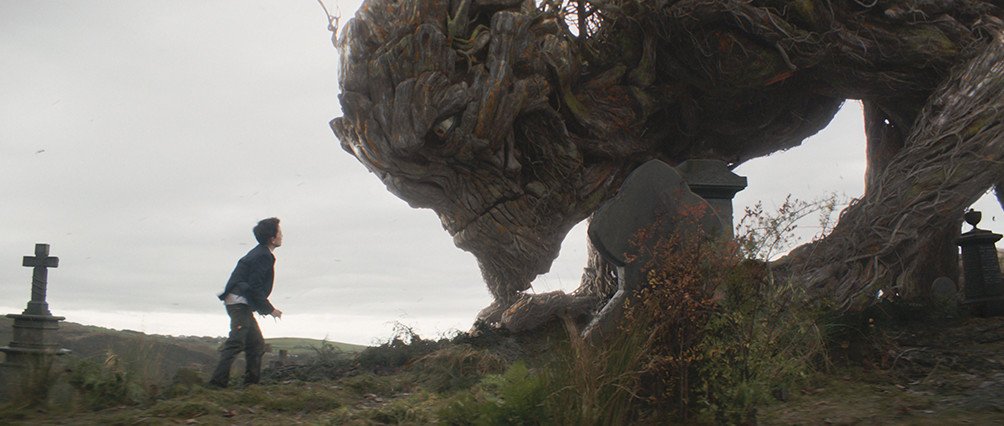
Conor retreats but he can't go far. Sleep brings the nightmares and his drawings are disturbing things that one night manifests to life in the form of a an animated yew tree (voiced by Liam Neeson)—the one that sits in the graveyard of the local church—that uproots with a burning fire inside it and invades his room at precisely 12:07 am with an ominous warning; he will tell him three true tales and once those stories are complete, Conor must reciprocate with one of his own—and if the story is not true, the monster will eat him.
Pretty simple story, with Grimm elements of the macabre, but A Monster Calls is anything but simple. When the stories begin, the film warps and woofs and spatters into bizarrely wondrous illustrations that morph into surrealism and suggestivism to tell their fairy-tale stories of kingdoms and wizards and differing points of view, but each of them have an edge that defy fairy-tale logic and mannerisms, don't hew to myth but to behavior and the complexities of psyche, paths that confuse and confound Conor, shaking him down to his his own core-beliefs of childhood, uprooting his own naivete and the expected behavior of youngster-hood.
Dad comes to visit, but he can't stay long, and before you know it, he's just a memory, leaving the situation of his ex-wife and son behind to return to life in the U.S. Mum moves to the hospital, and Conor to his grandmother's, where he is a stranger and a bit of a burden, an outsider but not a center of concern. The only one who seems to notice him and pay attention to him is the Monster, who tells Conor that, rather than the Monster coming to him, maybe it is Conor who summoned his presence to him.
A Monster Calls is an anti-fairy-tale, which does not comfort; it is a kid's movie not for kid's and that they won't understand—maybe be fascinated with the graphics and the out-sized emotions, but it ultimately will run against the grain of a child's expectations of easy solutions and happily-ever-after. But, it is also a film that is so much made up of the anxieties of a child's world that is much too large for them to be comfortable in, even if they grow five times their size. The embedded stories are not safe and, though they toy with issues of good and evil like a fable, the palette gets all mixed-up and smeared with the light and the dark. The images (created by the FX-house glassworks Barcelona) are beautifully painted nightmares (they also did the Tree-Monster FX although a bit more photo-realistically) that shift along with the attitudes inhabiting its characters.
Kids don't know id's, even while they are acting out on them all the time. They wear their hearts on their sleeves, even if they don't know exactly why they are feeling what they are feeling. Children don't know the secrets of adults (most times because one of those secrets is that they're being protected from them by their parents)...that time is short, life is hard, and that eventually yesterday's outnumber tomorrow's. Kids don't need to know that time is the ultimate bully and it will beat you up and it won't wait for recess to do it.
Life is hard. That's the reality of it, but a child is sheltered from the more harsh realities of life. A child barely knows life that they should know anything about death. Nor that, at the moment of their birth they're carrying an hourglass and time is running out for the first second. Children shouldn't know that stuff. They're fed stories that conclude "...and they lived happily ever after," when there are actually no guarantees on the "happily" and a definite negative on "they lived...ever after." The curse of original sin (from the biblical stories) may not be from the tree of knowledge, but born of the knowledge of death. Death thus becomes childhood's end even as it is for another. Life is cruel that way.
No, not cruel; Life is merely indifferent. And as I've said about indifference here before, it is the opposite of love.

As I said, maybe not for children—they can't comprehend the future. But, for adults, with memories of the past, it is amazing. And if those memories involve loss, there will be tears...over the painful dichotomies of life...and death...and how both can be embraced. A Monster Calls is that special.

Right down to its anti-fairy tale roots.


Friday, December 16, 2016

Rogue One: A Star Wars Story

The Force is Strong with this One
or
"You've Got to Start Some-where..."

Even though, as they say, I had "a bad feeling about" it, maybe this selling "Star Wars" to Disney may have been a good idea.

Rogue One: A Star Wars Story comes with the hype and anticipation as any entry in the saga "a long time ago in a galaxy far, far away" will. But, Rogue One goes in uncharted territory: it doesn't start with the big "Star Wars" crescendo and an opening crawl to infinity and beyond, the cast is unfamiliar and made up of mostly new characters.* And the synopsis we already know—it was in the opening crawl of the first "Star Wars" movie in 1977:

"It is a period of civil war. Rebel spaceships, striking from a hidden base, have won their first victory against the evil Galactic Empire. During the battle, Rebel spies managed to steal secret plans to the Empire's ultimate weapon, the Death Star, an armored space station with enough power to destroy an entire planet."
Rogue One is the story of those rebel spies, and it's a curious mixture of taking things in new directions while being devoted to the first film's original intentions. One thing that's always bothered me about the "Star Wars" films—after that first one that basically exploded a brand new Universe in a Big Bang and being so rich in detail, the sequels—all of them—collapsed on themselves. Sure, they'd visit a new planet with a singular eco-system (an ice planet, a "gas-planet," a "forest moon," a city-wide planet, a lava-planet), but they'd pretty much stage a galactic war in one place—budget considerations, probably. This movie gambit made that supposed galaxy-wide conflict pretty much a bottle-world where an event in one little corner would affect the Universe. Some "Empire."
But, Rogue One takes us all over the space-place, some new, some familiar. In fact, it jets around from one planet to another, not unlike the first film and the only other one that did, pre-tinkering, Revenge of the Sith. Those used to the usual limited-Universe view may actually become a bit confused at some point wondering "what planet is this, again?"
Before we get to the other aspect of it I liked, a brief synopsis: The building of the Death Star has fallen behind schedule and Imperial Director Orson Krennic (Ben Mendehlson) travels to the home of Galen Erso (Mads Mikkelson), one of the original engineers of the project, who has retired to a simple life of farming. Krennic's arrival is not welcome and Galen instructs his wife Lyra and daughter Jyn to go into hiding to avoid detection. Krennic will not hear of Erso's protests that The Death Star will not actually "bring peace to the galaxy" but terror. "You have to start somewhere," replies Krennic (with my favorite line of the movie).

Protests aside, Krennic takes Erso away, Lyra is killed and little Jyn goes into hiding, where her pre-arranged rescuer is Saw Gererra (Forest Whittaker), veteran of The Clone Wars and a leader of the Resistance.
It's 13 years later and the Death Star nears completion, which creates an up-tick of activity among the Rebels: an Imperial pilot named Bodhi Rook (Riz Ahmed) has defected, charged with taking a holographic message from Galen Erso to the Rebels. Their main base is the fourth moon of Yavin, where they bicker about strategies and have doubts about the Empire's so-called "super-weapon" (after thirteen years, no wonder!) Rook makes it to Gererra, now on the planet Jedha, and who is seen as "too radical" by the main force of the rebellion, and Jyn (all grown up to be Felicity Jones)is rescued from an Imperial Labor Camp by rebel Cassian Andor (Diego Luna) and a re-purposed Imperial droid named K-2SO (voiced by Alan Tudyk, who makes the most of his lines) to be taken to Jedha in the hopes of her leading them to Galen, so the rebels can kill him.
Well, they get to Jedha just in time for an uprising against the Rebellion by the populace, aided and abetted by two "Protectors" of "the Whills,"** Cherrut Imwe (Donnie Yen), a blind warrior dedicated to the ways of The Force, but not a Jedi and his companion Baze Malbus (Wen Jiang) a mercenary sharp-shooter (when you're a blind swordsman against Storm-troopers with blasters, it's good to have one of those around!). They all get captured by a group working for Gererra, who has a complicated history with Jyn that needs going over before he can show her the hologram of her father.
In the message, Erso tells his daughter that he has been forced to work on the Death Star against his will, but has taken pains to create a defect in the system that they can find out by procuring the weapon's plans held by the Empire's version of "Iron Mountain" on the planet of Scarif.*** Jyn wants to go to the area of space where the Death-Star is being built to try and rescue her father (which the Rebels are all-too-willing to agree to, since they want to KILL her father).
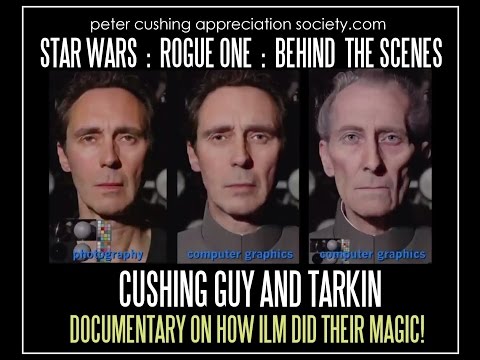
Things do not go so well for both the Rebels and Krinnic: Krinnic's control of the Death Star is undermined by the knowledge that he has let slip a security breach (oh, those uncontrolled servers) and this allows the Grand Moff Tarkin (Guy Henry, CGI'd to look like Peter Cushing****) to take control of the Death Star. His first target: the rebel base at Jedha. If you've seen "Star Wars," you're all too familiar with the sequence of events—a lot of switch-throwing, reaching for dials, and SSHHHHZZZZT! But, this is not the Death Star at full-power—it's firing just enough to wipe out a city, which it does with extreme effectiveness in a mult-plumed mushroom cloud. As K-2SO says, "There's a problem on the horizon. There IS no horizon!!"
The man battle and where things come to a head is the security facility on Scarif, which features an all-out assault between the Empire and the Rebels to get hold of those plans and director Gareth Edwards (he directed 2014's austere and weirdly effective version of Godzilla), where the disparate band of fighters with aerial support from Yavin fight to get those plans against everything the Empire has to throw at them, including things we only saw in the sequels. It's a terrific sequence that has genuine moments of edge-of-your-seat direness, and in case you think there's going to be a follow-up to this movie, there isn't...unless you count the original Episode IV.
And that's one of the things I like about Rogue One: it is its own movie, to be sure, but it is so tuned to the zeitgeist on the inspiration for "Star Wars" that it seems less removed from Lucas' sources than even Lucas managed. There are strains of Kurosawa throughout this, a level of disparity among the roles, not just in ethnicity but also in background story. Some are inspired by religion, some by revenge, some just because they're bad-asses itching for a fight. This Magnificent 7 are all scruffy, none of them polished—even K-2S0 is a might rusty—and the world they fight in is smudged, lived in and full of little goo-gah's that don't call attention to themselves, but exist as if they're part of the real world, not because they serve a dramatic purpose in the story-telling. 
The TIE-fighter doesn't appear in the movie, but it sure is cool-looking, in'it?
There's a strain of seriousness in the story-telling (not that there aren't lots of laughs along the way), it's just that Rogue One plays for keeps and is a bit more mature in its story-telling and less of (as one friend puts it) "a cheese-fest" than the rest of the "Star Wars" series. This is what happens when a "Star Wars" maker gets "serious" (oh, and is talented...there are way too many serious fan-flicks out there that suck) and is faithful to the spirit but not slavish to the style of a series. Great things can come of that. 
Rogue One doesn't diminish "Star Wars" (as I think The Force Awakens does). It builds on it, makes it a bigger Universe with more potential.

And that's what the series has needed since it started making sequels.
* Oh, don't worry. There are a lot of familiar faces...and face-plates...scattered throughout the movie, some of whom may surprise you.

** "The Whills" is a piece of Star Wars arcana dating way back to the novelization of Star Wars (released before the movie came out) written by Lucas and Alan Dean Foster based on Lucas' notes, the original "Star Wars" story was taken from "The Journal of the Whills" which was a tome...like the Bible...of ancient stories of the Galaxy. I remember there was a line attributed to Princess Leia Organa at the beginning—"They were at the wrong place at the wrong time. Of course, they became heroes."

*** They might have saved a half-hour of screen-time of Galen had just said in his already super-secret message that he took pains to smuggle out: "Look there's this thermal exhaust port, right below the main port—it's about two meters wide that if you send a proton torpedo down it, it'll set off a chain reaction and blow the whole thing up!. Get a really sharp pilot, you know, like a moisture-farmer who can bull's-eye womp-rats, like in Beggar's Canyon on Tattooine." But, he doesn't say that. He tells them to go get the plans at Scarif and figure it out for themselves. What, you can only have one secret per hologram in this Universe?

****