Showing posts with label Mads Mikkelson. Show all posts

Friday, June 30, 2023

Indiana Jones and The Dial of Destiny

Once More Without Spielberg
or
The Adventures of Old Indiana Jones
 
Released right before "Indy-pendence Day," Indiana Jones and the Dial of Destiny comes with a lot of promise and a few new wrinkles—and not just the ones on star Harrison Ford's face (although the opening sequence takes pains to "de-age" him as it takes place during World War II). This is the first of the adventures (with the exception of 28 episodes of "The Young Indiana Jones Chronicles") not to be directed by Steven Spielberg—instead it's overseen by James Mangold, who's no slouch having directed Logan and Ford vs. Ferrari. It also promises—with all the credibility that goes with the words "Farewell Tour"—to be the last of the Indiana Jones series.
 
Ford is getting "up there"—he'll be 82 on July 13th—and he's been joking since The Last Crusade that he'd prefer any next "Indy" film to be called "Indiana Jones and the Really Comfortable Bed."* Dial of Destiny doesn't prove to be that (although, he does spend some melancholic time sprawled out in a barcalounger). But age is catching up to the old whipper-snapper, and we find him in the year 1969—just after the Apollo 11 moon landing—doing more than the requisite small steps and giant leaps, certainly more than a man his age should be attempting.
Indiana—or as the world knows him Dr. Henry Walton Jones, Jr.—is spending "Moon-Day" in New York—the date of the Apollo 11 astronauts' ticker-tape parade—dreading it. He is retiring from his teaching post at Hunter College where his students are now bored by antiquities (including him!) and his teacher-prep consists of hitting the bottle rather than the books. He's alone; among the clutter of his dreary apartment are the unsigned divorce papers from Marion, one more separation in a life (and film-series) full of them. But, his class has one new auditor, Helena Shaw (
Phoebe Waller-Bridge), god-daughter to Dr. Jones and daughter of another of his allies during the second world war, Basil Shaw (Toby Jones). 
We've met Basil in the film's first sequence—a protracted chase of planes, trains, automobiles, and motorcycles to try and claim back treasures from a Nazi plunder-train to satisfy Hitler's fascination with the Occult. First, they're after the "Lance of Longinus" (which turns out to be fake), then attention is shifted to Archimedes' Dial—the Antikythera—which is of particular interest to a young Nazi physicist named Jürgen Voller (Mads Mikkelsen). The Dial was considered the first computer, constructed around 87 B.C. and was designed to calculate astronomical positions, eclipses, and the movie would have you believe it can predict geological upheavals and...time-fissures.** The trick of it is, though, that the Nazis only have half of it. They need the other half to make it work.
Anyway, Voller wants it, and Indy and "Bas'" want to keep it from him. Indy has been captured by the Nazis (of course) and they want information and he thinks all those antiquities should be in museums. While he's being threatened by the Nasties, Basil gets captured, as well, and is carted onto a train for any information about the Lance. After Indy survives an execution (several times), it becomes his mission to 1) get on that train 2) rescue Basil and 3) get all those baubles while surviving machine guns and bombing runs by the allies. All done at night, the better to hide the extensive special effects it takes to pull the sequence off, somewhat credibly.
One becomes aware, almost immediately, that Mangold is directing this entry and not Steven Spielberg (although George Lucas—who thought up the series—and Spielberg are listed as Executive Producers, they're not involved in the picture-making). It is in the DNA of Spielberg-as-director to make any sequence a playful series of complications that his shot-choices link one to the other. There's a flow that he intentionally puts into his action scenes that instantly telegraphs information to his audience. Mangold tries to do that, here, but there's a disconnect between elements that is often confusing and, at times, seems jarring to the point of obfuscation. The initial action set-piece immediately lowered my bar for expecting a superior Indiana Jones movie—as good as the other four, certainly—and those who have criticized the previous films may find themselves re-appraising their gripes (although I doubt it).
That's the set-up and the 1969-situated remainder of the movie involves the efforts to retrieve the other half of the Antikythera, which necessitates globe-trotting looking for clues to where that might be. I've always loved that element of the Indiana Jones—the tricks, the clues, the puzzles and translations unearthed from the vagaries of time and Nature. There's mounds and mounds of that, with the concomitant parallel of villains riding the research coat-tails that get in the way and delay the satisfaction of the reveals. 
In this case, its the older
Jürgen Voller, who has spent his time helping NASA with their rocket program and has gotten the co-operation of the U.S. government (specifically the C.I.A., in the form here, of Shaunette Renée Wilson doing a great "Foxy Brown" impression), and a couple of thugs (Boyd Holbrook, Olivier Richters) who have their own agenda, which is a bit more contemporary, even if they are less dramatically interesting. Throw in a kid-sidekick (Ethann Isidore) who starts out annoying and becomes gradually more entertaining.
Toss in helpers like Antonio Banderas (in too short a role) and old pal Sallah (John Rhys-Davies), and you have a nicely well-rounded cast.
Most valuable player, though, is Waller-Bridge, whose character, frankly, brings most of the energy to the whole enterprise, completing a series that seems to depend on complicated females of divided loyalties to play off Ford's adventurer-archaeologist. Sure, she probably employed just as many stunt-doubles as Ford, but her quick-witted delivery and expressions has the advantage of youth and energy. Ultimately, where Ford was previously the lynch-pin for audience identification, here, she's the character that may (eventually) engender trust to make things right, while Indy becomes something of a liability in terms of age and attitude.
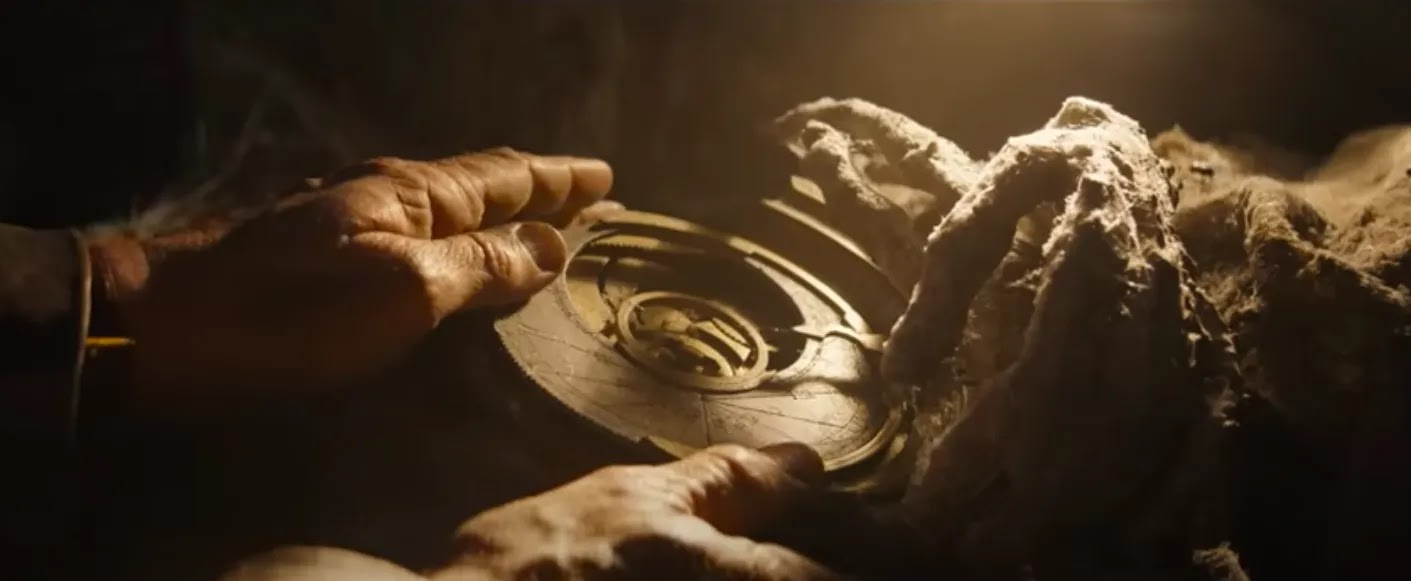
The end-sequences usually are where things get a bit dicey in these things (especially where "the Wisdom of the Fan-Tribe" weigh in), where the adventurers reach the end of the road and cross over into mysticism, myth and science-fiction. And although, credulity will be snapped to the breaking-point for many, I found that sequence to be the best part of the film, worth even enough to sit through the tedious bits (although I tend to be an apologist for this series, thinking quite highly of Kingdom of the Crystal Skull).
No spoilers here, but given the rather depressed nature of the older Dr. Jones Jr. throughout the film, the fourth act makes perfect sense, story-wise and emotionally, and presents an opportunity—although one hyper-fantastically reached—to complete a series-long character arc of learning and yearning. Okay, maybe I don't "buy" how they got there, but, dramatically, the ends justify the means and presents something unique to say,
with some real resonance, about this character we've followed from youthful arrogance to wistful dotage.
And the end-sequence before the credits? (there is no post-credit scene, thank you). I'm not ashamed to say I teared up, and it made me glad I saw the two hour-twenty-minute-movie even if two hours of it I found wanting. There was no reason for a fifth Indiana Jones movie—other than the thought that maybe they shouldn't go out on the fourth one—and the whole thing is an exercise in nostalgia. The coda only emphasizes that point. But, sometimes nostalgia is pretty important. Memories of the past warm the heart, enrich the soul, and make one step into an uncertain future with the hope of finding more treasures for the memory. Nostalgia isn't "what it used to be". It can also be a beacon to face the future.
But, I can't end this without acknowledging 81 year-old Harrison Ford for making another one of these when most of us hovering around decades of his age are worried about walking the stairs of the multi-plex without using a hand-rail. That's some stamina, man, I don't call how many stunt-doubles and digital-face-replacements were used to pull it off. That should be celebrated, along with the score by 91 year old John Williams, that still manages to raise goose-bumps and make the heart soar. 
 
If this is their mutual last movie, bravo. And thank you...for the memories.

* Me, skewing towards the time-chronology of the Indiana Jones series, wanted the 1960's adventure to be titled "Indiana Jones and the Electric Kool-Aid Acid Test". Oh, well.
 
** Sure, you'll call bullshit. But, you loved the Ark of the Covenant melting Nazis, cheered when rafts were used to bail out of airplanes and sled on the Himalayas...not to mention pulling beating hearts out of chests, and were awed by the Last Surviving Knight Templar. But, you couldn't get past "nuking the fridge." The suspensions of disbelief among fans are more rickety than the bridges Indy repeatedly has to cross. How can one love the one and hate the other? I think it has to do with being a fan as a child and a jerk as an adult—you grow up but never mature. Anyway, I'm long since done trying to understand fans of the "fantasy" genre. They seem determined to destroy what distinguishes the genre from the rest—imagination and wonder. End of lecture. No, I don't have office hours and I won't meet you for a fight in the parking lot. (And...I stole your lunch).

Friday, December 16, 2016

Rogue One: A Star Wars Story

The Force is Strong with this One
or
"You've Got to Start Some-where..."

Even though, as they say, I had "a bad feeling about" it, maybe this selling "Star Wars" to Disney may have been a good idea.

Rogue One: A Star Wars Story comes with the hype and anticipation as any entry in the saga "a long time ago in a galaxy far, far away" will. But, Rogue One goes in uncharted territory: it doesn't start with the big "Star Wars" crescendo and an opening crawl to infinity and beyond, the cast is unfamiliar and made up of mostly new characters.* And the synopsis we already know—it was in the opening crawl of the first "Star Wars" movie in 1977:

"It is a period of civil war. Rebel spaceships, striking from a hidden base, have won their first victory against the evil Galactic Empire. During the battle, Rebel spies managed to steal secret plans to the Empire's ultimate weapon, the Death Star, an armored space station with enough power to destroy an entire planet."
Rogue One is the story of those rebel spies, and it's a curious mixture of taking things in new directions while being devoted to the first film's original intentions. One thing that's always bothered me about the "Star Wars" films—after that first one that basically exploded a brand new Universe in a Big Bang and being so rich in detail, the sequels—all of them—collapsed on themselves. Sure, they'd visit a new planet with a singular eco-system (an ice planet, a "gas-planet," a "forest moon," a city-wide planet, a lava-planet), but they'd pretty much stage a galactic war in one place—budget considerations, probably. This movie gambit made that supposed galaxy-wide conflict pretty much a bottle-world where an event in one little corner would affect the Universe. Some "Empire."
But, Rogue One takes us all over the space-place, some new, some familiar. In fact, it jets around from one planet to another, not unlike the first film and the only other one that did, pre-tinkering, Revenge of the Sith. Those used to the usual limited-Universe view may actually become a bit confused at some point wondering "what planet is this, again?"
Before we get to the other aspect of it I liked, a brief synopsis: The building of the Death Star has fallen behind schedule and Imperial Director Orson Krennic (Ben Mendehlson) travels to the home of Galen Erso (Mads Mikkelson), one of the original engineers of the project, who has retired to a simple life of farming. Krennic's arrival is not welcome and Galen instructs his wife Lyra and daughter Jyn to go into hiding to avoid detection. Krennic will not hear of Erso's protests that The Death Star will not actually "bring peace to the galaxy" but terror. "You have to start somewhere," replies Krennic (with my favorite line of the movie).

Protests aside, Krennic takes Erso away, Lyra is killed and little Jyn goes into hiding, where her pre-arranged rescuer is Saw Gererra (Forest Whittaker), veteran of The Clone Wars and a leader of the Resistance.
It's 13 years later and the Death Star nears completion, which creates an up-tick of activity among the Rebels: an Imperial pilot named Bodhi Rook (Riz Ahmed) has defected, charged with taking a holographic message from Galen Erso to the Rebels. Their main base is the fourth moon of Yavin, where they bicker about strategies and have doubts about the Empire's so-called "super-weapon" (after thirteen years, no wonder!) Rook makes it to Gererra, now on the planet Jedha, and who is seen as "too radical" by the main force of the rebellion, and Jyn (all grown up to be Felicity Jones)is rescued from an Imperial Labor Camp by rebel Cassian Andor (Diego Luna) and a re-purposed Imperial droid named K-2SO (voiced by Alan Tudyk, who makes the most of his lines) to be taken to Jedha in the hopes of her leading them to Galen, so the rebels can kill him.
Well, they get to Jedha just in time for an uprising against the Rebellion by the populace, aided and abetted by two "Protectors" of "the Whills,"** Cherrut Imwe (Donnie Yen), a blind warrior dedicated to the ways of The Force, but not a Jedi and his companion Baze Malbus (Wen Jiang) a mercenary sharp-shooter (when you're a blind swordsman against Storm-troopers with blasters, it's good to have one of those around!). They all get captured by a group working for Gererra, who has a complicated history with Jyn that needs going over before he can show her the hologram of her father.
In the message, Erso tells his daughter that he has been forced to work on the Death Star against his will, but has taken pains to create a defect in the system that they can find out by procuring the weapon's plans held by the Empire's version of "Iron Mountain" on the planet of Scarif.*** Jyn wants to go to the area of space where the Death-Star is being built to try and rescue her father (which the Rebels are all-too-willing to agree to, since they want to KILL her father).
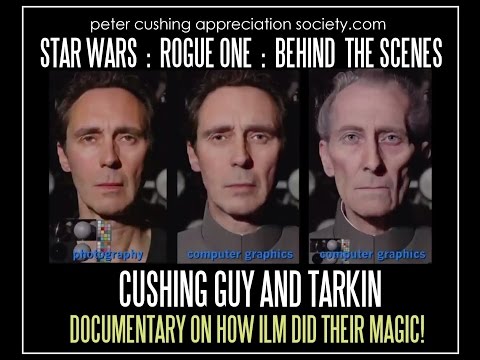
Things do not go so well for both the Rebels and Krinnic: Krinnic's control of the Death Star is undermined by the knowledge that he has let slip a security breach (oh, those uncontrolled servers) and this allows the Grand Moff Tarkin (Guy Henry, CGI'd to look like Peter Cushing****) to take control of the Death Star. His first target: the rebel base at Jedha. If you've seen "Star Wars," you're all too familiar with the sequence of events—a lot of switch-throwing, reaching for dials, and SSHHHHZZZZT! But, this is not the Death Star at full-power—it's firing just enough to wipe out a city, which it does with extreme effectiveness in a mult-plumed mushroom cloud. As K-2SO says, "There's a problem on the horizon. There IS no horizon!!"
The man battle and where things come to a head is the security facility on Scarif, which features an all-out assault between the Empire and the Rebels to get hold of those plans and director Gareth Edwards (he directed 2014's austere and weirdly effective version of Godzilla), where the disparate band of fighters with aerial support from Yavin fight to get those plans against everything the Empire has to throw at them, including things we only saw in the sequels. It's a terrific sequence that has genuine moments of edge-of-your-seat direness, and in case you think there's going to be a follow-up to this movie, there isn't...unless you count the original Episode IV.
And that's one of the things I like about Rogue One: it is its own movie, to be sure, but it is so tuned to the zeitgeist on the inspiration for "Star Wars" that it seems less removed from Lucas' sources than even Lucas managed. There are strains of Kurosawa throughout this, a level of disparity among the roles, not just in ethnicity but also in background story. Some are inspired by religion, some by revenge, some just because they're bad-asses itching for a fight. This Magnificent 7 are all scruffy, none of them polished—even K-2S0 is a might rusty—and the world they fight in is smudged, lived in and full of little goo-gah's that don't call attention to themselves, but exist as if they're part of the real world, not because they serve a dramatic purpose in the story-telling. 
The TIE-fighter doesn't appear in the movie, but it sure is cool-looking, in'it?
There's a strain of seriousness in the story-telling (not that there aren't lots of laughs along the way), it's just that Rogue One plays for keeps and is a bit more mature in its story-telling and less of (as one friend puts it) "a cheese-fest" than the rest of the "Star Wars" series. This is what happens when a "Star Wars" maker gets "serious" (oh, and is talented...there are way too many serious fan-flicks out there that suck) and is faithful to the spirit but not slavish to the style of a series. Great things can come of that. 
Rogue One doesn't diminish "Star Wars" (as I think The Force Awakens does). It builds on it, makes it a bigger Universe with more potential.

And that's what the series has needed since it started making sequels.
* Oh, don't worry. There are a lot of familiar faces...and face-plates...scattered throughout the movie, some of whom may surprise you.

** "The Whills" is a piece of Star Wars arcana dating way back to the novelization of Star Wars (released before the movie came out) written by Lucas and Alan Dean Foster based on Lucas' notes, the original "Star Wars" story was taken from "The Journal of the Whills" which was a tome...like the Bible...of ancient stories of the Galaxy. I remember there was a line attributed to Princess Leia Organa at the beginning—"They were at the wrong place at the wrong time. Of course, they became heroes."

*** They might have saved a half-hour of screen-time of Galen had just said in his already super-secret message that he took pains to smuggle out: "Look there's this thermal exhaust port, right below the main port—it's about two meters wide that if you send a proton torpedo down it, it'll set off a chain reaction and blow the whole thing up!. Get a really sharp pilot, you know, like a moisture-farmer who can bull's-eye womp-rats, like in Beggar's Canyon on Tattooine." But, he doesn't say that. He tells them to go get the plans at Scarif and figure it out for themselves. What, you can only have one secret per hologram in this Universe?

****

Thursday, November 24, 2016

Doctor Strange

Less Than Passing Strange
or
Mysto-babble is Dumber than Techno-babble

Hocus-pocus Marvelocus.

Marvel's mystical mage, Dr. Strange, makes it to the big-screen, with a lot of what made the comic interesting and a lot of what makes that comic problematic for writers—Strange is one of the characters that goes in and out of publication due to poor sales and then is brought back when somebody has an "innovative take" on the wizard.

Back in the 1960's (when artist Steve Ditko created it and Stan Lee provided the script), the comic was a big hit with the college-crowd, precisely for Ditko's warpy-woofy graphics (which is CGI'd ever so briefly in a tantalizingly short "trip" sequence), even becoming a black-light poster that was available in "head-shops" of the era. A direct example of "pop-art" (as opposed to Lichtenstein's "inspired" prints), it was emblematic of the psychedelic sensibilities and the *POW!* school of three-colored extremism.

In the superhero genre (and it's Marvel Universe sub-genre), this is a fair-to-middling adaptation, not as bad as some have been, nor as "fresh" as some of the recent "minor" Marvel films manage to get away with. But, Dr. Strange is no Ant-Man or Guardian of the Galaxy. He's one of the identifiable "big-league" Marvel characters—the type you wonder why they're MIA in the brand's cine-universe. Befitting a major player, it tries hard, very hard to wow with visual splendor while going a bit light in the impact/ramifications side of things. If the good Doctor stayed "out" of the MU, I'm not sure that anyone would miss him.
The narrative is rather flat. A "bad-guy" does something "bad." The "good-guy" is a jerk who must have a change of conscience in order to live up to the responsibilities that are handed him (this is especially true of the Marvel Universe) rather than being an innately good soul who sees his abilities as a gift to be shared (the DCU template). In Marvel, you gotta learn a lesson, campers, before you're going all-"Excelsior!"
The film introduces us to the magical world with a library invasion—always exciting—as Kaecilius (played by Mads Mikkelson, perpetually dyspeptic) and his coven of bad magi attempt to check out a book (without a card!). There's some business about energy whipping the caretaker and hoisting him spread-eagled—in what I believe is called a "disruption"—before beheading him (the things people do to avoid fines). Kaecilius then rips a couple of choice pages from the book they're seeking and creates a magical portal out of the library and into the streets of New York City, where he meets a yellow-garbed opponent who engages the group by literally changing the playing field, distending, convoluting, and bending the financial district. Despite all the "Eschering", "Kaeci" escapes to make good on his plans to...aw, who the hell cares. It ain't good, even if it may look impressive.

Cut to New York where Dr. Steven Strange (Benedict Cumberbatch) is a smooth operator on brains—a brilliant neurosurgeon, dismissive of all but one doctor (Rachel McAdams) at his Manhattan hospital. Egocentric, rude, and cavalier, he may know his way around brains but knows nothing about hearts. Until "one fateful night" where he crashes his car—while texting, and there's even a "Don't Do This, Kids" warning in the end-credits, sandwiched between the more-gratuitous-than-normal "sneak-peeks" at the end. He's wracked up, but the part of him that suffers the most damage is his ego—his hands are permanently disabled, and with it, his worth as a surgeon and, to his mind, as a man.

He travels to Katmandu, Shangri-la-la-land, or where-ever to seek out the secrets of tapping what there is of his soul to overcome the paralysis of his hands. After being beaten up by toughs, he is rescued by Mordo (Chiwetel Ojiofor), who takes him to the dojo of The Ancient One (Tilda Swinton, who, if she doesn't overcome the racism inherent in her casting, at least overcomes the sexism inherent in the role). She shows Strange "the ropes" (or at least the silver strings) that separate the corporeal from the spiritual self, and impressively enough that he stops being a know-it-all smart-ass and decides to go back to school.
I don't think I'm spoiling anything to say the biggest thing he learns is self-sacrifice (although if he has himself in a perpetual time-reset there's not much sacrifice) and it is amusing that he ultimately defeats the "Big Bad" by merely being annoying. But, other than that and milieu, it's fairly rote for a superhero movie. Ultimately, the only reason for having the movie is to reveal that one of the goo-gah's Strange luckily stumbles on* to get him out of scrapes contains an "Infinity stone", the "Macguffin" that Marvel has been teasing for the past (what?) five years now. Anything teased for too long tends to make that teased thing grumpy.

The film does benefit from Cumberbatch playing the lead, but though he hits his marks and does everything right, there's not a lot of inspiration to his performance (as we've come to expect). Maybe playing smart guys all the time makes you eventually run out of ideas. In any case, the performance reflects the film—uninspired but competent.

It's just not—dare I say it?—"magic."


* One of those is "The Cape of Somethingorother" which has the same anthropomorphic tendencies as inanimate objects in Disney cartoons. Oh, that's right Disney owns Marvel.

Wednesday, November 4, 2015

The Craig's: Casino Royale (2006)

Breaking Bonds

Is it that good?
Short answer: yes.
Is he that good?
Yeah. He's the best thing about it. There are other good things as well, but let's look at "Bond 6.0".


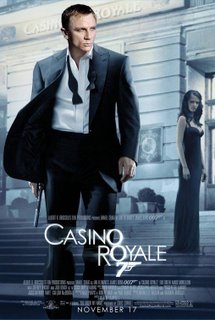
Not conventionally handsome, not the Arrow-shirt version of Bond, Daniel Craig has a multi-planed face that's great to watch whether it's jammed up against a shattered bathroom mirror considering just how much pressure it's going to take to strangle an assailant* or, half-a-movie later, in another bathroom mirror, clearly satisfied with himself in a newly-tailored tuxedo jacket. His acting choices are subtle, nicely measured. His atypical look is just one of the many breaks from the past in a series that has not only embraced clichés, but luxuriated in them, and would even occasionally ham-string a promising entry to accommodate them (quite opposite from the early intentions of the Broccoli-Saltzman producing team, which was to go against the grain of conventional thrillers--not too far afield from Fleming's literary intentions--and surpass them, and in that regard, Casino Royale is the first film since Goldfinger to actually improve on its source.) The films are, after all, about Bond, so you'd better have somebody interesting in the lead, and Craig's Bond, his face becoming criss-crossed with scars as the movie progresses, makes you care just how much of a toll the mission is taking on him, both physically and psychologically. When was the last time anybody gave a damn about James Bond's soul in the movies?
In this "reboot" the clichés are dusted off, their origins shown and exposed for the good ideas they once were. The stunts and longish action sequences are still there, but they're used, at their best, to expose character.** There are gadgets, but nothing you couldn't find in catalogs this Christmas (technology has long since caught up to Bond with cell-phones, GPS tracking and personal defibrillators). "The James Bond Theme" is merely hinted at in the body of the film as well as in the "Secret Agent Man"-ish title song*** (growled by home-boy Chris Cornell), and saved for the end with a fully formed (for good and ill) Bond.
As good as Craig is, he's matched by his co-stars. Mads Mikkelson as LeChiffre has a nice, oily quality to him, and certainly projects the most danger to Bond since Robert Shaw's Red Grant (in From Russia With Love), The only cast member retained (so far) from the Brosnan films is Dame Judi Dench, whose "M" is finally given the authoritative role over Bond that Bernard Lee once had, rather than seeming like Bond's subordinate.
And the Bond-"girls?" Well, there is Ivana Milicevic, who's there mostly for decoration. But Caterina Murino certainly can act, and brings a nice world-weary resignation to the role as a terrorist's wife out for some revenge. But the revelation here is Eva Green, whose Vesper Lynd manages to flesh out the cypher that Fleming created. A mystery in the book, Green conveys a genuine human being, and her scenes with Craig are some of the best written exchanges (and are cracklingly well delivered) in the series, and includes one heart-breaker of a scene, after a brutal fight in a stairwell. It's so moving and so well-done that it's surprising to see it in a Bond movie.
And that's the thing: there has always been a great deal of disparity between what constitutes a "Good James Bond Movie" and a genuinely "Good Movie." And this is a "Good Movie"...which happens to have James Bond in it...that can stand as a fine drama, AS WELL AS holding its own in the adventure/action aisle. I didn't cringe at a performance or roll my eyes at a joke once and if there was one thing I was dissatisfied with it might be the small amount of screen-time given to Jeffrey Wright...and maybe tweak the ending a bit. Credit the writers (regulars Purvis and Wade and the ubiquitous Paul Haggis), the director (Martin Campbell, who did "Edge of Darkness") and super-editor Stuart Baird. This is going to be a fun one to watch slowed down on DVD. Oh, and "Cubby" Broccoli's kids, who followed up one of the most profitable movies in the series (the loud, obnoxious video-gamer Die Another Day) with this one, that challenged, re-wrote, and kept the edge of Fleming's writing, when the temptation might have been to cash in on what worked before with just more of the same. 

Talk about gambling...
The View from 2012:  It still holds up, and if there are three great Bond films, Casino Royale would be firmly there, hovering near, if not holding, the top spot. Craig has proven to be a boon to the series, raising the bar, advising, bringing in top-drawer talent, and raising the entire series' image in the larger movie community.  One might even consider him indispensable (but that idea has been dis-proven before), which is a far cry from the derision that was tossed out when his choice was first announced.

* Oh, did I say "strangled?" There's a lot of very brutal violence in this movie (not just card-playing in tuxedos) that managed to skirt by with an inexplicable PG-13 rating, including a scene where Bond is stripped naked, tied to a seat-less chair, and has his testicles beaten with a very heavy, very gnarly knotted rope--a scene that should send any 13 year old boy running for the bathroom. This is not the clean "one-shot/no-blood" violence of past Bonds. Here the violence is fast, painfully brutish and bloody. Be warned.

** There is a wonderful moment when Bond has just (barely) foiled an attempt at industrial espionage, where he cocks his head, exhausted, at the untouched target and quietly marvels at what he's done.

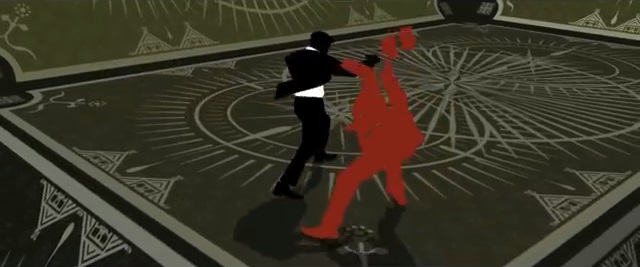
*** The title sequence is also unique--gone are the writhing go-go girls--but it should delight anyone who grew up with the imaginative main titles of many a 60's spy series.