Showing posts with label Chiwetel Ejiofor. Show all posts

Thursday, January 23, 2025

Redbelt

Written at the time of the film's release. 

 
Redbelt (David Mamet, 2008) One considers carefully before accusing David Mamet of writing a fairy tale.* But, considering the genre in which he's working—the sports film, which is almost always a glucose-encrusted, tears-of-joy-stained fantasy (aren't they, basically, "Cinderella stories?")—one also must admit that he's taken as much of the slop out of the form as he can. And if it strains credulity a bit, well...."you gotta sell a story."

Michael Terry (Chiwetel Ejiofor) is an ex-military, mixed martial arts/self-defense instructor with an emphasis on ju-jitsu, running a small not prosperous training center in the land of make-believe, L.A. He's a good man doing good deeds, cloistering himself, looking to achieve his own personal best (like so many Mamet men). That he believes in honor, and the proper way ("There's always an escape") would appear to be a weakness. But incidents happen to break the hermitic seal of Terry's life and he soon finds that good deeds do not go unpunished. Encounters with an attorney with coping issues (Emily Mortimer), one of his students (Max Martini), a past-his-prime action star (Tim Allen) and his producer (Joe Mantegna) convolute to seemingly improve his life...but at a cost.
Money and legal issues force him to cross a line he'd never thought to cross—and as a result, he becomes a participant in an exhibition match with all its gloss, hyperbole, myth-making and BS. That the match is based on an anecdote that he casually mentions at a swank party, but rigged to take the chance out of it, only compounds his anger and humiliation at the corruption that he's taking part in, and he must find his own way out of a trap of his own devising. A way of his own devising.
It must have been an interesting puzzle for Mamet: "How do I make my own version...my own version...of the most manipulative and phoney-baloney film genre out there and still make it 'Mametian?" And still make it "mean" something. The disciplines and the hierarchical nature of non-exhibition MMA that feed Terry are in direct contrast to the gladiator aspect of the money game, which in the Mamet tradition, is a rigged contest. Even rigged, both Golden Rules
** are in play.
Mamet's films usually exhibit stillness, but here, action is used as exposition and Mamet the director fails to do anything but document the moves, and none too well, at that. Clarity is sacrificed for speed, and no matter how long Ejiofor has trained for those scenes—he's great in the role, by the way—his efforts are for naught due to Mamet's direction and cutting of them. The cast is uniformly excellent with Mamet stock company players
Ricky Jay and Joe Mantegna breezing through their roles. and Ejiofor making a superb protagonist, aided and abutted by Alice Braga as his practical wife. Tim Allen drains the comedy out of himself and is a bit of a revelation in his well-observed role as an actor coasting. You always knew there was a good actor inside the goof-ball and it's interesting to see him come out. Mamet's story-telling, casting and working with actors has never been in question. It's his use of the camera, now, that needs perfecting if he intends to pursue more action oriented films.

* It's not like he hasn't done that before. You could make a case that The Untouchables is so far from the reality of the Elliot Ness-Al Capone story that it's a blood-soaked fairy tale of revenge. But how much that was Mamet, and how much was director Brian DePalma or the producers one can't say.
 
** 1. "Do Unto Others as They'd Do Unto You" 2. "The One With the Most Gold Makes the Rules"

Wednesday, July 5, 2023

American Gangster

Written at the time of the film's release...

"That's What's Wrong with America. You can't Find the Heart of Anything to Stick the Knife In"

American Gangster tells the story of Frank Lucas, who, for a time in the 60's and 70's, ran the most successful narcotics operation in Harlem. The film is based on a "New York" magazine article from an interview with the real-life Lucas, so it must be based on fact, right?*

Ridley Scott's played fast and loose with facts before (1492, Black Hawk Down), so one should take the credit "Based on a True Story" with a kilo of salt (or a pound of cocaine). 
 
But, that aside, how is the movie?
It tells the parallel stories of Lucas' rise in power on the Harlem streets by "cutting out the middle-man" smuggling in raw opium from Thailand, and manufacturing a concoction called "Blue Magic" that had twice the potency, but at half the cost, with the story of the cop who eventually busted him, a down on his luck detective named
Richie Roberts who's too honest to be trusted by the New York Police. 
While Lucas starts to make his version of the American Dream, Roberts continually has his legs knocked out from under him--his wife leaves him, takes his kid, he struggles with classes to better himself (public speaking, law), his partner turns junkie, and implicates him in a murder. The movie drips with irony at every turn, constantly showing the easy path of Crime and the tough road of Law Enforcement, that recalls that epitome of the thesis—"
The French Connection."
**
In a montage of Thanksgiving, Lucas is shown with his entire family at a stereotypical Thanksgiving spread (and in one of the more heavy-handed of Scott's directorial choices frames it like
Norman Rockwell's "Freedom from Want" painting, while Roberts, makes a cold sandwich of canned turkey-spread and potato chips over the kitchen sink. But then the director re-ups it by showing junkies shooting up between their toes in grimy bathrooms, and a mother passed out in bed, while her child is screaming in the room. Whatever glamour Lucas may enjoy, Scott is particular about showing the cost in human misery. No one gets off "Scott"-free.
Washington takes aim at a rival...
...and it's Idris Elba!
Sometimes the tables are turned. Lucas occasionally has troubles in the operation, and however much he may espouse core-values of honesty and integrity, the very nature of his business starts to rot his dreams for his family. And the more Roberts investigates, the closer he comes to his target, the more his team of "Untouchables" gel, and his investigation and life begin to come into focus.
Ridley Scott misses as much as he hits. For every good film (The Duellists, Alien, Black Hawk Down, Thelma and Louise), there is a terrible one (Legend, 1492, Someone To Watch Over Me, G.I. Jane, Hannibal, A Good Year), and some that have just enough quality in them (Blade Runner, Gladiator, Matchstick Men) that his directorial brio can compensate for weaknesses and messy scripts. But here, he has a cracker-jack script by Steve Zaillian, no worries about creating "a world" out of whole cloth, and a stunning cast that includes Clarence Williams III (uncredited), Joe Morton, Armand Assante, Josh Brolin, Cuba Gooding, Jr., the magnificent Ruby Dee, Ted Levine, Roger Bart, Carla Gugino, Chiwetel Ejiofor, and top-lined by Russell Crowe, but especially Denzel Washington. When these two heavy-weights get together, their scenes crackle with invention. Everybody does incredibly lived-in work.
And nobody less than the director. This is Ridley Scott's best film in ages. At times the details get a bit murky, but Scott does so to keep a multi-faceted story moving at a brisk pace. And he pulls off some amazing little camera tricks that stun, and some of the most unpretentious action-sequences put to film. Those action sequences are rough stuff--the film begins with the immolation and point-blank gun-down of a mob rival--and the junkie sequences are harrowing, so one should be warned. But missing it would be missing a great film.
* Merely a casual glance at the internet will disprove a lot of myth from fact. Lucas did not work for crime boss "Bumpy" Johnson for 15 years, but five (he's been in prison before), he was not with him when he died, did not marry "Miss Puerto Rico," or own "Small's" nightclub. And that's just the start for Lucas. The real Roberts is a bit miffed that to attract Crowe, they beefed up his part by making him more of a loser. Lucas admits that the film is "about 20% true."
 
** The names "Eddie Egan" and "Sonny Grosso" are invoked early on, and Crowe's Roberts employs a foot-chase under the "El" that figured so prominently in the movie.

Saturday, April 15, 2023

2012

Despite what "The Last Word" blurb—at the bottom of the page—says, I don't like writing reviews of bad movies. I just don't. (I don't even like WATCHING bad movies!)

But, I have to admit: I enjoyed writing this one.

Saturday is traditionally "Take Out the Trash" Day.


"...And I Feel Fine"

Earth to Roland Emmerich: "Cut it out!"

Between
Independence Day, The Day After Tomorrow, and, now,
2012, the German director has personally destroyed the world three times.

Well, enough is enough. Gaea's getting pissed.

And so am I.

Seventeen special effects companies, including Sony and Digital Domain (two heavy-weights and they're not even the first ones listed) were employed to create the global carnage on display in this flick, and there's still a recession going on. The attention to detail and dedication to photo-realism is the only evidence of professionalism in the enterprise. That's entirely appropriate as the only reason to see this monstrosity is to witness things blow up "real good." That they do.
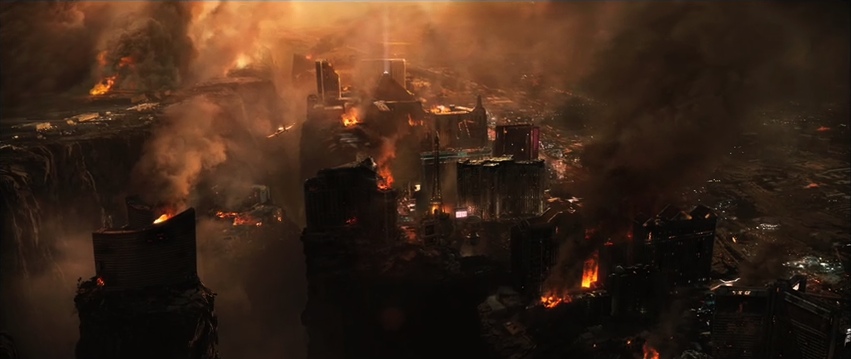
Los Angeles develops wrinkles and cracks that even Joan Rivers' supply of Retin-A can't erase and schlumpfs into the Pacific. Yellowstone faithfully incinerates in a verrry slow pyroclastic flow that the hero can out-run. Las Vegas becomes the new Grander Canyon (they were going to knock those buildings down anyway!). Hawaii's a volcano (but the surfing's great!). Washington D.C. becomes more chaotic than it already is.
I'll admit it. There is a giddy, monstrous 2-year old's glee in seeing the White House (which
Emmerich imploded with a shiny blue destructa-beam in Independence Day) being destroyed again—this time by the aircraft carrier John F. Kennedy, propelled on a Potomac tidal wave (That's about as "high concept" as this film gets). And St. Peter's. Tibet.
* All the hots spots become much hotter. The fly-over-and-through of Los Angeles over the splintering clover-leafs and under collapsing buildings is a thrilling roller-coaster ride through Hell with digi-people clinging to collapsing floors, all manner of auto-mayhem and even violence by Rolling Donut sign. But if you were to take out all the countdowns to disaster in 2012 ("We've got five minutes before everything blows!!") and just include the disasters, you'd have a 20 minute highlights reel, rather than a 158 minute poorly written series of contrivances and coincidences.

And everything blows, anyway.
You'd almost think the thing was worthwhile with
Chiwetel Ejiofor, Oliver Platt, John Cusack, Danny Glover, George Segal and Thandie Newton in the cast. But they're only mouth-pieces for exclamatory dialog with brows a-furrowed. Seems the whole thing starts with a planet re-alignment, which triggers solar flares which sends out neutrino's that miraculously microwave the Earth's core and destabilize the Earth's tectonic plates, reverse the Earth's magnetic field and create monster tsunami's.
Now, in this world-wide scenario, everybody in the cast has only one degree of separation to everybody else, so that they can look with surprise at their monitors and intone "Wait! I know that man/woman/dog!" Coincidences are the order of the doomsday, and little dialog goes unmatched without
the appropriate chunk of irony whistling through the air and squishing the speakers with a thud. It's the kind of movie where hubby says to wife "I feel like there's something pulling us apart" right before a fissure opens up between them. When St. Peter's Basilica starts to collapse, the cracks split down the Sistine Chapel right between Man and God's fingers. Roland Emmerich is not a subtle director. No man whose ambition is to make a better "Godzilla" movie can be.
And what Emmerich is re-making here is
When Worlds Collide,
** a 1950's sci-fi flick that imagined Earth hit by another planet, and its treasures, two-by-two's of animals and a lottery-chosen clutch of humans are rocketed off to the convenient companion planet that precedes it. Here, the art is rounded up, libraries accumulated, animals airlifted, and although a lottery is mentioned, the folks who go in the arks are world leaders (naturally), the folks who can afford to pay 1 billion euros per seat, and anyone conniving enough to smuggle themselves on-board. The Best and the Brightest, The Cream of Humanity. Everybody else becomes part of the new petroleum deposits the survivors will profit from in the future. Talk about your disasters. Imagine a world where among the survivors are Dick Cheney, Mahmoud Ahmadinejad, Hugo Chavez, Rod Blagojevich, Paris Hilton, Mike Tyson and Pat Robertson, but no research scientists—not even the guys who invented Post-it Notes! That's a version of Hell even Milton wouldn't have conjured.***
It was at this point, I would have been happy to see everybody die, but no such luck. The last few minutes of the film are
disaster heaped upon disaster, with survival dependent on the actions of one man—guess who? But, my concern was what exercises I could find to relieve the pain in my eyes from rolling them so much. They don't sell aspirins at the concession stand. Not even chocolate-covered ones.
Truth be told I don't enjoy writing reviews for bad movies, as there's more inspiration in good ones. But I'll leave it with this quote from the director (in a New York Times profile by Tyler Gray) complaining about people's reactions to his making a film like 2012 in a "post-9/11 environment."

"If I cannot destroy a big high-rise anymore, because terrorists blew up two of the most famous ones, the twin towers, what does this say about our world?”

Our world is fine, Rollie, no thanks to you. But it says your priorities are really shitty.

And the only way to make it good to us is to make all your digital models of people caught in wholesale slaughter based on your likeness.

Verstehen sie?

Verstehen sie nicht.

****
"thoughts and prayers..."

* But not Mecca. Fatwa's need not apply. Kinda lily-livered of Emmerich to not risk personal destruction when destroying the world for his art. Don't they have "sins of omission" in Islam?

** And just our luck, that master of the cinematic form Stephen Sommers (The Mummy, Van Helsing, G.I. Joe: The Rise of Cobra) is making his own direct re-make of "When Worlds Collide" to be released in 2010. Oh, the joy.
(As of 2023, IMDB lists it as still "In Develpment").

*** Not to politicize too much (or think, God help me) but given the Ark scenario envisioned by the movie, with the whole "two-by-two" concept, I'm imagining the passenger list is restricted to "breeders," meaning there are no gays and lesbians on the boats. Emmerich is gay. What is he thinking?

**** Part of the mission of these reviews is to promote the theatrical experience when it is deemed important to the presentation of the story. It is tempting to say that "The Big Screen" is the only way to watch 2012, because there are so many little demons in the details. But, no. The story is so lunk-headed and gleefully clap-happy nihilistic that the best presentation is merely putting a bow on a cess-pool.

Tuesday, July 14, 2020

Serenity

Written at the time of the film's release...

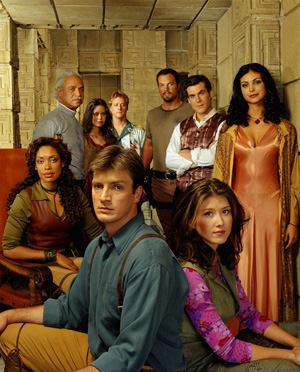
Serenity (Joss Whedon, 2005) Enjoyable, if violent, genre-bendin' space-farin' Western spinning off from the one season wonder "Firefly." But Serenity (that's the name of the ship) passes the crucial test of movies that make the leap from small to big screen—you don't need to have seen the series to "get" the concept and enjoy the film (probably because the concepts are so familiar). Sharply written and directed by series creator Whedon, and played by the regular cast, it boasts an intensely underplaying Chiwetel Ejiofor as a government operative who ritualistically silences outliers.

And outliers are exactly what the crew of the "Firefly"-class "Serenity" is comprised of; pirates, soldiers of fortune, outlaws, the scrappy veterans of the Galaxy's last civil war, who bounce from system to system dodging government entanglements and making a living by lying, cheating and stealing. Plus, they do good while doing bad.

The conceit of staging a Western in the infinitely wide-open spaces isn't new. "Star Trek" was sold to NBC as being "Wagon Train to the Stars"--not exactly true, but the suits got the point, "Star Wars" used Han Solo as a space cowboy ala Hondo (which Chewbacca as his faithful dog...or horse), and the "Wars" rip-off Battle Beyond the Stars was "The Magnificent 7 in Space." There isn't that much of a light-speed leap from horse-opera to space-opera. After all, the umbrella-genres of westerns and sci-fi can encompass all sorts of story-themes from Shakespeare to cleverly disguised issues of the day.
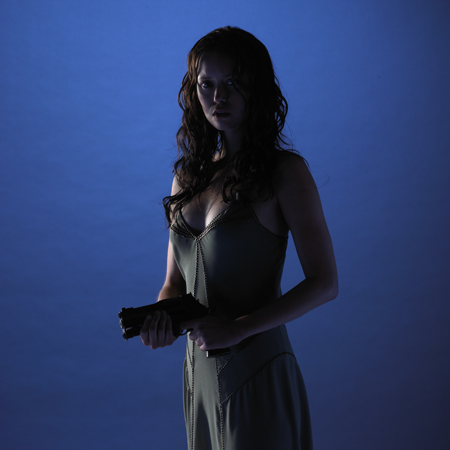
The plot for Serenity back-tracks a bit* to catch movie-goers up with the story of fugitives River Tam (Summer Glau) and her doctor-brother Simon (Sean Maher) and then resolves the conflicts their paid passage aboard Captain Mal Reynolds' (Nathan Fillion) ship of fools has created, and turns River from loose cannon on deck to a reliable asset. Along the way the crew stumbles on a gone-wrong planet-wide government experiment being kept under wraps. And since they're being pursued by "the op," anyway, they "aim to misbehave."
The characters are broadly drawn, easily discerned, and everyone is given significant plot-time (with the exception of Morena Baccarin's space-zen-hooker Inara, whose role was edited for time). Though not a success at the box office, it did spur interest in the series and kicked its box-set collection into hyper-drive. Though Whedon constantly discounts it, the crew of "Serenity" may fly again.

2020 aside: I'd still like to see it, as the film inspired a deep-dive into the TV series for me, although getting Fillion back would be a task—not to mention writer-director Whedon. And, given how everybody's aged a bit, it's going to have to surmount the "Star Trek movie-issue" of providing a sufficient reason for everybody getting back together, assuming that characters have gone separate ways and forged bonds elsewhere. Still, it was Whedon working on something he WANTED to work on and that usually entails his best work. I think a lot of it has to do with that I became a fan after it died...All that there was had already been done. And it was finite.

Maybe it's best to move on. 


* In a film-starting series of illusions that nest together like Matryoshka dolls.


Saturday, July 27, 2019

The Lion King 2019

Cheetahs Never Prosper (in the Uncanny Valley)
or
A Corporation's Belly is Never Full (Mustafa Your Face)

Disney, the corporation, has been systematically making live-action versions of their beloved cartoons. Starting with 101 Dalmations in 1996. they've been doing it for awhile, but it has, in very recent years, increased in frequency to the point where it is now a veritable flood. There have been two versions of The Jungle Book (1994 and 2016, without and with songs, respectively), Tim Burton re-thinkings of Alice in Wonderland and Dumbo, Cinderella, Beauty and the Beast and Aladdin and "Wicked" re-imaginings of Sleeping Beauty, with many more on the way including Mulan, Pinocchio, The Little Mermaid, The Hunchback of Notre Dame, even Lilo & Stitch. It's a way to increase the Scrooge McDuck-like coffers, while not really hurting the history—the animated versions are still there, after all, just as are the original stories (where there are)...for those who think they were cheapened by being "Disney-fied." It's not like anything's being replaced and the first versions aren't available.
Now, comes a version of their jewel in the monetary crown—The Lion King, which became a smash in its animated version (Disney's most successful cartoon) as well as in its Tony Award winning Broadway version directed by Julie Taymor. Who would have suspected that such a late bloomer would be its most precious commodity? Certainly not me. I was never a fan of the animated film, thinking it a step down from the Ashman-Menken days of Disney's resurgence. Audiences did not agree, as it produced a lot of revenue for Disney, despite being derivative (being based on Shakespeare's "Hamlet") and having an inferior array of songs (by Tim Rice and Elton John). I was also unnerved that the most interesting character was the villain, and that the film created a fantasy world of animals, especially in the lion kingdom where the females do all the hunting and the males...well, the males just have bragging rights.
I was also found it (oh, I hate using this word) "un-American." Hear me out. The Lion King champions the idea that power is earned the old-fashioned way—you inherit it. No room for democracy in the Pride-lands; young Simba is presented to the world as the Future King and not only do all the animals have to show up for the presentation, they have to accept it—"Here's the next King; Show some respect." Okay, who can resist a baby lion-cub, but the whole idea of the Right of Succession is what the words of the Declaration of Independence—"We hold these truths to be self-evident, that all men are created equal..."—was arguing in the most basic words possible; the signers were declaring that you did not have to be born in the house of Windsor or Stuart or Plantagenet in order to hold positions of power over others—better that they be decided by a majority of those to be governed. But, here we are, celebrating "kingly" DNA. Fie on it!
The film opens with a nearly shot-by-shot recreation of the "Circle of Life" sequence (I'm still expecting that to be a slogan for a fast-food restaurant or the tag-line for a Soylent Green remake) as young Simba, the son of King Mustafa (James Earl Jones, the once and future...) and Queen Sarabi (Alfre Woodard), is presented to the animal kingdome as the next line of succession. This throws a bone into the craw of the King's brother, Scar (the wonderful Chiwetel Ejiofor, in a performance much more dynamic than his on-screen performances, taking much more of a Shakespearean tone—in fact, Timothy Dalton's Shakespearean tone). Simba's birth has kicked Scar down a rung from becoming King and, having previously lost in a battle for supremacy with Mustafa, sets his mind to roiling how he can supplant his decreasing fortunes—by either eliminating Simba or Mustafa.
You know how this goes—Scar uses Simba as a lure to do away with the King, sending the young Simba into exile and leaving a vacuum in leadership that Scar is only too happy to fill. 
Simba is found by two jesters Timon and Pumbaa (Billy Eichorn and Seth Rogen and both better than you'd expect) who serve as the "Falstaff" to Simba's Prince Hal/Hamlet teaching him to let go of the past and live for the moment. The odd thing about having Rogen and Eichorn as the characters is that it turns the characters into unambitious loafs rather than mere free spirits—and their directives to eat grubs comes off as very convenient as the juicy worms can't talk—or sing—in protest. Simba grows up through his awkward phase and it is only due to him being found in exile that he returns to fight what is rotten in Scar-land.
It's all very similar and familiar—although the new one's PG rating allows the word "farting" in "Hakuna Matata" (rather than "Please, not in front of the kids!") and there is some suspicious cross-promotion between Disney products.
BIG difference, though, is how the CGI-photo-realistic animals compare to the stylization of animation. In animation, you can get away with anything, like smiling prideful lions or gravity-defying suspensions in the laws of physics (or, as above, "sashaying" animals) that the CGI modelling just won't allow.* The Lion King does NOT take place in The Uncanny Valley, and so anything that smacks of fantasy will get picked apart like digital carrion. And so, director Jon Favreau, cinematographer Caleb Deschanel, and the digital zoo-keepers work overtime to make the thing look like an episode of PBS' "Nature" (I kept wondering when David Attenborough was going to chime in: "The wart-hog, although not burdened by gastric issues, will most typ-ically..."belch"—and with alarming frequency." But, as the animals are doing all the monologing, he isn't needed). It's absolutely beautiful to look at, and often breath-taking in what it presents pictorially, even bringing about a real sense of majesty in realistic settings. It's just, in very subtle ways, off-putting.
The dialog is done subtly, so as to not make it too jarring. But, it also limits the movie in its theatricality. It's a bit less eccentric and a bit less entertaining as a result, a chronic problem with the Disney remakes. The studio is going to have to find a way—a brilliant solution ala Pixar—to cross the wide expanse between imaginative line-drawing and recreating reality in their fantasies.
It's not embarrassing—like, say, what they're trying to do with "Cats." But, it's a good attempt, even if this The Lion King keeps it down to a dull roar.

* There are no plans, as yet, to do a CGI version of Fantasia. Not yet, anyway. But, before they do it, I hope they solve the issue before attempting the sequence with the dancing hippos in tutus. That's something I'd like to see.

Thursday, November 24, 2016

Doctor Strange

Less Than Passing Strange
or
Mysto-babble is Dumber than Techno-babble

Hocus-pocus Marvelocus.

Marvel's mystical mage, Dr. Strange, makes it to the big-screen, with a lot of what made the comic interesting and a lot of what makes that comic problematic for writers—Strange is one of the characters that goes in and out of publication due to poor sales and then is brought back when somebody has an "innovative take" on the wizard.

Back in the 1960's (when artist Steve Ditko created it and Stan Lee provided the script), the comic was a big hit with the college-crowd, precisely for Ditko's warpy-woofy graphics (which is CGI'd ever so briefly in a tantalizingly short "trip" sequence), even becoming a black-light poster that was available in "head-shops" of the era. A direct example of "pop-art" (as opposed to Lichtenstein's "inspired" prints), it was emblematic of the psychedelic sensibilities and the *POW!* school of three-colored extremism.

In the superhero genre (and it's Marvel Universe sub-genre), this is a fair-to-middling adaptation, not as bad as some have been, nor as "fresh" as some of the recent "minor" Marvel films manage to get away with. But, Dr. Strange is no Ant-Man or Guardian of the Galaxy. He's one of the identifiable "big-league" Marvel characters—the type you wonder why they're MIA in the brand's cine-universe. Befitting a major player, it tries hard, very hard to wow with visual splendor while going a bit light in the impact/ramifications side of things. If the good Doctor stayed "out" of the MU, I'm not sure that anyone would miss him.
The narrative is rather flat. A "bad-guy" does something "bad." The "good-guy" is a jerk who must have a change of conscience in order to live up to the responsibilities that are handed him (this is especially true of the Marvel Universe) rather than being an innately good soul who sees his abilities as a gift to be shared (the DCU template). In Marvel, you gotta learn a lesson, campers, before you're going all-"Excelsior!"
The film introduces us to the magical world with a library invasion—always exciting—as Kaecilius (played by Mads Mikkelson, perpetually dyspeptic) and his coven of bad magi attempt to check out a book (without a card!). There's some business about energy whipping the caretaker and hoisting him spread-eagled—in what I believe is called a "disruption"—before beheading him (the things people do to avoid fines). Kaecilius then rips a couple of choice pages from the book they're seeking and creates a magical portal out of the library and into the streets of New York City, where he meets a yellow-garbed opponent who engages the group by literally changing the playing field, distending, convoluting, and bending the financial district. Despite all the "Eschering", "Kaeci" escapes to make good on his plans to...aw, who the hell cares. It ain't good, even if it may look impressive.

Cut to New York where Dr. Steven Strange (Benedict Cumberbatch) is a smooth operator on brains—a brilliant neurosurgeon, dismissive of all but one doctor (Rachel McAdams) at his Manhattan hospital. Egocentric, rude, and cavalier, he may know his way around brains but knows nothing about hearts. Until "one fateful night" where he crashes his car—while texting, and there's even a "Don't Do This, Kids" warning in the end-credits, sandwiched between the more-gratuitous-than-normal "sneak-peeks" at the end. He's wracked up, but the part of him that suffers the most damage is his ego—his hands are permanently disabled, and with it, his worth as a surgeon and, to his mind, as a man.

He travels to Katmandu, Shangri-la-la-land, or where-ever to seek out the secrets of tapping what there is of his soul to overcome the paralysis of his hands. After being beaten up by toughs, he is rescued by Mordo (Chiwetel Ojiofor), who takes him to the dojo of The Ancient One (Tilda Swinton, who, if she doesn't overcome the racism inherent in her casting, at least overcomes the sexism inherent in the role). She shows Strange "the ropes" (or at least the silver strings) that separate the corporeal from the spiritual self, and impressively enough that he stops being a know-it-all smart-ass and decides to go back to school.
I don't think I'm spoiling anything to say the biggest thing he learns is self-sacrifice (although if he has himself in a perpetual time-reset there's not much sacrifice) and it is amusing that he ultimately defeats the "Big Bad" by merely being annoying. But, other than that and milieu, it's fairly rote for a superhero movie. Ultimately, the only reason for having the movie is to reveal that one of the goo-gah's Strange luckily stumbles on* to get him out of scrapes contains an "Infinity stone", the "Macguffin" that Marvel has been teasing for the past (what?) five years now. Anything teased for too long tends to make that teased thing grumpy.

The film does benefit from Cumberbatch playing the lead, but though he hits his marks and does everything right, there's not a lot of inspiration to his performance (as we've come to expect). Maybe playing smart guys all the time makes you eventually run out of ideas. In any case, the performance reflects the film—uninspired but competent.

It's just not—dare I say it?—"magic."


* One of those is "The Cape of Somethingorother" which has the same anthropomorphic tendencies as inanimate objects in Disney cartoons. Oh, that's right Disney owns Marvel.