Showing posts with label Seth Rogen. Show all posts

Tuesday, November 29, 2022

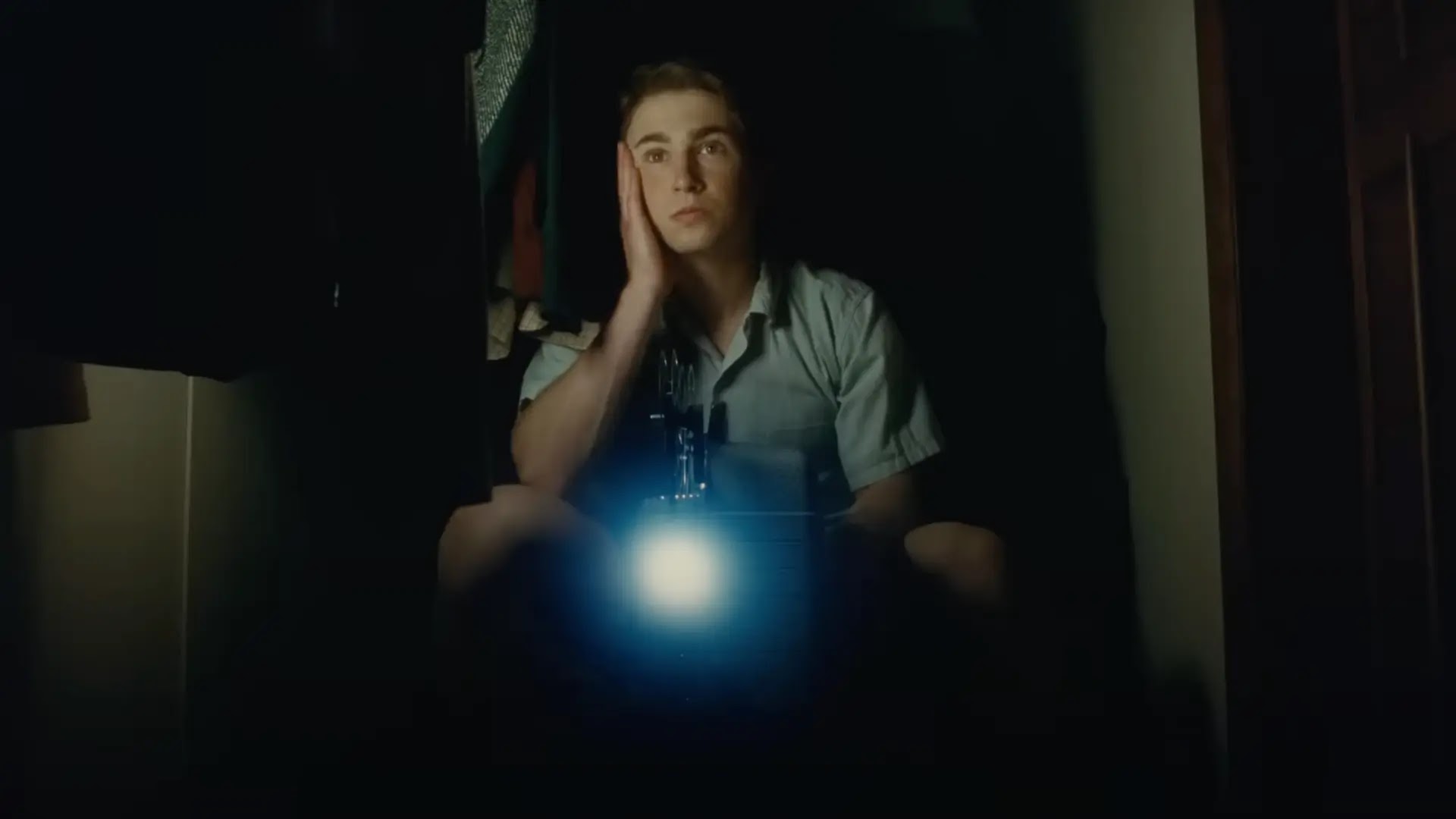
The Fabelmans

Persistence of Vision
or
"Who Spends $40 Million on Therapy?"
 
“A child is born into a world of phenomena all equal in their power to enslave. It sniffs - it sucks - it strokes its eyes over the whole uncomfortable range. Suddenly one strikes. Why? Moments snap together like magnets, forging a chain of shackles.”
“Look...to go through life and call it yours - your life - you first have to get your own pain. Pain that's unique to you."
Peter Shaffer "Equus"
 
There is a sequence in Steven Spielberg's The Fabelmans that I found absolutely hilarious, but mine was the only laughter in the theater.
 
The set-up is that young Sammy Fabelman (at this point played by Mateo Zoryan) is being taken by his parents, Burt (Paul Dano) and Mitzi (Michelle Williams) to his first movie, The Greatest Show on Earth. Sammy is worried. It will be DARK and he's scared of the dark. Father explains the technical aspects of film running as still images that take advantage of the limitations of the eye's retention—the persistence of vision—to  simulate a moving image, while Mom takes the romantic view:"Movies are dreams that you never forget." Already the family lines are drawn out between the adults: one is technical, one is artistic.
What happens to the child in between is something else entirely. He sits, rapt, edging closer and closer to the screen to the edge of his seat when something happens that is quite outside his ken: two "bad guys" are robbing a train when one of them notices the circus train is barreling down the tracks at them. Wanting to stop the train, one of the "bad guys" knocks out the other one and drives the car onto the tracks towards the train rushing towards them to warn them about the other one farther down the tracks and prevent the upcoming collision. But, the train has too much momentum; while the guy driving waves his arms in desperation, the train plows into the car flipping it like a toy (which it is) and crashes into the next train causing a massive wreck...achieved by models, inter-cut with live-action scenes of chaos and process shots of fleeing animals.
But, a child wouldn't know that. Driving home, Mitzi asks Sammy "What was your favorite part?" he can't answer...he doesn't answer, still gob-smacked by that approaching train and the disaster that he witnessed before his eyes. At Hannukah, Sammy gets trains as a present—Dad explains the scale and the connections and what makes it go. But, Sammy wants to watch them table-top height to re-create that scene from the movie and sets up elaborate things for it to crash into, inevitably breaking the engine and incurring Dad's disapproval. Break things? You're supposed to FIX things!
But, Mom gets it. Sammy's trying to recreate the scene to make it less scary—he wants to understand it, control it, master it. She gets some film for Dad's movie camera so Sammy can film the train again and again, so he won't be constantly breaking trains. And he shows Mom the movie he made of the train from various angles, various ways to make a model train scary. 
 
But, before the part where Sammy shows his little movie to his thrilled audience, there's a sequence where adult director Steven Spielberg makes an honest-to-god recreation of that "Greatest Show on Earth" crash using miniature trains, toy cars and unsuspecting Hannukah decorations using the same angles DeMille did. And it's amazing. Also funny as Hell. To think Spielberg—at 75 years old—was determined to get that sequence he was trying to make at 6 years old look as good as possible. It's hilarious. It's fun. It's poignant. It's a little brilliant in its meta-sense.
The Fabelmans
is Spielberg's telling (with a canny co-script by Tony Kushner*) of the story of his childhood, the birth of his love of making movies and the death of his parents' marriage. It's a story that spans two moves—from New Jersey to Arizona and Arizona to Los Angeles—and ten years and god knows how many hours with an eye to a viewfinder, hours squinting at film through a magnifying glass and cutting and splicing it together with glue as well as graduating from 8mm home movies to 16mm presentations. Oh. He also attended school, got bullied for being Jewish, and getting his first crush...on a shiksa.
 
Self-indulgent? Sure. But, then you're ignoring Hemingway's maxim "write what you know." Every film-maker (or author) taps into the well of their past** If you dismiss Spielberg doing it, you dismiss Richard Linklater or Francois Truffaut. You can't sneer at The Fabelmans and extoll Cinema Paradiso. Hell, Fellini made a career out of it. Howard Hawks used metaphorical occupations to tell stories about making movies. So, self-indulgent? Sure, join the club!
But, it's a fascinating exercise and an entertaining one, too, because it is Spielberg looking at himself through the rear-view-finder, looking through the aperture and seeing himself, fixing the story where it needs to be finessed or goosed (as he always does) and looking for the tell-tale detail that resonates. Only this time, it's personal, and it's fascinating to look at Spielberg's life as he observed it (or sees it now) and into his mind, as well.
For instance, there is a clear case of imposter syndrome where Sammy Fabelman is the family chronicler, filming everything as observer, story-teller, but ultimately outsider. The revelation comes out in a sequence that could be a horror movie. At a "family conference" it is announced by Mitzi and Burt that they are splitting up—he's going to remain in L.A. for his job and Mitzi is going back to Arizona for her sanity. It is a scene of tears and tearing apart.
Spielberg cuts to a shot of Sammy watching from the stairwell while the whole traumatic scene unfolds. Cut to a closer shot of Sammy with a look of horror in his eyes—is it suddenly dawning on him that his family is splintering apart? Is he reacting to his sisters' emotional trauma? No. He is reacting to the next shot Spielberg presents: Sammy sees himself (in a fantasy sequence, inserting himself into the scene) figuring out how to frame the scene with his camera.
That is a frightening scene. It shows that even in the most intimate, personal, affecting scene, he is outside, objectively looking for the angles, almost dispassionately when passions are running high. What has this "hobby," this obsession done to him that he can even see himself doing that, even if it is instinctually? It's a gift and a curse. As Sammy's Uncle Boris (a florid
Judd Hirsch) informs him "Art. Family. It will tear you apart!"
The movie is full of small truths, revelations large and small, that inform the color of a life. I could go on and on about details, themes, structures, performance details that inform this movie (and have influenced Spielberg's entire body of work) but that would just be robbing you of a personal experience of discovery, the individual way of connecting dots and frames. In a way, all movie-makers are communicating personally, whether they are telling their own story or somebody else's.
There is another sequence in the L.A. apartment Sammy is sharing with his father. It's very simple; disarmingly simple. Sammy comes home. Burt, soon after. Sammy is tired, frustrated, isn't getting anywhere in L.A. looking for work. The mail's on the table and there's a letter from Mitzi in Arizona, with pictures, snapshots. Does Burt want to see them? Sure.
 
There's then the standard Hitchcock sequence of three shots. Burt looks at the pictures. Sammy looks at Burt looking. Back to Burt, as Sammy seems him. But, the two shots of the father are not the same, obviously so, even though from the same vantage point, more or less. The first shot includes Burt looking at the pictures. Cut to Sammy looking. The next shot of Burt does not include the pictures—the camera has moved up and the ceiling of the apartment is weighing down on him. That is the shot of Sammy seeing his father's reaction to the snapshot of his absent wife—the sadness, the contemplation, the emptiness. It is SO simple, but it is importantly different, delivering a visual gut-punch you can feel and that is communicated, even if you don't recognize the shift. That is communication in its rawest, visual way, the way that make movies unique in how they tell stories. And Spielberg finds the best way, subtle and overt, to convey that to the audience (whether they recognize it as such or not).

This is why I love Spielberg movies. This is why I love movies.

The movie may not be the story of Spielberg's past, so much as it's the story of his DNA.

* Kushner's dedication to "get it right" even exceeded Spielberg's as recounted in this Collider article:  https://collider.com/the-fabelmans-ending-tony-kushner-interview/
 
** Some film-makers go back to recapture their youth. Supposedly, Orson Welles made The Magnificent Ambersons because it reminded him so much of his early childhood. Fellini made Amarcord. Francois Truffaut made The 400 Blows. George Lucas made American Graffiti. Francis Coppola drew on his family life on quite a few of his films. One always gets the impression from Wes Anderson's films that he's tapping into his early years. Robert Benton made Places in the Heart. Mel Brooks produced My Favorite Year. Noah Baumbach made The Squid and the Whale. The trend seems to be gathering momentum. Alfonso Cuaron made Roma. Lee Isaac Chung made Minari. Last year, Kenneth Branagh made Belfast. Paul Thomas Anderson made Licorice Pizza. 


Thursday, October 14, 2021

Monsters vs. Aliens

Okay, I know this isn't a horror film. It's an animated comedy for kids...but it has monsters and aliens and the monsters are based on actual horror movie monsters, so.... 

Written at the time of the film's release...
 
"The Ginormica Monologues"
 

It's the perfect wedding day for Susan Murphy (voice of Reese Witherspoon, cracked on the boil): she has the perfect dress, the perfect church, and the perfect groom in fat-headed weatherman Derek Dietl (Paul Rudd). But it's all in the timing.  

Just after a little pre-nuptial spat about honeymooning in Paris or Fresno, the bride-to-be gets squashed by a meteorite. At the altar, everyone comments that she's positively glowing...but...glowing green! Then, she goes from meteoric to all metaphoric, by growing enormously, dwarfing her puny groom and scientifically smashing the church to splinters. I kept waiting for the parents to say "our little girl's grown up!" but no such luck.*
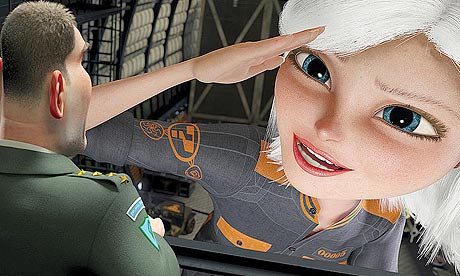
Pretty soon, the Army led by General W.R. Monger (a gruff Kiefer Sutherland, having fun) fires hypodermics in her butt and Gulliver her to the ground, where she awakens in one of those cavernous U.S. installations we only wish we had, with a bunch of other monsters Monger's captured since the atomic testing days of the 50's. There's the Missing Link (Will Arnett), a Blob named B.O.B. (Seth Rogen in a bit of typecasting), and the insane Dr. Cockroach (Hugh Laurie), as well as a giant Japanese moth creature called Insectizoid. Kept prisoners by the government, they are finally called out as a last resort when Aliens, led by the evil Galaxhar (Rainn Wilson, like you've never heard him) attack the U.S. ("...they only seem to ever attack here,"** intones a Brokawed-paletted news anchor) after humiliating the President (Stephen Colbert...typecasting again).
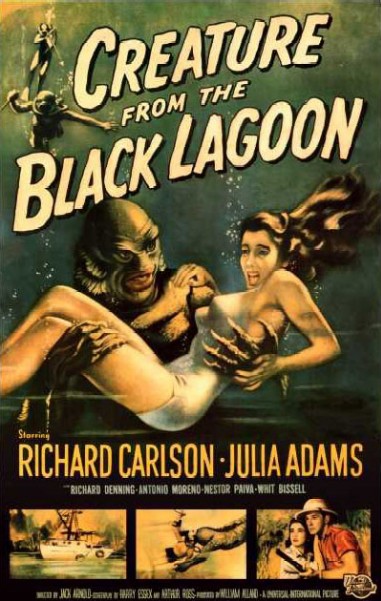
Dreamworks and the directors (Conrad Vernon and Rob Letterman of Shrek 2 and Shark Tale, respectively) do a nice job of plumbing the envelope of the monster-crowd giving us versions of Mothra, the Fly, the Blob, The Creature from the Black Lagoon and the 50 ft. Woman, and instilling the politically correct message that these aren't monsters but "special" people...er, things...entities (whatever). Indeed, the entire movie plays like a therapy session for Susan to embrace her empowerment and not to see her change as an accident of Nature, so much as...a happy accident of Nature. Hey, empowerment is empowerment even if you do go up 30 dress-sizes. 
The animation? Extraordinarily simplistic in a weird way. Susan looks like one of those big-eyed Keane children, and most of the men seem to be variations of Nixon (except for Derek, who looks uncannily like Conan O'Brien). The monsters are varying body-types and primary colors, so you can tell who's who when they're flitting across the screen (which they do a lot). 
Still, there is good planning going on, so one is never at a loss for where one is, and where the danger lies. In a totally made-up universe that can be a problem. And the 3-D effects are impressive, starting with a Dreamworks logo gag (heh), and a gratuitous paddle-ball sequence, although the 3-D-ness, sometimes comes off as having the dimensions of a pop-up book. But, the process has come a long way, and is frequently, deliberately eye-popping. It's not enough to recommend seeing it in theaters, though, so hopefully when it comes to DVD, they'll include the 3-D version, with glasses.
* ...and I'll bet the attendess threw puffed rice, (badum-bump!)

** Personally, I think it has to do with our Immigration Policy. "Okay, you can destroy the Golden Gate Bridge...once, but promise you'll never do it again and we'll consider granting you amnesty."\

Saturday, July 27, 2019

The Lion King 2019

Cheetahs Never Prosper (in the Uncanny Valley)
or
A Corporation's Belly is Never Full (Mustafa Your Face)

Disney, the corporation, has been systematically making live-action versions of their beloved cartoons. Starting with 101 Dalmations in 1996. they've been doing it for awhile, but it has, in very recent years, increased in frequency to the point where it is now a veritable flood. There have been two versions of The Jungle Book (1994 and 2016, without and with songs, respectively), Tim Burton re-thinkings of Alice in Wonderland and Dumbo, Cinderella, Beauty and the Beast and Aladdin and "Wicked" re-imaginings of Sleeping Beauty, with many more on the way including Mulan, Pinocchio, The Little Mermaid, The Hunchback of Notre Dame, even Lilo & Stitch. It's a way to increase the Scrooge McDuck-like coffers, while not really hurting the history—the animated versions are still there, after all, just as are the original stories (where there are)...for those who think they were cheapened by being "Disney-fied." It's not like anything's being replaced and the first versions aren't available.
Now, comes a version of their jewel in the monetary crown—The Lion King, which became a smash in its animated version (Disney's most successful cartoon) as well as in its Tony Award winning Broadway version directed by Julie Taymor. Who would have suspected that such a late bloomer would be its most precious commodity? Certainly not me. I was never a fan of the animated film, thinking it a step down from the Ashman-Menken days of Disney's resurgence. Audiences did not agree, as it produced a lot of revenue for Disney, despite being derivative (being based on Shakespeare's "Hamlet") and having an inferior array of songs (by Tim Rice and Elton John). I was also unnerved that the most interesting character was the villain, and that the film created a fantasy world of animals, especially in the lion kingdom where the females do all the hunting and the males...well, the males just have bragging rights.
I was also found it (oh, I hate using this word) "un-American." Hear me out. The Lion King champions the idea that power is earned the old-fashioned way—you inherit it. No room for democracy in the Pride-lands; young Simba is presented to the world as the Future King and not only do all the animals have to show up for the presentation, they have to accept it—"Here's the next King; Show some respect." Okay, who can resist a baby lion-cub, but the whole idea of the Right of Succession is what the words of the Declaration of Independence—"We hold these truths to be self-evident, that all men are created equal..."—was arguing in the most basic words possible; the signers were declaring that you did not have to be born in the house of Windsor or Stuart or Plantagenet in order to hold positions of power over others—better that they be decided by a majority of those to be governed. But, here we are, celebrating "kingly" DNA. Fie on it!
The film opens with a nearly shot-by-shot recreation of the "Circle of Life" sequence (I'm still expecting that to be a slogan for a fast-food restaurant or the tag-line for a Soylent Green remake) as young Simba, the son of King Mustafa (James Earl Jones, the once and future...) and Queen Sarabi (Alfre Woodard), is presented to the animal kingdome as the next line of succession. This throws a bone into the craw of the King's brother, Scar (the wonderful Chiwetel Ejiofor, in a performance much more dynamic than his on-screen performances, taking much more of a Shakespearean tone—in fact, Timothy Dalton's Shakespearean tone). Simba's birth has kicked Scar down a rung from becoming King and, having previously lost in a battle for supremacy with Mustafa, sets his mind to roiling how he can supplant his decreasing fortunes—by either eliminating Simba or Mustafa.
You know how this goes—Scar uses Simba as a lure to do away with the King, sending the young Simba into exile and leaving a vacuum in leadership that Scar is only too happy to fill. 
Simba is found by two jesters Timon and Pumbaa (Billy Eichorn and Seth Rogen and both better than you'd expect) who serve as the "Falstaff" to Simba's Prince Hal/Hamlet teaching him to let go of the past and live for the moment. The odd thing about having Rogen and Eichorn as the characters is that it turns the characters into unambitious loafs rather than mere free spirits—and their directives to eat grubs comes off as very convenient as the juicy worms can't talk—or sing—in protest. Simba grows up through his awkward phase and it is only due to him being found in exile that he returns to fight what is rotten in Scar-land.
It's all very similar and familiar—although the new one's PG rating allows the word "farting" in "Hakuna Matata" (rather than "Please, not in front of the kids!") and there is some suspicious cross-promotion between Disney products.
BIG difference, though, is how the CGI-photo-realistic animals compare to the stylization of animation. In animation, you can get away with anything, like smiling prideful lions or gravity-defying suspensions in the laws of physics (or, as above, "sashaying" animals) that the CGI modelling just won't allow.* The Lion King does NOT take place in The Uncanny Valley, and so anything that smacks of fantasy will get picked apart like digital carrion. And so, director Jon Favreau, cinematographer Caleb Deschanel, and the digital zoo-keepers work overtime to make the thing look like an episode of PBS' "Nature" (I kept wondering when David Attenborough was going to chime in: "The wart-hog, although not burdened by gastric issues, will most typ-ically..."belch"—and with alarming frequency." But, as the animals are doing all the monologing, he isn't needed). It's absolutely beautiful to look at, and often breath-taking in what it presents pictorially, even bringing about a real sense of majesty in realistic settings. It's just, in very subtle ways, off-putting.
The dialog is done subtly, so as to not make it too jarring. But, it also limits the movie in its theatricality. It's a bit less eccentric and a bit less entertaining as a result, a chronic problem with the Disney remakes. The studio is going to have to find a way—a brilliant solution ala Pixar—to cross the wide expanse between imaginative line-drawing and recreating reality in their fantasies.
It's not embarrassing—like, say, what they're trying to do with "Cats." But, it's a good attempt, even if this The Lion King keeps it down to a dull roar.

* There are no plans, as yet, to do a CGI version of Fantasia. Not yet, anyway. But, before they do it, I hope they solve the issue before attempting the sequence with the dancing hippos in tutus. That's something I'd like to see.

Wednesday, May 8, 2019

The Green Hornet

Superheroes come in all colors and stripes...and quality. We're all in the $2 billion glow of The Avengers: Endgame right now, but there have been some really lousy ones, too. Someone brought up Seth Rogen today, remembering him as "that funny guy." I brought up the name of Seth Rogen and when they said "yes" I mentioned snarkily that I got confused "when you mentioned that funny guy." Well, I remembered this movie. Wish I could forget...

"BUZZZZZZZZ.....zzzzzzzzzzzzzzzzzzzzzzz"
or
"Girls Are a Drag, Kato.  Thank God We've Got Each Other." 

"The Green Hornet" was a popular radio series in the 40's, and became a brief second tier in ABC-TV's "superhero" programming after the success of the Adam West "Batman" television show. Unlike the campy "Batman," "The Green Hornet" played it somewhat straight, albeit with the gleaming technology, out-there set decoration...and another fabulous George Barris car design. It also featured Bruce Lee, as Kato, Britt Reid's formidable kung-fu kicking house-boy, a couple of years before forsaking Hollywood for Hong Kong super-stardom.

When it was announced that Seth Rogen would be portraying "The Hornet" (as bad an idea, really, as when Jack Black was supposed to star in Green Lantern), I thought this could not come to any good. "The Green Hornet" was a distant lineage of "The Lone Ranger," in the continuity, and Rogen, known for playing ape-neck every-slobs, didn't seem to fit the bill (I couldn't even imagine Rogen throwing a punch!). Compounding the pre-release jitters, the movie was planned to be presented, rather unnecessarily, in 3-D, was delayed until after the Christmas crunch, and in the last couple months, the car has increasingly seemed to be the focus of the promotion. The Green Hornet appeared to be a victim of bad buzz, but cheerily trumpeted its excellence ("dude") at the top of its lungs—par-tay! The previews looked semi-amusing, so one walked in with a certain cock-eyed optimism.
It is abysmal. Starting out with a deadly serious "origin" episode  (de rigueur for all superhero movies, apparently*) where Daddy Reid (Tom Wilkinson) publisher of the "The Daily Sentinel" rips the head off young son Britt's superhero doll, traumatizing him,** the movie goes off-kilter fast. Directed by Michel Gondry (!!), the film soon settles into a un-comic romp with guns, gadgets, and all the cool things that will make the frat-boys spit out their beer in gawping appreciation: rock-themed fights, CSI-orifice-cams, gratuitous babes, "Matrix" slo-mo's, while generally following the "key-ingredient" rules of movie-making from Sweet Liberty.*** Ho-hum. But, the main problem is the lead character.  I like Rogen. I think he's very talented and, on occasion, very funny. Not here.  As played (and written with pal Evan Goldberg) by Rogen, Britt Reid's Green Hornet is a whining ADD cretin, with the slimmest, and dumbest, of character motivations. Rogen's Reid can't keep his mouth shut,**** no matter how inane his attitude or stupid his comment—he is entitlement-dumb, in marked contrast to the parade of millionaire-geniuses who inexplicably become "mystery men" in the genre. Indeed, he is so dependent on Kato (Jay Chou) for...everything...that you wonder why the kid from Shanghai***** doesn't insist on up-ending the billing (Kato with Hornet, the boy-doofus) and keep Reid corralled with a nunchuck leash.
The yin and yang of stupidity/competence continues throughout. Questions begin arising. Why does their super-slick, weapons-festooned car, "The Black Beauty" have rotating license plates, when it has "hornet" emblems all over it—even the gas-cap—making it hopelessly identifiable? Why does The Green Hornet hand out business cards at the scene of his bust-ups...with his internet address and e-mail account? Why does Reid talk about arming The Black Beauty out loud, sitting in a pool of accessory-chicks?
Why doesn't Kato just kick the green-snot out of Reid and be done with him?******

As with the series, Kato is the coolest character. Bruce Lee (who is given a brief homage) was the best thing about "The Green Hornet" show and one anticipated his fight scenes that rose, with considerable hang-time, above the common whiffed fisticuffs of television stunt-men. This Kato builds cars, seemingly from scratch, is an acrobatic master, martial artist, engineer and draughtsman...and...can make the perfect cup of coffee. Hmmm. Chou doesn't have much emotional range, but is loose enough that he can carry off the comedy, and still look like he knows business. However, the relationship between Reid and Kato is so skewed in the millionaire's favor (for no apparent reason) that the character comes off a bit as his "bitch," (which he calls him at one point—Kato is belittled constantly, short of racial slurs). And Rogen and Goldberg throw in a lot of unsubtle "bro-mance" references in case we miss the point.
And, the whole thing is a waste. The final set-piece is an exercise in over-the-top property destruction that reminds one of an unfunny version of the mall-destruction chase in The Blues Brothers. Good actors are squandered—not just Wilkinson, but also Christoph Waltz, who can't seen to decide if he's playing comedy or drama, Cameron Diaz in a "girlfriend" role, who tries to ad-lib with the big boys, but about the second line in a string says something inane, and Edward James Olmos, who looks dyspeptic every time he's on camera (his character is supposed to be frustrated, but I couldn't help but think he might be thinking about strangling his agent: "Hey, don't worry, Eddie, you thought "Battlestar Galactica" was a bad idea, too!")

The final segment begins with The Hornet saying "Everything we've done to this moment is complete and utter crap." Truer words...
What is most upsetting is to see a director like Michael Gondry, whose past efforts have included Eternal Sunshine of the Spotless Mind—a favorite of mine—and Be Kind Rewind—which isn't—continue a Shamalamyan decline in quality of work. This thing is a mess, and one can only wonder how cross-eyed it would make one in 3-D. I might actually worry about some form of brain-damage resulting from viewing this film.

Van Williams and Bruce Lee: In Memory, Still Green

* There was a preview of Thor in the promo-clusters before the show, and it appears to be the same story, but in Asgard—daddy issues are everywhere.

** .....o-kaaaay.

*** Those are: 1.) Rebellion against authority; 2.) Violence; 3.) Nudity.  I confess, of the venerable cliches, I didn't hear a "Wilhelm" scream, see a vegetable cart being overturned in a car-chase, but, "The Brother" does "Get It First."

**** There's a lot of post-production voice-over inserts to wedge in one...more...laugh-line, usually inane.  But, they're clumsy...and it feels like it's an attempt to go for a laugh so the audience doesn't think for very long.

***** Kato has always been, traditionally, Japanese...except for that time when he became Filipino after December 7th, 1941.

****** At one point in the film, he does.  But Rogen gets in enough licks, that it reminded me of the nadir of the "Green Hornet" series...in the cross-over with the "Batman" show, when Bruce Lee (Kato) was fought to a stand-still with Burt Ward (Robin, the Boy Wonder).  As if...  Supposedly, Lee was a bit miffed at that scenario.  And, for some reason, Kato is given a weakness that's condescending, not unlike how Jet Li was treated in The Expendables.

Friday, December 8, 2017

The Disaster Artist

Cogito Ego Sum
or
"You're Deconstructing Me Apart, Lisa!"

Have you ever seen The Room? First off, (SPOILER ALERT), don't bother. The Room is a 2003 character drama conceived, written by, produced, directed, and starring Tommy Wiseau an actor-hyphenate of indeterminate origin and talent who has been known by a select few who have seen the film and regard the guy as something extraordinary. He is a bit like piano-playing cats in that he is extraordinary meme material. And to find out if somebody in your relative sphere is familiar with him, all you have to do is clench your fists to your face and with a pained expression on your face (the veins in your forehead have to look like they're ready to explode if you need a directing tip) cry out "You're Tearing Me Apart, Lisa!!"

Go ahead. I'll wait.


The Room is one of those movies that is so bad and amateurish that I haven't even bothered to post a review of it. It is almost surrealistically dumb and amateurish, a train-wreck with the interesting parts cut out, a relationship film where it is hard to follow if the characters are the same people from scene to scene. I would liken it to an Ed Wood-directed movie, but without aspirations, imagination, crew camaraderie, and ingenuity in coping with a small budget. Nobody looks like they're having a good time, so earnest are the cast-members in hitting their marks and making sure-that-they-are-getting-the-words-right. The only reason to see it is if one is in a really bad, vindictive mood and just feels the need to tear into something with malice. I wouldn't even suggest seeing it high, as it is disorienting enough that it might make you want to check into an emergency room (but it's not you, it's not the weed—it's the movie). I might even suggest it as a suicide preventive measure (even though—SPOILER!—the lead kills himself), as after seeing it, one might find something positive about themselves to keep on living—"Geez, even I could do better than that!" Somebody's parents are mighty proud (well, except for the sex scenes, of course), in the same charitably forgiving-Christmas-play kind of way. But, that's it. 

Okay, you don't believe me. Here is YouTube channel CinemaSins video of The Room (in which they broke the "Sins" meter). I'll wait:   

Well, it is legendarily bad. So much so that in Los Angeles (of course...) it is legend...regularly playing at midnight shows...enough to make back its six million dollar (yes, really) budget. A bewildered article in Entertainment Weekly appeared. The film became a staple of the podcast "How Did This Get Made?"—which features Los Angeles fringies back-biting projects that they or their friends were not involved with, and one episode ,featuring Wisseau's friend, co-star, and line-producer for The Room, Greg Sestero, kicked a thought-about a book on the film into high gear. 
The rest is history. James Franco's Disaster Artist (from the Sestero book, adapted by Scott Neustadter and Michael Weber, who did the, for various reasons, wonderful (500) Days of Summer, The Spectacular Now, and The Fault in Our Stars), do an extraordinary job in recreating the madness that went into the making of the film and its results (and, let's face it, Franco made it easy on himself choosing this subject—not exactly a high bar).* After a flurry of "witness" interviews—with Kristen Bell, Danny McBride, Keegan Michael-Keye, Adam Scott, J.J. Abrams, and Kevin Smith—talking about what an amazing thing The Room is, the film starts with the first meeting of Wiseau (Franco, James) and Greg Sestero (Franco, Dave) in an acting class (taught by Melanie Griffith, I should say) where Sestero is frozen by fear and Wiseau is alarmingly voluble and, frankly, a little bit freakish. Sestero is entranced, though, and asks Wiseau to do some scenes with him. After being initially skeptical, Wiseau relents and his positiveness—his "all things are possible" instinct—turns them into fast friends, eventually deciding to become room-mates in L.A. (Wiseau has apartments in both San Francisco and Los Angeles, sparking one of the mysteries of the guy—where does he get all this money?
Sestero is able to make some headway towards acting—he gets an agent (Sharon Stone), if not any work in particular. But, Wiseau comes up against a brick wall with acting coaches, agents, and all the niche-workers who think he'd make a good vampire, but that's about it. Wiseau becomes despondent until Sestero, trying to cheer him up, tells him, heck, let's make our own movie. Hey, Judy and Mickey did that! 
And so, they did. With a script by Wiseau—that is handed out scene by scene on a "need-to-know" basis like it was the latest Star Wars script, and it might be leaked to the media, they find a studio, buy (rather than rent) equipment, shoot in BOTH HD and 35 mm and shoot entirely inside the studio, even if, rather than shooting on an alley set, there's a perfectly fine alley right outside the stage door. Based on Sestero's reportage, it was a chaotic shoot, with a lot of bad behavior on Wiseau's part and an extraordinary number of takes when he was on-camera. Franco can't quite duplicate the deadness in Wiseau's eyes when he's on-camera, like he's one "z" away from falling asleep, but other than that, it is a freakishly accurate performance. It would remind one of Ed Wood, Tim Burton's tribute film to the worst director in Hollywood, if for the lack of any real acceptance of its subject actually having a "vision-thing." Burton celebrated Wood's "gee-whizery" about making movies. Franco does not have that luxury, as Wiseau has no vision other than what is of the moment.
One is reminded of the phrase that a good movie is something of a miracle—a good movie has ingeniousness, good planning as well as that indefinable something that cannot be explained or, by sheer rigor, has eliminated everything that can possibly stand in its way. Martin Scorsese said that every first assemblage of footage should make you want to throw up—it is only in the editing room that a good movie "finds itself" and is born from the raw material that is purged from the self-indulgence that created the movie. But, what if there is nothing there but self-indulgence...?
It does celebrate something in that only in America could a marginally talented person achieve his dreams as long as he has enough money (yes, I'm talking about Tommy Wiseau) and that, even though it may be totally garbage, it will still find an audience who will embrace it. America is that diverse—and capable of absorbing and creating enough self-rationalizing bullshit—that someone, somewhere will find value in it. 

* And, in apparent effort to either show off how exacting it was or just how bad the original is, in case no one believes it, Franco ends the film with side by side comparisons. Stick around for the end for the post-credit scene in which Wiseau plays a L.A. party-goer having a conversation with Franco's portrayal. Think that's odd? When the character of Greg goes to have a meeting with a talent agent (played by Sharon Stone) he is first interviewed by an assistant who is played by...wait for it...Greg Sesteros! Oh! It's like space and time folding in on its cinematic self!! (Although, not really).