Showing posts with label Danny Glover. Show all posts

Saturday, April 15, 2023

2012

Despite what "The Last Word" blurb—at the bottom of the page—says, I don't like writing reviews of bad movies. I just don't. (I don't even like WATCHING bad movies!)

But, I have to admit: I enjoyed writing this one.

Saturday is traditionally "Take Out the Trash" Day.


"...And I Feel Fine"

Earth to Roland Emmerich: "Cut it out!"

Between
Independence Day, The Day After Tomorrow, and, now,
2012, the German director has personally destroyed the world three times.

Well, enough is enough. Gaea's getting pissed.

And so am I.

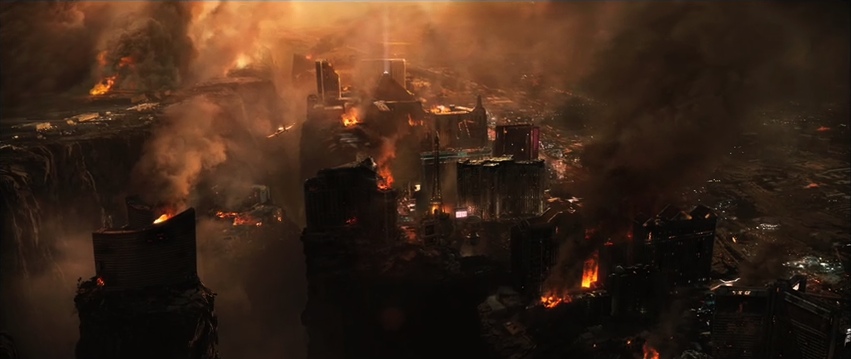
Seventeen special effects companies, including Sony and Digital Domain (two heavy-weights and they're not even the first ones listed) were employed to create the global carnage on display in this flick, and there's still a recession going on. The attention to detail and dedication to photo-realism is the only evidence of professionalism in the enterprise. That's entirely appropriate as the only reason to see this monstrosity is to witness things blow up "real good." That they do.
Los Angeles develops wrinkles and cracks that even Joan Rivers' supply of Retin-A can't erase and schlumpfs into the Pacific. Yellowstone faithfully incinerates in a verrry slow pyroclastic flow that the hero can out-run. Las Vegas becomes the new Grander Canyon (they were going to knock those buildings down anyway!). Hawaii's a volcano (but the surfing's great!). Washington D.C. becomes more chaotic than it already is.
I'll admit it. There is a giddy, monstrous 2-year old's glee in seeing the White House (which
Emmerich imploded with a shiny blue destructa-beam in Independence Day) being destroyed again—this time by the aircraft carrier John F. Kennedy, propelled on a Potomac tidal wave (That's about as "high concept" as this film gets). And St. Peter's. Tibet.
* All the hots spots become much hotter. The fly-over-and-through of Los Angeles over the splintering clover-leafs and under collapsing buildings is a thrilling roller-coaster ride through Hell with digi-people clinging to collapsing floors, all manner of auto-mayhem and even violence by Rolling Donut sign. But if you were to take out all the countdowns to disaster in 2012 ("We've got five minutes before everything blows!!") and just include the disasters, you'd have a 20 minute highlights reel, rather than a 158 minute poorly written series of contrivances and coincidences.

And everything blows, anyway.
You'd almost think the thing was worthwhile with
Chiwetel Ejiofor, Oliver Platt, John Cusack, Danny Glover, George Segal and Thandie Newton in the cast. But they're only mouth-pieces for exclamatory dialog with brows a-furrowed. Seems the whole thing starts with a planet re-alignment, which triggers solar flares which sends out neutrino's that miraculously microwave the Earth's core and destabilize the Earth's tectonic plates, reverse the Earth's magnetic field and create monster tsunami's.
Now, in this world-wide scenario, everybody in the cast has only one degree of separation to everybody else, so that they can look with surprise at their monitors and intone "Wait! I know that man/woman/dog!" Coincidences are the order of the doomsday, and little dialog goes unmatched without
the appropriate chunk of irony whistling through the air and squishing the speakers with a thud. It's the kind of movie where hubby says to wife "I feel like there's something pulling us apart" right before a fissure opens up between them. When St. Peter's Basilica starts to collapse, the cracks split down the Sistine Chapel right between Man and God's fingers. Roland Emmerich is not a subtle director. No man whose ambition is to make a better "Godzilla" movie can be.
And what Emmerich is re-making here is
When Worlds Collide,
** a 1950's sci-fi flick that imagined Earth hit by another planet, and its treasures, two-by-two's of animals and a lottery-chosen clutch of humans are rocketed off to the convenient companion planet that precedes it. Here, the art is rounded up, libraries accumulated, animals airlifted, and although a lottery is mentioned, the folks who go in the arks are world leaders (naturally), the folks who can afford to pay 1 billion euros per seat, and anyone conniving enough to smuggle themselves on-board. The Best and the Brightest, The Cream of Humanity. Everybody else becomes part of the new petroleum deposits the survivors will profit from in the future. Talk about your disasters. Imagine a world where among the survivors are Dick Cheney, Mahmoud Ahmadinejad, Hugo Chavez, Rod Blagojevich, Paris Hilton, Mike Tyson and Pat Robertson, but no research scientists—not even the guys who invented Post-it Notes! That's a version of Hell even Milton wouldn't have conjured.***
It was at this point, I would have been happy to see everybody die, but no such luck. The last few minutes of the film are
disaster heaped upon disaster, with survival dependent on the actions of one man—guess who? But, my concern was what exercises I could find to relieve the pain in my eyes from rolling them so much. They don't sell aspirins at the concession stand. Not even chocolate-covered ones.
Truth be told I don't enjoy writing reviews for bad movies, as there's more inspiration in good ones. But I'll leave it with this quote from the director (in a New York Times profile by Tyler Gray) complaining about people's reactions to his making a film like 2012 in a "post-9/11 environment."

"If I cannot destroy a big high-rise anymore, because terrorists blew up two of the most famous ones, the twin towers, what does this say about our world?”

Our world is fine, Rollie, no thanks to you. But it says your priorities are really shitty.

And the only way to make it good to us is to make all your digital models of people caught in wholesale slaughter based on your likeness.

Verstehen sie?

Verstehen sie nicht.

****
"thoughts and prayers..."

* But not Mecca. Fatwa's need not apply. Kinda lily-livered of Emmerich to not risk personal destruction when destroying the world for his art. Don't they have "sins of omission" in Islam?

** And just our luck, that master of the cinematic form Stephen Sommers (The Mummy, Van Helsing, G.I. Joe: The Rise of Cobra) is making his own direct re-make of "When Worlds Collide" to be released in 2010. Oh, the joy.
(As of 2023, IMDB lists it as still "In Develpment").

*** Not to politicize too much (or think, God help me) but given the Ark scenario envisioned by the movie, with the whole "two-by-two" concept, I'm imagining the passenger list is restricted to "breeders," meaning there are no gays and lesbians on the boats. Emmerich is gay. What is he thinking?

**** Part of the mission of these reviews is to promote the theatrical experience when it is deemed important to the presentation of the story. It is tempting to say that "The Big Screen" is the only way to watch 2012, because there are so many little demons in the details. But, no. The story is so lunk-headed and gleefully clap-happy nihilistic that the best presentation is merely putting a bow on a cess-pool.

Tuesday, November 6, 2018

The Old Man and the Gun

The Last Ride of the Sundance Kid
or
"Brother, I'm Not Talkin' 'Bout Making a Living"

It's the smile you notice. Forrest Tucker (Robert Redford) walks into a bank and if there's no women behind the teller-stations, he'll ask to see the manager. Then, invited to the manager's office, he'll sit down, smile, and open his coat showing the manager that he has a gun, and (very reasonably) ask for an emergency withdrawal of some weight to keep him from using that seen gun in a way injurious to that manager. He never says that the gun is loaded—psychologically, that is irrelevant—it achieves its purpose without getting into details. And he never has to demonstrate. It rarely doesn't work, and he'll leave the banking institution several thousand dollars richer.

Detective John Hunt (Casey Affleck) interviews employees post-robbery and when he gets to motivation, he strives to keep incredulity out of his voice when he re-states what he's been told: "So, you did what you did because he said he had a gun..." "Yes. And also, he was sort of a gentleman."
Robert Redford doesn't direct The Old Man and the Gun, but he does some producing chores on it, and it is David Lowery (who worked with Redford on his miraculous un-tuned version of Disney's worst musical, Pete's Dragon) who is calling the shots, making a breezy film based on David Grann's* New Yorker article on Tucker**, who became known as "The Gentleman Bandit" cutting a swath through Southern banks in the 1980's. Tucker usually worked alone, and on tougher jobs that needed more co-ordination and a fast getaway, with two long-in-the-tooth associates Teddy (Danny Glover) and Waller (Tom Waits), who became known in law-enforcement circles as "The Over-the-Hill Gang."
When we first meet Tucker, he does a job ("Belmont Texas, July 26, 1991" we're told to give the film some authenticity by place/time-stamps as well as a first title that states "The story, also, is mostly true."***), a hearing aid in his ear (which is tuned to police frequencies), and as he makes his escape, he passes a motorist, Jewel (Sissy Spacek), who has broken down on the highway. He stops to help, and as, after police cruisers have raced by, he pulls his head out from under the hood. "Do you know anything about cars?" Jewel asks. "No," he replies. "Not really."
A tow truck is called, as he knows nothing about cars. They're a means to an end, just like lunch at a diner with Jewel while the police are running around outside, looking for this "gentleman bandit." She's trying to figure him out. He introduces himself as "Bob...Bob Kelly." "I like that truck of yours," she mentions. "Yeah," he says casually. "I stole it." But his eyes twinkle when he says it. "Hey, I'm just pullin' your leg." When he's a little vague about what he does, she presses, and he asks for her phone number. She writes it down and slides it across the table. He writes down what he does and slides it back. She looks at him in shock. "What's worse—if I'm lyin' or telling you the truth?" More talk, and he talks about his list of "things I want to do, but haven't done yet."

"Better hurry up," she smirks.
It's probably as good as time as any to talk about Robert Redford's face. There's no longer a hint of the smooth, angelic planes that made his initial days of acting so problematic—finding roles that would play against type than as "the nice boy"—that he finally roughed it up with various facial hair until folks could look past...his looks. His face, now, is a complicated map of wrinkles that crinkle with every expression, going beyond the weathered look he's had in the last couple decades and becoming more expressive and more open in conveying what his character is feeling. It's like Redford's movie-star mask has dropped. And we're starting to see him in his own skin. More on that at the end.
Hunt actually has contact with Tucker, when he's inside a bank that gets robbed by him right under the detective's nose. The bank goes into lock-down and all he can think of is his kids in the car, who are probably wondering that's going on with daddy in the bank; they'll be panicking when they see the police cars showing up. Try as he might, he can't convince the bank officials that he IS a police officer and he doesn't NEED to wait for the police to show up. Somewhere in there, he must be frustrated that he's less convincing to the bank officials than the robber.
Hunt had been frustrated with police work, maybe even quitting, but Tucker's spree energizes him (despite the ribbing his fellow officers give him for chasing a senior citizen bank robber). He WANTS to catch this guy, even goes on television saying that he WILL catch him—a broadcast that Tucker sees, and when the next job happens, the Gentleman Bandit leaves a present of a $100 bill saying "Detective John Hunt: Good Luck! 'The Over-the-Hill Gang'."

Oh. It's on.
Meanwhile, Jewel and "Bob" start seeing more of each other. She invites him out to her farm, introduces him to her horses, tells him she's keeping the place, despite her kid's protestations that she should get herself a condo with little up-keep. "Now's the time to be a little selfish." "Bob" likes the idea of her keeping the place, being independent, but he's not smiling when he looks out at the place. At a mall, they look at a bracelet Jewel likes, and Bob grabs her by the arm and they walk out without paying for it. He's all smiles. She looks at him...and stops in her tracks. She turns to go back to the store, and he, sheepishly, follows her.."sorry, we totally forgot..he's paying for it."
The FBI steps in when the Gang pull a job across state lines, leaving Hunt to merely look on in frustration, while somebody else handles the leads. Then, he gets a letter: a young woman named Dorothy (Elizabeth Moss) writes him a letter, saying that the robber, from his description and from stories her mother told her about her absent father makes her suspect that the two might be one and the same. Her father's name: Forrest Tucker. Background work on Tucker shows a lifelong criminal history, with a penchant for escaping whatever prison thought might hold him. A chance encounter between the two men in the bathroom of the local diner just confirms what Hunt has begun to suspect—and the two men now know each other—by sight.
"Lookin' sharp makes you look like you know what you're doin'
...even if you don't."
Lowery's direction is low-key and efficient, less concerned for the striking image (as he has in the past), but keeping an eye for the magic that his cast can deliver at the drop of a smile, and the energy transference between a scene between an old pro like Redford and a "bury-it-deep" performer like Affleck manages to bring out sparks in both actors. Working with Redford seems to invigorate Affleck with just that much more wattage, as Spacek does the same for Redford. The story lends itself to making one wonder what makes a character like Tucker tick, and the answer lies in the very longevity that belies a high-risk occupation. This is some of Redford's more subtle work in his career and it's helped by the etching carved into his face that allows the slightest of smiles shine through with satisfaction. It is a melancholy acknowledgment of damage along the way, which might be apparent to those around Tucker, but he wouldn't be aware at all.

One can't help but smile, albeit sadly, in return.

If this is Redford's last film performance (I'm highly skeptical of that), it's a great one to go out on.


* Grann also wrote the book The Lost City of Z.

** January 23, 2003, if you're checking or looking for it at the old magazine store.

*** One should remember that Butch Cassidy and the Sundance Kid started with the title "Most of what follows is true." The "also" of The Old Man and the Gun hearkens back to it. The film is a sly little tribute to Redford in places; at one point there's a clip of the young Redford from The Chase (1966), and there's a sweet little nod to The Sting, that I won't spoil by pointing it out.

Tuesday, July 24, 2018

Silverado

Silverado (Lawrence Kasdan, 1985) Director Lawrence Kasdan took his big box office successes with Body Heat and The Big Chill and parlayed them into a Big Gamble to revive the western genre with this "all-in" tale (co-written by himself and his brother Mark) of four travelling pilgrims who happen to collide and find enough common ground in skill sets and back-story that they end up resolving each others' business. Why they happen to find each other in all the empty space of the West is a bit of a mystery, but I have a feeling it would have been inevitable as the four of them seem to follow the directions of their own individual moral compasses. Despite their differences, they're going to end up in the same place.

Just like the country. Even though it starts out in the dry wilderness of the West, everything seems to be moving to civilizing and taming the wild, except that things aren't exactly going to plan.

"Nothing wrong with the land. It's just the people," says one of the settlers of Silverado. That settler's brother gets an example of that at the very start of the film: Emmett (Scott Glenn) is asleep in a shack—at least it has a wood-stove—when the door burst opens and guns start firing. A reach for a holster and one guy is dead, but bullet-holes start blasting through the walls, and the roof explodes from rifle-fire. Emmett fires sight-unseen, anticipating the movements and when he finally exits into the sunlight, three men are dead, two horses are on the loose, but one has stayed. That horse will come in handy twice in the movie: once as transport and once as a clue to why someone would want Emmett dead.
Title sequence. While Bruce Broughton's classic score* starts with the first tremulous chords as Emmett exits the shack (in a move not to dissimilar from the opening shot of The Searchers) to reveal a dawn landscape and the music blossoms into full-throated Americana with a chime announcing the title of the movie, Broughton's main theme is presented over shots of Emmett's character travelling with the two horses across various picturesque landscapes, finally reaching a desert, where he spies a prone figure baking in the sun....wearing nothing but long-johns, his legs nonchalantly crossed as if he'd fallen from the sky that way. Emmett takes out his canteen and tentatively offers the sun-roasted character some water. He croaks something unintelligible. Emmett leans closer and we hear the first words from Paden (Kevin Kline): "Pleased to meet you."
They're also the first words spoken in Silverado, and already it sets the pattern for the dialogue that acts as series of laconic, well-chosen ironic words that make up the bulk of the film's banter ranging from austere sentiments that can have hidden depths of meaning and lines that are clever for their brevity and what's left unsaid. Kasdan has written many impressive original scripts and adaptations over his career, since his first optioned script (for The Bodyguard, sold in 1980 but not filmed until 1992), but none is as rich as this collaboration between the two Kasdan brothers.

Over nighttime coffee—Emmett always seems to have coffee—the two men share some history—how Paden got into that predicament (robbed of everything and left for dead by some fellow travelers) and his first summation of his experiences with luck, and Emmett's shack shoot-out ("Aw, I had to get up, anyway" is Emmett's comment). Emmett, it seems, has just been sprung from Leavenworth ("Never been there," says Paden) and he's going to meet up with his brother to reunion with his sister's family.  He asks Paden where he's going, and Paden's reply is practically undecided:

"Where's the pinto going?"
To the nearest outpost, apparently. The two make an odd pair, riding into the fort—the dusty cowboy and the guy in his skivvies. Emmett flips Paden a coin to buy some clothes to make himself presentable "I'm good for it," he says, and absent-mindedly tips the memory of a hat at a shocked mother and daughter. He may not be needing that coin. Across the way, he recognizes his horse...and his pants...and his shirt...boots...gun-belt and guns. The guys getting ready to mount up, so Paden runs into a general store, grabs a gun, but is stopped by the proprietor—that gun doesn't equal that coin. "Well, what can I get for this?" says Paden in a hurry.
Not much. The gun he gets is falling apart, the cylinder falling out of it, plus a box of cartridges more destined for dirt than defense, given his firearm. He has just enough time to hastily assemble the pistol, load a couple of shots, while the guy who's second hand Paden is riding down on him, shooting from horseback—one shot takes out the business-end of his long-johns and he takes a studied aim and fires the guy right off his (Paden's) mount.
You don't shoot a guy in the middle of the street without attracting attention and the local constabulary has questions and they're not buying a bum's story about getting robbed "Can't you see this horse loves me?" The Cavalry Sergeant (Sheb Wooley, he of The Wilhelm Scream) isn't impressed. "I had a gal do that to me, didn't make her my wife..." But, Paden's name is on the inside of the saddle he says and when he's asked for clarification, a voice in the crowd speaks up "P-A-D-E-N"

That's what the saddle says, all right, just like the man says. The man is Cobb (Brian Dennehy) and he and Paden have history. "Where's the dog?" is practically the first thing he asks him. It goes unanswered. In Silverado, some things are best left unsaid, but you will find out about them...eventually, and if you're not in too much a hurry.
Despite the shared past and Paden's recent change of fortunes (or maybe because of them) Cobb offers him a job working with him again. "I've given that up..." Paden says evasively. "So have I," replies Cobb. "I have a legitimate job now." The two commiserate just long enough for one of the men that Cobb HAS hired to be released from the stockade. It's Tyree (Jeff Fahey), who also knows Paden...only too well. "Where's the dog?" he sneers as he rides past him.

Emmett and Paden (with his clothes hanging back on him, again, but still missing his hat) make their way to the town of Turley: Emmett's going to "meet a guy on the way to Silverado." Paden rides along once he finds out there's a saloon and women there. 

And breakfast. They're on their way to eat when they're mistaken for a couple of trail-hands supposed to lead a wagon-train to the town of Silverado. When the two actually show up, they eye the hands suspiciously when they actually don't count their pre-job half of their wages. Odd.
At breakfast, a tall, dark, dusty stranger named Mal (Danny Glover) walks in and asks for a drink of whiskey and a bed (he's been without either for ten days). He's served, but the place's owner comes out and gets ugly and demands the stranger leave, which he doesn't. That's when three rough types decide to interfere and the stranger makes quick work of them and is only interrupted by the Turley Sheriff Langston (John Cleese) with a Pynton-esque "What's all this, then?" Langston advises Mal that he is not welcome in Turley, as it is his job to keep the peace. "That ain't right," says Mal, but his only defiance is to take a long pull from his whiskey, satisfied.
Langston, charged with keeping the Turley peace, sits down with the other two strangers, Emmett and Paden, and asks their business ("We'd like to stay," says Paden meekly). Emmett inquires about the man he's looking for—"about my size, full of juice, wears a fancy two-gun rig." "I know where that gentleman is..." says Langston.
Next stop: jail, where Emmett's brother, Jake (Kevin Costner) is delighted to see him. But, there's an issue—Jake is in jail for, in his view, "kissing a girl." But that act resulted in unpleasantness escalating to Jake killing a man...for which he is scheduled to be hung the following dawn. Emmett opines that this will certainly disappoint their sister, and he and Paden leave the jail. On their way to the local saloon, Emmett says regretfully he'll have to spring Jake, and Paden tells him he can't be any part of that.
He's spoken too soon. Upon entering the saloon, he recognizes a familiar sight—his hat, on a particularly surly gambler, who, when challenged, briefly stands to draw and quickly sits down again, dead from a shot by Paden.

He does get his hat, but also a night in the pokey, at the very least. "It was self-defense!" he says lamely as the door swings shut and locks with a clang. "That what I said!" says his new cell-mate, Jake.

True to form, there is a jail-break made, despite previous protestations, an inside job between the men sharing the cell, and Emmett who has created a distraction by burning down Jake's intended gallows and been standing by the now-three horses to make their escape. They are pursued by a hurriedly pulled-together posse led by Sheriff Langston, but they are stopped in their tracks by some welcome interference from the banished Mal and his Henry rifle.

"Now, I don't want to kill you, and you don't want to be dead..."
And as, the four have mutual interests in the direction of the town of Silverado, they ride together and director Kasdan and composer Broughton make a big show of their side-by-side cantering as a unit, galloping across a magic-houred vista. It's mean to be a "Moment," showing solidarity and unification of purpose as four strangers become one, for a moment, galumphing to a common destination, even though, in their minds, anyway, heading for different destinies.
But, I've always found it amusing—one of those moments where Silverado invokes the overblown melodrama of the "horse-opera" days of the western, edging up to the fence of "camp," but not quite crossing over. The four guys are just too precise of marksmen, always have that "just-so" reply, despite some flecks of shadow seem to be compelled to be on the side of virtue...as when they come across that wagon train again, and volunteer to help recover the party's "stake" after it's been stolen by those very trusting trail-hands they'd encountered earlier. All four are all too willing to risk life and limb in a well-coordinated intervention for a bunch of strangers. Of course, they're the good guys.
That moment of equine synchronicity is always a matter of amusement to me—but not derisively, mind you—not only because it's a bit overblown, accompanied as it is with Broughton's tripletting trumpets, but also because it's just amusing for me to see these four New York Method trained actors riding four abreast like natural cowboys. They carry it off, but it still brings a smile to my face every time.
"After a while, I won't be so pretty. But, this land will be."
It's emblematic of a generally quirky, but nonetheless scrupulous casting that also includes Dennehy's Cobb, Cleese's Sheriff "not from these parts", Jeff Goldblum's snaky gambler (named "Slick"), Roseanna Arquette's prairie flower love-interest, and especially the character of Stella, as portrayed by 4' 9" Linda Hunt ("The world is what you make of it, friend. If it don't fit, you make alterations.")—none would be found at the top of the 8x10 stack as obvious choices for their characters, but there's something about their heft—or lack of it—that immediately communicates a contrast in their interactions that allows the realization of their principled places in the universe to an audience far beyond what the sometimes circumspect dialogue insinuates.
"Welcome to Heaven..."
That goes for The Big Four, too. As the story progresses, fortunes rise and fall, loyalties are tested—sometimes to their limits—but that shot of the four riding astride stays in the mind throughout the movie. You can't imagine these four hombre's of differing, but no less expert skills, going against each other, despite how each one handles (or man-handles) a conflict. But, you can imagine that they make a formidable team, each acting separately, but with similar intentions, choosing their battles and and taking care of them the best way they know how.
Take, for example, the big ending action-piece in the town of Silverado, where, once and for all, personal goals having been met, they take on the last remaining bad guys who have insinuated themselves into the affairs of the town, in a four-fronted military action, each to their own fashion (familiar ones to those folks who have seen a lot of Westerns): Jake goes in loud and flashy;
Mal goes personal with some close-order street-fighting.
Emmett goes street to street, using the whole town as a back-drop, a defense and a weapon;
and Paden—he gets the old-fashioned mano-a-mano gun-down.
Despite their different methods, personalities, and their personal battles, they are still bonded together as a unit as they approach the town of Silverado, where their stories and challenges center on family, loyalty, and their repercussions.
No matter what movie associated with Kasdan I've seen—and I've seen just about everything including the recent standalone Solo (written by Kasdan and his son and directed by Ron Howard)—the strongest, most fully realized, and least dog-eared movie he's made is Silverado (Body Heat comes in a close second). It's almost too perfect, with the dialogue pointed and full of call-backs and reflections ("Didn't have much choice," "Bad luck" "That ain't right..." "Sounds good...") and a sureness of direction that's direct, not too fancy, but does take advantage of the film's widescreen field.
And it is just fun, with nice touches of malice to raise the stakes and make it a bit less larky—to spoil the mood and make you root for the good guys to win. It's an entertainment machine, with heroes who are too competent to fail and rarely miss their mark, with either bullets or words, and all the actors—all of them—are enjoying the ride, and that's infectious.
Silverado feels like family.

*

Wednesday, June 28, 2017

Places in the Heart

Places in the Heart (Robert Benton, 1984) Robert Benton's distillation of life growing up in Waxahachie, Texas during the Depression begins with an unfortunate accidental death, which expands to an unfortunate deliberate act of evil, but ends, after Earthly trials—from both Man and Nature—with an ambiguous epiphany that extends the simple gift of community into a surprising, almost shocking, expression of spiritual healing and harmony--one of the gutsiest segues from hard-scrabble reality to the Mystery of Faith ever put to film.

The cast is impeccable with unsentimental work from Sally Field, to pitch-perfect early performances from Danny Glover and John Malkovich, to excellent work by Ed Harris, Amy Madigan and Lindsay Crouse. All portray an extended family that forgo the boundaries of blood and race to pull together and survive the deprivations of Nature and man. It's a movie that doesn't shy away from showing people at their worst and quietly displaying them at their best.
Sure sounds like heavy stuff, but the artists behind and in front of the camera make it compelling drama that stays clear-eyed and rarely sinks into easy sentimentality. Quite the opposite, actually; Glover plays the role of a poor share-cropper with a tentativeness that awaits disaster, and Malkovich makes his blind war vet a petulant jerk. Plus, there's a collection of townsfolk that includes greedy bankers, murderous racists and opportunists of every stripe. In To Kill a Mockingbird, racism seems like bad manners and poor up-bringing, while in Places in the Heart it's a way of life and charity is the exception, rather than the norm.
For the Spalding Family, it's a story of tragedy and accommodating, changing and "making do" when they lose their stability in the community and become charity outcasts, banding together with other unfortunates to, as in the parlance, "pull yourself up by your boot-straps" and discovering along the way that charity is something you give in equal measures to accepting. Something about the quality of mercy being twice blessed (now, where have I heard that before?). It's a story of perseverance in the face of great change, and, if not welcoming and embracing change, at least having the grit to roll with it. It's one of my favorite films from a fine, often disregarded film director.
And that ending. It comes out of nowhere, punches you in the ventricles, and leaves you with a final image that is, at first, shocking and confounding, but, as it sinks in, moves beyond the factual to the spiritual and embraces time and memory and the broader outreaches of community—beyond mere property lines and borders and extends to the heart...and the soul. 
Gets me every time.