
or
Defying Gravitas ("Well, That's a Little Perky...")
I didn't know from "Wicked". Never saw the show. Never read the book. The only thing I knew was from YouTube videos watching Idina Menzel and Kristen Chenoweth doing songs from the show. That doesn't give you any sense of what the show is and what the story is about. You can glean that it's a "ret-con" origin story for the Wicked Witch of the West (played by Margaret Hamilton in the version of The Wizard of Oz that everybody knows and loves).
It's a trend. As I wrote in my review of Maleficent: "I don't mind when a
villain gets his just desserts, but I don't want to "feel for" them when
they receive it. I want no sympathy for villainy, no matter the
lawyering of its arguments. The fact is I don't care why the
Grinch stole Christmas, why the Wicked Witches terrorize Oz, or why
Booth shot Lincoln or Oswald shot Kennedy. I don't care why the creep
killed those people at USC. Some things cannot be explained away, or
understood for their motivations. God help me when I do understand the
terrible actions in this world. They are acts of evil, un-pure and
simple."
"It is a tragedy that we even have the opportunity to ponder them at all."
"It is a tragedy that we even have the opportunity to ponder them at all."
"Making Maleficent sympathetic diminishes us...and diminishes her."

I haven't changed much in my thinking. Other than to suppose that argument is a little heavy for something like "Wicked". And it does a good job of making the black-and-white/good-and-evil extremes of L. Frank Baum's stories more complex and nuanced. (So, calm down, you musical-theater students! I'm just pondering here and I wouldn't do that if "Wicked" didn't have some significance). I felt the need to see it, anyway, because, after seeing all the corporate tie-ins involved with the thing ubiquitously on television commercials, I began to think that not seeing it might make the economy collapse. I had to do my part. So, here's John M. Chu's version of Wicked (Part 1 it should be emphasized, this part ends right at the intermission of the play, with the rest of it to be released next year), and it takes full advantage of green-screens and movie-magic (just as the 1939 The Wizard of Oz made the most of the special effects technology of its day*) and is choreographed, production-designed, and cinematographed within an inch of its stage-life, except now taking advantage of the new camera technologies that give you a flying-monkey's perspective of Ozian landscapes.
 The film begins in media res of events of The Wizard of Oz with the camera gliding over the homicide scene of the Wicked Witch of the West's watery demise, with its sodden floor, the empty robes and the unadorned hat the only signs of what had gone before. We're whisked—past the figures of Dorothy and her companions making their way to the Emerald City to present the witch's broom to the Great and Powerful Oz—to Munchkinland where the decidedly un-heighth-challenged citizens celebrate the death of the one remaining bad witch when Glinda the good witch (Ariana Grande) confirms that, indeed, the Wicked Witch of the West has been liquidated, and her muted reaction to the news is muted. She reveals that she knew the Wicked Witch and reveals that, yes, they were even friends.
 She recalls that the Witch (Cynthia Erivo) was named Elphaba Thropp—conceived as a result of an affair between the Munchkinland Mayor's wife and a traveling salesman and disowned by the Mayor when she is born with green skin-tones, making her an outcast. They have a second child, Nessarose (Marissa Bode), who is born paraplegic and so the parents' affection and care gravitate to her with Elphaba seen as merely a caretaker. When the Mayor has Nessarose enrolled at Shiz University, Elphaba accompanies her, but when things get a little dire, she displays unbridled magical powers that attract the attention of Shiz's Dean of Sorcery Studies, Madame Morrible (Michelle Yeoh). She is enrolled over the Mayor's protestations with Morrible becoming her private tutor and is roomed with Galinda Upland (Grande), the perpetually bubbly social queen of Shiz.
 They do not get along. Galinda sees Elphaba as a drag and Elphaba sees Galinda as...typical. But, the two do see moments of value in the other, especially when Elphaba begins to stick up for animal rights at Shiz—talking animals being the legacy instructors at the University. But, the animal professors are being replaced by biped instructors by order of the Wizard of Oz (Jeff Goldblum) and that they be prohibited from talking, instructionally or otherwise, and to the ostracized Elphaba that feels more than specist, it feels authoritarian and she's had enough of that in her personal life, thank you. It's not nearly bad or merely bad, but really and sincerely bad.
 That's the gist—The growing trust between Galinda and Elphaba and the growing distrust between Elphaba and the Wizard, and what to do about it. Oh, there's boyfriends, too (Jonathan Bailey and Ethan Slater) just to complicate things, and lots and lots of ancillary characters on the fringes because they have to have dancers. It's a musical, after all.
 I'm hot-or-cold with musicals. The form always makes me suspicious, even while understanding that breaking into song is a better expression of feeling than "talking it out." But, those songs and those feelings have to be really strong to earn their place in the narrative. Anything less and you're wasting story-telling time and just harmonizing-in-place. Here, that number is "Dancing Through Life" which is just a pace-killer (although it serves as the intro piece to Prince Heartthrob, Fiyero). The thing just goes on forever and had me thinking of P.L.Travers' critique of Disney films with their "cavorting, twinkling, and prancing to a happy ending like a kamikaze." Fortunately, that's the only point where, if I had a watch, I'd be checking it. The rest of the film sails right on by with something always entering frame to goggle at or enjoy a vocal performance.
 And let's face it, the show is a bit of a two-hander between the characters of Elphaba and Galinda/Glinda and that's where Wicked is at its best. Grande is a natural for Glinda although the performance is leavened somewhat by the introduction of a cool aloofness that helps solve the problem of Glinda perky-power-housing through the show to the detriment of the more austere Elphaba character. The movie transfers some of that energy to the chorus of characters surrounding the two and it allows you to really appreciate one thing.
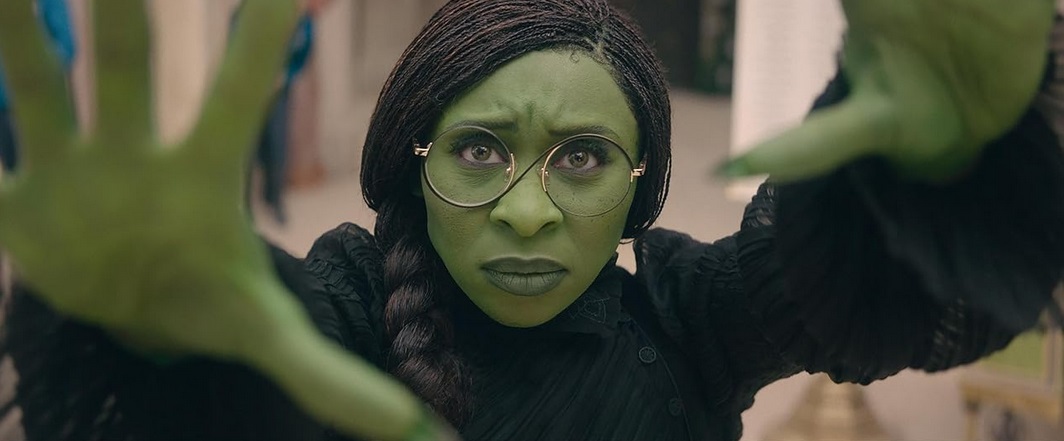
 And that's the concentrated subtlety of Cynthias Erivo's performance. While the rest of the movie is "twinkling and cavorting" she earns every slight tilt of the head, wry pull of the mouth, and doesn't waste anything. And she acts through her songs, so even through context, you know exactly what she's singing about—from everybody else, a lot of the lyrics get lost in the jumble. And when she tornadoes through a power-ballad, it shakes the theater-speakers and pummels the heart-strings. I dropped a tear or two during that "Defying Gravity" finale, and that's probably a little threatening to the character.




But, it made me want to see Part 2—and not just for the sake of the economy. I have to admit, it did cast a spell.

* The book, of course, didn't have to hew to any visual conception. The stage-musical leaned heavily into the 1939 movie version of things.


