Showing posts with label James Mangold. Show all posts

Friday, December 27, 2024

A Complete Unknown (2024)

How Does It Feeeeeeeeeel?

or
The Freewheelin' (Inscrutable) Bob Dylan
 
"Seven simple rules of going into hiding: one, never trust a cop in a raincoat. Two, beware of enthusiasm and of love, both are temporary and quick to sway. Three, if asked if you care about the world's problems, look deep into the eyes of he who asks, he will never ask you again. Four, never give your real name. Five, if ever asked to look at yourself, don't. Six, never do anything the person standing in front of you cannot understand. And finally, seven, never create anything--it will be misinterpreted, it will chain you and follow you for the rest of your life."
Bob Dylan
 
Musicians performing on-stage use something called "foldback speakers" so that they can hear themselves accurately against the wash of sound coming from auditorium reverberation or the cacophony of crowd noise fighting against them—modern musicians use ear-buds to have their music pumped backed to them without any deleterious feed-back from similar music sources competing. 
 
That little bit of insider trivia is what I was thinking about walking out of A Complete Unknown, the new bio-pic of a slice of Bob Dylan's life as he was becoming more known and making a name (and history) for himself prowling around the Greenwich Village clubs, riding a burgeoning folk-music wave and expanding the subject matter of the genre like his heroes, Woody Guthrie and Pete Seeger into advocacy-folk or what would become known as "protest songs," which formed the soundtrack of the youth movement of the early 1960's.
 
Dylan has been mixed up with movies before—the documentary Bob Dylan: Don't Look Back, various music videos, he wrote the music for and played in Pat Garrett and Billy the Kid, wrote and starred in Masked and Anonymous, and Renaldo and Clara, and although not mentioned by name is seen through a prism of stories and interpreters in I'm Not There.
Well, this one has his seal of approval, sticks to one actor as Dylan, and covers January 24, 1961 to July 25, 1965 (when Dylan first arrived in New York City at the age of 19 to his controversial performance set at the 1965 Newport Folk Festival). And it does a pretty good job of clearing away all the myths about Bob Dylan, his absences from the public eye (hard to believe these days, he's even done commercials), his changing personas more than Madonna or Bono, and just concentrates on that initial section where he became a performer, then The Brand New Thing, then The Highly Exploitable Thing, to The Voice of His Generation, all the while navigating the rigors of performing, the inanities of being a product, and the desire to start breaking things and doing something fresh.
Frankly, that's enough. It was never his mission to be understood, and the movie never tries to psychoanalyze or explain his actions, but merely the context into which he arrived and the way things changed once he started performing. He came in with talent and a poet's way of putting thoughts into words in a way no one had ever done before, inspired by folk music and its tendency towards metaphor. 
That is immediately recognized by practitioners of the art—Pete Seeger (
Edward Norton, wonderfully essaying the man as appeaser rather than rebel) and a hospitalized-by-Huntington's Woody Guthrie (Scoot McNairy, in a non-verbal performance), and he is promoted, signed by a label (Dan Fogler plays Columbia A & R guy Albert Grossman), and starts playing bigger venues, all the while already established folkies like Joan Baez (Monica Barbaro) start interpreting his material for the mainstream. The maxim is "it's the singer, not the song" but Dylan's "voice" (as far as his writing) was so distinct, he bobbed up through the commercialization as the Genuine Article quickly and, with his ungussied-up vocal stylings, bereft of soothing harmonies and homogenizing orchestrations.
So...back to that foldback speaker: Imagine you're putting yourself out there, performance after performance, and you're leading the field. Then, you start hearing yourself over and over again and not necessarily your voice. People are singing your songs, and then imitating your songs—Pete Seeger's "Where Have All the Flowers Gone" begets your "Blowin' In The Wind" and then that begets Phil Ochs' "There But For Fortune"—or imitating your composing-process, and then parroting and parodying your songs and then you're suddenly surrounded by the newest versions of "you" while (as movie-Dylan gripes) "you just want me singing 'Blowin' In The Wind' solo for the rest of my life." It's stifling. It's maddening. It makes you want a change.
But, that's not what your label wants. It's not what your manager wants. It's not what your fans want. They want the rebellion and the "new" sound to be what they're comfortable with...or what they're making money with. You want to create. They want to cash in. Or get their comforting nostalgia. No one gets it.
But it gets creepy. There's a scene in Don't Look Back where Dylan is talking to a fan and the exchange is this:
Fan: I just don't like any of the "Subterranean Homesick Blues" stuff. 
Bob Dylan: Oh, you're that kind - I understand, right now. 
Fan: It's not you. It doesn't sound like you at all! 
Bob Dylan: But, my friends, my friends were playing with me on that song. You know, I have to give some work to my friends too. I mean, you don't mind that, right? Huh? You don't mind them playing with me if they play the guitar and drums and all that stuff, right?
Fan: It just doesn't sound like you at all. It sounds like you're having a good ole laugh. 
Bob Dylan: Well, don't you like to have a good ole laugh once in awhile? Isn't that all right with you?
 
"That's not you." How the "homesick blues" does he know? Because he attended a concert? Because he bought himself a record? It's no wonder that at one point Dylan just blurted "Just because you like my stuff doesn't mean I owe you anything." See it as ingratitude if you must or see it as not "playing the game" but "you gotta do you" because "you" is what got you there in the first place. All artists go through this. Some have even rebelled. Some have got away with it. Some have not. Some have walked the tight-rope of practicality where you're either an "artist" or you pay the bills (you know...like we non-artists do).
A Complete Unknown is wonderful in every way for putting you not in Dylan's head but in his head-space. And if the man is still an enigma after you see it, you can, at least, understand why. If I have anything negative to say about it, it's that Ricky Nelson said the same thing in just over three minutes.* That's efficient.

Now, I've gotta pay the bills, do what's expected of me: how is Chalamet? Spot on. Pretty amazing, actually, but I've never ever been disappointed by a Chalamet performance. Of course, he's prettier than Dylan, but, like Joaquin Phoenix did with Johnny Cash in director Mangold's previous music bio-pic I Walk the Line, he suggests Dylan rather than does a full-on imitation. He has a less-is-more approach which is entirely appropriate for the subject, but there's a nice touch that he brings to his Dylan which is lovely—a defiant, almost predatory stare, observing, analyzing, like a biding-his-time hawk. And, considering his vocal talents in Wonka, of course he can do a dead-on imitation of Dylan's singing style. You have to listen very closely to tell the difference between Chalamet's versions of Dylan's songs and the memories of the real deal.

I mean, the real "real deal."

"I'm not angry. I'm delightful."
Bob Dylan 
*
 

Friday, June 30, 2023

Indiana Jones and The Dial of Destiny

Once More Without Spielberg
or
The Adventures of Old Indiana Jones
 
Released right before "Indy-pendence Day," Indiana Jones and the Dial of Destiny comes with a lot of promise and a few new wrinkles—and not just the ones on star Harrison Ford's face (although the opening sequence takes pains to "de-age" him as it takes place during World War II). This is the first of the adventures (with the exception of 28 episodes of "The Young Indiana Jones Chronicles") not to be directed by Steven Spielberg—instead it's overseen by James Mangold, who's no slouch having directed Logan and Ford vs. Ferrari. It also promises—with all the credibility that goes with the words "Farewell Tour"—to be the last of the Indiana Jones series.
 
Ford is getting "up there"—he'll be 82 on July 13th—and he's been joking since The Last Crusade that he'd prefer any next "Indy" film to be called "Indiana Jones and the Really Comfortable Bed."* Dial of Destiny doesn't prove to be that (although, he does spend some melancholic time sprawled out in a barcalounger). But age is catching up to the old whipper-snapper, and we find him in the year 1969—just after the Apollo 11 moon landing—doing more than the requisite small steps and giant leaps, certainly more than a man his age should be attempting.
Indiana—or as the world knows him Dr. Henry Walton Jones, Jr.—is spending "Moon-Day" in New York—the date of the Apollo 11 astronauts' ticker-tape parade—dreading it. He is retiring from his teaching post at Hunter College where his students are now bored by antiquities (including him!) and his teacher-prep consists of hitting the bottle rather than the books. He's alone; among the clutter of his dreary apartment are the unsigned divorce papers from Marion, one more separation in a life (and film-series) full of them. But, his class has one new auditor, Helena Shaw (
Phoebe Waller-Bridge), god-daughter to Dr. Jones and daughter of another of his allies during the second world war, Basil Shaw (Toby Jones). 
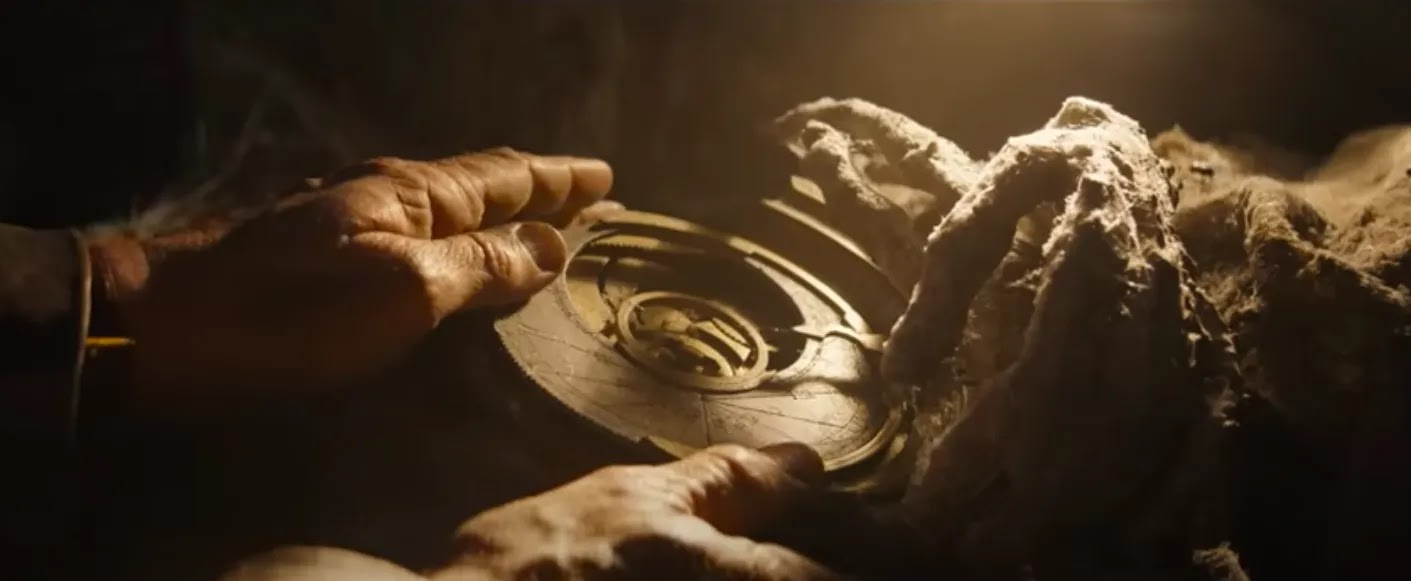
We've met Basil in the film's first sequence—a protracted chase of planes, trains, automobiles, and motorcycles to try and claim back treasures from a Nazi plunder-train to satisfy Hitler's fascination with the Occult. First, they're after the "Lance of Longinus" (which turns out to be fake), then attention is shifted to Archimedes' Dial—the Antikythera—which is of particular interest to a young Nazi physicist named Jürgen Voller (Mads Mikkelsen). The Dial was considered the first computer, constructed around 87 B.C. and was designed to calculate astronomical positions, eclipses, and the movie would have you believe it can predict geological upheavals and...time-fissures.** The trick of it is, though, that the Nazis only have half of it. They need the other half to make it work.
Anyway, Voller wants it, and Indy and "Bas'" want to keep it from him. Indy has been captured by the Nazis (of course) and they want information and he thinks all those antiquities should be in museums. While he's being threatened by the Nasties, Basil gets captured, as well, and is carted onto a train for any information about the Lance. After Indy survives an execution (several times), it becomes his mission to 1) get on that train 2) rescue Basil and 3) get all those baubles while surviving machine guns and bombing runs by the allies. All done at night, the better to hide the extensive special effects it takes to pull the sequence off, somewhat credibly.
One becomes aware, almost immediately, that Mangold is directing this entry and not Steven Spielberg (although George Lucas—who thought up the series—and Spielberg are listed as Executive Producers, they're not involved in the picture-making). It is in the DNA of Spielberg-as-director to make any sequence a playful series of complications that his shot-choices link one to the other. There's a flow that he intentionally puts into his action scenes that instantly telegraphs information to his audience. Mangold tries to do that, here, but there's a disconnect between elements that is often confusing and, at times, seems jarring to the point of obfuscation. The initial action set-piece immediately lowered my bar for expecting a superior Indiana Jones movie—as good as the other four, certainly—and those who have criticized the previous films may find themselves re-appraising their gripes (although I doubt it).
That's the set-up and the 1969-situated remainder of the movie involves the efforts to retrieve the other half of the Antikythera, which necessitates globe-trotting looking for clues to where that might be. I've always loved that element of the Indiana Jones—the tricks, the clues, the puzzles and translations unearthed from the vagaries of time and Nature. There's mounds and mounds of that, with the concomitant parallel of villains riding the research coat-tails that get in the way and delay the satisfaction of the reveals. 
In this case, its the older
Jürgen Voller, who has spent his time helping NASA with their rocket program and has gotten the co-operation of the U.S. government (specifically the C.I.A., in the form here, of Shaunette Renée Wilson doing a great "Foxy Brown" impression), and a couple of thugs (Boyd Holbrook, Olivier Richters) who have their own agenda, which is a bit more contemporary, even if they are less dramatically interesting. Throw in a kid-sidekick (Ethann Isidore) who starts out annoying and becomes gradually more entertaining.
Toss in helpers like Antonio Banderas (in too short a role) and old pal Sallah (John Rhys-Davies), and you have a nicely well-rounded cast.
Most valuable player, though, is Waller-Bridge, whose character, frankly, brings most of the energy to the whole enterprise, completing a series that seems to depend on complicated females of divided loyalties to play off Ford's adventurer-archaeologist. Sure, she probably employed just as many stunt-doubles as Ford, but her quick-witted delivery and expressions has the advantage of youth and energy. Ultimately, where Ford was previously the lynch-pin for audience identification, here, she's the character that may (eventually) engender trust to make things right, while Indy becomes something of a liability in terms of age and attitude.
The end-sequences usually are where things get a bit dicey in these things (especially where "the Wisdom of the Fan-Tribe" weigh in), where the adventurers reach the end of the road and cross over into mysticism, myth and science-fiction. And although, credulity will be snapped to the breaking-point for many, I found that sequence to be the best part of the film, worth even enough to sit through the tedious bits (although I tend to be an apologist for this series, thinking quite highly of Kingdom of the Crystal Skull).
No spoilers here, but given the rather depressed nature of the older Dr. Jones Jr. throughout the film, the fourth act makes perfect sense, story-wise and emotionally, and presents an opportunity—although one hyper-fantastically reached—to complete a series-long character arc of learning and yearning. Okay, maybe I don't "buy" how they got there, but, dramatically, the ends justify the means and presents something unique to say,
with some real resonance, about this character we've followed from youthful arrogance to wistful dotage.
And the end-sequence before the credits? (there is no post-credit scene, thank you). I'm not ashamed to say I teared up, and it made me glad I saw the two hour-twenty-minute-movie even if two hours of it I found wanting. There was no reason for a fifth Indiana Jones movie—other than the thought that maybe they shouldn't go out on the fourth one—and the whole thing is an exercise in nostalgia. The coda only emphasizes that point. But, sometimes nostalgia is pretty important. Memories of the past warm the heart, enrich the soul, and make one step into an uncertain future with the hope of finding more treasures for the memory. Nostalgia isn't "what it used to be". It can also be a beacon to face the future.
But, I can't end this without acknowledging 81 year-old Harrison Ford for making another one of these when most of us hovering around decades of his age are worried about walking the stairs of the multi-plex without using a hand-rail. That's some stamina, man, I don't call how many stunt-doubles and digital-face-replacements were used to pull it off. That should be celebrated, along with the score by 91 year old John Williams, that still manages to raise goose-bumps and make the heart soar. 
 
If this is their mutual last movie, bravo. And thank you...for the memories.

* Me, skewing towards the time-chronology of the Indiana Jones series, wanted the 1960's adventure to be titled "Indiana Jones and the Electric Kool-Aid Acid Test". Oh, well.
 
** Sure, you'll call bullshit. But, you loved the Ark of the Covenant melting Nazis, cheered when rafts were used to bail out of airplanes and sled on the Himalayas...not to mention pulling beating hearts out of chests, and were awed by the Last Surviving Knight Templar. But, you couldn't get past "nuking the fridge." The suspensions of disbelief among fans are more rickety than the bridges Indy repeatedly has to cross. How can one love the one and hate the other? I think it has to do with being a fan as a child and a jerk as an adult—you grow up but never mature. Anyway, I'm long since done trying to understand fans of the "fantasy" genre. They seem determined to destroy what distinguishes the genre from the rest—imagination and wonder. End of lecture. No, I don't have office hours and I won't meet you for a fight in the parking lot. (And...I stole your lunch).

Saturday, December 4, 2021

The Wolverine

Written at the time of the film's release...

Ronin on Empty
or
The SNIKT Hits the Japanese Fan

The last Wolverine movie—which was also the only entry in the "X-Men: Origins" series—was not very good. But, like Wolverine healing from his wounds and coming back whole, hope springs eternal like adamantium claws, and there were enough interesting aspects to The Wolverine that one wondered if this time they might have got it right. They were basing it on the Chris Claremont/Frank Miller mini-series from way, way back, and the director is James Mangold, who did Cop Land and Walk the Line. I mean he's no Darren Aronofsky (who he replaced on the project), but maybe, just maybe...

It tries very hard.
The script went through the hands of many writers, some of them quite accomplished—Christopher McQuarrie, Scott Frank—and Mark Bomback, who wrote Unstoppable and Live Free or Die Hard. It retains some of the Claremont-Miller story, like the beginning with a self-exiled Wolverine living in the mountains, and his dealings with a bear and its careless hunter, but abandons most of it, causing it to suffer from serious story-bloat. There are echoes of the original throughout—a mention of a bullet-train from the story turns into a full-fledged battle on the top of one in this—but instead of echoes, we have the roar of something almost wholly new, adding other elements and characters from other stories in the canon (thankfully limited to this world). For example, it gives us a back-story of how Logan 
(Hugh Jackman) first met the man he will be dealing with in the movie—Yashida (Ken Yamamura in these scenes, then aging to Hal Yamanouchi).It's World War II, and he's in a Japanese prisoner of war camp, conveniently close to the city of Nagasaki, just when the second atomic bomb is dropped. Logan shields the POW guard from the effects of the blast that crisps Logan, but, no worries, he heals from the effects in five minutes, although very painfully.
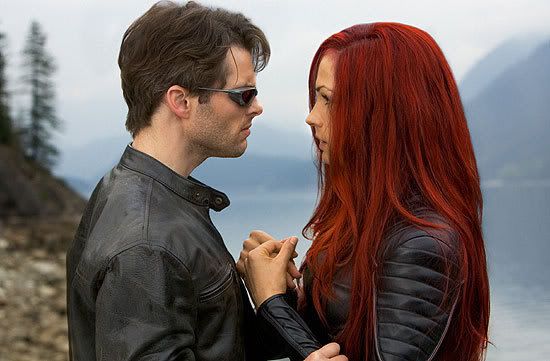
Fast forward. When we find Logan in the present, he is haunted by nightmares of his dead love Jean Grey (Famke Janssen). As she died in the egregiously terrible X-Men: The Last Stand, I know exactly how he feels—I'm still bitter about how they atomized the Scott Summers/Jean Grey relationship in that movie. While he's attending to the bear hunter in the bar, he's confronted with the pint-sized assassin Yukio (Rila Fukusima), who, in her stealth ninja style has electric red hair. Fascinating. She is in the employ of Yashida, who requests the man who saved his life at Nagasaki to do him a service before his death.* That would be in the form of relinquishing his mutant-powers to him. Makes sense—he's dying and wants to live forever, while Logan is living forever and hates it. Nobody's happy, so why don't we switch each other's green grass. Well, despite his oft-professed existential pain, the mutant either has a change of heart or he just knows how to position it and says that he would never curse someone with his everlasting powers, so, thanks but no thanks.  

Easy for him to say, he's living forever.

Yeah, I know Frank Miller likes it, but I never "bought" the
"Claws-stops-samurai sword" variation of Rock/Scissors/Paper.


Yashida dies (thanks, Wolverine!), distressing his family, including daughter Mariko (Tao Okamoto) who is attacked and threatened with kidnapping at her father's very public funeral.  So much for stealth.  At this point, it becomes a chase between the forces trying to kidnap Mariko (but who?) and some mysterious forces behind it all. Oh. And fights. And chases. And Logan gets hurt. And fixes himself, because that's what he does, even if it undermines any sort of tension that he actually might get killed.
Why do they usually change the comic-costumes of characters? 
Because they look stupid, that's why!
 
What Claremont and Miller cooked up in their mini-series was okay, if slightly uneventful. But without the Mariko-Logan back-story of the original tale, what Mangold and his writers have done is complicate things...a lot, drag in a standard Marvel villain, Viper (played by Svetlana Khodchenkova) (or Madame Hydra, as she was occasionally known and they dress her up in the customary cut-away latex thing the character always seemed to wear) and basically start from scratch, occasionally waving at the original story.
The whole thing feels convoluted and clunky and only brings some surprises if you've actually read the comic books—standard movie-goers just get the usual twists and turns that they can see coming a mile away. Mangold does try and bring something to the fights, but, with a PG-13 rating expected for the thing, there's only so much slashing that can be done in anything more than a suggestive fashion. As with the other X-men/Wolverine movies, you aren't shown the cleavage that happens when the
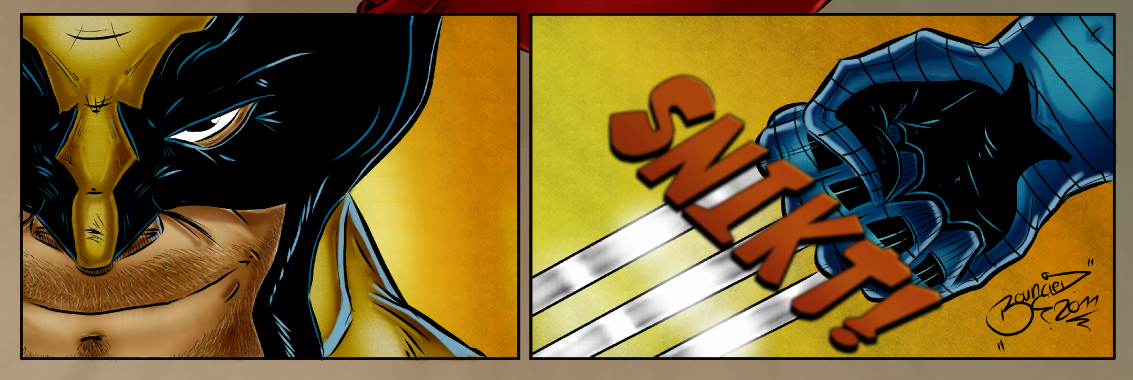
SNIKT! hits the fan. For all the talk of the character's bad-assery, the violence that his powers implies and the fan-boys want to see will always be ham-strung by the movie ratings system.
Despite Jackman's performance (and he'll always be associated with this role no matter how many musicals he'll do) this one doesn't feel fresh or fun, recycling a lot of material, but more so. That centerpiece fight on top of a bullet-train is the same sort of thing we've seen before—and recently in James Bond, Spider-man and The Lone Ranger—but the same stuff is being done, just faster and less impactful. Despite the constant threat of falling off or de-capitation (for Wolverine, everything will just heal), how can you make a fight on a bullet-train dull?
Well, maybe not so much dull as ludicrous.
Stick around as the credits roll out, though, for a couple of essential appearances—one of which is very surprising—that will lead into X-Men: Days of Future Past, which will attempt to unite the original X-men films with the "First Class" ret-conning to smooth out some of the two series continuity issues.  

Really, does it matter? How about just concentrating on making a better movie, like the First Class formula-blaster was?
Okay, I REALLY don't buy the claws stopping the Silver Samurai's sword.
("The Silver Samurai??")

 
* Wait a second here.  Wolverine saves HIS life at Nagasaki, and pulls him all the way to Japan to do this? I know he's an international crime-lord and all, but that's really against any "pay-back" principle or criminal code of conduct I've ever heard of. "You saved my life, so to repay you, I'm going to ask you to save it again." Oh. Well!  When you put it THAT way!

Thursday, July 15, 2021

Knight and Day

Written at the time of the film's release...

"Planes, Trains and Automobiles on Cruise-Control"
or
"Every Man His 007 (And Every Woman, Too)"

June Havens (Cameron Diaz) is going through a life-transition and doesn't even know it.  She's getting on a plane to Boston to be a brides-maid (never a bride) at her little sister's wedding, and letting go of the past by putting the finishing touches on her father's dream-project, restoring a pre-70's GTO, and giving it to her sister as a wedding present.

But, she's keeps running into this "guy," literally—the last time at the airport before she boards her plane, and finds that...sorry, the flight is full-up. The "guy," Roy Miller (Tom Cruise) enigmatically says, "Some times things happen for a reason" and boards the plane.
Truer words. Before you can say "Non-res" she's on the plane and chatting up Miller, who's personable, quiet, and (when she's not looking) scoping out the plane. It's the first instance of her not registering what's happening to her, but it won't be the last. Don't be too hard on herShe's a "newbie" at counter-espionage.
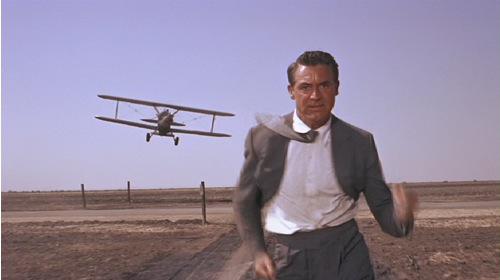
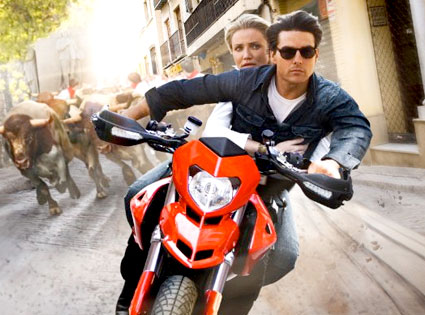
It starts tracking like a Hitchcock film—the "innocent" caught up in the intrigue—but it ends up morphing into Hitchcock's bastard love-child, the James Bond series. Cruise has always wanted to play Bond (incorrigibly American and too short, despite Daniel Craig's height issues—and some of the sets are low-ceilinged to disguise Cruise's short stature), hence the "Mission: Impossible" series that turned a team-effort into a one-man show. But, this is as close as he'll come, and he and the film do well by it, with the typical derring-do, a lot of homages to Bonds of the past, and doing one thing that the Bond's have never done:  this is a "Bond" film for women.
With all the variations on the theme the Bond producers have explored over the years, there's one thing they haven't done: looked at the adventure from the woman's perspective. As Kim Basinger said about Never Say Never Again, her part didn't amount to much because "it's all about Bond, anyway." Deft analysis.  It is always from Bond's perspective, and the women dragged into the scenarios, with or against their wills, are just chaff blown about in the fire-storm (or the Thunderball), accoutrements like his cuff-links and his wristwatch, though usually less functional.  Bond walks into their world, blows it up, and the best they can do is end up in the boat with him, ahead of the shock-wave. Even the most important and dynamic of the Bond-girls, Natalya Simonova from Goldeneye—she's the one who saves the world at the end—is along for the ride in all of the instantly disposable vehicles. Appropriate, as they're instantly disposable, too, the inevitable break-up happening between films never to be seen again in the series. Even the original books' author, Ian Fleming, tinkered with the idea, making "The Spy Who Loved Me," entirely from "the girl's" perspective.
And that's what this is, too. We're focused more on June and her "learning the ropes," frequently knocked out and dragged from one exotic location to another, by good guys and bad guys alike, a pawn in this battle of knights, Alice in "Thunderland."
The great thing about Knight and Day is that it doesn't have the "Bond cache" where he's always in charge, and stretches the formula to resolve a lot of the women's issues about control and taking charge in a satisfying, and complete, manner.
Of course, the "big" issue with a Tom Cruise movie is...how is Cruise? He's always been the eager-beaver, and sometimes, most times, in an effort to fill the void of the camera-frame, he'll take things so far as to be ludicrously over-the-top, practically mugging in an effort to create a character that registers.  He's learning. He's antic and funny in this, especially in the action scenes ("Alright, nobody move, or I shoot myself, and then the girl!"), sure, and sometimes frustratingly practical when the bullets are flying ("promiscuously" as they say in The Wind and The Lion) at him on the roof of car. But, in the quieter moments, he's relaxed and subtle, and emitting a mega-wattage star-power—somewhat less than Cary Grant, but certainly in the Christopher Reeve/Pierce Brosnan range, where he knows less is more. The camera loves him, and he accepts that love, without having to push it. He's GOOD in this, and Diaz, as ditzy as she can be, manages to make her "every-girl" sympathetic and identifiable.
This is the Bond movie that the wife/girl-friend won't sit in frustration during, as it's been nicely laser-etched with a "chick flick" by James Mangold, (and a bevy of screen-writers, starting with Patrick O'Neill and also passing though the PC of the great Scott Frank) with a cast rounded out by good actors like Paul Dano, Peter Saarsgaard, Gal Gadot, and Oscar nominee Viola Davis (Good to see HER again!).  Knight and Day, you are the one.

Sunday, April 26, 2020

Don't Make a Scene: Ford v Ferrari

The Story: When I saw Ford v Ferrari last year, it intrigued me despite not being "into" auto-racing. It was just good story-telling on the part of the writers and director James Mangold.

And one of the testaments to that is this scene: Carol Shelby being called on the carpet for not delivering a winning race despite the interference that prevented it.

I've seen on-line debates about this and how it might be unfair to Leo Beebe, the executive at Ford who comes across as the chief "problem" for success in the film. His actions were his actions and Beebe's concerns were corporate "Big Picture" matters of protecting the brand rather than having racing "cowboys" save the company's reputation.

But, I loved this scene and how all the parties made it riveting and surprising, despite it being a "corporate boardroom" scene. One wishes that I could find the particular scene on video to illustrate Damon's "Tommy Lee Jones"-like Texas laconic drawl that makes the "Yer welcome" such a big laugh-line, but it has disappeared.

This will have to suffice.

The Set-Up: In an effort to "gear up" the stodgy image of the Ford Motor Company and its product, marketing chief Lee Iacocca (Jon Bernthal) has convinced Henry Ford II (Tracy Letts) to promote its "sport" line with a focus on its auto-racing image. To do so, he's hired legendary driver Carol Shelby (Matt Damon) to win the 24 hour race at LeMans. To do so, Shelby and his team have hired legendary engineer and driver, Ken Miles (Christian Bale) to oversee and pilot the Ford entry. But, Miles is eccentric, uncompromising and has run afoul of Ford middle-man Leo Beebe (Josh Lucas), who vetoed the idea of Miles being behind the wheel of the first race of Ford against the dominant Ferrari team, the resultant being an embarrassing finish. And somebody is going to be held responsible.

Action.

Final Shooting Draft 04.24.19 
76.

CUT TO: INT. HENRY FORD II'S CORNER OFFICE, THE GLASSHOUSE. DAY 
Sport Illustrated on his desk: "Murder Italian Style - Ford humiliated by Ferrari". To the side, ever-present Leo Beebe. In front, Iacocca. Ford drops a newspaper. "Ford Destroyed." "Ford Hammered At Le Mans". "Ford. Humiliation at Le Mans." 
IACOCCA We made mistakes. (He stops) Mr Ford. There's a difference between Ford and Ferrari. Between our methods. 
HENRY FORD II Apart from the fact he came in 1, 2, 3 and we failed to cross the finish? Apart from the fact we're the biggest firm in the world and I could lose his tin-pot operation down the back of my couch? 
INT. DEUCE’S OFFICE LOBBY. DAY 
Shelby sits, listening the Deuce’s voice through the door, as he flicks through a newspaper: "Ford Craps Out. Ferrari In Front." 
He takes out his pills, pops a couple, watching as-- 
A YOUNG EMPLOYEE pushes a mail cart. He hands a manila envelope to the Deuce’s second assistant, who opens it and walks the enclosed red folder to the Deuce’s Secretary. 
ASSISTANT Grace?

She looks at Shelby as he pops a couple more pills. 
BACK INSIDE 
BEEBE Are you insane? The guy's a snake-oil salesman. A Stetson. Yesterday man. A good driver who's washed up. 
IACOCCA Shelby is a winner. He knows how. 
BEEBE What you're saying, what I'm hearing, is that in light of this debacle, you're prepared to stake your reputation on this guy. 
Neither blinks. Ford watches. 
IACOCCA Yes I am. 
INT. DEUCE’S OFFICE LOBBY. DAY
SECRETARY Yes sir. I'll send him right in. Thank you. 
Mr. Ford's secretary puts down the phone and walks toward Shelby. He watches her closely.
SECRETARY Mr. Ford will see you now.
SHELBY Alright.
SHELBY ENTERS THE OFFICE.
LEO BEEBE ...this guy.
SECRETARY This way, Mr. Shelby. 
Before she leaves, the secretary puts the red folder on Ford’s desk, but not before Beebe peeks at it. 
Shelby watches her close the door. 
SHELBY Mr. Ford. 
SHELBY Gentlemen. 
HENRY FORD II Shelby. 
HENRY FORD II Give me one reason... 
HENRY FORD II ...why I don't fire everyone associated with this abomination, starting with you. 
Iacocca shifts uncomfortably. Shelby holds Ford's gaze. 
SHELBY Well, Sir. I’ve been thinking of that very question as I sat out in your lovely waiting room. 
SHELBY And while I was sitting there, I watched that little red folder right there...
SHELBY ...go through five pairs of hands... 

SHELBY ...before it got to your mitts. And that’s not including...
SHELBY ...the twenty two Ford employees who must’ve poked at it...
SHELBY ...before it got to the 19th floor. With all due respect, sir, you can’t win a race by committee. 
SHELBY It’s like trying to run with a load in your pants. You need one man in charge. 
Iacocca looks at Shelby in total incredulity. 
SHELBY (cont’d) The good news is, you ask me, even with the extra weight in the trunk
SHELBY ...we still managed to put ol’ Ferrari right where we want him. 
FORD Did we. 
SHELBY Oh yes. 
FORD Expand. 
SHELBY Well... 
SHELBY Sure we haven't worked out how to corner. Or stay cool.
FORD Or stay on the ground. 
SHELBY And a lot of stuff broke. In fact the only thing that didn't break is the brakes. 
SHELBY Right now we don't even... 
SHELBY ...know if the paint lasts 24 hours.
SHELBY But (the fact is) our last lap clocked 218mph down the Mulsanne straight. Now in all his years of racing, Enzo ain't seen nothing move that fast. 
SHELBY And now, he knows without a doubt... 
SHELBY ...we're faster than him. 
SHELBY Even with the wrong driver. 
SHELBY And the... 
SHELBY ...committees. 
SHELBY That's what he's sitting in Modena thinking about, right now.
SHELBY He’s worried this year you might actually be smart enough to give me the control I need to win. 
(looks at them all)
SHELBY So yes. I'd say you got Ferrari exactly where you want him.
SHELBY You’re welcome. 
Iacocca’s jaw drops. Beebe stares, horrified at Shelby’s insolence.
Ford eyeballs Shelby for a good seven seconds. 
He stands. 
FORD C'mere...

Looks out the window. A crease of a smile. 
FORD See that little building... 
FORD ...down there? 
FORD In WW2... 
FORD ...three out of five US bombers rolled off that line. 
FORD You think Roosevelt beat Hitler? 
FORD Think again. This isn't the first time...
FORD ...Ford Motor’s gone to war in Europe. 
FORD We know how to do more than push paper. 
FORD And-- (points to himself) --there is one man running this company.

FORD And you report to him. Understand me?
SHELBY Yes, sir.
FORD (He turns) Go ahead, Carol. 
FORD Go to war. 
SHELBY Thank you, sir.

Ford v Ferrari (aka LeMans '66)

Word by Jez Butterworth, John-Henry Butterworth and Jason Keller


Pictures by Phedon Papamichael and James Mangold


Ford v Ferrari is available on DVD and Blu-Ray from Fox Home Video.