Showing posts with label Harrison Ford. Show all posts

Sunday, March 9, 2025

Captain America: Brave New World

Re-Heated Leftovers
or
The President's a Red Hulking Jerk (So What Else is New?)
 
The new Captain America movie—Captain America: Brave New World—has been the #1 movie of the past three weekends, so it was about time I checked it out. It's the first new "Cap" movie with the retirement of the Steve Rogers (Chris Evans) character in Avengers: Endgame, and after a Disney+ series try-out, Anthony Mackie gets to stop being called The Falcon and being called Captain America in an actual movie from Marvel Studios. 
 
Too bad he feels like a co-star in his own movie, as the character flails around trying to solve a government conspiracy involving the big dump of adamantium that's been sitting in the Indian Ocean since The Eternals (and that was—what?—four years ago?), while at the same time a villain from the past (2008, specifically, but from another Marvel movie series from a previous studio), who has supposedly been rotting in a secure jail-cell somewhere apparently isn't and has his own plans for—muah-ha-ha—revenge. Already the "Brave New World" title of the movie feels like a stretch as it seems to be recycling old dangling plot-threads from the less-than-successful Marvel movies of the past.
And speaking of recycling, 
Harrison Ford takes over for the late William Hurt (who took over from Sam Elliott) playing General Thaddeus "Thunderbolt" Ross, who has previously been a thorn in The Avengers' boots and has parlayed that into becoming President of the United States (Ford is President again? Man, we ARE recycling). And as much as Ford tends to dominate the proceedings of the film, he overshadows Mackie's Sam Wilson/Cap and (I think) to the film's detriment.
So, the film begins after the events of "The Falcon and the Winter Soldier" (which I never saw, but it apparently doesn't matter much) where Cap and the new Falcon, Joaquin Torres (
Danny Ramirez) take part in an undercover operation in Mexico to stop a mercenary named Sidewinder (Giancarlo Esposito), who works for "Serpent" guess they're bad guys—to recover some MacGuffin (which turns out to be refined adamantium that the Japanese government had secured from that Eternals thing which has now been called "Celestial Island"). Don't worry if all of that sounds new, because it is, and no, you haven't missed anything.
Anyway, mission accomplished with the help of Cap's new, improved vibranium-infused wings from Wakanda and a lot of gee-whizardry. Despite doing well in Mexico, Cap insists that Torres train with one of America's super-soldiers, one Isaiah Bradley (
Carl Lumbly, always enjoyable), who was introduced in the Disney+ series. Long story short, he was a super-soldier in Korea, but had been imprisoned by the government for the past 30 years...but isn't now. Cool.
After the successful mission, everybody gets invited to the White House to meet the President (both the U.S. and Japanese variety), but while Ross is giving a presentation on how the world should be safe-guarding and sharing adamantium for the world's benefit (unlike those Wakandans!) and doing one of those "it's-for-your-own-good" speeches that American Presidents do, phones start erupting with a song by The Fleetwoods, which turns some in the audience—including Bradley—into "attack" mode (actually, The Fleetwoods aren't that bad!) and they start firing on the President. A big melee happens and Bradley is taken into custody even though he can't remember anything about trying to shoot the President. It's back to prison for Bradley, and Cap is on the "outs" with Ross because Cap's friend tried to shoot him.
Anyway, you get the gist. An international plot (that may involve World War III!) with personal repercussions for our Captain, and it just gets so complicated with mind-controlling cell-phones, nobody trusting anybody, Ross' potential heart-problems, on top of the lamest of character motivations at this late date—how  now-President Ross feels so bad that he's estranged from his daughter Betty (Liv Tyler) because he tried to kill her ex-boyfriend, Bruce Banner, The Hulk (back before he was Mark Ruffalo) making everything a bit of a mish-mash.
That last bit—the daughter thing—undercuts the movie quite a lot, and although Ford plays it gamely, it's a bit of weak tea for motivation, especially given the higher stakes globally, and finally makes President Ross a bit of a lame character, where his ambitions as President pale to his "just wanting to get along" with his own kid. If it was really such a big deal as the movie makes it out to be, it wouldn't be resolved so soporifically as it is in the movie.
But what am I complaining about, nobody cares much for all that thin "character stuff," as what they really want to see is Ross turn into The Red Hulk because it's promised in the poster and the previews. Given the character's history with the Green Hulk, this is irony with a capital SMASH! and, frankly, has nothing to do with the rest of the movie other than that the same bad guy responsible for all the mind-controlling has been setting up the Third Act Hulkitude as well, just so that...Ross can look bad in front of his daughter, frustrating him into full chili-pepper berserker mode. Oh, and cause all sorts of damage to prominent monuments...and cherry trees.
One senses in that final Cap vs. Red Hulk confrontation that a lot of screenplay back-filling was done in order to bring it about (there are five credited screenwriters), but even given the cheesiness that goes into a lot of the funny-book verisimilitude, the  efforts here strain the goodwill needed in order to accept it.
I mean I know it's based on comic books and superheroes, but it takes a Hulk-style leap of faith to accept the ways and means it takes to get there. It takes a lot of the geek-fun out of it to know you're being played. Still, it IS good to see Tim Blake Nelson come back. He's a good actor, a good director, and a heck of a nice guy. He plays evil good, too. But, just as he was ill-served in The Incredible Hulk movie so many years back, he's ill-served by this one, too.
So, it's disappointing, especially because it's Anthony Mackie's first Captain America movie and I've always liked him. And because...legacy. Of all the Marvel properties, the Captain America series was the last of the "majors" to come out before the first "Avengers" movie, and the studio managed to work with its old-fashioned and, frankly, jingoistic tendencies and make it work well. In fact, they did their job so well that
the Captain America series was the one trilogy of movies in the Marvel stable that didn't falter in any of its three films. 
 
Now, it has. And that leaves me feeling a bit sad...and disappointed.

Friday, June 30, 2023

Indiana Jones and The Dial of Destiny

Once More Without Spielberg
or
The Adventures of Old Indiana Jones
 
Released right before "Indy-pendence Day," Indiana Jones and the Dial of Destiny comes with a lot of promise and a few new wrinkles—and not just the ones on star Harrison Ford's face (although the opening sequence takes pains to "de-age" him as it takes place during World War II). This is the first of the adventures (with the exception of 28 episodes of "The Young Indiana Jones Chronicles") not to be directed by Steven Spielberg—instead it's overseen by James Mangold, who's no slouch having directed Logan and Ford vs. Ferrari. It also promises—with all the credibility that goes with the words "Farewell Tour"—to be the last of the Indiana Jones series.
 
Ford is getting "up there"—he'll be 82 on July 13th—and he's been joking since The Last Crusade that he'd prefer any next "Indy" film to be called "Indiana Jones and the Really Comfortable Bed."* Dial of Destiny doesn't prove to be that (although, he does spend some melancholic time sprawled out in a barcalounger). But age is catching up to the old whipper-snapper, and we find him in the year 1969—just after the Apollo 11 moon landing—doing more than the requisite small steps and giant leaps, certainly more than a man his age should be attempting.
Indiana—or as the world knows him Dr. Henry Walton Jones, Jr.—is spending "Moon-Day" in New York—the date of the Apollo 11 astronauts' ticker-tape parade—dreading it. He is retiring from his teaching post at Hunter College where his students are now bored by antiquities (including him!) and his teacher-prep consists of hitting the bottle rather than the books. He's alone; among the clutter of his dreary apartment are the unsigned divorce papers from Marion, one more separation in a life (and film-series) full of them. But, his class has one new auditor, Helena Shaw (
Phoebe Waller-Bridge), god-daughter to Dr. Jones and daughter of another of his allies during the second world war, Basil Shaw (Toby Jones). 
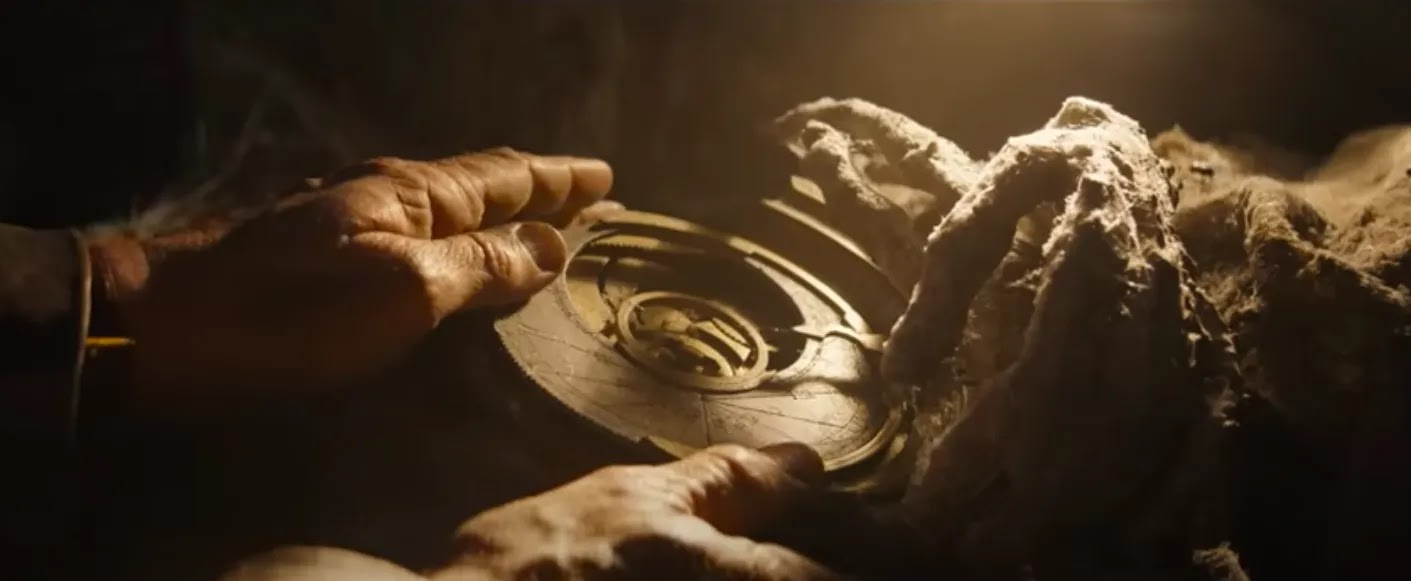
We've met Basil in the film's first sequence—a protracted chase of planes, trains, automobiles, and motorcycles to try and claim back treasures from a Nazi plunder-train to satisfy Hitler's fascination with the Occult. First, they're after the "Lance of Longinus" (which turns out to be fake), then attention is shifted to Archimedes' Dial—the Antikythera—which is of particular interest to a young Nazi physicist named Jürgen Voller (Mads Mikkelsen). The Dial was considered the first computer, constructed around 87 B.C. and was designed to calculate astronomical positions, eclipses, and the movie would have you believe it can predict geological upheavals and...time-fissures.** The trick of it is, though, that the Nazis only have half of it. They need the other half to make it work.
Anyway, Voller wants it, and Indy and "Bas'" want to keep it from him. Indy has been captured by the Nazis (of course) and they want information and he thinks all those antiquities should be in museums. While he's being threatened by the Nasties, Basil gets captured, as well, and is carted onto a train for any information about the Lance. After Indy survives an execution (several times), it becomes his mission to 1) get on that train 2) rescue Basil and 3) get all those baubles while surviving machine guns and bombing runs by the allies. All done at night, the better to hide the extensive special effects it takes to pull the sequence off, somewhat credibly.
One becomes aware, almost immediately, that Mangold is directing this entry and not Steven Spielberg (although George Lucas—who thought up the series—and Spielberg are listed as Executive Producers, they're not involved in the picture-making). It is in the DNA of Spielberg-as-director to make any sequence a playful series of complications that his shot-choices link one to the other. There's a flow that he intentionally puts into his action scenes that instantly telegraphs information to his audience. Mangold tries to do that, here, but there's a disconnect between elements that is often confusing and, at times, seems jarring to the point of obfuscation. The initial action set-piece immediately lowered my bar for expecting a superior Indiana Jones movie—as good as the other four, certainly—and those who have criticized the previous films may find themselves re-appraising their gripes (although I doubt it).
That's the set-up and the 1969-situated remainder of the movie involves the efforts to retrieve the other half of the Antikythera, which necessitates globe-trotting looking for clues to where that might be. I've always loved that element of the Indiana Jones—the tricks, the clues, the puzzles and translations unearthed from the vagaries of time and Nature. There's mounds and mounds of that, with the concomitant parallel of villains riding the research coat-tails that get in the way and delay the satisfaction of the reveals. 
In this case, its the older
Jürgen Voller, who has spent his time helping NASA with their rocket program and has gotten the co-operation of the U.S. government (specifically the C.I.A., in the form here, of Shaunette Renée Wilson doing a great "Foxy Brown" impression), and a couple of thugs (Boyd Holbrook, Olivier Richters) who have their own agenda, which is a bit more contemporary, even if they are less dramatically interesting. Throw in a kid-sidekick (Ethann Isidore) who starts out annoying and becomes gradually more entertaining.
Toss in helpers like Antonio Banderas (in too short a role) and old pal Sallah (John Rhys-Davies), and you have a nicely well-rounded cast.
Most valuable player, though, is Waller-Bridge, whose character, frankly, brings most of the energy to the whole enterprise, completing a series that seems to depend on complicated females of divided loyalties to play off Ford's adventurer-archaeologist. Sure, she probably employed just as many stunt-doubles as Ford, but her quick-witted delivery and expressions has the advantage of youth and energy. Ultimately, where Ford was previously the lynch-pin for audience identification, here, she's the character that may (eventually) engender trust to make things right, while Indy becomes something of a liability in terms of age and attitude.
The end-sequences usually are where things get a bit dicey in these things (especially where "the Wisdom of the Fan-Tribe" weigh in), where the adventurers reach the end of the road and cross over into mysticism, myth and science-fiction. And although, credulity will be snapped to the breaking-point for many, I found that sequence to be the best part of the film, worth even enough to sit through the tedious bits (although I tend to be an apologist for this series, thinking quite highly of Kingdom of the Crystal Skull).
No spoilers here, but given the rather depressed nature of the older Dr. Jones Jr. throughout the film, the fourth act makes perfect sense, story-wise and emotionally, and presents an opportunity—although one hyper-fantastically reached—to complete a series-long character arc of learning and yearning. Okay, maybe I don't "buy" how they got there, but, dramatically, the ends justify the means and presents something unique to say,
with some real resonance, about this character we've followed from youthful arrogance to wistful dotage.
And the end-sequence before the credits? (there is no post-credit scene, thank you). I'm not ashamed to say I teared up, and it made me glad I saw the two hour-twenty-minute-movie even if two hours of it I found wanting. There was no reason for a fifth Indiana Jones movie—other than the thought that maybe they shouldn't go out on the fourth one—and the whole thing is an exercise in nostalgia. The coda only emphasizes that point. But, sometimes nostalgia is pretty important. Memories of the past warm the heart, enrich the soul, and make one step into an uncertain future with the hope of finding more treasures for the memory. Nostalgia isn't "what it used to be". It can also be a beacon to face the future.
But, I can't end this without acknowledging 81 year-old Harrison Ford for making another one of these when most of us hovering around decades of his age are worried about walking the stairs of the multi-plex without using a hand-rail. That's some stamina, man, I don't call how many stunt-doubles and digital-face-replacements were used to pull it off. That should be celebrated, along with the score by 91 year old John Williams, that still manages to raise goose-bumps and make the heart soar. 
 
If this is their mutual last movie, bravo. And thank you...for the memories.

* Me, skewing towards the time-chronology of the Indiana Jones series, wanted the 1960's adventure to be titled "Indiana Jones and the Electric Kool-Aid Acid Test". Oh, well.
 
** Sure, you'll call bullshit. But, you loved the Ark of the Covenant melting Nazis, cheered when rafts were used to bail out of airplanes and sled on the Himalayas...not to mention pulling beating hearts out of chests, and were awed by the Last Surviving Knight Templar. But, you couldn't get past "nuking the fridge." The suspensions of disbelief among fans are more rickety than the bridges Indy repeatedly has to cross. How can one love the one and hate the other? I think it has to do with being a fan as a child and a jerk as an adult—you grow up but never mature. Anyway, I'm long since done trying to understand fans of the "fantasy" genre. They seem determined to destroy what distinguishes the genre from the rest—imagination and wonder. End of lecture. No, I don't have office hours and I won't meet you for a fight in the parking lot. (And...I stole your lunch).

Thursday, May 19, 2022

Morning Glory (2010)

Roger Michell died last year at the age of 65, before his latest film The Duke was released. It is out now and I recommend seeing it, especially in a theater, where it will do the most good. Michell's most popular film is probably Notting Hill, but he also made The Mother and Enduring Love (for you Daniel Craig fans), and Hyde Park on Hudson (with Bill Murray as Franklin Roosevelt). To sum up, he made movies that are usually placed in "art-houses" where films of a limited budget and less than frivolous subject matter, unsullied by hyperbolic press and saturation campaigns go to die...and merit consideration during Awards Season, where sometimes their fortunes are favored, but mostly forgotten. And he was darned good at it. 
 
This was written at the time of the film's release.
 
"You're Gon-na Make it After Alllll"*
or
"Will Someone Tell Me Why I Logged Off 'BangingGrannies.com' For This?"

Talk about quick turn-around. Plucky news-producer Becky Fuller (Rachel McAdams) has just rebounded from being fired from her New Jersey TV station to being hired to produce an in-the-ratings-dumper morning news-klatsch in New York City. The stipulation from boss Jerry Barnes (Jeff Goldblum, whose height advantage over McAdams is used to very good advantage) is that she has to turn the ratings around on the clunker or the venerable TV-institution called "DayBreak" will be cancelled.

But who wants to work in an institution?
The place is a televised mad-house. Goofy weatherman, clueless reporters,
a perv' anchor (he delivers the second headline above), and the Nurse Ratched of the place is the veteran house-mother-anchor (Diane Keaton) who views Becky as just one more producer for a show that's "a revolving door for cretinous morons." She's seen 'em come and go, while she's been "pulling the train up the hill (...with my TEETH!)" for fourteen years. "DayBreak" needs to be fixed.

Becky starts to shake things up, and her first job is to find an anchor a little less orange.
She goes the credibility route and seeks out Mike Pomeroy (Harrison Ford, who hasn't done this much mugging since Return of the Jedi**), a veteran news-man (he lunches with Chris Matthews, Bob Schieffer, and Morley Safer), grumpily living out his golden parachute contract, and has no desire to lower his standards working on a show with "half an audience who've lost the remote, and the other half are waiting for the nurse to turn them over." 
Warned that he is "the third-worst person in the world...after
Kim Jong-Il and Angela Lansbury" by the movie's obligatory boy-friend (Patrick Wilson...slumming***), Becky finds a loop-hole in his contract and forces the pro to "lower his standards," but raise the bar on passive-aggressive behavior (he refuses to "banter, from the Latin word for 'gibber like a moron'")...as if the show needed any more of that. Pretty soon, every surface at the station has Becky-forehead-sized dents from her beating herself into them—that and her seeming incapacity to open doors are the two consistent jokes of which no opportunity is passed.

It's got the TV-industry cynicism down, but raised to the bitchy level of the fashion industry (the writer, Aline Brosh McKenna, also wrote The Devil Wears Prada, ...and 27 Dresses , and Laws of Attraction, and Three to Tango...so this is the first movie of hers I haven't actively avoided...although I did see Prada, and admired it). Director Roger Michell can do rom-com fine (Notting Hill), but he's capable of doing better stuff, and he keeps everything lively and semi-sunny, despite the rampant cruelty tossed around like so much unnecessary paper-shuffling on a news-desk. But, he can't do much with the cliched material, from the "meet cute" to the "slo-mo run through new York." 

Morning Glory is okay, but it breaks no boundaries (or news, for all that), it's another "working girl" comedy in the revolving door of them.

* Cue the hat-throw. Give credit where credit is due: I didn't notice this was basically "The Mary Tyler Moore Show" (and a two-hour stretch of the half-hour pilot, at that) until Ford's crusty news vet says to the young producer "You have a repellent moxie" in the same way that Ed Asner's Lou Grant said "You've got spunk....I HATE spunk!"  Where's Betty White when you need her?

** ...which makes me think something is wrong.  Ford is the master of the subtle slow-burn comic performance, but this one is at a hard-boil. His lines delivered in a husky, phlegmatic drone, you start to wonder if Ford—like his character—just isn't happy to be there (y'know, like his narration in BladeRunner?). Then, he manages to take what should have been the movie's worst scene, and make it shine, giving it depth, resonance and heart...while still not betraying his character. Nice work.

*** Yeah, but on the other hand, I've felt so sorry for so many good actresses playing "the girlfriend" over the years, this is one for equal opportunity. 

Friday, August 27, 2021

Milius

Milius
(Zak Knutson, Joey Figueroa, 2013) The title would be referring to John Milius of the notorious USC Brat-pack, pal of Coppola, Lucas, Spielberg, Scorsese, Zemeckis, and writer/director/producer of some good films—like Dillinger, The Wind and the Lion, Big Wednesday, Conan the Barbarian, Red Dawn, Farewell to the King—those he directed. He wrote (or co-wrote) 1941, Jeremiah Johnson, Dirty Harry and Magnum Force, Apocalypse Now, and contributed to little projects like Jaws (the U.S.S. Indianapolis speech) and The Hunt for Red October (Sean Connery liked him, which makes me suspect he worked on The Rock, too). One suspects he was the model for Walter Sobchak in The Big Lebowski—even this documentary does—but, that might just be speculation.
 
I was recording a commercial once with a football player and he said he'd just come back from making a movie. "Which one?" I asked. "Conan The Barbarian," he replied. "Oh, I want to see that one," I said. "Oh, good," he smiled. "You a Conan fan?" "Not particularly," I said. "But I really like John Milius' movies." His smile tightened. "Man," he said. "That guy's nuts."
 
Maybe. He is certainly a maverick in every sense of the word. A burly, gun-loving raconteur who talked big and loud and often preposterously, but with a twinkle in his eye. He is a romantic who hates love scenes, a historian of the John Ford school ("If the legend becomes fact, print the legend"), and has a fine sense of the absurd. 
He doesn't make little movies. The ones he makes are about brio and talking big and having big dreams. His movies swagger, but his characters don't, and they have an old-fashioned movie-showman sense to them that bring a smile to the face, even if you're shaking your head at the loutishness of it. He wanted to do Apocalypse Now because Orson Welles had tried (and failed) to make a movie of Joseph Conrad's "Heart of Darkness." As a script-doctor, he was more of a script-puncher, pushing movies places that they'd might not intended to go. But, one could ignore the theatricality...or avoid the temptation.
The movie takes a look at Milius' career—the tag-line "Man/Myth/Legend" is appropriate—with his film-making compatriots, all of whom have obvious affection for him, even if it's a rueful "That's John" smile. At the time of the film—2013—Milius was battling back from a debilitating stroke that had interfered with his speaking—the brain was functioning but he was having difficulty speaking and writing—which leaves you on a tragic note. Spielberg almost breaks down: "That's the worst thing I could imagine happening to a story-teller."
 
One wishes him well. One does not want the story to end.

Friday, May 7, 2021

Anytime Movies #8: American Graffiti

While I catch up on the reviews still in "Draft" phase here, I'll re-run a feature I ran when I first started this blog seven years ago,* when it was suggested I do a "Top Ten" List.

I don't like those: they're rather arbitrary; they pit films against each other, and there's always one or two that should be on the list that aren't because something better shoved it down the trash-bin.

So, I came up with this: "Anytime" Movies.


Anytime Movies are the movies I can watch anytime, anywhere. If I see a second of it, I can identify it. If it shows up on television, my attention is focused on it until the conclusion. Sometimes it’s the direction, sometimes it’s the writing, sometimes it’s the acting, sometimes it’s just the idea behind it, but these are the movies I can watch again and again (and again!) and never tire of them. There are ten (kinda). They're not in any particular order, but the #1 movie IS the #1 movie.

What's George Lucas' best film? For most, it's probably Star Wars (I'm sure there's some poor soul out there who likes Radioland Murders). There's a lot to like about his charmingly scruffy homage to the Buck Rogers serials. But one wonders what direction his career might have gone if he hadn't felt the need to exploit that first "Star Wars" movie as much as he did. It seems the more he explained about his initial concepts the worse the movies got, and the more rich and famous they made him, the more elephantine and fossilized they became.

For me, Lucas has yet to top
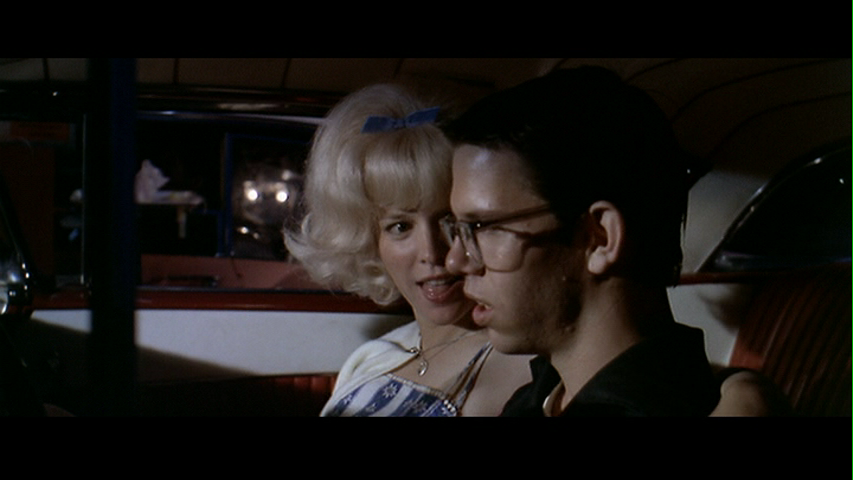
American Graffiti. Made for under a million dollars and filmed mostly at night using a skeleton crew (albeit one headed by Haskell Wexler), it showed just how ingenious Lucas could be when he was strapped for cash. It has the structure and froth of a Shakespeare comedy with the values and budget of an AIP teen flick.  Seemingly aimless, American Graffiti follows four storylines of small town kids on the last night of summer before heading to college. Curt (Richard Dreyfuss) has a scholarship to a big university but is reluctant to go, and spends the night bounced around by local toughs, and diverted by his quixotic pursuit of a phantom blonde in a white Thunderbird. Steve and Laurie (Ron "Ronny" Howard and Cindy Williams) are a couple in transition. Class President and Head Cheerleader, they're the Royal Couple of the Sock-Hop. But Steve can't wait to head out of town to conquer new territory, and Laurie-still in high school-knows she'll lose him when he goes. John (Paul LeMat) is a high school drop-out and legendary hot-rodder endlessly cruising the streets of town, looking for the next race. And Terry (Charles Martin Smithlives a rich fantasy life (that's a kind way of saying he's deluded) where he can imagine himself everything that he's not.
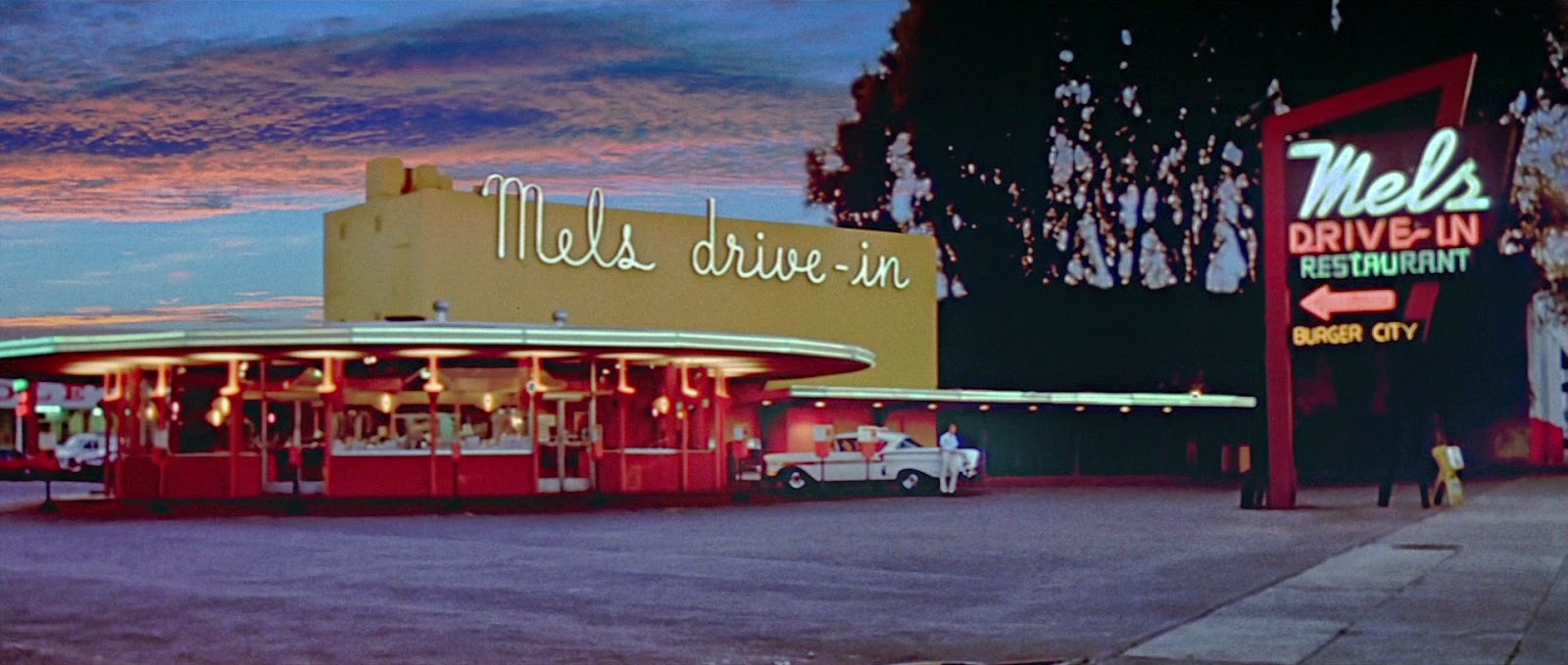
The Village Square
Lives intersect, couples form and break apart, lies are told, misunderstandings abound (to really make it Shakespeare all you'd need is a set of twins), while the majority of kids drive endlessly in circles--not going anywhere, but hoping to, and if not tonight, there's always tomorrow. They're not going anywhere.

In the background are the constant echoes of rock n' roll pouring out of car windows and reverberating down the hallways and back-alleys, broken only by the howls and shrieks of the common thread in their lives,
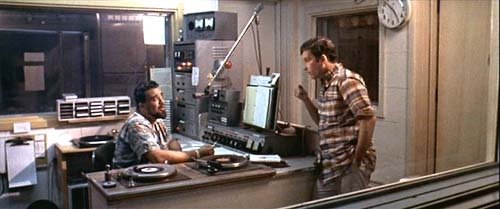
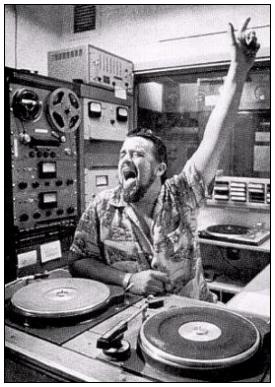
Wolfman Jack. All the kids have their Wolfman myths and he acts as sage, seer, siren and Master of Ceremonies for the evening's adventures. He's also the Fool and "The Man Behind the Curtain." Ultimately the long night's journey leads to his door-step, and, in disguise, dispenses his wisdom to the seeker. 
The Siren
One thing Lucas always knew was how to make a curtain call and American Graffiti is his best. As Curt flies off to college, he is left two signs of passage: the white T-bird reappears one last time to remind him what he's giving up, while locked away in his plane, the sounds of the radio station that have buoyed and sustained all the characters throughout the night fades to static. For the first time in the film there is no music and in the silence that creates, broken only by the drone of the plane we're told the rest of the story. Terry "goes missing" in Vietnam. Steve is an insurance salesman in town. John is killed by a drunk driver. Curt's a writer in Canada. After that punch in the gut, Lucas unsentimentally hammers it home with one of the cheeriest songs in the Beach Boys catalog—"All Summer Long," dismissed earlier in the film as "surfing shit." Lucas turns the future into a sobering fate—the film is set in 1962. The next year would signal the end of the innocence of the 50's and American Graffiti is a sweet farewell to trivial concerns and living in the past.
The Knight-Mentor
Lucas has said that he based the boys on different aspects of himself in high school--the intellectual, the nerd, the sosh' and the JD. Lucas' lesson in this, and all of his work seems to be "Advance or Die." It's the lesson of Graffiti. It is certainly the basis of the story of Anakin Skywalker. So what became of Lucas? Did he follow his own advice? Well, you could say he went to the future with Star Wars, but he set it in the far-away past. Then he built an Empire of his own...in his hometown.

The Trailer for American Graffiti--in the style of Beach Blanket movie

American Grafitti touched me in two ways. I had already been inspired by Lucas' first film, THX-1138 with its inventive sound-scape, to seek out his work and the work of his sound editor Walter Murch. Grafitti was their second collaboration and pretty much sealed my fate for going into sound work. Listening to it now, it's crude and has a lot of holes and bad edits, but the innovations are just as unique 30 years later and just as inspiring. On top of that, the unglamorous portrayal of a radio disc jockey's life (yet romantic in its anonymous/omnipresent effect on a community) made me think "I could do that!" and I started my sound career spinning discs at a radio station. My last job as such was at a station with a glass window that looked out on the town's "loop." Sort of like watching American Graffiti in reverse. That was KEDO-AM in Longview, Washington--long ago bulldozed.

Wolfman Jack explains it all for you, baby

I'd just done a "Don't Make a Scene" segment for American Graffiti* and was looking forward to writing new "insights" on this film, but reading it again, no, I pretty much covered them all. Not that American Graffiti is that simple—it's just that given Lucas' skimpy out-put, there's not a lot of complexity in his ouvre. It is interesting that Lucas goes the Joseph Campbell route in this film before he actually read "The Hero with a Thousand Faces" and used the "seeker's path" for the construction of Star Wars. He was already using it here and doing variations of it for the four Lucas-aspects, each with different fates (a cautionary tale, indeed). He also uses the cross-cutting on different fronts that would be his staple in the "Star Wars" films, but interestingly in his first Star Wars (A New Hope) and this film, there is no cross-cutting at the end, everyone is melded into the final story-line, buttoning everything up nice and neat. 

He wouldn't do that again.
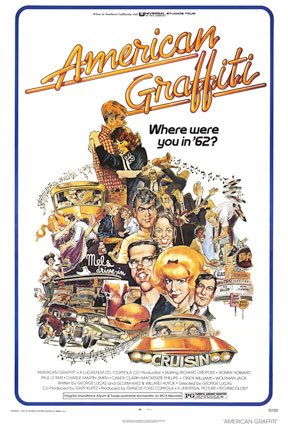
Mort Drucker's original artwork for American Graffiti
from the Estate of Howard Kazanjian
Anytime Movies:
American Graffiti
To Kill a Mockingbird
Goldfinger
Bonus: Edge of Darkness

* And, on Sunday, we'll put up a "Don't Make a Scene" feature from each week's film.

Saturday, August 29, 2020

42: In Memoriam

Written at the time of the film's release. Chadwick Boseman has gone on to play James Brown in Get On Up and "The Black Panther" in Captain America: Civil War.

Chadwick Boseman died of cancer on Friday at the too-young age of 43. He was great.


Changing the Face of the American Game
or 
The Saint of Swat

One of the great "unmade" movies is the story of Jackie Robinson of the Brooklyn Dodgers, the baseball player who broke the color barrier in the quintessential American game.

Oh, it has been made before: Robinson, himself, older and showing the effects of the strain the game and his task had put on him, starred in a B-movie version, The Jackie Robinson Story, in 1950; Ken Burns' definitive documentary Baseball made his story the lynch-pin of the parallel stories of The Game and race relations in America in the 20th Century (and will probably always be the best telling of what happened).*


But Robinson's story has been kicking the turf of home plate for a couple of decades lately—Spike Lee has been working tirelessly to make a film of his story for that long, and I've always wanted to see his version of it, as his directorial voice would absolutely put a distinctively personal philosophical spin on the heroics of it.  A Spike Lee "joint" might also provide some angry tension that was part and parcel of the Jackie Robinson Story, but could never be expressed, lest the long-delayed abolition of sanctioned (but unspoken) segregation of baseball fail in a double-play of racism posing as informed sports commentary (which still goes on today for some reason).

Brian Helgeland's film about Robinson, 42 (the number Robinson wore for the Dodgers and the only number permanently retired in the MLB), doesn't have the inflamed spirit that Lee might have imposed, and is content to stick to the facts, which are enough as the events were charged with over-laying race issues, prejudice posing as business politics, and the uneasy first faltering post-war steps to civil rights legislation.

Make no mistake. It was a super-human task to be the first black man in an all-white league. He was a fine hitter, a better runner, and a brilliant strategist who would earn runs without connecting bat to ball, merely by "freaking out" pitchers by stealing bases. Plus, he had a defiant spirit that would not let prejudice stand. He wouldn't "just take it." But, the "handshake" part of his signing with the Dodgers was that he would have to "take it," whatever was thrown his way, be they death-threats, or murderous pitches. He promised his manager that he would not fight back, show restraint, and be the model player. 


Oh. The bottom line was that he had to perform, as well.

Robinson and Rickey on the day he signed with the Dodgers
Robinson knew the opportunity that his role would provide, not only for him but also for other "Negro players." He was described as "a race man," passionate about the lot of African-Americans in a country with Jim Crow laws in place, segregated bathrooms, water faucets and diners, and prejudices not so public under the guise of "tolerance," that actually seemed to take pride in a sentiment like "separate but equal." And he shouldered it, showing the humility and great generosity of his spirit, always saying the "breaking of the color barrier" was not his story but Branch Rickey's.
But, as dramatized in the film, it was also the story of everyone in the Dodgers organization, especially the players, initially reluctant to allow Robinson in, and upon seeing the rough treatment he was getting from fans, other teams, and previously friendly hotels and restaurants, becoming his ally, team-mate, friend, and first line of defense. Robinson's imposed tolerance in the face of hate, naked or subtle, inspired empathy with his fellows, and his play raised their game, making all of them better players, and in the words of Dodger announcer Red Barber "better men."
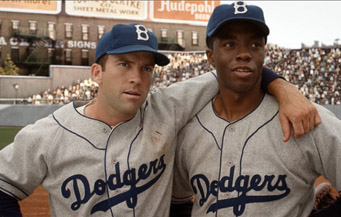
Performances are uniformly excellent. Harrison Ford is top-lined as Rickey, and Ford chews into the role the way John Wayne jawed Rooster Cogburn, growling and over-playing just a little bit to provide "character," Christopher Meloni of "Law and Order: SVU" does a fine job playing Dodgers coach Leo Durocher, soon replaced by "Barney Miller"'s Max Gail as Burt Shotton, Lucas Black plays Pee Wee Reese and Ryan Merriman plays Dixie Walker, and Nicole Beharie plays the devoted Rachel Robinson with a bracing mixture of grace and spine. Alan Tudyk surprises with a particularly unsympathetic portrait of Philadelphia coach Ben Chapman, whose taunts on-field But special praise has to be given to Chadwick Boseman's performance as Robinson, which he has down cold. There's enough footage of his play to copy, but what he nails is Robinson's expression, the enigmatic not-a-smile, and the wary eyes and darkened brow of the already burned and suspicious player, a bit of a caged lion not allowed to roar.
It's a good tribute to the man, if only missing a little bit of the fire that must have burned in the man to accomplish what he needed to, and that needed to be internalized amid so much pressure. He (with Rickey's patronage) turned the puerile accomplishments of a kid's game (the wins, the records) into something far greater for humankind (American division). He was the slugger who couldn't hit back, who turned the other cheek and turned America around. Babe Ruth was baseball's "sultan of swat."  

Robinson is its saint.


As dramatized in the film, Robinson posing with Phillies coach Ben Chapman who was criticized for shouting racial slurs at the player during a game. This photo op was Chapman's way of trying to fend off charges of "unsportsmanlike conduct." He was fired by Philadelphia in 1948. Looking at the smile on Robinson, casual and a bit cocky, "helping out" the guy by posing with him, always makes me smile.


* Just this year, Burns also produced a film dedicated solely to Robinson.