Oh! Look at the month! It's October, so it looks like, over the next 30 days, I'll be dumping a bunch of the horror films I've saved up over the year. You have been warned.
Oh! And Saturday is traditionally "Take Out the Trash" Day.
The Satanic Rites of Dracula(aka Dracula and his Vampire Bride)(Alan Gibson, 1973)The last of Christopher Lee's appearances as Dracula in the Hammer series is in this scraping-the-bottom-of-the-coffin sequel to Dracula A.D. 1972. The same writer. The same director. And Christopher Lee and Peter Cushing are in it, as well as Michael Coles as Inspector Murray and the character of Van Helsing's granddaughter Jessica returns, although not played by Stephanie Beachum this time, but by Joanna Lumley. If you'll recall, in the previous entry, Dracula died after being pushed into a pit conveniently filled with stakes, with the added help of Dr. Lorrimer Van Helsing (Cushing) using a shovel to push the stakes deeper into him, and him turning to ash on the spot.
This movie's aim is so low they don't even explain how Dracula gets resurrected from that outcome—he just shows up at the 31 minute mark of the movie as if nothing had ever happened. At this point, you'd think the man would learn to avoid anything sharper than a rubber ball!
The exploitation level is very high—so much so that Lee's Dracula is barely in it—and there's less of a Dracula plot and more of a spy-thriller aspect to it, as least initially, as an agent from MI6 escapes captivity while downstairs four prominent Englishmen are taking part in a ritual (presumably to revive Dracula but that runs counter to the timeline laid out in the movie) involving a naked blonde*and the blood of a chicken. It's a long ritual, judging by the simultaneous-event-cross-cutting, that the agent has time to escape, whisked to HQ and burbles a 30 minute tape record of his experience, then dies and the micro-film in his wristwatch camera gets developed by the time it's over.
By the time the movie is over, you'll realize that the 'satanic rites" opening and closing the films are irrelevant and Dracula has no vampire bride, making you wonder just what either of the titles had to do with the movie. Did I mention that, although the movie was released in Britain in 1973, it didn't get released in the U.S. until 1978? Not that it was particularly missed.
Anyway, MI6, being so efficient and all, determines they'll need outside help so they contact Inspector Murray "of the Yard" who helps identify the four big-shot Englishmen (one of them's a Nobel Prize winner in biology, but you'd never know it as he's playedFreddie Jones in full "gibbering" mode!) and makes the leap to blood sacrifices in order for him to say "Blood? I know somebody who knows a thing or two about blood!"
Cue Peter Cushing as Professor Van Helsing! He agrees it's all pretty suspicious and as the biology genius is an old acquaintance of his, he goes off to visit him, while MI6 agent Torrence (William Franklyn), Murray and Van Helsing's granddaughter Jessica go out to where the dead agent was held captive to blunder about asking questions of whatever suspicious conspirator they can find. They find those, but they also find a coven of vampirettes in the basement/wine-cellar. Crikey, that sounds out-of-place!
Okay, everybody stumbles about, but the upshot is that Dracula has posed as a real estate developer (!) living in the penthouse of the high-rise built on the very spot where he died in the previous film. Living like Howard Hughes and amassing a fortune in downtown London, he has financed the creation of a form of bubonic plague with enhanced virulency that he plans to unleash upon—dare I say it?—the world. It sounds exactly like a Bond-villain plot,** but Dracula isn't holding the world to ransom—he just wants to do it (BECAUSE he's Dracula!).
Oh, there's stakings, an electrocution, the stronghold being set on fire and Jessica unconscious on a sacrificial altar...again!...before the big fight between Dracula and Van Helsing, which ends with Dracula being caught in hawthorn bushes. Hawthorn bushes. Okay, Wikipedia says that works, folklorically—just like turning on the sprinkler system dispatches the vampirettes in the basement—but, damn!, dramatically, it's a bit underwhelming. Now, I could understand Dracula not having a weed-whacker yet as they'd only been invented in 1971, but...if the guy's so rich he can fund a bubonic plague program, why can't he afford a gardener? It would have kept him from getting stuck—and then staked—by Van Helsing in the end.
Thankfully, nobody built a high-rise on that patch of Earth, as there wasn't a sequel...not with Lee's Dracula, anyway. He wouldn't be back. Cause of death is officially hawthorn branches and multiple stake-wounds. But, I think that's a cover-up. Judging by The Satanic Rites of Dracula, he died of anemia.
* I remember seeing this on one of the Elvirapresentations of horror movies and there's so much gratuitous nudity that at one point she interjects "Uh...what's our "blurring" budget on this one?"
The Mackintosh Man(John Huston, 1973) One of the best kept secrets (until 1974, anyway) of the second World War was Project Ultra, the British operation centered in Bletchley Park tasked with breaking the German Enigma codes that scrambled their communications so as to be undecipherable. What the Germans did not know (because the British kept it secret) was that their dispatches were being regularly decoded and read, and their plans made known to forces in the field. This was a great boon to the generals who took advantage of the intel—many, including General Patton, did not—but there were times when the messages were merely shelved. The most egregious example might be the Coventry Blitz, although the facts are in dispute. Some authors (including the man who first shed light on Ultra) have claimed that Churchill knew of the devastating November 14, 1940 raid by the Luftwaffe, but did nothing to warn the populace or take counter-measures, lest it tip off the Germans that the code had been cracked, thus nullifying an important source of information and intelligence. If the Nazis knew their messages were being decoded, they might (probably would) make new measures to keep their transmissions secret. And so (the story goes) Coventry burned in order to keep the secret. War is not logical, and spycraft even less so, but there's an absurd madness there that parallels the Vietnam-era quote stated "we had to destroy the village in order to save it."
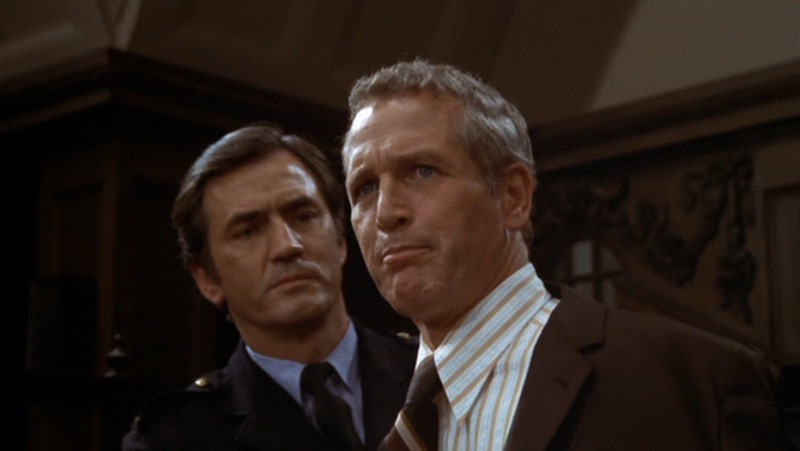
That logic (or lack of it) is much in display in John Huston's film of The Mackintosh Man (written by Walter Hill based on the novel "The Freedom Trap" by Desmond Bagley),*a spy thriller the director made in Britain and Malta with Paul Newman. In it, a British Intelligence agent (Newman) is framed and sent to prison, in order to infiltrate a criminal organization. But, unknown to him, the deceit goes much deeper, as his superior, Mackintosh (Harry Andrews), is using the mission to ferret out a leak in information in the British government.
Once the agent, named Rearden, is sprung from prison by the conspirators, overseen by an enigmatic figure named "Mr. Brown" (Michael Hordren). Rearden and another prisoner, Blake (Ian Bannen), are spirited away to an unknown location, drugged and held until the police activity surrounding the prison break cools down. The escape causes a row in Parliament, led by a law-and-order lord, Sir George Wheeler (James Mason), who rails against the bumbling way in which the prisons and the law are handling it, until he is persuaded to cool down the rhetoric by Mackintosh, himself.
Things get complicated when Mackintosh is run down in the street, and the operation taken over by his deputy, Mrs. Smith (Dominique Sanda), who is now charged with a double mission—Rearden's and the murder of Mackintosh.
Huston barely takes any of this seriously, even if Newman plays it straight, and Sanda—well, it's hard to tell if she plays it at all, her character being so enigmatic as to be undecipherable. But, it's all staged well (and photographed by the legendary Oswald Morris), especially a car chase through winding Irish country roads that looks dangerous as Hell, and Huston ends on a typically ambiguous note. But, he's made much better films about duplicity and duty (as has Hill, for that matter), and this one feels like a minor effort before tackling much more ambitious projects. His next film would be his long-planned adaptation of The Man Who Would Be King.
* This was around the era where Huston was no longer adapting classics, but beginning to take advantage of the scripts of the new college-class of film-makers, including Hill and (for his previous film) John Milius.
There's the continuity issues. Cards need to be in right positions and chips—the chips!—need to be stacked just so and remain that way from camera set-up to camera set-up. Not just in the "pot" but also individual's piles of chips. And the set-ups guarantee that you're always going to be looking at the back of someone's head or around somebody's shoulders out of focus in the foreground. So, unless you choose the "Julia-Child-cooking-show" of an overhead camera looking down—"The Instagram dinner plate shot?"—there's no way for everybody to be in the frame.
Then, there's the rules, the rituals (a good site explaining poker can be found here)*that have to be done in order, but are usually broken up in parts, all requiring a different camera angle, and the actors to be in the same approximate body language each time. It's a nightmare of continuity issues just waiting to be mentioned in the "Goofs" portion of your IMDB page.
The big one here is that Ward wrote a script for a game of "Straight Poker" (which has no drawing of cards after the initial bet), where what they're playing in the scene is "Draw Poker" (where once you've bought in, you can switch out cards to be dealt new ones). This caused all sorts of issues when laying out the scene with the script. Hopefully, it's not too confusing—I tend to favor what's "on the screen" to what was scripted.
Also, you can write a poker game on the page. Easy enough. You can eeven describe strategy and what the person is feeling. Ward did it in his script. But, men sitting around a table throwing cards and chips is just not an exciting visual in a visual medium. You have to add something to it, and that usually comes down to personality and how un-poker-like the faces of the participants are.
Here, you have five guys and the conductor-"bank" all crowded in a little room playing a game that's supposed to be "hush-hush". In Ward's script, the conductor, Clemmons, intoduces Gondorff's alias "Mr. Shaw" to the poker players:
The only guys we care about are Gondorff's "Shaw" and Lonnegan, the villain of the piece. But, Lonnegan cares what Mr's. Clayton, Jameson, and Lombard think. It's his game, his reputation, and his humiliation if he lets this "Mr. Shaw" jack-ass drunken bookie win at the game. Shaw treats everybody like a punching bag, is a sore loser and a horrible winner and nobody likes him. Especially Lonnegan.
But, we keep going back to "the other guys," especially Jameson and Clayton for reaction shots and reaction shots of Lonnegan reacting to their reactions. They're important to the psychology of the game, even if they play no part in it.
And Paul Newman gets to fill in some stage business by having Gondorff
constantly looking over his shoulder to see if anybody's spying his
cards (Newman does lots of business while Shaw does everything with his eyes). But, they're "small potatoes" in the scene, though they play a part.
The guy most people remember and who does a lot of heavy lifting in this scene is "Lloyd," Lonnegan's bodyguard and deck-"cooler," who stacks a deck for Lonnegan to switch after their "little break." Director Hill cuts back to him a lot, mostly because the guy playing Lloyd—character actor Charles Dierkop (he of the perpetually flattened nose)—is hard to miss looking over Paul Newman's shoulder reacting to the game. Inadvertently, he becomes the center of the scene, because of everybody in the room, he has the most to lose. He's the guy who stacked the deck, takes pride in his work, and is left genuinely berieved at how things turn out ("Did I mess up? I don't think I did! But, the cards are different and the boss who was proud of me a couple minutes ago is pissed at me now!"). Most importantly, he's "the capper" for getting out of the scene on a light note.
It's not there in the script. It looked so easy!
The Tale: Small-time grifter Johnny Hooker (Robert Redford) is after gambling gangster Doyle Lonnegan (Robert Shaw) for the murder of his pal, Luther Coleman. Luther had once advised Hooker to seek out Chicago con man Henry Gondorff (Paul Newman) and Hooker, on the run from the law and Lonnegan, leaves Joliet for the Big City to learn "The Big Con" in an effort to take Lonnegan down. To finance the grift, Gondorff books passage on the 20the Century Limited as a bookie named "Shaw" and talks his way into one of Lonnergan's high-stakes poker games.
What Lonnegan doesn't know is that, earlier, he'd had his wallet "lifted" by another member of Gondorff's gang.
You're up, kid.
The game plays out differently in writer David Ward's script. Where it matched the finished product, I kept it. If something was taken out, I've done a strike-through of that portion, and additions are marked in Green.
THE CARD GAME AGAIN
The room is dense with smoke now, and the players are
feeling the heat. Gondorff has his white shirt open,
revealing a stained T-shirt underneath. The bottle next to
him is almost empty.
He sneezes
and wipes his nose with the
tie Lonnegan gave him.
The chips are now about equally divided between Gondorff and
Lonnegan. The others are losing badly.
GONDORFFI'll bet 3.Raise 300.
JAMESON (throwing in his last
few chips) Call. And raise 200.
LOMBARDCall.
LONNEGANNo.Pass.
CLAYTONI'm out.
GONDORFF Call.Two and call.
JAMESONAces over.
Jameson lays down two pair.
LOMBARDThree cowboys.
GONDORFFAll red.
GONDORFFQueen high.
Gondorff has a flush.
Gondorff
rakes in the chips, which now put him ahead of Lonnegan.
JAMESON
Well, that finishes me.I'm out.
GONDORFF Don't worry about it, pal.
(laughs)
GONDORFF Lemongan
hereThey wouldn'ta let you playin the game
if you weren't a chump.
GONDORFFLombard will be joinin' you here in a couple minutes.
JAMESON Now, look here, Shaw...
LOMBARD(interrupting)I've had enough of this game and QUITE enough of this company. Check me out, Clemons.
GONDORFF I guess that just leaves the three of us.
LONNEGANThat's right, Mr. Shaw. It just leaves us three.
LONNEGANMr. Clayton, I think we should take a little break for five minutes.
LONNEGANTemperatures seem to be running a little high.
GONDORFFAw, c'mon, Lineminn, I'm just startin' to DO good!
Lonnegan smiles and chuckles.
Gondorff responds with a drunken laugh.
LONNEGAN
(getting to his feet)
I've had enough of your lip, Shaw.
Gondorff grabs the whiskey bottle next to him, breaks it
against the table and waves the jagged end in Lonnegan's face.
GONDORFF
(barely able to stand up)
Just take it easy there, Larrabee.
Jameson and the conductor step in between.
JAMESON
Let's take a break for a couple
minutes and cool off.
Lonnegan storms out of the room, followed by Floyd and
Bodyguard.
INT. SMOKING ROOM
We pick up Lonnegan coming down the passageway to enter the
smoking room.
LONNEGAN
(to his assistant)
I've had it with that bum, Floyd.
Stack me a cooler, Floyd.
FLOYD
(trying to settle him down)
You've only been playin' three
hours, Doyle. C'mon Doyle, we'll be in the station in another hour. The other guys are the big losers. You're still okay.
LONNEGAN
(not to be pacified)
I don't care. Load me a deck. Set
it up for threes and nines. I'll
cut it in on hisClayton's deal.
FLOYD
(taking a deck and
beginning to sort it)
What do ya want the othersClayton to get?
LONNEGAN
Nothin'. They gotta be outta there
early. I'm gonna bust that bastard bookie
in one play.
CUT TO:
INT. THE POKER ROOM AGAIN - NIGHT
CLEMONSFour hundred to you, Mr. Jameson. You're even.
A pair of hands shuffling. We pull back to reveal that
they're Gondorff's Clayton's.
JAMESONWell, I guess it wasn't my night.
He passes the deck to Lonnegan to be
cut and turns to pen a new whiskey bottle.
Lonnegan takes
the deck
and in one lightning motion substitutes a new deck,
while making it look like he's cutting the old one.
Clayton antes. Gondorff antes.
JAMESONBoy, I need it...
LOMBARDKnow what time we're supposed to get in?
JAMESONNo, I don't...
GONDORFF Hey, where's your ante?
GondorffClayton picks up the deck and begins to deal.
As the hand
is picked up,
we see that Gondorff has four threes,**
Lonnegan
four nines,
and everybody else has nothing.
GONDORFF500.
LONNEGON Your 5.
LONNEGANOne thousand.
CLAYTON(opening the bidding)
Fold.
GONDORFFI'll play.
CLAYTON Cards?
GONDORFF Two.
LONNERGAN Three.
GONDORFF 500. Raise 1,000.
LONNERGAN Your...
LONNERGAN ...500.
LONNERGAN And one thousand. Raise 500.
The spectators shift a little. It's the biggest bet of the night.
GONDORFF Your one thousand.
GONDORFFI'll raise you two thousand. (slowly)
Raise 2,000.
Gondorff looks at Lonnegan very carefully for a second.
LONNERGAN Your...
LONNERGAN ...two thousand...
LONNERGAN Mr. Clemmons...give me ten thousand dollars more.
Lonnegan meets his stare.
GONDORFFI'll Call.
LONNEGAN Four 9's.
Lonnegan puts down his four nines.
Gondorff just stares at
them a second,
lets out a deep sigh and lays down four jacks.
GONDORFFFour jacks.
Lonnegan is aghast. This just can't be.
He glances at
Floyd,
who can do nothing but sit there with his mouth open.
GONDORFF
(raking in the chips)
Well that's all for me tonight,
boys. I'm gonna leave ya some cab
fare.
The other players look at each other in disgust, and reach
for their wallets, all of which are well stocked.
GONDORFF
(to Lonnegan)
You owe me 15 grand, pal.
Lonnegan, with a stare that could kill, reaches for his
wallet.
Suddenly the stare goes soft.
He tries a few more
pockets.
No soap.
LONNEGAN
(getting up to get it)
I guess I Must have left it in my room.
GONDORFF
(blowing up)
What! Don't give hand me that crap you
little weenie. How do I know you
ain't gonna take a powder.
(waving his wallet,
which is full of
Lonnegan's money)
GONDORFF
You come to a game like this, you
bring your money.
GONDORFF
How do I know you won't take...
GONDORFF ...a powder?
Lonnegan, having had all he can take, goes for Gondorff, but
is restrained by the conductorJameson.
JAMESON No-n0-no-no
GONDORFF
All right, buddy, I'll tell you what I'll do.
GONDORFF I'm gonna send a
boy by your room in five minutes,
GONDORFF ...and you better have the moneythat jack, or
it's gonna be all over Chicago that you welched.
your name ain't worth a dime.
GONDORFFYou won't be able to get a game of jacks!
GONDORFFCash me in for the rest of these bones.
Gondorff stalks out of the room.
We pick him up coming down
the passageway to his compartment.
The Sting is available on DVD and Blu-Ray from Universal Home Entertainment.
* My diligent research for a good poker site took hours of my time, many, many downloads, and an ample number of—uhh—"investments" that could end up with my legs be broken as collateral. But, the research is DONE. Please, I don't need suggestions for helpful sites written in the "Comments."
** Yeah, I know, he doesn't. I chose to correct the script dialog, but not the stage direction...which has the bets different—interestingly, Ward has Gondorff be a lot more aggressive in his betting with Lonnegan lagging behind, which is weird, both as a strategy and as a gangster personality trait) and doesn't even have a draw. Like in poker, ya gotta choose your battles.


.jpg)