Showing posts with label Dracula. Show all posts

Saturday, October 5, 2024

The Satanic Rites of Dracula

Oh! Look at the month! It's October, so it looks like, over the next 30 days, I'll be dumping a bunch of the horror films I've saved up over the year. You have been warned.

Oh! And Saturday is traditionally "Take Out the Trash" Day.


The Satanic Rites of Dracula (aka Dracula and his Vampire Bride)(Alan Gibson, 1973)  The last of Christopher Lee's appearances as Dracula in the Hammer series is in this scraping-the-bottom-of-the-coffin sequel to Dracula A.D. 1972. The same writer. The same director. And Christopher Lee and Peter Cushing are in it, as well as Michael Coles as Inspector Murray and the character of Van Helsing's granddaughter Jessica returns, although not played by Stephanie Beachum this time, but by Joanna Lumley. If you'll recall, in the previous entry, Dracula died after being pushed into a pit conveniently filled with stakes, with the added help of Dr. Lorrimer Van Helsing (Cushing) using a shovel to push the stakes deeper into him, and him turning to ash on the spot.
 
This movie's aim is so low they don't even explain how Dracula gets resurrected from that outcome—he just shows up at the 31 minute mark of the movie as if nothing had ever happened. At this point, you'd think the man would learn to avoid anything sharper than a rubber ball!
The exploitation level is very high—so much so that Lee's Dracula is barely in it—and there's less of a Dracula plot and more of a spy-thriller aspect to it, as least initially, as an agent from MI6 escapes captivity while downstairs four prominent Englishmen are taking part in a ritual (presumably to revive Dracula but that runs counter to the timeline laid out in the movie) involving a naked blonde* and the blood of a chicken. It's a long ritual, judging by the simultaneous-event-cross-cutting, that the agent has time to escape, whisked to HQ and burbles a 30 minute tape record of his experience, then dies and the micro-film in his wristwatch camera gets developed by the time it's over.
 
By the time the movie is over, you'll realize that the 'satanic rites" opening and closing the films are irrelevant and Dracula has no vampire bride, making you wonder just what either of the titles had to do with the movie. Did I mention that, although the movie was released in Britain in 1973, it didn't get released in the U.S. until 1978? Not that it was particularly missed.
Anyway, MI6, being so efficient and all, determines they'll need outside help so they contact Inspector Murray "of the Yard" who helps identify the four big-shot Englishmen (one of them's a Nobel Prize winner in biology, but you'd never know it as he's played
Freddie Jones in full "gibbering" mode!) and makes the leap to blood sacrifices in order for him to say "Blood? I know somebody who knows a thing or two about blood!"
Cue Peter Cushing as Professor Van Helsing! He agrees it's all pretty suspicious and as the biology genius is an old acquaintance of his, he goes off to visit him, while MI6 agent Torrence (
William Franklyn), Murray and Van Helsing's granddaughter Jessica go out to where the dead agent was held captive to blunder about asking questions of whatever suspicious conspirator they can find. They find those, but they also find a coven of vampirettes in the basement/wine-cellar. Crikey, that sounds out-of-place!
Okay, everybody stumbles about, but the upshot is that Dracula has posed as a real estate developer (!) living in the penthouse of the high-rise built on the very spot where he died in the previous film. Living like Howard Hughes and amassing a fortune in downtown London, he has financed the creation of a  form of bubonic plague with enhanced virulency that he plans to unleash upon—dare I say it?—the world. It sounds exactly like a Bond-villain plot,
** but Dracula isn't holding the world to ransom—he just wants to do it (BECAUSE he's Dracula!).
Oh, there's stakings, an electrocution, the stronghold being set on fire and Jessica unconscious on a sacrificial altar...again!...before the big fight between Dracula and Van Helsing, which ends with Dracula being caught in hawthorn bushes. Hawthorn bushes. Okay, Wikipedia says that works, folklorically—just like turning on the sprinkler system dispatches the vampirettes in the basement—but, damn!, dramatically, it's a bit underwhelming. Now, I could understand Dracula not having a weed-whacker yet as they'd only been invented in 1971, but...if the guy's so rich he can fund a bubonic plague program, why can't he afford a gardener? It would have kept him from getting stuck—and then staked—by Van Helsing in the end.
Thankfully, nobody built a high-rise on that patch of Earth, as there wasn't a sequel...not with Lee's Dracula, anyway. He wouldn't be back. Cause of death is officially hawthorn branches and multiple stake-wounds. But, I think that's a cover-up. Judging by The Satanic Rites of Dracula, he died of anemia.

* I remember seeing this on one of the Elvira presentations of horror movies and there's so much gratuitous nudity that at one point she interjects "Uh...what's our "blurring" budget on this one?"
 
** Lee would do that NEXT year as the villain in The Man with the Golden Gun.

Wednesday, October 21, 2020

Dracula Has Risen from the Grave

Dracula Has Risen From the Grave (Freddie Francis, 1968) It was the fourth of Hammer's "Dracula" films and the third to star the malevolently magisterial Christopher Lee* as the "Count-of-Few-Words," where, the events of the previous film, Dracula: Prince of Darkness, the Count has been dispatched by being thrown into the frozen moat that surrounds his high castle. Not quite as thorough as a stake through the heart or an hour in a tanning booth, but that seemed to be good enough to end the film with. One wonders why nobody worried about a potential Transylvanian spring-thaw just to make sure the Count was really and sincerely dead rather than merely or nearly dead. Perhaps they anticipated the sun's rays hitting the moat would do the trick.

Perhaps I'm thinking too logically about a movie featuring vampires.

Anyway, the nearby village still has an issue, in a preamble set a year before the film, a young church helper is stunned to find a recently bit damsel tumbling from a belfry bell. Presumably, it's a reminder that Dracula was about and has a lot to do with the idea of desecration—Dracula had chosen to do his dirty work in the very house of God. But, he got his; he's in a frozen moat, never to be heard from again.

Not bloody likely...
And it's religious hubris that sets off the chain of events that frees him, all in the name of trying to do the right thing. No good deed goes unpunished, etc. You can't have religion in a horror movie without some irony attached to it.
Monsignor Mueller (Rupert Davies—he played John Le Carre's George Smiley in The Spy Who Came In From the Cold) visits the town to find that nobody is going to church and it's in ruins. The young helper has become mute from his belfry shock and the parish priest (Ewan Hooper) is found in the local tavern, drinking something stronger than sacramental wine. He has lost his faith, given the previous year's struggle with the Count, and even though Dracula sleeps with the fishes, none of the towns-people have returned to the church, fearing Dracula's evil influence as the shadow of his mountain-top castle still touches the church.
Mueller intends to rectify things, so, with the priest in tow, he climbs to the Count's castle to exorcise it, jamming a crucifix in its door-way. The fallen priest, frightened by the influence of the place, literally falls, cracking his head on the rocks, and the blood from his wound makes its way into the moat, eventually reviving Dracula. Prematurely satisfied that he has solved the problem, Mueller gathers up the injured priest and they return to the town. The Monsignor returns to his home-city of Keinenberg, where he stays with his sister-in-law and her daughter, his niece (Veronica Carlson).
"SNARLINGLY miffed..."

Dracula is snarlingly miffed that he can't re-enter his castle and swears revenge (rather than immediately bite someone and tell them to remove the cross—vampires are so unpractical! But he'll get there, eventually). Placing the village-priest under his thrall, he extracts the name of the Monsignor and the two travel to Keinenberg, the Monsignor's home-town, where the venerable old priest has enough things to worry about. It seems his niece Maria has a young man, Paul (Barry Andrews), a student and baker's assistant, and the two are quite in love. But, when he is invited for Maria's birthday dinner, the subject of religion comes up and it seems that Paul is an atheist, which so offends the monsignor that he leaves the table early.
Maria doing what Hammer heroine's do:
laying around in diaphanous sleepwear and breathing hard

Maria still loves Paul—enough to sneak out of her bedroom window and walking over roof-tops to be with him—but with Dracula in town, any comely blond with a good collection of ornate peignoirs had best keep her windows locked, her meals heavy in garlic, and a rabies vaccination nearby. But, her nightly habits are bad enough—what with being out at night and roof-hopping—she's the perfect match for Dracula (they have so much in common!) And, as she's the monsignor's niece, he thinks she's the only game in town to pay back getting crossed at his castle.
The director for Dracula Has Risen From the Grave is Freddie Francis, who started out his career as a cinematographer, and a very good one, versatile with both black-and-white and color, and working with some very visual directors—John Huston, The Archers, David Lynch, Jack Clayton, Robert Mulligan, Martin Scorsese—and was the shooter of choice for some cinematographer/directors like Jack Cardiff. He won two Oscars for his work—for Sons and Lovers and Glory—but, one of my favorite films that he shot is Clayton's The Innocents. 
Francis had another cinematographer shoot this for him when he took over directing the film (for ailing Hammer veteran Terence Fisher), but he lent him the filters—tinged at the edges with red, amber and yellow—used for that film for every scene that featured Lee's Dracula. The results are jarring (especially when it goes from a shot without to one being used), but they create a creepy sense that the Count even has an effect corrupting the film it'd been shot on, giving it a jaundiced unhealthy look. For that, and Francis' direction, it makes an interesting part of the series.

And even though Lee hated the jokey way that Hammer sometimes treated and advertised the films, that poster is hilarious.
Lee does his "these aren't the droids you're looking for" move.


* Dracula does not appear in The Brides of Dracula, as the film centers around Peter Cushing's Dr. Van Helsing.

Friday, October 18, 2019

Abbott and Costello Meet Frankenstein

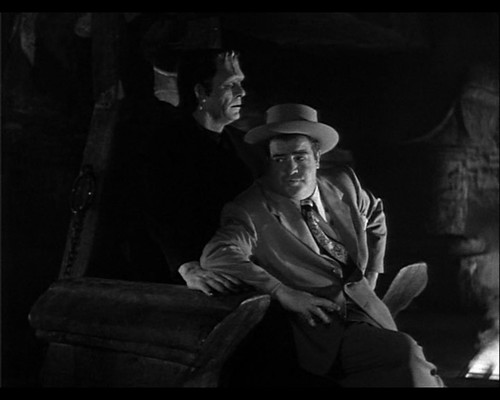
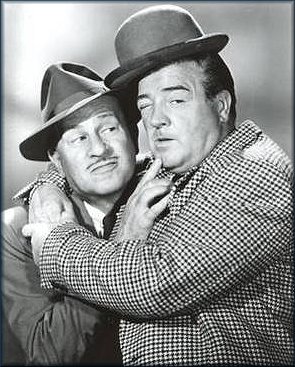
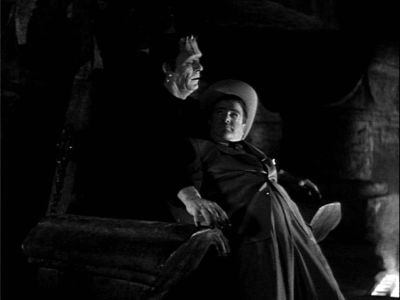
Abbott and Costello Meet Frankenstein (Charles Barton, 1948) The full title is Bud Abbott and Lou Costello Meet Frankenstein (as they all had the same production studio, Universal Pictures). But even that mouthful of a title leaves out two major characters in the film: Bela Lugosi re-stakes his claim as Count Dracula, the role he originated in the 1931 Universal film, and Lon Chaney, Jr. plays that poor S.O.B., Larry Talbot, aka "The Wolfman,"* who turns lycanthropic whenever the moon is full (sort of an eternal frat-boy)** 

The unholy trio of Universal met long-time companions Bud and Lou for some hi-jinks and low horror. The boys play Chick Young and Wilbur Grey, who are warehouse workers with the bad fortune to be dealing with two crates of European antiquities bound for the local museum--Dracula's coffin (with an "occupado" sign on it) and the inanimate Frankenstein Monster (victim of a dead battery). Talbot's in the neighborhood, as he's tracking the shipments for some convenient reason.
The plot revolves around Dracula's ambition to re-animate the Monster, but replace its criminal brain with a more compliant, simpler brain, and Lou's character, Wilbur Grey, is the perfect candidate. This film was a favorite of the kids in my neighborhood, and when it aired (around Hallowe'en, after "The Brakeman Bill Show"), it was the sole topic of conversation for two weeks, and endlessly recreated on the streets and playgrounds. All the Great monsters--in one movie!! Of course, it'd be great!
And it was: giddy fun with enough strangeness, horrible deeds, and the slapstick and repartee that Bud and Lou were good for. Maybe it's "Mom's Apple Pie Syndrome,"*** where the tastes of childhood circumvent our better instincts later in life, but a re-appraisal of "A + B = F" in adulthood found me admiring its competence, humor and basic story-telling construction (circuitous, though it is). It's good stuff--strictly "B" material, but when did that ever get in the way of Big "E" Entertainment?
And it had Monsters. The Bestest Monsters. The ones that represented our Id's and haunted our dreams. Given the content of my previously sex-obsessed reviews of "Frankenstein" and "Dracula," what, then, can we glean from "A + B = F?" well, despite my "longtime companion" crack, Bud and Lou were room-mates who were 'into" dames. In fact, as if to counteract the threats of homosexuality (Frankenstein) and rapacious heterosexuality (Dracula) the Monsters represent, they are SO hetero, that Lou's Wilbur has two women vying for his attentions, though "bad girl" scientist Dr. Sandra Mornay only wants him for his mind. Bud and Lou are "safe" examples of "normal" sexuality--ya know, dancing and going to parties and dressing up and nothing further than "First Base."

"Who?"

Now, don't get me started....

Wait a minute....Bud Abbott's character's name is "Chick." Hmmm.

* Chaney, son and heir-apparent to the make-up master of the Silent Era, claimed that he also stood in for Glenn Strange as The titular Monster, when the latter actor suffered an ankle injury.

** Vincent Price also makes a cameo non-appearance as "The Invisible Man!"

*** "Mom's Apple Pie" Syndrome usually rears its ugly head when dealing with "fanboy favorites," like the Star Wars films, or the Indiana Jones series, (ie. "You think the serial-mugging/teddy-bear warfare of Return of the Jedi was better than the recent Trilogy?" or "You seriously think the thuggish, racist and puppetoon Temple of Doom and slap-dash Last Crusade were "classics" compared to Kingdom of the Crystal Skull?)

Friday, October 11, 2019

Dracula (1931)

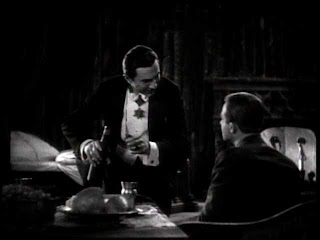
Dracula (Tod Browning, 1931) Filmed version of the stage-play* featuring its matinee-idol, Bela Lugosi. As with "Frankenstein," there had been other versions of Count Dracula's British Invasion, including one (Nosferatu by F.W. Murnau) that got around copyright issues by calling its "vampyre" "Count Orlok."** As with Universal Picture's earlier productions of The Phantom of the Opera, The Hunchback of Notre Dame and The Man Who Laughs, the film is heavy on theatrics, but, this time, is a bit lean in the make-up department, although Lugosi did wear painful silvered contact lenses to enhance his seductive glare. Lugosi's elegant monster, with his slash of a mouth, and eyes wide open while balefully squinting with a laser-like intensity manages to still evoke "the creeps" to this day.

Tod Browning's direction is full of subtle touches--the sudden appearance of the Count's "brides," for example--and not-so-subtle--a shot of Jonathan Harker on Dracula's staircase is shot through a spider web, and Dwight Frye's performance as Renfield is babblingly over-the-top, as is required of so many actors in the horror genre.

As we wrote of the primal homosexual aspects of Frankenstein, Dracula is the straighter blood-brother--the heterosexual aspect of humanity gone hysterical. Dracula's attacks start as seductions, but his acts are akin to rape--animalistic and savage--and linked to sexuality--penetrative, taking blood and passing on the disease of vampirism to his victims. sapping life-strength and energy. And it's all under the guise of civility and position, of manners and societal restraint. But underneath throbs the bestial urges--hidden by day, and only alive at night. Sure, it's nice to bask in the glow of celebrity, but make sure the smile isn't hiding fangs.
Count Dracula, then, is one big hard-on, that by light of day, crumbles to dust. That his bane are religious icons and his own lack of reflection (self-knowledge) only reinforces the metaphor. He's never gone out of style, no matter how straight-laced or free-loving the times. Dracula is one popular "playa."
With the times, the incarnations of "Dracula" have become increasingly sexual over the years, *** only making more obvious what Bram Stoker and Tod Browning buried in the sub-text. "Dracula" is, and always has been, the personification of serial criminal sexuality--which can only be curbed by the light of day. Dracula is The Forbidden, and carries the risk of damnation for seeking it. Besides the purifying rays of the sun, the surest way to kill a vampire is a blessed stake...through the heart.
Frankenstein-homosexuality. Dracula-heterosexuality. Of course, these haunts were conjured during the repressed Victorian era. But what horrified them, still carried a tingle, just as their stories intrigue us and our children, thrill us, and haunt our dreams. No wonder the Religious Right condemn them, or any aspect of the occult.
Hollywood makes a vain attempt (or stab) at killing them, but these monsters of the Id keep coming back, rising from the grave (or the ashes) to stalk another day...er...night. How do you handle these monsters/urges?

The answer next Friday


*Adapted from Bram Stoker's 1897 novel by Hamilton Deane and John L. Baderston. A Spanish-language version was filmed simultaneously (the English version during the day and the Spanish at night) using the same sets, directed by George Melford and starring Carlos Villarias, Lupito Tovar, and Eduardo Arozamena. BOTH versions are in the National Film Registry.


** "Dracula" did not go into the public domain until April, 1962.


*** A guided tour of coffin-dwellers (PLEASE, no flash pictures!): Christopher Lee's athletic, animal Dracula in the heaving Hammer films, Frank Langella oozing Byronesque charm in the 70's stage version and 80's film version, Barnabas Collins, cutting a swath through the ladies of daytime soap-opera on "Dark Shadows," Anne Rice's tortured, damned rock-star vampires, and right on up to current day with the throbbing vampiric (though chaste) teen romances of the "Twilight" series.

Sunday, October 18, 2015

Don't Make a Scene: Dracula (1931)

The Story: And now, submitted for your pleasure and Hallowe'en pre-functioning, this cautionary tale of getting into the real estate trade.

Poor, poor Renfield. Not only did he take the place of Jonathan Harker in the transition from Bram Stoker's novel to the 1931 movie version of Dracula, but he was also played by Dwight Frye, whose over-the-top capering would inform many a hunched lab assistant in the years to follow (If he had a nickel for every time he said "Master..."). The changing of Renfield to the man Count Dracula has over for dinner simplifies the story somewhat, but also severs the tragic ties that Stoker's story eventually leads to in the fate of Mina Harker.

In the film Ed Wood, Tim Burton partially chronicles the friendship between the hapless titular director and the fading film star Bela Lugosi. Here is the man in his prime, in fact, his pinnacle. Bela Lugosi never had greater fame than as the vampire Count, playing him to ecstatic reviews on Broadway and then on film—a few times, in fact, where he bolstered ever-weakening scripts, breathing life into them quite counter to his role as a blood-sucker.

And it's not a theatrical performance, as the impressionists have made it.* The secret to Lugosi's Dracula is a preternatural stillness—the creepiness instilled by one who stares at you for too long. A stalking look that bides its time. That stillness is used all too rarely in horror films, but you can still find it on occasion. In fact, I'd bet the Oscar Anthony Hopkins won for his Hannibal Lecter in The Silence of the Lambs is partially owed to Bela Lugosi.

Stillness is also part of Tod Browning's directing scheme: there are...a lot...of awkward...pauses, emphasizing Renfield's unease, and very few of Browning's shots move—this was, after all, one of the early sound movies and the cameras were bulky and inflexible—but when they do move...cover your throat. Here, he trucks the camera towards Dracula when he sees the blood seeping from Renfield's finger, in a sort of cinematic blood-rush?

Mention must also be made of a lighting technique that is employed in Dracula's close-up's—the strip of light that emphasizes the eyes (for certain shots Lugosi wore painful reflecting contact lenses). There is a more technical term, I'm sure, but a director of acquaintance always referred to it as "Kirk lighting," as it was employed often to show William Shatner's Captain Kirk on the original "Star Trek" in moments of distress/sorrow.

The Set-Up: Renfield (Dwight Frye) has arrived at the Transylvanian castle of the Count Dracula (Bela Lugosi). The Count has written in interest of leasing Carfax Abbey in a fresher clime. And Mr. Renfield has endured quite a bit for his client in transit. The last carriage ride was particularly upsetting. But now he has entered the Count's castle and is dwarfed by the immensity of the foyer, which is in some disrepair...and seems to be infested with...armadillos. Now, his host descends the vast stair-way gated by huge spider-webs to show him his room and see to his needs.

A meal has been prepared.

Action!


THE CASTLE FOYER

Renfield enters the Count's castle, he's dwarfed by the ancient entry-way and looks around warily, his attention distracted by bats hovering by a window and strange creatures that seem to appear from the crevices of the walls. He doesn't even notice his guest walking quietly down the stairs.

DRACULA: I am...Dracula.
RENFIELD: It's really good to see you. I don't know what happened to the driver and my luggage and...well...with all this, I thought I was in the wrong place.
Dracula: I bid you welcome.
Dracula pivots and heads upstairs.
Offstage: Wolf call
DRACULA: Listen to them...children of the night. What music they make!
The Count turns and ascends the stairs, seeming to pass through vast collections of spider-webs the criss-cross the landing.Renfield follows Dracula, breaking a path through the spiderwebs.
DRACULA: A spider spinning his web for the unwary fly.
DRACULA: The blood...is the life, Mr. Renfield.
RENFIELD: Why, yes.
RENFIELD'S BED-CHAMBER
Enter Dracula and Renfield
DRACULA: I'm sure you will find this part of my castle more inviting.
RENFIELD: Oh, rather! It's quite different from outside. Oh, and the fire! It's so cheerful.
DRACULA: I didn't know but that you might be hungry.
RENFIELD: Thank you. That's very kind of you.
RENFIELD: But I'm a bit worried about my luggage. You see, all your papers were in...
DRACULA: I took the liberty of having your luggage brought up. Allow me.
RENFIELD: Oh, yes. Thanks.
The Count takes Renfield's coat and bags to an aft-chamber, the doors seeming to open on their open, and shortly he returns.
DRACULA: I trust you have kept your coming here...a secret?
RENFIELD: I've followed your instructions implicitly.
DRACULA: Excellent, Mr. Renfield, excellent. And now, if you're not too fatiqued...
DRACULA: ...I would like to discuss the lease on Carfax Abbey.
RENFIELD: Oh, yes. Everything is in order, awaiting your signature.
RENFIELD: Here...here is the lease. I hope I've brought enough labels for your luggage.
DRACULA: I am taking with me only three...boxes.
RENFIELD: Very well.
DRACULA: I have chartered a ship to take us to England. We will be leaving...tomorrow...evening.
RENFIELD: Everything will be ready.
DRACULA: (pointing to bed) I hope you will find this comfortable.
RENFIELD: Thanks. It looks very inviting.
Renfield cuts his finger on a paperclip.
RENFIELD: Ouch!
DRACULA stealthily approaches Renfield
Renfield's crucifix falls over the cut finger.

DRACULA turns quickly away, as if stricken, shielding himself with his cape.
RENFIELD: Oh, it's nothing serious.
RENFIELD: Just a small cut from that paperclip.
RENFIELD: It's just a scratch.
DRACULA: (pouring a glass of wine) This...is very old wine.
DRACULA: I hope you will like it.
RENFIELD: Aren't you drinking?
DRACULA: I never drink...wine.
RENFIELD: Well...
RENFIELD (drinks): ...It's delicious.
DRACULA: And now, I'll leave you.
RENFIELD: Well, good night.
DRACULA: Good night, Mr. Renfield.
Dracula lingers at the door, watching his guest.
Dracula exits. Renfield is left to survey his surroundings, and is overcome with a wave of sleepiness.

Dracula

Words by Hamilton Deane, John L. Balderston, Garrett Fort, and Dudley Murphy, Louis Bromfield, Tod Browning, Max Cohen and Louis Stevens

Pictures by Karl Freund and Tod Browning

Dracula is available on DVD from Univeral Home Video.


* My favorite is "The Count" from "Sesame Street." He even gets the dramatic "wine" pause right: "I am the Count! I love to count...things."