Showing posts with label Frankenstein. Show all posts

Sunday, October 23, 2022

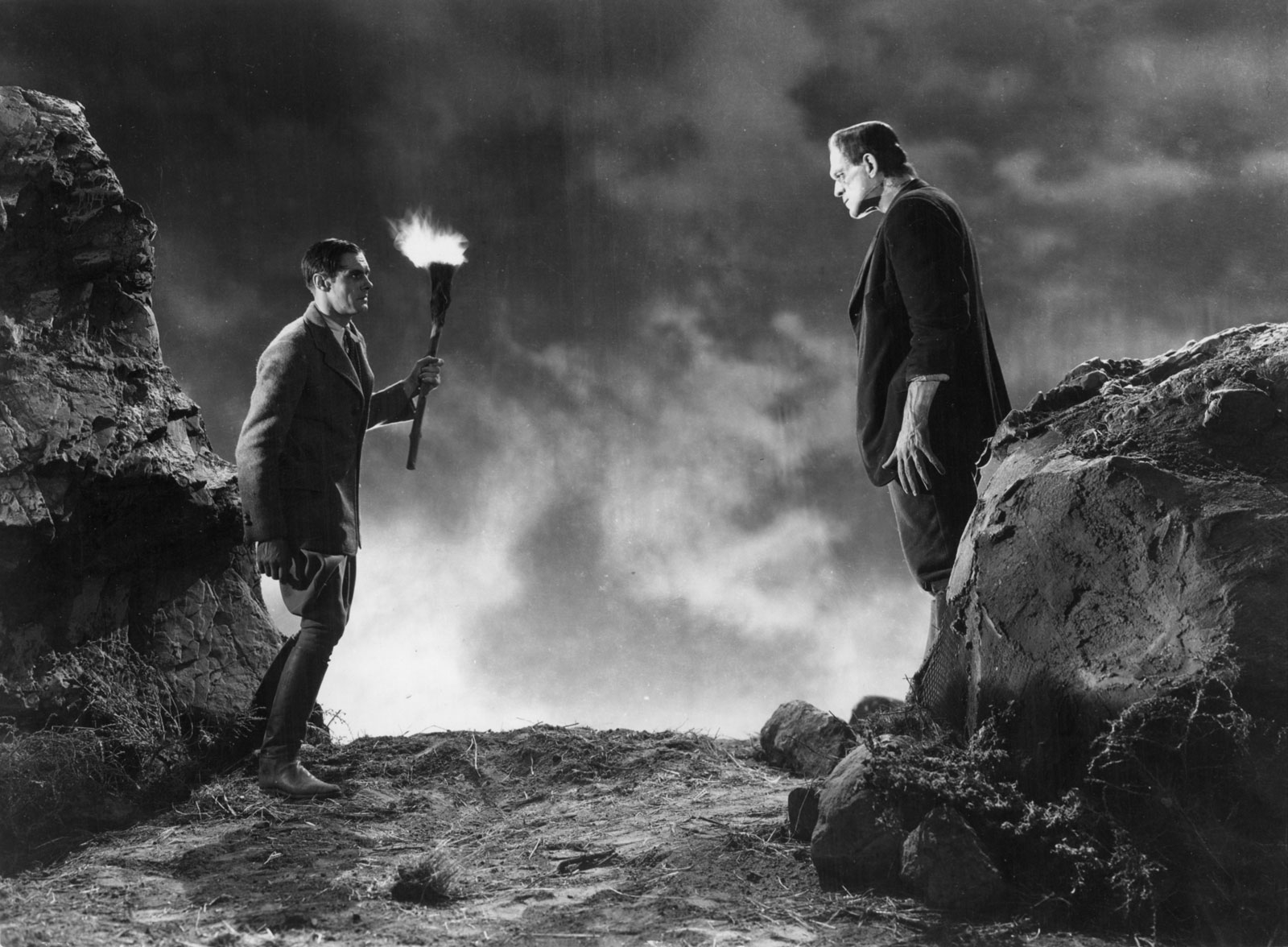
Don't Make a Scene: Frankenstein (1931)

The Story:
When Pauline Kael wrote of a review of Zeffirelli's version of Romeo and Juliet, she made a big deal of quoting a lyric from "The Bandwagon" to denote its style: "She came to me in stages." 
 
Well, Frankenstein—or I should say "Frankenstein's Monster"comes to you in parts (some assembly required). 

Director James Whale, who wanted and took over the project from Robert Florey—whose concept of "The Monster" was as an unthinking killing brute and was using a John Dalderston adaptation of a play for the film's basis—as the second film in his five-year contract with Universal.
 
As a child, when I first saw this sequence, it thrilled me. Now, as an adult, it thrills me even more because I understand that it was—and is—filled with dexterous flourishes of direction to ramp up the suspense and pay it off for the audience. Despite what most people say about magic, sometimes, you can appreciate the talent more if you know how the trick is done.

Case in point: The monster's entrance. There has been a movie's worth of build-up, what with the concept, the digging up of dead bodies, the experiment itself, the hiding of the form under the sheet. And then, there are the foot-prints right before this scene, as Doctors Frankenstein and Waldmon talk about the resuscitation of dead tissue to create new life. They come closer, and then the paradox look to the door.

Whale cuts to the door, which slowly opens with the tried and true creak to set the spine on edge. 

Except the creature is facing away from us in shadow.

Cut closer. We can see the bolts coming out of its neck and it turns...very slowly...first revealing a scar under its jaw—and if we can tear our eyes away from that—that its head is alarmingly flat on top.
 
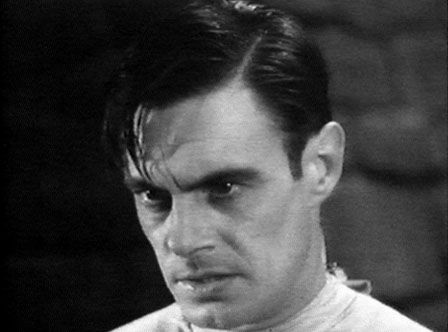
As we see more of its face, another layer is peeled off, as the creature comes into the light, and we can see the dead, unseeing eyes as they LOOK RIGHT AT US!!! 
 
And then, when we get a full view of its face, Whale moves in to a very tight close-up. 
 
And then, just a split second before we can get linger on even more detail, he moves to an even closer shot, putting us seemingly nose-to-nose with the creature. 
 
Most film-makers and cinematographers will tell you this is a bad move, and spoils a smooth transition between two separate images, and that to do so can be a jarring effect that will interfere with an audience's absorption into the scene.But, that's exactly the effect Whale wanted: he wanted to shock us with the transition, draw us closer to a repellent image and make us feel it with an edit that comes too soon and too close, adding to our discomfort.

It's a superb example of Whale's showmanship, theatricality, understanding of the mechanics of both film and fear, and a wicked sense of gleeful sadism on what could be achieved with an audience. Bravo.
 
The Set-Up: Most fiancee's spend their engagement staying out of the way of the wedding arrangements. Not Henry Frankenstein (Colin Clive). At his Alpen laboratory, he has been obsessively working trying to re-animate dead tissue and has constructed an entire human body in an attempt to do so. With the rapt attention of his former teacher, Waldron (), Henry explains that his research has been a success. Would he like to see it.
 
Well, wait a few minutes. Someone's in the hall....
 
Action! 

E-3  MEDIUM SHOT
THE CAMERA, CHANGING ITS ANGLE, now takes in the door, keeping Waldman and Frankenstein in the foreground.
Both have now turned to the door, which slowly opens, revealing the Monster in the frame.
The Monster is a strangely hideous, grotesque, inhuman figure -- its figure supplying the only semblance of humanity.
It stands there in the doorway, staring out of unseeing eyes at the two men. He does not move....a slight, twitching about the mouth alone denotes life. 
Dressed in an old suit of Frankenstein, which is far too small for him, making the Monster look shrunken -- or in a shape-less, colorless sack-like garb, perhaps -- it looks like a dead thing.
Its flesh is gray, blotchy, the lips almost black.
The top of its head has a curious flat ridge like the lid of a box.
The hair is fairly short and quite obviously combed over the ridge to hide the defect of the joining where the brain was put in.
It is apparent that the Monster is becoming used to the dim light. 
Doctor Waldman is visibly alarmed but stands his ground.
Frankenstein goes toward the thing; after a few steps, however, he stops, fascinated by the creature, hardly knowing what to expect.
He motions to the Monster with his hand and says: 
FRANKENSTEIN: Come in! Come in! 
The Monster slightly sways, and we think it is going to fall but it starts MOVING toward Frankenstein.
All the joints are quite stiff, yet it has perfect balance.
It does not walk like a Robot, it glides forward with a slightly swaying, rythmic movement.
E-4  CLOSER SHOT

The CAMERA TRUCKS BEFORE Frankenstein as he, backing slowly, leads the Monster to a chair.
Still facing the creature, Frankenstein makes half-hypnotic, half-persuasive gestures with his hands.
FRANKENSTEIN: Sit down!
The monster fails to understand. Frankenstein though quivering with excitement painstakingly goes through the required movements; now he reports:
FRANKENSTEIN: Sit down! DOWN!
With slow, jerky tentative movements the Monster assumes a sitting posture.
 
 
Words by Garrett Fort and Francis Edward Faragoh (Draft dated August 12, 1931)
 
Pictures by Arthur Edeson and James Whale
 
Frankenstein is available on DVD and Blu-Ray from Universal Home Video.

Friday, October 18, 2019

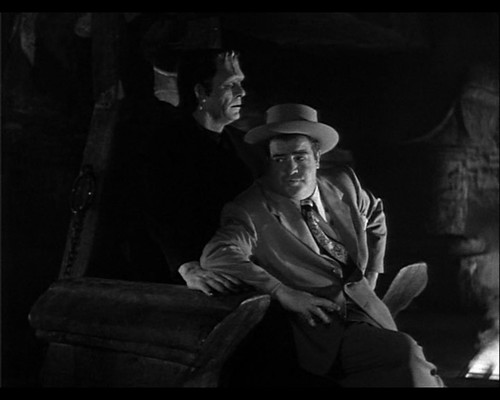
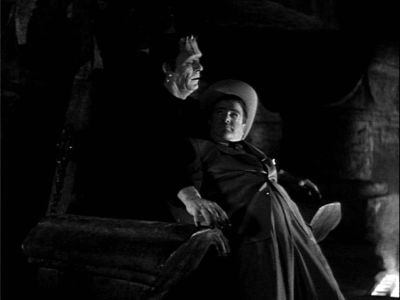
Abbott and Costello Meet Frankenstein

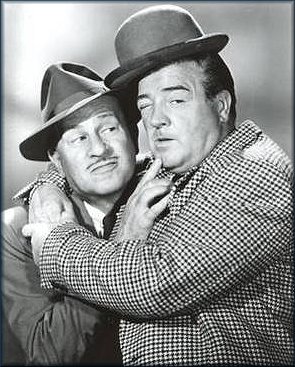
Abbott and Costello Meet Frankenstein (Charles Barton, 1948) The full title is Bud Abbott and Lou Costello Meet Frankenstein (as they all had the same production studio, Universal Pictures). But even that mouthful of a title leaves out two major characters in the film: Bela Lugosi re-stakes his claim as Count Dracula, the role he originated in the 1931 Universal film, and Lon Chaney, Jr. plays that poor S.O.B., Larry Talbot, aka "The Wolfman,"* who turns lycanthropic whenever the moon is full (sort of an eternal frat-boy)** 

The unholy trio of Universal met long-time companions Bud and Lou for some hi-jinks and low horror. The boys play Chick Young and Wilbur Grey, who are warehouse workers with the bad fortune to be dealing with two crates of European antiquities bound for the local museum--Dracula's coffin (with an "occupado" sign on it) and the inanimate Frankenstein Monster (victim of a dead battery). Talbot's in the neighborhood, as he's tracking the shipments for some convenient reason.
The plot revolves around Dracula's ambition to re-animate the Monster, but replace its criminal brain with a more compliant, simpler brain, and Lou's character, Wilbur Grey, is the perfect candidate. This film was a favorite of the kids in my neighborhood, and when it aired (around Hallowe'en, after "The Brakeman Bill Show"), it was the sole topic of conversation for two weeks, and endlessly recreated on the streets and playgrounds. All the Great monsters--in one movie!! Of course, it'd be great!
And it was: giddy fun with enough strangeness, horrible deeds, and the slapstick and repartee that Bud and Lou were good for. Maybe it's "Mom's Apple Pie Syndrome,"*** where the tastes of childhood circumvent our better instincts later in life, but a re-appraisal of "A + B = F" in adulthood found me admiring its competence, humor and basic story-telling construction (circuitous, though it is). It's good stuff--strictly "B" material, but when did that ever get in the way of Big "E" Entertainment?
And it had Monsters. The Bestest Monsters. The ones that represented our Id's and haunted our dreams. Given the content of my previously sex-obsessed reviews of "Frankenstein" and "Dracula," what, then, can we glean from "A + B = F?" well, despite my "longtime companion" crack, Bud and Lou were room-mates who were 'into" dames. In fact, as if to counteract the threats of homosexuality (Frankenstein) and rapacious heterosexuality (Dracula) the Monsters represent, they are SO hetero, that Lou's Wilbur has two women vying for his attentions, though "bad girl" scientist Dr. Sandra Mornay only wants him for his mind. Bud and Lou are "safe" examples of "normal" sexuality--ya know, dancing and going to parties and dressing up and nothing further than "First Base."

"Who?"

Now, don't get me started....

Wait a minute....Bud Abbott's character's name is "Chick." Hmmm.

* Chaney, son and heir-apparent to the make-up master of the Silent Era, claimed that he also stood in for Glenn Strange as The titular Monster, when the latter actor suffered an ankle injury.

** Vincent Price also makes a cameo non-appearance as "The Invisible Man!"

*** "Mom's Apple Pie" Syndrome usually rears its ugly head when dealing with "fanboy favorites," like the Star Wars films, or the Indiana Jones series, (ie. "You think the serial-mugging/teddy-bear warfare of Return of the Jedi was better than the recent Trilogy?" or "You seriously think the thuggish, racist and puppetoon Temple of Doom and slap-dash Last Crusade were "classics" compared to Kingdom of the Crystal Skull?)

Friday, October 4, 2019

Frankenstein (1931)

I've spent quite a few October's on this blog presenting all sorts of reviews of horror films (and the tradition continues this year), but I've never published reviews of the "Big Two" horror films—Frankenstein and Dracula. Well, it's never too late. Time to unearth them from another archive.

Frankenstein (James Whale, 1931)

"We are about to unfold the story of Frankenstein, a man of science who sought to create a man after his own image without reckoning upon God. It is one of the strangest tales ever told. It deals with the two great mysteries of creation – life and death. I think it will thrill you. It may shock you. It might even – horrify you. So if any of you feel that you do not care to subject your nerves to such a strain, now's your chance to – uh, well, we warned you."
Every young boy's horror touchstone—and if we're to believe Víctor Erice's El Espíritu de la colmena every little girl's, too. One of Carl Laemmle Jr.'s ghoul gallery of public domain necromancy movies that spawned dozens of sequels and dozens of imitators, all inferior to the craft of these primitive films, made at the fog-shrouded dawn of the Sound era.
But towering above them all in the pounding hearts, toad-squirming minds, and knocking knees of horror fan-dom is the story of "The Modern Prometheus" and the Monster to whom the public bequeathed his name. Frankenstein boasts odd beginnings. Written by Percy Bysshe Shelley's frail flower of a wife, aged 18 when she conceived it, during a Gothic night's creativity, "Frankenstein's" story and it's several graves-deep inner meanings had been a classic for decades. It had been filmed before (even by Thomas Edison), but Laemmle's production, directed by James Whale has emerged as the one with the biggest boots to fill.
It might be because of its introduction (reproduced above). Edward Van Sloan walks out onto the filmed stage and warns us of the subject matter to come and the blasphemous implications of a man not "reckoning upon God." It's a good tactic—a carnival barker's come-on—for rather than warn us away, it whets the audience's appetite for the terrors to come.
And James Whale doesn't disappoint. Whale's life has merged with Legend (the movie Gods and Monsters), but his German-expressionism-influenced eye and sense of the absurd (which would come to full flower in the follow-up, The Bride of Frankenstein) created a sinister world of vast-shadowed hallways, spitting whirling laboratories, and castle chambers that resembled gargantuan funeral homes.

Before going on to the actors, homage must be paid to the craftsmen: Art Director Charles D. Hall, whose bizarre designs for the film give it its scale and majestic decay; and, of course, make-up artist Jack Pierce, who transformed a slight British actor named Karloff into a 7-foot, barrel-chested, electrode-studded,* flat-skulled (and copyrighted) hulk. There have been many subsequent designs for Frankenstein's piece-meal monster, but none have been so iconic as the Whale-Pierce-Karloff version.
Karloff's contribution cannot be slighted—including his removal of an upper dental plate to give the Monster a dented, off-kilter face. But mention should be made of Colin Clive's hyper-bi-polar doctor (he was a wayward medical student in Shelley's tale), prone to manic exultation or fainting dead away in emotional extremis. The good doctor's a bad drama queen. As his house-keeper would say in the sequel, he's a queer fellow.
There's another reason to celebrate the longtime classic-ness of James Whale's Frankenstein. It and it's sequel The Bride of Frankenstein may be two of the greatest gay-themed movies to come out of straight, Hayes Code mainstream Hollywood. I had a film professor who was studying Bride and told of his curiosity about the air of exoticism in the first two "Frankenstein" films, when that "queer" line came out, it was the lightning-bolt that was the key. What is Frankenstein and The Bride of Frankenstein except the story of a man (or two men in Bride, with Frankenstein and Professor Pretorius collaborating) trying to by-pass God (and women) to give birth.** 
The melancholy cruelty of Nature and mob-hysteria towards the different permeates both of Whale's "Frankenstein" films,*** and turns Monster into mirror, a figure of identity rather than horror, and occurs whether the audience is gay or straight. There's a reason the shunned figure of Frankenstein's Monster resonates: he's an outcast, yearning but misunderstood, tortured, but sympathetic. And though kept prisoner in a castle dungeon rather than a closet, he would emerge sequel after sequel, never vanquished—indomitable—his super-human will-to-live allowing him to see another day. As they say in Jurassic Park, "Life will find a way."
Frankenstein is one gifted director's roaring protest against the Nature of Things ... and man's intolerance. 
* One of the basic copy-rights of the Universal design are the electrodes sticking out of the Monster's neck. Though "Frankenstein," the story, is in the public domain--one of the main reasons Francis Ford Coppola produced a version years ago--and anyone can do a re-make, those electrodes, and the rest of the make-up design, are the commodity of Universal Pictures. When Mel Brooks made his Young Frankenstein in the 70's, he by-passed the neck-studs...with zippers.

**When he presented his theory in class, one of the students remarked "That's kind of mind-blowing..." to which he replied, "I'm glad you said 'mind...'"

*** Christopher Isherwood also used Frankenstein and Pretorius (dubbed "Polidori") to create a more homo-erotic version of the story...for NBC television...when he wrote the teleplay for "Frankenstein: The True Story"


Tuesday, October 21, 2014

The Spirit of the Beehive

The Spirit of the Beehive (aka "El Espiritu De La Colmena") (Victor Erice, 1973) Victor Erice is the Terrence Malick of Spain (though to be correct it should be the other way around). His films are precise and planned so carefully that he has made just three films since 1972's The Spirit of the Beehive, his most famous work and the one that seems to have seeped into the public world-wide consciousness the most.

Spirit tells the story of two Castillian children, Ana (Ana Tennant) and Isabel (Isabel Telleria); Father (Fernando Fernan Gomez) is a bee-keeper, Mother (Teresa Gimpera) is a repressed housewife. That "repressed" thing is going around: The Spanish Civil war has just ended (it is 1940) and the outlying areas are barely recovering from the turmoil of the conflict and are just starting on the long march to Franco's fascist regime.  Hind-sight is 20/20 and Erice's film was made towards the end of the Francoist government.
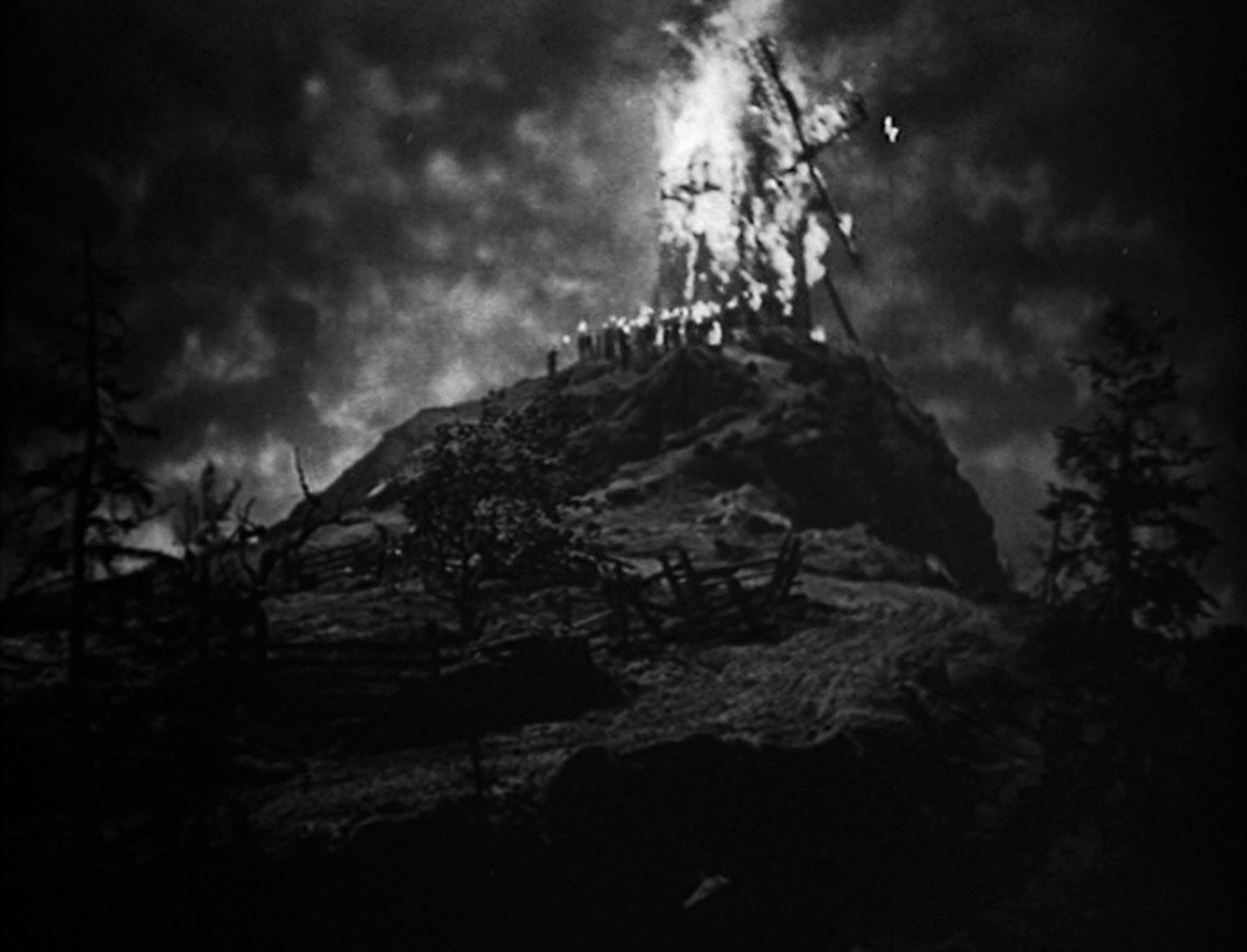
One day, a travelling projectionist comes to town.  The children go to see a matinee of James Whale's Frankenstein, (it's 1940 and the movie has been out since 1933 but there was this little thing about a war going on) which deeply affects the youngest, Ana. She wonders why, in a pivotal scene, the monster kills a young child (in the film it's never seen) and if the monster is real. She's told by her older sister that the monster is a spirit who will come at her call—"Hello, I am Ana." And Ana begins an obsessive quest for the monster that she believes exists and walks among the countryside.
It's relatable. I was obsessed with Frankenstein's monster when I was young and in my single digits. There was nothing "deep" about it. I was not concerned with its origins as the brainchild of Percy Shelley's wife, or of the Monster's representation of the unnatural brought to life. I knew nothing of it's overarching theme of man's desire to be God and re-animate life from death, and more than nothing about it's sequel's of man's desire to be Woman and create life as a collaboration. No, what I knew was he was tall and green, had a flat head and bolts in his neck (which were pretty cool). And his suit didn't fit. And his shoes were massive. And he was a monster, impure and simple—no bats, no bandages, no dual identity to complicate things. What you saw was what you got and the monster's visage (and director Whale's way of shooting him) had a dynamic I liked.

Grrrrrrrr.  Monster gooood!
In a natural world this vast, something un-natural must fascinate.
And I certainly didn't think that Frankenstein's monster could be used as a symbolic stand-in for a repressive regime that would instill look-over-your-shoulder dread in its citizenry in the same way a lightning-blasted corpse-quilt come to life would the umlaut-stricken in a bürger-hamlet.

Or instill it in any child anywhere in the world.

After all, Ana and Isabel's childhood world/playground is a vast canvas of Nature, where an unnatural thing (like the Monster) would be completely out of place and at odds with the rhythm and hum of the way things are, much like a war would, or an industrial revolution, or an imposed order.
Ana sees this monster, this inarticulate creature, who yearns to learn—much as she does—but fears it for the way it could destroy her (like the little girl with the flowers in the movie). The Monster is magical in a way that the world is not. It's her boogey-man in the closet that she hopes she can control like everything else in her world. And when she is told by her Sister that the monster's spirit walks still and probably lives in that barn "over there," Ana must investigate.
This sets in motion a series of events that juxtaposes life and freedom, identity and society, death and repression. Erice made this in the last echoes of the Franco regime and the citizens of the post-war world walk around in a form of zombie-state, their expressions impossible to read. That the Frankenstein monster is also seen in this context as a symbol of life and freedom shows what a palpable symbol it remains, and how malleable.