Showing posts with label Mae Clarke. Show all posts

Friday, October 4, 2019

Frankenstein (1931)

I've spent quite a few October's on this blog presenting all sorts of reviews of horror films (and the tradition continues this year), but I've never published reviews of the "Big Two" horror films—Frankenstein and Dracula. Well, it's never too late. Time to unearth them from another archive.

Frankenstein (James Whale, 1931)

"We are about to unfold the story of Frankenstein, a man of science who sought to create a man after his own image without reckoning upon God. It is one of the strangest tales ever told. It deals with the two great mysteries of creation – life and death. I think it will thrill you. It may shock you. It might even – horrify you. So if any of you feel that you do not care to subject your nerves to such a strain, now's your chance to – uh, well, we warned you."
Every young boy's horror touchstone—and if we're to believe Víctor Erice's El Espíritu de la colmena every little girl's, too. One of Carl Laemmle Jr.'s ghoul gallery of public domain necromancy movies that spawned dozens of sequels and dozens of imitators, all inferior to the craft of these primitive films, made at the fog-shrouded dawn of the Sound era.
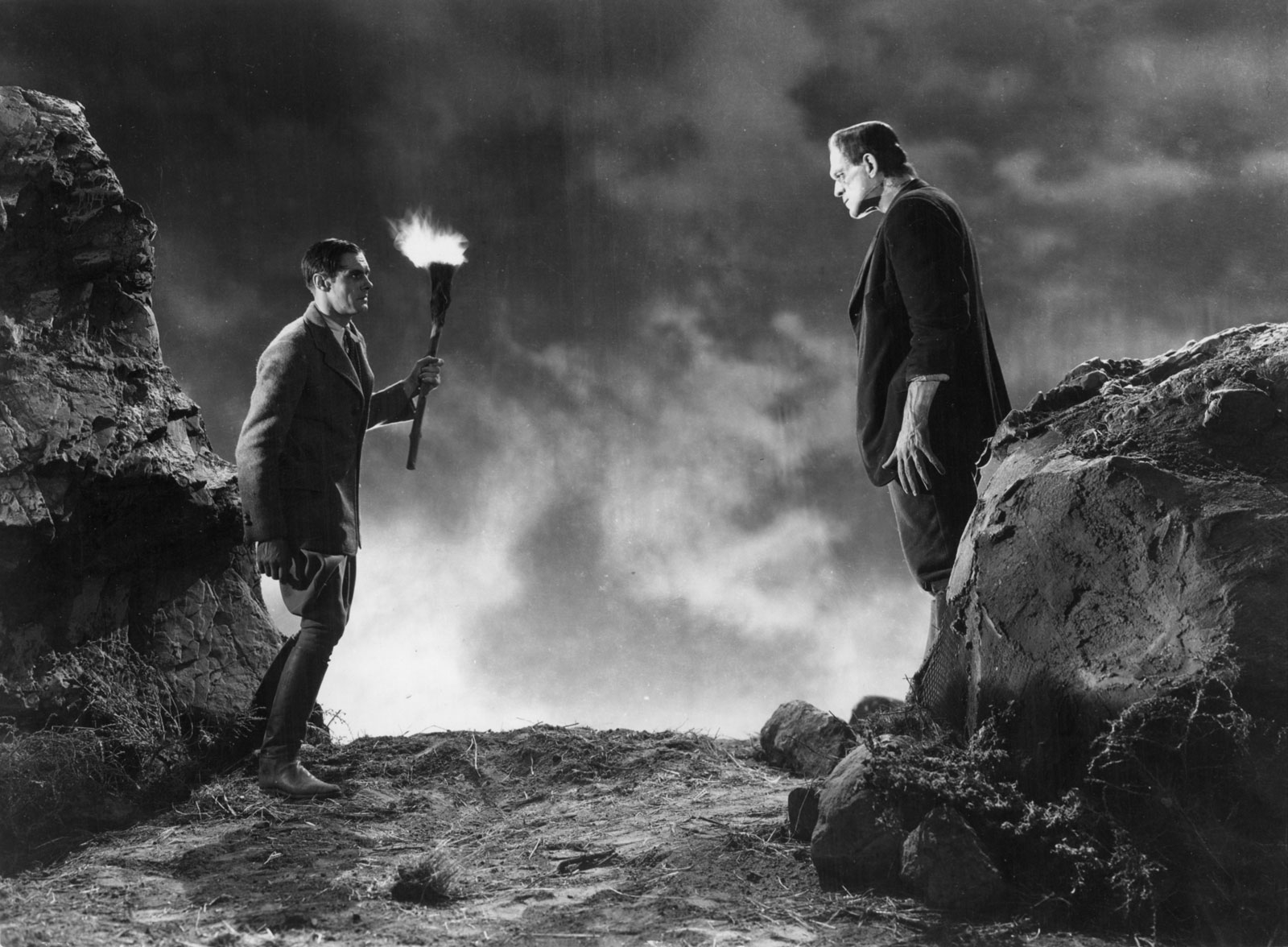
But towering above them all in the pounding hearts, toad-squirming minds, and knocking knees of horror fan-dom is the story of "The Modern Prometheus" and the Monster to whom the public bequeathed his name. Frankenstein boasts odd beginnings. Written by Percy Bysshe Shelley's frail flower of a wife, aged 18 when she conceived it, during a Gothic night's creativity, "Frankenstein's" story and it's several graves-deep inner meanings had been a classic for decades. It had been filmed before (even by Thomas Edison), but Laemmle's production, directed by James Whale has emerged as the one with the biggest boots to fill.
It might be because of its introduction (reproduced above). Edward Van Sloan walks out onto the filmed stage and warns us of the subject matter to come and the blasphemous implications of a man not "reckoning upon God." It's a good tactic—a carnival barker's come-on—for rather than warn us away, it whets the audience's appetite for the terrors to come.
And James Whale doesn't disappoint. Whale's life has merged with Legend (the movie Gods and Monsters), but his German-expressionism-influenced eye and sense of the absurd (which would come to full flower in the follow-up, The Bride of Frankenstein) created a sinister world of vast-shadowed hallways, spitting whirling laboratories, and castle chambers that resembled gargantuan funeral homes.

Before going on to the actors, homage must be paid to the craftsmen: Art Director Charles D. Hall, whose bizarre designs for the film give it its scale and majestic decay; and, of course, make-up artist Jack Pierce, who transformed a slight British actor named Karloff into a 7-foot, barrel-chested, electrode-studded,* flat-skulled (and copyrighted) hulk. There have been many subsequent designs for Frankenstein's piece-meal monster, but none have been so iconic as the Whale-Pierce-Karloff version.
Karloff's contribution cannot be slighted—including his removal of an upper dental plate to give the Monster a dented, off-kilter face. But mention should be made of Colin Clive's hyper-bi-polar doctor (he was a wayward medical student in Shelley's tale), prone to manic exultation or fainting dead away in emotional extremis. The good doctor's a bad drama queen. As his house-keeper would say in the sequel, he's a queer fellow.
There's another reason to celebrate the longtime classic-ness of James Whale's Frankenstein. It and it's sequel The Bride of Frankenstein may be two of the greatest gay-themed movies to come out of straight, Hayes Code mainstream Hollywood. I had a film professor who was studying Bride and told of his curiosity about the air of exoticism in the first two "Frankenstein" films, when that "queer" line came out, it was the lightning-bolt that was the key. What is Frankenstein and The Bride of Frankenstein except the story of a man (or two men in Bride, with Frankenstein and Professor Pretorius collaborating) trying to by-pass God (and women) to give birth.** 
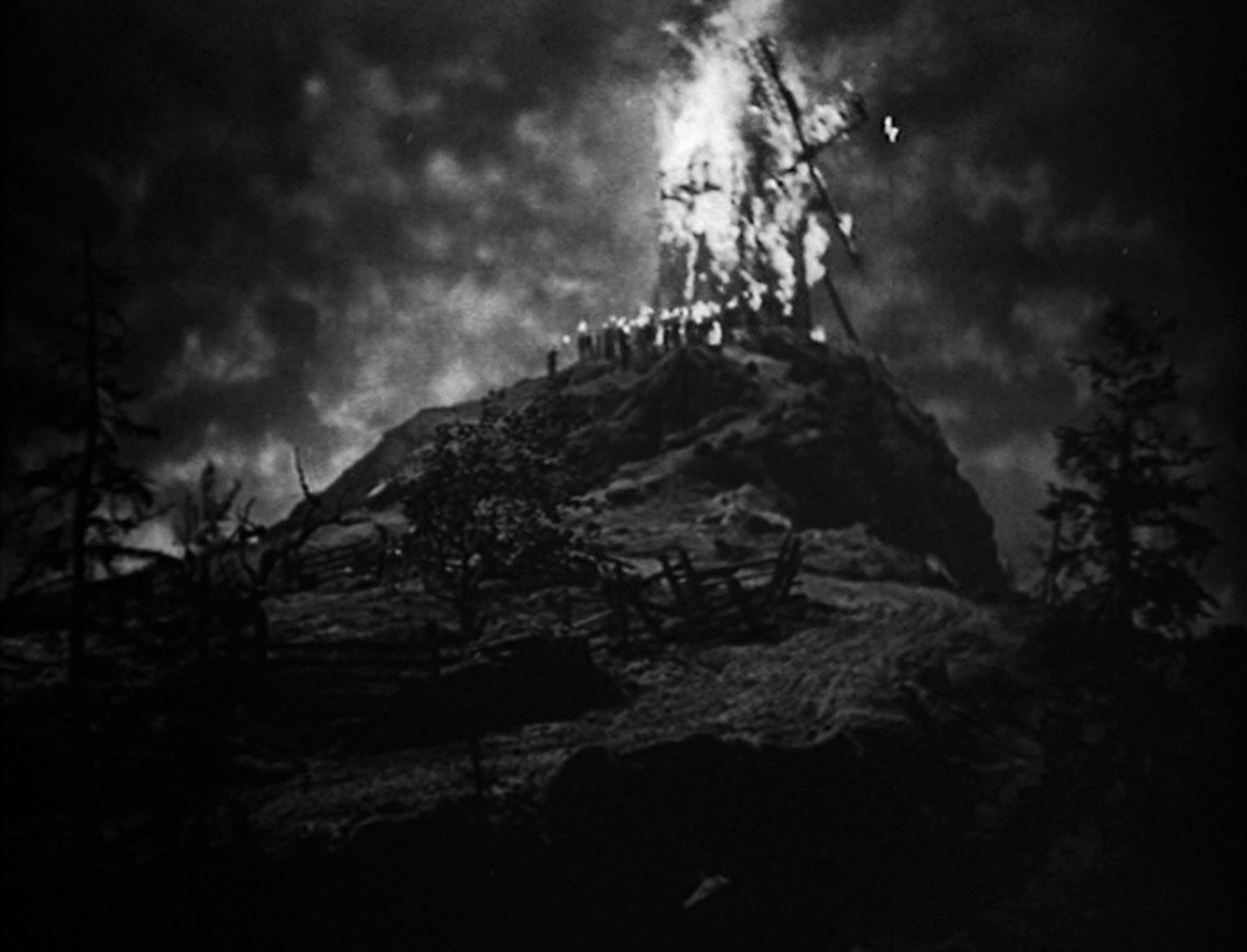
The melancholy cruelty of Nature and mob-hysteria towards the different permeates both of Whale's "Frankenstein" films,*** and turns Monster into mirror, a figure of identity rather than horror, and occurs whether the audience is gay or straight. There's a reason the shunned figure of Frankenstein's Monster resonates: he's an outcast, yearning but misunderstood, tortured, but sympathetic. And though kept prisoner in a castle dungeon rather than a closet, he would emerge sequel after sequel, never vanquished—indomitable—his super-human will-to-live allowing him to see another day. As they say in Jurassic Park, "Life will find a way."
Frankenstein is one gifted director's roaring protest against the Nature of Things ... and man's intolerance. 
* One of the basic copy-rights of the Universal design are the electrodes sticking out of the Monster's neck. Though "Frankenstein," the story, is in the public domain--one of the main reasons Francis Ford Coppola produced a version years ago--and anyone can do a re-make, those electrodes, and the rest of the make-up design, are the commodity of Universal Pictures. When Mel Brooks made his Young Frankenstein in the 70's, he by-passed the neck-studs...with zippers.

**When he presented his theory in class, one of the students remarked "That's kind of mind-blowing..." to which he replied, "I'm glad you said 'mind...'"

*** Christopher Isherwood also used Frankenstein and Pretorius (dubbed "Polidori") to create a more homo-erotic version of the story...for NBC television...when he wrote the teleplay for "Frankenstein: The True Story"


Thursday, February 14, 2019

Parole Girl

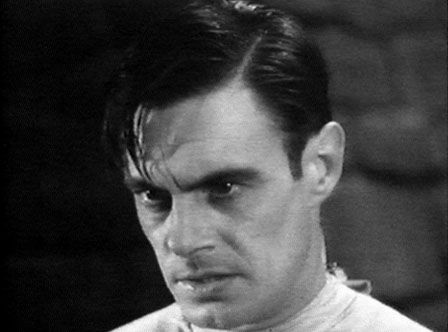
Parole Girl (Edward S. Cline, 1932) Sylvia Day (Mae Clarke of Frankenstein and The Public Enemy) is a rookie grifter working scams on department stores—when her partner accuses her of being a pick-pocket in public, she threatens the store with legal action, which the managers are  only too willing to avoid by writing a compensatory check ("We don't hold people up! We got a racket!" says her partner, Tony, played by Hale Hamilton)—when she is caught and thrown in prison for a year, after the store's manager won't let her go on directions from the store's insurance agency. As she's carted off she vows vengeance on the man, Joe Smith (Ralph Bellamy), saying she's going to ruin his life the way that he's ruining hers.

In the slammer she meets Jeanie (Marie Prevost), who's in for being an accomplice ("Can you beat a hold-up? Me? I wouldn't do anything as crooked as that! There's too many honest ways for a girl to make a livin': blackmail, forgery and just plain framing a guy in a hotel room...").
With dialog like that, you know it's a Pre-Code film, that era in movies when gangster and socially-minded films told stories of the wages of sin and the value of redemption by openly exploiting the very licentiousness they were warning against in order to attract audiences. They "got away" with a lot in that time before the Hays Code was established. The exploitative aspects of the film were ballyhooed to attract the rubes who were expecting flashes of the seamier side of life, only to be served conventional outcomes and moralistic preaching to keep the Protectors of Society at bay. It's a bit of a shell-game, hearkening back to the roots of hucksters trying to attract a crowd.
Sylvia devises a way to get out. Her old crony on the outside smuggles matches to her, and when assigned to the soft-works factory manages to stage a fire (one should note that this is only 22 years after the Triangle Shirtwaist Factory fire in 1911) and while the other women panic, trying to get out of the locked door, Sylvia grabs the nearest extinguisher she spies and puts out the worst of the fire, then passes out (or pretends to) to get sent to the prison hospital. A grateful warden awards her clemency and she's sprung to seek her revenge on the store executive who had her sent away.

Fortunately, for her, he's all too susceptible: he's just received a promotion, and while he's out celebrating, she finds him and encourages his binge. Fade to black-out.
Smith wakes up with a massive hang-over and a woman's pump in his bed. Sylvia's in the bathroom, ready to give him a chaser—she announces that the two of them are now married, for better and probably worse. No matter that her partner posed as the judge—Smith doesn't know that—and she begins to spend Smith's money like it's going out of style. Plus, there may be an issue of bigamy—Joe might be married, and therefore in trouble with the law. It's a nice little honey-trap and Smith has no idea whether it's true or he's being bamboozled, all he can do is protest that Fate is against him and she must be a woman.
Parole Girl is rather crudely directed with smart, sassy performances and an eye towards moving the show as quickly as possible to keep people from poking holes in the plot. It would inspire a whole sub-genre of noir where the female component has the upper hands over the males and we'll be looking at a few of them—some, the originals and their more recent remakes—in this month of Valentine's.

Wednesday, September 20, 2017

The Public Enemy

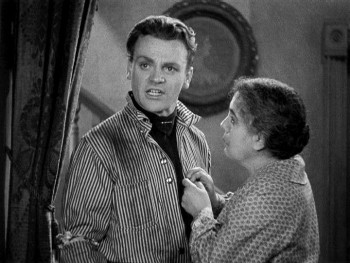
The Public Enemy (William Wellman, 1931) "Learn your lines, find your mark, look 'em in the eye and tell 'em the truth." That was James Cagney's recipe for good acting, succinct, humble, with plenty of lee-way to find your own path, and completely shy of the mark when it came to talking about how he did it. This gangster film was Cagney's first starring role—in fact, up until two weeks before filming, Edward Woods (who plays Tom Powers' best friend) was going to play the lead. But, there was something about the little guy with the bantam rooster's brio that made director William Wellman turn the tables on the roles.

It's the story of a rotten kid from a good family with all the contrary instincts to look out for a number one—himself—who has no moral compunctions about anybody else, that leads him down a precariously slippery slope at a time in history when society was providing an excellent opportunity for taking advantages of loop-holes in the law and morality. Pretty soon, "Tommy" is a booze-runner during Prohibition, and anybody getting in his way, even some he'd pledged loyalty to earlier, would find their way on the wrong end of his fist or the business end of his gun (and curiously, Cagney's Powers employs both the same way, with a forward thrust of the arm, as if fist and firearm were interchangeable).
It's a pretty standard morality—or immorality—tale. But, you watch Cagney do it his way and you never forget it. He's extremely charismatic, and like James Dean, does so in a way that separates him from everybody else. Where the rest of the cast—in one of the early talkies—is ramrod-stiff and talking with fine e-lo-cu-tion, Cagney is loose in everything, wrapping himself around furniture, spitting out his slang dialogue, and if there's a little dead-air, he throws in a little wise-crack in word or gesture for good measure. He's encouraged by Wellman, who takes a lot of chances in this pre-Code drama ("Did he just say what I think he said?" "Is that gesture in the credits what I think it means?"), and who sets up the tenor of the times in one masterful shot from a street corner's vantage-point, moving from a distillery to a corner-bar, following a pole of beer-buckets that crosses the path of a Salvation Army band. Wellman liked to play it rough—they used real bullets in a shot where masonry is picked off close to Cagney's head, and when Cagney is hit by the actor playing his sanctimonious brother, Cagney goes down like a ton of bricks—because Wellman told the other actor to clobber him, breaking a tooth in the process. And there's the famous grapefruit-in-the-face shot (making Mae Clarke something of a legend extending far beyond her career), that Wellman came up with—because he always imagined doing that to his own wife, who habitually ate half a grapefruit in the morning.
But, it's Cagney that's the Big Show. Watch the scene where he stands in the rain, luxuriantly eyeing his next targets, the guys who gunned down his buddy in the street. With murder on his mind, a smirk comes over his face, that turns into a fierce grin, then disappears into a grimace as he moves forward and walks right into the camera, like a ball of fire that can never be put out. 

Cagney's so good, he's scary.  
Cagney's Tom Powers with murder on his mind—that not even a downpour can douse.

Thursday, April 7, 2016

Lady-Killer (1933)

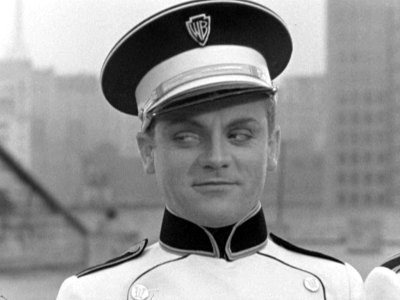
Lady-Killer (Roy Del Ruth, 1933) Light-hearted gangster picture in the same manner as the Humphrey Bogart All Through the Night. Cagney plays Dan Quigley, an entrepreneur of sorts, who when we first see him is "in the picture business"—he's an usher in a Big Apple movie theater, in trouble for disappearing and running crap games on the side. He gets fired for telling a patron what she can do with her toy poodle, and out on the street, notices a dame (Mae Clarke) losing her billfold. Nice guy Dan follows her to her apartment, returns it and finds a nickle-ante poker game in the back. He helps himself, gets cleaned out and on his way out the hall, runs into another rube...returning another billfold. The poker game's a racket, a going concern, with the billfold a way to lure in good-intentioned suckers. But rather than getting sore, Dan laughs it off, and uses his cracking wise to parlay himself in on the deal.

Before long, he and the girl, Myra, and the four poker grifters are running a crooked speak-easy, the 7-11 Club, while also doing some knock-overs of ritzy swells from the casino on the side. Dan stages traffic accidents outside the manses of the targeted customers, gets himself taken inside by the worried owners to case the joint, then once his cronies arrive with an ambulance, he gets taken out on a stretcher and the "attendants" do the same for the loot. But, during one of the capers a maid gets her skull caved in and eventually (as they say in the movie) "croaks." The Club gets raided on the word of a stoolie and soon the whole bunch is on the lam.

Quigley and Myra high-tail it to L.A., only to have Dan picked up on suspicion by the LAPD, and when he calls Myra to cough up his bail, she's skipped, along with gang-leader Spade Maddock (Douglass Dumbrille). With nothing to hold him on, the cops release Quigley and eventually he finds work as an extra in the movie business, at which point, life starts to get good, especially with frequent co-star Lois Underwood (Margaret Lindsay), until his old partners start making trouble for him.
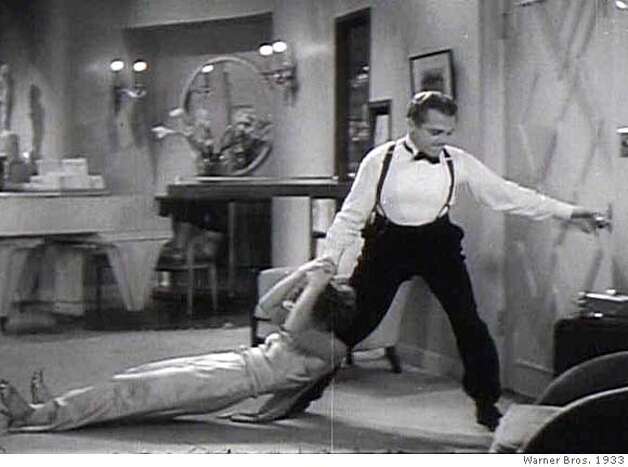
Very fanciful, but Cagney is lighter on his feet here than he is playing his "heavies," in fact, this movie is full of wise-acre slang and a lot of good laugh-lines, most of them coming from Cagney's Quigley, who laughs at every joke. He's a good-time charlie, not meaning any harm, but not wanting to do too much good, either. And Cagney's paired with his co-star from The Public Enemy, Mae Clarke, who gets more than a grapefruit pushed in her face here. At one point, Cagney alarmingly grabs her by her hair and drags her out of his room and throws her, bodily, into the hallway (alarming enough that I'm not posting the gif of it here) The makers have a lot of fun at Hollywood's expense, sending up the movie business and the extravagant lifestyle. It's almost a romp for Cagney, only a couple years removed from The Public Enemy, and goes some way—but not too much—in rehabilitating his public image. Still a tough guy, but not pure evil, either.