We are inundated by news. Saturated with it. Awash with it. Some is fact-checked, some have two sources, a lot of it—most of it—is just blather, speculation, filling time and selling soap...or pharmaceuticals. "I heard a guy who said..." followed by professional blowhards, who used to have a job, saying what they think, and their "act" is that they know. So much of what poses as "news" is "opinion"—newspapers traditionally limit that to just two pages. That's on the national level. On the local level, it's all sports and weather with the top story being somebody died...and the last story something about puppies. All smiles. "Have a good night."
It didn't used to be that way, back in the "old" days, before "24 hour news" channels (which never have 24 hours of news), and back when there were only three networks and each one had their own news department that encapsulated the news in 30 minutes (minus commercials). They didn't have time for opinion (we shouldn't have time for it at all). That's the way it was...and somehow you were assured that was right.
The only time you saw a lot of news was in the Dickensian "best of times, worst of times". Coronations. Moon missions. Assassinations. And the 1972 Munich Massacre. If you don't know about it, Spielberg made a movie of it...and its vengeful aftermath. But, to boil it down, during the 1972 Olympic Games in Munich, a terrorist group called "Black September" broke into the Israeli compound in the Olympic Village, killed some, took hostages, made demands to be flown with the hostages to Egypt, and then everyone was killed, hostages and terrorists before the plane could get off the ground. And it was covered "live" on television.
By ABC Sports.
September 5, the film by Swiss director Tim Fehlbaum, tells the story of what was going on inside the ABC Sports facility and the herculean task of trying to report a terrorist attack with the same resources they used to show swimming, boxing, and track-and-field. In charge of their broadcast unit was Roone Arledge, head of the ABC Sports division and whose promotional mantra was "up-close and personal" in that he would have pre-produced background stories for athletes to engage viewers with the drama inherent in the matches rather then merely showing anonymous individuals competing. It was a brilliant model for sports-broadcasting, adding the back-story to the competition, raising the dramatic stakes and adding the element of "inspiration" to what was merely gamesmanship—which would, in turn, serve as inspiration to future generations of viewers who might, then, want to take on the challenges of sport—that's why "talent competition" shows these days fill up their time-slots with back-stories of simply everybody who participates. "Up-close and personal."
But, nobody was prepared for this. A world-stage of athletes from all over the world competing in peace, and that year in a country whose previous hosting was under the leadership of Adolph Hitler, who saw the Olympics as a political tool, advancing Germany's status, and trying to make a point of Aryan superiority in the process. That was the year of Jesse Owens and "The Boys in the Boat" so things didn't go according to the Master-Race plan. The 1972 Munich Olympics were envisioned by the country to bury past ghosts and be seen as a meeting place for peace after having plunged the world into war and committing genocide on an inhuman scale. And, again, things didn't go according to plan.
A Palestinian-militarist group breached the lack of security in the Olympic Village—armed guards and security would have provided a bad "image" for this post-Nazi German Olympics—and started killing Israeli athletes. They made demands that, if they weren't met, would mean the death of another Israeli on the hour. It was political warfare as theater, or—in the word that would become despicably familiar then from—"terrorism." To cover it would be to give the bastards what they wanted. But, cover it, ABC News did.
What else were they to do? Ignore it? Lives were at stake. Early on, Arledge made the decision that ABC News would not take over the coverage—they were half-a-world away and would have consisted of talking heads filling time. ABC Sports was on-site and closest to the story. In their zeal to do as complete a job as possible, they probably went too far—planting cameras across from the Israeli living quarters to get "good shots," deceiving security guards that their runners were athletes in order to smuggle film back and forth between their photographers and the ABC facilities. They punted. No one at the base could speak German, so an assistant editor (played in the film by Leonie Benesch)became the eyes and ears of official announcements and police scanners. The audio guy started soldering make-shift connections between walkie-talkies, telephones, and the control board.* For replays of video-tape, hands manually moved the reels. It was all duct-tape and spit and flying-by-instinct, but without the journalistic rigor associated with news coverage (except for the on-site presence of Peter Jennings (played by Benjamin Walker, whose voice-imitation of Jennings is eerily good).
They got the story. But, in one critical juncture, they got the story wrong—okay, they reported mis-information from the German spokespeople, but it was still wrong. And it was still put out in the world, and spread by other sources monitoring the ABC coverage, and it was just as wrong. That information was that the hostages were rescued in a daring raid by German police. It wasn't true. They were all killed and (although the truth didn't start coming out until 2012) that the raid was an unmitigated disaster. Those "rescued hostages" were all dead. There was a rush to judgment to get out the story. And rather than get the story right, they just wanted the pictures.
Eight years later, CNN started business and the business of getting the pictures, rather than the story right became a news business model. And we've seen examples of "news specialists" getting it wrong ever since. September 5 shows us where it all began...we in our bubbles and they in theirs...and how we haven't learned anything since. So much for keeping us "informed."
The WNYC program "On the Media" which is something of a "news-watchdog" has put out a series of handy "Breaking News Consumer Handbooks" with helpful advice on how to listen to "Broken News." There are quite a few of them, but I'll post a few salient ones.
* One thing they got right (but for all the wrong reasons): the invention of the "network bug"—those irritating graphics burned into the corner of network feeds to identify the source-station. ABC started burning their logo into their coverage because so many news sources were copying it and ABC wanted it known where the pirated sources came from. It also tells us who we can blame.
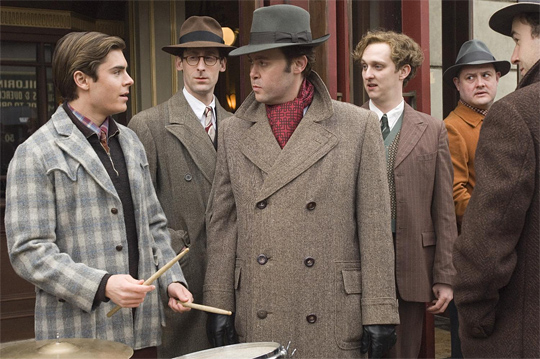
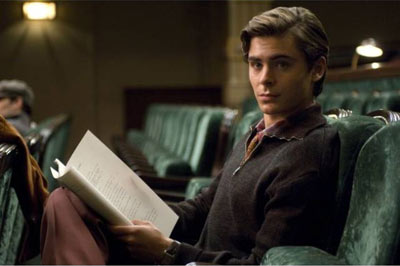
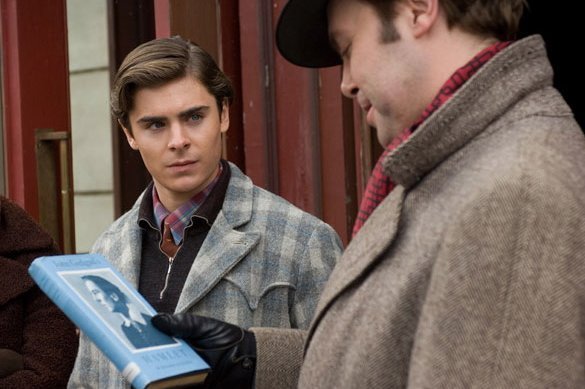
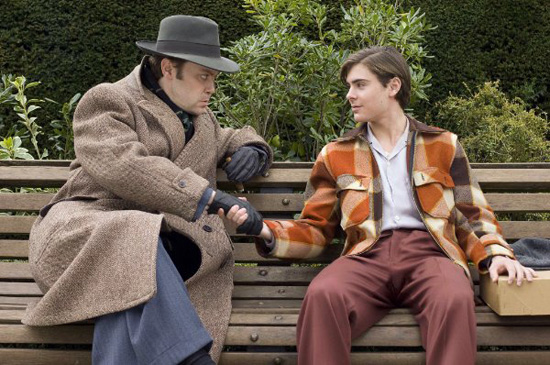
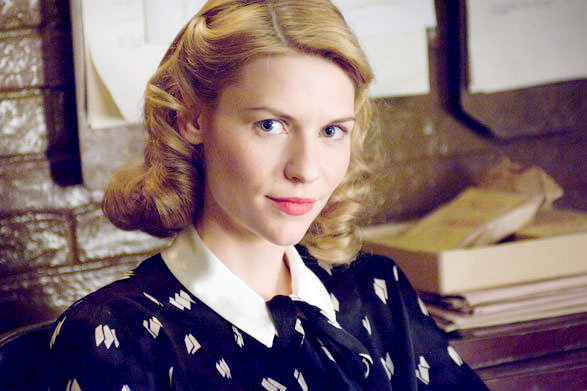
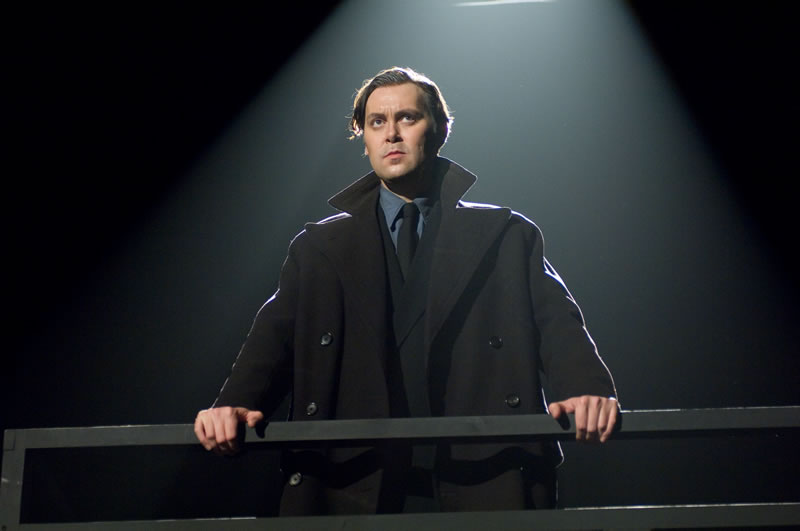
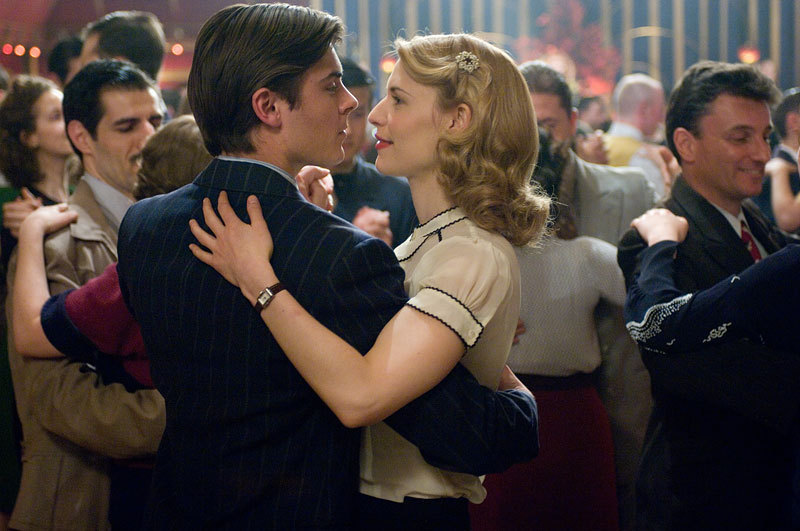
Young Richard Samuels (Zac Efron) is 17, "almost an actor," which puts him just a few hefty years (and worlds) behind the 22 year old Orson Welles (Christian McKay), who has established (by a shoestring) his Mercury Theater in New York, where he is in rehearsals for his modern-dress version of "Julius Caesar"—that is when he is not being whisked from studio to studio by ambulance to perform in various network radio shows, carrying on affairs with ballet dancers, associates, and "just met" women behind the aching back of his pregnant wife.*
And that just wouldn't do. It's all about Orson, even when it isn't. There's not that much difference between on-stage and off-stage because the star of it all is Orson Welles, manufacturing drama where there is none, generating excitement even needlessly, and making sure that the limelight is on him. He is the hero of it all and the villain with the best lines. He desires to be, as Alice Roosevelt said of her president-father, "the bride at every wedding and the corpse at every funeral." Life isn't enough, and art has to be stretched to accommodate him.
So do budgets. This fascist recreation of "Julius Caesar" is "modern dress" because there is no money for costumes, but nobody has to know that, it looks like a comment is being made and art is reflecting life au courant. Just like doing a "Voodoo" Macbeth means his all African-American cast is that much cheaper. It looks like a statement, but its merely the ones with a bottom line. But it's a fine recreation, and if you're not interested in the details, it still makes a compelling story of getting what you need, whether you want it or not. For those who do know the history, it's particularly fun to see Big Names tossed off: there's Joe (James Tupper), and Lloyd (Leo Bill) and Coulouris (Ben Chaplin) and Jack (Eddie Marsan).**McKay only slightly resemblesWelles, and his voice is a timbre higher, but his phrasing, his articulation are spot-on....if the mannerisms seem to be those of the Welles that is familiar on-screen. And if Zac Efron isn't entirely up to the task of playing his part, that's okay. His role is "Candide,"trying to run with thoroughbreds, while he's still admiring the track, crushed with more experienced hoof-tracks. And Efron has just enough skill to do nothing when playing a kid who "doesn't know what he doesn't know." It's a boy's version of The Devil Wears Prada, but it's also The Stunt Man, where illusion is all and practiced and can dazzle the rubes. "J.H. (John Houseman) says everything about theater is bull-shit." says Sonja(which she explains is spelled with a "j" but pronounced with a "y"). But the trick is getting the bull-shit to flow in one direction and that's towards the audience, so they can't see the gears in the background, and the compromises, and the cat-fights and ego-clashes and the spit flying in the klieg-lights. It's new and they've never seen it before, and like the magician he was, Welles was good at deflection while making you never want to blink.
And director Linklater (Dazed and Confused, A Scanner Darkly) suddenly seems to understand that. Where before he was content to trace his way through movies, now he's using it as a weapon to win over the audience rather than merely please himself. The big joke at the beginning of the film is a seemingly endless number of production companies that "present" Me and Orson Welles. Hell, the Isle of Man Film Commission is a producer and so is the special effects company that maintains the period illusions (they had me at the "Re-Elect Laguardia" bumper-sticker on the phone-booth), for like Welles, Linklater is trying to make his movie any way he can, and in one telling shot in the latter part of the movie, he shows how deep he knows his themes. He starts with a close-up of an orchestra singer, and she's nothing to look at. But as the camera moves back, back, back in the hall, soon all you hear is her voice and the spangling of her dress and at some point, it doesn't matter where—she's the most beautiful girl in the world and she can make you fall in love. It's a simple camera move, just a way-stop to what is important in the scene, but it speaks volumes about illusion and The Moment. It's this trickery and the fascination with the curtain that distinguishes this little recreation of Welles' prestidigitation from Tim Robbins' hyper-serious (and more than a little dull) Cradle Will Rock. At times, it seems like Robbins was making a judgmental spoof rather than telling the story, which in its own way reveled in the incalculable effect of stirring theater.
And Linklater has a keen grasp of what makes Welles tick (not in his words, because "the official" Welles confounds biographers by telling different stories of his past), but by his actions. Welles had a fascination with the ephemeral, of the moment that could disappear in a flash and make you wonder if it was ever really there to begin with. Not wanting to be tied down, or set things in stone, he was finally confounded—not in the confused sense, but the frustrated sense—with film and its opening dates and burned-in images and permanent records. Change it, compress it, speed it up, keep everybody on their toes—they might see something up there—that was the Welles credo. Keep it fresh, or, at least play it fresh. Everything is fleeting, nothing is permanent, so you better move fast and enjoy it, or move past and forget it. "Ripeness is all." In that way, Me and Orson Welles is in the same radar zone with Up in the Air.
At a time when James Cameron is recycling his old stuff as futuristic, and trumpeting it as revolutionary at the top of his ego, the most amazing thing in this movie season is how two boy-filmmakers, Guy Ritchie and Richard Linklater, grew up to make stellar, fun and deep entertainments out of the past. Like Quentin Tarantino, these film-makers always gave off an air of being too hip for the screening room, but like Tarantino's Inglorious Basterds, Sherlock Holmesand Me and Orson Welles are smart, tough entertainments that may only appeal to the loges, but the fact that, given the materials, these directors can rise so magnificently to the occasion is the most eye-opening of movie-going experiences.
For awhile now, I've been peppered with little alerts about this movie on Welles-groups on the Internet and taking them with a grain of salt. There've been other movies about those wild early years, even a couple of TV-movies about "The Night That Panicked America," and "RKO 281" (about the making of Citizen Kane) and they've been tepid exercises that oftentimes embellished the facts. But, I think Welles would have enjoyed this one, and even roared with laughter a couple of times. But he would have had one problem with it.
72 Years difference: the NYT Hirschfeld cartoon for "Julius Caesar"
The 2009 cartoon of "Me and Orson Welles" in The New Yorker.
* The story is fiction based on fact: Author Robert Kaplow saw a photograph of the "Julius Caesar" production of Welles with a young man playing a lute, and decided to write a story about that young man. Except for the fact that his story is fictional, the rest if fairly accurate. Odd. Usually goes the other way.

 The only time you saw a lot of news was in the Dickensian "best of times, worst of times". Coronations. Moon missions. Assassinations. And the 1972 Munich Massacre. If you don't know about it, Spielberg made a movie of it...and its vengeful aftermath. But, to boil it down, during the 1972 Olympic Games in Munich, a terrorist group called "Black September" broke into the Israeli compound in the Olympic Village, killed some, took hostages, made demands to be flown with the hostages to Egypt, and then everyone was killed, hostages and terrorists before the plane could get off the ground. And it was covered "live" on television.


 But it's a fine recreation, and if you're not interested in the details, it still makes a compelling story of getting what you need, whether you want it or not. For those who do know the history, it's particularly fun to see