The Sins of the Sons of the Father or What if the Hokey-Pokey IS What It's All About? (500) Days of Summer was one of my favorite movies a couple years back, a smart combination of naiveté, winsomeness, and cynicism about the whole "love" thing...especially from the needy/selfish male point of view, and was very charitable to the elastic female point of view...something you wouldn't find in your basic Woody Allen (or any male-written) love story. The director, Marc Webb is off (er...) web-slinging on the re-booted "Spider-man" series, but writers Scott Neustadter and Michael Weber have done a new screenplay of Tim Tharp's National Book Award finalistThe Spectacular Now, directed by James Ponsoldt, who's less flashy than Webb, a little less assured technically (especially in the sound department), but has a great casting eye as he's gotten a spectacular ensemble cast for this film. When we first meet Sutter Keely (Miles Teller, who is brilliant in this, his face morphing between man and boy with split-second speed), he's filling out a college entrance question: "Describe a misfortune, hardship or challenge in your life: How did it affect you, and what did you learn from it for the future?" Sutter doesn't even hesitate: "Dear Dean of Admissions: Up until yesterday, I had the best fucking girlfriend in the world. Sorry, I probably shouldn't say 'fuck' in this..."
Miles Teller, the breakout performance of The Spectacular Now
It's true. Sutter's just gone through a bad break-up with Cassidy (Brie Larson), who, in his eyes, was the perfect girlfriend and they were the perfect couple, the hit at every party (and there are a lot of them), but it's all come crashing down when she says "I'm done!" over Sutter helping his buddy get a girl, by giving a couple of fellow high-schoolers some of the ice-cooler'd beers he regularly stashes in his trunk. Sutter's good for that, but for Cassidy that's not good enough. They're through, so over and done. Cut to the title. Next thing we know, we're looking up at a sun-blocking silhouette saying: "Hey! Hello? He-lllooo! Oh my God, you're alive!"
It's 6 am. He's passed out on a lawn of a house he's not familiar with, his car is nowhere to be found, and standing over him is Aimee Finecky (Shailene Woodley, proving that her instinctually felt performance in The Descendants was no fluke), who is out doing her Mom's paper route, only to find a body on the way. They know each other from school. Aimee helps Sutter up, and the two continue the route with two missions: delivering the papers and looking for his car. The goals are short-term, which suits Sutter just fine. It's clear early on that Sutter is a boat without a rudder (or even a paddle), and the women in his life, be they his Mom (Jennifer Jason Leigh, welcome back), Cassidy or the new Aimee, keep him focused and on the true. Or as true as Sutter will let himself be (and Teller has a wonderful ambling gait, which I started calling "The Sutter Strut" that is both assured yet not going altogether fast, keeping anything approaching at a measured pace). Fairly early on, we learn that Sutter may indeed be "the life of the party," but he's also considered a flake and unreliable. A heated discussion in the family kitchen produces a "Sometimes, you remind me so much of your father..." comment (and not in a complimentary way) from his mother and he's annoyed because a) his father, having left the family early with no subsequent contact, leaves a void about how that should be taken; and b) he harbors the notion that the reason Dad's gone is that it's Mom's fault, all evidence to the contrary gone missing. In the meantime, and for the moment, he is spending his critical senior year in High School marking time, regretting Cassidy and "hanging out" with Aimee.
"Dude, she's not a rebound!" he assures a buddy, but it's pretty clear she is, at least at the start, using her as an excuseto go see Cassidy at a kegger. It's a quid pro quo kind of arrangement: she can help him with algebra, he up's her social quotient—she's never had a boyfriend and he's an established arm to hang on. But before long, the conversations start to get deep, the facile conversations ("what's your 'thing?'") turn personal, the "maybe-I'll-see-ya's" become orchestrated "bump-into's" and the period apart starts to become a noticeable measure of time. They're starting to fall into something: for her it means someone to share her plans for the future and college; for him, a long-term commitment is asking her to the prom.
She already knows what he's just beginning to suspect.
Now, before we go too far into this, let me say what a joy it is to watch Teller and Woodley riff off each other. The lines are established, sure, but the way they stumble, falter, eke out, and fly from each other's mouths colliding in awkward crashing cadences and emotional ranges between feigned self-assurance to tip-toeing fear is truly something to see and enjoy. Both actors are top of the line working with the other actors, but, with each other, there's a yearning sparring that feels like the magnetism of puppy-attraction. If it ain't convincing as love, it sure is convincing as fresh conversation that feels real (and spoken for the first time), and is as fine as any movie bantering I've seen in years between young actors.*
So, with all that raw talent going for it,**where does the movie go? There's been so much writing here, one worries that too much is going to be given away, and any particulars in subject matter and how it is revealed will result in the spoilage of any sort of subtle enjoyment of the film and how it subtly ingratiates and glad-hands you into darker territory. It skirts Afterschool Special territory, but does it in so circumspect a way that you may not even be aware of The Problem, until you are confronted with it in the same way Sutter confronts it, in reflection, but he sees it, not when he looks in the mirror, but when he is especially focused on something other than a short-term goal, but rather on the realization of a dream. Sutter has no depth, except in what he avoids, and he only realizes it to his horror and imagined shame. The Spectacular Now includes author Tim Tharp's original ending for the book, but the screen-writers give Sutter an "out" to end on an up-beat note in the grand Hollywood "bauble" tradition, but at least they take a page from Mike Nichols' play-book, and don't make it a comfortable one, but leaves him...and the audience hanging on a precipice, leaving the Spectacular Now and entering an Uncertain Future.***
"Stumble, falter, eke out and fly..."- Teller and Woodley
* Come to think of it, they remind me of the Andrew Garfield-Emma Stone hemming-hawing in The Amazing Spider-man. ** And I haven't even told you about Kyle Chandler, who plays against "type" and does it so unnervingly well, you want to start a barroom brawl with the guy. *** The view from the "Now:" Talk about an uncertain future—Marc Webb got bumped off the "Spider-man" series after the under-performing Amazing Spiderman-2, Teller gained a more reputable role in Whiplash and doused it with Fantastic Four, and Shailene Woodley has very nearly wasted her talent with the "Divergent" series (Teller has co-starred in those). These are all talented people—what are they doing wasting their talents on "tent-poles?"
The Sins of the Sons of the Father or What if the Hokey-Pokey IS What It's All About? (500) Days of Summer was one of my favorite movies a couple years back, a smart combination of naiveté, winsomeness, and cynicism about the whole "love" thing...especially from the needy/selfish male point of view, and was very charitable to the elastic female point of view...something you wouldn't find in your basic Woody Allen (or any male-written) love story. The director, Marc Webb is off (er...) web-slinging on the re-booted "Spider-man" series, but writers Scott Neustadter and Michael Weber have done a new screenplay of Tim Tharp's National Book Award finalistThe Spectacular Now, directed by James Ponsoldt, who's less flashy than Webb, a little less assured technically (especially in the sound department), but has a great casting eye as he's gotten a spectacular ensemble cast for this film. When we first meet Sutter Keely (Miles Teller, who is brilliant in this, his face morphing between man and boy with split-second speed), he's filling out a college entrance question: "Describe a misfortune, hardship or challenge in your life: How did it affect you, and what did you learn from it for the future?" Sutter doesn't even hesitate: "Dear Dean of Admissions: Up until yesterday, I had the best fucking girlfriend in the world. Sorry, I probably shouldn't say 'fuck' in this..." It's true. Sutter's just gone through a bad break-up with Cassidy (Brie Larson), who, in his eyes, was the perfect girlfriend and they were the perfect couple, the hit at every party (and there are a lot of them), but it's all come crashing down when she says "I'm done!" over Sutter helping his buddy get a girl, by giving a couple of fellow high-schoolers some of the ice-cooler'd beers he regularly stashes in his trunk. Sutter's good for that, but for Cassidy that's not good enough. They're through, so over and done.
Miles Teller, the breakout performance of The Spectacular Now
Cut to the title. Next thing we know, we're looking up at a sun-blocking silhouette saying: "Hey! Hello? He-lllooo! Oh my God, you're alive!" It's 6 am. He's passed out on a lawn of a house he's not familiar with, his car is nowhere to be found, and standing over him is Aimee Finecky (Shailene Woodley, proving that her instinctually felt performance in The Descendants was no fluke), who is out doing her Mom's paper route, only to find a body on the way. They know each other from school. Aimee helps Sutter up, and the two continue the route with two missions: delivering the papers and looking for his car. The goals are short-term, which suits Sutter just fine. It's clear early on that Sutter is a boat without a rudder (or even a paddle), and the women in his life, be they his Mom (Jennifer Jason Leigh, welcome back), Cassidy or the new Aimee, keep him focused and on the true. Or as true as Sutter will let himself be (and Teller has a wonderful ambling gait, which I started calling "The Sutter Strut" that is both assured yet not going altogether fast, keeping anything approaching at a mesured pace). Fairly early on, we learn that Sutter may indeed be "the life of the party," but he's also considered a flake and unreliable. A heated discussion in the family kitchen produces a "Sometimes, you remind me so much of your father..." comment (and not in a complimentary way) from his mother and he's annoyed because a) his father having left the family early with no subsequent contact leaves a void about how that should be taken; and b) he harbors the notion that the reason Dad's gone is that it's Mom's fault, all evidence to the contrary being missing. In the meantime, and for the moment, he is spending his critical senior year in High School marking time, regretting Cassidy and "hanging out" with Aimee.
"Dude, she's not a rebound!" he assures a buddy, but it's pretty clear she is, at least at the start, using her as an excuseto go see Cassidy at a kegger. It's a quid pro quo kind of arrangement: she can help him with algebra, he up's her social quotient—she's never had a boyfriend and he's an established arm to hang on. But before long, the conversations start to get deep, the facile conversations ("what's your 'thing?'") turn personal, the "maybe-I'll-see-ya's" become orchestrated "bump-into's" and the period apart starts to become a noticeable measure of time. They're starting to fall into something: for her it means someone to share her plans for the future and college; for him, a long-term commitment is asking her to the prom.
She already knows what he's just beginning to suspect.
Now, before we go too far into this, let me say what a joy it is to watch Teller and Woodley riff off each other. The lines are established, sure, but the way they stumble, falter, eke out, and fly from each other's mouths colliding in awkward crashing cadences and emotional ranges between feigned self-assurance to tip-toeing fear is truly something to see and enjoy. Both actors are top of the line working with the other actors, but, with each other, there's a yearning sparring that feels like the magnetism of puppy-attraction. If it ain't convincing as love, it sure is convincing as fresh conversation that feels real (and spoken for the first time), and is as fine as any movie bantering I've seen in years between young actors.* So, with all that raw talent going for it,**where does the movie go? There's been so much writing here, one worries that too much is going to be given away, and any particulars in subject matter and how it is revealed will result in the spoilage of any sort of subtle enjoyment of the film and how it subtly ingratiates and glad-hands you into darker territory.. It skirts Afterschool Special territory, but does it in so circumspect a way that you may not even be aware of The Problem, until you are confronted with it in the same way Sutter confronts it, in reflection, but he sees it, not when he looks in the mirror, but when he is especially focused on something other than a short-term goal, but rather on the realization of a dream. Sutter has no depth, except in what he avoids, and he only realizes it to his horror and imagined shame. The Spectacular Now includes author Tim Tharp's original ending for the book, but the screen-writers give Sutter an "out" to end on an up-beat note in the grand Hollywood "bauble" tradition, but at least they take a page from Mike Nichols' play-book, and don't make it a comfortable one, but leaves him...and the audience hanging on a precipice, leaving the Spectacular Now and entering an Uncertain Future.
"Stumble, falter, eke out and fly..."- Teller and Woodley
* Come to think of it, they remind me of the Andrew Garfield-Emma Stone hemming-hawing in The Amazing Spider-man. ** And I haven't even told you about Kyle Chandler, who plays against "type" and does it so unnervingly well, you want to start a barroom brawl with the guy.
The Splintered Arc of a Love Affair or "Something as Permanent as a Greeting Card" ("Color My Life with the Chaos of Trouble")
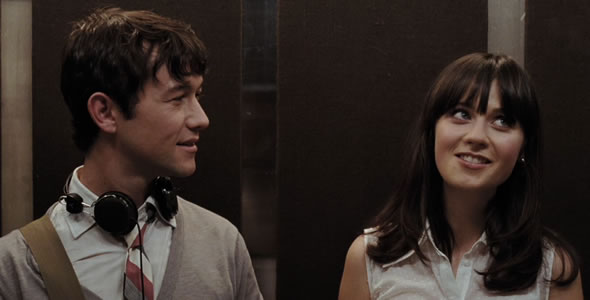
Once in a blue moon a little movie comes along that takes you completely by surprise if you're walking in with low expectations and an objective demeanor. If (500) Days of Summer isn't the best movie of the summer season—now seemingly locked into alternating between "tent-pole" franchises and Film-Fest pick-ups, of which this is the latter—then it will do until something better comes along. And halfway through July that looks very unlikely.
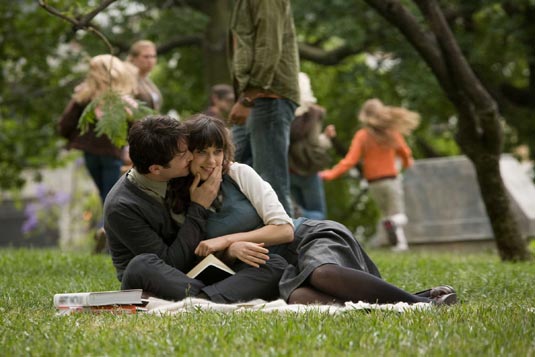
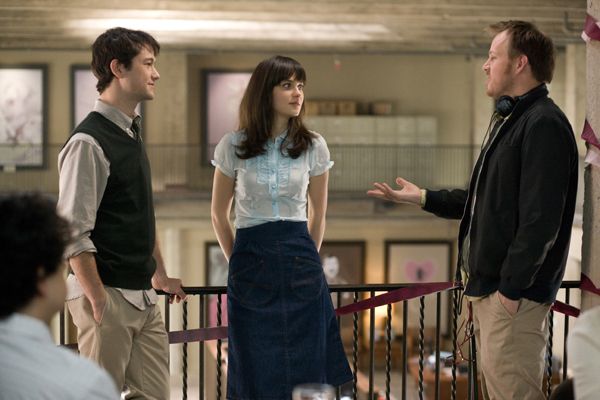
This would be dreadful taken chronologically. But directorMarc Webb and his scripters Scott Neustadter and Michael H. Weber* (who start off with a great touch) shake up the story and spill it out on the screen in a complex timeline that flies back and forth between good times and bad, reflecting the bi-polar extremes of Tom (which veer between music-video exuberance and plate-smashing depression) and the shifting moods of Summer (who runs hot and cold). The juxtapositions are great grist for comedy and the laughs are smart and plentiful. Throughout, Tom is advised by his small posse (Geoffrey Arend, Matthew Gray Gubler) and little sister (Chloe Moretz), all surprising in ways one doesn't expect.
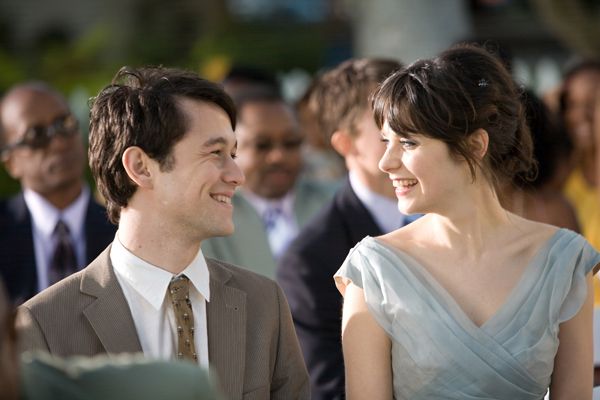
It's the two leads that are exceptional. Zooey Deschanel is a fringe-actress roller-skating the edge of fame and one would hope that this was the role that gooses her career choices. Deschanel has always been good at the atypical waif, but her Summer has a solid spine that makes her the leader in the dance. And Deschanel is just interesting to watch for her choices. During a party scene when asked, "What brought you here?" her brow furrows and her poached-egg eyes rattle through five fast and different expressions before she says anything, in sentences that are eerily elongated on certain words. And as the lovelorn Summer lover, Joseph Gordon-Levitt shows a hither-to unseen range of ways to elicit comedy. If Tom is on a self-imposed short-leash, Gordon-Levitt is given a lot of rope to play with. It's a great, wise, funny performance that belies the actor's Keanu-like outer calm.
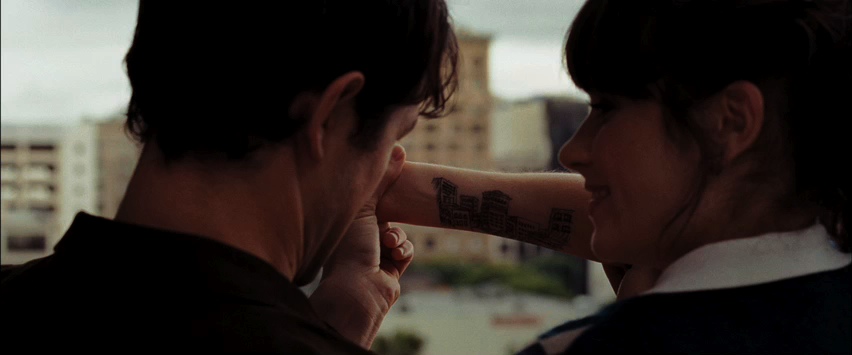
But it's the film-makers at play that finally wins you over—not just in the intricately shifting timeline that a second viewing will only confirm, but in one magical sequence that is so painfully honest and wonderfully cruel to romantic notions that you wonder why someone hasn't done it before. A sequence of Tom going to a party at Summer's split-screens to show his expectations of how the night should go alongside the brutal reality that sends him running into the night backed by an ironic pop-song (of which the film is full). It's a great idea carried off masterfully, as so much of this film is. But technique is one thing. What the film gets brutally right is the anticipation of love, the thrill of receiving it and the abject horror of losing it. And the film cracks wise about it at every step. As Tom says at one point (I believe it's Day 122), "Loneliness. It's underrated."
"It's underrated."
* Webb has gone on to direct the Andrew Garfield-Emma Stone "Amazing Spider-man" movies (where the interactions between the two leads were the best parts of the movie) and Neustadter and Weber subsequently have adapted two great films about young people, The Spectacular Now and The Fault in Our Stars.
Black Sunday(John Frankenheimer, 1977) From the twisted mind of Thomas Harris (who would later write "Red Dragon" and "The Silence of the Lambs") comes this entry in the "disaster movie" cycle of the 1970's. Only this one seemed entirely credible. Harris' first novel (and the only one that doesn't have Hannibal Lecter in it) conceived of a terrorist plot by a cell of the PLO called Black September (the group behind the Israeli athlete massacre in Munich in 1972) to kill everyone in the stadium hosting the Super Bowl. The film had the promotional tagline "It could be tomorrow!" Robert Evans bought the movie rights in his independent production deal with Paramount after leaving the studio, Ernest Lehman was contracted to write the screenplay (it would prove to be his last, with additions by Ivan Moffat and Kenneth Ross) and John Frankenheimer hired to direct—he had just finished a sequel to The French Connection and was starting to be noticed (again) as a gifted film-maker, especially when it came to thrillers. From the beginning, Frankenheimer wanted to set Black Sunday apart from the normal string of disaster movies in vogue during the 70's*by making it seem as true-to-life as possible, giving it an almost documentary feel.
The movie begins with a night-time raid on a September cell by a ruthless Mossad squad (led by Robert Shaw's agent David Kabakov) that is brutally efficient in taking out the terrorists, with one notable exception: catching September agent Dahlia Iyad (Marthe Keller) in the shower, he lets her go with only an appraising gaze.
Big mistake. Dahlia has a plan...and a means to carry it out. She has been "grooming" the aid of a court-martialed Vietnam vet, Michael Lander (Bruce Dern), who is on the psychological edge—suffering from PTSD as a Vietnamese POW, and by the resulting collapse of his marriage upon his return, he is chronically suicidal. Curiously, that hasn't stopped him from getting a job driving the promotional blimp for the Goodyear Tire company. Bad for them. Good for Dahlia. She convinces Lander that if he is going to commit suicide, he should do it in the most spectacular way possible, striking back at the country he's convinced has betrayed him, taking out as many Americans as possible in a terrorist attack on the Orange Bowl during that year's Super Bowl.
Meanwhile, the Mossad has brought in the FBI—in the form of agent Sam Corley (Fritz Weaver) on the results of the raid. Kabakov is starting to realize his error; Iyad is a former Baader Meinhoff member now offering her services to the PLO...and he had her dead to rights. She's now dropped off the intelligence radar and the Israeli's want the assassination mission completed, something Kabakov takes on as his personal responsibility. A recording that was found at the compound leads the investigators to suspect some sort of action is imminent and that the tape was meant to be discovered after the attack...but where and when the recording isn't specific.
The movie begins to take two parallel paths, following both the terrorists in their preparations and the FBI/Mossad investigation about what they might be doing. Their first idea that something is about to happen comes from a report from the Coast Guard to the FBI—twelve crates have been unloaded from a freighter to a man and woman wearing masks, but when the CG tried to intervene they were outrun. Kabakov travels to Long Beach and sneaks aboard the freighter under cover of darkness to interrogate the captain who needs a little persuasion to talk. But, when the captain answers a telephone, he is killed in an explosion and Kabakov is injured by the blast.
Those smuggled crates contain statues of the Madonna—made out of plastique that will be shaped into a large bomb to be brought into the Orange Bowl by the blimp and detonated, releasing thousands of steel flechettes, enough to kill everyone in the stadium. An initial test in the desert convinces Lander that the explosion will be uniform enough to cause the most devastation within the bowl-shaped stadium. With the plot proven in theory, Lander and Dahlia start work on the details to be ready for the next Super Bowl, while Kabakov and Corley are delayed by the Mossad agent's hospitalization. But, an aborted attempt by Dahlia to kill Kabakov in his room, convinces them that what could have been a few unrelated clues is a very real plot, one that their suspects are trying to see to completion by eliminating the investigators.
Upon Kabakov's release from the hospital, the investigation becomes more intense: Kabakov threatens a Los Angeles based importer to tell him that the shipment was for explosives to be delivered to a woman named "Kaza," then meets with an Egyptian intelligence official (Walter Gotell) who eventually tells him that this "Kaza" is actually Dahlia Iyad; when she is seen on January first in the Miami vicinity, the team start concentrating their efforts there and their suspicions begin to point to one target—the Orange Bowl, the Super Bowl.
The film then becomes a race against time and a fight against obstacles for both sides—the path is smooth for neither the terrorists or the security forces and one is kept guessing along the way whether the plot will come apart at the seams due to its own dicey nature or whether it will succeed in spite of it because the game authorities just choose to "bureaucracy" themselves into suicide. Both sides are firmly dedicated to a fanatical extreme and by the time Frankenheimer has ramped up the tension of the final denouement, you're just about willing to believe anything can happen.
And that's where director Frankenheimer is the biggest co-conspirator in the whole plot; he knows how to set things up to make the audience put the framework together, and by game-time, he has the audience both wanting to see the plot come together at the Super-Bowl, but also to see it quashed in as viscerally satisfying a way as possible. His editing has been moving at an ever-quickening pace culminating with a shootout on a Miami Beach, but, the realization of the target becomes known, the film settles into a complicated rhythm due to all the pieces coming together. And at that point, he pulls out every visual trick in the book to try to convince you that there is a goddamn blimp flying into the middle of the freakin' Super-Bowl and using every suspense trope right down to a sputtering, burning fuse.
It's pretty amazing what the film-makers got away with back in the innocent days of 1977: First off, yes, Frankenheimer did film at the genuine Super-Bowl game—Super-Bowl X (Steelers/Cowboys), to be exact—with permissions from the NFL and the two vying teams to use their logo's**—and the shots of the blimp hovering into the stadium were filmed the days before and after, with a lot of crowd cooperation going on for the scenes of panic. In fact, at one point, there's a shot of Robert Shaw sprinting along the side-lines where he is nearly strong-armed by a very real stadium security guard who didn't recognize Shaw and maybe didn't realize the movie was being filmed (the many film camera's were disguised to look like CBS-television cameras to ensure that one wasn't caught inadvertently due to all the footage being shot).
One or two effects shots are a bit dodgy amidst the hundreds it took to construct the sequence and some of the process work stretches credulity—as if the methods used to subdue a runaway blimp weren't incredulous enough—but, that last half an hour of the film does have one on the oft-cited "edge of one's seat." When I see a film of this nature (and it's successful in its purpose) my left leg has a tendency to bounce in a nervous response that would resist any amount of sticky gum on the theater-floor and Black Sunday had that effect (and it had nothing to do with matching John Williams' "thrummy" tension music at that point in the proceedings).
At the time of the film's release (it's opening was basically swamped by the juggernaut of the first Star Wars movie), the film and story was a competent, if fanciful, thriller of the paranoid variety on the cusp of the "disaster" cycle of films. Now, it's a cautionary tale, a blueprint for terrorists to some—it and Tom Clancy's "Debt of Honor" are regularly brought up in terrorism discussions—a call for vigilance by others, but, unfortunately, no longer fanciful. We've seen worse, for real. And it's tagline—"It could be tomorrow"—rather than a come-on, now sounds like a threat.
* After the heady rush of Irwin Allen hits ofThe Poseidon Adventure and The Towering Inferno, they were starting to ebb in popularity and ideas—another entry of that year was the rather ridiculous Rollercoaster (rather than a disaster movie, it might have been a "bad accident" movie) and a previous terror-in-the-football-stadium was the previous year's Two Minute Warning, which was "legacied" into the genre for the fact that it starred Charlton Heston. ** And, if we are trying to keep it in the real world, Frankenheimer used his clout with Goodyear Tire Company (he'd worked with them in filming 1966's Grand Prix) to get the actual Goodyear blimp—with the company's actual logo—to make it feel more like a credible event. Now, that is truly amazing. And a step above Harris' novel; the author sidestepped the issue by calling it "the Aldrich blimp," creating a fictitious and non-litigious company to sponsor the air-ship.
In The War of Orphans, Winning is Who You Leave Behind
or
"Tell Mother I Died Game" ("Well, It Just Goes to Show No One's Indestructible")
The continuity-conscious Daniel Craig era of the James Bond series has had a through-line simmering throughout all of its previous four films—"Don't trust anyone."
By the time of Craig's fourth film, SPECTRE, he has tipped so far over the edge that he draws down on a random mouse to ask it "Who sent you? Who are you working for?"
As the song (from Quantum of Solace) says: "...someone that you think that you can trust is just another way to die."
The official series' 25th entry*,No Time to Die, sees Craig's James Bond retired in Jamaica and recruited—by CIA pal Felix Leiter (Jeffrey Wright)—for an operation that eventually reunites him with the people he does trust to go after people he can't, something involving a missing scientist. Another one. Hey, the series has been going on for nearly 60 years, everything can't be original and nor would the many "James Bond" devotees not allow the "familiarity factor" to creep into the story ("Where's the Aston Martin?" "Where's the martini line?" "I didn't hear 'Bond...James Bond!" "Is he going 'rogue' again?"**).
Still, with all the Fleming novels having been filmed—in one form or another—and a good smattering of the short stories included, the filmmakers have been hard pressed to keep Bond current, the movie-plots being set "a few minutes from now" with call-backs from past novels and films spattered in, as well as acknowledgments from other sources that the producers use to know that they know they're being watched.***And the films have for the most part been formulaic—Pre-Credit Sequence/Main Title/Meeting with M/Visit to Q/Two Women (at least) with one being of mixed loyalty/The Sacrificial Lamb/Meet the Villain/Big Finish (with Explosion)/Sting in the Tail With a Challenging Henchman/"James Bond Will Return in..."—so that there were things you could count on. Rules were played with, but some you just didn't violate.
No Time to Die up-ends them.
As I mentioned, the Craig films are continuity-conscious. When last we left James Bond (Daniel Craig, pushing it this time, in all aspects—age, acting, etc...), he had crushed the international crime league, S.P.E.C.T.R.E., and brought to ground (literally) its ring-leader, Ernst Stavro Blofeld (Christoph Waltz)—but didn't kill him—instead walking off into the London night with Dr. Madeleine Swann (Lea Seydoux), daughter of the mysterious SPECTRE middle-man Mr. White (seen in three of the Craig's). The last shot of SPECTRE had the two seated in Bond's recently re-constructed Aston Martin, sharing smug, self-satisfied smiles. They were meant for each other.
No Time to Die begins with an episode from the past (not involving Bond, but will), and the story of the two scar-crossed lovers on a European honeymoon of sorts that is ruined when Bond is attacked visiting the grave of...Vesper Lynd (the "other woman" from Casino Royale). Coincidence? Not much of one, and as Swann and Bond are high-tailing it out of there, it's revealed that Blofeld has engineered the whole thing from his prison and implicates Madeleine. Despite her protests, Bond puts her on a train and she's out of his life. Bond and his trust-issues again.
In the past, we'd gotten used to the disappearing Bond-girl act, where after the final clinch of each movie, she is never seen...or mentioned...again. "Who?" But, the fact that Seydoux is even there—and she's the only actress playing the same Bond-woman part over two movies—means that she's special. And that the producers have "borrowed" a piece of music from the series' past (written by John Barry!!) to serenade the Bond-Swann romance means she's more than special. More on that later—Madeleine Swann Will Return.
Five years later and Bond is retired in Jamaica and alone, spending his days fishing, cooking and (probably) drinking. One day, he comes back to his house and sees evidence that someone had been there—someone who smokes cigars. He goes into town, realizes he's being followed, and manages to catch the culprits in the act. It turns out to be Leiter and a State Department official Logan Ash (Billy Magnussen) who are trying to get Bond to help track down Valdo Obruchev (David Dencik), a biochemist who has recently been kidnapped by SPECTRE. Bond had a hand in bringing him in during his tenure, and under the agency's careful watch, the man had been working on something called the Heracles Project, a form of targeted weaponized virus. MI6 lost him and the CIA is trying to get him back.
But, they're not the only one. Also tracking him in Jamaica is a "00" agent from MI6, in fact, the new "007" ("I'll bet you thought they'd retired it"), Nomi (Lashana Lynch), who's also on the look-out for the chemist. Despite her warnings to back off, Bond travels to Cuba, where SPECTRE agents seem to be gathering. Nomi is there too, and with the help of a new CIA agent (Ana de Armas), Bond walks right into a viper's nest.
The Cuba sequence, with its fights, the jokey repartee of Bond and "Paloma," their pauses to drink, while Nomi is skulking in the background looking for opportunity is probably the highlight of the film. It works like a violent dance, with a Cuban jazz background (part of Hans Zimmer's functional score) that gives it verve and a sense of hysteria. That it follows one of the creepiest scenes in a Bond film probably helps to provide that sense of chaotic relief.
But, just because that's the giddy apex of the movie doesn't mean the rest of its bad. There's a hell-bent Aston Martin chase in an Italian villa, a spooky cross-country shoot-out through a foggy Norwegian forest that is terrific, and another example of those spectacular villain lair designs that have always set the series apart from its competitors.
This is another of those Bond films that stun for how well done the practical effects are, the cinematography—by not one of the upper tier of photographers—is lush and colorful, the editing is crisp and tight (while giving you a sense of continuity and flow—something not apparent in Quantum of Solace), and the sheer kinetic verve of the action sequences goggle. Credit director Cary Joji Fukunaga for his precise direction and making a movie that never feels like it's 2 hours 46 minutes in length ("We Have All the Time in the World," indeed!). It's a bit of a miracle, really.
Fukunaga has also inspired Craig's most intense performance as Bond, part of which must also be credited to Phoebe Waller-Bridge's re-write of the original Purvis/Wade script. Fukunaga's practice of letting the actors "wing it" gives the film a richer, fuller life, much more than the standard Bond direction of "line (beat)/funny line (beat-beat)" that makes the viewing of the older films of the series seem awkward. Here the dialogue fairly scampers when Craig's present, and only slows to a crawl when Rami Malik's puppet-master Safin appears. "He's kinda creepy" is how he's described early and, indeed, he is, reminiscent of a trembling Peter Lorre, with a philosophy that's a bit hard to decipher, though natter on about it he does. The Bond villains have some motivation, whether it be greed, errant activism, or a power grab. Safin is simply crazy, but a self-important, rambling crazy.
Now, this is going to be a spoiler-free review, but, as mentioned, this one up-ends things, but not in a way that anyone who's read a book by Bond-creator Fleming wouldn't recognize. Because the Bond films have only flirted with a strict continuity lately means they can get away with it with no harm done. The older films had a strict "Bond is fresh with each adventure" edict, which the Craig films have ignored. Bond never got hurt in the old films, but now they keep track of the scars. This is Craig's last film—he's been doing it for 16 years, longer than anybody, and wife Rachel Weisz was getting annoyed he was coming home broken. There will be another Bond, but whether the series will be as continuity-conscious next go-'round hasn't been decided.
Original Bond producer Cubby Broccoli always maintained that Bond should be "at the top of his game" and that nobody would be interested in an "early Bond" origin story. When his kids got control, they tried it with Craig and it's worked. But, now that they've done it, there's no need to do it again. Bond may go a different route, like going back to stand-alone movies. Maybe they'll do Cold War period pieces. Maybe they'll remake a couple of the bad ones. Who's to say? And who's to say who'll be the next Bond. Finding Craig was something of a miracle despite the initial nay-saying, so I'll trust their judgment on the matter.
One thing is certain and that is, as the credit says "James Bond will Return." As long as the British flag flies, and the box office receipts are healthy.
* "Official" refers to the films made by EON Productions (founded by Harry Saltzman and Albert R. Broccoli), starting with Dr. No in 1962, and featuring the Ian Fleming titles they had the film-rights to, which—at the time—excluded "Casino Royale" and (owing to an early '60's plagiarism suit) "Thunderball". "Casino Royale" appeared ("unofficially") as an episode of CBS-TV's "Climax" (starring Barry Nelson as "Jimmy" Bond, American) and a 1967 "spoof" film starring David Niven, Peter Sellers and Woody Allen, before EON got the rights to it for the first of Daniel Craig's films. Thunderball became an EON presentation when the fellow who won that lawsuit wanted to make his movie with Sean Connery and worked out a deal with EON to "present" the film—with Connery—thus avoiding any competition that might hurt box-office receipts. However, when that same guy wanted to remake Thunderball (which, contractually, he could do after ten years), things were so contentious between him and EON that both sides battled in court before that remake (called Never Say Never Again and starring Sean Connery) was released in 1983, the same year as EON's Octopussy starring Roger Moore. EON now owns the rights to both the books "Casino Royale" and "Thunderball" (even including those "un-official" movie versions). They've since been doing original stories for ages, (and over several agents), and it's a wonder when some morsel of the original Fleming writing sneaks undercover into the films.
** The series' Bond has "gone rogue" in On Her Majesty's Secret Service,Licence To Kill, Die Another Day, Casino Royale, Quantum of Solace, Skyfall, and SPECTRE. It's as if the producers have preferred Bond's role to be less a company man and more of a rebel.
*** Hmm. Live and Let Die was put in during the craze for "Blax-ploitation" films,The Man with the Golden Gun was taken out of its novel-locale of Cuba to be set in Hong Kong, Thailand, and Cambodia to catch the "Kung-Fu" craze, Moonraker timed to take advantage of the Star Wars-prepped audience, Octopussy threw in some Indiana Jones action, Goldeneye's Xenia Onatopp was a soul-sister to Never Say Never Again's Fatima Blush, the fight sequences of late owe much to the "Bourne" series, and the Austin Powers movies stole all of the series' leering jokes leaving the Craig films to be a bit more stoic—although the Bond screenwriters stole the "villain-is-a-relation-to-the-hero" bit from Goldmember...as either series might say "Tit for Tat"






_Days_of_Summer/2009_500_days_of_summer_004.jpg)