Friday, November 17, 2023

Guys and Dolls

Guys and Dolls (Joseph L. Mankiewicz, 1955) I'm not a big fan of musicals, although there are musicals I'm quite fond of. It's the form that bothers me—the interruption of narrative flow for a serviceable song that may or may not have anything to do with what came before or after it. If it's an operetta, sure, I can go with that if everything is mostly sung, anyway. If the musical involves the musical field, breaking into song is a natural extension. I admit it's a small-minded prejudice and, despite my grumpy attitude, it isn't absolute—I admire things that are exceptions to the caveats. Hey, nobody's perfect. And when I lean away from my prejudices, it's usually because a song is so musically magical or the lyrics so damned clever that they would be sorely missed if they were taken away. Plus, there are musicals that elevate the inherent emotion with song in ways that merely dialog, however well-written, could not achieve. So, my collection of cherished musicals is sparse, with subject matter all over the map and in different formats, animated and live-action. They thrill me, rather than having me carp through a song: "Get on with it..."
"Guys and Dolls" is one of those exceptions. Based on two Damon Runyon stories—"The Idyll of Miss Sarah Brown" and "Blood Pressure", it was a Broadway "smash" when it debuted in 1950 (directed by George S. Kauffman!), with a book by screenwriter Jo Swerling, which was rewritten by Abe Burrows, with songs (composed between the two drafts) by Frank Loesser. The later script had to merge into the songs from the earlier draft, which causes a little bit of a fracas here and there, but it makes for an entertaining and charming evening. 
So, you'd think when the movie adaptation came along, after 1,200 Broadway performances and 555 in London, everything would be on the square and level. But, the movie adaptation, produced by the Samuel Goldwyn Company, compounded issues by dropping songs—some of them ("A Bushel and a Peck,""Marry the Man Today,""More I Cannot Wish You," and "My Time of Day") already made very famous by the Broadway run—and then added three new songs...to accommodate the casting, which was done with an eye toward box office returns, rather than production logic. More on that later, but first give us to introduce personae dramatis:
The story revolves illegal betting in New York City. One of the high rollers is one Nathan Detroit (played in the film by Frank Sinatra), who, through his connections, runs a necessarily "floating" crap game from many locations throughout the city. But, due to the efforts of the local police constabulary, Nathan Detroit, one particular night, cannot get one of his usual locales to provide the hosting duties for the evening's festivities. The Biltmore Garage might do it...but with the first presenting of a security deposit of one thousand clams. This, Nathan Detroit does not have.
But, he happens upon another high roller in the well-tailored form of Mr. Sky Masterson (Marlon Brando), who is a good bet to never turn down any bet. Nathan Detroit then wagers with Mr. Sky Masterson that he cannot convince any woman of his choosing to go to a romantic dinner in Havana, Cuba. To Masterson, this is a cinch of the lead-pipe variety. Until, of course, Detroit chooses Sergeant Miss Sarah Brown (Jean Simmons) of the "Save a Soul" Mission. For Masterson, this is akin to drawing a Nothing card hand, or rolling Snake Eyes.
The film then follows Masterson's efforts to win the bet, thus saving himself a thousand G's, and Detroit's efforts to secure a hospitable roost for the Big Game in the happenstance that he should be the loser of the bet. Oh...and to further put-off his fiancee of fourteen years, Adelaide (Vivian Blaine—the only hold-over lead star from Broadway*), a nightclub dancer at the Hot Box Club.
Goldwyn was thinking Gene Kelly for the role of the smooth Masterson, who is the romantic lead role and has quite a few songs to sing, but Kelly's studio—M-G-M—would not loan him out (which is ironic as they ended up distributing the movie for Goldwyn, anyway). The next choice, naturally, would be Frank Sinatra, who desperately wanted to play Masterson. But this circumstance was not to be. Goldwyn chose, in his stead, to give the role to the biggest box office bonanza at the time, which happened to be Marlon Brando. Marlon Brando, who could not sing...maybe could dance a little. It was fine with the director, Joseph Mankiewicz, who had directed Brando in Julius Caesar, a role of some considerable acclaim and status...and moolah made at the box-office. Brando got the role. 
This did not impress Mr. Sinatra, who could sing and could dance and had displayed these abilities in many a previous musical production. The Masterson role was played on Broadway by Robert Alda (father of Alan Alda), who had a rich voice and who could acquit himself well with a song. But Sinatra was stuck in the Nathan Detroit role, which was more of a character type, played by Sam Levene on the stage (and one must say that Levene was not too accomplished a crooner) and so, received simpler "talky" songs. This was a situation for which Sinatra could not be feeling gratified about. He was much aggrieved and could only wish that a stage light would fall on his co-star, so as he might be able to step into the role.
But, he was given a conciliatory song—"Adelaide" (which he sang out of character)—and sat back while the actor he called "Mr. Mumbles" was given voice lessons that he might warble the songs that Sinatra could do at the drop of a down-beat.
 
The results, however, for all the effort, were none too shabby.   
Sure, they had to splice together a usable version of the ditties from many Brando attempts, but Brando brought Method to the madness and "acted" his way through it, which was compelling enough for Mankiewicz and the paying rubes who hadn't taken in the stage version.
And, by the by, it's not a bad production. Mankiewicz doesn't try to make it realistic in any way, creating a stagey New Yawk gangster bubble-world where everything is immaculate—even the sewers!—and there is merely the suggestion of rough-house among these sharps, but nobody really gets hurt...or "offed". No "rods" are produced, and no legs get broken. Not even a nose gets bent out of shape.
And the only "singing" that is done is...well, it's a musical, no matter how many "takes"...it takes.
But, it's not the Tony Award-winning stage version. Oh, folks did get to see a version of Vivian Blaine's performance (with a couple of her songs axed). And they got to see the performance Mankiewicz was most grateful for--
Jean Simmons' turn as Sarah Brown. She was a third-choice compromise after the director had been turned down by, first, Grace Kelly, and, second, Deborah Kerr. Simmons was accomplished and well-known (and already Oscar-nominated...for playing Shakespeare, fer crying out loud) and she had the added advantage of already having worked with Brando before (in Désirée the year before). He called her "the dream...a fantastically talented and enormously underestimated girl. In terms of talent, Jean Simmons is so many heads and shoulders above most of her contemporaries, one wonders why she didn't become the great star she could have been."
And, of course, they got to see "the show-stopper" in the play's last act--"Sit Down, You're Rockin' the Boat" performed by the stage-show's 
Stubby Kaye (who played the role of Nicely-Nicely Johnson in both versions).
It was one of the "sure things" in a production that spent a lot of its time rolling the dice, hoping for the best.

* Marilyn Monroe lobbied for the part.

Wednesday, November 15, 2023

The Ghost Writer (2010)

"Brilliant...in a Horrible Kind of Way"


From the first jolting burst of rain on the soundtrack to the last exquisitely planned-out shot (and indeed to the thudding end of Alexandre Desplat's Herrmannesque score), Roman Polanski's film of The Ghost Writer is one of the most intricately mapped out paranoid-thrillers since the heady post-Watergate days when they were in vogue. But, more than those austere films of plots, counter-plots and figures in shadows, this film has wit, wisdom and a sorcerer's command of the English language. In fact, it feels more like a Hitchcock film than any of Polanski's other thrillers.

And that's due to the precision of the writing—as it should be, since the film is about writing and word-choice and the differences between truth and artifice. Co-scenarists
Robert Harris (who wrote the movie source "The Ghost
") and Polanski, set up an intricate puzzle to be solved, ala Hitchcock, that is both visually compelling and haunting.
For those of us who live in the Pacific Northwest, it's a familiar story: a ferry pulls into dock, and the off-load of vehicles is stopped by one lone vehicle with no one behind the wheel. Already, there's a story there with several possible outcomes. Did the driver forget he had his car and walked off the ferry? Are they still on the boat, say, in the bathroom?

Or did they fall overboard? Or, for that, were they pushed?
A simple story line—common, really—but it creates the question: where did the driver go? And for a movie it's a natural, because it can be presented in purely visual terms.
Turns out the missing man was a writer—a ghost-writer, specifically, named Mike McAra, and, within days, he's found washed-up on shore with an extremely high blood-alcohol content. McAra, at the time, had been working anonymously on the memoirs of the once popular former
Prime Minister Adam Lang (Pierce Brosnan, never better
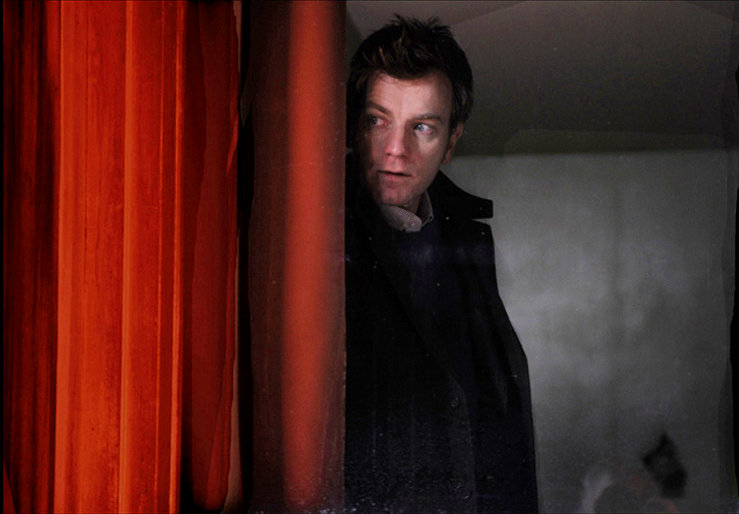
*) A new ghost-writer is hired (Ewan McGregor), and is given access to the top-secret manuscript (and the former PM) only by traveling to the high-security compound owned by the publishers to which Lang and his small staff have retreated to work on the book. The new ghost (he is never named, as he wouldn't be on the book) is de-briefed, patted down, scanned, searched and only then is he allowed to read the draft, which is under lock and key and never to leave its present sequestered location.
To his horror, he finds the book a snoozer—he doesn't like political memoirs, anyway—and he's determined to beat it into some kind of readable shape, given a time-limit of only four weeks.
The compound he's staying at on Martha's Vineyard is a concrete nightmare that looks more suited to one of the villains Brosnan battled in the Bond series—high-tech-gadgeted, and constantly surveilled. The minimal staff includes Lang's assistant from the No. 10 days,
Amelia Bly (a smart, sharp Kim Cattrall), and overseen by Lang's wife Ruth (the wonderful Olivia Williams from Rushmore and An Education). Soon, complications set in and the building goes into crisis mode as it is revealed that Lang, in his dealings with the U.S. on the war on terror, was involved in the kidnapping and torture of terror-suspects, and may be brought up on charges as a war criminal by the International Criminal Court.
Suddenly, the compound is in a state of siege
and that memoir becomes a hot topic: The publisher (Jim Belushi, unrecognizable and nicely brusk) wants the book in two weeks before the headlines get cold, Lang leaves to go on an image-building trip to Washington, the press is bombarding the compound ("the pack is on the move" as Amelia puts it), protesters chant outside the gate, and The Ghost is left there with a few mysteries to unravel. Both he and Lang are nicely metaphored by the compound's gardener trying to keep the dead grass he's just raked into a wheelbarrow on a blustery day.
Leave the exposition at that. But it calls to mind past Polanski films of protagonists walking in the foot-prints of people who have come before, and in danger of losing their own identity to them—not that hard for The Ghost, as he has no identity in the film (
Lang merely calls him "man," because he has no head for names).
There are twists and turns, but where it is enticing is the way Polanski mines the material for suspense and humor. No detail goes unused—not the security, not the weather, not the language, not the technology, not the sound. Small glances through slitted curtains may be significant, as are muffled conversations in the next room, or the insistence by a staff-member to use a car on the island, rather than the bicycle. It COULD be innocent. He really MIGHT be concerned about the weather. But, then again...
Then, again. Along with the paranoia are moments of perverse comedy where The Ghost's stealth make him stick out like a sore thumb, or just makes things more difficult for himself. Aware of his position as a replacement, he soon finds himself retracing his predecessor's steps, having to both live up to the trusted writer's reputation, but also to do right by him to find out what happened.
If he can escape the same fate.
The performer's are uniformly excellent:
McGregor is a perfect protagonist, veering between deer-in-the-headlights and the wily hubris of the Man Who Knows Too Much, Brosnan and his character share a theater background, and the actor allows the arrogance and The Act of being a politician look believable in equal measure. Olivia Williams is by turns steel and rubber in her role, and Cattrall is efficiently perfect—you suspect her immediately. There are also nice turns by Timothy Hutton, Eli Wallach and the ubiquitous Tom Wilkinson, and by Robert Pugh as one of Lang's political rivals.
But it's Polanski's show—he's the Puppet-Master, the audience-conductor like Sir Alfred, and effective enough that you leave the theater with a heightened sense of awareness, looking around corners, at things out-of-place, that the world is a more dangerous place.

And the most deliciously perverse irony is that Polanski had to complete the film in the place that informed the sensibility and interests of the young Hitchcock's film career: a prison cell.
**

* Despite his hard-scrabble up-bringing Brosnan has always been better at playing effete characters. It's why his James Bond was something of a bore—Brosnan seems more suited to knocking someone out with a nerve-pinch than a karate chop.

** "I must have been about four or five years old. My father sent me to the police station with a note. The chief of police read it and locked me in a cell for five or ten minutes, saying "This is what we do to naughty boys." Hitchcock/Truffaut p. 17

Tuesday, November 14, 2023

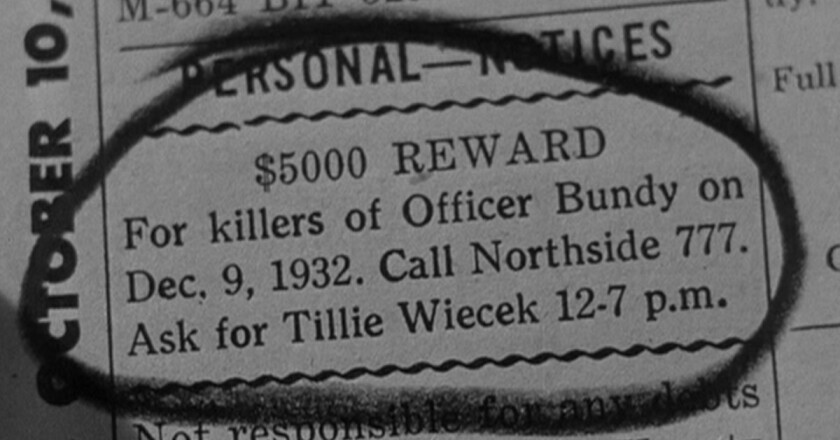
Call Northside 777

Call Northside 777 (Henry Hathaway, 1948) There was a brief period in American films where Hollywood embraced the neo-realist school coming out of Italy—where stories were filmed out in the streets, not in the rarefied atmosphere of a film-studio (It started in Italy because their huge studio, Cinecittá, was being used to house refugees), and it dove-tailed (if one can use so plumy a word) with the gritty post-war world of film-noir and crime-thrillers. Elia Kazan made one, even Hitchcock did.

But the most well-remembered of them was
Call Northside 777 with James Stewart as blasé "Chicago Times" reporter Jim McLane, who, upon taking an assignment he doesn't want, turns it into a cause celebre and his own obsession to see Justice done.
This was one of the first movies
Stewart did after his Air Force service, as he was beginning to challenge and even destroy his callow image audiences were used to at the beginning of his career. Now, with an added maturity he could actually pull off the cynical journalist role he wasn't too convincing as in The Philadelphia Story (which won him a "sympathy" Oscar after losing the previous year for Mr. Smith Goes to Washington the year before) He returned from the war determined to play characters with a darker edge.
Henry Hathaway
directed with a subtle eye, finding interesting deep-focus shots in lackluster surroundings. McLane's first encounter with a scrub-woman washing the stairs of a cathedraled office building carries the visual weight of years of work needed to raise the reward-money to help spring her imprisoned son (Richard Conte). The jailhouse of the visitation scenes IS the jailhouse, and the arrest of Conte's character looks and feels like actual newsreel footage. Finally, you get to go back in time and watch vital clues produced by the old technology of wire-photo transfer. It's another instance where the straight-laced neo-noir style goes a long way in selling the truth of a story, however implausible it might seem.

Wednesday, November 8, 2023

J. Edgar

The F.B.I. (Love) Story
or
"What Determines a Man's Legacy is Sometimes That Which Isn't Seen"

J. Edgar Hoover ruled the Federal Bureau of Investigation for 45 years under the Department of Justice. Over the course of his tenure, he made the FBI his personal weapon in defending the nation from threats as he saw them, even as they changed form—from Bolshevik radicals to hayseed bootleggers and bank robbers to Communists to Civil Rights Activists to his very bosses. He did this unsubtly and unequivocally with press-trumpeted raids and whispered-about secret files that, if it didn't make him (as the phrase goes) "the most powerful man in the country," he was certainly the most feared. It was always assumed that Hoover had "the goods" on everyone, and guaranteed his long-held government post with weapons in manila files.
When he died (in office), Hoover's mug had
the well-known face of a haggard bulldog—keeping secrets is something that can age you rapidly—and keeping secrets is something Hoover did best. Not only those of others, but his own.  Rumors swirled about the nature of his relationship with FBI Associate Director Clyde Tolson—that they were secretly gay lovers rather than "gentleman cops," that Hoover was a cross-dresser, and that the reason Hoover didn't pursue the gangsters of La Cosa Nostra in the '40's and '50's was because of compromising photographs in the hands of Meyer Lansky. Nothing has ever been confirmed. It's all just rumor, the smirking kind that the powerful get (but there's never any proof).


Which is why news of a Hoover bio-pic, written by Dustin Lance Black and directed by Clint Eastwood seemed so intriguing. Eastwood isn't afraid to take chances, turning cliches on their ear and Black's clear-eyed script for Milk garnered an Oscar. Their film J. Edgar promised "red meat," of the kind that could be delightfully and salaciously chewed.
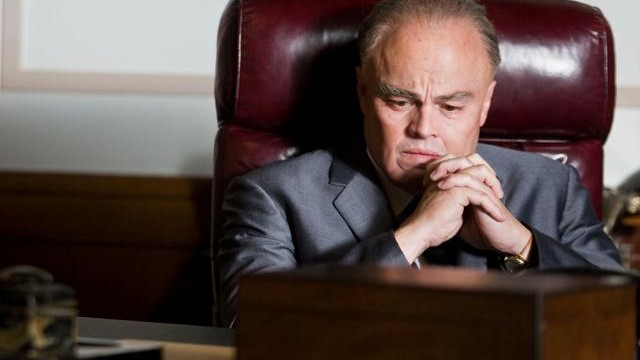
And the two men have taken chances...but not with the result you would think.  Rather than being a rant or skreed, J. Edgar is actually a sympathetic look at the FBI director and his peccadilloes and shortcomings. There's nothing hysterical (save for one fist-fight that breaks out between Leonardo DiCaprio's Hoover and Armie Hammer's Tolson) in script or direction, but it offers a look at a severely closeted man who had to be in the times he lived and with the mantle he carried. Ambitious, yes. Paranoid, certainly. Vain and glory-hunting, without a doubt. Hoover craved the spotlight and his role in being "Head G-Man," while at the same time operating in the shadows, single-mindedly hoarding the secrets of others, while keeping his own is the height of ironies. At the same time that he espoused the Bureau ethic for red-blooded American males as agents, one wonders if it is done for appearances' sake, a beard that would mask his own leanings while also serving as a "hiding-in-plain-sight" revelation of his own taste in men.

Black and Eastwood conduct the story-telling in flashback, as
Hoover in his latter years, decides to set the record straight, dictating his memoirs to an amusingly rotating number of agent-stenographers who disappear as soon as a point is questioned, or a weakness revealed. The story is a white-wash, reflecting the man's "official" view of the Bureau's history in a mix of incident and myth. At many times, J.Edgar is a bit reminiscent of Citizen Kane, with its fracturing point-of-view, shifting perspective, and ironic commentary on some of the incidents.*

It also shares Kane's sense of the unattainable summation of a life. C.F. Kane's had little to do with "Rosebud," just as Hoover's gay leanings was a small part of his whole story. It began with
a controlling mother (Judi Dench), determined to keep young John Edgar from becoming a drunk like his father. Groomed to become "the most powerful man in the country," Mother Hoover controls her son's life to make him the image of the perfect son, diction lessons to force past a stammer, impeccable grooming, and the enforcement of all of her prejudices. And the nullification of any behavior less than manly. He is made in the image of his Mother's "perfect son," even though that image may be completely counter to reality. It sets him on a lifelong course of fighting her battles, never really being his own man, as much as posing in the presentation he wanted to project. A performance. An act. Myth and lies.

It is a story soaked in ironies: the man who kept secrets on everybody, but the biggest being his own; the investigator who saw no harm in exposing other's private lives, while keeping an iron grip on his own; the policeman who targeted and made war on many enemies, the primary one being himself. Black and Eastwood present
a case for sympathy, even empathy, for a man who shaped, and was shaped, by his times, who rose through the ranks of power in society, to not be shunned by it, and who searched for verifiable fact while living in denial, and closeted by the bureau of his own making.

Hoover and Tolson at their regular table at The Stork Club.

* Not to mention that DiCaprio's "old-man" make-up makes him look more like the aged Charles Foster Kane than the jowly Hoover (still, it's better than the never convincing make-up that Hammer sports as an aging Tolson), and the shots of Hoover witnessing the Inaugural parades of Franklin Roosevelt and Richard Nixon are shot from the same angle as the "newsreel" shot of Kane in a balcony appearance with Adolph Hitler.

Tuesday, November 7, 2023

Olde Review: Love and Anarchy

This was part of a series of reviews of the ASUW Film series back in the '70's. I should say, the "1970's". Last century. Except for some punctuation, I haven't changed anything from the way it was presented, giving the kid I was back in the '70's a bit of a break. Any stray thoughts and updates I've included with the inevitable asterisked post-scripts.

In celebration of the shroud of smog that envelops Seattle, the ASUW will continue to show "Thrillers" on Saturday night in 130 Kane and the particular films are Lina Wertmüller's Love and Anarchy, and Bernardo Bertolucci's The Conformist.

Love and Anarchy aka "Film d'amore e d'anarchia, ovvero: stamattina alle 10, in via dei Fiori, nella nota casa di tolleranza..." (Lina Wertmüller, 1974) First of all, I have to say that I approached Lina Wertmuller's film with some wariness. I have a built-in prejudice about movies and directors that are praised to the skies by critics, fawned over by the press and I tend to go to that particular movie with an attitude of "All right....prove it!" That's a terrible way to go see a movie; you should be completely unprejudiced (which a lot of critics aren't). Your mind should be a complete blank (which is easy for a lot of critics). You can't be unprejudiced in any endeavor you try. So...that, for what it's worth, is my apology for not being at all thrilled by Wertmüller's Love and Anarchy to everyone who was.*

On the debit side of the ledger,** Ms. Wertmüller tends to stress very arty-looking shots in her work but at times when the movie isn't really doing anything. When the movie takes a lull in the action, we are given very striking, if obvious compositions. Why? Her dialog is, at times, very unoriginal. Directors should at least come up with new cliches for their characters to spout (and this is a questionable point, as the film is subtitled, so the translations may be a little rough--and again, with both of the Saturday night films, they are subtitled--sometimes invisibly super-imposed over white objects--so go early, as the best place to read them, if you can at all, is on the main floor of 130 Kane). Ms. Wertmüller's portrait of a high-echelon Fascisti is badly caricatured, turning him into an Italian Colonel Klink. Also, easy irony turns me off, as when a light little theme is used to accompany a character's death by bludgeon. Nothing much there to praise.
What there is, is in the performances. Giancarlo Giannini is someone to praise to the skies, a more likable sad-sack I have never seen since Buster Keaton, and there is an immediate identification and sympathy for him when he first appears on the screen. He is a delight, and he keeps the film above water for quite awhile.
Lina Wertmüller is still making films, but the critical parade has moved on. When her
Swept Away... was re-made by Guy Ritchie a few years ago, featuring Mrs. Ritchie in the lead, the film was attacked for her screeching, unpleasant performance, probably forgetting the fact that it was in keeping with the original. Lina Wertmüller was (and is) a challenging film-maker, exploring her themes with a none-too-subtle hand, and making points that polarized film-goers, except for the fawning. Lovers didn't love Love and Anarchy and neither did anarchists--a San Francisco anarchist group picketed and distributed leaflets denouncing the film and Wertmüller during its initial run. Perhaps they didn't know she was making a tragedy. (I wonder if anarchists picket in an orderly manner...or if they just make it up as they go....Hmmm. best not to think too much about that).
The cinema needs movers and shakers like Lina Wertmüller, if only to challenge the complacent. Then again, the complacent probably wouldn't seek out one of her films.
The view from 2023: Lina Wertmüller died December 9, 2021 at the age of 93. She was the first female director to be nominated for an Oscar—in 1976 for her film Seven Beauties. Someone has to be first, even if it is late. And Wertmüller, whose work was seemingly omnipresent in the 1970's, could not be ignored.

Her last film was 2004's Too Much Romance...It's Time for Stuffed Peppers, which starred Sophia Loren and F. Murray Abraham.


* Whatever thoughts one has about Lina Wertmüller or any director, the best policy is to go into any film with an open mind, thereby allowing yourself the luxury of appreciating what is there, without being hampered by predilections towards negativity. One makes one's own reality. If you walk into a movie expecting it to be a bomb because of "X," chances are you will walk out convinced it's a bomb (because of "X"). And in the work of confirming your own opinions by ticking off your personal check-list of dislikes, you will be more than likely to miss something that might change your mind. I don't believe "Once a hack, always a hack." Every film is a learning experience, for creator and viewer. I've seen too many good films by directors I haven't liked, to believe, or trust, in prejudices.

** See what I mean about ticking off a checklist of dislikes?


Sunday, November 5, 2023

Don't Make a Scene: Star Wars

The Story:
Oh, if they only knew...

Part of the charm of the original Star Wars (now known as Episode IV: A New Hope) were the characters and how they were written...not so much the special effects, the sound, and all the other things that made the movie seem so fresh "a long time ago" in 1977.

It was the flinty banter of the hayseed hero, the haughty princess, and the ego-bag smuggler. And it was the way the thing was edited to catch every hint of emotion from its players...who'd done maybe one or two films previously. Creator George Lucas had wanted to make a "space opera" along the lines of the old "Flash Gordon" movie serials (in fact, he tried to get the rights to Flash Gordon but was unsuccessful) and that included dialog of the fast-paced variety that reflected the theatrics of serials, rather than, say, the mumblings of Method actors.

The Luke-Leia-Han triangle dynamic was a sub-text among the whooshing and zapping that made up the larger conflicts of the story. Like everything, it got untangled over the trilogy-story of toppling/exploding the Evil Empire. Luke's impetus for joining the struggle (besides his own desire to quit the moisture-farm and become a pilot) was the flickering image of the Princess pleading for help. For Han, it was a hired job to take an old wizard and his farm-kid to the planet Alderaan, which ended up with the planet in rubble and their ship being captured. Han just wanted to get off the Death-Star, but, Luke, learning the Princess was on-board, roped the Corellian pirate and scrumrat into crashing Leia out of detention, and getting her to safety (they didn't really need to—the plans to the Death Star were down-loaded into one of Luke's work-droids, they just didn't know it yet).
 
Luke wanted to rescue the Princess, but Han and she didn't exactly hit it off right away, bickering like each one was in charge of things. But, Han's character arc was to push him from being a selfish loner (I mean, look at his name!) to a a slightly more noble team-player, so, eventually, the sand-papering scorn and mockery wore down his rough edges. Luke was still beholden to the Princess, so Luke and Han settled into a competitive rivalry over who would get her attention.
 UA Cinema 150
It wouldn't be until a third of the last party of the trilogy that Luke would learn why he was drawn to the Princess—Force-siblings?—which would lead to making the ultimate sacrifice of surrendering himself to the Empire. Han and Leia would begin an affectionate relationship when left-alone in the romantic surroundings of a space-slug's belly. And in all the mishegoss of rescuing each other from some threat or another, the two rivals wound up in a mutual mode of getting out of each other's way for the Princess' hand (even if Luke could have used an extra one).
 
So, it's amusing that, in this round of of the Leia-Han tussle, he keeps calling her "sister". There's no way—NO--WAY—that there's any sort of pre-saging of future events, even if the director says he knew all along (although there's a precedent in The Thief of Bagdad, and Star Wars was "influenced" by a lot of diverse film culture), but George Lucas keeps changing his story...about changing his story.

Still, it's amusing looking at it in retrospective. The scene itself produced a chuckle when I first saw the film the day after its opening day at the late, lamented UA Cinema 150...which went on to play the film...for more than a year.
 
The Set-up: It is a dark time for the galaxy (blah blah blah). Farm-boy Luke Skywalker (Mark Hamill), inspired by ex-Jedi Knight Obi-wan Kenobi (Alec Guinness) has abandoned his home-planet of Tatooine to save Princess Leia Organa (Carrie Fisher) from The Galactic Empire's new battle-station, The Death Star. Having saved the Princess and lost Kenobi in the attempt, they flee the Death Star aboard the Millenium Falcon, piloted by spice-smuggler Han Solo (Harrison Ford) and his wing-manwookie Chewbacca (Peter Mayhew).
 
Action.
 
STAR WARS Episode IV A NEW HOPE 
From the JOURNAL OF THE WHILLS 
by George Lucas 
 Revised Fourth Draft January 15, 1976 
LUCASFILM LTD. 

INT. MILLENNIUM FALCON - COCKPIT 
Han, removes his gloves and smiling, is at the controls of the ship. Chewie moves into the aft section to check the damage. Leia is seated near Han. 
HAN Not a bad bit of rescuing, huh? 
HAN
You know, sometimes I even amaze myself. 
LEIA That doesn't sound too hard. 
LEIA
Besides, they let us go. 
LEIA
It's the only explanation for the ease of our escape. 
HAN Easy... you call that easy? 
LEIA Their They're tracking us! 
HAN Not this ship, sister. 
Frustrated, Leia shakes her head. 
LEIA At least the information in Artoo is still intact. 
HAN What's so important? What's he carrying? 
LEIA The technical readouts of that battle station. I only hope that when the data is analyzed, a weakness can be found. 
LEIA
It's not over yet! 
HAN It is for me, sister! 
HAN
Look, I ain't in this for your revolution, and I'm not in it for you, Princess. 
HAN
I expect to be well paid. I'm in it for the money! 
LEIA  You needn't worry about your reward. If money is all that you love, then that's what you'll receive! 
She angrily turns, 
and as she starts out of the cockpit, passes Luke coming in. 
LEIA Your friend is quite a mercenary. 
LEIA
I wonder if he really cares about anything... or anyone. 
LUKE
I care! 
Luke, shaking his head, sits in the copilot seat. He and Han stare out at the vast blackness of space. 
LUKE
So... 
LUKE
what do you think of her, Han? 
HAN
I'm trying not to, kid! 
LUKE
(under his breath) Good... 
HAN
Still, 
HAN she's got a lot of spirit. 
HAN
I don't know, 
HAN
what do you think? 
HAN
Do you think a princess and a guy like me... 
LUKE
No! 
Luke says it with finality and looks away. 
Han smiles at young Luke's jealousy.

STAR WARS (Episode IV—A NEW HOPE)

Words by George Lucas 

Pictures by Gilbert Taylor and George Lucas

Star Wars: Episode IV—A New Hope is available on DVD (in all sorts of versions) on 20th Century Fox Home Video.