Sunday, July 12, 2020

Don't Make a Scene (Redux): Lincoln

The Story:  "Times like this, I'm best alone" he says on the fade from the White House corridor to the hat.

There's a lot of good writing in Steven Spielberg's version of Lincoln, thanks to a phenomenal script by Tony Kushner, only part of which Spielberg filmed (it still irks me that he lost the Best Original Screenplay Oscar to Quentin Tarantino's messy Django Unchained script, but that's movie politics). Words are important in it, more so than most other screenplays. You're dealing with period language.  You have to go back in time and lose a lot of history and industrial vocabulary. This one and and 2013's 12 Years a Slave had a good ear for arcane language and the expression of it. Good period writing is its own time machine, letting you listen in on the conversations of the past, knowing it is the past, by the carbon-14 of its language, that has not yet been drained of its color, its edge burnished, its vibrancy dimmed, by time and misuse.

Here, the screenplay finds Lincoln in the act of composing a telegram. He's written down what he wants to say, the particulars involving transportation of a delegation from the Southern states to negotiate a peace agreement to the Civil War. But, the details are messy. Lincoln is fighting two fronts, one on the battlefield and one in the legislature. He wants to pass a bill outlawing slavery before the end of the war, in order to have the status of former slaves in place before its end, and that is a slow process in the halls of Congress, where compromise and obstructionist idealism (or what passes for it) keep pushing the realization of it further off. Meanwhile, the war goes on, tirelessly chewing through the nation's populace, doing double damage, because both sides of the fight involve Americans. To delay the peace means more of "us" die. To end the war...now...means only persons of a certain pigment are free.   

What would Lincoln do?

He'll go back to the words. Our sacred texts. And focus on one hyphenate embedded there: "self-evident." As in "we hold these truths to be..." Thomas Jefferson's use of the word harkens back to Euclid's Elements, and the very basis for geometry and all the "given's" that we take for granted in all those proofs. If it works in math, it works for the world, and "equals" means the same: 1=1.  That's a "given." That's "self-evident." Just like "all men are created equal."*  

We're created equal. But that's where it stops. After that, fate, charity and happenstance determines what we are: free man, slave, or property. Governance and economy decides our worth, and unequally. But, if that's true, "a nation conceived in liberty" will be stillborn in the throes of slavery.

1=1. Self-evident.

And so the war goes on while men and women are slaves. He'll amend that telegram to delay the peace negotiators until men and women are not, and it is safe to end the war...for all Americans.

Or all of them that are left.

He touches the shoulders of his two adjutants...and leaves, after those dictated words...so paltry and so innocent, but with the deadliest of intent ...frees some and kills others. But that's the thing about war.

You don't win it. Never completely. Not if you do the math.

The Set-Up: Abraham Lincoln (Daniel Day-Lewis) is this close to passing the Thirteenth Amendment abolishing slavery in the House of Representatives. But petty squabbling in the House and his own Cabinet is keeping that from being accomplished. Most House Republicans, especially the fiery abolitionists led by Thaddeus Stevens (Tommy Lee Jones) will water down their positions in order for it to pass, but the Democratic minority will not budge, especially if it can bring a speedy end to the Civil War by negotiating a settlement, and abolishing slavery would make that negotiation dead before starting. A secret negotiating team is heading for Washington now, and Lincoln does not want that knowledge watering down the urgency for abolition. Before dawn, he goes to the war-room telegraph office to send an urgent message to his Union commander, Ulysses S. Grant. He has one more tactic that he can pull...as he ever does...from his hat.

Action!

INT. THE TELEGRAPH ROOM, WAR DEPARTMENT - PRE-DAWN
Lincoln is seated at Eckert's desk, shawl wrapped around his shoulders, glasses on; he stares down into his hat, held between his knees. Homer Bates and Sam Beckwith are waiting for him. Lincoln draws a handwritten note from his hat and carefully unfolds it. 
LINCOLN "Lieutenant General Ulysses S. Grant, City Point. I have read your words with interest."
Sam Beckwith transcribes Lincoln's words into code on a pad with a pencil. 
LINCOLN (CONT'D) "I ask that, regardless of any action I take in the matter of the visit of the Richmond commissioners, you maintain among your troops military preparedness for battle, as you have done until now." 
He stops for a moment. Beckwith waits, pencil poised. Lincoln looks at the note, folds it, tucks it in a band inside his hat.
LINCOLN (CONT'D) "Have Captain Saunders convey the commissioners to me here in Washington." 
(ANOTHER PAUSE) 

LINCOLN "A. Lincoln." 
LINCOLN And the date. 
SAMUEL BECKWITH (WHILE WRITING:) Yes sir. 
Lincoln places the hat on the floor. 
SAMUEL BECKWITH (CONT'D) Shall I transmit, sir? 
LINCOLN (a beat, then:) You think we choose to be born?
SAMUEL BECKWITH I don't suppose so. 
LINCOLN Are we fitted to the times we're... 
LINCOLN ...born into? 
SAMUEL BECKWITH I don't know about myself.
SAMUEL BECKWITH You may be, sir. Fitted. 
LINCOLN (TO HOMER:) What do you reckon? 
HOMER BATES I'm an engineer. 
HOMER BATES I reckon there's... 
HOMER BATES ... machinery but no one's done the fitting. 
LINCOLN You're an engineer, you must know Euclid's axioms and common notions. 
HOMER BATES I must've in school, but... 
LINCOLN I never had much of schooling, but I read Euclid, in an old book I borrowed. 
LINCOLN Little enough ever found its way in here - (touching his cranium) - but once learnt it stayed learnt. 

LINCOLN Euclid's first common notion is this: "Things which are equal to the same thing are equal to each other." 
Homer doesn't get it; neither does Sam. 
LINCOLN (CONT'D) That's a rule of mathematical reasoning. It's true because it works; has done and always will do. 
LINCOLN In his book, Euclid says this is "self-evident." 

(A BEAT) 
LINCOLN  D'you see? There it is, even in that two-thousand year old book of mechanical law:...
LINCOLN ...it is a self-evident truth that things which are equal to the same thing are equal to each other.
LINCOLN  We begin with equality. That's the origin, isn't it? That balance, that's fairness, 
LINCOLN  ...that's justice. 
He looks at his scribbled note, then at Sam and Homer.
LINCOLN (CONT'D) Read me the last sentence of my telegram. 
SAMUEL BECKWITH "Have Captain Saunders convey the commissioners to me here in Washington." 
LINCOLN A slight emendation, Sam, if you would. 
Beckwith writes as Lincoln dictates. 
LINCOLN (CONT'D) "Have Captain Saunders convey the gentlemen aboard the River Queen..."
LINCOLN "... as far as Hampton Roads, Virginia," 
LINCOLN "...and there wait until..." 

(BEAT) 
LINCOLN "...further advice from me." 
LINCOLN "Do not proceed to Washington."

Lincoln

Words by Tony Kushner

Pictures by Janusz Kaminski and Steven Spielberg

Lincoln is available on DVD and Blue Ray from Touchstone Home Video.

 
* I believe that when Jefferson wrote that line into the 1776 Declaration, he was making the rhetorical point that people have the right to choose their government and not have policy dictated merely because of family ties—whether your name was Tudor or Plantagenet or York or Lancaster or Stuart...or Windsor. Just because you're born into a "house" doesn't make you capable or deserving of leading a nation of individuals, as in the British system.  George III was the King of England at the time and ruler in absentia of the British colonies in North America. That was 1776 and the issue was a nation's self-determination.

But, the vibrancy of those words in that declaration and the Constitution it inspired have come to be accepted as "everybody starts out equal; their rights should be equal, too." It is the logical extension of those simple words. And so it should be.

Saturday, July 11, 2020

City of Fear (1959)

Saturday is "Take Out the Radioactive Trash" Day.

City of Fear (Irving Lerner, 1959) An ambulance containing two escaped San Quentin convicts careers down a back-road to Los Angeles. Both men are (described in a radio bulletin) "desperate and considered extremely dangerous."

They're half-right: one of them is dead, wounded in the break-out that left one guard dead, one wounded, and the prison doctor in his own hospital. The survivor, Vince Ryker (Vince Edwards) matches the psychological description, anyway. He's desperate, but he's also got big plans once he hits L.A. He's got a steal container which he snatched from the prison medical facility. He thinks he's got a full pound of heroin with him. It's going to guarantee him a big score and an easy life. He pulls over a passing motorist, takes his car, but not before disposing of his dead pal, the unfortunate driver, and the ambulance by torching them and leaving them off to the side of the road. The bodies are starting to pile up.
But, they're potentially just the beginning. What Vince is actually carrying is a pound of cobalt-60. And as the "radiological coordinator" of the Air Pollution Control district (played by one of the screenwriters Steven Ritch) it's a bad radioactive thing "easily dissipated and spread. In a granular form, it's the most deadly thing in existence. Contamination begins almost immediately. Within 84 hours, you're dead." 

If you're going to have a McGuffin, make it a big one.
Lyle Talbot and John Archer play city officials who decide to keep the threat under wraps (in order to avoid a panic) while scouring the city (with geiger counters) for Ryker and any of his cronies before any of the stuff gets released into the water supply or worse. Meanwhile, Ryker reaches out to his girlfriend (Patricia Blair) and pals in the drug trade to set up a deal.

Trouble is, he can't get the cylinder open to look at the stash which he's convinced will net him a million dollars. It's a race against time for both parties as everyone who comes in contact with Ryker and his radioactive nest-egg starts getting sicker...but, without the canister, the city will never be safe. Face masks and social distancing are not going to help.
It's a tight little film noir, bouncing back and forth between the clueless hoodlums and the complicit authorities while the city just goes about its business without a clue that there's any danger. You'd think there might be some heat generated from the thing sitting in Ryker's pocket, but, if so, nothing is made of it.

The film is helped by some wonderfully pulpy cinematography by Lucien Ballard, some clever editing sleight of hand by Robert Lawrence, and an itchy, early score by Jerry Goldsmith, which can be summed up as "primitive." It's all a little primitive, in the same sort of modern quagmire as Kazan's Panic in the Streets, but with the added complication that the police aren't asking the public for help—they're avoiding the issue altogether and keeping it under wraps.

If that isn't noir...and reflective of our current world...nothing is.

Seconds

Seconds (John Frankenheimer, 1966) Post "Star Wars," science fiction films have been pretty cookie-cutter—fleet-ships, a Hero with a Thousand Names, odd plasticized bi-ped creatures in supporting roles and quests that somehow or other usually get around to revenge. Even the "new" can become old hat.

Science Fiction used to be about concepts, and technology was just an aspect of futurism. For all the newly-conceptualized metal and plastic and wires and blinking lights, it is the organic that has to contend with the changes and evolution just can't keep up with the advancement of tools (especially when they're eventually turned into weapons). Who or what is being served? How does one adjust...if one adjusts? That's why to see Seconds is still a thrilling experience, as it calls to mind a feature-length, subtler "Twilight Zone" episode, that takes an idea and turns it around in its hand, exploring the angles...and the consequences.*
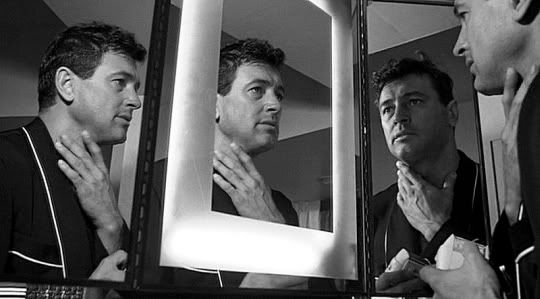
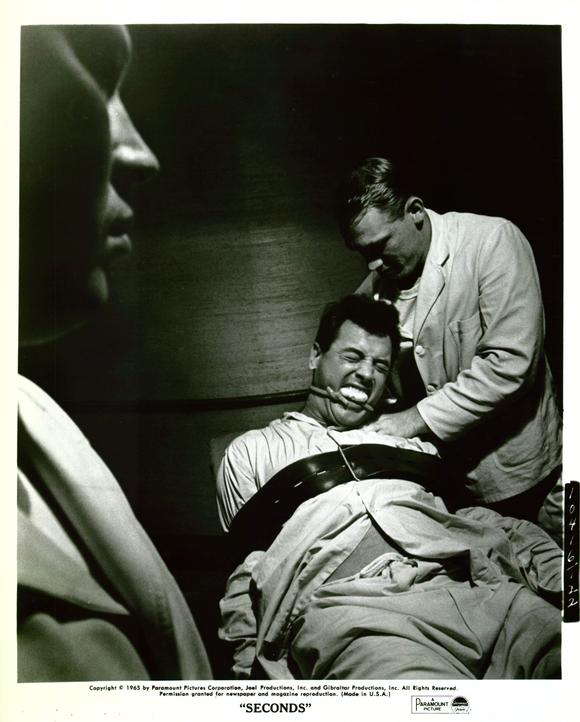
Bank executive Arthur Hamilton (John Randolph) is receiving mysterious phone-calls from someone who claims to be an old friend but doesn't sound like him. A note is slipped into his hand as he enters the subway, and upon further exploration (and prompting) learns that he is being offered a second chance in life. The anonymous corporation will transform him with plastic surgery (even replacing his finger-prints) and an exercise regimen, while setting up a planned "accident" with an unrecognizable "similar body-type" to explain his absence. To the world, he will die, but he'll be resurrected as a new man, with a new life, in a new community—everything re-arranged neatly and clinicallyFrom the ashes of Arthur Hamilton will emerge Hamilton 2.0, Antiochus Wilson (Rock Hudson), bohemian painter. "Wilson" makes a go of his second chance, but he's still the man he used to be inside, and he struggles internally with his new choices...and the ones he left behind. Changing his mind becomes the greatest challenge.
Filmed in black and white—this film would have been over-powering and kinda ugly in color—by the master cinematographer James Wong Howe (with assistance by John A. Alonzo), Seconds is filmed in disorienting tight close-ups, and with unnerving wide-angle lenses that contort, bend and mold the right-angles of life into constricting prisons. The helter-skelter editing of David Newhouse and Ferris Webster keeps the viewer from becoming complacent, and Jerry Goldsmith's bizarre discomfiting score only adds to the unease. This is Hudson's best role—if you're like me and aren't into rom-com's—and his best movie. But it's contradictorily a one-sided performance—there's not an awful lot of joy (I think that may be the point), and he's unsure, disoriented or drunk throughout most of it. And, as Frankenheimer says in his commentary, he really worked hard in this role...especially towards the end.
One should also be aware that in one scene in the corporation's stark "briefing room," the cast is comprised of Randolph, Will Geer (he's especially creepy in this role, while being his most benevolent) and Jeff Corey—all "brethren" in the secret society of blacklisted actors.
This version of Seconds is not the one released in the States in 1966. A disorienting wine-making festival sequence with pre-hippie free-thinkers orgiastically stomping grapes in the buff was deemed too risque for its release (and Hudson wasn't comfortable with the sequence, as is evident in his performance), but it has been restored for the DVD release.

It's still an affecting film, even now, over 40 years later, a cautionary time-capsule of that era when the concerns of the speculative writer was society and not space-ships. Sometimes, fantasies have a nasty habit of becoming nightmares.

Saul Bass' disorienting Title Sequence gets you in the mood.
* Director Frankenheimer worked in the Golden Age of Live Television and worked with Rod Serling, pre-TZ, and post-TZ—Serling wrote the script for Frankenheimer's Seven Days in May.

Thursday, July 9, 2020

All Night Long (1962)

All Night Long (Basil Dearden, 1962) I've been watching a lot of Basil Dearden movies lately—the only ones already on the site, reviewed, are Khartoum and a horror anthology he'd participated early on in his career, Dead of Night—and they're pulpy but intelligently produced with an underlying social concern, interestingly framed, and with a sometimes perverse energy designed to take the audience slightly to the edge of their seats. They're at least designed to produce a nervous tick in the leg.

All Night Long, though, is more designed to keep a steady beat of foot-tapping, based as it is in the jazz idiom. In fact, for aficionado's, it's a bit of a must-see for performances by some "legends" (a much used word, but actually appropriate here), such as Charles Mingus (he gets lines to say!—"Hi, thanks for inviting me!"), Dave Brubeck, John Scott, John Dankworth, Tubby Hayes, Bert Courtley and Keith Christie. That's a great joy to the film, but I imagine it's frustrating for the very people who would want to see this for that purpose because it has a story and actors who distract from the performances and from the music for whole minutes at a time (I imagine that the first frenetic Beatles fans were frustrated with A Hard Day's Night for that same reason). On the other hand, for those folks into narrative in their films, they might be stymied by the story being stopped dead by performance drops. These people have never heard of or seen musicals.
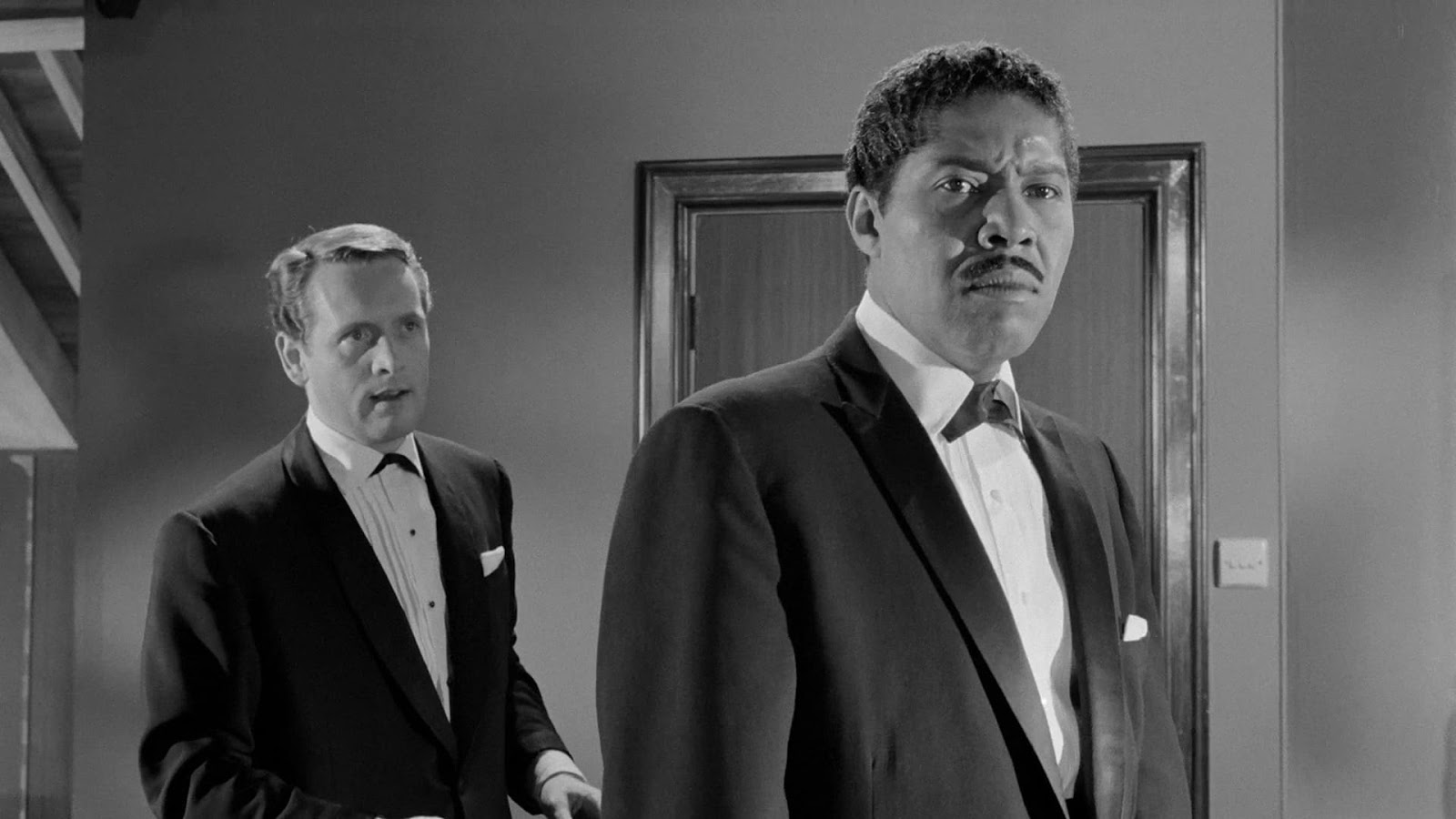
The story is basically the story of Othello brought up to a jazz-beat (a bit uncomfortably) and a jazz-idiom. Entrepreneur and impresario Rod Hamilton (Richard Attenborough) goes to his club where he has prepared a very special night—a party celebrating the first anniversary of jazz King and Queen Aurelius Rex (Paul Harris) and wife Delia Lane (Marti Stevens), jazz pianist and songstress (retired), respectively. Guests are band-mates, acquaintances, and some notables in the industry and Hamilton has designed it to be a night of celebration and song for the happy couple. He should have checked the guest-list.
Brubeck and Scott and Dankworth are fine, of course—they're providing music. But along with Aurelius' inner-circle of Cass Michaels (Keith Michell) and his girl Benny (Maria Velasco), there is also drummer Johnny Cousin (Patrick McGoohan) and his wife, Emily (Betsy Blair). Cass is Aurelius' manager and completely loyal to him and a confidante to Delia. That relationship will become critical to the machinations of Cousin, who has been promised a side-deal for his own band by another manager, but only if he can persuade Delia to come out of retirement and join his band as vocalist. If he is to have any chance at success, he must drive a wedge into the happy marriage between Aurelius and Delia before she could even entertain fronting his group. And for that, he works on Cass.
He needs in-for-ma-tion. So, he invites Aurelius' manager to a private meeting on an outside landing and cozies up to Cass (who's been clean and on the straight and narrow for years and a dependable business partner) and plies him with some reefer, relaxing Cass enough to give Johnny inside intel on any weaknesses in the Rex-Lane marriage, which is (for him) disappointingly stable. But, he knows that Cass and Delia are close, so he devises a plan to make Aurelius suspect that the two are actually closer than her husband suspects. So, Johnny does a solo performance with everybody at the party, sewing doubts and intrigues and creating tensions where there are none.
It becomes apparent that Johnny Cousin is Shakespeare's Iago (and Cass is Cassio, which is not much of a name-stretch). But, where the bard's version goes through the play without any rationalization or motive for his actions (other than "I hate the Moor"), Johnny is totally and completely about getting his "gig" and, if a little chicanery and a marriage-split will advance it, then so be it. Suspicions are communicated between parties (at the party), but that can only go so far. And Johnny has a technological ally for fabricating proof.
Hamilton is a huge jazz fan, and part of his plans are to record a couple of sessions using a tape recorder (an EMI TR90 for you gear-heads), which Johnny uses to make recordings of some conversation. With that, he can take desired bits of conversation, and record his own voice for insinuating connections between the juicy bits to make it all seem like there's an affair going on between Delia and Cass to inflame Aurelius' jealousy. Anybody who's tinkered with tape will know that such an operation takes split-second timing (lest you erase the original) and you've got to have a stop-watch handy to be able to do it without editing—and in those days, you'd need a razor blade and tape, which is pretty obvious evidence of tampering. But, Johnny must be very good because his evidence doesn't even contain any electronic evidence that a tape has been started or stopped.
Technical quibbles aside, his gambit works—at least for a little while—and there is a real danger that he might get away with it, but not with the results he might want (this is based on "Othello," after all). There will be distrust and dust-up's, enough to ruin any high-class party, and certainly enough to interrupt any of the jazz interludes that pop up for the aficionado's. 
It is a thrill to watch Mingus and Brubeck jam in one of the pieces, particularly to watch the effortless fingering on strings and keyboard. That comes early on in the film, but there's enough good material throughout to keep folks who just came for the music to enjoy. And stick around: McGoohan learned to play drums for the film and he has a frenetic solo towards the end that looks damned convincing, even if—as I suspect—he's just playing to a tracked music piece. He's an intense actor—around this time, he was right in the middle of doing the "Danger Man" series (it played in the U.S. as "Secret Agent" with a Johnny Rivers title song)—and the same intensity is born out in that solo.
This came out in 1962—1963 in America—and at that time, what was called "mixed marriages" were illegal in one-third of the States. It was an issue here and might have had a hand in the film's limited distribution and it's somewhat rare availability. It is refreshingly not an issue in this British-based film where nothing—absolutely nothing—is made of it. It's not even mentioned, other than the marriage is one for celebration...and strong enough not to be rent asunder by the conniving of an ambitious narcissist. 
Another aspect that might have been controversial in the States is the on-camera portrayal of marijuana use. Even though the Hayes Code was dying of purposeful neglect during this period of film-making, drug use and distribution was prohibited under its strictures. Come to think of it, so was "mixed race" relationships. Something to consider while you're "bogarting" and considering the ash-bin of History and how time inevitably leaves prejudice there.
For whatever reason you come to it, for the music, or for the Shakespeare link, or you're a McGoohan fan/completist (or Attenborough...or Betsy Blair...or whoever), or if you're looking at the films when Dearden was telegraphing social messages and conspicuously pushing the barriers of what got on film—as Preminger was trying to do in the States—you come away with respect for this little doorway in the alleyway of film-noir sticking its neck out that although the world can be a nasty place, it's lit by the idea that the important things are devotion. And trust. 

And all that jazz.


Wednesday, July 8, 2020

Into the Wild

In a time when the toppling of statues and monuments have been making the news, one may have missed your attention. Officials have removed the "Into the Wild" bus from its position in Denali National Forest in Alaska. The bus, where the body of adventurer Chris McCandless was discovered, has been a macabre destination for tourists and fans of the Jon Krakauer book and Sean Penn film made from it. But, many came ill-prepared. Many rescue operations had to be dispatched, and there were some deaths. And so, authorities flew in on one last rescue mission to end all rescue missions and end the possibility of any more tragedies that might echo that first one. 
Here's the review of that film, written at the time of its release.


Finding Oneself and Getting Lost

There is a pleasure in the pathless wood,
There is a rapture on the lonely shore,
There is society, where none intrudes,
By the deep sea, and music in its roar:
I love not man the less, but Nature more,
From these our interviews, in which I steal
From all I may be, or have been before,
To mingle with the Universe, and feel
What I can ne'er express, yet cannot all conceal.

Lord Byron

The films of Sean Penn's directorial career have all carried the underlying theme of obsession. But until now, he has always shown the dark side of it—The Indian RunnerThe Crossing GuardThe Pledge (the latter two focusing on revenge, of sorts)—the Need to get even, to balance the books, to set the world and Nature right. But with his Oscar-winning role in Clint Eastwood's Mystic River, he seems to have cauterized that need from his system. His new film, Into the Wild, is just as obsessive but presents more of a spiritual quest. Nature is already balanced. Now one must become a part of it. Based on Jon Krakauer's book (which is expanded from his articles on "Outside Online"—originally called "Death of an Innocent" and not available on the site at this time), it dogs the footsteps of Christopher McCandless, who upon graduating from college, disappeared on a journey across the country and eventually to Alaska, where he tried to live off the land, and his body was found by moose hunters in an abandoned bus. If he wanted to become one with Nature, he achieved it. But there's no great trick doing that. As so often happens, the destination isn't as important as the journey.
Penn (who also wrote the complex screenplay) presents McCandless' Odyssey as a rite of passage, literally divided into chapters, starting with his shedding of everything tying him to a middle-class life like his parents (played cold and shrill, by, respectively, Willian Hurt and Marcia Gay Harden), and simply disappearing, leaving no trace, and ensuring that he would have at least a couple months head-start before anyone knew he'd left. These chapters serve as flash-backs of a sort (given the opening of the film, the whole thing could be a flash-back) to McCandless' day-to-day life living in the abandoned bus/hunting drop that would unwittingly be his last stand. 
The narrative is punctuated by McCandless' writings in dreamy, floaty script, and a journal-like view from home from the perspective of his sister (played by Jena Malone). Each chapter begins with an extended montage played over songs by Eddie Vedder (which sounds like it could be horrendous, but Vedder's introspective lowing is the perfect counter-point to the images and one begins to look forward to the transitions). The results are never less than hopeful while never losing sight of the hardships along the way, the lessons learned and the experiences along the way.
Or the people. Along the way in the form of jobs worked, beds crashed, and meals shared, McCandless (who travels by the name of "Alexander Supertamp") encounters reflections of his parents and free spirits who push him to abandon his mental baggage, that, instead of establishing lasting ties, only steels his determination to complete his trek to Alaska. Here the movies shines with wonderful performances by Catherine Keener, Vince Vaughn (who's great), Hal Holbrook (who is heart-breakingly good-he should be recognized for this) and some folks that Penn just found on location (including a guy named Brian Dierker, who runs a ski shop in Flagstaff, Arizona--first movie--endearing performance). 
And its here that if the movie has a weakness, it is that Everybody Loves Chris, wanting him to settle, and by having that be the sole reaction, one's manipulation-shield is engaged, wondering if Penn is stacking the deck, making his McCandless not merely charismatic, but near-messianic. Counter that with the fact that these people are road-blocks to his purposes, while being necessary way-stops on the journey, and those quibbling mountains become mole-hills.* 
I suppose one could have done more to balance his character (for example, including the opinions of the native Alaskans who thought him merely "stupid"), but short of showing him rolling a drunk, I'm not sure that such a pruning would be all that worthwhile. His encounters are already showing the roads not taken, it is THIS path that is the subject of the film. Anything else would be a detour.
I didn't want this film to end, frankly. It's truly exciting to see a director use a kaleidoscope of techniques to tell a story that celebrates life.

Even if it ends in death.

* I wrote this entire review without mentioning the amazing work of Emile Hirsch as McCandless--the guy's in the ENTIRE movie, and if McCandless is too much of a good thing, it's because Hirsch's performance is so constantly winning, and focused. You're compelled to keep watching this kid, and fear that his next step will be wrong. It's an involving, remarkable performance. While Penn's work is astonishing, he has the best co-conspirator in Emile Hirsch. His next role? He's playing "Speed" Racer. Sure, he looks just like him, but...I mean, c'mon, man. AAAAUGH!

Tuesday, July 7, 2020

Wings of Hope

Wings of Hope (Werner Herzog, 2000) The most extraordinary things happen by accident. I watched this rather amazing documentary due to a Facebook post that was culled from one of those "Weird History" click-bait things that pop up and disappear like mushrooms in our digital forest. The accompanying picture of that article showing a somewhat immaculately dressed young woman wading through what appeared to be a swamp may have come from an exploitive 1974 Italian movie based on the incident (Miracles Still Happen, 1974—I watched it and you can skip it), but other than that, the story is absolutely true.

Absolutely, weirdly, almost unbelievably true.

Skipping details, it is about a 17 year old girl, Juliane Koepcke, who was on a Christmas Eve 1971 flight that was repeatedly struck by lightning over the Andes, the plane broke apart, and she was sent hurtling out of the plane, strapped to her seat, fell 3000 feet into the Amazon rain-forest, survived the impact, and for 10 days made her way to an encampment where she was found the next day by fishermen, who started the process of getting her back to "civilization." She was the only survivor.
Parse out that paragraph and any of those things brings up a myriad of questions that all begin with "How...?" When you delve into the history and the details, you might assume (as I did) that she was the perfect person to be able to survive such an ordeal and her chance survival from the catastrophic plane mishap was simple luck and a fortuitous series of happenstances. 
So, how does director Werner Herzog fit into all this? Why would he make a film about it? The reasons—as usual—are personal. Herzog was supposed to be on that doomed plane. Scouting locations for Aguirre, the Wrath of God, a last-minute change in the plane's itinerary cancelled Herzog's reservation. His narrow escape haunted him for decades, and was understandably fascinated by Koepcke's survival. He sought her out with the idea of going back to the crash-site (not necessarily a cruel thing as she had been back a few times) and telling her story in the areas in which they occurred. Koepcke, who had been avoiding publicity and media contact for years—Herzog doesn't reveal her married name in the film—thought this would be therapeutic and agreed, accompanied by her husband. Koepcke is very transparent about her experiences, expressing jitters to be sitting in the same designated row and seat on the flight out, but once in the jungle, she's in her element—"the casual way she dealt with mosquitoes and other vermin was the first thing that struck us about Juliane" says Herzog in his narration—and her commentary reveals her jungle-upbringing and studious approach to discoveries, calm and curious and sympathetic to make the story as relatable as possible, but with no sense that anything done at the time was remarkable, merely necessary. She is the perfect field-guide. 
In fact, she and Herzog are so matter-of-fact in their approach that one becomes accustomed to the extraordinary. Floating down the Amazon? It's the best approach to civilization and not disturbing wildlife. But the crocodiles and piranhas? Not a danger, especially when floating calmly down the river. And unlike that Italian movie (which Koepcke amusingly mocks in the film) or any other presentation I've seen, it is refreshingly free of histrionics and pumped-up-doco drama (as if it were necessary) for a story that even "Dateline" would reject as being too fantastic. A lot of that is helped by Herzog's customary dead-pan narration which tamps down the drama while still being mordant (a commenter on YouTube opines that "Herzog could make a film about a Swiss chocolate factory...and make it seem macabre").

It's a fascinating story, as studiously told as could be in the documentary, making an unfathomable story seem comprehensible and that, in a chaotic world, miracles still happen (uff, that movie)...but only if one is prepared and capable of taking advantage of it, however it occurs.    

Wings of Hope is available for viewing on YouTube (as is Miracles Still Happen)
...at least for a little while (don't be surprised if the link dies).