Friday, June 2, 2017

Alien: Covenant

The Horrifying Hybrid
or
I think I was trying to suggest something about the duality of man, sir.
The what?
The duality of man. The Jungian thing, sir.
Whose side are you on, son?

Ridley Scott is a really frustrating director (for me, one should reiterate). He is a master of the image. Think of a movie of his and some image will pop into your mind that is so beyond the norm of what has gone before that it takes your breath away. Below are a bunch of screen-captures of various Scott movies.* None of them have movie-star's faces in them, they're scattered throughout Scott's filmography (and thus, were achieved either photo-chemically or by CGI and, amazingly, it doesn't make a difference), but if you've seen these films, you can identify which of Scott's films they are from, just from the indelibility of the image. 

Take a look:
Beautiful. Amazingly composed, with a painterly color pallette, and exquisite in its detail. Artistic.

It's just too bad some of them are really bad movies. Gorgeous, sure. But bad.

And you're never sure what you're going to get with a Ridley Scott movie; it might be beautiful to look at, but also completely lunk-headed, insufferable, or botched, whether by studio interference (Blade Runner and Legend) or by Scott's way of over- or under-thinking his movies, so that he forgets what they're actually about in the process. It's why Ridley Scott is a well-regarded director, but he's not in the pantheon of innovators or "great" directors. He may make great looking art, but is not considered an artist pushing the art-form forward, sort of a Thomas Kincade of directors.

So, here's Alien: Covenant, Scott's second sequel to his 1979 Alien, his sequel (of a sorts) to 2012's Prometheus, and a return to form of what the series is—not speculative fiction as Prometheus lurched towards, but back to horror, as in the original.**  
After a brief scene between the android David (Michael Fassbender again) and his manufacturer's CEO Peter Weyland (Guy Pearce again) where they discuss "the big question" (where do we come from?), we jump forward in time (past Prometheus, time-wise, by ten years, to 2104) to the good ship Covenant, a colony spaceship tasked with establishing an outpost on a distant planet that has been surveyed from Earth, Origae-6. The ship is tended by its onboard computer, "Mother" and a lone android, Walter (Michael Fassbender...again), who oversees the automated systems*** keeping the cryo-sleeping crew and colonists, as well as a couple thousand embryo's to, I don't know, "seed" the planet (first thing they need to build on this planet is an orphanage!).
The crew of The Covenant: don't get too attached to any of them...
The ship is damaged in an ion storm (caused, presumably, by the meteor shower that damaged the Avalon from Passengers, six months earlier)**** which wakes up the crew before their appointed time. The captain of the vessel, Branson (an unbilled and only briefly seen James Franco) is killed in the resuscitation, leaving the ill-prepared First Mate Oram (Billy Crudup) as captain, and Branson's widow, terraforming expert Daniels (Katherine Waterston) grieving and alone. After making repairs to the ship, the pilot Tennessee (Danny McBride*****) receives a weird ghostly transmission in his helmet communicator that interferes with him getting back to the ship. Analysis of the signal shows it coming from a relatively nearby planet with Earth-like conditions. In a weird moment of "the-only-reason-to-do-this-is-to-keep-the-movie-going," the usually careful captain decides to check it out, rather than continue on the prescribed mission to the original destination.
Once in orbit, a landing party descends to the surface and they find an idyllic, if dramatic landscape of flora, but no fauna. Daniels remarks that there is no sound—no birds, no animals, nothing. To any rational person that would make one think that maybe, because they're the only life detectable on the planet, they should maybe get those thrusters warmed up and get out of there, but, no.
Recently, I heard some wag say that it doesn't matter what the first thing you say is important, but it will get really interesting if the second thing you say is  "...and then people began to die." Well, after some exploration of the planet and tromping around as humans do so delicately, that's exactly what happens—people begin to die. And they die in spectacular fashion, hatching those critters that we've come to expect. And then, because it needs to, their lander blows up.
So, after everybody's trapped on the surface with a couple rampaging beasties skittering through the high grass and their communication cut off from the main ship, they're rescued by a familiar face—it's the android David, who's been living on the planet for ten years after the crashing of the ship from Prometheus carrying him and Dr. Elizabeth Shaw (Noomi Rapace) in their quest to find the planet of the Engineers, whose little weapons experiment facility they found in the previous movie. David takes them to his hideout, while they figure out how to contact the Covenant and get out of there.
Really, that's all you need to know if you want a spoiler-free review, but, any viewing of the previous Alien films tells you exactly what will probably happen. It's familiar killing grounds in Alien: Covenant, it's just the way that they occur that makes them unique. Then, there's the added wrinkle that we have two androids in the series, David and Walter (Fassbenders, both) who are interacting with each other: David, with his Lawrence of Arabia fetish and genteel British accent and perverse curiosity, and Walter, whose accent is very American and is a bit of a neophyte...for an android, that is.
So, expect a lot of the expected in Alien: Covenant. That Scott abandoned the "Paradise Lost" project (albeit mentioning events briefly in flashback) and went back to "formula" is a bit of a disappointment. That he has made a hybrid film, borrowing liberally from the James Cameron episode and from his own Blade Runner (even to the admiration, even preference, that he showed for the synthetics rather than the humans involved) is also a bit of a downer, calling back elements from those films rather than offering something more challenging to the audience. One wishes there were some hope for the series going on (Scott is saying that he'll make two, no, three more sequels before we get to the original's time-line), but, really, there's no place for the series to go except to endlessly re-generate the same scenario in a nihilistic fashion.
That leaves me rather bugged.


* They are (in order): Alien (1979), The Counselor (2013), Legend (1985), Black Rain (1989), The Duellists (1977), Gladiator (2000), Blade Runner (1982), Thelma & Louise (1991), White Squall (1996), The Duellists, Prometheus (2012), 1492: Conquest of Paradise (1992), Gladiator, The Martian (2015), Blade Runner, The Duellists, Black Rain, Thelma & Louise, Legend, Gladiator.

** Scott originally wanted this to be a direct sequel to Prometheus, entitled "Alien: Paradise Lost", but when Prometheus proved divisive among the populace, he chucked that notion, handling the plot components in flash-backs (and internet-only sneak-peeks), and went with something a bit more like the original. Why Scott came back to Alien is a question in itself. The man's 80 years old now and perhaps he tired of working on things like The Counselor and Exodus: Gods and Kings that flop at the box-office and went the George Lucas route of going with "what works."

*** There would appear to be gravity and life-support on a ship where everybody human is in cryo-sleep, presumably to protect the very resources that are being squandered on one non-breathing android. Why?

**** And that wouldn't be as far-fetched a coincidence as some of the ones in the Alien series where the tag-line should be "In space, everybody runs into each other..."

***** I have to confess: while one shouldn't walk into movies with prior expectations, I was really looking forward to a scene where Danny McBride gets offed by one of the xenomorphs—I rarely have seen McBride in anything where I found him with an ounce of talent or charm, he's one of those few actors I actively don't like. But, here, he's terrific, taking an under-written part and bringing a lot of good choices and subtle nuances to the role. I'm now a fan.

Thursday, June 1, 2017

Prometheus

Going to Meet Your Maker 
or 
"Eloi, Eloi, lema sabachthani?"*

Every time I see a poor copy of a good idea become the latest pop darling out there, I get the inevitable useless reply from someone who takes it personally: "There aren't any original ideas anymore! Just because it's been done before doesn't make it bad!" (And it certainly doesn't make it "good!") It's missing my point. I don't care that it's been done before (and I'll identify where if anybody wants to look it up), what I care about is that it isn't done as well. Jean-Luc Godard said "It doesn't matter where you take things from, it matters where you take things to."  

Succinct and right on.

So, now, Prometheus—Ridley Scott's return to SCI-FI, and the world he created in Alien. If one goes in seeking another "Alien" movie, one might come out a little disappointed. Oh, there are chases with disoriented POV's, conflicted crews and amoral androids, "hair-in-the-drain" icky effects, H.R. Giger designs, shocks and revelations, but this isn't Alien.
It's better, richer, and more thought-provoking...while still being a rather nifty action-horror-science-fiction hybrid. It must be a hybrid, as Scott (and screenwriters Jon Spaihts of The Darkest Hour and "Lost"'s Damon Lindelhof) have stolen just about every science-fiction idea in the Universe.  

But, again, where they take it is original in its implications. SCI-FI always asks "What if...?" This one goes one question further in the interrogation and asks "But why?" Yes, it's a monster movie, but like so many of those, God plays a role. 
There's a significant amount of religion in this film, and speculation about God and our origins, but it still manages to find room for Faith in settings that remind one of Hell.
Dr. Elizabeth Shaw (Noomi Rapace, the first "Girl with the Dragon Tattoo") is an archaeologist who stumbles on the latest of a series of cave paintings that have the same image even though originating from different parts of the globe. This new one is in the Isle of Skye in Scotland. The paintings show a group of primitives praying to a huge humanoid figure who is gesturing towards a configuration of six planets.
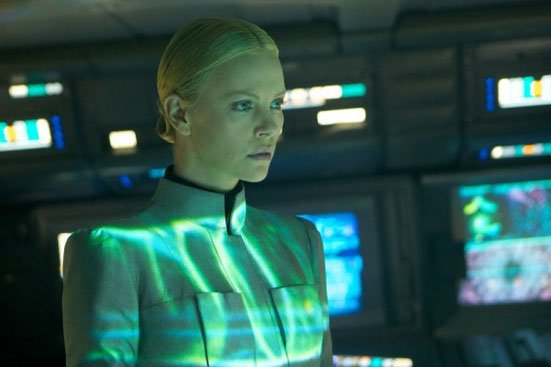
It's enough to fund Shaw and her lover-colleague Dr. Holloway (Logan Marshall-Green, in a performance that's trying too hard to find significance) on a trillion dollar excursion to find the only place in the Universe where the planets have that configuration at that point in the sky (??) aboard the good ship USCSS Prometheus, captained by Janek (Idris Elba, even more impressive than he was in Thor, in fact, I'd enjoy a movie centered around this character), overseen by Meredith Vickers (Charlize Theron, in brittle ice-queen mode) of The Weyland Corporation, caretakered by David (Michael Fassbender, in a terrific heavily-influenced performance), an android who serves as ships' H.A.L. in all manners, including a slightly unctuous air, but in movie choices fancies David Lean over Kubrick.** Once they get planet-side, a holographic image of the CEO of the Weyland Group (Guy Pearce, in extreme old-age make-up) introduces Shaw and Holloway to the dubious crew—the mission: to find that planet in the cave paintings and see if we can find the humanoids pointing us there. In simple terms, we want to find that ancient "god." They find a landing strip of sorts and settle there because "God does not build in straight lines."
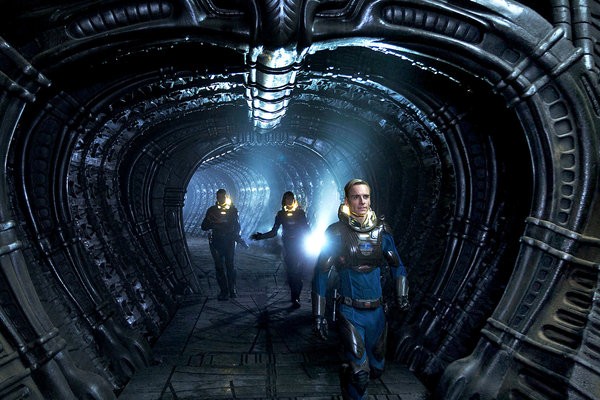
Upon landing they find a semi-hostile environment with two ancient dome-like structures. They enter and begin digital cartographing with laser mapping drones. As they go deeper into the structures, things seem somewhat familiar to the sequel-oriented movie-goer, but not really. It's a clean environment, protected against savage wind-storms, snaking corridors and the occasional dead body of an alien species. What happened here?
If you think you know where it's going, you're wrong. This one's going somewhere else than running down a neon-lit corridor being chased by a monster (well, there's some of that, in fact quite a bit of it). But, it's a much bigger Universe than the Xenomorph of the first one (I've started calling them "glitches" after this movie), and if there is a sequel to Prometheus, it's going to be along a different track than Alien, and has bigger fish to light up with a flame-thrower.
It's technically stunning, and fun to see how they took all the unused stuff left on the drawing room floor in Alien and incorporated it here. And lest you think that this is a high-philosophy movie, no, it's scary, designed to make you jump and gross you out. It is a horror film, after all, but for all the shock stuff, it might also make you think, as it toys with big sci-fi ideas—"A Shaggy God Story" as acerbic critic John Simon called 2001: A Space Odyssey. But, it's Scott's best film in years, retracing old steps, sure, but finding a new path to go somewhere else, some place a lot more interesting.
"The answer, Dear Brutus, is not in our stars, but ourselves"

* No, it's not Klingon. It's Aramaic.

** In fact, he watches a scene that we featured in a "Don't Make a Scene" article.

The Lost City of Z

In Memory Yet Green
or
"What's a Heaven For?"

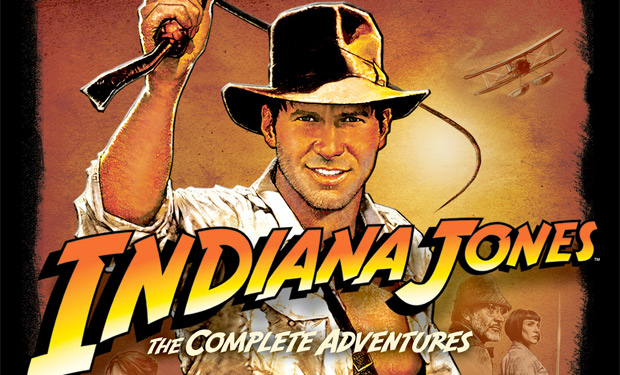
James Gray's new film, The Lost City of Z (I prefer to call it The Lost City of Zed, as it is articulated in the film), is not just "Based on a True Story (that cliche tag-line of so many movies these days), but "Based on the Incredible True Story." And it's about bloody time. Its protagonist, Col. Percival Fawcett (played quite effectively, if opaquely by Charlie Hunnam*) has been fictionalized enough times, being the inspiration for Challenger of A. Conan Doyle's "The Lost World," Quatermain of H. R. Haggard's "King Solomon's Mines," and their modern descendant of antiquities, Jones of Indiana. The original should get his due, because his story truly is incredible, filled with hardships and danger, both foreign and domestic, and proved a challenge to the complacent way of thinking about what makes a civilization among the class-conscious societies of England at the time. Fawcett was a forward thinker who became lost in the past. 

But it wasn't always so. When we first encounter Fawcett, he is long trek from legendary. A "lifer" in the British Army at the turn of the century, he has been passed over for promotion on numerous occasions—not through any dereliction of duty, not because he is untalented, he is, in fact, one of the best and boldest of his company. He overhears the reason after bagging the stag in an elk hunt held for the Archduke Ferdinand*—"He's been rather unfortunate in his choice of ancestors," as one of the stuffy dignitaries puts it. Dad was a bit of a drunk in his military career, so the sins of the father are visited upon the son. Class, and the lack of it, are married in one unfortunate summation. Geez, no wonder there's an America.
Skilled, he may be, and respectable, he certainly is, his career nevertheless is stalled, and so he accepts an assignment he's recommended for with the Royal Geographical Society (headed by former "Star Wars" Emperor Ian McDiarmid)—to map unexplored borders of the Amazon rain-forest and maybe, just maybe, find its source.
It is hazardous duty to be sure, from flora, fauna, disease, and natives, who have never advanced past the tribal stage (but, then, has anybody?) and might not take kindly to strangers. The Army offers him nothing and so he agrees, knowing full well it will be a journey of years; his wife Nina (Sienna Miller) knows the frustration of her husband and, rather reluctantly, agrees. Fawcett bids farewll to wife and child (with one on the way), taking with him Colonel Henry Costin (Robert Pattinson, unrecognizable and good enough to forgive anything he's done in the past), whose knowledge of the rain-forest proves essential, as well as a native guide Tadjui (Pedro Coello), picked up after a visit to a rubber plantation, run by the Baron De Gondoriz (Franco Nero), who warns him of the exploration parties that have not returned, but Fawcett forges ahead, determined to prove his mettle in the "uncivilized" world, a land without prejudice.
Tadjui tells him of an ancient city in the Amazonian jungle, a golden city with a large population, a city that Fawcett begins to call "Zed," and on his first mission, he finds pieces of pottery and figurines, artifacts that prove to him that, though there may not be a city of gold, there is one with a civilization that does more than hunt with spears, but is capable of art and practical tools. He finds the source of the river, but in their excitement at their find, Tadjui makes his escape.
Fawcett is welcomed back to England a hero and his accomplishments are lauded, but his theories about "the lost city of Zed" and that the natives of what he calls "Amazonia" are far more advanced than had been previously thought are controversial and met with scoffs and derision. It isn't long before he is enticed to go back to prove his contentions that the native populations have a sophistication and civilized organization that threatens the British imperialist image of savages.
There is also some controversy at home. His son Jack resents his time away, and his "equal wife" quickly realizes how far that goes when she wants to accompany him on his next trip—she has found an artifact in public records that alludes to a fabulous city somewhere in the Amazon. He tells her she is just not capable of it and steadfastly refuses to take her.
But, he does allow a renowned biologist James Murray (Angus McFadyen), late of Shackleton's Nimrod expedition and wants to reclaim his past glories on this latest endeavour that has so impressed the world. He should have taken his wife, instead, as Murray is quite ill-prepared to handle the tropics.

In a scene straight out of Apocalypse Now, the boatload of explorers sees another boat aground precariously on shore. by the time they notice a man aboard and that he's dead, the air becomes lethal with arrows and spears, too suddenly for some on the boat to avoid being killed. But Fawcett is determined to find the source of the attack and wades ashore, arms outstretched. One last arrow pierces his notebook and he stares at it in wonder, not just in that he was spared, but at the precision it took to hit and not go all the way through to kill him.
Fawcett walks up the bank. Soon, one warrior appears amidst the brush (which director Gray, like so many directors before him, treats as not merely a backdrop, but as one of the characters), then, another shows as back-up, then another. Soon, a half-dozen natives have emerged, and one goes back to report what has happened, while the others maintain eye contact. And with that, Fawcett achieves acceptance and discovers the tribe has a sophisticated defense mechanism to maintain its security. Despite his party's casualties, his trust is rewarded in kind.
A good thing, too, as the members of the tribe turns out to be cannibals, something that thoroughly repulses the biologist Murray. Fawcett and the veterans of the previous party know enough to keep quiet, lest they go from being the guests for dinner to being the main course. But, Murray, who has slowed the party down, and has been known to steal rations from others in the group. A knee wound leaves him raving and in need of medical attention, so the Fawcett thinks it best for all concerned if they send Murray packing to seek attention from the last known encampment on their journey as they go their own way. This will come back to haunt them when they return to England after they've found finished their expedition.
But, they've found no Zed—evidence of sophisticated farming and medicine, yes. But no golden city.

And, then World War I happens, even if doesn't turn out to be The War to End All Expeditions.
It is an "incredible true story." And all parties involved in The Lost City of Z do right by it. Filming in the jungle—the genuine jungle—is a logistical nightmare for a filming crew, but Gray is a fastidious director, but not so much so that he doesn't provide the telling grace note that moves the story from mere communication to the poetic. Because you cannot tell a story like Fawcett's without exploring how the quest becomes more than the goal, but about the journey itself, not only of the landscape, but also of the mind. Because the trek can have a profound effect on the traveler...as it did with T.E. Lawrence or Meriwether Lewis. What began for Fawcett as a way to gain acceptance transcended it beyond class, beyond family, beyond self...to the point where he became a man apart...unto himself. It is only appropriate...if unfortunate...that his last trip to find the lost city—one he took with his son—he never returned from...as if he disappeared into his own dream.
An incredible story, yes. A true story, as far as we have knowledge of.
But one could also say legendary, if it weren't for the mystery of the man at the center who lets life and love go by for a dream, thus making the story more..."proverbial." More cautionary. More universal. Do not lose your way. Do not lose your soul.

And in the end, the man and his goal became one. Fawcett's body was never found, nor has his lost city.
Fawcett in the jungle c. 1908


* Hunnam is much more appropriate for the role than the two who dropped out: Brad Pitt (whose Plan B Productions is behind the film) and Benedict Cumberbatch, who dropped out due to conflicts filming Dr. Strange) 

** I hear your arched eyebrows raise, history-buffs....