Sunday, August 10, 2014

Don't Make a Scene: Dr. Strangelove: or How I Learned to Stop Worrying and Love the Bomb

This week's headlines brought the Cold War and all its absurdities back home. One can imagine Obama and Putin on the hot-line, threatening economic sanctions against each other and Putin saying "Oh, yeah?! Well, I'm going to not import any of your food!" not realizing that it would cause more harm to the Russian people than it would to the U.S. economy.

Hmmm. Maybe he was drunk. 

The Story: Stanley Kubrick's nightmare comedy about the checks and balances of the American-Russian nuclear stalemate coming undone provided many opportunities for the display of Official Absurdity, and the way that things can go wrong at the worst times. The President's hot-line call to the Russia President is the most sustained of these and quite a solo act for Peter Sellers as President Merkin Muffley, a well-meaning Adlai Stevenson-like egghead. As with so much of the movie, the comedy comes from everything conspiring to make the situation worse from faulty phone-lines to the peccadilloes of those in power. And in the style of then-up-and-coming comic Bob Newhart, the heart of the comedy comes from only getting one side of the conversation. It is enhanced that the clock is ticking on mutual annihlation, and yet, protocol must be met, niceties offered...and awkwardness inevitable. Tick. Tick. Tick.

The Set-up: An Air Force general has gone nuts and sent a squadron of B-52's to drop their nuclear payload on Soviet Russia. With time a critical factor, and recalling the planes an impossibility, the American President calls his Russian counter-part to inform him of the news from the War Room of the Pentagon, while Joint Chiefs (including the hawkish General "Buck" Turgidson--played by George C. Scott) and the Russian Ambassador DeSadesky (Peter Bull) listen in.

Action!


Ambassador DeSadesky: I've done as you ask. Be careful, Mr. President. I think he is drunk.
President Merkin Muffley: Hello?
President Merkin Muffley: Ah, Hello, uh, Dimitri? Listen, I-I can't hear you too well. Do you suppose you could turn the music down just a little? Oh, that's much better.
Muffley: Yes, heh, yes...Fine, I can hear you now, Dimitri, clear and plain and coming through...
Muffley: ...fine. I'm coming through fine, too, eh? Good, then. Well, then, as you say, we're both coming through fine. Good. Well, it's good that you're fine...
Muffley: ...and-and I'm fine. I agree with you, it's great to be fine. Ha ha ha ha.  
Muffley: Now, then, Dimitri, you know how we've always talked about the possibility of something going wrong with the Bomb.
Muffley: ...The Bomb, Dimitri. The Hy-drogen Bomb.
Muffley:
Well, now what happened is, um, one of our base commanders, he had a sort of...we-ell, he went a little funny in the head. You know, just a little...funny...
Muffley: And-uh-he went and he did a silly thing. Well, I'll tell you what he did: He ordered our planes....to attack your country. A'--
...well, let me finish, Dimitri.
Muffley: Let me finish, Dimitri.

Muffley: Well, listen, how do you think I feel about it? Can you imagine how I feel about it, Dimitri? 
Muffley: Why do you think I'm calling you, 
Muffley: ...just to say "Hello?" Of course, I like to speak with you! Of course, I like to say "Hello!" Not now, but anytime, Dimitri! I'm just calling to tell you something terrible has happened....It's a friendly call, of course, it's a friendly call. Listen, if it wasn't friendly...you probably wouldn't have even got it!
Muffley: They will not reach their targets for at least another hour. I am...I am positive, Dimitri. 
Muffley: Listen, I've been all over this with your...
Muffley: ...ambassador, it is not a trick! Well, I'll tell you...we'd like to give your air staff a complete rundown of the targets the flight plans and the defensive systems of the planes.
Muffley: Yes! I mean if-if-if we're unable to recall the planes I'd say that, uh...well, uh...We're just gonna have to help you destroy them.
Muffley: I know they're our boys. 
Muffley:  Alright, well, listen now, who should we call? Who should we call, Dimitri? Wha..? The People...sorry, you faded away there.
Muffley: The People's Central Air Defense Headquarters. Where is that, Dimitri? In Omsk. Right? Yes? Oh, you'll call them first, will you? Uh-huh. Listen, do you happen to have the phone number on you, Dimitri? We..What? I see, just ask for Omsk Information. A-a-a-mmm.
Muffley: I'm sorry too, Dimitri. I'm very sorry. Alright, you're sorrier than I am, but I'm sorry as well!
Muffley: 
I'm as sorry as you are, Dimitri. Don't say you're more sorry than I am, because I'm capable of being just as sorry as you are. So, we're both sorry, alright? 
Muffley: Alright!


Dr. Strangelove or: How I Learned to Stop Worrying and Love the Bomb

Words by:
Peter George, Terry Southern ,Stanley Kubrick, and Peter Sellers

Pictures by:
Gilbert Taylor and Stanley Kubrick


Dr. Strangelove is available on Sony/Columbia DVD.

We'll meet again.


Friday, August 8, 2014

Make Way for Tomorrow

Make Way for Tomorrow (Leo McCarey, 1935) Orson Welles famously called Make Way for Tomorrow "the saddest movie ever made," containing one scene "that would make a stone cry." Not the sort of endorsement that would have you running out to see it. But, it's been on my list of "must-see's" for a while and I finally got a chance to see what all the hankie-wringing was about. I found not "the saddest movie ever made" but certainly one of the best, if not the best, films McCarey ever made.

It's the story of Barkley and Lucy Cooper (Victor Moore and Beulah Bondi), two old retired souls just coming out of the Great Depression. They invite their kids (Thomas Mitchell, Elisabeth Risdon, Minna Gombelli,and Ray Mayer) over to tell them the news: they're moving out of the family homestead. This shocks the children—why would they leave their home? Well, because they have to...the bank has foreclosed. They've made arrangements with the bank to pay what they can while Barkley maintains hope that he can still work—hard to believe at his age and at the end of the Great Depression.


Well, when will they have to move out, asks George (Mitchell), the oldest.


"Tuesday," comes Barkley's dry reply.

It's a funny moment, but also slightly horrifying. It's up to the kids to find a place for Mom and Dad and at short notice. They've been getting by, hoping for the best in a bad situation and they don't want to bother the kids who have their own lives and own complications. But that's made the inevitable a situation that has to be dealt with on the spur of the moment. The kids scramble to find a solution, but the one child who might be able to house both of the parents has a husband who needs convincing and that's going to take some time. So, everyone agrees on a short term solution—George will take Mom and another of the kids will take Dad. They're going to split them up, a couple who've been together fifty years, until such a time as they can get them back together again...at some indeterminate time down the road. And time, for them, is in increasingly short supply.

It's sad, but McCarey and his writers (Viña Delmar did the screenplay based on a play by Helen and Nolan Leary, adapted from a novel by Josephine Lawrence) have the tragedian's eyes towards the better and worse natures of human beings, finding the humor in frailties and sadness in the noble gesture. 

This is what makes the movie very, very special. It's a common issue of dealing with the elders, who've lived independently and taught their kids to do the same. Now, the folks are dependents, and everyone has to adjust...and uncomfortably so. Dad is sickly and has to sleep on one daughter's couch, while looking unrealistically for employment. Mom inserts herself into the eldest's family, and George's wife finds her life and independence and social standing threatened. Lucy realizes all of this and tries to be understanding, but the family dynamic makes her stand out, a fifth wheel.  

Meanwhile, the parents pine for each other, writing letters that Dad has trouble reading—he's broken his glasses—and wait for the day they can reunite and be together again. But, it's a dream until the children can get their acts together, but their own lives are tough enough. Life conspires to pull the old folks apart until they can meet again before they are separated again...maybe for forever.

It could be so treacly, but Moore and Bondi underplay, Bondi more so than Moore, letting the emotions simmer below her face and centered on the eyes, which seem perpetually downcast and slightly confused. She was only 50 when she starred in it, but make-up and her empathetic restraint make her seem much older.

"Empathetic restraint" is a good phrase for the tone of the entire film, sympathetic, but rarely sentimental in the face of poor circumstance, charming in the times of nostalgia, ironic, the other times. Life is full of irony. Grace is in how you rise above it.

Two lovely passages of writing: the first when Lucy confronts Grandma with the circumstances of her situation:

Rhoda Cooper: Why don't you face facts, Grandma?
Lucy Cooper: Oh, Rhoda!
[Pats her hand]
Lucy Cooper: When you're seventeen and the world's beautiful, facing facts is just as slick fun as dancing or going to parties, but when you're seventy... well, you don't care about dancing, you don't think about parties anymore, and about the only fun you have left is pretending that there ain't any facts to face, so would you mind if I just went on pretending?

And a poem that Barkley and Lucy share in their last fling of the movie—maybe forever:

A man and a maid stood hand in hand; 
bound by a tiny wedding band. 
Before them lay the uncertain years 
that promised joy and, maybe tears. 
"Is she afraid?" 
thought the man of the maid.

"Darling," he said in a tender voice, 
"Tell me. Do you regret your choice? 
'We know not where the road may wind, 
'or what strange byways we may find. 
'Are you afraid?"
said the man to the maid.

She raised her eyes and spoke at last. 
"My dear," she said, "the die is cast. 
'The vows have been spoken. 
The rice has been thrown. 
'Into the future we'll travel alone. 
'With you," said the maid, 
"I'm not afraid."

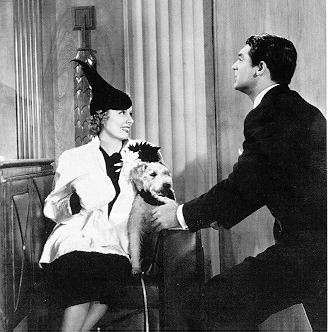
McCarey made two movies in 1937—Make Way for Tomorrow and The Awful Truth. The latter is one of the most entertaining movies about divorce ever made, and, with a cast headlining Irene Dunne and Cary Grant, it went on to win the Academy award for Best Picture that year.  In his acceptance speech, McCarey said "Thanks. But you gave it to me for the wrong picture."

Truer words were never uttered at the Academy Awards.


Make Way for Tomorrow was voted into the National Film Registry in 2010.

Make Way for Tomorrow was released in May, 1937; The Awful Truth in October, 1937.   
After the latter became a big hit, the former was advertised in much the same way.

Wednesday, August 6, 2014

The Awful Truth (1937)

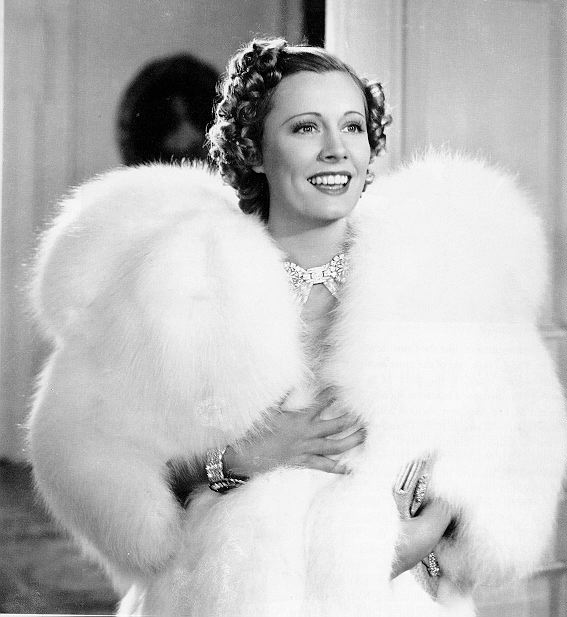
The Awful Truth (Leo McCarey, 1937) When Leo McCarey accepted his Oscar for Best Director for The Awful Truth, (which also won "Best Picture" that year) he famously said in his acceptance speech "You gave it to me for the wrong one!" Having not seen Make Way for Tomorrow(the other one he did that year), one has to content oneself with the reputation of the Award-winner, which I was familiar with because of an in-joke Howard Hawks inserted into Bringing Up Baby a year later* But The Awful Truth was the crowd-pleaser (allowing Cary Grant to become a top-billed star--as opposed to here, where Irene Dunne leads), whereas Make Way... was a box-office disappointment.

Based on a successful stage-play by
Arthur Richman (which had already been filmed twice before), The Awful Truth belongs to that sub-category of "Romantic Comedy," "Much Ado About Nothing," where squabbling couples take the consequences to the edge of divorcement, and back again.** The scriptwriters were Vina Delmar and Sydney Buchman (who wrote Holiday, Mr. Smith Goes to Washington, The Talk of the Town, Here Comes Mr. Jordan, and was thanked for his hand being in so many classics by being blacklisted by the Hollywood industry for refusing to name names).
McCarey kept things moving briskly and encouraged the actors to ad-lib to increase the pace (McCarey also

directed pictures featuring the Marx Brothers, where ad-libbing didn't need to be encouraged and, practically, couldn't be prevented!) Grant took to the technique particularly well--he wasn't comfortable in his role, and would have preferred to play Ralph Bellamy's part.*** His Jerry Warriner became a template for Grant's light comedy roles to follow. He's matched by Irene Dunne "the best actress to never win an Oscar," who may not excell at the off-hand remark, but knew how to fill space with a sarcastic faux-laugh. She could also effortlessly play foolish while maintaining a glamorous veneer--a trick she uses to great advantage in The Awful Truth
Like the best of the "Much Ado.." comedies, The Awful Truth has a cynical bite to it, extolling the virtues of marriage, while acknowledging the way the new wine of romance turns to vinegar with time...and inattention. It also employs the comedy-generator of how taken away, one fights even harder to gain it back.The comedy of The Awful Truth also has a buffered side to it. Everyone remains very genteel while seething a bit inside, and no one goes for a hay-maker remark, but are satisfied that the recipient feels the wind of the passing blow. Time and society would allow the knives to come out later, but for The Awful Truth, just the suggestion of insult was enough.

Entertaining and a crowd-pleaser, The Awful Truth pales a bit in comparsion with its more savage progenitors, but to contemporary audiences it must have seemed like a roller-coaster ride.
Tomorrow: Make Way for Tomorrow


* In Bringing Up Baby, Susan (Katherine Hepburn) with most of the cast in jail, pretends to be a wise-cracking moll and refers to the hapless David as if he's a mob-boss named "Jerry The Nipper," which is a laugh-line regarding Grant's character in The Awful TruthOrson Welles also mentions McCarey's Oscar remark in his recorded remarks in "This is Orson Welles."

**Besides, "Much Ado...," such films in the sub-category include The Philadelphia Story, Private Lives, His Girl Friday, Mr. and Mrs. Smith, etc. Cary Grant excelled at them

*** Which provided another joke for
Hawks in His Girl Friday. When Grant's character is asked to sum up his ex-wife's (Rosalind Russell) fiancee, says "He reminds me of that actor...Ralph Bellamy," apt because Bellamy played the part!


Tuesday, August 5, 2014

Lucy

"Lucy, You Got Some 'Splainin' To Do!"
or
Giving It Your Full 10% (Who Put the Scar in ScarJo?)

Luc Besson is France's "high concept" director (and when I say "high concept" I mean that his movies are made up of interesting nuggets (and sometimes only a memorable line of dialog, ala Taken) and pads it out with a lot of obfuscation and action to fatten out the movie to feature-length.

His movies tend to be a bit on the loutish side, but he does, rather refreshingly, pay equal attention to the ladies. Movies like La Femme Nikita, Leon: The Professional, The Messenger, even The Fifth Element had strong female characters, and his last couple projects (directing, he's only supervising the "Transporter" and "Taken" series), barely released in the States were The Lady and The Extraordinary Adventures of Adele Blanc-Sec (which, I have to say, looks interesting). They tanked at the box-office here, so it's only natural that he go back to his action roots, this time with the latest addition to The Unlikely Action Heroes Club (after Bruce Willis, Nicholas Cage, and Liam Neeson), Scarlett Johansson, whose last few roles, perhaps out of career frustration in a male-dominated industry, have consisted of characters that are barely human.

Lucy (Scarlett Johannson) being blinkerdly
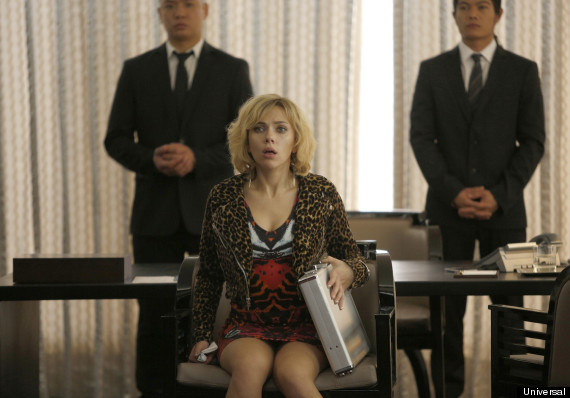
Lucy (just "Lucy"—even her passport doesn't have a last name) is an American wandering around Taiwan with a loser named Richard (Pilou Asbæk), who is all "I love you, baby, do this for me, just one more thing..."  The "thing" he wants her to do is take a briefcase into an office building and ask for a "Mr. Jang." When Lucy asks what is in the briefcase, he says "paperwork..." non-committally.

That's some paperwork—one of J.D. Salinger's unpublished manuscripts, maybe. Because once Richard proves his ultimate douche-baggery and hand-cuffs her to the briefcase, things start to go very, very wrong.  She's confronted by a swarthy band of body-guards—he's killed (no loss)—and she is dragged before Jang (Min Sik-Choi) who's just finished "Scarfacing" an associate in another room. At gun-point, Lucy is forced to open the briefcase (while Jang and the bodyguards protect themselves in another room) and she finds...explosives? That shrieking plutonium from Kiss Me Deadly? A better script?

No. She finds four zip-lock bags of spangly blue micro-crystals, that, when huffed by the most extreme of junkies, turns him into a laughing psycho. She is then knocked out.

Cut to Morgan Freeman
(which is the way the world should work, actually). He plays Professor Samuel Norman in the middle of a perfectly-timed lecture (the class is, evidently, Exposition 101) about how human beings only use 10% of their brains (which isn't true, but he evidently has tenure, so no one argues with him). What would happen, he postulates, if human beings developed themselves to use 20% (like dolphins do*)...even (dare I say it?) 100%...of their brains? One suspects that 1) they would call "bullshit" on Professor Norman or 2) probably have nothing to do with this movie and build a better mouse-trap—a shot of which is inserted.  


I should mention that Besson has all sorts of fun tossing in "found footage" throughout the movie of animals in their natural habitat and other things that comment on the film's story—for example, when those bodyguards start advancing on Lucy, we get many shots of leopards hunting gazelles, she being the gazelle, they being the leopards, if I remember the lecture on "analogies" in film-class.

Lucy has something on her mind
Lucy wakes up and finds herself in a hotel room with an incision in her abdomen; she and three other luckless souls are to be "mules" smuggling the bags of crystals surgically implanted within them through customs to four different countries.

No one has heard about body-scanners, I guess.
The picture's not flipped.  Lucy is on the ceiling during her drug freak-out.
The question is: "why?"  Your brain will need to be at least 50% capacity to answer.
Lucy draws the short straw and the short trip, being sent to Korea, where a little bit of attitude gets her beaten and kicked repeatedly in the stomach. Bad move, that, especially for drug-runners who (you would think) know the drugs are being hidden in her stomach, so that (ya know?) they can retrieve them. If humans are only using 10% of their brains, these guys are low in the single-digit capacity. The bag leaks the drug (called CPH4, probably for "Cheap Plot Hook") into Lucy's body, which causes Lucy to lurch around the room, including up the walls and across the ceiling—not sure why this might happen, but it looks interesting—her eyes incongruously going cat-like, lizard, and snake (but fortunately not "goat," because that would be just creepy).
It becomes apparent (because large letters appear on the screen saying "20%") that the Professor Norman lecture was not just some diversion, but is telling us that this CPH4 stuff is probably juicing Lucy's brain to expand its capacity. How does she use this gift? By seducing one of her guards, breaking his arm, and grabbing handfuls of weaponry that she instantly has total mastery of, making her way to a hospital and coercing the surgeon on call to get the bag out of her stomach without anesthesia (she doesn't need any, chatting with her Mother on the phone while she's being gut-slit). This after shooting the surgeon's patient dead because "you couldn't save him, anyway." That expanded brain-power gives her a great opportunity in insurance risk-management.
Guns don't kill people.  SMART people kill people.
All good, huh? Not really. Lucy flies to Paris to talk to Professor Norman about this brain-power stuff and alert the French police (led by Amr Waked) to where the other "mules" are going. Her reasons are purely for self-interest—when the drug starts to wear off, Lucy starts to disintegrate, losing her form—something that most things can do with less than 1% brain capability. She chows down on the remaining crystals and gets it together in time to disembark the plane.
Lucy demonstrates the true meaning of the phrase "On the other hand.."
Most of the rest of the movie is a demonstration reel for CPH4 and special effects houses. We get to see the full-range of what Lucy can do when she puts her mind to it—changing her hair color, growing extra appendages, displaying various forms of telekinesis, psychokinesis, and being able to discern all sorts of spectra, including in one impressive display, being able to read cell-phone conversations by picking them out of the ether. I can just imagine Edward Snowden watching this movie and choking on his popcorn. All this ability to change and she still looks like Scarlett Johansson, even in "disguise."
Before it's all over, she'll be teleporting and traveling through time to not much end. After all, Bresson the scriptwriter is still operating at only 10% of his potential, and thus, the film's.

Lucy does the NSA a million times better:  tapping into and reading everybody's
cell-phone calls and texts.  Probably still has a hard time figuring
out a phone-bill, though.

What is most amusing about all this, is that by the time the film has run its course, you realize that it would make a great prequel (on a double bill, if such things still existed) for Her, in which Johansson portrayed an operating system. Who knows, maybe she's seeing Johnny Depp from Transcendence—except NO ONE saw Johnny Depp in Transcendence.

The movie ends with Johansson intoning: "Life was given to us a billion years ago. Now you know what you can do with it."

Yeah, you know what you can do with it, too.


* Probably do 10 shows a day at Seaworld, I presume...